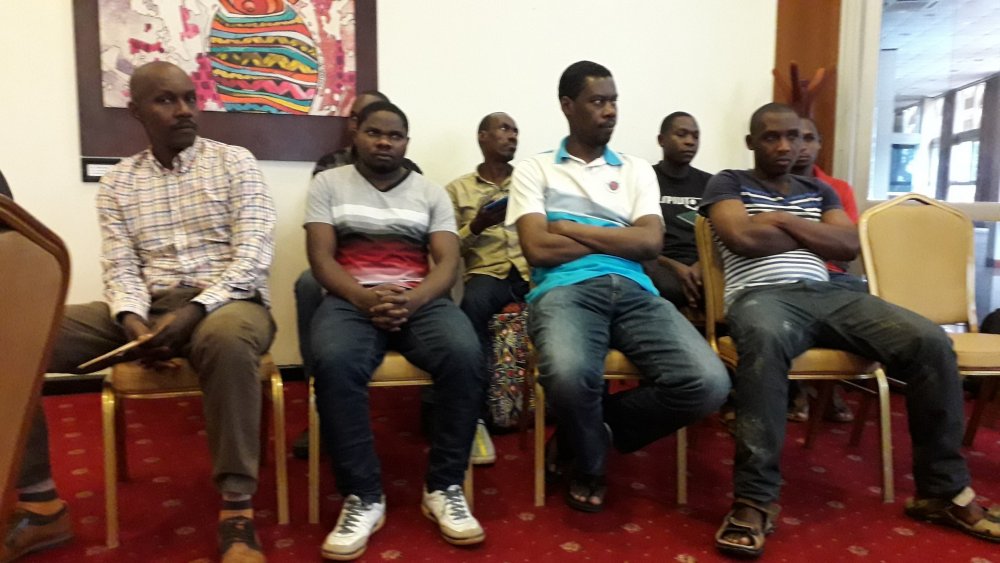
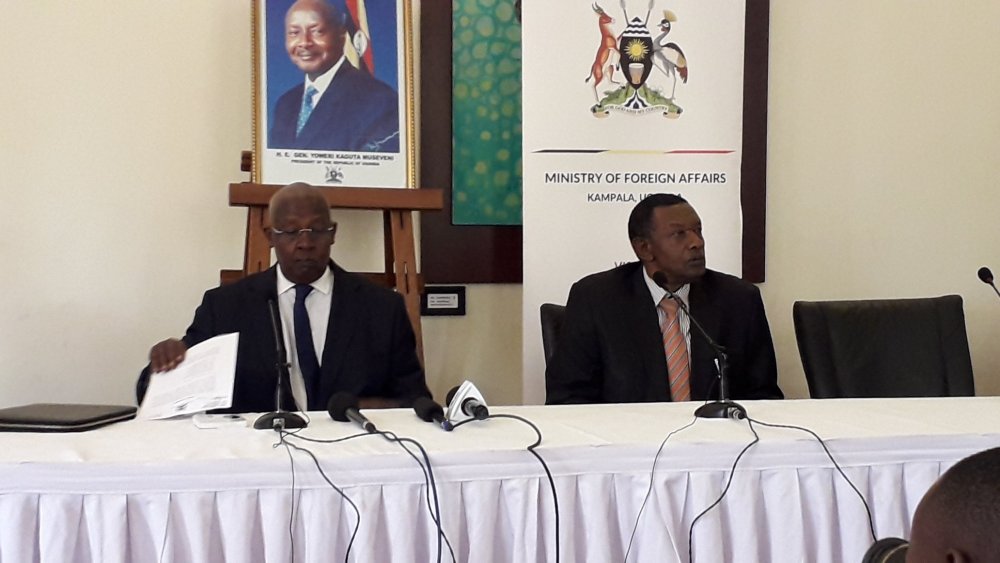
The 9 Rwandans were handed over to Rwanda’s High Commissioner to Uganda Frank Mugambage this morning, during a press conference at Uganda Media Center that was chaired by Uganda’s Foreign Affairs Minister, Sam Kutesa.
They are the first Rwandans who are legally repatriated since the Rwanda-Uganda conflict sparked given that others were tortured, looted and forcefully chased from Uganda and or dumped at the border posts.
Minister Kutesa said that the 9 Rwandans were released as a result of recent discussions between Uganda’s special envoy, Ambassador Adonia Ayebare and President Kagame.
“Ambassador Ayebare was sent to Rwanda with a message from President Museveni and as you can notice, all this is a result of the discussions they had.”
Ambassador Mugambage said it is a sign of goodwill to solve the conflict on Uganda’s part and that there is hope that the latter will also stop supporting anti-Rwanda terrorist groups.
The state minister in the Ministry of foreign affairs, Olivier Nduhungirehe showed gratitude for the release of the seven innocent Rwandans but told the media that there are many other Rwandans still under arbitrary arrest in Uganda.
Arresting and torturing Rwandans, hindering trade between Rwanda and Uganda and supporting anti-Rwanda terrorist groups including RNC and FDLR are among the main accusations Rwanda holds against Uganda.
After Luanda agreements that aimed at ceasing the hostilities between Rwanda and Uganda, Rwanda demanded the release of its citizens that are held in captivity in Uganda before any further resolution was implemented.
In December 2019, President Kagame hosted President Uganda’s special envoy, Ambassador Adonia Ayebare where it was announced that there was hope for the two countries to regain good relations.
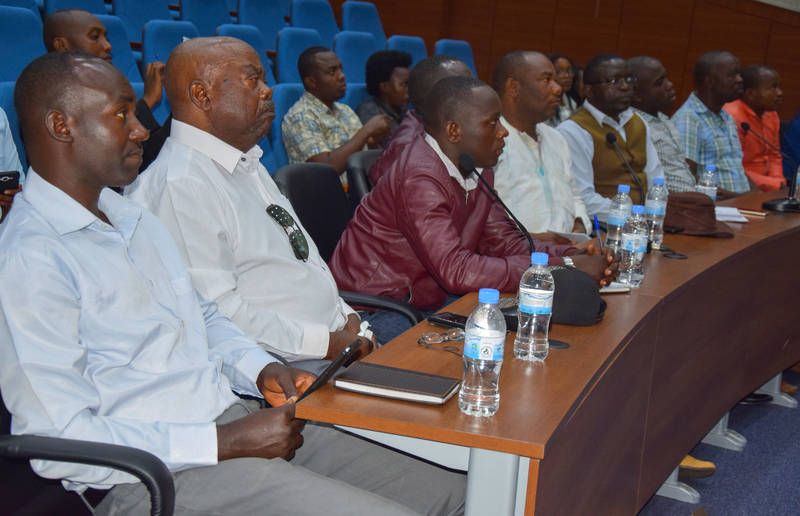
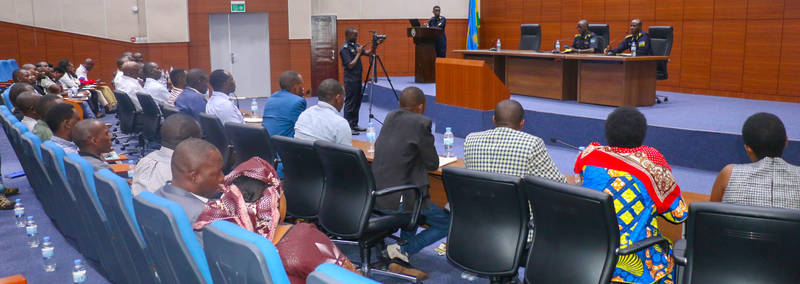
The call was made on Tuesday during a meeting between RNP and owners and representatives of driving schools operating in the country. There are 41 registered driving schools across the country organized under their umbrella association—ANPAER.
The meeting held at the RNP General Headquarters in Kacyiru is part of the ongoing 52-week road safety campaign dubbed Gerayo Amahoro, which is in its 35th week.
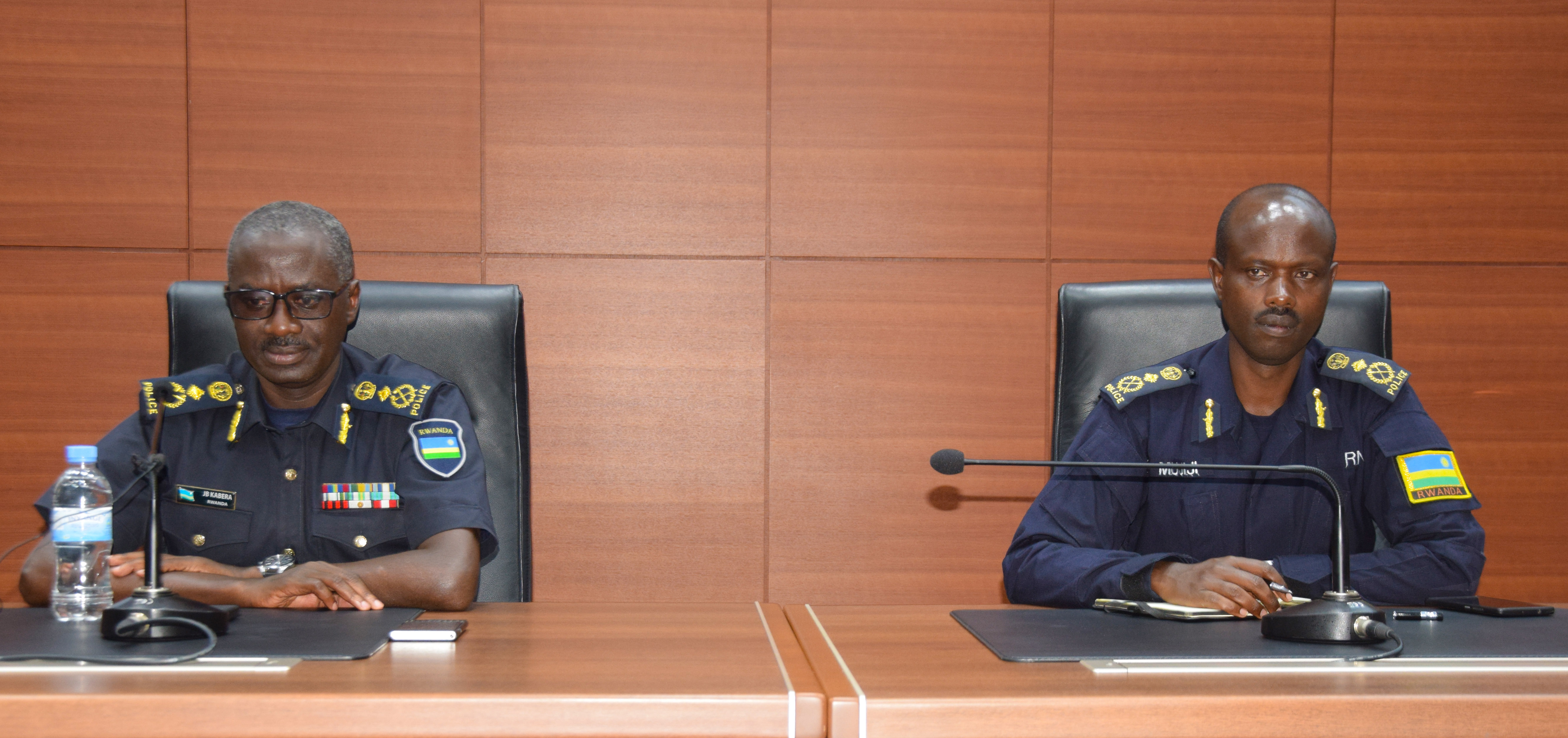
RNP spokesperson, Commissioner of Police (CP) John Bosco Kabera, said that the importance of driving schools in road safety cannot be overemphasized.
Encouraging safer, professional and modern driving techniques for aspiring drivers, he said, is important in minimizing road accidents caused by human behaviours.
“If only drivers received proper training and road safety education, road accidents would significantly reduce,” CP Kabera said.
“Well trained drivers can make the road safe for everyone, and driving schools can play that important part. We urge you to revise your training manual for aspiring drivers to suit the demands of road safety and produce disciplined drivers to eliminate bad driving habits.”
The training, CP Kabera said, should identify the bad behaviors of a driver and Gerayo Amahoro concept should be part of basic training.
CP Rafiki Mujiji, Commissioner for Traffic and Road Safety department urged driving school owners to stop traditional methods of teaching which just focus on “passing rather than understanding.”
“Adopt some methods that can make your clients good drivers. The training you provide should help drivers to develop positive habits of being more prudent and cautious while on the road to reduce risks,” CP Mujiji told proprietors of driving schools.
Callixte Nkundimana, ANPAER spokesperson, said: “Road safety education plays a vital role in shaping the attitude and behavior of drivers, thereby ensuring that they become responsible road users.”
He added: “We do understand that there is need to change the way we teach our students, from now on we will be focusing on behavioral change.”
The meeting was also in preparation of the second round of the joint Gerayo Amahoro campaign in primary and secondary schools scheduled to start on January 14. Over 2000 schools are to be covered in this second round.
Tumayine was arrested on Monday in Rebero Village, Rugando Cell in Kimihurura Sector shortly after confiscating traffic documents from a taxi-moto operator identified as Francois Nsanzabaganwa.
Chief Inspector of Police (CIP) Marie-Gorette Umutesi, the police spokesperson for the City of Kigali, said that information was provided by another motorcyclist after suspecting Tumayine to be a scammer.
“Tumayine found Nsanzabaganwa where he was parked in Busanza, Kanombe and required him to produce traffic-related documents, including a driver’s license, motorcycle insurance, and logbook, which he confiscated,” said CIP Umutesi.
Without telling him why he had confiscated his documents, Tumayine jumped on Nsanzabaganwa’s motorcycle and ordered him to ride to Kacyiru Police station.
“Fortunate enough, another motorcyclist, who was also parked there, out of suspicion, trailed them and told the whole story to traffic Police officers at Kisementi, who in turn relayed information to other officers along that axis, Tumayine was intercepted in Rugando, Kimihurura,” CIP Umutesi explained.
She commended the motorcyclist, who saved his colleague and facilitated the arrest of Tumayine.
“Tumayine could have used that trick to get free transport to Gisozi where he apparently lives or wanted to defraud the motorcyclist but he has been handed over to RIB for further investigations,” the spokesperson said.
She urged the general public to always be vigilant and report anything suspicious so as to fight such “criminal-minded individuals.”
Energy and manufacturing accounted for 75% of all investments registered (45% and 30% respectively). Other sectors that attracted significant investments were construction, agriculture, services including ICT as well as mining.
35,715 jobs are expected to be created by the new investments with the manufacturing and construction sector expected to create 22,935 and 3,053 new jobs respectively. The government aims to create 200,000 new jobs every year from investments and other employment sources.
Joint ventures (local and foreign) contributed 44% of the investments registered whereas foreign direct investment represented 37%. 19% of investments were registered by locals.
The increase in joint ventures is attributed to two major investments registered in the energy sector: Rusizi III Energy (US$ 613 million) and Gasmeth Energy (US$ 442 million).
In comparison, domestic investment registrations accounted for 51%, foreign investment registrations represented 48% and joint ventures accounted for 2% in 2018.
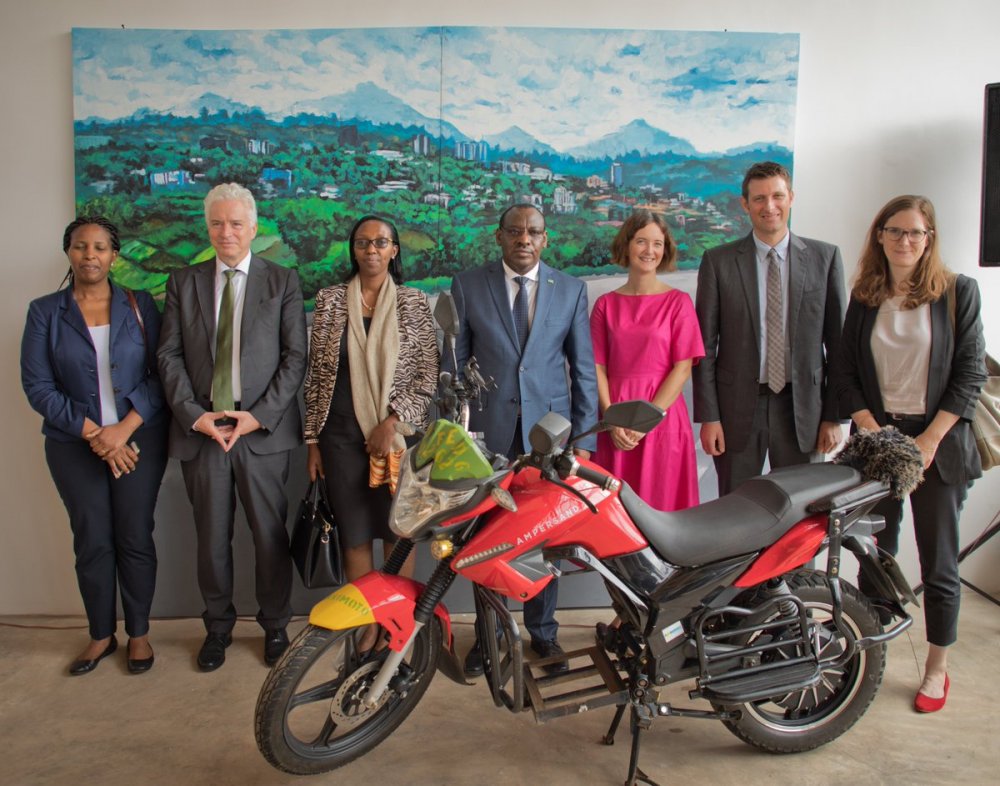
The top five projects registered in 2019 in terms of the size of investment were Rusizi III Energy (US$ 613 Million), Gasmeth Energy (US$ 442 Million), Ampersand (US$152Million), Remote Estate (US$ 145Million) and Nots Solar Lamps (US$72Million).
Other key investment projects registered during the year included Great Lakes Cement Ltd (an expansion of a local cement manufacturing factory in Musanze), Kenyan owned Mataba Farms Ltd (a mixed farming project), Mountain Ceramics Co. (a local ceramic products manufacturing), Elrumalya Rwanda Ltd (a renewable energy project), MJ Minerals and Petrol Ltd (a jewellery manufacturer), Fantastic Investment Group (a real estate firm) and Cheza Rwanda Games (an online gaming service).
Commenting on the 2019 investment registration figures, RDB Chief Executive Officer, Clare Akamanzi, said:
“After surpassing US$ 2 billion in investments registered for the first time in the country’s history in 2018, we continued our strong investment growth with over US$ 2.4 billion in 2019, our highest investment registration to date. This was up from about US$ 400 million registered in 2010.
This is a sign of continuous investor confidence in Rwanda by both local and foreign investors. The increased investment figures will help curb our balance of trade deficit by promoting the production of locally made goods for the local and regional market.
Last year Rwanda exported goods worth US$ 1.021 billion, up from US$ 995 million in 2018.
As a result, we have seen Rwanda’s Gross Domestic Product (GDP) grow by 11.9% in the third quarter of 2019 compared to the same quarter in 2018.
The increased investments registered by RDB are a direct result of the initiatives that leadership and the Government of Rwanda has put in place to continuously make Rwanda an attractive destination for investment. Rwanda remains the second easiest place to do business in Africa and 38th in the world”.
In terms of investor facilitation, RDB operates a One-Stop Centre, which provides information and services to guide investors through the key steps of starting a business such as registration, licenses, immigration, land, utilities, environmental clearances and tax and mortgage registration services.
In addition, RDB offers aftercare services, to ensure that business projects are implemented free of avoidable impediments. RDB also introduced investor engagement platforms such as the’ Investor Open Day’ every week as well as a ‘CEO Forum’ four times a year where senior management meets and engages with business leaders.
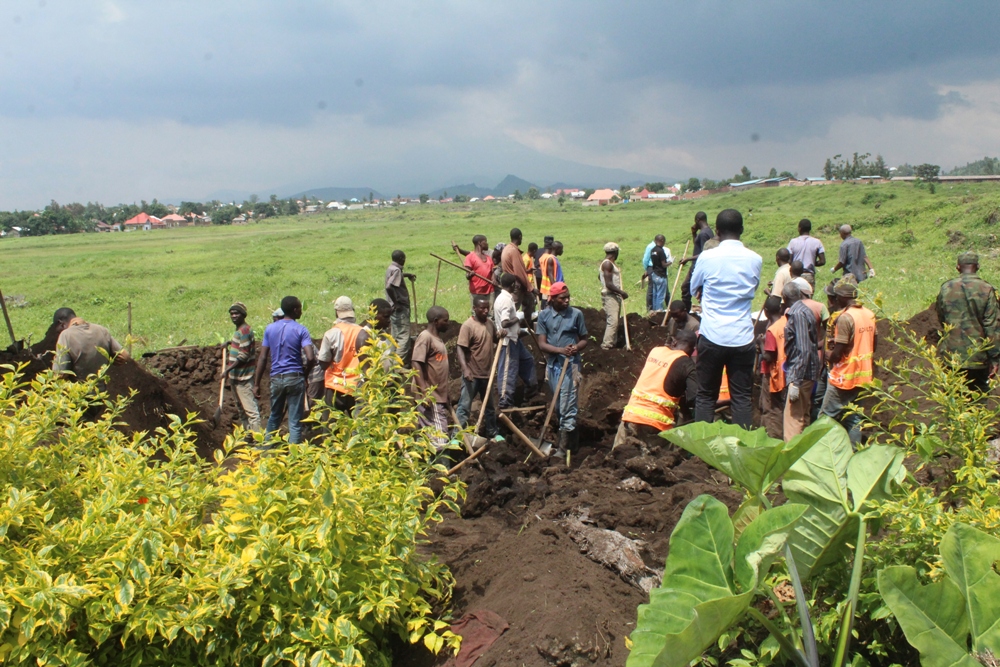
On Tuesday, January 7th, 2020, activities to unearth the bodies started and so far, 28 bodies have been found.
Rubavu District administration urged residents to provide information about where other bodies were dumped during the genocide so that they can be properly buried and their cases brought to a court of justice.
Survivors of the 1994 genocide against Tutsi said that there is a possibility that some houses were built above mass graves and that some people are still reluctant to provide information.
Segacaca Hassan, a survivor of the genocide confirmed that in former Gisenyi, some houses are built above mass graves.
“Most of our people were dumped in pits and many of them were women with children. It is a challenge to unearth bodies in mass graves in residential areas since it implies, we would have to pay for the destroyed houses. We are requesting for the support of the government to help us deal with this issue so that we can bury our families properly.”
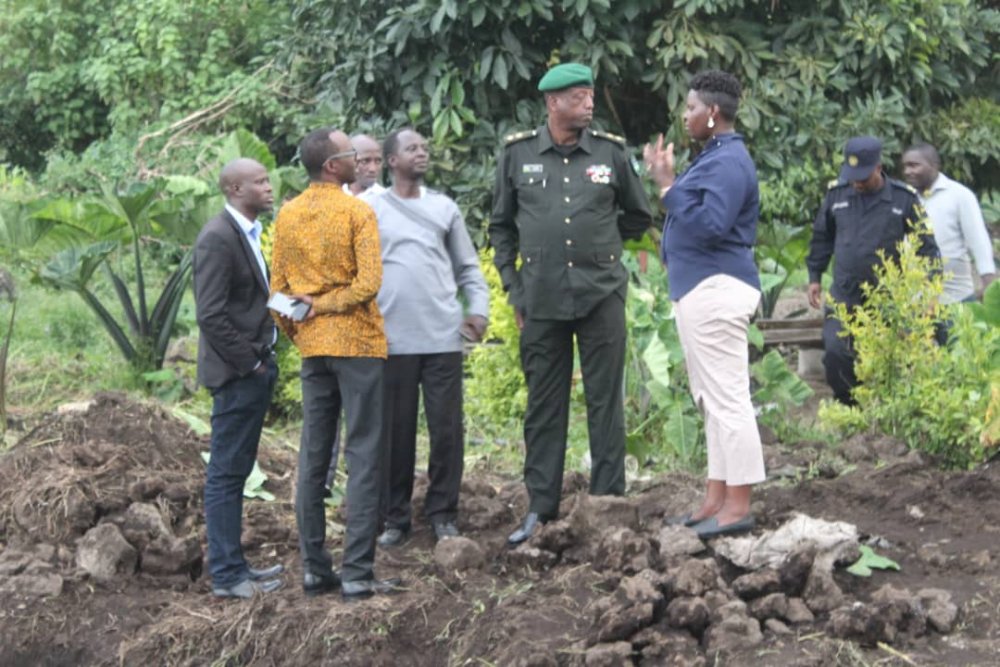
Ishimwe Pacifique, Rubavu Vice Mayor Social Affairs said that caterpillar trucks will be used to unearthing bodies in the remaining mass graves.
“We have found 28 bodies so far including 24 adults and 4 children. We will continue to unearth the bodies so that they can be buried properly. Rubavu Airport is a rocky platform and the machines will be used to ease the work.”
During the annual genocide commemoration period, Rubavu residents are constantly recommended to give information about where genocide victims were dumped and it is rumored that some victims were never found and that others were killed and thrown or buried alive at former ‘Commune Rouge’ in Gisenyi.
On Tuesday, January 7th, 2020, some of Rubavu residents who were begged to provide information on where victims’ bodies were dumped said they did not recall the exact course of events during the 1994 genocide against Tutsi.
In the past 5 years, several mass graves were discovered in Gisenyi including in 2015, a mass grave in front of Gisenyi Hospital where Tutsi victims were identified including late staff and patients who were killed during the genocide.
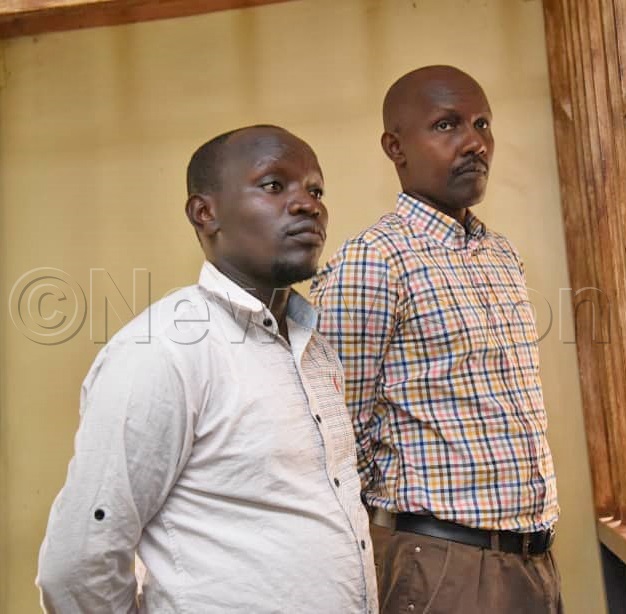
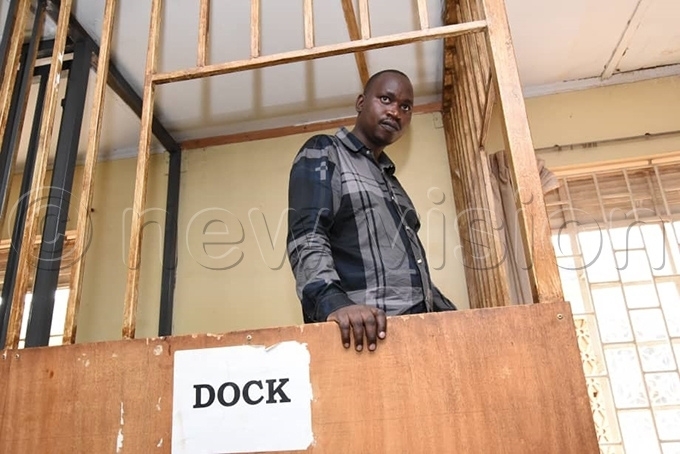
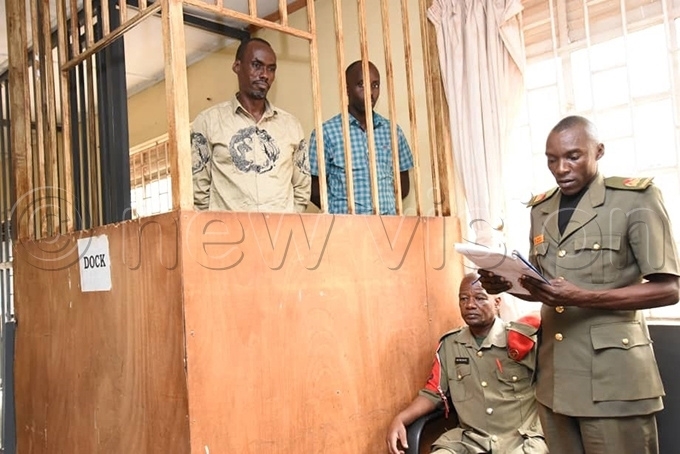
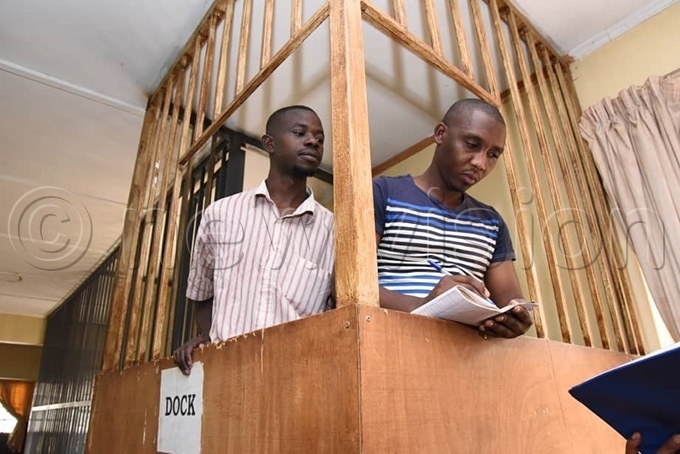
The verdict was pronounced Tuesday morning, January 7th, 2020 after finding them innocent of alleged different crimes including illegal possession of firearms.
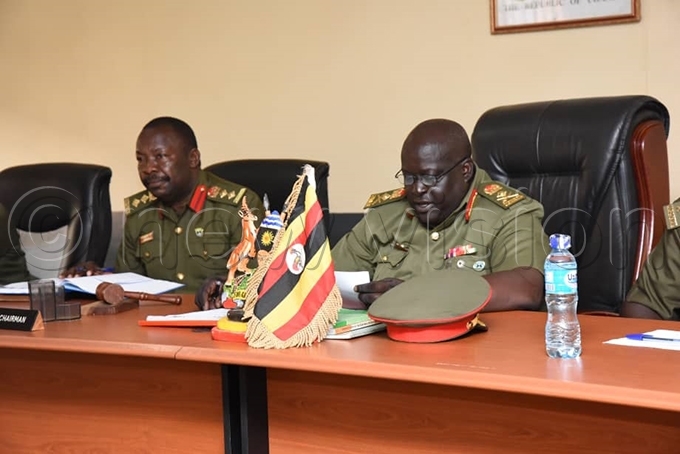
General Court Martial Chairman, Lt. Gen. Andrew Gutti said that the suspects were acquitted as they have all been found innocent.
Among the Rwandans who were released are; Bahati Mugenga, Emmanuel Rwamuco, Augustine Rutisiri, Etienne Nsanzabahizi, Charles Byaruhanga, Claude Iyakaleme and Rutagungira René who was the first Rwandan to be abducted from a bar by Ugandan authorities on August 7th, 2017.
After he was arrested, Rutangungira was subjected to torture with machines that leave no physical marks including stun belts, a method of torture that Uganda’s Chieftaincy of Military Intelligence (CMI) has been using for so long.
There was however no judgment read before court giving facts and omissions that were considered before acquitting the 7 Rwandans of their alleged crimes.
Rwanda’s High Commissioner to Uganda, Frank Mugambage told IGIHE that he had no further information on the case since their release was not communicated in advance.
The state minister in the Ministry of foreign affairs, Olivier Nduhungirehe showed gratitude for the release of the seven innocent Rwandans but told the media that there are many other Rwandans still under captivity in Uganda. He said that what the Government of Rwanda wishes is for Rwandans being held unjustly to be immediately released.
The verdict is pronounced a few days after President Kaguta Museveni of Uganda sent special envoy, Ambassador Adonia Ayebare with a message to President Paul Kagame where the office of the president said the new developments in the Rwanda-Uganda conflict gave hope.
In a message he posted on his Twitter account towards the end of 2019, President Museveni said “Ambassador Ayebare was well received by His Excellency Paul Kagame and they had very fruitful discussions. Soon, the two sides will be taking decisive actions to end the tension. Uganda, I can guarantee, will do its share of the normalization of the relations between our two countries. I salute H.E Paul Kagame, the brotherly people of Rwanda and the people of Uganda.”
In a recent interview with Rwanda Broadcasting Agency (RBA), President Kagame said that Ambassador Ayebare was in Rwanda with the aim of finding common ground and solutions to the Rwanda-Uganda conflict but that what matters the most apart from discussions, is the implementation of resolutions.
Rwanda has been reproaching Uganda of arresting Rwandan citizens unjustly, torturing them and leaving some of them impaired for life. Uganda was also accused of supporting anti-Rwanda militias and terrorist groups including RNC and FDLR.
Since September last year, more than 100 Rwandans were chased from Uganda and 588 in total since the beginning of 2019.
Since January 2018, 1438 Rwandans were permanently chased from Uganda by Uganda’s CMI and the Internal Security Organisation (ISO) of Uganda.
The spokesperson of NDC-R, Ngabo Désiré, said that 25 people fell in the fight, including 4 women of NDC-R and the rest being FDLR rebels.
He said, “FDLR, together with CMC/Nyatura attacked our Katsiru post. The statistics of those who fell in the fights, on our side, are five women, others were wounded. It is difficult to tell the number of those killed by our soldiers, but they are above 25.”
He added that NDC-R cleared the FDLR from the zone and now the fights are taking place 6 kilometers from Nyanzale.
In 2014, President Kagame requested for the consolidation of all 416 Umurenge SACCO through the ‘Cooperative Bank’ project that was expected to broaden “financial inclusion” in the country, working through the Umurenge Saccos and increasing financial services in rural areas.
In February 2015, FinTech International Limited won the bid to consolidate all SACCOs but the project deadline ended without the completion of computerization and linking of SACCOs operations as it was expected.
However, after the project was handed over to IT experts in Rwanda, results are slowly but surely materializing where since January 4th, 2020, Rutunga district SACCO started benefiting from the program.
In an interview with IGIHE, Prof. Harelimana Jean Bosco, RCA Director-General said that the project is currently being managed by different institutions in Rwanda including RCA, the Ministry of Finance and Economic Planning (MINECOFIN) and Rwanda Information Society Authority (RISA).
“We have conducted a pilot trial in three SACCOs including Rutunga, Gisenyi, and Kanombe and if results are satisfying, we expect to start using the same model in all SACCOs by the end of 2020.”
RCA mentioned that it is difficult to estimate the value of the project since it is being managed by IT experts who already work in different government institutions. “This is a locally tailored initiative and no plan was elaborated to estimate the exact value of the project.”
Linking all SACCOs to a common computer system is expected to curb corruption practices that have characterized SACCOs in the past and guarantee safety to stakeholders who complained that the co-operatives were not in any way supporting financial inclusiveness.
Prof Harelimana said that after the computerization of SACCOs’ operations, most issues that were reported in the past will be completely solved.
“We expect quicker services and daily reports that will allow for complains to be immediately addressed.”
Umurenge SACCO was launched by the Government of Rwanda in 2009 with the aim of pooling savings for members and providing them with credit facilities at low-interest rates, therefore, promoting financial inclusiveness.
There are currently 416 Umurenge SACCO across the country. In 2019, SACCOs reported a 2.7 million customer base, assets worth Rwf 120 million and savings worth Rwf 60 billion.
Mutangana would soon after receive a phone call from someone, who identified himself as Eric Tuyisenge.
The caller told Mutangana that he had accidentally sent Rwf34, 000 to her phone and requested her to wire at least Rwf30, 000 to a phone account he gave her.
Mutangana was quick to go to the Mobile Money agent identified as Julienne Musabyimana, without verifying the message she had received, and told the agent to wire Rwf30, 000 to the phone account she had been given.
On checking, she noticed that it was just an SMS. The scammer had succeeded using Mutangana to defraud Musabyimana.
“People should beware that fraudsters employ different tricks to achieve their criminal purpose, and be extra vigilant. Always verify messages and phone calls you receive,” Chief Inspector of Police (CIP) Hamdun Twizeyimana said.
BNR invited bids on behalf of the Government of Rwanda and set the interest rate at 11.55% per annum.
The bond is a benchmark bond and will be subject to withholding tax at the rate of 5% for all investors.
In July 2019, BNR had opened another 20-year treasury bond worth Rwf 15 billion which attracted the attention of bidders on a 141.03% rate with more than 80 investors in different sectors across Rwanda.
Treasury bonds pay a fixed interest rate on a semi-annual basis. This interest is exempt from state and local taxes but is subject to federal income tax. Bonds are a safe-haven investment for investors since payments are directly made into the owner’s bank account. Owners earn interest until the bond matures.
Bonds can also be given as collateral to the ban when the owner is requesting for a loan. The owner can as well sell back the bond to the capital market.
All bids will be submitted to the National Bank of Rwanda through any of the licensed commercial banks or Capital Market intermediaries. The market will open from Monday, January 20th, 2020 to Wednesday, January 22nd,2020.
@CentralBankRw would like to inform the public that on behalf of @RwandaGov there is a Reopen of 7-year T-Bond worth 15.0 billion.
The market will be open from Monday January 20, 2020 to Wednesday January 22, 2020