The money was recovered Wednesday from one Samuel Mbatezimana, 22, who was a domestic worker for the victim at her residence in Kicukiro District.
Mbatezimana allegedly stole a bag containing Rwf1.2 million, after breaking into his boss’ bedroom, recently.
Chief Inspector of Police (CIP) Hamdun Twizeyimana, the police spokesperson for Eastern region, said that Police first got to know about the theft through related messages which were circulating on social media.
“We first say the alleged theft on messages, which were circulating on WhatsApp, but we were later formally informed that the prime suspect could have escaped to Nyagatare,” CIP Twizeyimana said.
“Law enforcement organs worked together to locate and arrest Mbatezimana, the prime suspect in Rukomo Sector, Rurenge cell. We found only Rwf612, 000 on him,’’ he added.
The money was less Rwf600, 000, which the suspect had already spent buying different items like smartphone and clothes, among others, the spokesperson said.
The victim, CIP Twizeyimana said, was informed of the recovery of her remaining money.
Theft, under article 166 of the penal code, attracts an imprisonment of between one and two years and a fine of Rwf1 million to Rwf2 million, a community service of not more than six months or one of the two penalties.
As Rwandans grapple with the consequences of this pandemic, the two institutions have committed to provide relief to customers as they navigate through this difficult period.
Effective 15th May, all customers who are not able to pay their MoKash loans within 30 days of taking the loan will not be charged a late repayment fee. The late repayment penalty has been extended by 30 days. Customers who fail to repay their loans by 60 and 90 days thereafter will not have their loan limits reduced or cancelled respectively. An additional 30 days have been granted before a customer’s loan limit is reduced or cancelled.
Accessible via MTN Mobile Money (by dialling *182*5#), MoKash is a loan product offered by NCBA and MTN. MoKash provides 30-day term loans at 9% interest. Through MoKash, customers can also open savings accounts with interest of up to 7% per annum.
“As the Coronavirus continues to stir global economic fears, NCBA will continue to support our customers who may be financially affected by the outbreak” said Lina Higiro, Chief Executive Officer, NCBA Rwanda.
She added, “We would like to urge customers to be responsible with the credit solutions to ensure that as a collective we care for each other during this tough time. The Bank shall through MoKash continue to responsibly support all customers through this difficult period”
In addition, in a bid to promote cashless payments, customers will be able to move any amount between their MTN MoMo wallets to MoKash at no additional cost.
Speaking about this Corporate Social innovation, MTN Rwanda’s CEO, Mitwa Ng’ambi said, “We have taken a very frontal approach in engaging our partner NCBA and together we have come up with interventions to support Rwandan citizens and assist in the overall fight of the pandemic. MTN will also leverage its knowledge and infrastructure in the continued participation in the many forums that have been set up to assist those in need.”
NCBA and MTN will continue engaging and working with customers during this time to ensure that they can manage loan repayments.
Rwanda National Police (RNP), CP John Bosco Kabera said that they were caught at about 9 am.
Curfew starts at 8 pm up to 5 am.
Besides violating the curfew, CP Kabera said, they were traveling in a vehicle authorized to carry only four people in this period as part of the measure adopted to prevent the spread and combat the pandemic of Coronavirus.
One of those arrested, Jean Nzabihimana and Aboubakar Nibonshuti, while speaking to the media at Kicukiro Police station, said that they traveled to Rusumo border post in the same Toyota Hilux, RAB 394Q.
“We left Kigali for Rusumo on May 13, at about 11:00 Hrs, we were nine in the same vehicle, which should only transport four people as per the government directives,” said Nzabihimana.
He added: “We were fortunate that we were not caught along the way. When we arrived in Rusumo we took separate vehicles to Kigali. We linked up again in Kigali and traveled in the same car to Kicukiro where we were intercepted.”
Nibonshuti, on his part, said that they were aware of the violated directives only that they hoped they would not be caught.
CP Kabera said that they were caught in varied violations put in place to prevent the spread of Coronavirus.
“In this period, vehicles are also required to carry a specific number of people to ensure social distancing. A vehicle licensed to transport say, 70 people will only take 35; those licensed to take 30 will be carrying 15.
Unfortunately, they understand these directives and they breached them intentionally, including violating the curfew,” said CP Kabera.
He explained that the main focus is not to arrest or to use force but for the public to understand and heed the call to respect the measures put in place for everyone’s safety.
He warned that RNP will continue to ensure that the measures put in place by the government to prevent the spread of the pandemic, are understood and respected, and those violating them detained or fined.
Beauty salons and barbershops are among the businesses with a green light.
Needless to say, while getting a fresh haircut, getting your hair braided and other services, it should be done with utmost safety precautions.
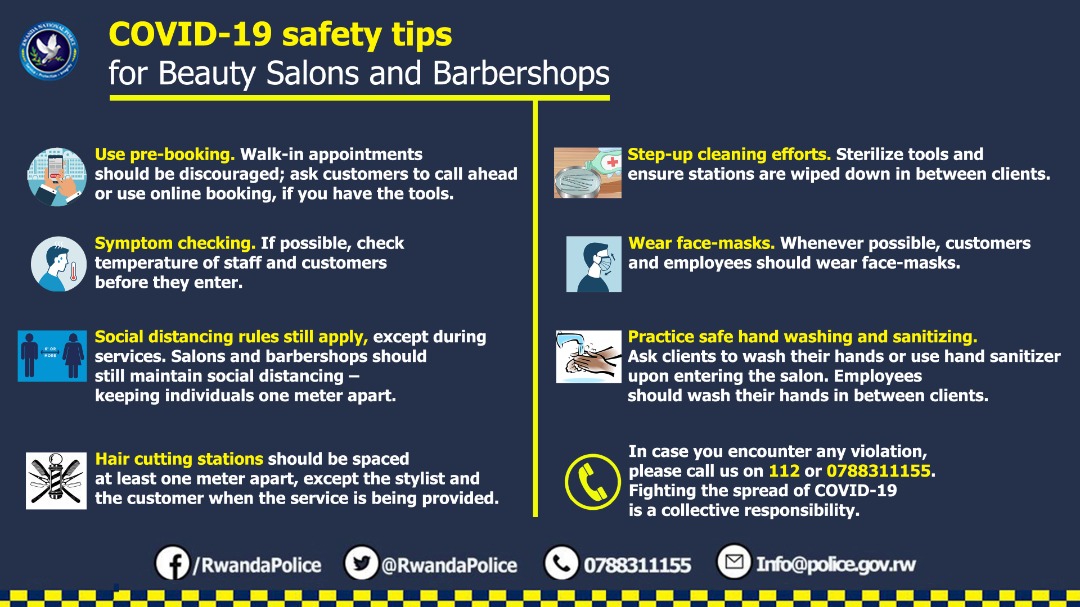
Here are some COVID-19 risks and safety tips for Beauty Salons and Barbershops:
Use pre-booking. Walk-in appointments should be discouraged, ask customers to call-ahead or use online booking if you use one.
Symptom checking. If possible, check temperatures of staff and/or customers before they enter.
Social distancing rules still apply, except during services. Salons and barbershops should still maintain social distancing – keeping individuals one meter apart.
Customers and stylists be not less than one meter apart while services are performed.
Haircutting stations should be spaced, at least one meter.
Kick up your cleaning efforts. With COVID-19, step up your cleaning efforts. Sterilize tools and ensure stations are wiped down in between each client.
Wear face-masks. Both customers and employees should wear face-masks.
Practice safe hand washing and hand sanitizing. Ask clients to wash their hands or use hand sanitizer upon entering the salon. Employees should wash their hands in between all clients.
Let’s be safe by practicing safety practices. Individual responsibility and following all recommended healthy practices is key to beating the pandemic.
Mathieu Ndayisaba, 21, and Ildephonse, 30, were arrested in Gasarabwayi Cell after the victims reported the fraud, Chief Inspector of Police (CIP) Hamdun Twizeyimana, the Police spokesperson for the Eastern region, said.
CIP Twizeyimana explained that the victims were tricked to believe that the suspects are collecting money to help those who were affected by disasters in the area.
“The victims are from different associations. Every member contributed between Rwf25, 000 and Rwf28, 000. Some of the associations’ members became suspicious and asked their local leaders the main cause for contributions,” Twizeyimana said.
He added: “After the local leaders realized that they are conning people, they immediately reported to Police. Law enforcement organs worked together to trace and arrest the two suspects to face justice. The suspects are also members of the associations they fleeced.”
“Besides the money they collected lying it is meant for helping vulnerable people, they also conned more than 50 others alleging that they are preparing development projects for them.”
CIP Twizeyimana advised the general public to be vigilant when it comes to pay their money.
He also warned people to refrain from “unlawful shortcuts to prosperity.”
Clause One of article 174 of the law determining offences and penalties in general in Rwanda, defines fraud as deception, obtaining another person’s property, whole or part of his/her finance by use of false names or qualifications, or offering positive promises or threats of future misfortunes.
Clause Two of the same article provides a term of imprisonment of between two and three years, and a fine of not less than Rwf3 million but not more than Rwf5 million, upon conviction.
The alarm raised by the two UN high ranking officials is substantive and worrying at a time when the world is grappling with an “invisible enemy” that has spread like a wildfire in a forest across the borders of developed and developing world, disrupting life for the rich and the poor alike in big and small cities and plunging world economies.
Users of social media platforms in Rwanda have witnessed cases in which institutions in the country had to intervene to urge the public to disregard false information circulating on social media and some internet sources.
There were many, but the most recent and notable among them is a false statement of cabinet resolutions that spread from one WhatsApp group to another while there was no such a meeting at all. Fake news also went as far as spreading rumors that Rwanda had registered the first death related to Covid-19.
The level at which false information “fake news” spreads around the world has reached an unprecedented level because with the increased internet connection, instant messaging services, and social media the world has become like a wired village where communities are closer to each other, and individuals much connected to each other that even a simple whisper can get far.
The Global Digital Report (GDR) 2020 indicates that 4.54 billion (59%) have access to the internet and the number of active social media users stands at 3.80 billion which is 49% of the total world population.
The latest figures by the Internet World Stats, a website that provides reports on internet access in the world, indicates that 5,981,638 Rwandans have access on the internet which makes them potential users and consumers of information on social media and other internet based channels. The most frequent social media used in Rwanda are Facebook, WhatsApp, twitter, youtube, Instagram
The number of social media users is also expected to continue rising thanks to the Connect Rwanda, an initiative aimed at distributing smartphones to families that cannot afford to buy one. During the Connect Rwanda campaign, the Ministry of ICT and Innovation revealed that out of 2.8 million households existing in Rwanda 14% have at least one smartphone.
According to Rwanda Media Barometer 2018, produced by RGB, the fiber-optic cable laid around the country is gradually increasing public access to “new media” or Social Media and other high-tech driven sources of information among other advantages.
The benefits are immense. Service delivery is becoming faster and cost effective, communication, and information much easier, accountability, and transparency enhanced. And more importantly, people were able to work from home and deliver services during the lockdown due to the Coronavirus pandemic.
On the other side, the irresponsible use and abuse of the information technologies and social media is also on the rise. With the new media, a user is both a content creator and publisher; they can record an audio, edit a video, create a text including any information they want, true or false and send it to the public through social media channels.
In the case of the false information reporting the first Covid-19 death in Rwanda, a voice of someone pretending to be familiar with the case was shared on several WhatsApp groups until the information was refuted as a rumor.
Some users tend to consume the information they get uncritically, go on to share it with friends, classmates, workmates, village mates. It could be hard for some users to detect false information because the authors use fake accounts of real institutions, photoshopped stamps, and letterheads that in some cases look like genuine ones.
Some rumors are also created around existing issues, realities, and occurrences like in the case of the statement of cabinet resolutions that members of the public were anxiously waiting for. Lack of digital media literacy is also contributing to the lack of questioning over content consumed. People must carefully verify the sources of information whether they are credible before duplicating by sharing.
Among the new media sources of information, we cannot ignore to talk about the explosion of Youtube channels some of which work as television stations. Some of the content carried using videos is fictional.
We have seen some videos where the producers claimed they met with the devil eye to eye (Twiboneye satani imbona nkubone). These are fake news that are unethical and punishable under cybersecurity laws.
Content creators on Youtube channels can increase their viewers without indulging in falsehoods which sometimes even instill fear among the population. In Rwanda’s case, Youtube content creators can make more profit than mainstream media if they concentrate on customized content that is valued by the audience.
As I conclude, social media may be an effective tool or a harmful tool depending on how we users want it to be. However, as I observe it today, the problem lies in that there is a growing number of people using it irresponsibly. It is high time we learned to use social media responsibly and consume content shared thereon in a healthier way.
The International Congress and Convention Association (ICCA)2019 statistics report released on Tuesday, May 12, indicates that the City of Kigali ranks in second position after South Africa’s Cape Town.
City of Kigali attained the same position in for 2018 after climbing one position up on the list the year before.
ICCA’s rankings are based on the number of association meetings taking place regularly (annually, biannually), rotating between at least three different countries and with at least 50 participants.
Every year, the association ranks cities and countries following stringent guidelines.
“This is great news and proof that the MICE strategy is generating value for Rwanda,” commented Nelly Mukazayire, the Chief Executive Officer of Rwanda Convention Bureau, the national MICE agency.
“We shall continue to identify and work better with our local associations and other stakeholders to help the destination do better in the ICCA rankings in the years to come.”
Tourism is the largest foreign exchange earner in Rwanda. With over 10,000 rooms in Kigali and 50,000 square meters of meeting space, MICE contributed 20% of all tourism revenues, amounting to US $56 million and 38,745 delegates, according to RCB; revenues for 2019 were projected to increase to US $88 million.
With the COVID-19 disease outbreak, 20 association meetings previously scheduled between March and April were halted, drawing national income back by US $10 million or 10 percent of estimated revenues in 2020.
Among the major meetings in Rwanda that were disrupted by the COVID-19 outbreak, include the Commonwealth Heads of Government Meeting (CHOGM) which was slated for June but was pushed forward due to the outbreak.
In global city rankings for 2019, Paris came top, followed by Lisbon and Berlin; all the top five cities are European.
In country rankings, USA holds the top spot, remaining the titleholder for the last two decades while the top 20 countries remain unchanged.
ICCA comprises of over 1,100 member companies and organizations in almost 100 countries and territories worldwide.
Niringiyimana, who was arrested Monday, is among the prime suspects in the recent separate cases of theft in Huye and Nyanza districts.
In one theft case, Niringiyimana together with his accomplices still at large, allegedly stole two generators in Huye, Rwaniro Sector in Mwendo Cell before stealing Rwf50, 000 from an elderly woman in Nyanza.
Chief Inspector of Police (CIP) Sylvestre Twajamahoro, the Southern region Police spokesperson, said that Niringiyimana was arrested due to information provided by those who witnessed the theft.
“They stole the generators and money in the same night. Fortunate enough, a neighbour of one of the victims, managed to get their identities and shared the information with the Police,” CIP Twajamahoro said.
He added: “Niringiyimana has been handed over to Rwanda Investigation Bureau at Rusatira and law enforcement are still searching for his accomplices.”
CIP Twajamahoro thanked residents, who called the Police after witnessing the crime and called for continued partnership and real time information sharing on such wrongdoers.
Theft, under article 166 of the law determining offences and penalties, is punishable with an imprisonment of between one and two years, and a fine ranging between Rwf1 million and Rwf2 million; community service of up to six months or one of these penalties.
Some of these revisionists claim to be genocide survivors so that they can win favour and sympathy from the international community, including the host countries where they sought refuge after their 1994 atrocities. How ironic that genocide perpetrators have turned into genocide deniers and then claim to be genocide survivors.
These chronic sowers of hatred and merchants of death are scattered throughout the world in both developed and developing countries including the United States, the United Kingdom, France, Belgium, Canada, and even in countries such as Australia and New Zealand where genocide ideologists founded an outfit of Rwandan Association of Queensland to promote the lethal thinking.
Some of the individuals that are bent on promoting genocide ideology are profiled below.
{{Bene Gatebuke}}
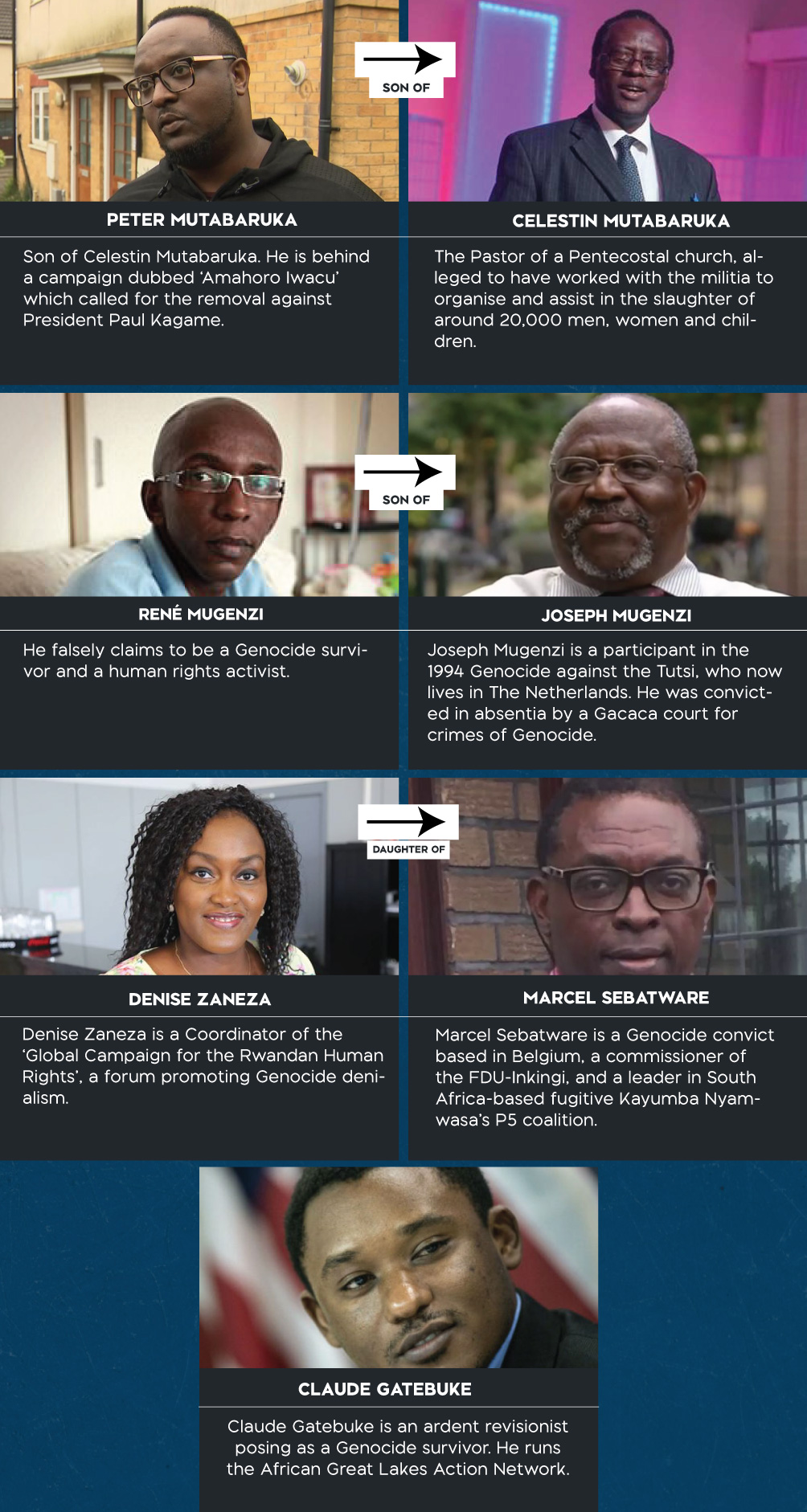
Claude Gatebuke and his sister Alice, who live in Nashville, Tennessee, are descendants of Gatsinzi Gatebuke, a native of Gisenyi in the former Kayove Commune.
They both claim to be genocide survivors. But those who knew Gatsinzi Gatebuke testify that he hated Tutsis so much so that he could not sit at the table to eat with them.
Gatebuke runs the African Great Lakes Action Network (AGLAN), made up of himself, his sister, and Lauren Brinkley-Rubinstein, who use it to raise money from those who do not know the truth about Rwandan history.
{{Denise Zaneza, Europe Coordinator of “Global Campaign for Rwandans’ Human Rights”}}
Claude Gatebuke works closely with Denise Zaneza, a prominent woman who denies the 1994 Genocide against the Tutsi. She is the eldest daughter of [Marcel Sebatware->https://cnlg.gov.rw/index.php?id=87&tx_news_pi1%5Bnews%5D=3979&tx_news_pi1%5Bcontroller%5D=News&tx_news_pi1%5Baction%5D=detail&cHash=b5ae79ff1006adb91b4862c19a8e6f9b] from Mukingo commune in Ruhengeri, who lives in Belgium and is accused of[involvement in the Genocide.
->https://cnlg.gov.rw/index.php?id=87&tx_news_pi1%5Bnews%5D=3979&tx_news_pi1%5Bcontroller%5D=News&tx_news_pi1%5Baction%5D=detail&cHash=b5ae79ff1006adb91b4862c19a8e6f9b]
The National Commission for the Fight against Genocide [CNLG] indicates that Sebatware is in self-exile in Belgium, hiding behind political activities to obscure his role in the Genocide against the Tutsi. He is a commissioner and one of the founders, along with Victoire Ingabire, of the FDU-INKINGI party in Belgium.
Denise Zaneza claims to be a human rights activist and is the Europe coordinator for the denialist organisation called “Global Campaign on Rwandan Human Rights”, “and a genocide survivor.” It is all a disguise because she is not a Genocide survivor.
{{Jambo Asbl}}
Jambo Asbl, operating in Belgium, is an organization that claims to protect humanity, yet aims to deny and belittle the 1994 Genocide against the Tutsi.
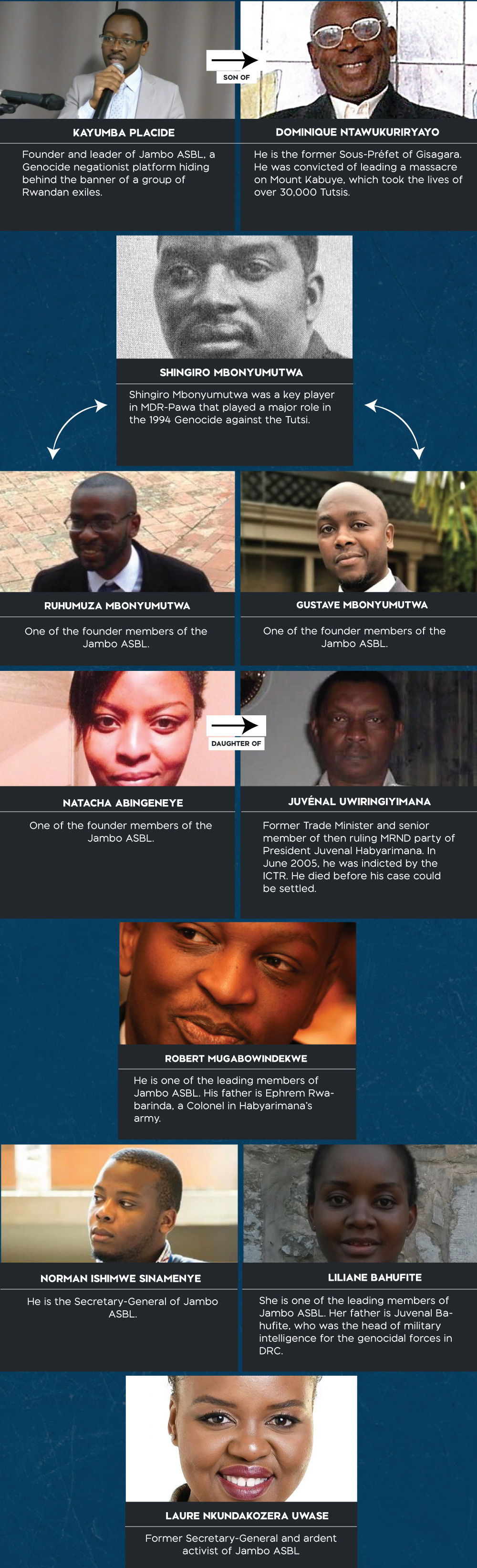
Among its leaders is Placide Kayumba, founder and CEO of Jambo Asbl, the son of [Dominique Ntawukuriryayo->https://unictr.irmct.org/en/cases/ictr-05-82], who became Sous-Prefet of Gisagara during the 1994 Genocide against the Tutsi.
In 2010 he was [sentenced by the ICTR to 25 years in prison->https://unictr.irmct.org/sites/unictr.org/files/case-documents/ictr-05-82/trial-judgements/en/100803.pdf]. He was convicted of leading a massacre on Mount Kabuye, killing more than 30,000 Tutsis.
There is also Natacha Abingeneye, the President of Jambo Asbl, the daughter of Juvénal Uwiringiyimana who became the Minister of Trade and was an MRND activist. In June 2005 he was summoned by the ICTR, where he died before his trial ended.
Another one is Gustave Mbonyumutwa, son of Shingiro Mbonyumutwa, who prosecuted by the Gacaca courts for his role in the Genocide against the Tutsi, and the grandson of Dominique Mbonyumutwa, one of the founders of MDR Parmehutu, who became the first President of Rwanda in 1961.
Also among the members of Jambo Asbl is Liliane Bahufite, daughter of Colonel [Juvenal Bahufite who led the massacre in Gisenyi in 1990-1993->https://www.nytimes.com/1995/07/18/world/mugunga-journal-a-refugee-camp-hums-with-the-spirit-of-home.html]. He was also a spokesperson for the militia that carried out the Genocide after they fled to Zaire.
Laure Nkundakozera Uwase, former Secretary-General of Jambo Asbl, and editor-in-chief of Jambo News in collaboration with Ruhumuza Mbonyumutwa, is the daughter of Anastase Nkundakozera, who was convicted by the Gacaca Courts of genocide against the Tutsi, and whose mother, Agnès Mukarugomwa, was a prominent MRND activist.
The current leader of Jambo Asbl, Robert Mugabowindekwe, is the son of Lt Col Éphrem Rwabalinda who served as Adviser to the Commander-in-Chief of Habyarimana’s Armed Forces. During the Genocide, Lt Col Rwabalinda was sent to Paris between 9-13 May 1994 to meet with French military leaders.
The message that he had brought when he was received by General Jean-Pierre Huchon included demands for weapons to confront the RPF Inkotanyi.
The Jambo team also includes Norman Ishimwe Sinamenye, the Secretary-General. His father, André Sinamenye, was born in Gikongoro, he was not involved in the Genocide but was against the government that organized it. From 1991 to 1994 he was a member of the PSD.
IGIHE has since learned that Norman Ishimwe’s father was unhappy with the path his son has taken, and even tried to get him out of the Jambo Asbl but wasn’t successful.
Unlike Robert Mugabowindekwe, Laure Uwase, Natacha Abingeneye, Placide Kayumba, Ruhumuza, and Gustave Mbonyumutwa and others, Norman Ishimwe, was not indoctrinated into genocide denial by his parents, but through his friend in Jambo Asbl.
Jambo Asbl uses many tactics to minimise and negate the Genocide against the Tutsi. Despite their recent pretence of using of UN-accepted language, they are quick to add to the “genocide against the Hutus.” They do not agree with the role of the Interim Government (that executed the Genocide), the MRND, the Hutu Power, and the FAR were involved in the genocide, but claim that the Interim Government wanted to restore peace.
{{René Mugenzi in the UK}}
René Mugenzi last year appeared on Al Jazeera television claiming to have survived the Genocide. However, his father, Joseph Mugenzi, is suspected of involvement in the Genocide, has fled justice, and is believed to be hiding in the Netherlands.
{{Peter Mutabaruka, of Peace at Home (Amahoro Iwacu)}}
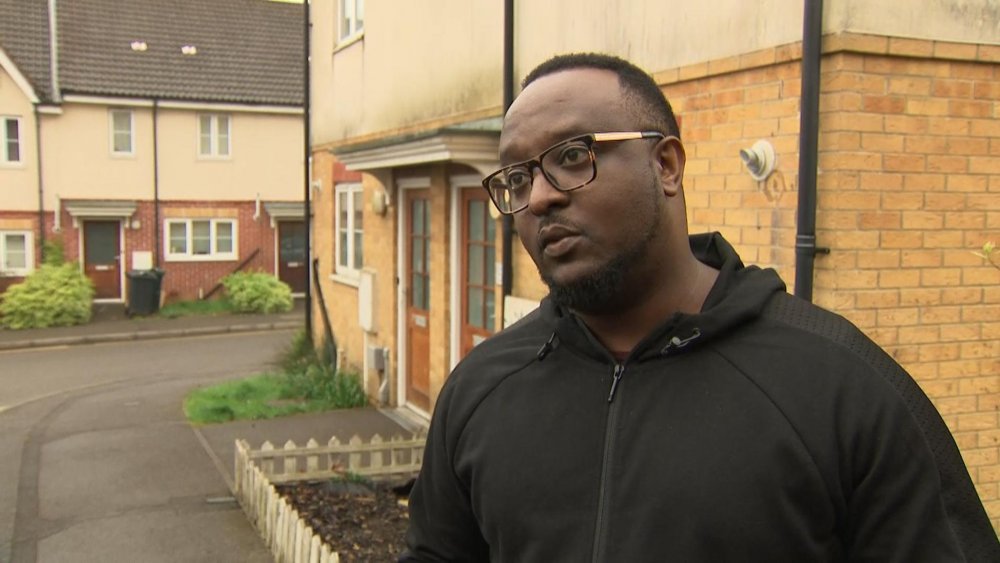
Peter Mutabaruka lives in the UK with his father, Celestin Mutabaruka, one of the infamous “UK Five” fugitives who are suspected of involvement in the Genocide against the Tutsi. The 64-year-old Celestin Mutabaruka, a pastor in the Community Church, is accused of being involved in the massacre of Tutsis of Bisesero at Kibuye in 1994.
Despite his father’s actions, Peter Mutabaruka continues to accuse the Rwandan government of violating human rights, and in 2017 launched a campaign called Amahoro Iwacu, in which he called for the removal of the President of Rwanda. He uses social media sites extensively, particularly Facebook and YouTube.
{{Deniers in Australia, New Zealand, and Canada}}
Others continue to deny the Genocide and have already multiplied in Australia and New Zealand, where their activities have been highlighted during the #Remembrance26. They continue to use the “Genocide in Rwanda”, instead of the UN-mandated name, Genocide against Tutsis.
These include Nelson Muhirwa and his wife Yvette Muhirwa from Australia, who use social media sites such as YouTube, to allege that the RPF has committed crimes against Hutus. Others are RNC militants, including Robert Mukombozi and Kalisa Mubarak.
In countries such as Canada, there is Louise Uwacu, who also claims to have survived the Genocide. She spreads genocide denial working closely with Claude Gatebuke and other genocide deniers.
Louise Uwacu’s family fled from Ruhengeri to Zaire after the RPF defeated those carrying out the Genocide.
Other influencers include Eric Udahemuka, spreading falsehoods on YouTube and other hate speech broadcasters, especially through Ikondera Libre TV, which is widely used by genocide deniers.
One of the political analysts who spoke to IGIHE said that the new generation of Tutsi Genocide deniers is using social media to spread genocide ideology and minimise the Genocide. “Such acts have to be fought until they stop.”
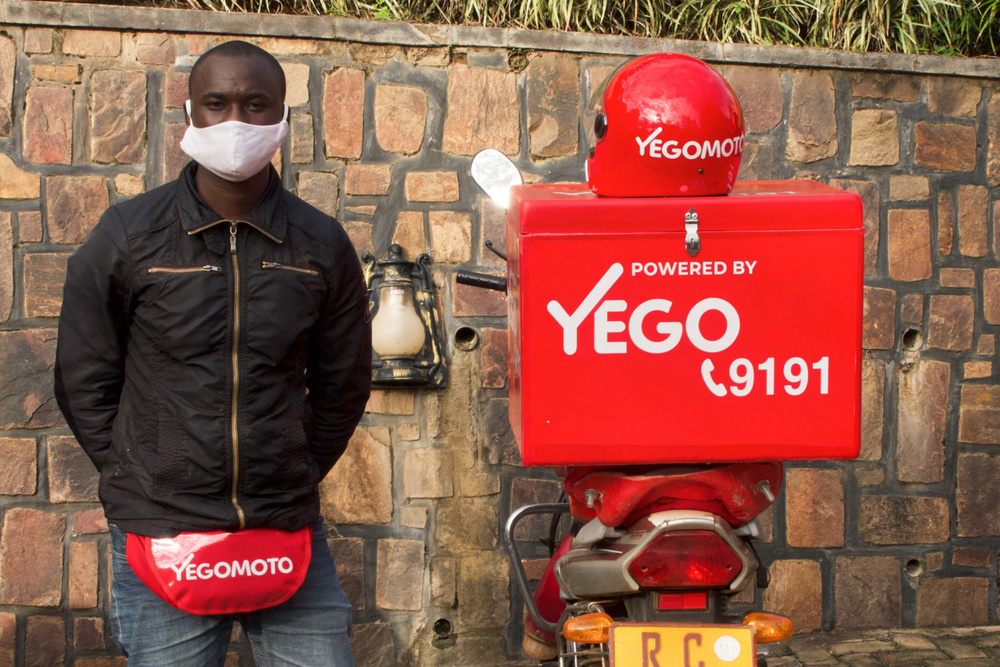
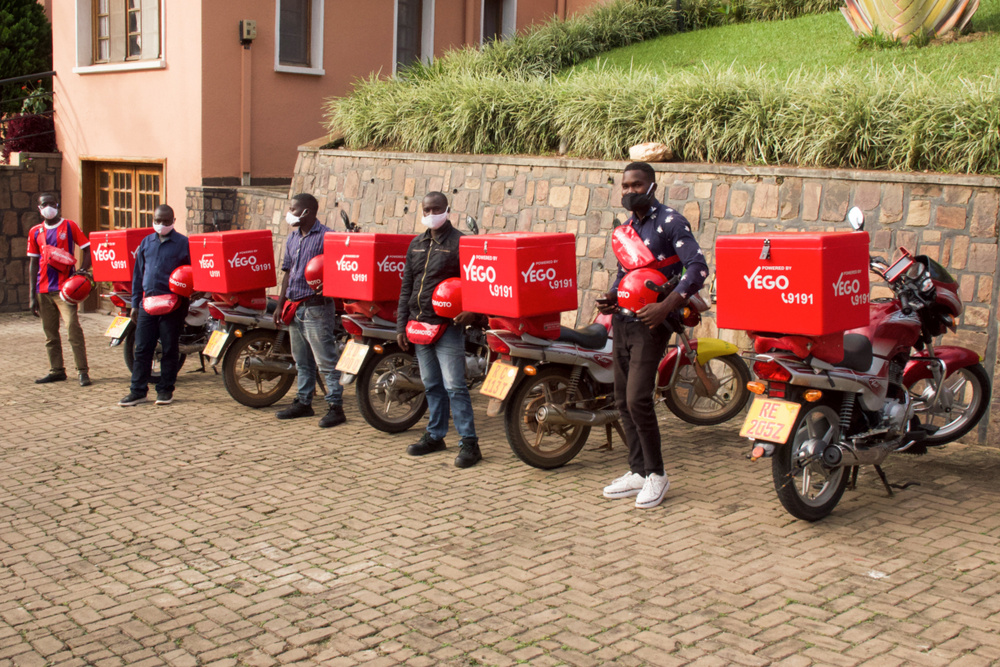
The focus of the training was on teaching Drivers how to stay safe, maintain a safe distance while delivering, and how to practice proper hygiene at all times.
Therefore, we have implemented a cashless, no-contact delivery process to protect the health and safety of our Customers, Drivers, and Merchants. All our drivers wear masks and use sanitizers before handing over goods. We currently have a fleet of 50+ Motos for Delivery in Kigali, all of whom are equipped with ICFMs (Intelligent Connected Fare Meters).
Getting delivery boxes has been a big challenge but we hope that, in the coming months, our fleet will expand to 1000 Motos.
After completing our roll-out in Kigali, we plan to roll out the service to other cities in Rwanda. YEGO’s aim is to address a much larger demographic and to enable them to enjoy the online shopping experience.
We have already partnered with over 60 merchants including Restaurants, Groceries, Supermarkets and Pharmacies. We intend to support all SMEs and independent contractors offering different good and services. Although our mobile App and website are under development, financial inclusivity has always been a core value at YEGO.
Today, with a simple feature phone you can place and pay for your order; one doesn’t even need to be connected to the internet!
{{HOW IT WORKS:}}
Simply call a merchant, place your order and pay, and say “I want Yego to deliver my order”. The Merchant provides YEGO with your phone number. Our Agent calls you, confirms your delivery location, and your order is delivered in 60 minutes or less! “We have been testing our service for over a month and have seen that most orders are delivered within 35 minutes!
Moreover, since our drivers deliver only one order at a time (orders are not clubbed), this means your food order arrives warm and fresh. Our Drivers benefit as they get more rides and a chance to earn a fair living.”
{{3 Simple Steps for Merchants: }}
1. A Customer calls the Merchant, places an order, and pays via Mobile Money.
2. The Merchant sends the customer’s phone number to Yego’s WhatsApp.
3. A Yego Driver picks the order and delivers it to the Customer. Metered Charges: The Delivery charges are calculated automatically based on the distance from the Merchant to the Customer. Cashless Payments: Customers can pay with Airtel Money, MTN Mobile Money, MTN Tap & Pay, or Yegomoto Ride-Tap-Pay NFC tags.
Since we insist on cashless payments and support a range of methods, you don’t have to worry about having exact change or risk contracting COVID-19 by handling cash. We wholeheartedly support Rwanda’s Vision to become a cashless economy.
While Rwanda has done a stellar job of limiting the spread of COVID-19, it seems that social distancing will be the “new normal”. We will change the way we eat, access goods & services, and even socialize.
YEGO aims to create a delivery ecosystem that benefits the community by safely delivering meals, groceries, medicines, etc., by our trained drivers.
Supporting the delivery ecosystem benefits local vendors and customers while also helping our Moto Drivers feed their families.
YEGO reiterates its commitment to the national economic strategy on augmenting cashless transactions, enhancing safety and security, driving financial inclusion, creating employment, and facilitating digital literacy to benefit all Rwandans.