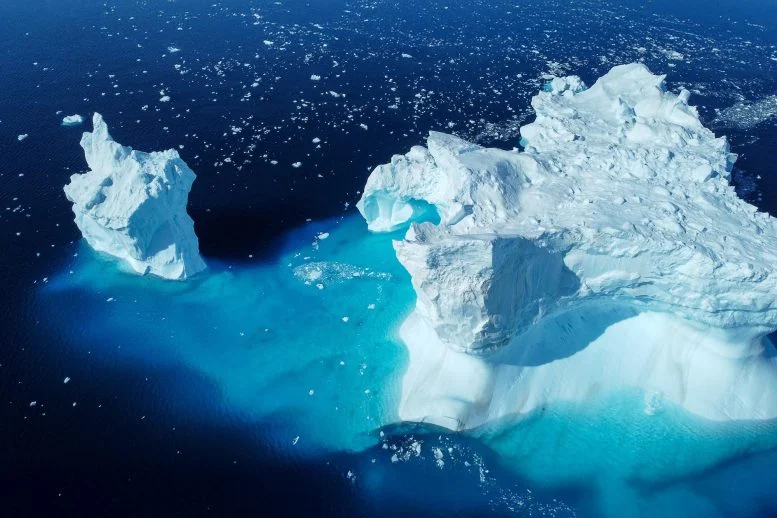
This research highlights a warming process that has been difficult to detect but may play a surprisingly large role in how ice sheets break down in a warming world.
Unlike melting caused by rising air temperatures or surface water runoff, this warming is happening from below the ice shelves massive floating extensions of the Antarctic ice sheet that act as natural “brakes,” slowing the flow of inland ice into the sea.
What researchers have found are long channel‑like formations in the underside of ice shelves that can trap relatively warm ocean water.
Instead of warmer water flowing away, these channels hold heat close against the ice, causing faster and more efficient melting from below.
This form of heat being trapped underneath the ice means that even ice regions once thought to be relatively cold and stable may be far more vulnerable than previously believed.
In these channel systems, warm water lingers and can melt ice at rates much higher than normal locally increasing melt many times over.
If these ice shelves thin and weaken, they are less able to hold back the enormous glaciers behind them. Those glaciers could then move more quickly into the ocean, directly adding to rising sea levels.
Current climate and sea‑level models may underestimate this process, because they do not fully account for the way ocean water circulates beneath ice shelves.
The discovery suggests that global sea‑level rise predictions may need to be revised to include this deeper, hidden source of melting.
With rising ocean heat pushing deeper toward Antarctica, this hidden mechanism could make future sea‑level rise faster and more severe than scientists have forecasted in many scenarios.
The implications reach far beyond Antarctica itself. Rising sea levels pose serious threats to coastal communities worldwide, impacting infrastructure, ecosystems, freshwater supplies, and millions of people living near oceans.
Understanding these newly uncovered melting processes is therefore critical for more accurate climate projections and planning for a future in which sea level continues to rise.
Leave a Reply