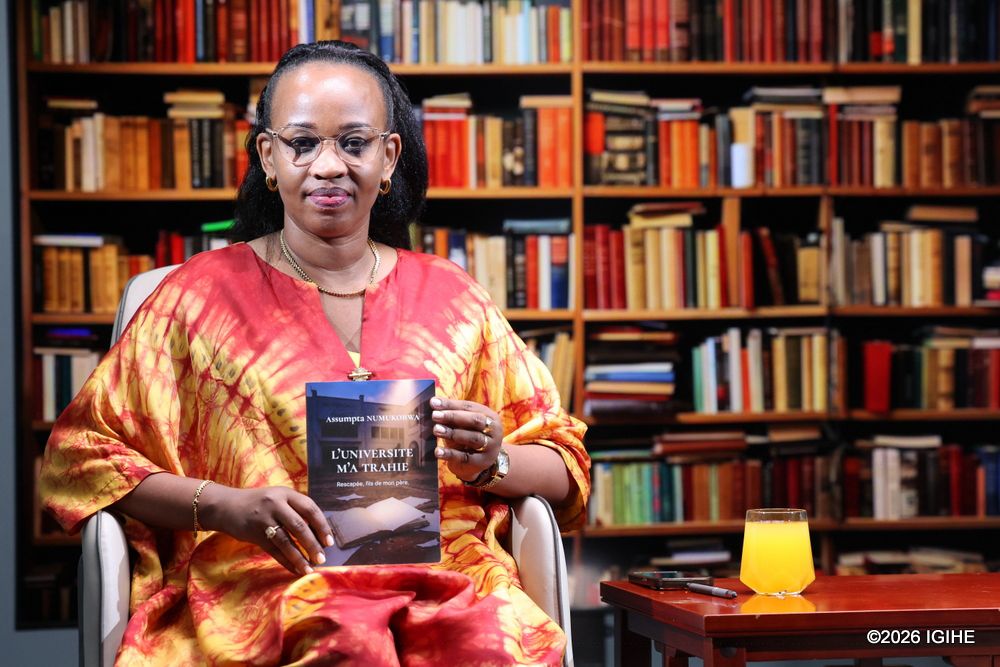
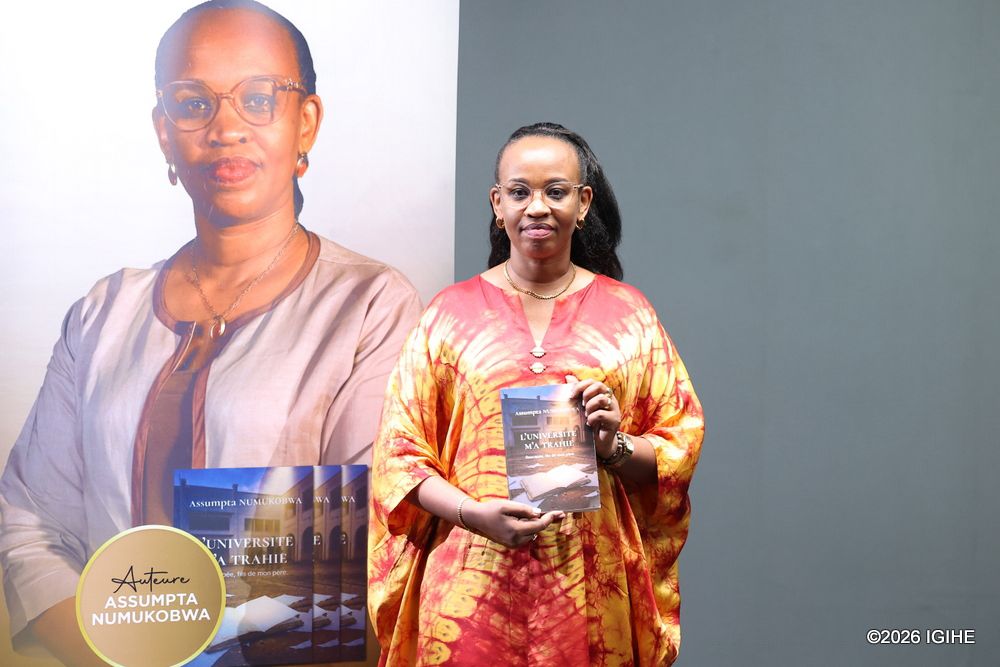
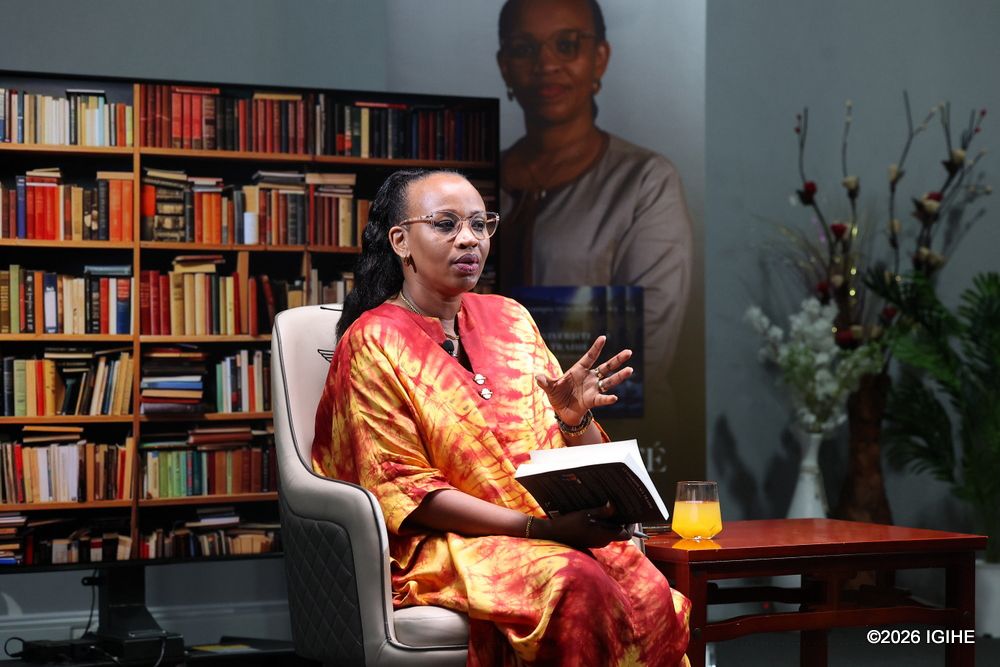
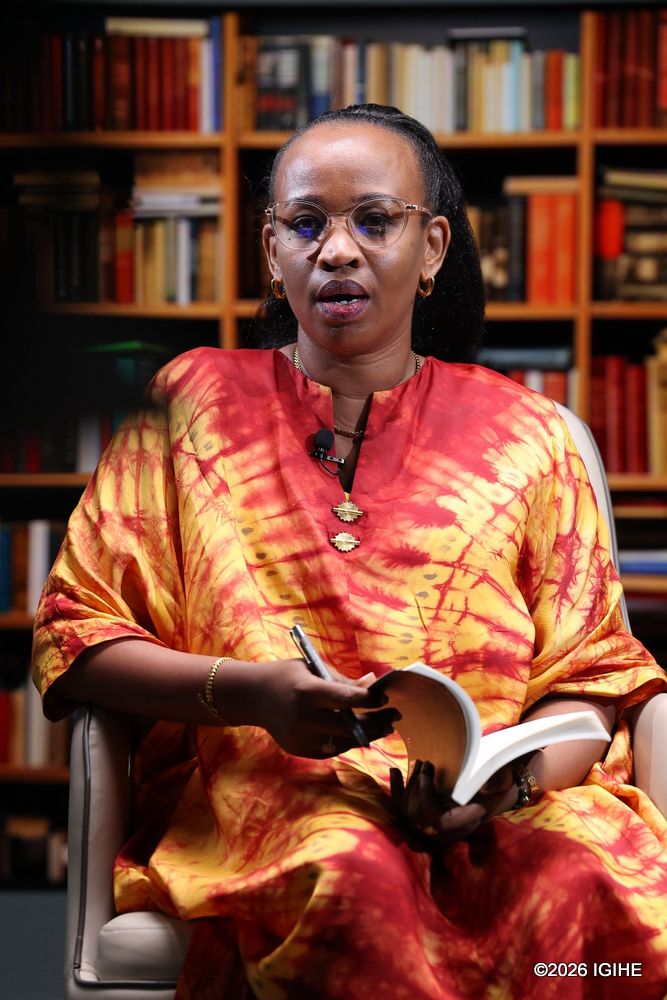
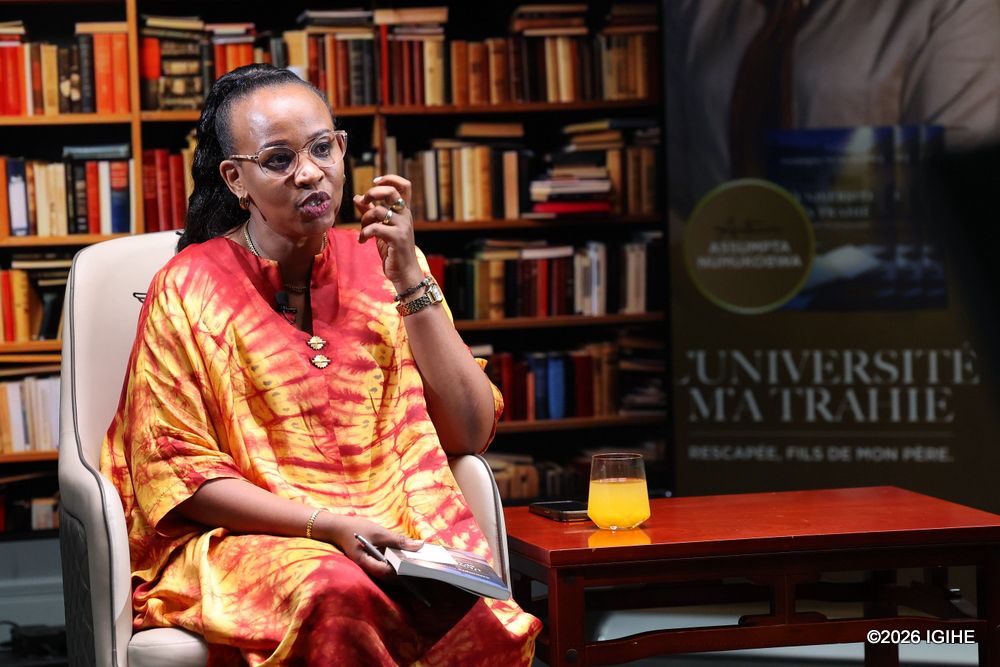
Through her book launched on Friday, February 27, at Kigali Genocide Memorial, the author seeks to preserve the memory of the students who were victims of the genocide on the campus of the National University of Rwanda in Butare, while also questioning the moral responsibility of educational institutions in the face of hatred and violence.
A childhood built around education and values
The story begins with the author’s childhood in Kigali, in a family deeply committed to Christian values, solidarity and the importance of education.
Despite economic difficulties and the unstable political context of Rwanda at the time, her parents encouraged their children to pursue their studies and to believe in the future.
Assumpta Numukobwa recalls her early school years with emotion, retracing her educational journey from primary school to her admission to Lycée Notre‑Dame de Cîteaux in Kigali.
At this renowned school, she discovered a world of learning, cultural activities, and youth movements that played an important role in shaping her personal development.
These experiences helped build her character, develop her sense of responsibility, and nurture her ambition to pursue higher education.
Yet behind this relatively normal school life lay a darker reality: Rwandan society was already marked by deep ethnic tensions and persistent discrimination against the Tutsi.
The dream of university
After completing her secondary education, Numukobwa briefly taught in a primary school. Encouraged particularly by her brother Emmanuel, she decided to pursue her dream of higher education.
Numukobwa eventually obtained a scholarship that allowed her to join the Faculty of Medicine at the National University of Rwanda in Butare.
For the young student, university represented the fulfillment of a dream. She imagined it as a space of intellectual freedom, discovery, and the construction of the future.
The Butare campus appeared dynamic and stimulating: university buildings, libraries, gardens, student residences, and meeting spaces created an environment conducive to exchanges and the training of the country’s future leaders.
However, the author quickly realized that the university was not entirely sheltered from the political tensions affecting Rwandan society. Students began to divide along political and ethnic lines, and the influence of political parties increasingly infiltrated university life.
Despite these tensions, student life continued; classes, discussions, friendships, and future plans shaped the daily lives of the young students.
Warning signs
At the beginning of the 1990s, Rwanda entered a period of deep political turmoil. The liberation war launched in 1990 by the Rwandan Patriotic Front, the introduction of multiparty politics, and rivalries between political parties contributed to the radicalization of public discourse.
On the university campus, these divisions became increasingly visible. Students participated in political meetings, and hate speech circulated openly.
Media propaganda, particularly broadcast by Radio Télévision Libre des Mille Collines, fueled hatred against the Tutsi. The climate of mistrust and tension gradually intensified.
On April 6, 1994, when President Juvénal Habyarimana’s plane was shot down, this event was immediately exploited by the extremist faction of Hutu Power as a pretext to trigger the genocide against the Tutsi, which had been planned for long time.
What was meant to be a place of knowledge and dialogue gradually turned into a space of fear and violence.
University turned into a place of betrayal
In her testimony, Numukobwa painfully describes how the university, supposed to protect its students, became a place of denunciation and persecution.
Tutsi students were hunted, isolated, and threatened. Some classmates, as well as members of staff and even teachers, actively participated in their persecution.
This betrayal was particularly painful for the author because it often came from people she knew personally: dormitory neighbors, classmates, or teachers with whom she had previously shared everyday spaces.
Gradually, fear spread across the campus. Meetings organized under the pretext of security were sometimes used to identify Tutsi students. Information broadcast on the radio was used to publicly designate certain individuals as enemies.
Numukobwa also recounts the tragic disappearance of many classmates and friends. Many students were stopped at roadblocks, while others were killed on campus or in nearby areas.
The book pays tribute to those students whose dreams and ambitions were brutally cut short.
Surviving the unspeakable
For several months, the author lived in constant fear of death. Numukobwa had to hide, flee, and attempt to escape militias and killers.
Like many other survivors, she witnessed the loss of members of her family and friends.
Numukobwa speaks about the psychological trauma left by these events; painful memories, nightmares, and the difficulty of rebuilding a life after experiencing such violence. To survive also means carrying the weight of memory and the burden of irreparable loss.
Rebuilding and passing on memory
After the genocide, Numukobwa embarked on a long process of personal reconstruction in a country deeply marked by tragedy.
Institutions gradually resumed their activities, and survivors attempted to rebuild their lives.
The author eventually succeeded in rebuilding a professional and family life, but the memories of the genocide remained deeply embedded in her mind.
This duty of remembrance pushed her to testify regularly, particularly during commemorations organized on the Butare campus, now part of the University of Rwanda.
These testimonies ultimately led her to write ‘L’Université m’a trahie’ in order to preserve the memory of the students who were victims of the genocide and to pass on their story to future generations.
A reflection on the role of education
Beyond personal testimony, the book raises a fundamental question; how could an institution meant to transmit knowledge become a place that participated in genocide?
For the author, the tragedy highlights a profound gap between academic knowledge and human values. She argues that diplomas and scientific knowledge do not inherently guarantee morality or respect for human life. Without ethics and conscience, education, she warns, can be manipulated to serve destructive ideologies.
Her book serves as a powerful reminder that memory is crucial for understanding the past and preventing such tragedies from recurring.
Education, she asserts, should not only transmit knowledge but also shape citizens who are equipped to defend human dignity and resist hatred.
karirima@igihe.com
Leave a Reply