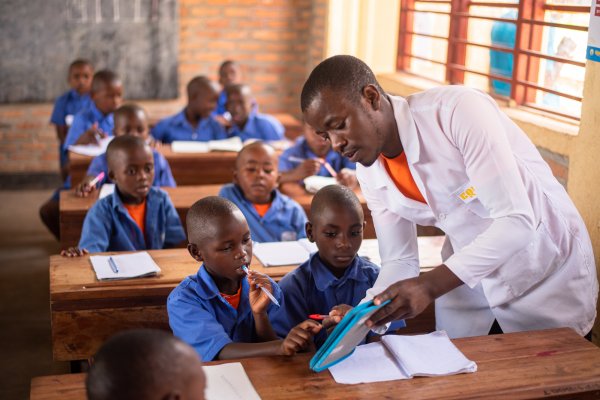
The Rwanda Basic Education Board (REB) says the current teacher training model for primary schools needs to be revised, noting that the duration of training is too short and should be extended. Under the proposed reforms, individuals seeking to teach at the primary level would first be required to complete university education.
The Ministry of Education’s 2024/2025 performance report, released on March 30, 2026, shows that Rwanda has 4,996 schools. Of these, 2,083 operate under government-aided agreements, 1,576 are public schools, and 1,337 are privately owned.
As of December 2025, Rwanda had 133,029 teachers across primary and secondary schools. Among them, 71,011 hold only secondary school qualifications, 10,667 have undergraduate degrees, while 21,147 possess postgraduate qualifications.
REB Director General, Dr Nelson Mbarushimana, has told RBA that the current system used to train teachers in teacher training colleges needs to be modernised to align with evolving education standards.
Rwanda currently has 16 teacher training colleges that admit students after lower secondary education. After three years of study, graduates are qualified to teach in primary schools.
However, Dr Mbarushimana said this training period is relatively short compared to regional and global standards, and ongoing research is exploring ways to extend it.
“They study to become primary school teachers, but when you compare the time they spend in training with other countries in the region and globally, it is still short. We are reviewing this through research and working to improve it,” he said.
He pointed out that in some countries, teacher training extends by an additional two to four years, meaning primary school teachers may hold advanced diplomas or university degrees.
“Teaching is not an easy profession. When you see a doctor performing surgery, using anaesthesia and carrying out complex procedures, teaching may not involve machines, but it requires equally intensive training,” he added.
Dr Mbarushimana emphasised that primary education forms the foundation of learning, where children acquire essential skills such as reading, writing and numeracy.
“When learners have competent teachers at this level, it prepares them better for secondary education and beyond, whether they pursue technical training or higher education. This ultimately contributes to building a capable citizen who can drive national development,” he said.
Asked whether, in the near future, graduates of university-level teacher training programmes could go on to teach in primary schools, he replied, “It is true.”
Reforms aim to address gaps in curriculum delivery
The proposed changes come alongside broader education reforms introduced last year, which replaced traditional subject combinations in secondary schools with a new system known as “learning pathways.”
According to Dr Mbarushimana, the shift was informed by research and international benchmarks, which revealed limitations in the previous system that restricted students’ ability to make flexible academic choices.
“We identified gaps that limited students’ freedom to choose their academic paths. We introduced three main learning pathways: science and mathematics, humanities, and languages,” he said.
Within the science pathway, students can specialise in combinations such as mathematics, physics, biology and chemistry, or mathematics, physics, geography and economics.
“This allows a student interested in science to follow that path and make informed choices when they reach university,” he added.
REB also noted that the reforms have led to an oversupply of teachers in certain subjects, as schools now combine students from the same level into larger classes for specific subjects, reducing the number of teachers previously required.
The government says the ongoing reforms are designed to strengthen the overall education system and better align it with both national development goals and global standards.

Leave a Reply