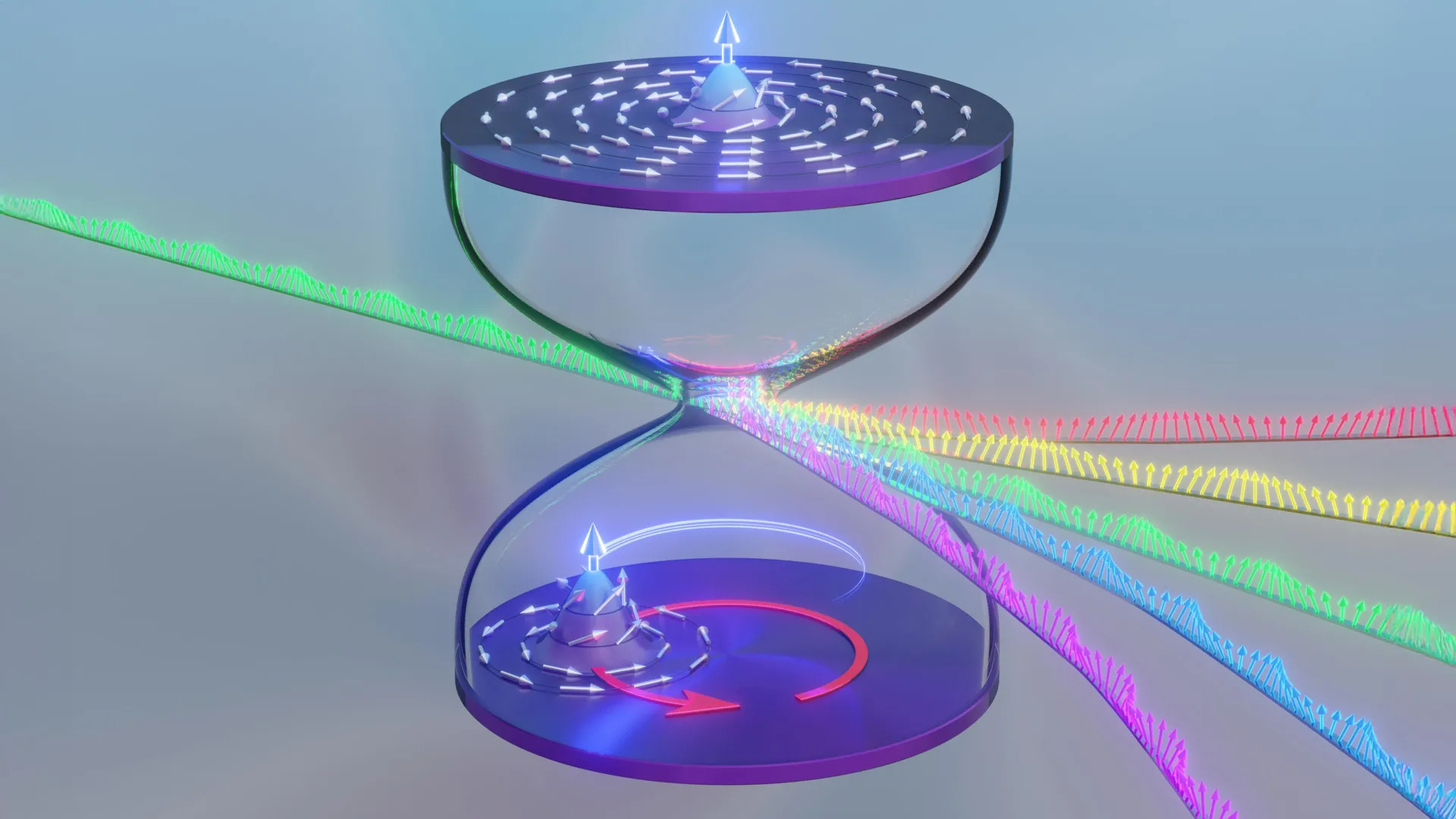
Magnetic vortices form inside very thin disks made from materials like nickel‑iron. In these disks, the magnetic moments tiny magnetic directions of atoms align in a circular pattern, like a miniature whirlpool.
When magnetic waves were applied, the vortex core began to move slightly in a repetitive way.
This motion caused the magnons (the collective waves of magnetic activity inside the material) to produce a frequency combining a series of regularly spaced signals instead of a single simple signal. This series of signals shows that multiple oscillation states can exist at once, something scientists had not seen in these magnetic systems before.
Project leader Dr. Helmut Schultheiß explained that the discovery offers “a powerful new way to link future computing technologies” because magnons can transmit information without needing to move electrical charge.
In conventional electronics, flow of electrical charge produces heat and energy loss. But magnons can carry information through magnetic waves, potentially allowing for low‑energy, highly efficient communication between devices.
What makes this finding especially significant is the very low energy required to produce these exotic states. Earlier research on related magnetic phenomena often needed intense laser pulses and large amounts of energy to see new oscillation patterns.
In contrast, the Dresden team showed that just weak magnetic excitations, on the order of microwatts (far less than what a typical smartphone uses in standby), are enough to trigger these complex magnon states.
This could help scientists design energy‑efficient magnetic systems for future technologies, including spintronics (electronics that use magnetic spin rather than charge) and even quantum devices.
The findings were published in the journal Science, and they challenge existing assumptions about how magnetic vortices behave, opening up new avenues for research into controlling magnetic information at the nanoscale.
Leave a Reply