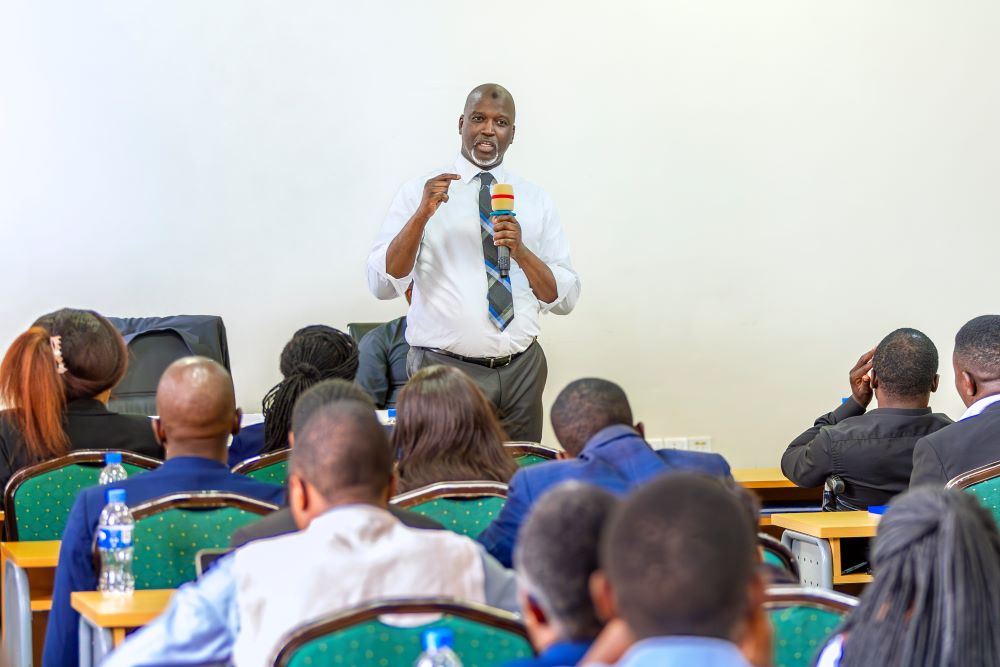
This lecture on “International Criminal Justice and the Genocide against the Tutsi: The Role of the ICTR and the Residual Mechanisms in Upholding Genocidaires Accountable,” was delivered on March 31, 2026 by Mr. Abubacarr M. Tambadou, the Registrar of the International Residual Mechanism for Criminal Tribunals.
The session provided a sweeping look at the pursuit of justice, the evolution of international criminal justice, and the complex human realities of post-genocide accountability.
Established by the United Nations Security Council, the International Criminal Tribunal for Rwanda (ICTR) faced a monumental and logistically impossible task: prosecuting the thousands of perpetrators involved in the genocide. Instead, the tribunal took a pragmatic and deeply symbolic approach.
“By prosecuting those who bore the greatest responsibility particularly top-level leaders in the political, military, religious, and business spheres the ICTR sent a clear message,” the lecture highlighted. “It demonstrated that absolutely no one is above the law, while simultaneously establishing global standards for fair trials and due process.”
Through its international authority, the ICTR successfully compelled nations across the world, especially from Africa and Europe to transfer fugitive suspects many of whom had fled Rwanda back into its custody to face trial.
Beyond individual prosecutions, the ICTR fundamentally reshaped international human rights law. The lecture placed special emphasis on the landmark case of Prosecutor v. Jean-Paul Akayesu.
For the first time in history, this case formally recognized rape and sexual violence as acts of genocide under international law, provided they were committed with the specific intent to destroy a targeted group.
“This ruling expanded the interpretation of the Genocide Convention,” the expert noted during the session. “It set a lasting, irrefutable precedent for all future international tribunals.”
Furthermore, the ICTR cemented the doctrine of command responsibility, ensuring that leaders could no longer turn a blind eye to atrocities, holding them legally accountable when they failed to prevent or punish crimes committed by their subordinates.
One of the most gripping moments of the lecture came from the personal testimony of a former ICTR prosecutor, illustrating the deep emotional toll of the tribunal’s work. Mr. Abubacarr recounted the visceral trauma of reading witness statements, which frequently resulted in recurring nightmares.
“Initially, I struggled so deeply with the horrific nature of the crimes that I refused to even shake the hands of the detained perpetrators,” the former prosecutor shared.
However, a pivotal shift occurred when they realized that cooperation from these lower-level detainees was the only way to build airtight cases against the senior architects of the genocide.
“By setting aside my personal judgment and choosing to treat the detainees with basic dignity, I gained their trust and cooperation,” the prosecutor explained. “It highlighted a difficult but necessary truth: while their crimes were horrific, the perpetrators were still human beings. Acknowledging that complexity transformed my understanding of justice and is essential for long-term reconciliation.”
Emmanuel Manzi, a DLP student in attendance, reflected on how deeply the tribunal’s history connects to the upcoming Kwibuka (commemoration) period.
“This lecture went far beyond legal insights,” Manzi observed. “It served as a powerful reminder of our shared responsibility in preserving memory and promoting unity among all Rwandans.”
As the nation prepares to remember the victims of the Genocide against the Tutsi, the session provided attendees with vital guidance for the days ahead. The core message emphasized the importance of standing in unwavering solidarity with the survivors of the Genocide against the Tutsi while firmly rejecting all forms of discrimination, division, and genocide ideology.
To put these principles into practice, attendees were encouraged to actively participate in national efforts and community events throughout the commemoration week, ultimately fostering an enduring culture of unity, compassion, and healing among all Rwandans.
The lecture ultimately served as a poignant reminder that the legacy of the ICTR is not just an academic or legal exercise. It is a living testament to the necessity of accountability, and a roadmap for a world striving to ensure that “Never Again” is a reality.

Leave a Reply