Garcia, a Brazilian professor of international relations, made the remarks in a recent interview with Xinhua on the upcoming BRICS summit to be held in South Africa from Tuesday to Thursday.
BRICS has a global role to play to balance international relations and seeks to accumulate economic and technological power, as well as an intellectual, moral, ideological capacity to build new consensuses, she said.
Garcia explained that regarding climate change, the need for technological development focused on energy and climate issues, and the need for public policies aimed at serving the most vulnerable populations, thus BRICS will have a very relevant role in the current period.
BRICS countries offer opportunities that can generate other consequences that were neither foreseen nor desired in a capitalist system, she said, noting that BRICS needs to improve South-South cooperation.
In this sense, she highlighted China has been already providing very important aid to the African continent.
“It is necessary not only to reach top-down governmental agreements with South-South cooperation projects, but also to open spaces for participation, dialogue, exchange and audits of local populations and other actors involved in the projects so that the countries of the Global South have a voice,” she said.
On cooperation among BRICS countries, Garcia said, “BRICS needs to create institutions and common spaces where there are technology transfer and development of vaccines, technologies for sustainable development and energy transition, programs and policies that can help.”
To reform the multilateral institutions that exist today is what BRICS countries need to do for “more of a voice,” she said, noting that it is necessary for the member countries of considerable relevance in regional and global terms to be represented, countries that consider global problems and responses, not just individual issues.
On expectations for the BRICS summit, she commented that it should address “the accession of new members” into the grouping, which currently unites Brazil, Russia, India, China and South Africa, among other issues of common interest.
Guided by the BRICS spirit of openness, inclusiveness and win-win cooperation, member nations have enhanced cooperation to promote economic recovery in the aftermath of the COVID-19 pandemic, according to the experts.
China’s foreign trade with other BRICS countries — Brazil, Russia, India and South Africa — soared 19.1 percent year on year to 2.38 trillion yuan (about 330.62 billion U.S. dollars) in the first seven months of 2023, data from the General Administration of Customs showed Monday. This accounted for 10.1 percent of China’s total foreign trade value during the period, marking a rise of 1.6 percentage points.
Specifically, China’s exports to these countries totaled 1.23 trillion yuan, up 23.9 percent year on year, while its imports reached 1.15 trillion yuan, with a year-on-year growth of 14.3 percent.
According to Dr. Kenneth Creamer, an economist from the University of the Witwatersrand in Johannesburg, “the main objective of BRICS is to encourage increased levels of trade and cooperation among member countries and BRICS has been successful in advancing this objective since its first meeting.”
“Increased cooperation in sectors such as energy and agriculture can play an important role in lifting levels of economic growth and employment in BRICS member countries. Increased trade and cooperation among BRICS countries can also assist in promoting economic recovery after the negative impact of the COVID-19 pandemic,” said Dr. Creamer, who is also a member of the Presidential Economic Advisory Council.
Regarding the China-South Africa cooperation, Dr. Creamer said China and South Africa should build on existing strong relations to seek to better integrate the countries’ manufacturing and supply chains to aid development and opportunity in both countries.
In the first half of the year, bilateral trade between China and South Africa reached 28.25 billion U.S. dollars, up 11.7 percent year on year, official data showed. China has maintained its position as South Africa’s largest trading partner for 14 consecutive years, while South Africa has been China’s largest trading partner in Africa for 13 consecutive years.
“Chinese enterprises should be encouraged to use South Africa as a base country from which to manufacture, assemble and deliver products and services for sale in other countries in Sub-Saharan Africa,” Dr. Creamer said.
China has remained Africa’s largest trading partner for 14 consecutive years. The two sides have together constructed and commissioned over 10,000 km of railway, nearly 100,000 km of highway, and an array of important infrastructure projects, including airports, docks, bridges and power plants, according to China’s Ministry of Commerce.
Speaking to Xinhua, Tshifhiwa Tshivhengwa, CEO of the Tourism Business Council of South Africa, said they are looking at the BRICS summit to bring in more tourists. “It’s a major event. We’re expecting it to boost our tourism.”
“We need to focus on countries like China to bring more tourists to the country. That’s where our growth in terms of tourists will come from; we need to look beyond the traditional areas,” Tshivhengwa added.
Wandile Sihlobo, chief economist and researcher at the Agricultural Business Chamber of South Africa, pointed out that China has one of the biggest markets in the world in terms of agricultural products.
“South Africa is one of the countries that is also trying to deepen its exports into China, which is something that is part and parcel of the discussions that are happening within the various BRICS business working groups,” Sihlobo said.
Themed “BRICS and Africa: Partnership for Mutually Accelerated Growth, Sustainable Development and Inclusive Multilateralism,” this summit will carry forward the sound momentum of cooperation from the BRICS “China Year” 2022 and chart a brighter future for BRICS.
“The summit is of great significance for advancing practical cooperation among emerging markets and developing countries in various fields, promoting global governance reform, and enhancing the representation and voice of developing countries,” said Li Wentao, a researcher with the China Institutes of Contemporary International Relations.
Li added that against the backdrop of major global changes, the solidarity and cooperation among BRICS countries will bring more certainty to an uncertain world.
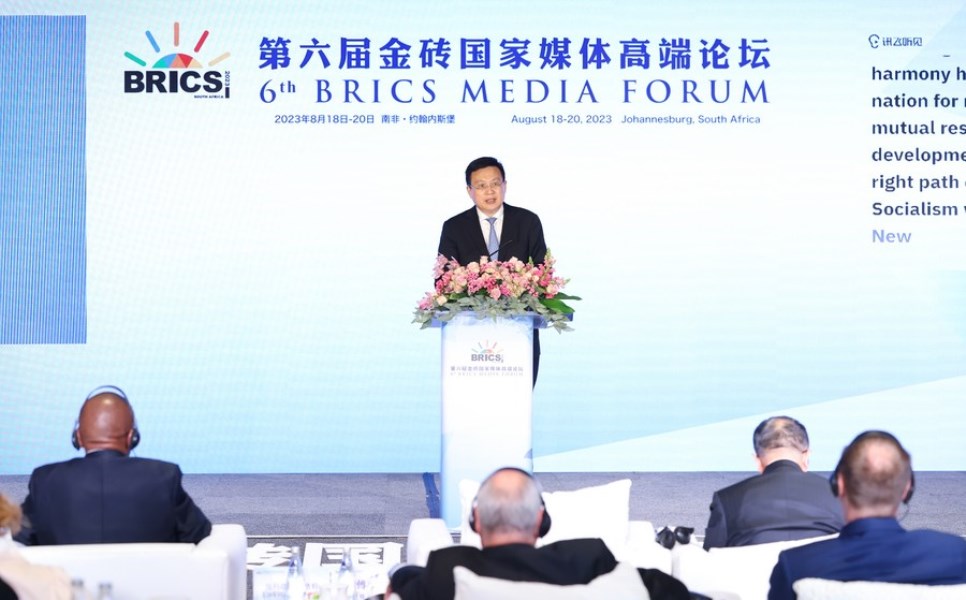
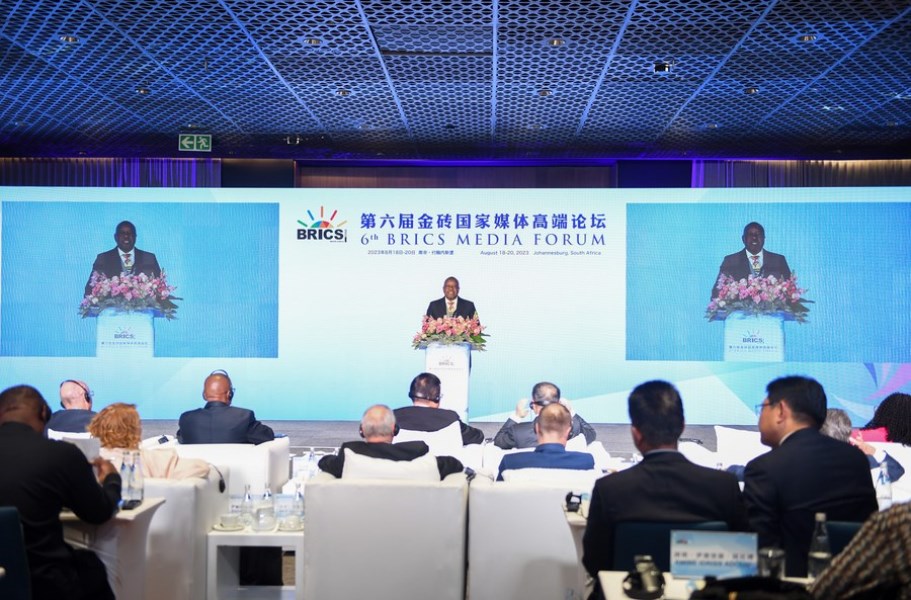
The forum, co-hosted by China’s Xinhua News Agency and the China Energy Investment Corporation (CHN Energy), is being held under the theme of “BRICS and Africa: Strengthening Media Dialogue for a Shared and Unbiassed Future.”
“The purpose of this forum is to facilitate the successful convocation of the BRICS Summit and to further promote communication and cooperation in greater depth among BRICS media and among BRICS countries,” said Fu Hua, president of Xinhua News Agency, at the opening ceremony of the forum.
Media outlets of BRICS countries shoulder significant responsibilities in this era and enjoy broad space for cooperation, said Fu, who is also executive chairman of the BRICS Media Forum.
The BRICS Media Forum was proposed by Xinhua News Agency and jointly initiated by mainstream media outlets from Brazil, Russia, India and South Africa, with the forum presidium as its top decision-making body.
{{ADVANCING BRICS MEDIA COOPERATION}}
“Since its inception in 2006, the BRICS mechanism has gone through 17 years and has stood the test of changes in the international landscape and become an important platform for emerging markets and developing countries to seek strength through unity,” said Hu Heping, executive deputy head of the Publicity Department of the Communist Party of China (CPC) Central Committee and Minister of Culture and Tourism.
Over the past eight years, the BRICS Media Forum has been operating on a regular basis and at a high level, becoming an important platform for efficient coordination and cooperation among mainstream media of BRICS countries, Hu said.
To advance the high-quality development of cooperation among BRICS media, Fu called for promoting the shared values of humanity, jointly promoting the construction of a more just and equitable international order, better telling BRICS stories in the new era, and jointly promoting cultural exchanges and mutual learning among civilizations.
Media outlets of BRICS countries should work to build a community with a shared future for humanity, promote shared values of humanity, stay committed to peace, development, cooperation, and mutual benefit, and spread the vision of global governance featuring shared growth through discussion and collaboration, said Xinhua president.
He urged media outlets of BRICS countries to actively raise voices for fairness and justice on the international stage, promote the vision of common, comprehensive, cooperative and sustainable security, oppose hegemonism and power politics, and strive to enhance the voices and influence of emerging markets and developing countries, so as to ensure a more just and equitable international order.
The diverse cultures of the BRICS nations enrich global conversations, and the BRICS media advocate for an inclusive, cooperative and just new world order, said Iqbal Surve, executive chairman of Independent Media of South Africa.
The forum sheds light on the challenges facing developing nations, providing them with a platform to express their perspectives and aspirations, Surve said.
{{ENHANCING VOICE OF BRICS COUNTRIES}}
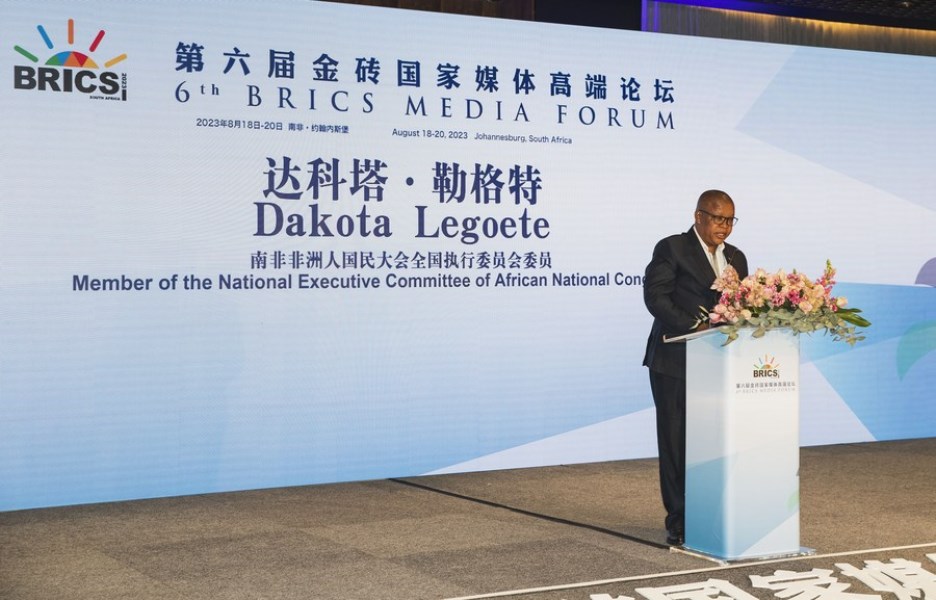
“Since its establishment in 2015, the BRICS Media Forum has become an important platform to enhance the voice of BRICS countries,” Dakota Legoete, a member of the National Executive Committee of the African National Congress, spoke at the opening of the forum.
While some countries attempt to monopolize the international discourse and weaponize the media to attack other sovereign states, the BRICS media have demonstrated that the media should be committed to promoting world development, rather than becoming a tool to provoke wars, Legoete said.
Media of BRICS countries bear the responsibility of being the “chief storytellers” of BRICS cooperation, Fu said. “We should fully report on the innovative explorations of BRICS countries in their modernization endeavors, tell vivid stories of BRICS countries’ deepening reforms, improving people’s well-being, and developing green energy.”
Echoing Fu’s proposals, Wang Min, director of CHN Energy, said media serve as an important force for social progress and media empowerment is indispensable to ensuring energy security and accelerating the green and low-carbon transition in BRICS countries.
Supported and witnessed by the BRICS media, the energy cooperation among BRICS countries has been deepened and the momentum of development has been continuously enhanced, Wang said, noting that CHN Energy has been actively engaging in such cooperation with fruitful results.
Jose Juan Sanchez, chief of Brazil’s financial and agricultural information provider CMA Group, stressed the importance of credible and impartial news information. “Communication among BRICS media is crucial, and the member countries should seek sustainable development in economic, environmental and social areas,” he said.
News media produce cultural products and carry the cultural mission of promoting exchanges and mutual learning among civilizations, said Fu, who called for BRICS media outlets to promote equality, mutual learning, dialogue and inclusiveness among different civilizations.
As a member of the forum’s presidium and home to the forum’s liaison office, Xinhua is willing to provide strong support for the effective operation of this mechanism and offer solid support for the steady and sustained progress of media cooperation among BRICS countries, Fu said.
The forum, which runs into Sunday, gathers around 200 participants from around 100 media outlets, think tanks and international organizations from about 30 countries.
At the forum, New China Research (NCR), the think tank of Xinhua News Agency, released two research reports entitled “Toward Modernity: The Value of Xi Jinping’s Economic Thought” and “The ‘Second Integration’ that Transforms China — Theoretical Innovation and Practice in Building the Modern Civilization of the Chinese Nation.”
{{(Video reporters: Zhang Zhihuan, Yin Jiajie, Li Shuting, Liu Chunhui, Tian Hongyi; video editors: Liu Ruoshi, Zhang Yuhong, Liu Yutian, Lin Lin).}}
“The safety and security preparations for the summit are on track, with all critical role players ready to execute their various responsibilities as per their mandate,” said Deputy National Police Commissioner Tebello Mosikili.
“We are prepared to receive the leaders of the BRICS in a secured and safe environment,” said Mosikili, also co-chair of the country’s National Joint Operational and Intelligence Structure (NATJOINTS).
In order to prevent and battle any sort of opportunistic crime, prior to, during, and after the summit, Mosikili indicated that the NATJOINTS would increase police visibility around the summit’s venue.
Any threats and disruptions will be dealt with decisively within the ambit of the law, she said. “To this end, high density operations through increased roadblocks, vehicle checkpoints, high police visibility on foot, and air patrols will be conducted.”
BRICS is the grouping of the world’s leading emerging market economies, namely Brazil, Russia, India, China and South Africa.
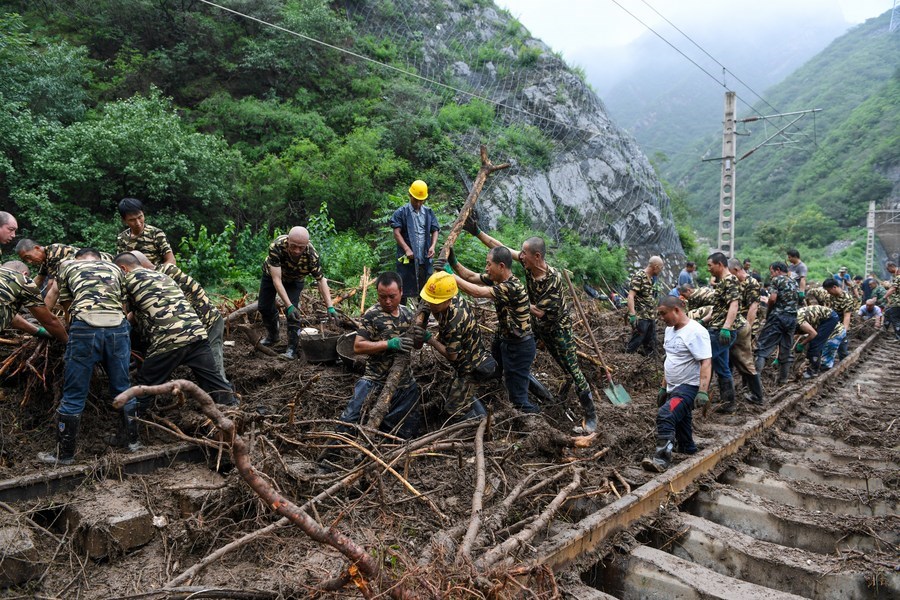
The heavy overall rains in the Beijing-Tianjin-Hebei region caused anomalous floods in several districts of Beijing and several localities in north China’s Hebei Province in the past few days.
At urgent times, the Communist Party of China (CPC) Central Committee with Xi Jinping at the core kept standing firm in putting the people first and once again provided powerful backing for all those affected.
{{Beijing must stand the test }}
Landing on the southeast Chinese coast on July 28, Typhoon Doksuri had not kept its realm in southern China as many other typhoons that weakened after landing but continued moving northward, bringing rain clouds to northern China.
President Xi closely followed the development of Doksuri, stressing that special precautions should be taken in the Beijing-Tianjin-Hebei region.
Late July and early August are the usual rainy season in China. In early July, Xi, also general secretary of the CPC Central Committee and chairman of the Central Military Commission, asked relevant authorities to enhance coordination, step up monitoring and early warning, and provide targeted guidance over disaster prevention and rescue efforts.
In the face of Doksuri, authorities immediately mobilized, and multiple disaster alerts for mountain torrents, floods and waterlogging were announced.
Typhoon Doksuri brought heavy downpours in north China and resulted in floods and geological disasters.
On July 30, over 2,800 passengers were trapped on the K396, K1178 and Z180 trains in Beijing due to railways cut off by the rainfalls, facing a shortage of food and water and no communication signals.
The situation quickly came to Xi’s notice and he immediately made instructions.
“Local authorities and relevant departments must get in touch with the trains and make every effort to arrange rescue and give out food and drugs to ensure the safety of the trapped passengers,” Xi said in an instruction.
During the following days of rescue, Xi repeatedly stressed sound logistics guarantees for those temporarily settling where the trains were stuck, urging efforts to transfer trapped passengers to Beijing as soon as possible while ensuring their safety.
On Aug. 3, all the passengers were able to leave the temporary settlement spots.
Amid the rescue, Xi continued to give instructions concerning all those suffering from the natural disaster, stressing efforts to make appropriate arrangements for people affected by the floods and geological disasters, promptly repair damaged infrastructure, including transportation, telecommunications and electricity facilities, and restore order in work and life as soon as possible.
Party members and officials must charge forward, and primary-level Party organizations must play their roles so that the people can feel like they have something to rely upon, said Xi.
“As a modernized metropolis, Beijing must stand the test,” he said.
{{All-out rescue efforts in Hebei }}
When Beijing was drenched, rainstorms also swept half of the counties and city districts in neighboring Hebei. Around 2.2 million people were affected.
Zhuozhou City in Hebei saw 60 percent of its urban areas immersed in water up to 6 meters deep.
Xi was deeply concerned about the disaster situation in Hebei. He learned about the water levels in places including Zhuozhou and instructed the province to mobilize rescuers and resources to promptly evacuate trapped individuals, ensure effective drainage in urban areas, and expedite restoring normal urban operations.
On Aug. 1, Xi demanded all-out search and rescue efforts to find people missing or trapped in floods.
The Organization Department of the CPC Central Committee has allocated 44 million yuan (about 6.16 million U.S. dollars) in funds to assist with flood control and disaster relief work in Beijing, Hebei and Tianjin.
On Aug. 4, the Ministry of Finance and the Ministry of Water Resources allocated 450 million yuan for disaster relief in Beijing, Tianjin and Hebei.
On the same day, the country earmarked an additional 100 million yuan from its central budget to assist in rehabilitation in Tianjin and Hebei.
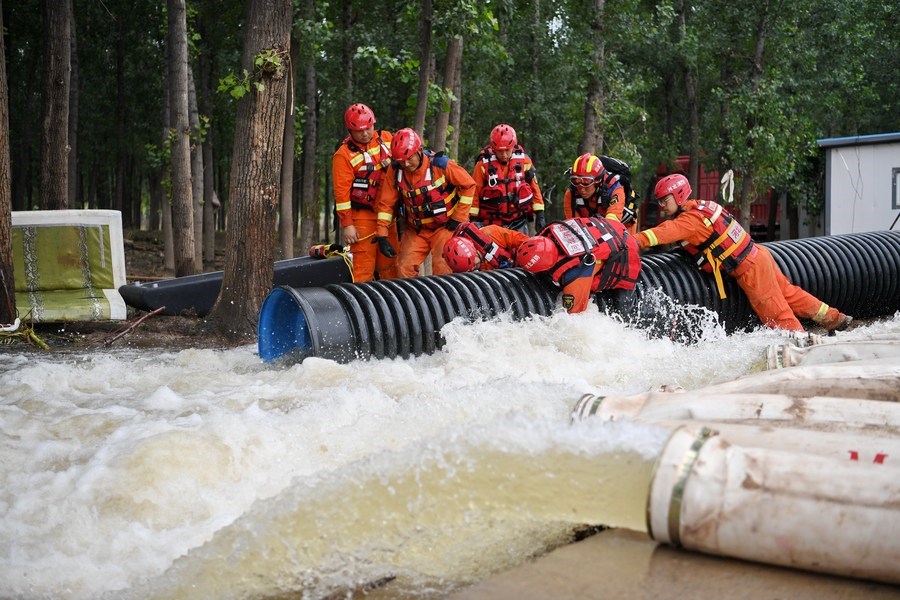
Local authorities in Hebei mobilized large rescue forces to the flood-hit areas: 4,705 rescue teams consisting of 105,988 members were formed, and emergency departments of various levels exchanged information daily with the teams.
On Xi’s instructions, the central government and Beijing also sent support. The Ministry of Housing and Urban-Rural Development and the National Health Commission sent work teams and experts to guide the rescue efforts on site. Beijing Drainage Group dispatched four units of large-scale water pumps, 14 vehicles and 63 technicians to assist with water drainage.
Currently, the ongoing rain has significantly eased, but flood prevention remains a tough challenge.
Xi emphasized that all regions and relevant departments must strengthen monitoring, forecasting and early warning efforts and enhance inspection measures.
On Aug. 4, Xi warned the disaster-affected areas, especially those in mountainous regions, to be vigilant against secondary disasters and not lower their guard.
Authorities in Hebei strived to ensure the safety of flood detention areas and made every effort to minimize losses caused by flood detention.
As of Aug. 4, about 1.6 million people have been evacuated in Hebei, and expressways have all reopened. In the worst-hit Zhuozhou, all 402 villages resumed contact with the outside world, and electricity supplies were restored in 75 urban neighborhoods suffering power cuts due to the flood.
“After the rescue teams cleared the roads, villagers actively took part in relief efforts and transported supplies,” said Zhao Feifei, Party chief of Qiyu Township in the city of Baoding, Hebei Province, where a landslide took place.
“We are confident that we can help people restore normal life and production soon,” she added.