{{ Pakistan’s caretaker government told the Supreme Court on Monday it will not file treason charges against former military ruler Pervez Musharraf but will leave the decision on that to the winner of the upcoming election.}}
The petitions before the Supreme Court alleging Musharraf committed treason while in power constitute just one of several legal challenges he is facing following his recent return to Pakistan from self-imposed exile.
The former military strongman was placed under house arrest over the weekend in connection with a different case, which involves his decision to fire senior judges while in power.
Musharraf’s detention was the latest in an array of setbacks he has faced since returning home last month with hopes of making a political comeback.
Lawyers have filed private petitions before the Supreme Court alleging Musharraf committed various treasonable offenses, including toppling a civilian government, suspending the constitution and declaring a state of emergency.
But according to Pakistan’s constitution, the government is the only one with authority to file treason charges against Musharraf.
Attorney General Irfan Qadir submitted a statement to the Supreme Court on Monday, saying caretaker officials have decided not to file treason charges because it was not part of their mandate.
The caretaker government should avoid controversial matters that are not reversible by the winner of the May 11 parliamentary election, Qadir said. Instead, he added, caretaker officials are focused on routine matters, such as ensuring security for the upcoming election.
However, Law Minister Ahmer Bilal Soofi indicated that caretaker officials would not defy the Supreme Court if the judges ordered the government to act.
“At present all the focus, the attention is on the election arrangement,” Soofi told reporters in Islamabad. “But we will be ready to proceed according to what the court asks us to do.”
The interim government took over last month and will hold power until a new government is formed after the vote.
At this point, it’s unclear how the next government will choose to proceed in the case of treason charges against Musharraf.
The front runner to become the next prime minister is Nawaz Sharif, who was toppled by Musharraf in a military coup when he was serving as premier in 1999.
{{Iranians lined up to buy cooking oil and meat in Tehran on Monday, as price hikes threatened to stir discontent less than two months before presidential elections.}}
Prices of staples such as imported cooking oil, chicken and red meat have jumped up to 60 percent since authorities decided last week to increase the official dollar exchange rate for importers who need the currency to do business.
They now pay 24,500 rials for $1, nearly double the previous rate of 12,260.
Iran’s economy is flagging under international and Western sanctions over Tehran’s disputed nuclear program. The West suspects the program could lead to production of weapons, but Iran denies the charge.
The sanctions, which include an oil and banking embargo, have led to a shortage of foreign currency and drastically cut the government’s income, while the country’s persistent inflation eats into consumer buying power.
Despite government assurances that the new rate will go not go into effect for several weeks, many people are stocking up on goods before prices rise even more.
The government has banned prices hikes until the new measures are in place and dispatched inspectors to keep tabs on businesses.
“Any price rise is illegal,” said Mojtaba Farahani, an official in the Commerce Ministry. “So far a remarkable number of reports have been filed about wholesale and retail shops,” he told media.
{{Manchester United won their 20th league title on Monday when a Robin van Persie hat-trick led them to 3-0 victory over Aston Villa and gave them an unassailable 16-point lead over last season’s Premier League champions Manchester City.}}
Van Persie’s goals after two, 13 and 33 minutes – the second among the best scored at Old Trafford – propelled Alex Ferguson’s side to victory in front of a jubilant home crowd.
It is the 13th Premier League title for both the club and Ferguson, who has now won 49 club trophies in his managerial career.
United, who will surpass the record of 95 points set by Chelsea in 2004-05 if they win their four remaining games, have 84 points with City, who have a game in hand, on 68.
After the hurt of having their crown snatched away by Manchester City on goal difference in stoppage time on the final day of the 2011-12 season, United were determined to make sure of the title with four games to spare.
In front of an Old Trafford crowd in celebratory mood, United got off to a dream start with less than 90 seconds on the clock after a move started by a delightful long pass from Wayne Rooney.
His diagonal ball from his own half found Antonio Valencia on the right wing and the Ecuadorian passed to Rafael who crossed to Ryan Giggs with the 39-year-old pulling the ball back for Van Persie to tap in with ease.
The Dutchman could have scored a second a minute later when he volleyed just over, while Rafael hit the post before Van Persie produced a candidate for goal of the season to double their lead in the 13th minute.
Another superb pass from deep by Rooney from the halfway line set up Van Persie for an exquisite left-foot volley from just outside the box that flew into the net.
His third, on 33 minutes, again involved Giggs who was fed by Shinji Kagawa before finding Van Persie in the box. The Dutchman had time to shift the ball on to his left foot before sending it in off the post for his 24th league goal of the season.
Villa, desperate for damage limitation in their relegation battle, did a better job of containing United in the second half and Van Persie was called on to demonstrate his worth at the other end of the field with a headed clearance off the line.
Kagawa missed a chance to give United a fourth, inexplicably firing high and wide, but that will be forgotten as the party gets into full swing.
While the celebrations are likely to carry on into the night, United’s players will not get their hands on the trophy for another three weeks as it will not be presented until their final home match of the season against Swansea City on May 12.
{{Authorities have arrested two men accused of planning to carry out an al Qaeda-supported attack against a Canadian passenger train on one of its busiest routes, the Royal Canadian Mounted Police said Monday.}}
Chiheb Esseghaier, 30, and Raed Jaser, 35, are charged with “receiving support from al Qaeda elements in Iran” to carry out an attack and conspiring to murder people on a VIA railway train in the greater Toronto area, Assistant Police Commissioner James Malizia said.
“When I speak about supported, I mean direction and guidance,” he said.
Despite the allegation of links to al Qaeda in Iran, there was no evidence to suggest the planned attacks were state-sponsored, Malizia said.
Authorities said the suspects were not Canadian citizens, but declined to identify their nationality or how long they had been in Canada.
There was no link between the Canadian investigation and the Boston Marathon bomb attack, an official with the Royal Canadian Mounted Police told media.
Canadian authorities were tight-lipped about the planned time frame of the alleged attack except to say it was in the planning stage and not imminent.
“We are alleging these two individuals took steps and conducted activities to conduct a terrorist attack,” Police Capt. Jennifer Strackan told reporters.
“They watched trains and railways in the greater Toronto area.”
The alleged attack included a plan to derail a passenger train, she said.
The Canadian media quoted “highly placed sources” as saying the suspects were under surveillance for more than a year.
Media reported that the investigation was “part of a cross-border operation involving Canadian law enforcement agencies, the FBI and the U.S. Department of Homeland Security.”
Essenghaier, of Montreal, and Jaser, of Toronto, will make their first court appearance on Tuesday, police said.
News of the arrests came the same day Canada’s parliament debated an anti-terrorism bill.
{{Serbia and its former province of Kosovo struck an historic deal on Friday to settle their fraught relations, opening the door to European Union membership talks for Belgrade in a milestone for the region’s recovery from the collapse of Yugoslavia.}}
EU foreign policy chief Catherine Ashton said the prime ministers of both sides had initialled an agreement during talks in Brussels, capping six months of delicate negotiations after over a decade of deep animosity since Kosovo broke away in war.
« It’s very important that now what we are seeing is a step away from the past and for both of them a step closer to Europe, » Ashton told reporters.
Kosovo’s EU’s integration minister, Vlora Citaku, tweeted: « And the white smoke is out! Habemus pactum! Happy:))) »
Serbian officials said the deal remained subject to approval by « state bodies » back in Belgrade. « We will inform the EU by letter on Monday whether we accept the deal or not, » Serbian Prime Minister Ivica Dacic told reporters. EU diplomats said there was very little chance of Serbia reversing course.
The pact tackles the ethnic partition of Kosovo between its Albanian majority and a small Belgrade-backed pocket of some 50,000 Serbs in the north, a schism that has dogged regional stability since Kosovo seceded from Serbia in 2008.
It will also likely open the door to greater international integration of the young state, the last to emerge from the ashes of federal Yugoslavia but which Belgrade considers the cradle of the Serb nation.
Serbia hopes it will be enough to win the green light on Monday from the EU’s 27 members for the start of talks on Serbian accession to the bloc.
That process could unlock Serbia’s potential as the largest market in the former Yugoslavia and lure much-needed foreign investment to its struggling economy.
Syrian troops loyal to President Bashar al-Assad stormed a flashpoint town near Damascus on Sunday, said a watchdog, adding that scores of bodies, some of them disfigured, were found there.
The Syrian Observatory for Human Rights said at least 80 people have been killed in the town of Jdaidet al-Fadl in five days of violence.
“Regime troops have taken complete control over the town of Jdaidet al-Fadl and its surroundings,” said the Observatory which has documented the names of at least 80 people killed.
“We call on the International Committee of the Red Cross to send a delegation to Jdaidet al-Fadl in order to investigate,” Abdel Rahman Observatory director said.
Three of those killed were children and six others were women, the Observatory said, adding that the rest were men, among them many rebel fighters.
The Observatory distributed amateur video filmed in the town showing the bodies of men laid out on the ground, some with mutilated faces and covered in blood.
Jdaidet al-Fadl is located in an area southwest of Damascus that is home to several communities, including Sunnis, Druze and Christians.
After the outbreak of Syria’s conflict, which the United Nations says has forced millions to flee their homes, many of those living in the area were internally displaced people.
An activist in Damascus said via the Internet that all communication, water and electricity have been cut off in Jdaidet al-Fadl, adding that some of the corpses were “found in one of the hospitals” in the town.
Identifying herself as Enas, the activist said some of the bodies “were severely beaten on the head, causing it to crack open. Others had bruises all over their face”. She added that other bodies had been “burnt”.
Since last year, the army has tried to root out rebels positioned southwest and east of Damascus, in a bid to secure the capital.
Sunday’s violence comes a day after at least 121 people were killed across Syria, the Observatory reported.
{{China will refuse to grant new licenses to iron ore importers unless they participate in a domestic trading platform, in a fresh move by the world’s biggest iron ore consumer to wrestle pricing power away from global miners.}}
China, which buys around two-thirds of the world’s 1-billion-tonne plus sea-borne iron ore, has been attempting to regain the upper hand in pricing the steel making raw material since grudgingly accepting an industry-wide shift to spot pricing after four decades of a yearly-set price ending in 2010.
Under new rules, traders and steel mills seeking a new license to import will now have to trade at least 551,155 tons of iron ore on the platform set up by the China Beijing International Mining Exchange (CBMX), a document on the regulations obtained by Reuters showed. Only Chinese firms are eligible for import licenses.
China’s first physical iron ore trading platform competes with the globalORE platform in Singapore, but the new rules, in a country with tens of thousands of iron ore traders, could give CBMX more business and boost liquidity.
Global miners BHP (BHP.AX), Vale (VALE5.SA) and Rio Tinto (RIO.AX) and Chinese steelmakers including Baoshan Iron and Steel (600019.SS) are members of both platforms.
China has long suspected that iron ore pricing is manipulated by some miners and traders and wanted a platform that it deems more transparent, although miners may be wary of Beijing gaining control if more business flows to the exchange, particularly after Chinese pressure over ore price levels.
Last month, China’s top economic planning agency accused the world’s top three miners and some traders of manipulating the market to push up prices that soared more than 80 percent to near $160 a 1.1 ton .IO62-CNI=SI in February from three-year lows in September.
{{Britons’ finances deteriorated in April at a faster pace than in March as incomes fell and living costs rose, and households expected the squeeze to continue, reducing their ability to spend and support the economy.}}
Survey compiler Markit said on Monday that its headline Household Finance Index fell to 37.7 from 39.3 in March, sinking further below the 50 level that would mark no change compared with a month ago. That is the first drop in the index since December.
The index is not adjusted for seasonal influences due to a limited history of data.
Thirty-two percent of households said their finances worsened this month, while only 8 percent reported an improvement.
On future prospects, almost 42 percent expected to be worse off in 12 months’ time versus the 27 percent who thought they would have more money to spend.
“April’s survey highlights a deepening downturn in financial well-being, driven by renewed pressures on household income and another strong rise in living costs,” said Tim Moore, the author of the report, saying this was likely to undermine consumer spending in coming months.
The threat from high inflation was particularly striking: the index measuring inflation expectations for the year ahead rose to its highest level since the survey was first compiled more than four years ago, reaching 94.6.
Consumer spending, which generates about two thirds of Britain’s gross domestic product, is vital to the economy’s chances of meaningful growth after more than a year of stagnation.
The survey of 1,500 people was conducted between April 10 and April 15.
{{A powerful earthquake struck the steep hills of China’s southwestern Sichuan province on Saturday, leaving at least 156 people dead and more than 5,500 injured, nearly five years after a devastating quake wreaked widespread damage across the region.}}
Saturday’s quake, while not as destructive as the one in 2008, toppled buildings, triggered landslides and disrupted phone and power connections in mountainous Lushan county.
The village of Longmen was hit particularly hard, with authorities saying nearly all the buildings there had been destroyed in a frightening minute-long shaking by the quake.
“It was such a big quake that everyone was scared,” said a woman who answered the phone at a kindergarten hours later and declined to give her name. “We all fled for our lives.”
Rescuers turned the square outside the Lushan County Hospital into a triage center, where medical personnel bandaged bleeding victims, according to footage on China Central Television.
Rescuers dynamited boulders that had fallen across roads to reach Longmen and other damaged areas lying farther up the mountain valleys, state media reported.
CCTV reported that at least 156 people had died. The government of Ya’an city, which administers Lushan, said in a statement that more than 2,600 people were injured, 330 of them severely.
The quake — measured by the China Earthquake Administration at magnitude-7.0 and by the U.S. Geological Survey at 6.6 — struck the steep hills of Lushan county shortly after 8 a.m., when many people were at home, sleeping or having breakfast.
People in their underwear and wrapped in blankets ran into the streets of Ya’an and even the provincial capital of Chengdu, 115 kilometers (70 miles) east of Lushan, according to photos, video and accounts posted online.
The quake’s shallow depth, less than 13 kilometers (8 miles), likely magnified the impact.
Chengdu’s airport shut down for about an hour before reopening, though many flights were canceled or delayed, and its railway station halted dozens of scheduled train rides Saturday, state media said.
Lushan reported the most deaths, 76, but there was concern that casualties in neighboring Baoxing county might have been under-reported because of inaccessibility after roads were blocked and power and phone services cut off.
As the region went into the first night after the quake, rain started to fall, slowing rescue work. Forecasts called for more rain in the next several days, and the China Meteorological Administration warned of possible landslides and other geological disasters.
One trail in the search for clues about why two ethnic Chechen brothers may have carried out the Boston Marathon bombings leads to a sleepy town in Kyrgyzstan where former neighbors recalled a quiet family that was never in trouble.
Tamerlan and Dzhokhar Tsarnaev are remembered as decent and obedient boys from their time in the 1990s in the small community of Chechens in Tokmok, a leafy town under the snow-capped Tien Shan mountains outside the capital, Bishkek.
Tamerlan, the elder of the two, studied well. His father, Anzor, made a living selling used cars and was welcomed with open arms when he visited the town again two years ago, 10 years after the family left for Russia and then the U.S.
The news that Tamerlan had been shot dead by police and Dzhokhar captured after a daylong manhunt on suspicion of carrying out the April 15 bombing, in which three people were killed, was greeted with shock and disbelief.
“The Tsarnaevs were such a good family. They yearned to be well-educated. None of them were rowdy. It was a very cultured family,” said former neighbor Raisa Kaayeva, a middle-aged housewife who is also an ethnic Chechen.
“I feel it with my heart — these boys were framed. Why did they go to this America? They should have stayed in Russia to lead a quiet life. Now they have been made scapegoats. I pity these boys. I was weeping when I saw it on TV — their lives were broken, as well as the lives of their mother and father.”
Badrudi Tsokayev, a friend of the father, waved his hands repeatedly as he described his shock at hearing the news. Like others who recalled the family, he saw no signs of radicalism.
“I wouldn’t imagine seeing this even in a nightmare,” Tsokayev, 60, said on a quiet street in Tokmok, 60 kilometers from Bishkek. “As a child, Tamerlan was such a quiet boy. Today everyone is calling me with just one question — is this true?”
He said Anzor Tsarnaev, who was born in Kyrgyzstan, had been fiercely proud of Tamerlan’s prowess in the boxing ring and said his son had been looking forward to going to Sochi to watch the 2014 Winter Olympics next February.
It is in this town of 53,000 that the boys would have become aware of their Chechen roots.
They would have learned about the difficult fate suffered by their predecessors in Soviet times that has fostered a sense of injustice among some Chechens and helped fuel an independence drive in Chechnya that led to two wars with Moscow in the 1990s.
Kyrgyzstan, a mainly Muslim nation of 5.5 million which hosts U.S. and Russian military air bases, had a huge influx of ethnic Chechens in 1944. Hundreds of thousands of Chechens and ethnically close Ingush were evicted from their homes in the North Caucasus and moved to Central Asia in cattle wagons after being accused by dictator Josef Stalin of collaborating with Nazi Germany.
About 99,000 of the Chechens and Ingush ended up in what was then the Kyrgyz Soviet Republic.
In Tokmok, the Tsarnaev clan alone inhabited a whole street before most of them moved back to their native village of Chiri-Yurt in Chechnya in the 1960s, residents said. About 20 Chechen families still live in a district popularly known as the Glass Factory, after the building that dominates it.
The brothers would have become more familiar with Islamist militancy when they moved in 2001 to Dagestan, the southern Russian province that lies at the heart of an Islamist insurgency and sees daily violence, and where their parents still live.
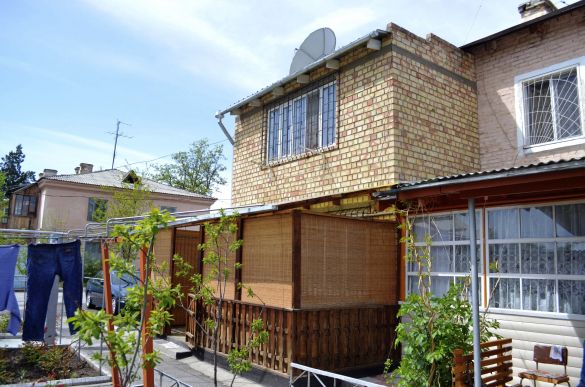
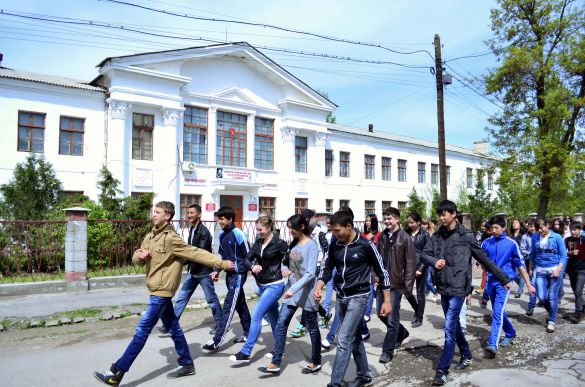
In Tokmok, they lived in a modest brick house before moving to a more spacious, two-story house opposite School No. 1 in the town center, where Tamerlan and his two sisters studied.
A school register shows Tamerlan’s date of birth — Oct. 21, 1986 — and the date when he entered the fifth grade, Jan. 18, 1999. He studied here for a year. Dzhokhar, born in 1993, was too young to go to school at the time.
“Yes, the Tsarnaevs studied here. I wouldn’t say they were anti-social or anything like that. No, I can’t say so,” said school director Lyubov Shulzhenko.
“The Chechen community here is so closely-knit and decent. We have never had problems with their children,” said Natalya Ryabovol, a physics teacher.
In the Soviet era, Tokmok hosted a busy base which trained military pilots for pro-Soviet countries stretching from eastern Europe to Africa. A Soviet-made jet fighter is perched on a pedestal at the town’s entrance.
Many of the townspeople today make a living by growing fruit and vegetables and tending cattle. The attack in Boston seems part of another world.
Kyrgyzstan, which borders China, is politically fragile after the toppling of two presidents since 2005. It says it cannot be held responsible for the brothers’ actions.
{A house in Tokmok where the Tsarnaev brothers, Dzhokhar and Tamerlan, lived before leaving for Dagestan.}
{Schoolchildren marching on Friday in front of a school where Tamerlan Tsarnaev studied in Tokmok.}