Equally still, Mukeshimana could stealthily deliver the narcotics to different clients in Gisenyi town and other neighbouring districts.
As the old saying goes, “a thief has only 40 days,” Mukeshimana’s days were also numbered. Her luck run out on Monday, May 30, when she was arrested in her home village of Kinyandaro, Gasiza Cell, Busasamana Sector in Rubavu District with 1,000 pellets of cannabis.
She had wrapped the narcotics around her waist and covered with clothes, a trick used by many drug traffickers.
“Mukeshimana had brought the narcotics days before from DRC and kept them in her house located in Kinyandaro village,” superintendent of Police (SP) Bonaventure Twizere Karekezi, the Police spokesperson for the Western region, said.
He added: “On Monday at about 10:45pm, as she was waiting for a motorcycle to transport her to Gisenyi town, residents got suspicious after they saw her alone in that darkness, so they called the Police at Busasamana station, which is located about 15 minutes drive from where Mukeshimana was standing.
Indeed, when searched, Police officers found 1,000 rolls of cannabis concealed in a polythene bag and wrapped on her stomach. She was arrested and handed over to RIB at Busasamana station.”
Rubavu is mapped as one of the main transit routes for drug traffickers from the DRC.
As such, Rwanda National Police (RNP), local authorities and other partners have strengthened operations and campaigns against one of the high impact crimes.
Over 1000kgs of cannabis seized in the last eight months, were disposed of in Rubavu District last week. At least 103 people were arrested with the disposed of substances, including 76 in Rubavu, 23 in Nyabihu and 4 in Ngororero.
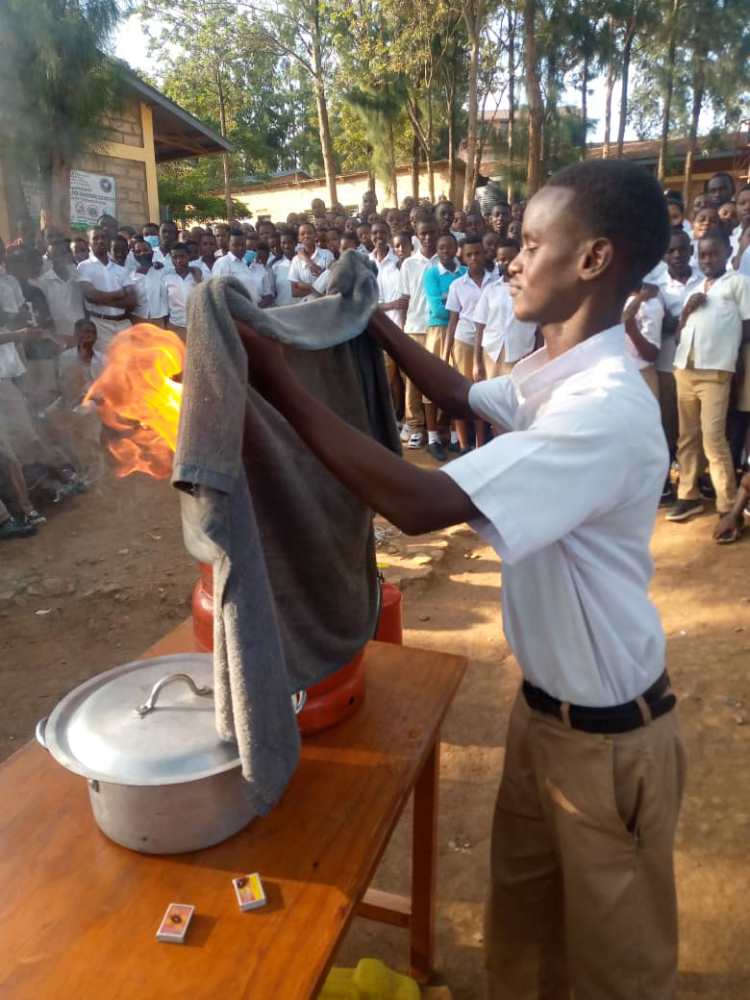
On Tuesday, the campaign launched in schools early May, was extended to about 1700 students and staff of ESSA Nyarugunga and G.S Remera Protestant both in Kicukiro District.
The outreach combines theory and practical sessions on the causes and components of fire, safer measures against fire and how to use different firefighting gadgets to put out fire.
The FRB team also inspected the school safety standards, which is also part of the campaign.
So far, the campaign has been extended to 11 schools in Kigali.
Assistant Commissioner of Police (ACP) Paul Gatambira, the commanding officer for FRB said that this week, the training will be extended students of St. Joseph in Nyamirambo, Nyarugenge District as well as St. Vicent Pallotti and G.S Kicukiro both in Kicukiro District.
Minister Biruta made the revelation on Tuesday 31st May 2022 during a press conference on the current situation of deteriorating relations with DRC.
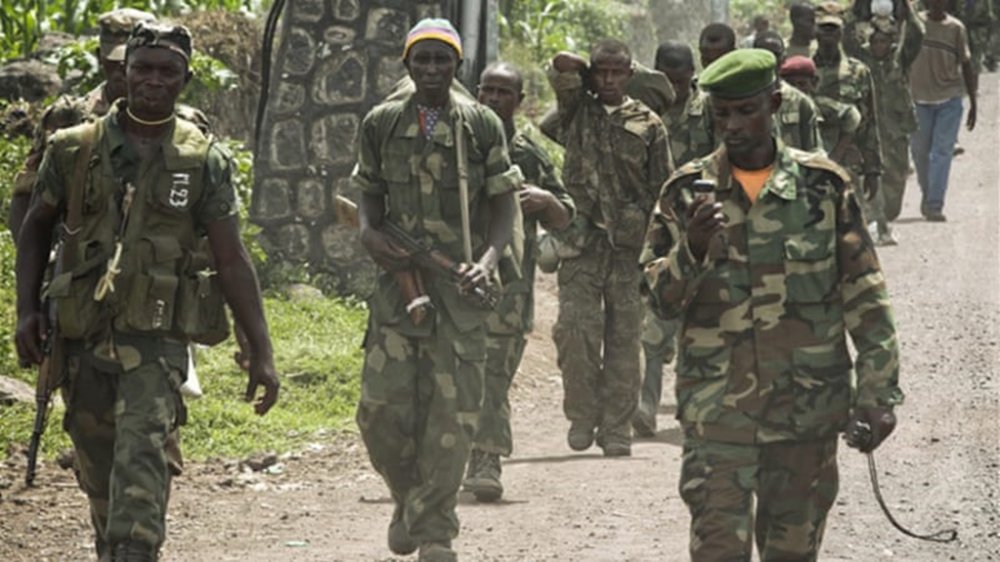
The press conference has been held amidst ongoing tension between Rwanda and DRC, where the latter accuses Rwanda of supporting M23 rebel outfit in clashes with Congolese Army (FARDC). Rwanda has however been maintaining that the allegations ‘are baseless’ and accused DRC of working with the Democratic Forces for the Liberation of Rwanda (FDLR).
Minister Biruta has said that Congolese Army first shelled Rwandan territory on 19th March 2022. At the time, the projectiles did not injure anyone.
“However, the recent incident on 23rd May 2022 saw several projectiles shelled on Rwandan territory in Burera and Musanze, destroying houses and injuring people,” he noted.
Minister Biruta said that he called his counterpart of DRC inquiring into what happened, but did neither apologize to Rwanda nor reassure that it won’t happen again.
Apart from shelling on Rwandan territory, DRC in collaboration with FDLR was recently reported to have kidnaped two Rwandan soldiers on patrol.
FDLR is rebel outfit comprised of remnant masterminds of the 1994 Genocide against Tutsi who at different times plotted hit-and-run attacks to Rwanda and repelled back.
Minister Biruta has talked about Rwanda’s possible reaction in case DRC’s provocations linger. He also disclosed that Rwanda won’t fold arms if DRC doesn’t stop its provocations.
“We have responsibilities to protect our citizens and country’s borderlines. A country defends itself against attacks. This means, if the issue persists, we cannot idly sit by and wait for repetitive shelling on our citizens every day or provocations to kidnap people anytime. It is among issues pointed out at the African Union Summit in Malabo. I clearly indicated that we have legitimacy to respond and defend ourselves, in case we are attacked,” he noted.
“We want such provocations to stop. We want these soldiers released. However, in case these attacks continue to threaten our country’s security, we would be legitimate to defend ourselves and you know that we have capacity,” Minister Biruta added.
The Deputy Spokesperson of the Government of Rwanda, Alain Mukuralinda has said that clashes with M23 rebel group is DRC’s internal matter that might continue to affect the country if no solution is reached.
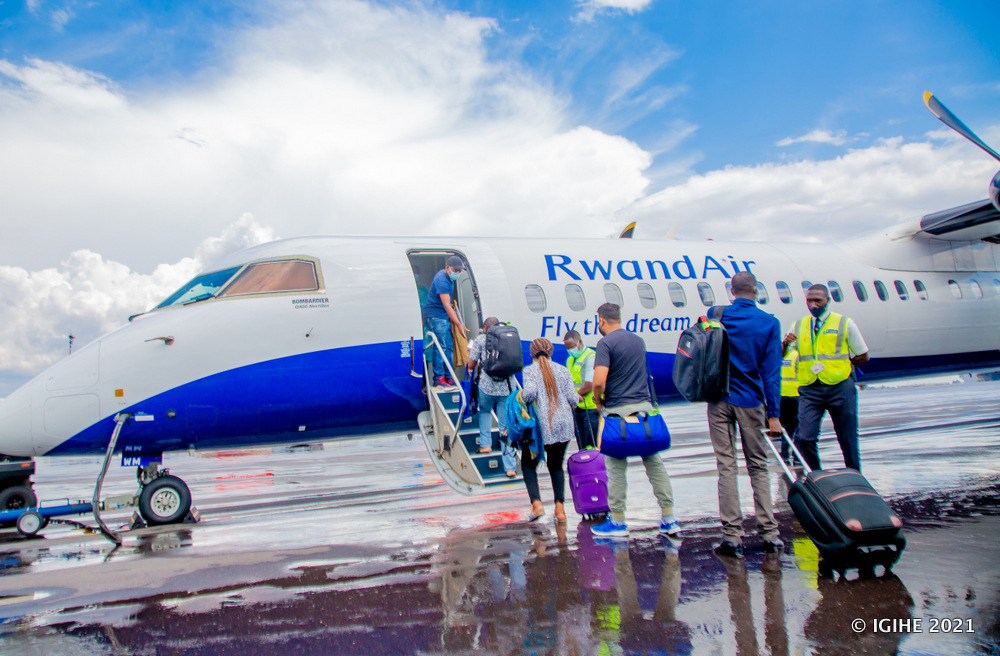
DRC announced the suspension of RwandAir flights on Saturday 28th May 2022 after accusing Rwanda of supporting M23 rebels in clashes with Congolese Army (FARDC).
Following the decision, RwandAir announced the suspension of flights to DRC and apologized to customers for any inconvenience it might cause.
Speaking to RBA, Dennis Karera, the Vice Chairman East African Business Council (EABC) said that the decision of barring RwandAir flights to DRC disrupts trade and free movement within the region.
“RwandAir mostly carry traders from Congo and other EAC or other countries like China and Dubai. Suspending its flights does not only affect Congolese but also blocks EAC traders seeking to travel to Kinshasa, Goma and Lubumbashi or other towns,” he said.
Karera has observed that the decision was inappropriate and taken in haste.
“It is not reasonable to suspend flights for any problem. We were in Goma and Bukavu last week to discuss with our counterparts and encourage them to join the council. We can only achieve it when traders are moving freely,” he noted.
“As far as we are concerned, the decision was reached hastily. We call upon DRC leadership not to rush for such decisions tampering with trade,” added Karera.
It has been two months since DRC was admitted into EAC.
Last week, FARDC in collaboration with the Democratic Forces for the Liberation of Rwanda (FDLR) shelled rockets on Rwanda’s territory which injured residents and destroyed houses in Musanze and Burera districts in Northern Province.
The shelling occurred when FARDC was accusing Rwanda of supporting M23 rebel group in eastern DRC.
Following the incident on Monday, Rwanda Defence Force (RDF) requested the regional Extended Joint Verification Mechanism (EJVM) to launch probe into the incident.
In the same week on Saturday 28th May 2022, RDF announced that Congolese Army with FDLR kidnapped two Rwandan soldiers on patrol.
Rwanda maintains that DRC’s allegations are baseless and called the clash with M23, ’an internal issue’.
[{{Related story: RwandAir flights to DRC suspended amidst escalating tension between both countries}}->https://en.igihe.com/news/article/rwandair-flights-to-drc-suspended-amidst-escalating-tension-between-both]
DRC announced the suspension of RwandAir flights on Saturday 28th May 2022. The latter has been conducting flights to Lubumbashi, Goma and Kinshasa.
Apart from the suspension, the country also summoned Rwanda’s ambassador, Vincent Karega to receive detailed explanations on the allegations.
The Minister of Communication and Government Spokesperson of the Democratic Republic of Congo Patrick Muyaya has announced that his country’s measures are meant to defend territorial integrity.
“The problems won’t deviate us from our choice of looking to the future […] the choice of peace for our country,” he said.
“We cannot close all doors for discussions but those seeking negotiations should come to us with sincerity,” added Muyaya.
Since the crisis broke out, Rwanda maintained that it does neither have troops on DRC’s land nor support M23.
Rwanda has also said that the issue of M23 and DRC is an internal matter of the country which has to be solved without dragging Rwanda into the problem.
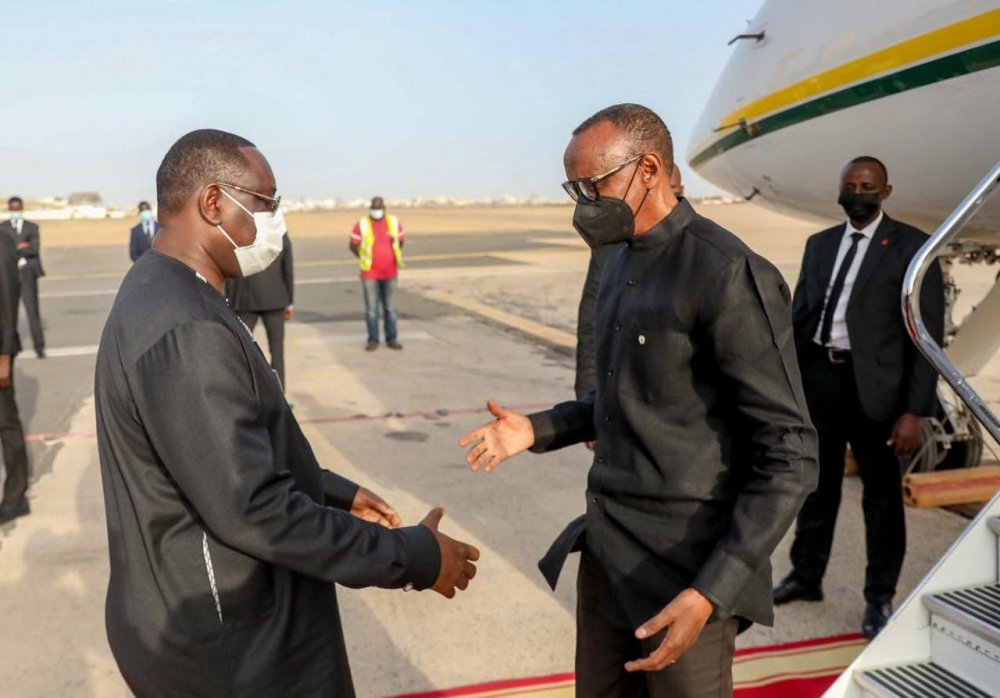
President Paul Kagame and Felix Tshisekedi of DRC yesterday held talks with their counterpart of Senegal, Macky Sall who also serves as the Chairperson of the African Union.
Maky Sall has revealed via Twitter handle that the discussions revolved around tension between Rwanda, DRC. He thanked Kagame and Tshisekedi after having a phone conversation with them to seek a solution to the problem.
Macky Sall has also requested the Angolan President, João Manuel Gonçalves Lourenço to follow up efforts to mediate the crisis between Rwanda and DRC.
Lourenço also serves as the chairperson of the International Conference for the Great Lakes Region (ICGLR).
[{{Related story: Fighting is not our option : Rwanda reassures citizens on relations with DRC}}->https://en.igihe.com/news/article/fighting-is-not-our-option-rwanda-reassures-citizens-on-relations-with-drc]
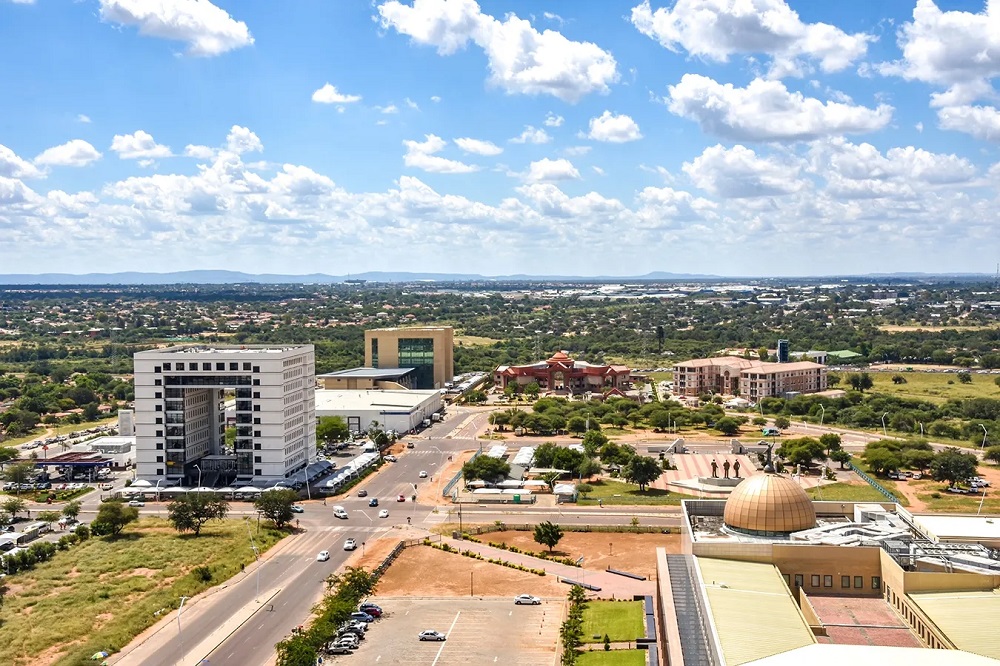
The country has a developed tourism sector with national parks covering 38% of its land area.
The latest population census in the country indicate that it has slightly more than 2 million sparsely populated people as 70% of the country is covered by Kalahari desert.
About 11.6 percent of the population lives in the capital and largest city, Gaborone wile the majority of its population is concentrated in in eastern part of the country.
The country was a colony of the British and held the name of Bechuanaland under the colonial rule. The name changed to Botswana in 1966 after obtaining Independence.
Botswana is also renowned for its strong democratic tradition. After gaining independence in 1966, the country has experienced more than four decades of uninterrupted civilian leadership and a consistent record of democratic elections.
Botswana was among African countries hit by poverty following its Independence in 1966 but rapidly transformed into an upper middle-income country, enabled by significant mineral wealth, good governance, prudent economic management, and a relatively small population.
It is among 12 African countries that achieved upper-middle income status including Gabon, Namibia, Ghana, Cape Verde, and South Africa.
The country’s Gross Domestic Product (GDP) amounts to US$18.3 billion with a per capita income of US$7 831.
Among others, the country’s currency (Botswana Pula- BWP) is among strongest ones in Africa where US$100 is exchanged for approximately 1210BWP.
Figures from the World Bank show that the livelihoods of Botswana’s population continue to improve overtime.
From 2002 to 2006, the number of people living on a daily per capita income below US$1.90 per day dropped from 29.8% to 16.1%.
Economic analysts show that the country owes its fast development to advanced agriculture, tourism and reducing inequalities among the poor and rich.
Other reasons include the presence of minerals including Diamond and Gold.
In 2020, Botswana’s exports hit US$4.58 billion becoming the 114th country with large scale exports.
These include Diamonds worth US$4 billion, Gold worth US$87.2 million among others, majority of which was exported to Belgium, USA, the United Arab Emirates, India, South Africa and Singapore.
{{Opportunities for Rwandan investors}}
During COVID-19 pandemic, Botswana faced economic shortfalls as the mining sector was not fully operational due to related restrictions yet the country’s economy heavily relies on minerals.
This pushed the country to expend much effort in other sectors of the economy to keep national development on track where agriculture and tourism were given priority.
To ensure the efforts yield good results, investors from Botswana toured different countries to explore avenues for collaboration with their counterparts.
In April 2022, the delegation from Botswana led by the Minister of Foreign Affairs, Lemogang Kwape and Keletsositse Olebire, the CEO at the Botswana Investment and Trade Center (BITC) visited Rwanda for the same cause.
At the time, Botswana business delegation had an opportunity to engage one on one with their Rwandan counterparts as well as undertake site visits to explore areas of collaboration.
Lemogang Kwape said that Rwandans have investment opportunities in his country.
He explained that Rwanda has developed its agriculture sector where Botswana can learn from Rwanda’s practices to reduce related imports.
“We are exploring how to collaborate with our counterparts so that we can exchange expertize to reduce agricultural imports and increase exports,” he said.
Lemogang added that tourism is among potential areas of collaboration.
He said that Rwanda and Botswana have developed tourism sector and stressed the need to create synergies to lure tourists from outside Africa to attractions fin respective countries.
The visit was concluded with the signing of Memorandum of Understanding (MoU) between Rwanda and Botswana in the areas of economy and investment.
Both countries also signed framework for cooperation agreements in the areas of mining among others.
The signed agreements open doors for Rwandans to explore investment opportunities available in the country.
Botswana has introduced different incentive programs to lure international investors where manufacturers, financial institutions and tech companies are taxed 15% on profits from approved operations.
Meanwhile, businesses in other sectors are charged 22% while the Value-added tax (VAT) is 12%.
Depending on negotiations, an international investor may be exempted from taxes between five and ten years while those with investments transforming communities’ livelihoods are not taxed on imports of raw materials. The same applies to the import of machinery to be used in these factories.
Investors also benefit from the country’s agreements for elimination of double taxation with South Africa, the United Kingdom, Sweden, Mauritius, India and Russia.
For Rwandans, it is an opportunity to export goods to countries of Southern African Development Community (SADC) with more than 300 million population.
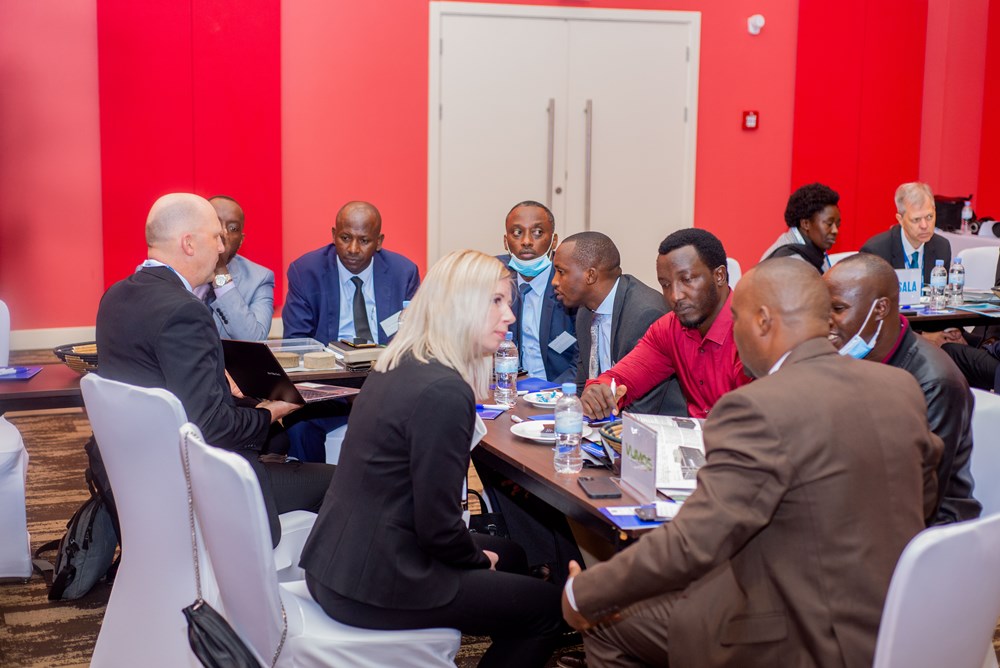
{The European Business Chamber in Rwanda, in partnership with Business Finland has organised its second business forum with a European delegation in 2022 where seven Finnish businesses are visiting Rwanda in connection with the opening of the country’s consulate.}
This follows a grant agreement between the European Union and EBCR signed earlier this month in order support the private sector-led growth of the Rwandan economy by connecting, informing, and representing the European linked businesses in Rwanda.
The Finnish delegation is headed by Ms. Nina Kopola, the Director General of Business Finland.
Speaking during the business Forum, EBCR’s Board President, Mr. Giovanni Davite said that “The organization is dedicated to support European investments in Rwanda and has already more than 100 members from various sectors including health, agri-rocessing, education, mining and construction. Our mandate is to support their effort to grow in the Rwandan market and to support a positive business climate where businesses can thrive”
EBCR experience to date has been overwhelmingly positive, with a good reception from the business community and from Government partners, who are keen on constructive dialogue with the private sector.
The development has been confirmed by Macky Sall through a message posted on Twitter handle where he revealed that the discussions were held over the phone to seek a solution to the issue.
“I thank President Felix Tshisekedi and Kagame for our phone conversations held yesterday and today with a view to seek a peaceful solution peaceful to the dispute between the DRC and Rwanda,” he tweeted on Monday 30th May 2022.
Macky Sall has also requested the Angolan President, João Manuel Gonçalves Lourenço to follow up efforts to mediate the crisis between Rwanda and DRC.
Lourenço also serves as the chairperson of the International Conference for the Great Lakes Region (ICGLR).
The tension broke out recently when DRC accused Rwanda of supporting M23 rebels in clashes with Congolese Army (FARDC). DRC also recently banned RwandAir flights to the country over the same allegations.
Apart from DRC’s accusations said to be unfounded, Rwanda announced that FARDC in collaboration with the Democratic Forces for the Liberation of Rwanda (FDLR) shelled rockets on Rwandan territory that left civilians injured and destroyed property.
FDLR is rebel outfit comprised of remnant masterminds of the 1994 Genocide against Tutsi who at different times plotted hit-and-run attacks to Rwanda and repelled back.
They were arrested in a coordinated operation conducted by Rwanda National Police (RNP), local leaders and members of other security organs, said Superintendent of Police (SP) Theobald Kanamugire, the Police spokesperson for the Southern region.
He identified those arrested as Emmanuel Ndayahoze, 32, who was found in possession of 13kgs of cassiterite; Claude Ngizwenayo, 28 (4kgs), as well as the trio of Simon Mugwiza, 29, Jonathan Kwizera, 20 and Emmery Dushimimana who were found with 3kgs, each.
“They were being suspected of selling minerals illegally. On Monday early morning, a search was conducted in their respective houses, where they 26kgs were recovered and suspects taken into custody,” SP Kanamugire said.
Such illegal mineral trade, he added, also influence malpractices in mining activities.
“Illegal mineral traders create also market for illegal miners and mineral thieves. These strengthened operations, are therefore, meant to fight all those illegal activities in mineral business,” said SP Kanamugire.
He warned against such unlawful acts and urged residents to report other people engaged in mineral business illegal.
The suspects and exhibits were handed over to RIB at Rukoma station for further investigations.
Article 54 of the law N° 58/2018 of 13/08/2018 on mining and quarry operations, states that; any person, who undertakes mineral or quarry exploration, exploitation, processing or trading without a licence, commits an offence.
Upon conviction, the offender is liable to imprisonment for a term of between two and six months and a fine of not less than Rwf1 million and not more than Rwf5 million or only one of these penalties.
The court also orders confiscation of any seized minerals or quarry in storage, trading or processing without a license.
Commenting on the financial results, Mr. Robin Bairstow, the CEO of I&M Bank (Rwanda) PLC said: “We have delivered a strong first quarter, built on the solid momentum of 2021 and ongoing execution of our iMara 2.0 strategy. A review of the results shows positive performances across key financial metrics.”
{{Financial performance review}}
{{Q1-2022 Income statement highlights (vs Q1-2021)}}
The strength of the bank’s performance was reflected in all profitability metrics, with return on equity (ROE) and return on asset (ROA) increasing to 12.14% and 1.61% respectively.
• The Bank has reported RWF 9.3 Billion in net revenue (before impairment provisions), up by 15% year-on-year, driven significantly by an increase in net interest income of 14%.
• Fees & Commission (net) were up by 4% year-on-year on the back of improved efficiencies and continued digital adoption. This has helped drive improvements in efficiency and customer satisfaction, with the Bank’s cost-to-income ratio capped at 59%. In the reported period, operating expenses increased by 9% year-on-year to RWF 5.5 Billion.
• As a result, Profit After Tax (PAT) for the first quarter of 2022 was RWF 1.9 Billion, up by 17% year-on-year.
{{Q1-2022 Balance sheet highlights (vs. Dec 2021)}}
The Bank’s balance sheet remains robust, with the non-performing loan ratio standing at 3.45%, in line with Dec-2021 levels.
• Loans & advances to customers (net) increased by 4% to RWF 231 Billion from RWF 222 Billion (December-2021). The growth was supported by new deals booked across all segments.
• Total financial investments increased to RWF 112.2 Billion, up by 23% from RWF 91.5 Billion reported at the end of December 2021, in line with the Bank’s strategy to efficiently deploy capital.
• Deposits held for customers and financial institutions were up by 10% to RWF 359 Billion (Rwf 327Billion- December 2021), resulting in a loan-to-deposit ratio of 64%. Borrowings position for the period were RWF 62 Billion. The liquidity coverage ratio was 528% as of the end of March 2022.
• The Bank remains well capitalized with Tier I capital adequacy ratio of 17.54% and Tier II ratio of 20.16%.
{{Financial & Business performance review}}
Speaking on the Q1 2022 performance, Mr. Robin Bairstow – CEO of I&M Bank (Rwanda) Plc – said, “The bank’s strong performance was driven by an activity rebound in the economy, with growth noted both on our loans & advances and our deposit liabilities, which led to solid growth in net interest income and net fee income.
In the reported period, our customer base was up by 24% year-on-year, with the highlight being our MSME segment with year-on-year customer growth of 70%.
We remained anchored around delivering value and excellence in service to our customers. Our investments in state-of-art digital platforms delivered where we have noted a constant in digital services adoption with 75% of all customer-initiated transactions go through our digital channels.”
He further added: “As business activities pick up across the country, we remain resolute to the core purpose of our brand “We are on your side” and in our commitment to support the country’s economic recovery.”
{{ABOUT I&M BANK (RWANDA) PLC}}
Incorporated in 1963, I&M Bank (Rwanda) Plc is the oldest Bank in Rwanda. It is today one of the leading players in the industry with a strong footprint across the country.
I&M Bank Rwanda offers the full range of personal, business, institutional and corporate banking products throughout its locations. The Bank has been listed on the Rwanda Stock Exchange since March 2017.
The Bank is also a subsidiary of I&M Group PLC, a leading regional financial services group in Eastern Africa with a presence in Kenya, Tanzania, and Uganda as well as a joint venture in Mauritius. I&M Group has a long history in banking and has established a wide network of correspondent banks across the globe and enjoys a strong relationship with leading international Development Financial Institutions.