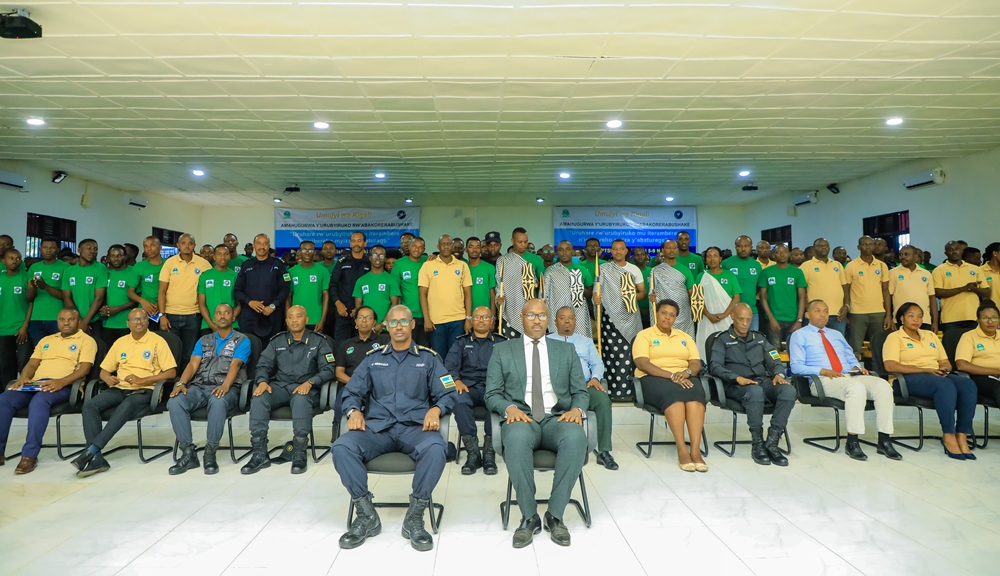
The closing of the training was presided over by the Inspector General of Police (IGP) Dan Munyuza alongside the Mayor of City of Kigali, Pudence Rubingisa.
IGP Munyuza emphasized the role of the young people in security and community development and challenged them to live up to their expectations.
“You are partners in security and we thank you for your spirit and responsiveness in all aspects of security to further make your country safer for all,” IGP Munyuza told the youth.
He urged them to engage in individual development programmes, be defined by Rwandan values, discipline and to always feel proud in fighting and defending the image of their country.
The IGP asked the youth to refrain from drunkenness, fight any unlawful practices such as theft, drug trafficking, sell and abuse; and corruption.
He further appealed to them to actively fight all environmental degradation practices, be hygienic and to support security and development activities in their communities.
The youth volunteers group, which currently has close to 500,000 members across the country, was formed in 2013 particularly to drive the national security and development agenda.
Mayor Rubingisa thanked the youth for their spirit of volunteerism but urged them to be innovative.
“You have the ability to create change in your families and communities; utilize that advantage and have one voice,” the Mayor said.
During the five-day training, the youth were enlightened on job creation, community policing, patriotism, fighting crimes such as narcotic drugs and psychotropic substances, and theft.
At the end of their training, the youth adopted at least 23 resolutions, all related to supporting security and community social development.
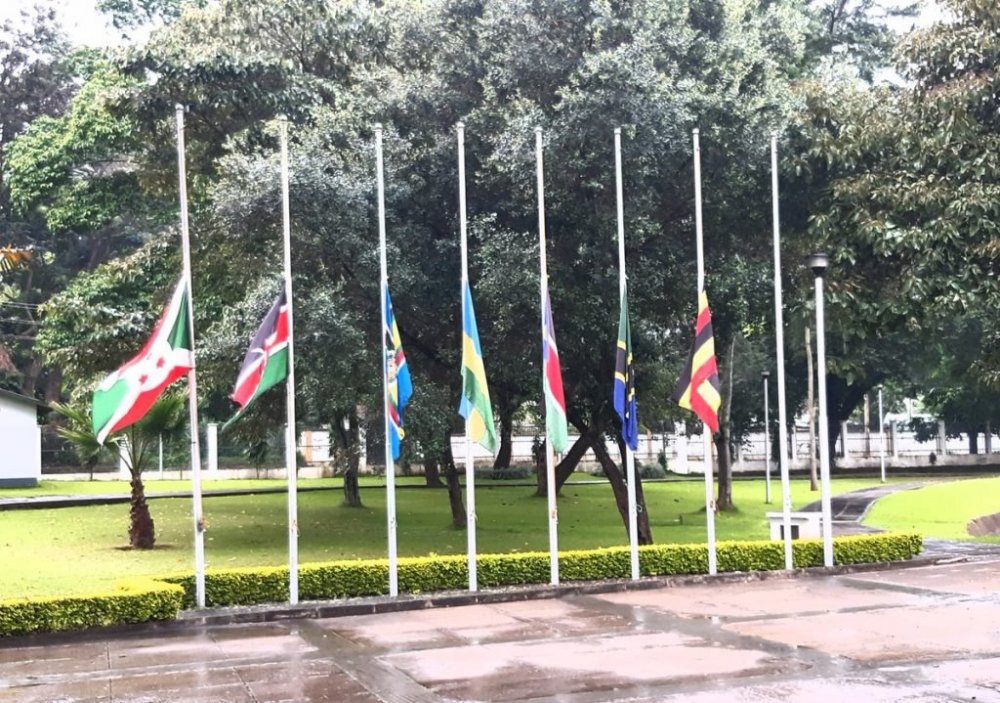
The national mourning has been announced in a statement released by the Office of Prime Minister signed by Premier, Dr. Edouard Ngirente.
“Upon the passing of her Majesty Queen Elizabeth II, the President of the Republic, His Excellency Paul Kagame has instructed that the National Flag and the Flag of the East African Community, on Rwandan territory, be flown at half-mast from today, 9 September 2022, until the conclusion of the State Funeral Service for Her Majesty,” reads the statement.
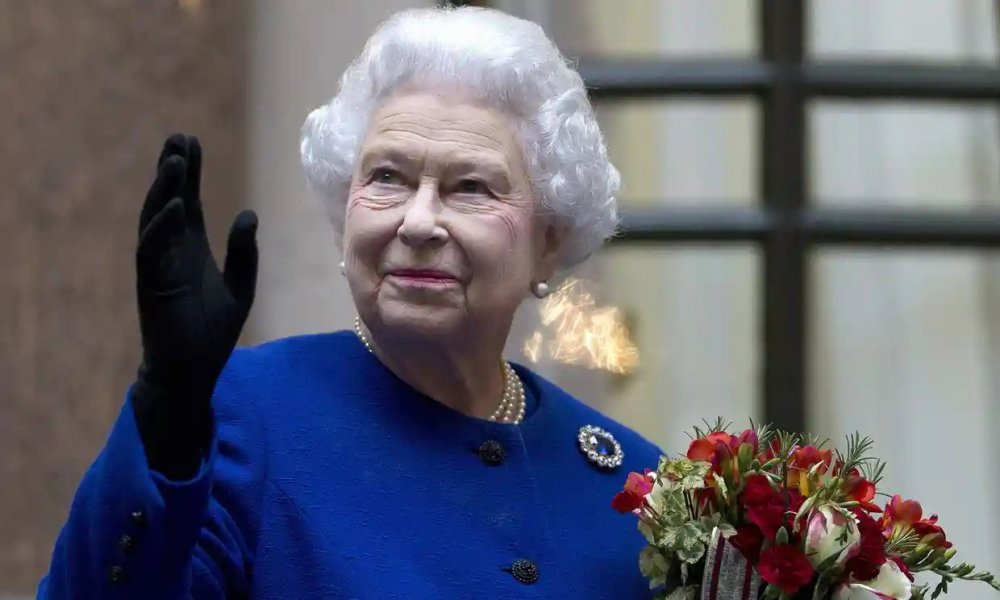
Queen Elizabeth II died on Thursday 8th September 2022. Earlier in the day, Buckingham Palace had said the monarch was under medical supervision due to doctors’ concerns over her health.
She is Britain’s longest-reigning monarch in history.
Born on April 21, 1926, Elizabeth II was proclaimed Queen after the death of her father, King George VI, on Feb 6, 1952. She was formally crowned the monarch of the United Kingdom on June 2, 1953.
She was considered “a beacon of hope” for the nation as she used her annual Christmas speeches, televised since 1957, to rally the nation in times of hardship.
In total, the Queen greeted 15 prime ministers during her long reign, including Winston Churchill, her first, and Truss, her last.
Her husband, Prince Philip, died at the age of 99 in April 2021.
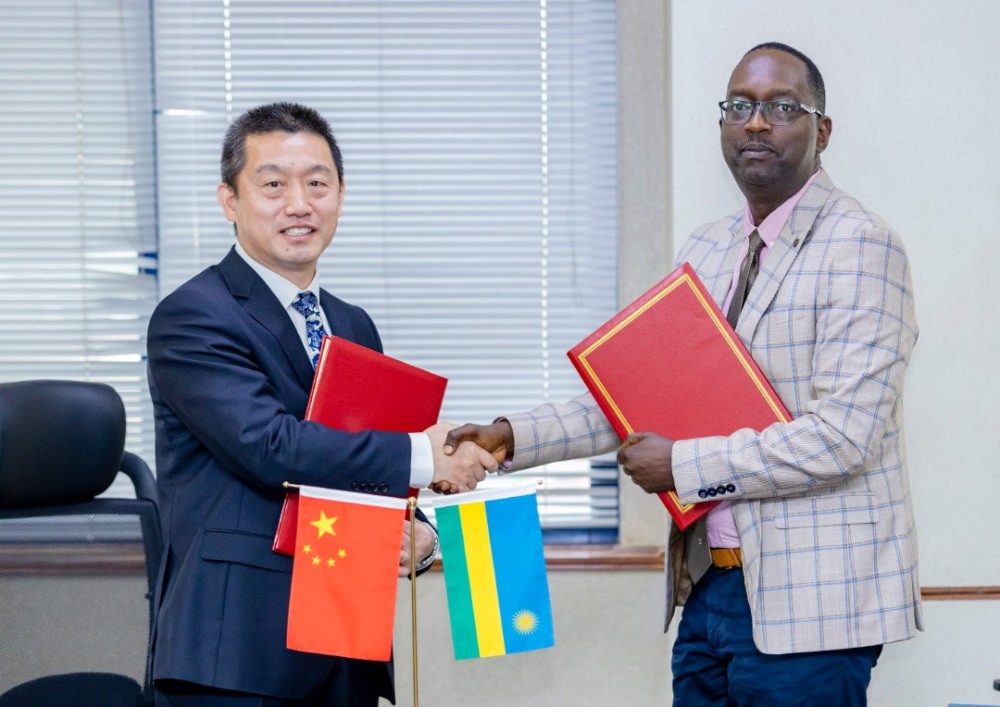
“We are expecting doctors from some fields where we have some gaps in terms of specialists. We appreciate this partnership. After 40 years of medical cooperation between the Rwandan government and China, today we are expanding this agreement for another five years because we appreciate the services of those doctors so far in the country,” Dr. Daniel Ngamije, Rwandan Health Minister, said at the signing ceremony on Wednesday 7th September 2022.
The doctors will be working in Masaka Hospital in Kigali and Kibungo Hospital in eastern Rwanda.
Chinese Ambassador to Rwanda, Wang Xuekun said that China and Rwanda enjoy a long-lasting friendship, and cooperation in the fields of medical and health care demonstrates the two countries’ deep traditional friendship of sharing weal and woe, through thick and thin.
“The Chinese government sent the first Chinese medical team to Rwanda in 1982. Over the last 40 years, 22 medical teams and more than 270 Chinese doctors received up to hundreds of thousands of patients and performed more than 10,000 surgical operations in Rwanda,” Wang said.
He added China is willing to join hands and work together with Rwanda, to further deepen cooperation on medical and health care matters and lift their ties to a new height in the post-pandemic era.
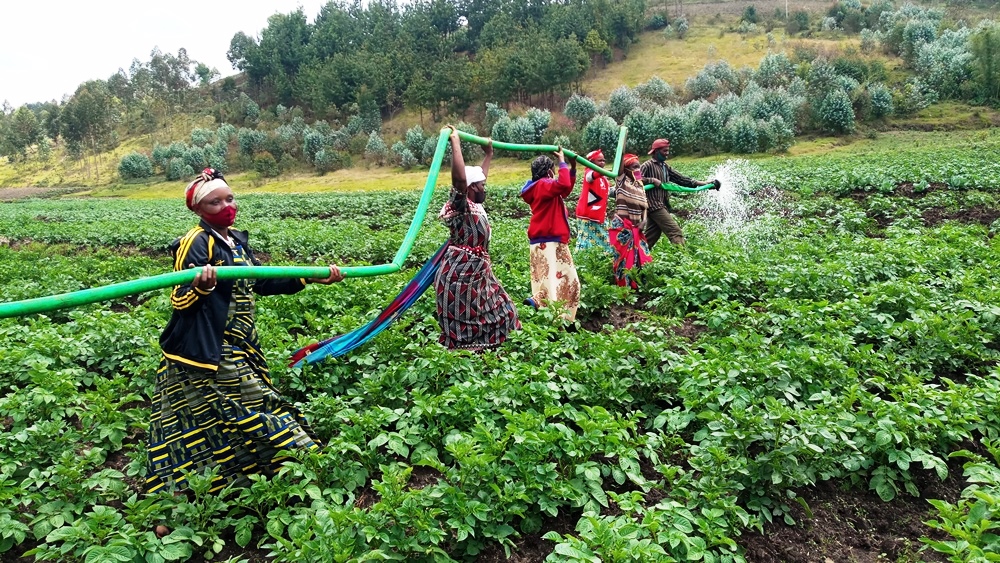
AGRA’s new strategy is a response to recent global and African catastrophes including famine, COVID-19, drought, fall army worm, climate change, soaring food, fertilizer and energy prices, and the conflict in Ukraine. These events have created a truly urgent need for rapid strengthening of food systems and accelerated transformation of agriculture.
The new strategy will build on AGRA’s achievements to date, and crucially the lessons it has learned with its partners.
In the strategic period 2017-21, AGRA’s direct contributions have seen 11 million farmers reached directly, 26 million farmers reached through policy, state capability and partnerships work.
It has also facilitated 42 policy reforms, supported 11 national flagships and catalyzed US$1.4 billion in investment. Among others; 33,000 village-based advisors were trained, 75% of AGRA farmers adopted fertilizer use, 48% of AGRA farmers adopted improved seed while 60% adopted post harvest practices.
Despite the progress, Africa’s food systems urgently need further radical transformation. Many countries still struggle to achieve food security and provide diverse, nutritious choices for their populations. Supply chains that bring food to markets are often long and fragmented, leading to significant waste and higher costs for consumers. This is exacerbated by climate change and environmental degradation that threatens livelihoods, biodiversity and sustainability across much of the continent’s agricultural sector.
Speaking at the launch of the strategy; AGRA’s President, Dr. Agnes Kalibata disclosed that the new strategy will help to do more for farmers.
“We have demonstrated that when farmers have access to choices of inputs and when those inputs give a clear yield differential farmers adopt and their lives change. We have also seen that this only happens sustainably when markets are available to farmers” she said.
“Our new strategy therefore will see us do more of what works for farmers and will see us trying to understand markets better. In all this we must bring more youth, more nutrition and be smarter in use of environmental resources,” added Dr. Kalibata.
AGRA’s new strategy, which will run from 2023 to 2027 at a cost of US$550 million, concentrates on key areas of work from the last strategy, including seed system development, government engagement and expands AGRA’s work in sustainable farming and markets and trade, and focuses on three critical areas of change mainly: climate change, gender, youth and inclusion work, and transforming African diets.
{{Overview of focus areas and targets}}
{{Working with smallholder farmers: }} AGRA will aim to reach 28 million farmers in 15 countries to enable their full participation in sustainably growing Africa’s food systems.
{{Developing seed systems:}} AGRA seeks to build on the ten countries where it has strengthened seed systems to ensure farmers gain access to affordable, productive, climate and pest resistant seeds.
{{Sustainable farming:}} AGRA has set a goal of 30 percent of targeted farmers to adopt sustainable farming practices that build livelihoods today, and protect the environment for tomorrow.
{{Inclusive markets and trade:}} AGRA plans to invest US$300 million through its platforms to enhance market competitiveness for farmers, while bringing nutritious food to consumers.
{{Policy and state capability:}} AGRA will support 12 countries to develop strategies and investment plans for food system transformation pathways, that create an environment where farming businesses thrive.
{{Inclusivity:}} AGRA’s new strategy will see a 25 percent increase in funding for women-led SMEs, which will create new opportunities for women and youth to thrive in farming.
{{Nutrition:}} AGRA’s new strategy aims to support targeted farmers to adopt improved varieties including climate smart and nutrient dense varieties, to provide affordable, diverse, and nutritious diets for consumers.
{{Climate adaptation:}} AGRA aims to help 40% of targeted farmers to adopt varieties including climate smart and nutrient dense varieties.
The new Strategy also speaks to the need for businesses to recognize growth opportunities and have the confidence, financing, and capabilities to serve farmers, trade produce, and process food profitably.
Government representatives, NGOs, companies, small holder farmers, traders and all those involved in the growing, processing and distribution of food in Africa gathered in Kigali this week at the annual summit of the AGRF from 5th to 9th September 2022.
The former Ethiopian Prime Minister, Hailemariam Dessalegn who serves as AGRA’s Board Chair explained that AGRA is a proudly African institution noting that food systems need to be built on solid foundations to achieve sustainable and inclusive work.
“Together in partnership, we can transform our agriculture; protect our environment; create equitable prosperity; and feed our communities and families,” he said.
{{About AGRA}}
Established in 2006, AGRA is an African-led and Africa-based institution that puts smallholder farmers at the center of the continent’s growing economy by transforming agriculture from a solitary struggle to survive into farming as a business that thrives.
In collaboration with partners, AGRA catalyzes and sustains an inclusive agricultural transformation to increase incomes and improve food security in 11 countries.
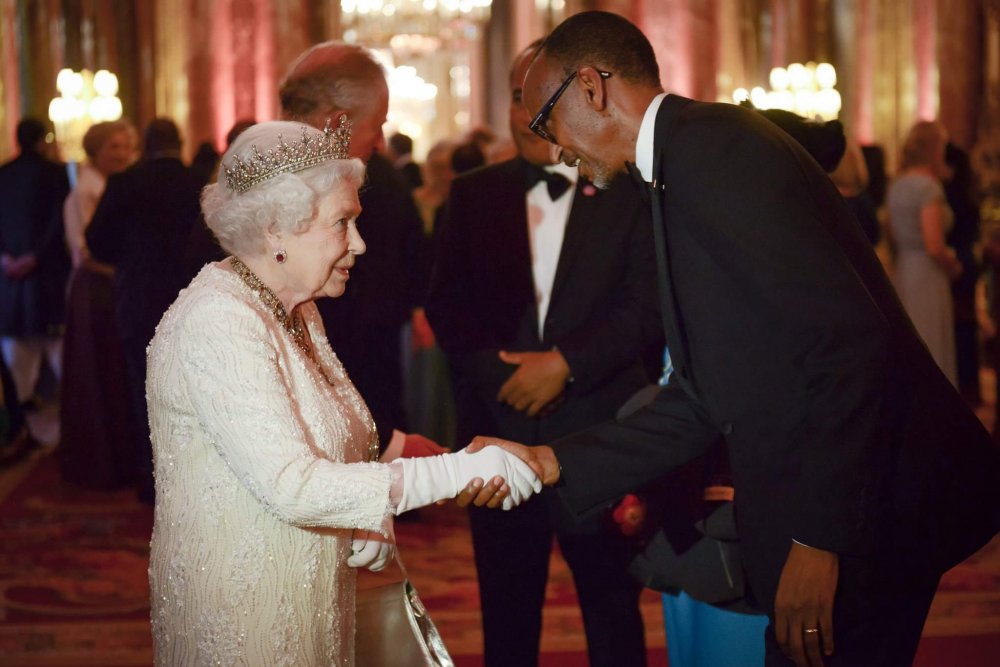
“In this moment of sorrow at the passing of Her Majesty Queen Elizabeth II, we recall her 70 years of stewardship of the Commonwealth of Nations. The modern Commonwealth is her legacy,” he tweeted.
“I extend my deepest condolences to His Majesty the King, Her Majesty the Queen Consort, and the entire Royal Family, as well as the people of the United Kingdom and the Commonwealth,” added Kagame.
President Kagame is the current Commonwealth Chair-in-Office for two-year term.
He replaced the former UK Prime Minister, Boris Johnson in June this year.
Queen Elizabeth II died two days after she appointed Liz Truss as Britain’s new prime minister, succeeding Boris Johnson.
Following her passing, Prince Charles immediately became Britain’s new King.
Queen Elizabeth II is Britain’s longest-reigning monarch in history.
Born on April 21, 1926, Elizabeth II was proclaimed Queen after the death of her father, King George VI, on Feb 6, 1952. She was formally crowned the monarch of the United Kingdom on June 2, 1953.
She was considered “a beacon of hope” for the nation as she used her annual Christmas speeches, televised since 1957, to rally the nation in times of hardship.
In total, the Queen greeted 15 prime ministers during her long reign, including Winston Churchill, her first, and Truss, her last.
Her husband, Prince Philip, died at the age of 99 in April 2021.
Residents were further called upon to strengthen the community policing partnership to fight these unlawful practices, which are still common in some parts of the district.
On Wednesday, September 7, Police and local authorities in Ngororero arrested two people after they were found conducting illegal mining in Gishwati National Park.
The suspects were caught red-handed mining coltan with traditional tools, in Mwiyanike Village, Rugeshi Cell of Kavumu Sector.
The Western Region Political and Civic Education Officer (RPCEO), Chief Inspector of Police (CIP) Mucyo Rukundo identified the suspects as Jean Damascene Rwihandagaza, 45, and Jean Pierre Munyentwari, 36.
“Police had prior information that there are groups of people that conduct illegal mining in Gishwati National Park. On Wednesday at about 4pm, we received a call from a resident that two people with traditional tools were mining in the side of park located in Mwiyanike village. An operation was conducted and the suspects were apprehended red-handed,” said CIP Rukundo.
He added: “Their practices were not only illegal but were also destroying the protected forest as well. They were cutting trees and digging holes inside the forest, which is also an act of environmental degradation.”
The suspects were handed over to RIB at Kavumu station for further investigations.
Article 72 of the Law N° 064/2021 of 14/10/2021 governing biological diversity provides that without prejudice to provisions of other laws, a natural person who undertakes minerals exploration activities or exploits mines or quarries in a protected area, commits an offence.
Upon conviction, he or she is liable to a term of imprisonment of not less than one (1) year but not more than three (3) years and a fine of more than Rwf5 million and not more than Rwf7 million.
If the offence referred to in Paragraph One of this Article is committed in a national park or a strict nature reserve, the penalty is a term of imprisonment of not less than three (3) years but not more than five (5) years and a fine of more than Rwf7 million but not more than Rwf10 million.
“The Queen died peacefully at Balmoral this afternoon,” Buckingham Palace said in a statement.
“The King and The Queen Consort will remain at Balmoral this evening and will return to London tomorrow,” it added, indicating her son, Prince Charles, has now become Britain’s new King.
Earlier in the day, Buckingham Palace said the monarch was under medical supervision due to doctors’ concerns over her health. The royal family members soon rushed to Scotland to be at her side following the announcement.
“The death of my beloved Mother, Her Majesty The Queen, is a moment of the greatest sadness for me and all members of my family,” King Charles said in a statement.
“We mourn profoundly the passing of a cherished Sovereign and a much-loved Mother. I know her loss will be deeply felt throughout the country, the Realms and the Commonwealth, and by countless people around the world,” it added.
Queen Elizabeth II died two days after she appointed Liz Truss as Britain’s new prime minister, succeeding Boris Johnson.
The monarch made fewer public appearances in recent months due to mobility issues after recovering from COVID-19 in February. During the four-day nationwide celebration in early June to mark her 70 years on the throne, she made two brief appearances only on the balcony of Buckingham Palace.
After the announcement of the Queen’s death, thousands of people gathered outside Buckingham Palace in London despite the rain to pay tribute. Local media said Britain will enter an official 10-day period of mourning beginning Friday. There has been an outpouring of condolences from politicians and governments following the Queen’s passing.
“Queen Elizabeth II was the rock on which modern Britain was built. Our country has grown and flourished under her reign. In the difficult days ahead, we will come together with our friends across the United Kingdom, the Commonwealth and the world to celebrate her extraordinary lifetime of service. It is a day of great loss, but Queen Elizabeth II leaves a great legacy,” Truss said in a statement.
“We mourn the death of Queen Elizabeth II. she was a role model and inspiration for millions, also in Germany. Her commitment to German-British reconciliation after the horrors of World War II will remain unforgotten,” German Chancellor Olaf Scholz tweeted.
“Queen Elizabeth II has just passed away. An Elizabethan era is coming to an end. The United Kingdom forever bears the seal of the one who embodied it for seventy years with unalterable strength and moral authority. France pays tribute to the woman who marked the history of her country, our continent and her century,” France’s Elysee Palace said in a statement.
Born on April 21, 1926, Elizabeth II was proclaimed Queen after the death of her father, King George VI, on Feb. 6, 1952. She was formally crowned the monarch of the United Kingdom on June 2, 1953.
She was considered “a beacon of hope” for the nation as she used her annual Christmas speeches, televised since 1957, to rally the nation in times of hardship.
In total, the Queen greeted 15 prime ministers during her long reign, including Winston Churchill, her first, and Truss, her last.
Her husband, Prince Philip, died at the age of 99 in April 2021.
The Queen traveled to China in 1986, the first British monarch in history to do so.
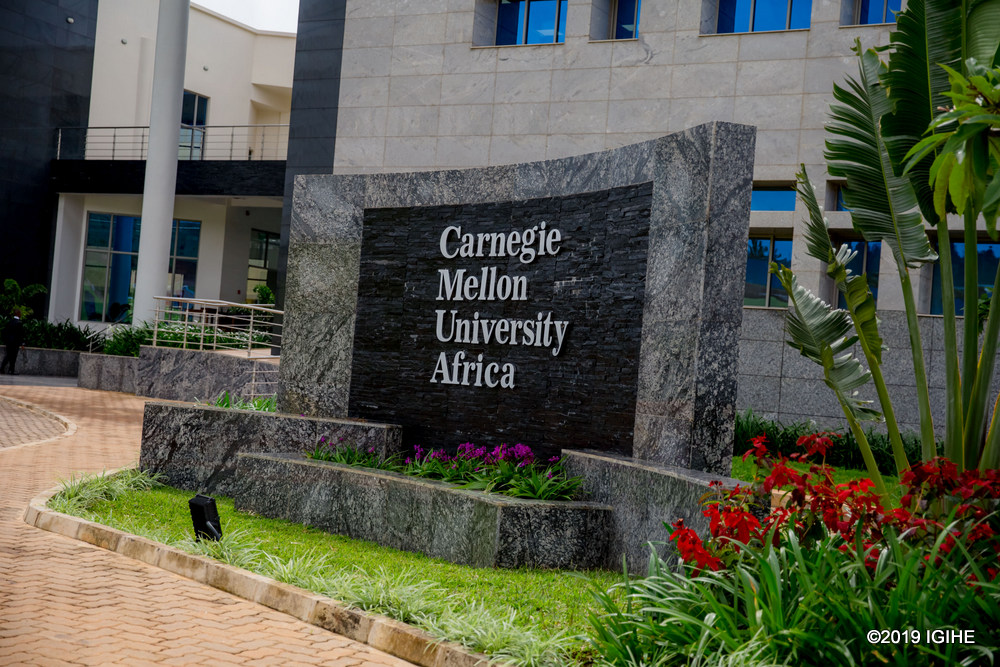
The US$275.7 million partnership with the Mastercard Foundation will significantly expand advanced engineering and technology education at CMU-Africa in Kigali. The investment from the Foundation includes a US$175M endowment to perpetually fund CMU-Africa. It also includes US$100.7M to establish CMU-Africa’s Center for the Inclusive Digital Transformation of Africa.
Specifically, through this historic partnership with the Mastercard Foundation, CMU-Africa will:
-* Expand instructional capacity, including introducing a new degree in engineering artificial intelligence, and online learning programs.
-* Grow the annual cohort of students enrolling in CMU-Africa by more than 33%.
-* Provide additional financial assistance to more CMU-Africa students, including increased support for the Mastercard Foundation Scholars Program at CMU-Africa.
-* The partnership will provide direct scholarship support to a total of 300 students.
-* Ensure programs recruit and provide opportunities for marginalized groups, including women, people with disabilities, and displaced people.
-* Pilot programs for English language immersion to help prepare undergraduate students from other African universities for graduate study.
The new partnership will also strengthen Africa’s research, entrepreneurship, and innovation ecosystem more broadly by:
-* Establishing a network of higher education institutions in Africa that will work with the private sector and governments to create the conditions for inclusive digital transformation.
-* Supporting up to 10 African universities to deliver high-quality engineering and technology education.
-* Increasing digital knowledge creation to drive technology development and job-creating innovation through training, seed funding, and collaboration opportunities for researchers at CMU-Africa and other partner universities.
Directly involving faculty and staff from CMU-Pittsburgh in CMU-Africa activities to innovate in education and help create the knowledge needed to drive the inclusive digital transformation of Africa in fields that include agriculture, health, and finance, among others.
Through these various pillars of the partnership, a total of 10,000 young people will gain the skills to compete in the global marketplace, innovate, design new tools that solve regional and global challenges, and bring those tools to market.
Carnegie Mellon is the only U.S. research university with master’s degree programs and full-time faculty, staff, and operations on the continent. CMU-Africa was established in 2011 through a partnership between Carnegie Mellon University and the Government of Rwanda. Through the strategic collaboration and generous support of the Government of Rwanda and the Rwandan people, CMU-Africa has built a strong educational platform that serves the continent.
“The key to creating opportunities for promising African students from all socioeconomic backgrounds is access to education in the high-tech fields that are driving the economies of the future,” said Farnam Jahanian, the president of Carnegie Mellon University. “We are grateful to the Mastercard Foundation for their partnership with CMU over the past six years to help empower the next generation of Africa’s leaders, and we are delighted to be expanding our partnership even further. With this new collaboration, we will accelerate our shared mission and provide life-changing educational and career experiences for students across the continent.”
Africa has the youngest and fastest-growing population in the world. By 2030, there will be 375 million young people in the job market in Africa, and that number is expected to grow to more than a billion people within the next few decades. Young people in Africa represent the workforce of tomorrow and can serve as a force for Africa’s transformation if they have the skills and knowledge to participate in and build the economies of the future.
“Mastercard Foundation Scholars and graduates from this program will be at the forefront of creating technologies and companies that will generate jobs and enhance Africa’s economic competitiveness. We are excited that this initiative will strengthen the role of African universities in developing the continent’s scientists, innovators, and problem-solvers as well as generating knowledge that will benefit society more broadly,” said Reeta Roy, the president and CEO of the Mastercard Foundation.
The new initiative builds on a previous partnership between the Mastercard Foundation and Carnegie Mellon University, as well as a successful 10-year partnership between the Government of Rwanda and CMU-Africa that has connected 561 young people from 21 African countries to world-class training—including 125 students supported through the Mastercard Foundation Scholars Program.
“The strategic partnership with Carnegie Mellon University is one of the Government of Rwanda’s key investments to support the development of a critical mass of skills in science and technology, particularly in ICT, required by the knowledge economy and to help accelerate Rwanda’s and the region’s socioeconomic transformation. We express our sincere appreciation to the Mastercard Foundation for their significant support, which will help Rwanda realize its vision for the future in establishing the Regional Center of Excellence in Rwanda (CMU-Africa) and ensure the sustainability of the program. The Regional Center of Excellence, coupled with other important strategies will help ensure that we are part of, and benefit from, the global digital revolution,” said Valentine Uwamariya, Rwanda’s Minister of Education.
CMU-Africa offers graduate degrees in information technology, electrical and computer engineering, and engineering artificial intelligence through Carnegie Mellon’s top-ranked College of Engineering, with the same standards, curricula, and requirements as its Pittsburgh campus. As of spring 2022, the program enrolled over 230 students representing 21 African countries.
“The Mastercard Foundation’s support will enable us to accelerate our Africa strategy, which is uniquely defined to prepare higher education students to meet the complex needs of the digital future along with the research and entrepreneurship necessary to compete in the global economy,” said William Sanders, dean of the College of Engineering.
CMU-Africa’s impact includes a close to 90% employment rate within the first year of graduation. Its alumni have founded or joined startup companies, are pursuing their Ph.D.’s in top doctoral programs in the U.S. and Europe, and are serving in government information offices, including within the Government of Rwanda and the World Bank.
“The Mastercard Foundation has been a critical partner in the growth of CMU-Africa as we help meet the growing demand for high-quality technical talent who will accelerate development on the continent,” said Allen Robinson, director of CMU-Africa and associate dean for international programs in Africa. “This new, extraordinary phase of our relationship will exponentially magnify our ability to build a pan-African network that positively impacts the future of young people across the continent.”
{{About the Mastercard Foundation}}
The Mastercard Foundation works with visionary organizations to enable young people in Africa and in Indigenous communities in Canada to access dignified and fulfilling work. It is one of the largest, private foundations in the world with a mission to advance learning and promote financial inclusion to create an inclusive and equitable world. The Foundation was created by Mastercard in 2006 as an independent organization with its own Board of Directors and management.
{{About Carnegie Mellon University}}
[{{Carnegie Mellon}}->http://cmu.edu/] is a private, internationally ranked research university with acclaimed programs spanning the sciences, engineering, technology, business, public policy, humanities, and the arts. Its diverse community of scholars, researchers, creators, and innovators is driven to make real-world impacts that benefit people across the globe.
Witnesses have told Radio 10 that Suzanne Mukarwego was the first to see the grenades and rushed to alert local leaders.
The Executive Secretary of Mwendo Sector, Floribert Muhire has confirmed the presence of the grenades noting that the area was demarcated lest nearby residents are affected.
Muhire also disclosed, by press time, that security officials were alerted pending further action.