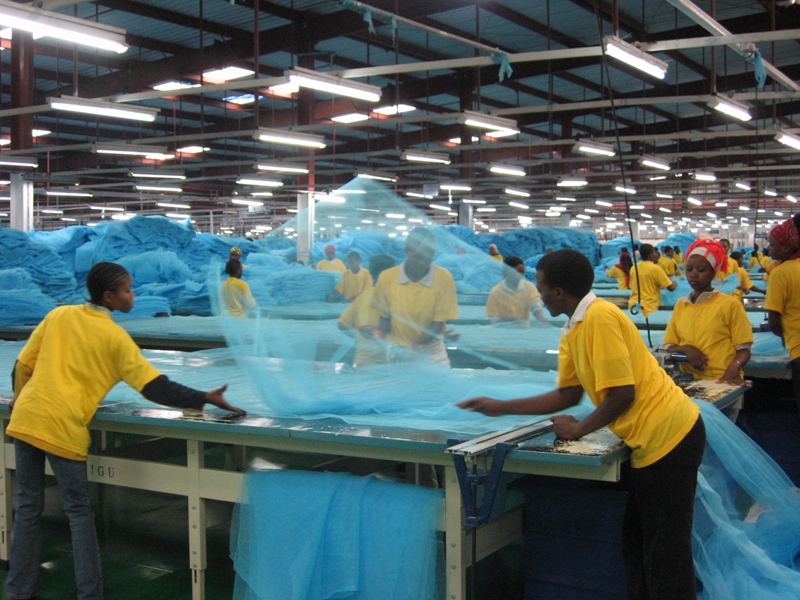
{Rwanda is among countries committed to reduce the number of malaria deaths through prevention mechanisms including the mobilization of citizens to use mosquito nets among other strategies.}
The government of Rwanda has revealed a plan to launch an industry manufacturing mosquito nets inside the country as a move to cut prices spent on mosquito nets imports.
In an interview with IGIHE, Ruzibiza Alex the Director General in charge of Industry SMEs Development at MINICOM said that establishing a mosquito net manufacturing plant is embedded in the government’s wide plan of promoting local products to cut imports expenses.
“It is a general idea going beyond the manufacture of mosquito nets since we want to develop other Made in Rwanda products like construction materials among others. There is no need to keep importing products that we would be able to make in Rwanda,” he said.
He explained that they are seeking through announcements an investor equipped with all requirements who can partner with Rwanda to build the mosquito net industry within a short time.
Ruzibiza assures that the construction of the mosquito net plant has no correlation with Malaria increase adding that the introduction of this plant anticipates increased job opportunities among Rwandans.
The study undertaken by MINICOM indicated that from 2009 to 2013 Rwanda released USD 18,000,000 million on yearly mosquito nets imports.
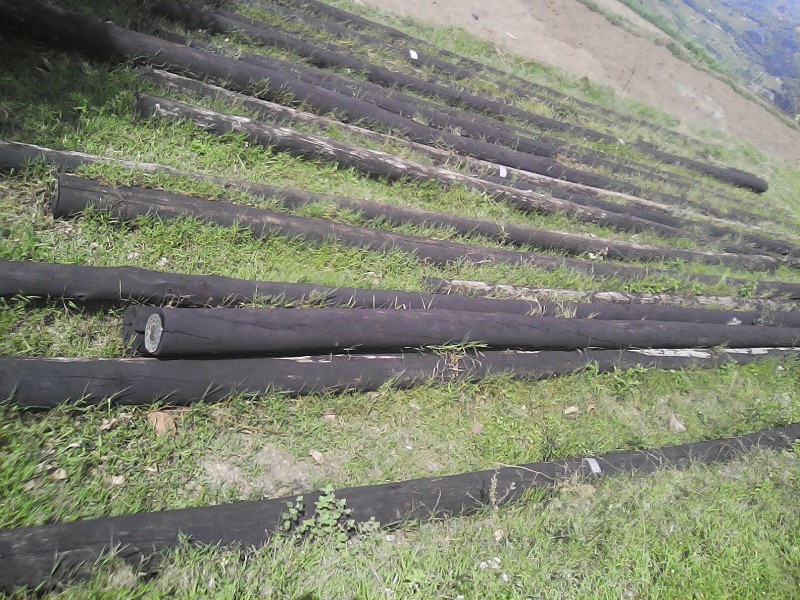
{Residents of various villages of Karihira, Mayanjye and Nyirabadodo from Kageyo sector of Gicumbi district say that it is three years since Rwanda Energy Group took electricity poles in their vicinities, laid them in heaps but have not yet got electricit}y.
Residents in villages in the vicinity of Gicumbi town say the electricity poles are laid alongside roads and are starting to get wasted since they have been covered by small bushes while small insects continue to gnaw onto them.
“These electricity posts may be stolen. They have been laid alongside roads for long. We have carried these posts from Kageyo road where the truck deposited them hoping to connect electricity to the network. We are disappointed. You can see how they are covered by grasses over staying by road sides for long,” said one resident, Kagimbangabo Aloys.
Another resident who requested anonymity said “We had contributed Rwf 15000 for each household. Our money should have been spent for other purposes.”
Talking to IGIHE, the director of REG in Gicumbi district, Nkundabakuze Fulgence said that the delay of connecting electricity resulted from other projects they were completing.
“We are aware of the matter but the delay is attributed to the fact that we decided to complete other long projects we had already started. I think that in collaboration with the district these villages will be on the list of people to get electricity in 2016/2017 budget,” he said.
{Eight people were been injured in a car accident that took place in Kigina sector of Kirehe district when a truck from Kigali collided with a coaster carrying passengers from Rusumo. They were taken to Kirehe hospital.}
The incident took place around 5:00 pm yesterday when a track driven by Ahamis collided with the Coaster.
The executive secretary of Kigina sector, Iragaba Felix said that seven passengers were injured but the driver was seriously injured. He however said that no one died.
“Even though people from the two trucks which collided were injured, there was no case of death,” he said.
Iragaba said that the car collision resulted from high speed of the track driven by Tanzanian.
He appealed to citizens to be cautious while crossing roads and advised drivers to avoid high speed.
The road from Rusumo to Kigali often experiences accidents mainly resulting from inattention or fatigued drivers.
{Rwanda Governance Board (RGB) has requested civil society organizations which have accessed donations meant to boost their performance to make good use of them for better services and efficiency spelt out in their mandate.}
The call was made yesterday during the opening ceremony of a two-day training of members from 19 civil society organizations.
The CEO of RGB, Prof Shyaka Anastase shared noted that the support delivered to civil society organizations is meant to foster good management of wealth and implementation of projects.
“We want civil society organizations to properly manage the projects under their mandate. Even though they are undergoing restructuring, they have to maximize benefits derived from their activities,” he said.
The 2013 report on performance of civil society organizations indicated that mismanagement and sluggishness are among the challenges faced in implementation of projects and resulted in failure to effectively accomplish duties including advocacy and mobilization.
Some representatives of civil society organizations also attributed the gap in performance to inadequate financial means.
Darius Rutaganira, the coordinator of the Monitoring Implementation of Public Projects in Collectif des Ligues et Association de Défense des Droits de l’Homme au Rwanda (CLADHO) said that they recently received a fund to increase awareness among citizens on their rights unlike the past where they would face financial obstacles.
{Bones of a suspected victim of 1994 genocide against Tutsi have been found in Gataramo village of Rusambu cell in Nyakarenzo sector of Rusizi district.}
The skeleton was found as residents were digging a water canal. Information from Nyakarenzo sector indicates that the bones were found on Sunday March 13th, 2016 around 10:00 am.
“They retrieved bones of a human skeleton while digging a water canal. It is suspected that the retrieved bones are of a genocide victim based on where he was located,” said the executive secretary of Nyakarenzo sector, Nyirangendahimana Matilde.
Matilde explained that residents who suspect that the dead body is of their relative killed during the genocide have been called at Karangiro police station to provide information.
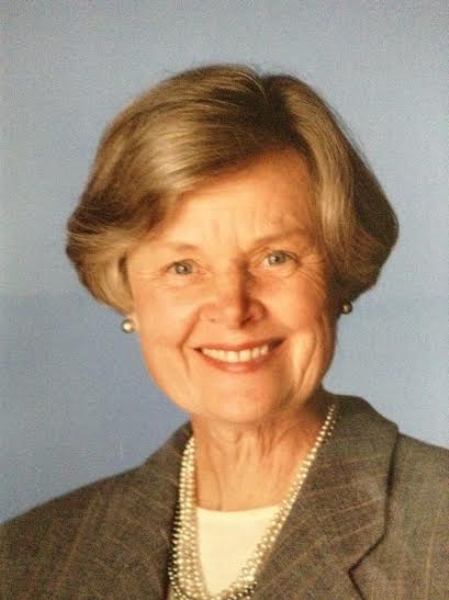
My name is Maureen Ruettgers. I have the honour of being the first Chair of Friends of Imbuto Foundation, an organization established in Boston, Massachusetts, with a mission to support the vision of Imbuto Foundation through networking and fundraising initiatives.
With the 15-year anniversary in full swing, I am excited to reflect on how my family and I became interested in Rwanda, this little country lodged in the heart of Africa, and involved with Imbuto Foundation a few years into its launchby Her Excellency, the First Lady of Rwanda, Mrs. Jeannette Kagame.
From the onset, like so many others, our family knew Rwandans just simply, as special people. Committed, resilient, visionary and dignified, even while facing the immense and daunting task of nation-building. I still vividly remember my first encounter with Rwandan women in 2001, at a Harvard’s Kennedy School of Government forum called Women Waging Peace. A short few years only after the genocide, the extent of their responsibilities and range of expertise, were impressive – Girl Scout leader, hotel owner, health worker, Minister of Gender, journalist, judge and Mayor. In ensuing years, I would reach the same conclusion when working with the Rwandan First Lady and her team.
On her end, my daughter Polly Ruettgers Fields also echoed these thoughts. She had been working in Rwanda with the Clinton HIV/AIDS Initiative and Partners in Health, in collaboration with the Government of Rwanda and the First Lady’s Protection and Care of Families against HIV/AIDS program. Polly often marvelled at Rwanda’s vision and vanguard touch in leading such a comprehensive family health approach, which saved countless lives from the AIDS epidemic.
The beginning of our family’s more than a decade long friendship with the First Lady and Imbuto Foundation, started when she hosted the first meeting of the Organization of African First Ladies against HIV/AIDS (OAFLA) many years ago. As a founding member and then President, her Excellency worked diligently to mobilize resources and gain consensus on priorities.
At the same time, OAFLA’s continental campaign “Treat every child as your own” had picked upmomentum, and the First Lady was advocating for countries to have it customized to their national contexts. As a family, we embraced this initiative and saw an opportunity to support a cause that resonated with us. This opened the door to an enduring and warm relationship that quickly extended to other Imbuto and Rwandan initiatives.
Frequently, I have been asked, “What is Jeannette Kagame really like?” My answer has always been the same: “she is first and foremost a thoughtful and terrific wife and mother. And she never relents on her intent to value the importance of respecting and supporting each and every child as your very own.”
These 15 years are a testament to the unwavering leadership of Mrs Jeannette Kagame. In her role as First Lady, she has shown not only to her country but the world at large, that she is an exemplary leader. As the Chairperson of Imbuto Foundation, she has marked her organization with a spirit of dedication and excellence, which set the tone for the strong and fruitful relationship Imbuto Foundation and Friends of Imbuto have enjoyed over the past few years. As a matter of fact, last year Friends of Imbuto was excited to fund more than 300 scholarships and equip 40 houses built by AVEGA Agahozo for widows and families survivors of the genocide.
The work of Imbuto spans a variety of needs: health, youth empowerment, and the promotion of education, which has become the trademark of Imbuto Foundation and holds a special place in my heart. Over time, more than 6,000 secondary school students have benefited from scholarshipsand over 4,000 girls have been awarded for doing exceedingly well in national examinations. In this month where we celebrate women worldwide, I find it particularly fitting to praise these young girls and Imbuto Foundation’s annual campaigns that value and reward their achievements.
With this message, I wish all of the Imbuto team a happy anniversary for 15 years of incredibly meaningful work. Partnerships and a community of support are critical for Imbuto to meet its goals and continue to expand its mission and reach, so we are happy to have been part of its journey. As a family, we are proud of Imbuto’s role in building a brighter future for Rwanda. It has been a terrific investment and it is my hope that others will be inspired to lend support. We all have the power to initiate positive change.
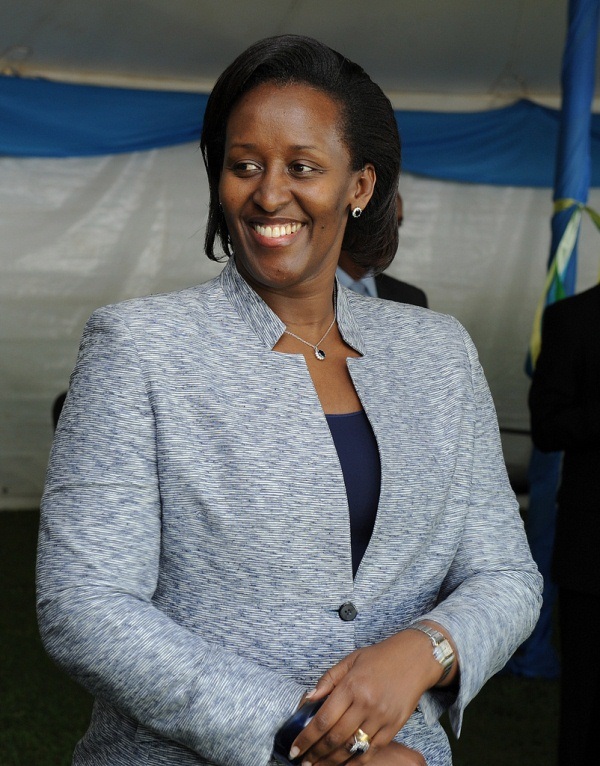
{Madam Jeannette Kagame will on March 19th, 2016 join Rwandans living in United States in a meeting which will discuss the Diaspora role in Rwanda’s development.}
The meeting is part of celebrations of International Women’s Day organized by Rwandan Diaspora in US (USRD) in collaboration with Rwandan Embassy in Washington DC and the international Rwandans Diaspora.
The meeting was organized after realizing the role of women involvement in governance of Rwanda and USA. It will be an opportunity of sharing ideas on women’ needs about job opportunities, seeking together how to address obstacles affecting them and how to promote women through education while keeping norms of Rwandan culture.
The meeting will also discuss achievements in governance and identify gaps that need to be purged.
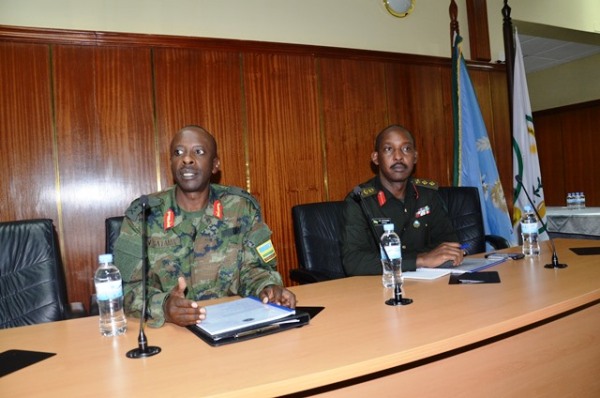
{A Rwandan contingent composed of 43 participants that include 30 military, 6 Police officers and 7 civilians will leave Kigali on Sunday 20th March 2016 for Nairobi, Kenya to participate in Eastern Africa Community Military Exercise codenamed “EAC Command Post Exercise (CPX) Ushirikiano Imara 2016”.}
The drills will be held in EMBAKASI site, Nairobi from 20th March- 4th April 2016 and involve 249 participants from EAC partner states namely Burundi, Kenya, Rwanda, Tanzania and Uganda.
The aim of the exercise is to practice the EAC Partner States’ Armed Forces and stakeholders in planning and conduct of peace support operations, counter terrorism, counter piracy, and disaster management in order to enhance their capacity in combating complex security challenges. It is a test to the readiness and capability for the Defence, Police and Civilians working together in an integrated training Exercise on Peace Support Operation.
Rwandan Contingent is led by Brig Gen Vincent Gatama who will be the Chief Umpire for the Command Post Exercise. The Exercise Director will come from Kenya, the host Nation. The drills involve Infantry, Maritime, Air Components and Police roles. Civilians’ roles during the Exercise include among others Gender, Human Rights and environment officers, Child protection and political advisors as well as planning officers.
The CPX is annually organized in accordance with Article II of the EAC Memorandum of Understanding on Cooperation in Defense among partner states.
{Water is very important to the body, not just because it feels good to drink it, but because it helps keep us alive and healthy. People who drink enough water are healthy people, generally speaking, and those who do not are likely to suffer the following troubles…}
{{1. CONSTIPATION}}
Constipation is simply having difficulty stooling. This condition is mostly caused by a lack of sufficient water in the body. The intestines need water to aid digestion. When water isn’t sufficient in the body, the colon uses up the ones the intestines would have worked with, thereby, making it difficult for proper digestion to take place.
{{2. YOU RARELY URINATE}}
Naturally, you pass more urine when you drink much water. So, when you start urinating less, it’s probably because you lack enough water in your system — and that is not really good because urine is one of the ways the body rids itself of toxic waste.
{{3. YOU EXPERIENCE DIGESTIVE PROBLEMS}}
A lack of enough water in the body would cause stomach acid to cause serious harm inside the body. This results to problems like heartburn and indigestion
{{4. YOU SUFFER FROM SICKNESSES OFTEN}}
The body needs enough water to continually flush out harmful toxins from the body. When you do not provide it with enough water, it cannot perform this task well. Also, when one is dehydrared, the body borrows water from places it can find some, like the blood for example, and that can open up doors for more dangerous sicknesses and diseases.
{{5. JOINT PAINS}}
The cartilages and spinal discs in the body contain about 80% water. This is to ensure that the bones do not grind against each other as we walk or move around. Keeping the body hydrated makes sure that our bones and joints are strong enough to withstand activities like running, jumping, etc.
{{6. DRYNESS OF THE MOUTH, SKIN AND EYES
}}
Remember that sticky feeling of dryness you get in your mouth? It’s as a result of a lack of enough water in your body. Not drinking enough water can also make the skin dry. When you do not have enough water in your system, you tend to sweat less. What that implies is that your body would not be able to rid itself of toxins. Over time, this would cause the skin to dry up as well. Finally, by not drinking enough water, you risk suffering dryness of the eyes as well. This is due to a dry-up of the tear ducts.
{{7. YOU EXPERIENCE REGULAR THIRST}}
Whenever the body lacks enough water, it makes this known via a couple of ways — thirst is one of them.
So you’ve seen some of the troubles that accompany dehydration. If you consciously or subconsciously do not drink enough water, you would be doing yourself a lot of good by changing that today.
{Scientists have found the ‘root of all evil’ which triggers a person to engage in certain unacceptable behaviours, and you wouldn’t believe where it was found.}
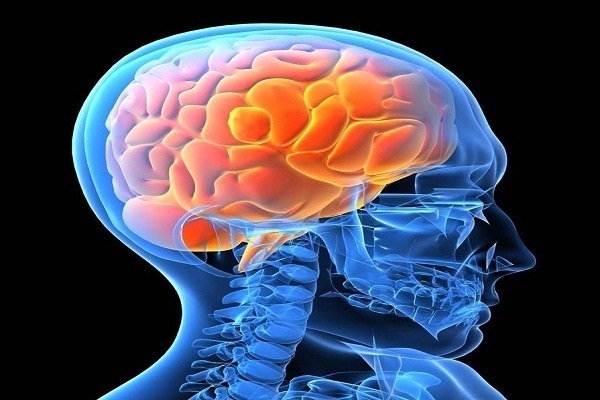
Researchers from New York University wanted to find out if bad intentions could be seen forming in the brain before any violence or aggression took place. They found that a distinct part of the hypothalamus – the brain region that controls body temperature, hunger and sleep – is activated shortly before an attack.
The part of the brain that switches on before aggressive behaviour is known anatomically as the ventro-lateral part of the ventromedial hypothalamus, or VMHvl, because of its central location inside the brain on the underside of the hypothalamus.
The researchers say it may be possible to spot early warning signs of premeditated violence, stalking, bullying and even sexual aggression, and prevent it occurring for good.
“Our study pinpoints the brain circuits essential to the aggressive motivations that build up as animals prepare to attack,” said study senior investigator Dayu Lin, of the Neuroscience Institute at NYU Langone.
Researchers say the finding could lead to drugs that help people control violent behaviour, without the need for restraints or sedation. It might even be possible to monitor brain activity continually and alert health experts or the security services before an aggressive attack.
To conduct the study, male mice were trained to attack weaker males and then monitored to see how aggressively they tried to gain access to, and bully, another mouse. One measure used to gauge aggression was counting the number of attempts made by mice to wiggle through small holes that led to another mouse, which they could then attack.
The researchers found nerve cell activity in the VMHvl routinely peaked just before mice began to poke through the holes. Nerve cell activity in the VMHvl also increased up to tenfold during the initial seconds after the weaker target mice appeared.
The researchers say it is possible the region is linked to reward centres of the brain that make an attack seem more desirable and may promote a flow of endorphins.
The research was published in Nature Neuroscience.