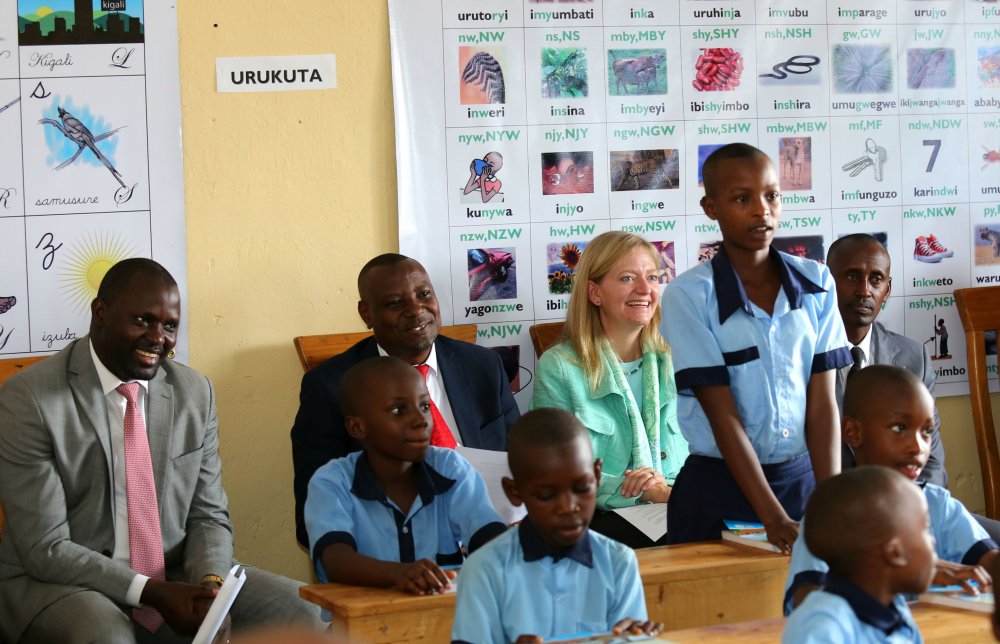
{On February 21, the United States Agency for International Development (USAID) and the Rwanda Education Board (REB) joined the worldwide celebration of International Mother Language Day by hosting a special talk show on Rwanda Radio.
The radio program highlighted the importance of the “mother language” of Rwanda, Kinyarwanda, for the schooling of Rwandese children. Research from the USAID funded Literacy, Language, and Learning (L3) initiative has shown that children with a strong foundation in Kinyarwanda reading are better able to read in other languages, such as English, and to succeed in school.}
REB Director General JanvierGasana, and the winners of the USAID-sponsored Andika Rwanda writing competition participated in the talk show. The Director General emphasized, “The Kinyarwanda language is the foundation of our country’s culture and its children’s education. By ensuring that children in the early grades learn to read in the language they speak at home, Rwandan children can learn to read faster and better, and then transfer those skills to be successful readers of English in P4.”
USAID, through the Soma Umenye Activity, is supporting the Rwanda Education Board to improve children’s reading ability in Kinyarwanda at the lower primary level.
The partnership includes support to increase the quantity and quality of Kinyarwanda language textbooks and supplementary reading materials in early-grade classrooms, as well as to provide training for teachers about how to improve instruction for Kinyarwanda reading. By ensuring that children have a foundation in the first and most crucial competency, Kinyarwanda reading, Rwanda’s youth will be prepared to address the challenges on the 21st century.
On the radio program, USAID Basic Education Specialist Emile Rudasingwa echoed the importance of Kinyarwanda literacy. He explained, “Education in the mother language is vital for children to succeed in school and to realize their full potential.
Only when people realize their full potential will the country achieve its development goals. By partnering with the Government of Rwanda to support Kinyarwanda literacy, we are ensuring that Rwanda’s children have the keys to success for themselves and their country.”
{The ‘InstitutPanosGrandsLacs (IPGL) in collaboration with community radios network (Réseau des Radios communautaires,RCRN) and Never Again Rwanda have organized a public debate in Rutare sector of Gicumbi district in Northern Province in which citizens and local leaders will express their concerns on the role and implication of Gicumbi residents in the execution and evaluation of performance contracts. }
The debate is due on Thursday 23rd February 2017.
The debate will be broadcast live by four community radios including Ishingiroin Gicumbi (Northern), radio Izuba in Ngoma district (Eastern Province),radio Isanganoin Karongi (Western Province) and radio Hugukain Muhanga district (Southern Province) from 2:00 to 4:00 hours pm.
Between 150and 200 participants are expected to attend the debate which will be held for the 7th time since 2016. It is incorporated under the project dubbed Elections ,Media,Civil Society and Democracy in Rwanda «Elections, Médias, Sociétécivile et Démocratie au Rwanda » (ELMS) financed by Europian Union.
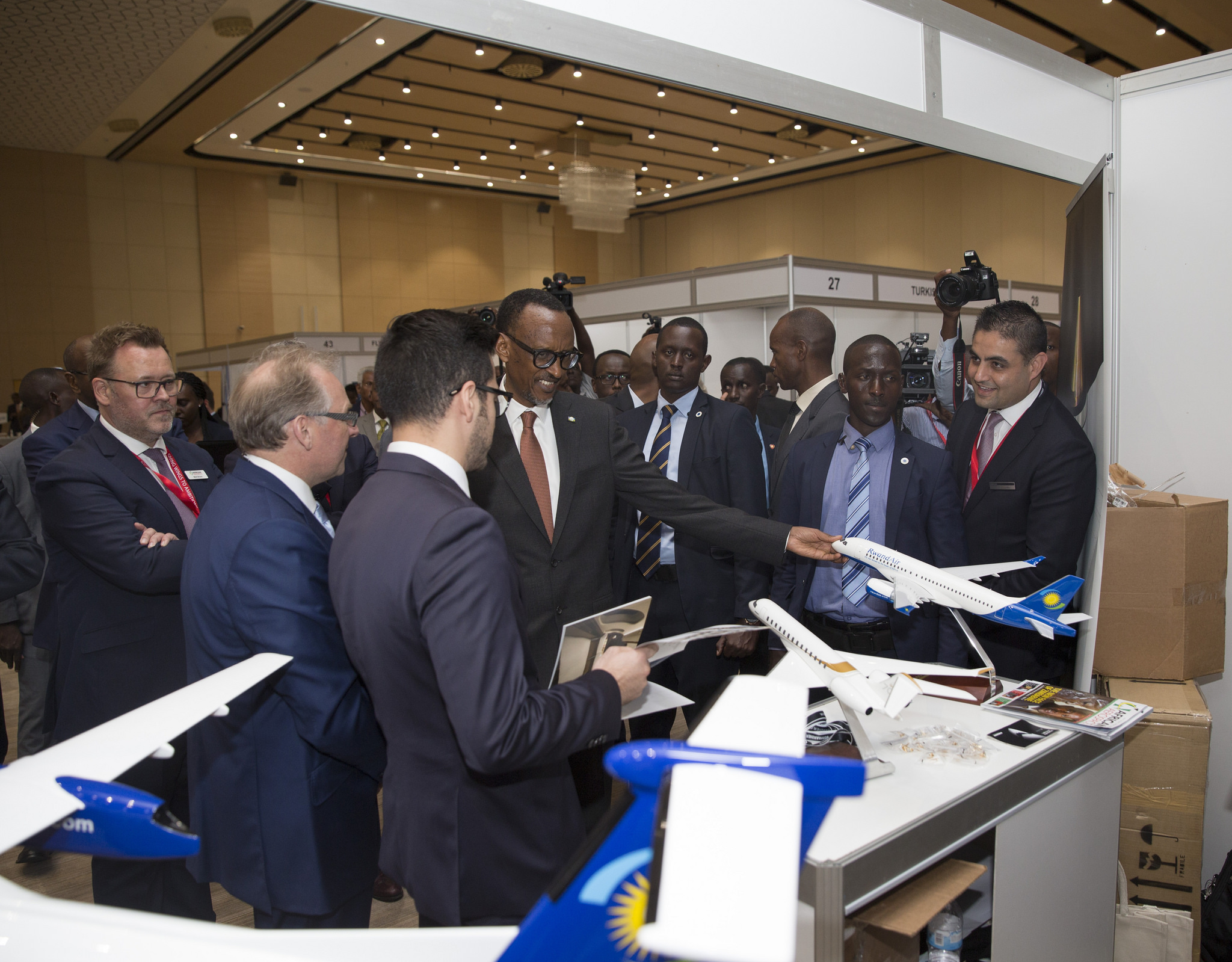
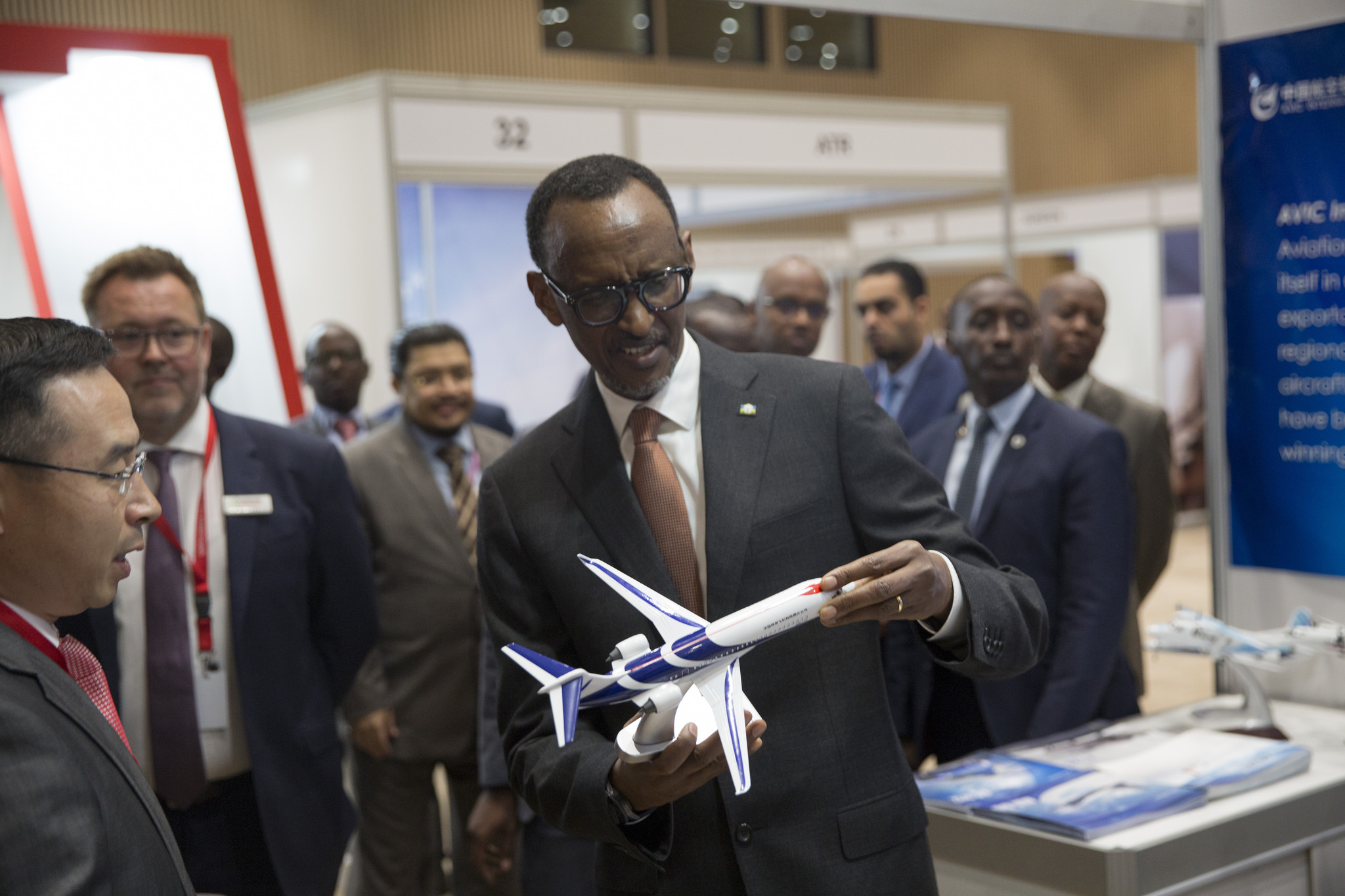
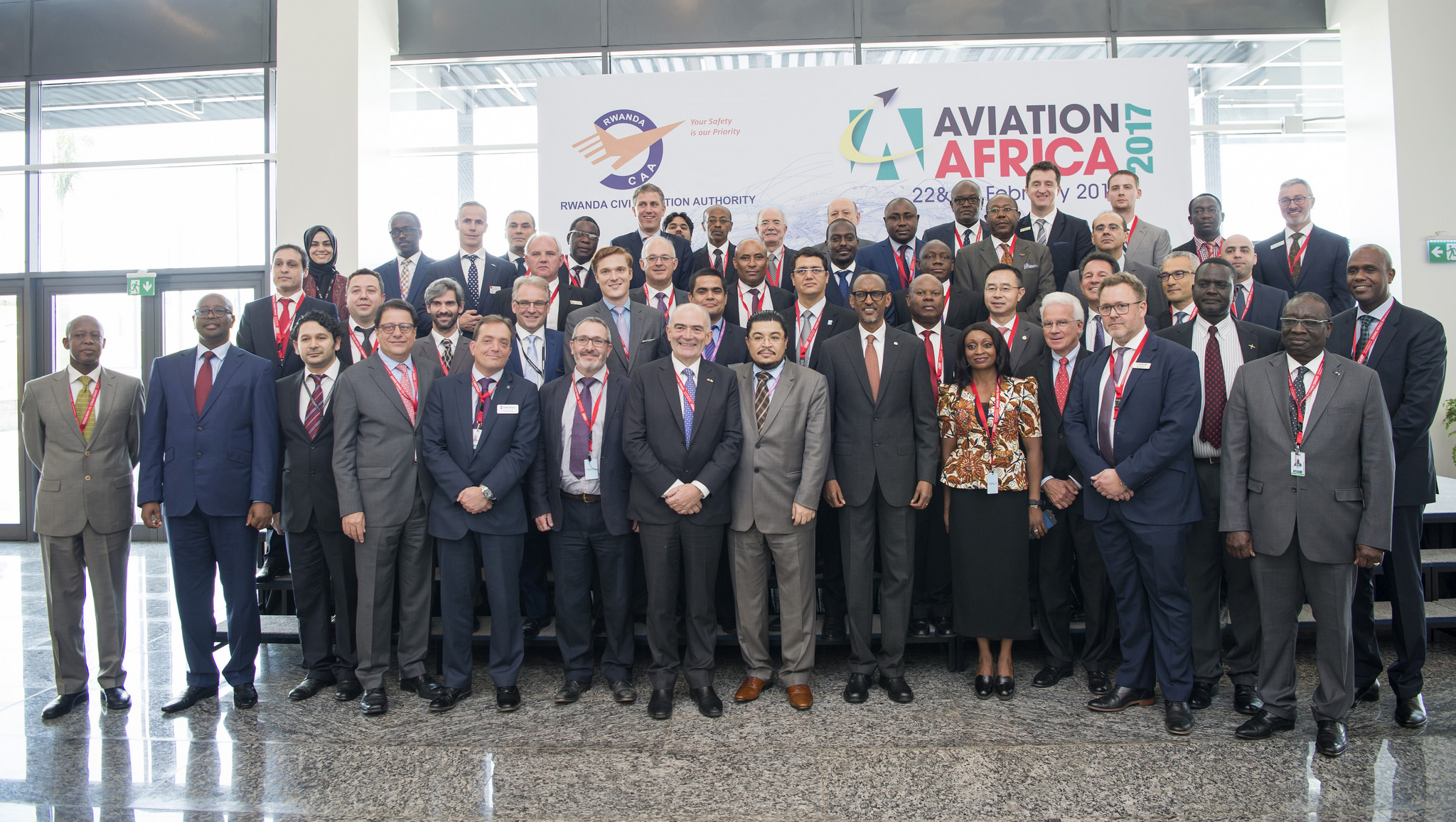
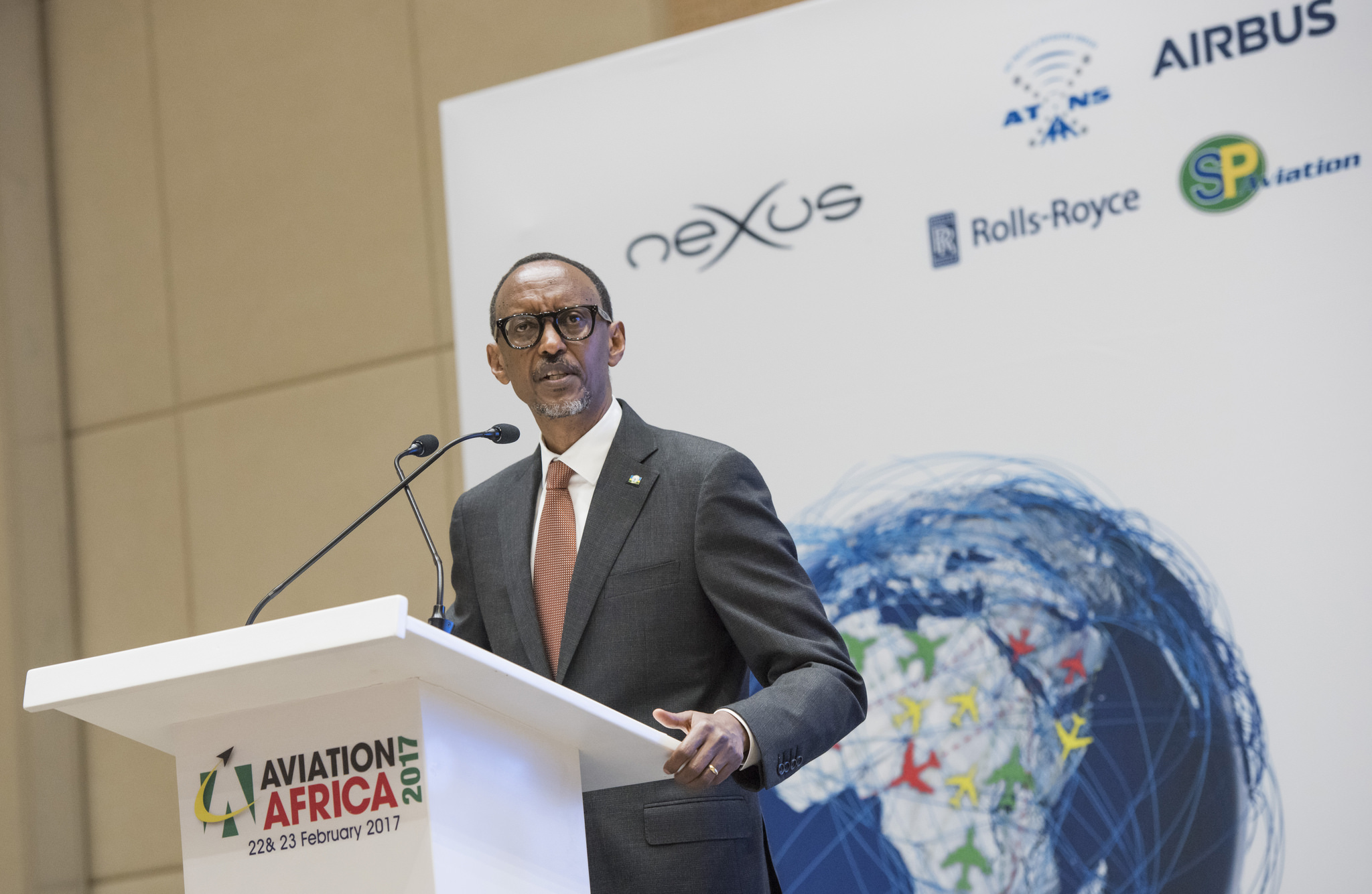
{President Paul Kagame has urged African countries to open skies, work together to promote aviation transport because it would hardly progress without integration with other continents. }
He made the remarks today as he officially opened Aviation Africa Conference taking place at the Kigali Convention Center.
The Aviation Africa Conference brings together 550 delegates from 58 countries including 120 airline delegates and 56 exhibiting companies.
Addressing participants, Kagame said that Rwanda has stepped up efforts towards the creation of a single African air transport market ‘by fully opening up our skies’ noting that aviation travels in Africa should be extended to other continents.
He explained that Yamoussoukro Agreements need effective implementation to enhance Africa integration with other continents other than working alone.
“Yamoussoukro Decision still needs to be implemented & Africa remains more connected with other continents than internally,” said Kagame.
“When our skies are closed it is harder to make air transport safer, more reliable and more affordable. As we work to expand regional transportation and digital networks, we must do the same with air transport,” he added.
Kagame has also called for removal of challenges in African aviation transport which is still low compared to other continents.
“Removing barriers is imperative but not enough. We need to build capacity in different aspects of the aviation industry. We must consistently exceed expectations in order to compete globally,” he said.
He expressed desire to see many young Rwandans and Africans pursuing careers in aviation as pilots, engineers, designers, business analysts.
Kagame has said that Rwanda is committed to promoting aviation transport where RwandAir continues to expand its route network in Africa, and beyond.
He also observed that Rwanda is investing in infrastructure, upgrading Kigali International Airport and building the new Bugesera International Airport and working with others across Africa to create a conducive environment for private sector investment in the industry.
A similar conference was previously held in Dubai in May 2015.
{•Excellency, Paul Kaba Thieba, Prime Minister of the Republic of Burkina Faso
•Honourable Ministers and Senior Officials
•Air Force Chiefs
•Mr Abdullah Al-Sayed, Founder and Chairman of NEXUS
•Mr Alan Peaford, Editor-in-Chief of Times Aerospace
•Business Leaders & Distinguished Delegates
•Ladies and Gentlemen}
Good morning.
Allow me to warmly welcome all of you, to Rwanda.
For those of you visiting for the first time, I hope your schedule will permit you, to get to know what our country has to offer, even beyond Kigali.
This is an exciting time for our country, and our continent, as we see new networks and capabilities beginning to take shape, which bring us closer to the prosperous future, that our people want, and deserve.
I wish to acknowledge our partners for this landmark event, Times Aerospace, Access Group, and NEXUS, along with all the sponsors and exhibitors.
This is the first Aviation Africa Conference to take place on our continent, and it comes fifteen years after44 members of the African Union, committed to deregulate air services, and promote competitive regional aviation markets.
Rwanda has stepped up efforts towards the creation of a single African air transport market, by fully opening up our skies, and working actively with partner states, to do the same.
However, the Yamoussoukro Decision still needs to be fully implemented, and Africa remains more connected with other continents, than it is internally.
When our skies are closed, it is harder to make air transport safer, more reliable, and more affordable. The growth of the mega-businesses, which depend on a vibrant aviation sector, is also considerably slowed, hurting all of us.
As we work to expand regional transportation and digital networks, we must do the same with air transport, if we want to increase tourism, trade, and investment within Africa, and with the rest of the world.
However, we remain enthusiastic about the renewed focus, on the growth of aviation in Africa.
We hope that in the near future, when a passenger in Africa transits through a city outside the continent, in order to reach another African city, it will not be out of necessity, but by choice.
Removing barriers is imperative, but not enough. We also need to build expertise and capacity, in different aspects of the aviation industry.
The brand quality of African airlines rests on excellent service and comfort, an impeccable safety record, good corporate governance, as well as integrating the latest technology.
We must consistently exceed expectations, in order to compete globally.
An additional plus, is the opportunity to leverage our favourable demographic dividend.
We want to see many young Rwandans and Africans pursuing careers in aviation, as pilots, engineers, designers, or business analysts.
Finally, innovation is critical to ensure sustainability. While some legacy national carriers are no longer in business, new players continue to join the market.
We in Rwanda experimented with different business models, before creating RwandAir. Along the way, we gained a better understanding of what it takes, to succeed in this business.
For example, the aviation sector extends beyond the airlines, to include the full range of associated services, represented by many of you gathered here, such as airport management, cargo handling, catering, training, logistics, and maintenance.
RwandAir continues to expand its route network in Africa, and beyond. We are investing in infrastructure, including upgrading Kigali International Airport, and building the new Bugesera International Airport.
At the same time, we are working with others across Africa, to create a more conducive environment, for private sector investment in the industry, more generally.
This is why it is important, that the Aviation Africa Conference become a regular event in the years ahead, at which the partner ships that Africa needs, can be forged and deepened.
In Rwanda, we are very happy to work closely with you going forward, as hosts and collaborators.
The challenges facing our continent are well-known, but the enormous potential here, is just as obvious.
By working together, with a welcoming spirit, and a sense of urgency for Africa to keep getting better, we can all do our part, to keep things moving in the right direction.
I thank you, and wish you a productive conference.
{Despite global and regional economic challenges, Rwanda economy was resilient with a growth rate of 6.1% in 2016 from 6.9% in 2015. }
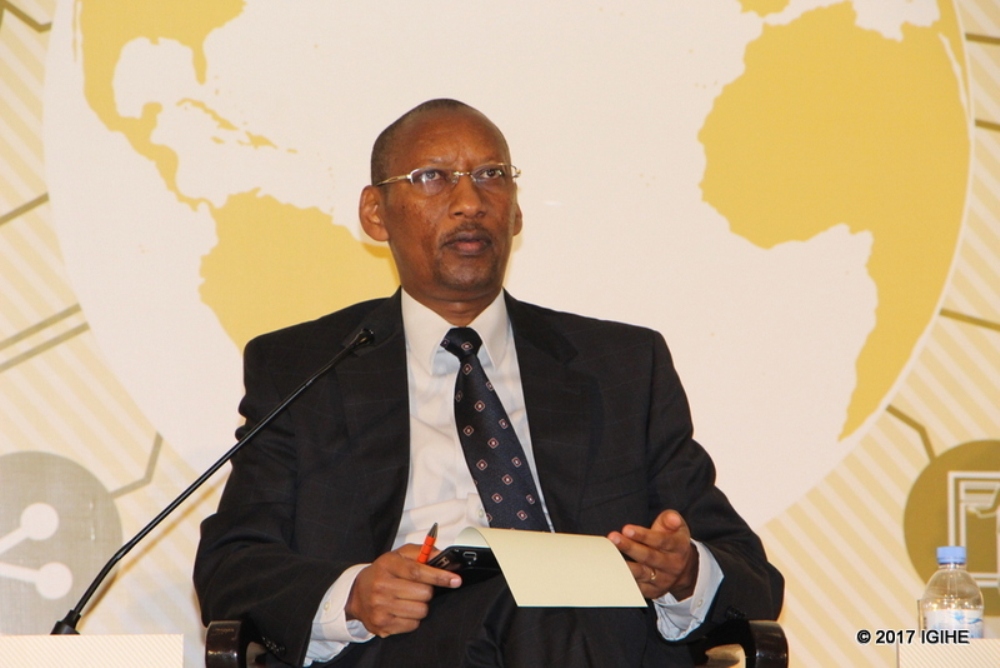
This has been revealed today by the governor of the National Bank of Rwanda (BNR), John Rwangombwa during the presentation of Monetary Policy and Financial Stability statement held in Kigali Serena Hotel.
Service sector growth in 2016 was 7.7% up from 7.0% in 2015, contributing 49.7% of GDP, followed by industrial sector contributing 14.6% and agriculture with 29.6%.
BNR has attributed the growth of service sectors to the gain in hosting events including CHAN, WEF, AU Summit and Kwita Izina among others.
Transport has also been identified as a growing sub-sector with RwandaAir being in the lead, having opened six new routes.
Agricultural production contracted in the first three quarters of 2016 having grown by 3.7% down from 5.3% of 2015. Drought has been cited as a responsible factor for this slump.
Industrial sector grew by 5.0%, down from 6.7% in similar period of 2015. The decline is attributed to instability in the minerals market.
The gap between imports,exports is 5.9% in 2016 equaling USD1649.8 million from USD1752.5 in 2015. Authorized exports increased 7.1% while licensed imports decreased by 2.7% in 2016.
Rwanda economy is expected to rise by 6.0% in 2017.
In general World’s economy decreased by 3.1% in 2016 down from 3.2% of 2015 while Sub-Sahara Africa has seen it economy decreasing by 1.6% over the reduction of exportations, drought, Ebola in the West and political chaos in some countries.
Africa Sub-Sahara economy is expected to rise by 2.8% in 2017.
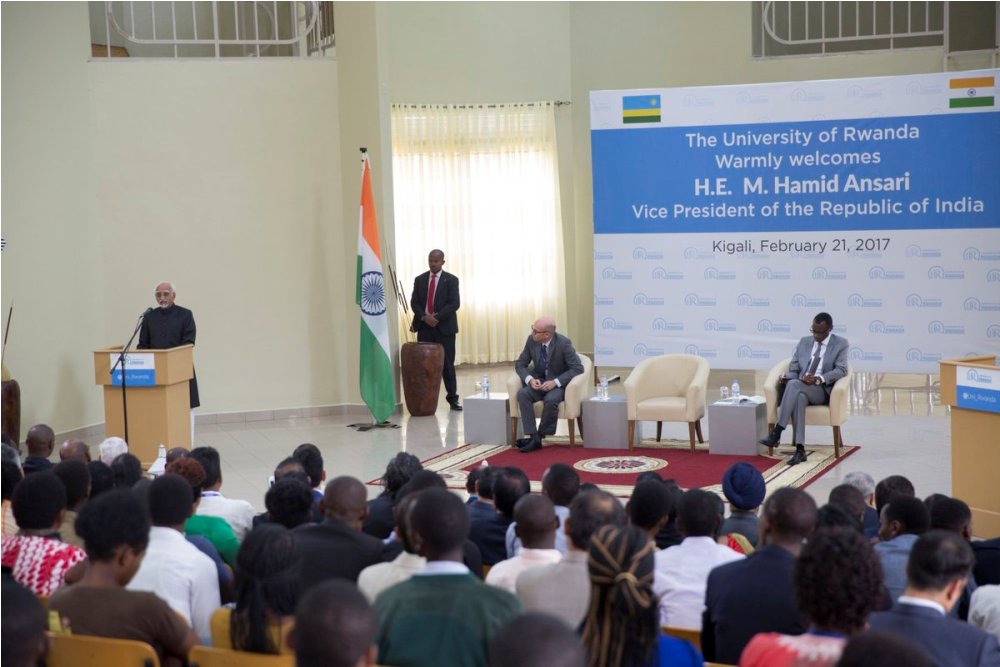
{India vice president M. Hamid Ansari has promised that his country will continue to maintain good relations with Africa and supporting initiatives that ensure security. }
Ansari has noted this as he delivered a public lecture at the University of Rwanda attended by students, UR employees and the Minister of Education, DrMusafiri Papias Malimba.
Ansari has said that Rwanda has a good cooperation with India rooted on development activities including trade which has doubled to USD 106 million over the past five years.
“We will keep encouraging India companies to take Rwanda on heart and think about investment opportunities present here,” he said.
He has said that Africa-India cooperation is founded on shared history, common interest and mutual respect.
This article appeared in the January 2017 issue of Forbes Woman Africa
Rwanda, striving for gender equality, serves as an example of how a nation could be built by communities. In an exclusive interview with FORBES Woman Africa, the country’s First Lady, Jeannette Kagame, tells us how the 15-year-old Imbuto Foundation has been taking Rwanda and its people forward.
{{When does a country become synonymous with its community?}}
Just visit Rwanda on the last Saturday of any month, and you will see it here, in this hilly East African country, where the masses – from ministers to farmers, shopkeepers to entrepreneurs – rub shoulders to become one harmonious, homogeneous entity; laying roads, digging the earth, planting trees, and cleaning gutters and drains; holding broom, shovel and spade.
The only thing that counts is the richness of the earth, the fresh mountain air and a united mission to keep the streets green and immaculately clean as a contribution to nation-building and improving the living conditions of the country’s 11.5 million citizens.
It’s on one such Saturday that FORBES Woman Africa is invited to travel upcountry to Rwanda’s verdant Rulindo district, past Kigali’s bustling traffic and up the winding roads when the city’s modest skyscrapers appear no match for the country’s magnificent hills.
It’s the day the country observes Umuganda, a home-grown initiative that requires people from all walks of life – villagers and city-folks – to congregate for community work, once a month, from 7 to 11 in the morning.
Today, most of the action is in this northern province, where schoolgirls in blinding yellow and pink uniforms, rural women in colorful African dresses, and men in gum boots, form neat lines to take their turn planting saplings in the fertile earth.
Today, they are also awaiting a special visitor who will dig the earth with them under the hot mid-morning sun.
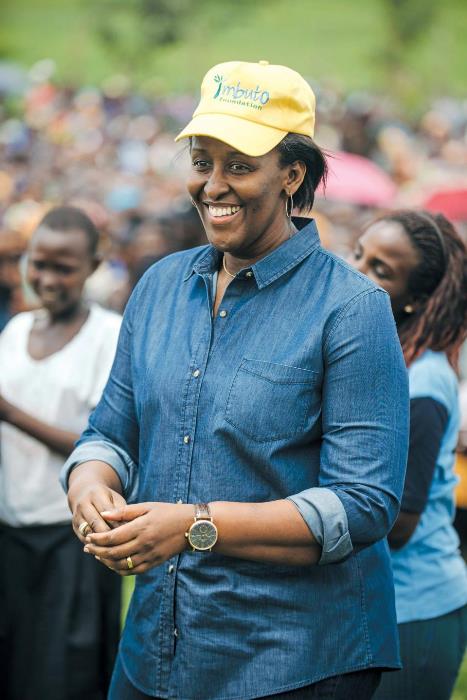
The earth is an apt way to introduce the Imbuto Foundation—the word ‘Imbuto’ meaning ‘seed’ or ‘fruit’ in Kinyarwanda, Rwanda’s local language. And the special guest is none other than the foundation’s President, Jeannette Kagame, the nation’s much-loved First Lady, wife to the country’s dynamic President, Paul Kagame.
There is collective silence and adulation when she arrives, wearing denim pants and shirt and a yellow cap, getting to work right away with a shovel. A stone’s throw away, in a classroom, young girls aged 10 to 12 are seated in a circle on straw mats, ready to welcome her.
They call this ‘the circle of friendship’, and around them are their mentors, young women themselves, aged 18 to 25.
Today is also the launch of the third year of Imbuto Foundation’s successful 12+ program in the area.
The program, in line with the national plan under the Ministry of Health, has achieved significant milestones, reaching 52,000 girls nationally over the last two years. Such milestones are significant as Imbuto celebrated its 15th year in 2016.
The girls are taught about savings, discipline and confidence, in tandem with Imbuto’s motto to ‘engage, educate and empower’. The younger girls are also taught about sexual health; ground-breaking by itself, as sex is still a taboo topic in the communities, and the girls are equipped with the knowledge about their bodies early, before they transition to adolescence.
In the classroom, the girls pass around a ‘speaking ball’ to each other, taking turns to voice their opinions in Kinyarwanda. They speak with supreme confidence – unfaltering even in the presence of the First Lady – drawing their hands on the charts in front of them, promising to never break their circle of friendship. Her Excellency listens to them keenly, before they pass the ball to her, and she politely introduces herself.
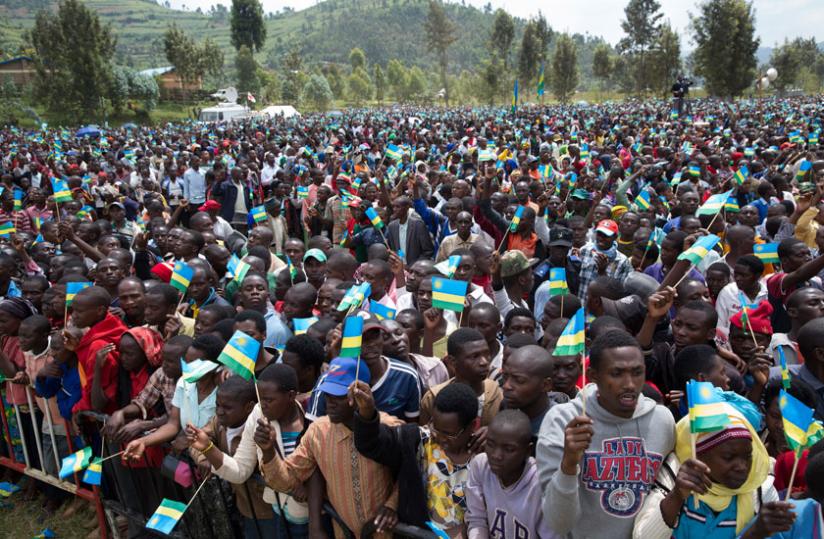
Her next stop is further down the dirt road, for a community gathering after Umuganda, where she is expected to speak to the thousands gathered on the hills, patiently waiting under cheerful umbrellas for a glimpse of their First Lady.
Greeted with music, ribbons and flowers, there is rapturous applause from the crowd when she arrives. The cool country breeze complements the convivial mood. The district mayor speaks about how the previous phases of the 12+ program have influenced the girls to open bank accounts, start kitchen gardens, and importantly, stay in school.
A 10-year-old girl, Amina Merci Dieu, steps up to the podium to speak about how she built a vegetable garden, sold the vegetables she planted and persuaded her parents to open a savings account. She speaks without fear, walking up to hug the First Lady when she is done.
I am seated next to Assumpta Ingabire, Director General in charge of Local Government Inspection, who was formerly with Imbuto.
“Our First Lady is such an inspiring role model. You can share your problems with her and she always sees things in a positive way,” she says, smiling.
“Imbuto does not work in a vacuum; it works in line with national priorities, working with communities. Without our communities, things would have taken forever [to rebuild],” says Sandrine Umutoni, Acting Director General of Imbuto Foundation.
It’s a pertinent point, as the country has had to reconcile and persevere to rebuild itself after the horrific genocide against the Tutsi that killed a million of its people in 1994. The only way it could turn around was by involving its communities.
Imbuto was initially launched as Protection And Care of Families against HIV/AIDS (PACFA) working to help families and genocide survivors with AIDS. It changed its name to Imbuto at the end of 2007, incorporating a holistic model for individual development, focusing mainly on educational projects.
One of Imbuto’s flagship programs is a girls’ education campaign called Best Performing Girls (BPG).
“The girls who graduate from high school get training in IT, and also get laptops, which the First Lady hands out every year in March,” says Umutoni.
“They call her ‘mother’,” she adds. “In Kinyarwanda, when they call a person that, it means the person has accompanied you through difficult challenges, guiding you, counseling you, and providing support at specific moments in your life.”
Imbuto also organizes a Youth Forum Series every year. In addition, the foundation works with 22 cooperatives across 13 districts, introducing women to income-generating vocations. With the money, they pay school fees and medical insurance and enter new entrepreneurial activities.
The week that FORBES Woman Africa is in Kigali to follow the First Lady’s activities is when the King of Morocco is also visiting, to sign an memorandum of understanding with Rwanda on specific health and education projects. The Princess of Jordan, Sarah Zeid, is also visiting.
As part of her packed schedule, the First Lady also attends a meeting with members of the 20-year-old Unity Club that she heads. The club brings together current and former members of cabinet and their spouses to promote unity and reconciliation in Rwanda.
The meeting with the Unity Club members takes place at Imbuto’s temporary office in the President’s office complex in Kacyiru – their office on the same grounds is being renovated – a stunning manicured setting with frangipani trees, hibiscus flowers, ferns and foliage.
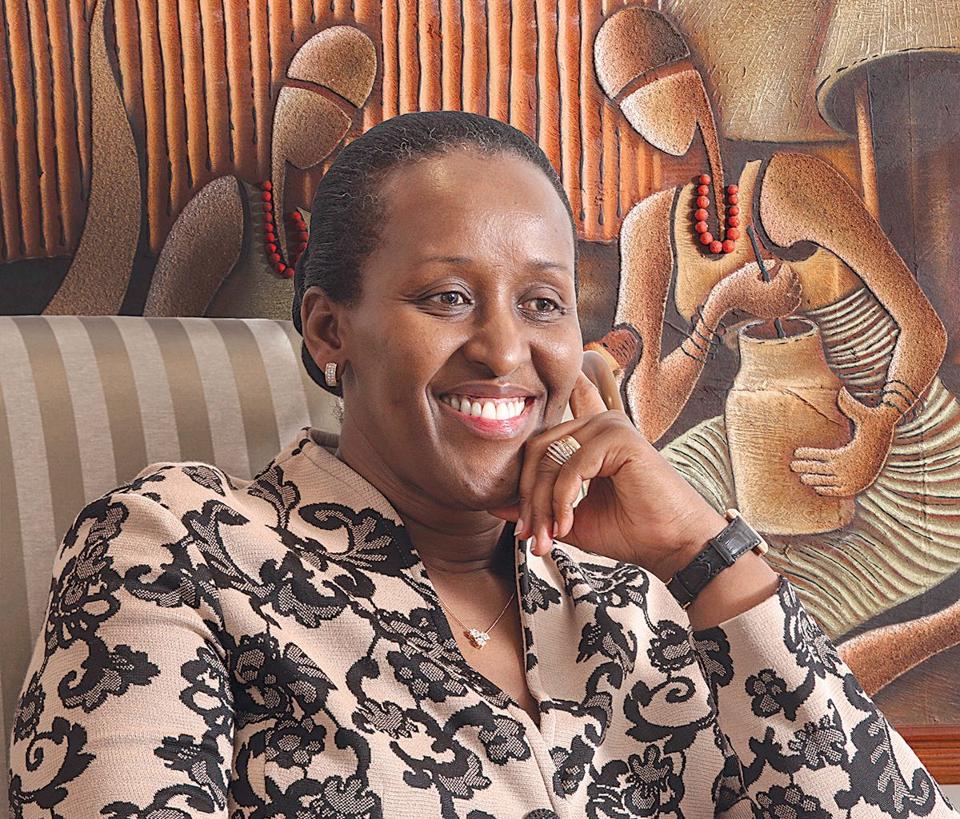
The First Lady is dressed in a smart beige and black suit and sits at the head of the mahogany table in the meeting room. She listens patiently and intently, speaking softly in Kinyarwanda as the ladies consult the files in front of them. She offers solutions and better approaches for some of the issues raised. It’s an in-depth discussion that goes on for over two hours, the seriousness interspersed at times with jokes by the First Lady, displaying an effortless sense of humor.
One of the ladies at the meeting is Radegonde Ndejuru, the First Lady’s advisor, who has been with Imbuto for 10 years now.
“We have a family spirit at Imbuto,” says Ndejuru. “Her Excellency is always so respectful. Her text messages to everyone starts with ‘good morning’ or ‘good evening’. We put passion in everything we do as that is the way she does it. She also has a phenomenal memory and shows great attention to detail… I always ask her: ‘do you sleep enough?’ She is here in the morning, reads a lot and what I admire is she always follows through projects.”
In March 2016, at the 5th Kigali International Conference Declaration General Assembly in Algeria, the First Lady was presented an award along with United Nations’ Secretary-General Ban Ki-moon, in recognition of their contribution to women’s empowerment and their fight against gender-based violence.
Rwanda is a global model for gender equality. The World Economic Forum Global Gender Gap Report 2016 ranks Rwanda fifth globally for closing the gender gap in various spheres. The country has the highest representation (64%) of women in Parliament.
As part of gender mainstreaming, there is a Gender Monitoring Bureau in every institution in Rwanda, as the country works towards achieving a middle income status by 2020.
The First Lady works with a team of young, spirited, hard-working women, who exemplify the qualities of their leader. It is clear they have a great admiration for her work.
Before we settle for the interview, Mrs. Kagame, as she is also called, begins by asking how I am, with a disarming smile. And that aptly sets the tone for the rest of the conversation. It’s easy to see how this mother of four has won the hearts of Rwandans.
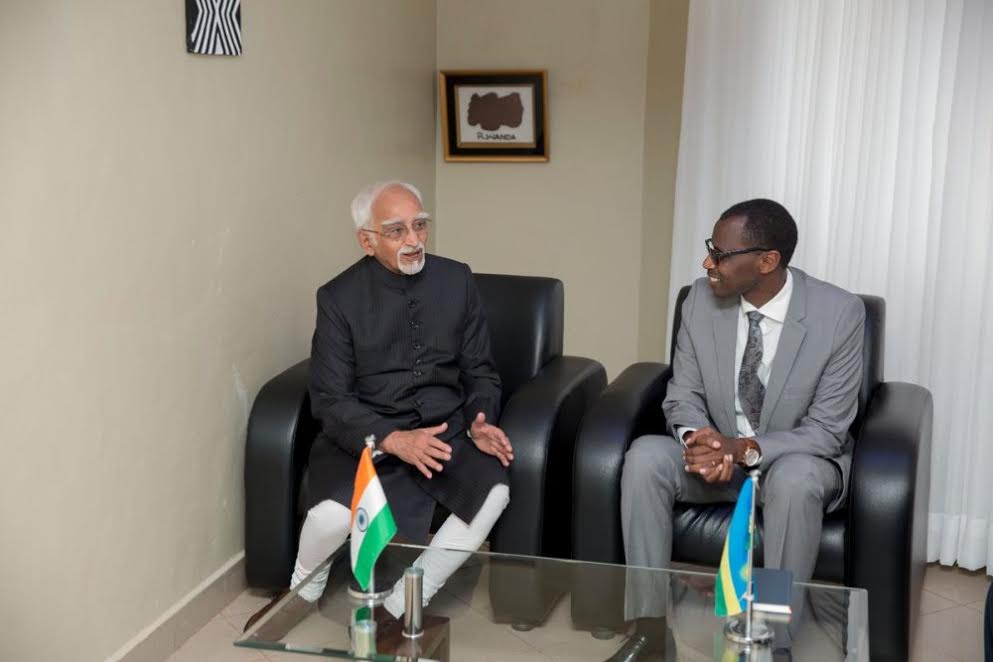
{Vice President Hamid Ansari on Tuesday said India was Rwanda’s strong development partner.}
“We in India see ourselves as a strong development partner to Rwanda. We are already cooperating in sectors such as solar electrification, food processing, skill development and hydropower projects,”
Vice President Hamid Ansari said in an address at the University of Rwanda.
“India’s engagement with Africa has its own unique script, based on what Prime Minister Narendra Modi has called ‘strong emotional link’ defined by our shared history of struggle against colonialism and our aspiration to bring prosperity to our people,” Ansari said.
Ansari was on a visit to Rwanda from February 19-21.
Speaking on the outcome of the visit of the Rwandan President Paul Kagame to India, Ansari said: “During President Kagame’s recent visit, an understanding has been reached for a new line of credit worth $80 million for a road project. We are also committed to continuing and enhancing the provision of scholarship for training of Rwanda civilians and defence personnel under various technical cooperation and cultural cooperation programmes.”
Kagame was on his maiden official visit to India from January 9-11.
During his visit, both sides agreed to raise the level of bilateral cooperation to a strategic partnership and India extended a $120 million credit to bring over 41,190 hectares of cultivable land under irrigation in the African country.
On the bilateral trade between the two nations, Ansari said: “Our bilateral trade has doubled over the last five years, but as $106 million, remains modest and much below its potential. Rwanda has a dynamic economy and ranks highly in the ease of doing business, providing many incentives for inventors.”
On Indian investments in the African agriculture sector and its market potential in India, he said: “The growing middle-class in urban India can become a dependable consumer for African food processing Industry.”
“India provides a long-term, stable and profitable market to the goods and services that Africa generates. For India, Africa has the potential to become a major contributor to our energy security and food security requirements. This is a ‘win-win’ situation.”
“The quantum of Indian investment in Africa has increased in recent years and is presently estimated to be about $35 billion, with a large part of it concentrated in Southern and Eastern Africa,” he added.
India has announced concessional credit of over $10 billion for Africa, over a period of next five years.
{ {{Rwandan Airways to begin direct flights between Kigali and Mumbai in April}}
India and Rwanda have concluded a bilateral air services agreement enabling direct flights between the two countries. This is among the three memorandums of understanding (MoUs) concluded during Vice-President Hamid Ansari’s visit to the African nation. In the words of Amar Sinha, Secretary, External Affairs Ministry, it was a visit from which India learnt a lot.}
Rwandan Prime Minister Anastase Murekezi and Mr. Ansari witnessed the signing of the MoU by Mr. Sinha and Alexis Nzahabwanimana, Rwandan Minister of State for Transport.
“With direct flights between the two countries, we expect our exchanges to be more fruitful,” Mr. Murekezi said.
Rwandan Airways will begin direct flights between Kigali and Mumbai in April.
The other two MoUs pertained to the setting up of an entrepreneurial development centre in Rwanda and exemption of visa for entry of diplomatic and official passports.
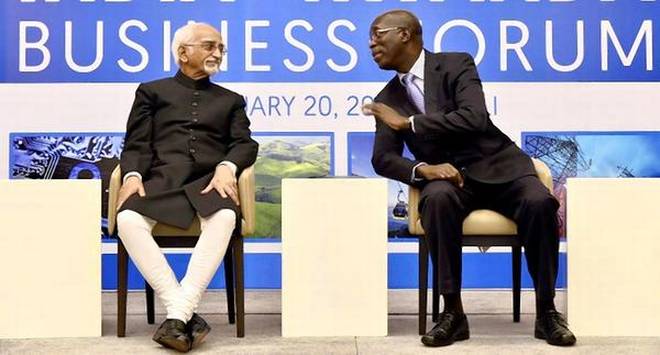
The agreements were signed in the presence of a large business delegation from India at the newly constituted India-Rwanda Business Forum organised by the FICCI and the Rwandan government.
Briefing the media at the conclusion of the visit, Mr. Sinha said while there was much to discuss what the Rwandan government wanted from India, including the desire of many pharmaceutical companies to open shop in the country and to have Bollywood films shot in Kigali, Mr. Ansari too had several questions on the many Rwandan initiatives.
{{Encourage tourism}}
“The Rwandan government wants to encourage tourism. With the air services agreement, that should happen. But they also want Bollywood films to be shot here, because they have noticed how tourism to New Zealand picked up after Bollywood started shooting films there,” Mr. Sinha said.
He said Mr. Ansari had many questions about President Paul Kagame’s governance model that had helped Rwanda become one of the cleanest, most well-run states in the region.
“It’s a visit where we too had a lot to learn … the reconciliation of various groups, to be conscious of a colonial policy of divide and rule and to try and overcome it, and how they are overcoming ethnic majoritiarianism by concentrating on a shared linguistic and cultural heritage.”
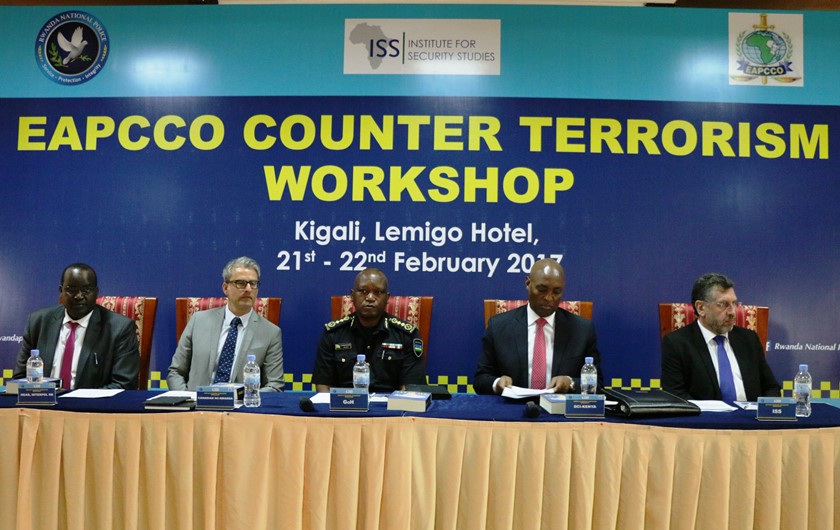
{Counter-terrorism experts from police institutions in the region and international organizations are meeting in Kigali for a two-day workshop to deliberate on various strategies against the major security threat of the 21st century.}
At least ten countries from the Eastern Africa Police Chiefs Cooperation Organisation (EAPCCO) and representatives from international organizations including Interpol, and Institute of Security Studies (ISS) are taking part in the workshop that started yesterday.
The third EAPCCO counter terrorism meeting held under the theme: “Sustaining regional cooperation to combat terrorism and violent extremism,” also brings together partners including the Federal Criminal Police Office of Germany and Canada.
Top on the agenda is enhancing partnership between counter terror departments and agencies in EAPCCO, training – field training and command post exercise – looking at the current state of terrorism and radicalization in the region, laying deradicalization strategies; and exchanging best practices in combating terrorism and violent extremism, among others.
The Deputy Inspector General of Police (DIGP) in charge of Administration and Personnel, Juvenal Marizamunda, while officiating at the opening of the meeting, said that such platforms signify the threat to peace and security posed by terrorism in the region and beyond.
“The success of counter-terrorism efforts depends upon strong commitment and concerted actions among countries,” DIGP Marizamunda said.
He added that to achieve this, it requires comprehensive approach encompassing not only security-based counter-terrorism measures but also preventive actions to address underlying conditions that drive individuals to be radicalized to join violent extremist groups.
Experts say that terrorism and extreme violent activities have increased exponentially over the last five years in the region. According to the 2016 report by the European Institute for Security Studies, more than 11, 000 fatalities were recorded in 2015 in Somalia, Kenya, Sudan, South Sudan and Ethiopia.
Some of the terror groups operating in the region include Al-Shabab, ADF, FDLR composed of remnants of the 1994 Genocide against the Tutsi, ISIS, and Al-Qaeda.
“EAPCCO countries have been working closely together through various bilateral and multilateral arrangements to prevent and combat terrorism. It is our responsibility to ensure that our region doesn’t become a safe haven or a soft target for terrorist groups,” DIGP Marizamunda said.
Francis Muhoro, the chairman of the EAPCCO Permanent Coordinating Committee (PCC), said that there are great strides in the region, either individual countries or joint efforts including deradicalisation strategies to deplete the pool so that terrorist doesn’t have the recruitment source.
“EAPCCO have been able to develop standard operating procedures in fighting counter terrorism; strengthening and capacitating directorates of criminal investigations and counter terrorism, developing CVE [countering violence extremism] strategies, and establishment of centres of excellences,” Muhoro said.
Currently, Kenya hosts the regional counter terrorism centre of excellence, and the Interpol’s hybrid as a ‘City Node’ which further provides EAPCCO countries with a pool of tools and expertise especially in three major areas of counter terrorism, cybercrime and emerging crimes.
“Terrorism has no defined physical barriers; to make the assumption that terrorism and violent extremism can only be associated with a particular country is a grave mistake. The networks are wide and borderless. We must remain vigilant, empower our people to speak out,” Muhoro said.
Canadian High Commissioner to Rwanda, Yannick Hingorani, whose country has been supporting counter terror activities in the region, pledged Canada’s continued support.
Willem Els from the Institute of Security Studies, a leading African organisation that enhances human security, said: “Cooperation is no longer a choice… it’s a necessity. Some of these terrorist groups are stronger than just a nation.”
The 3rd EAPCCO counter-terrorism workshop follows two others including the maiden one held in Seychelles in February 2014, and the second one held in Naivasha-Kenya in March last year.