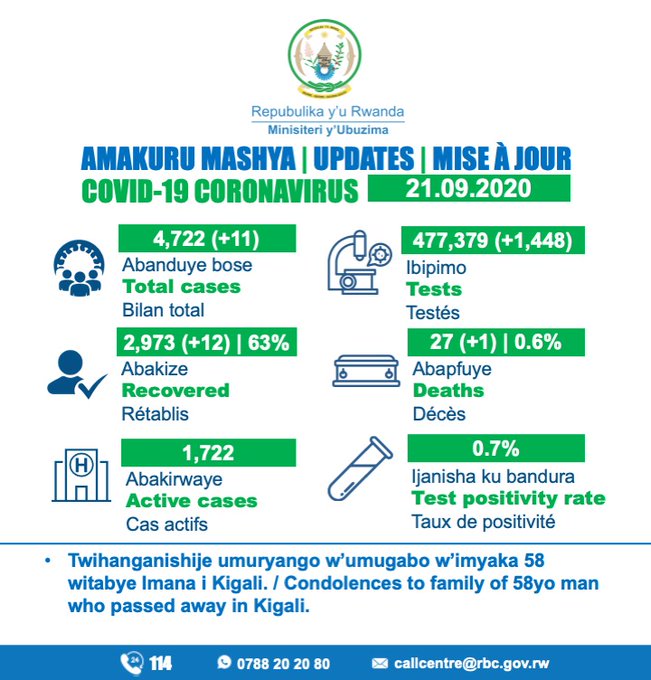
On the same day, the country recorded 12 new recoveries bringing the number of recoveries to 2973.
Of the new cases, 7 were detected in Kigali among contacts of previously confirmed cases, while Nyamagabe district in Southern Province also confirmed four new cases.
The latest results were obtained from 1,448 sample tests conducted in a single day, making the number of tests taken by the country to reach 477,379.
So far, in total, the country has 4,722 confirmed cases, of which 1,722 are still active cases.
Rwandans are required to continue complying with government regulations, especially with frequent washing of hands and water and soap, wearing masks when leaving home or in public.
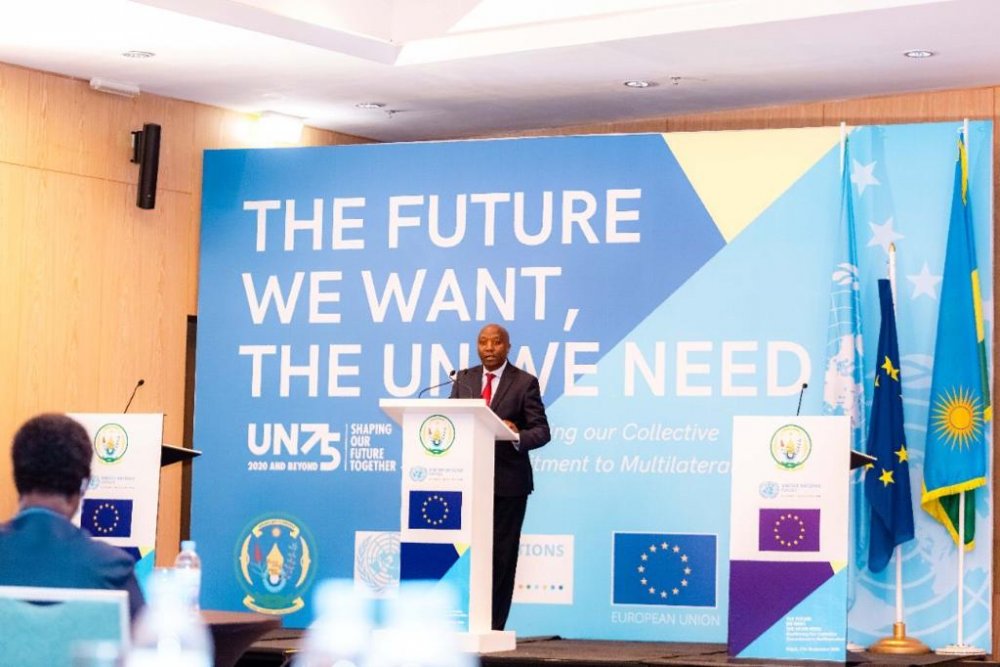
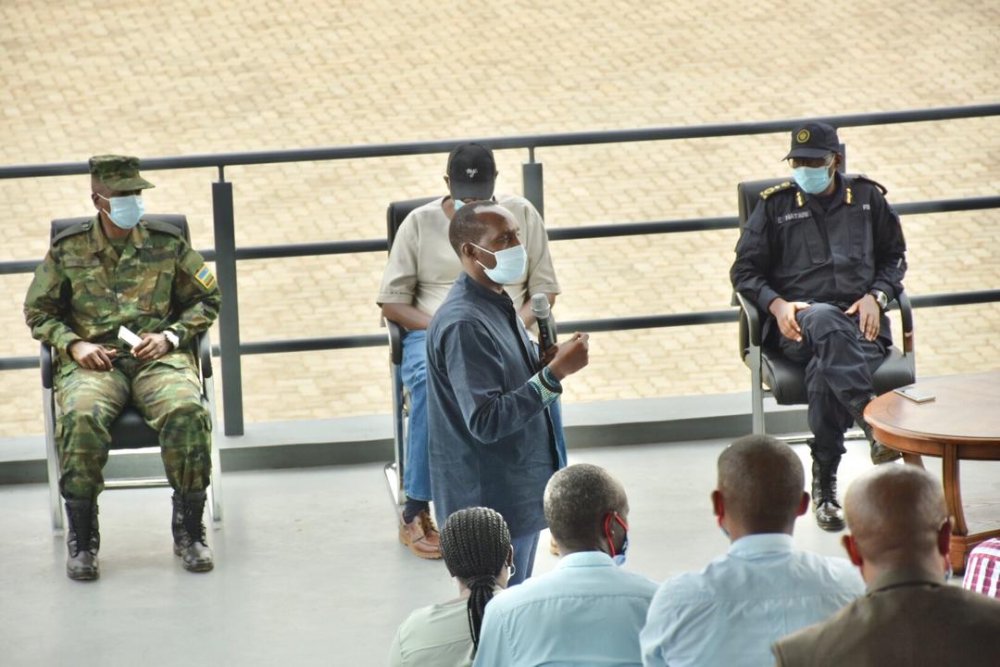
The Premier made the call at the celebration of the 75th anniversary of the United Nations held on September 21, Monday in Kigali.
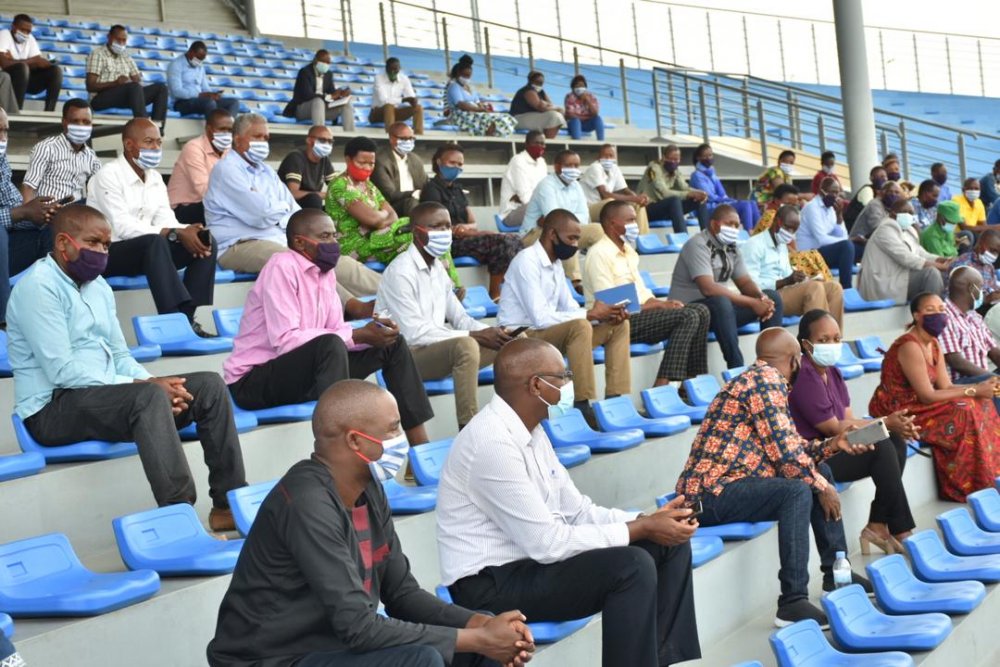
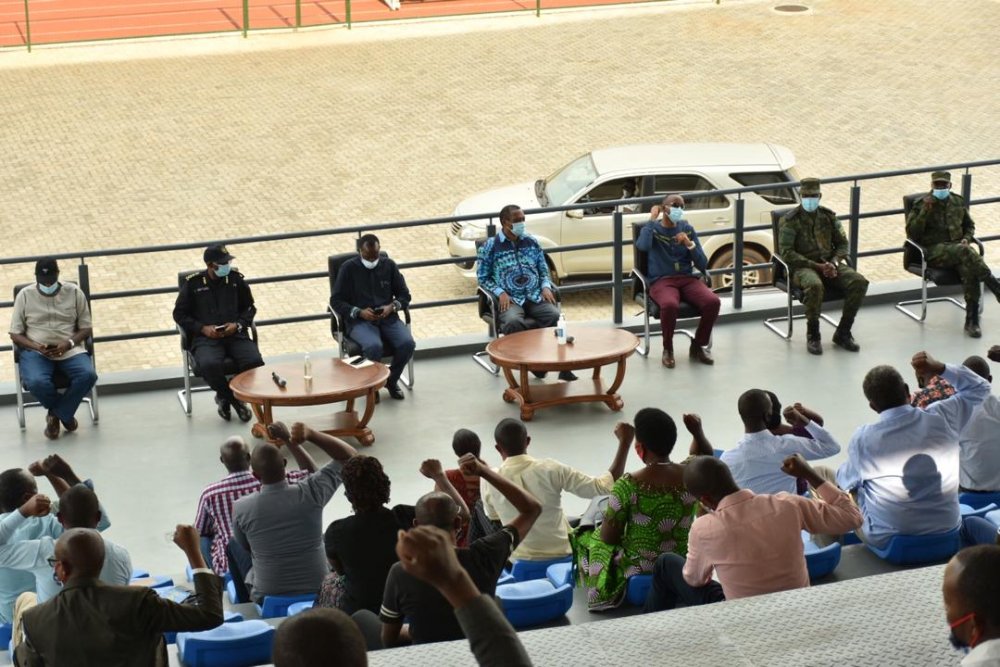
The celebrations in Rwanda brought together representatives of UN agencies in Rwanda and top government officials, convening for a high-level meeting to reflect on the body’s mission of keeping global peace and security, 75 years after the Second World War.
The UN marked its 75th anniversary at a time of great disruption for the world, compounded by an unprecedented global health crisis with severe economic and social impacts.
Ngirente highlighted the urgent need for international cooperation to address present and future global crises.
“We are celebrating this anniversary during the challenging times of Covid-19. And one of the key lessons learned from the Covid-19 pandemic is the importance of international cooperation and solidarity to overcome any global crisis,” he said.
“The Covid-19 pandemic has shown that global risks are interconnected. Therefore, strong and committed institutions are crucial in solving these interlinked challenges.”
“Without international cooperation and global solidarity, we cannot confront the challenges of our time and those coming tomorrow. These common threats will require us to come together as nations in order to find sustainable and inclusive solutions.”
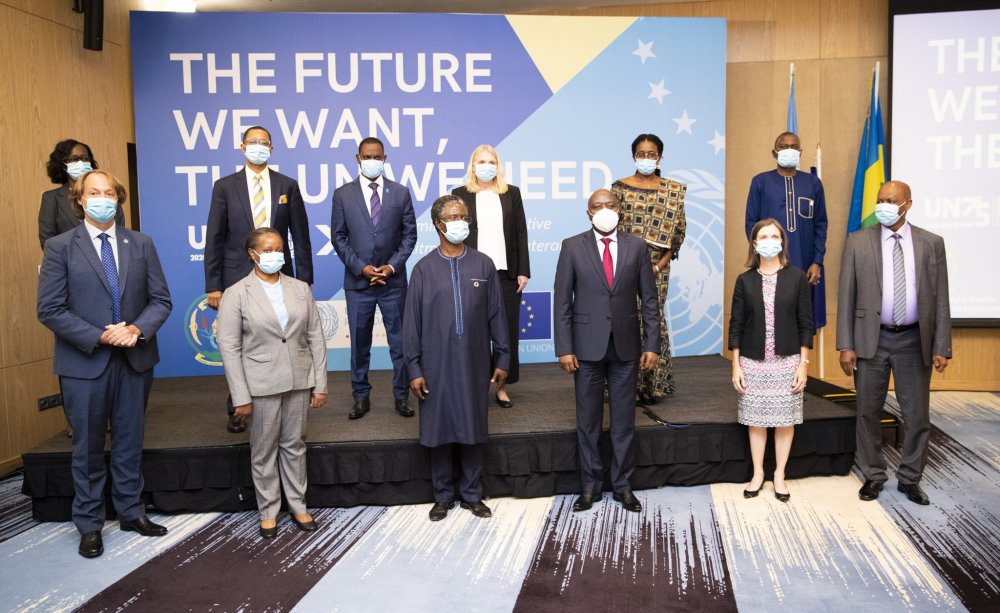
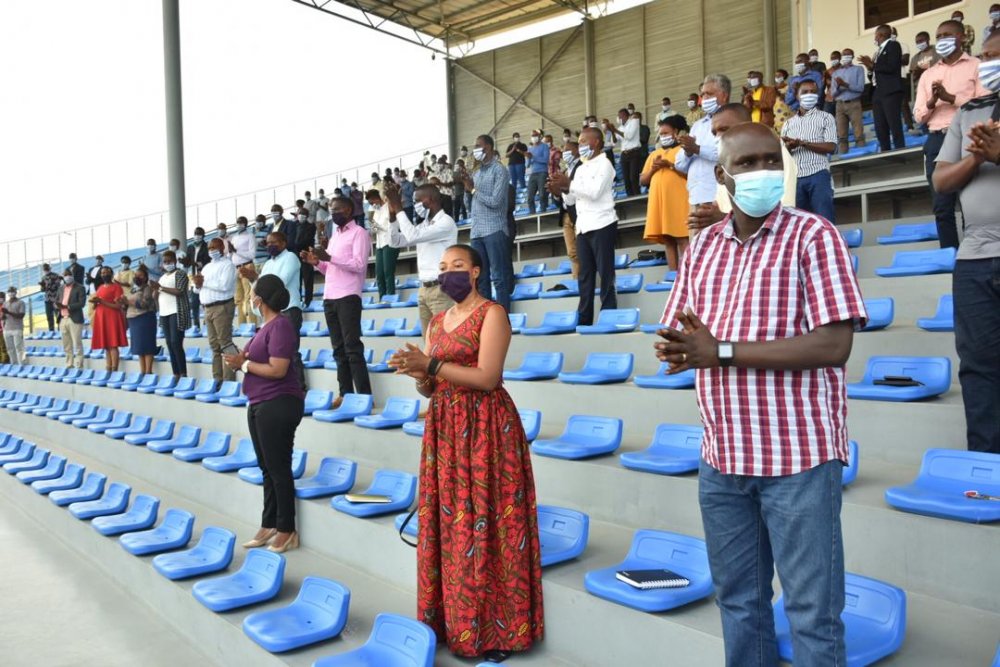
The ceremony in Kigali was co-organized by One UN Rwanda and the European Union. It was segmented by moments of silence to commemorate lives lost during UN peacekeeping operations.
UN Resident Coordinator for Rwanda, Fode Ndiaye reiterated that global cooperation will be key to overcoming multifaceted damages caused by Covid-19.
“This health crisis has created major distraction, distrust, rising vulnerabilities, inequalities, racism, populism and nationalism. But it also has shown the importance of international cooperation. No one will be safe unless all are safe,” Ndiaye said.
The year 2020 theme is “The Future we want, the UN We need; reaffirming our collective commitment to multilateralism”.
Ndiaye suggested that responding to the pandemic collectively reflects the organization’s commitment to promote multilateralism as reaffirmed by a global survey framing the UN towards its centenary in 2045.
To meet priorities voiced by one million responders including access to basic services such as healthcare, sanitation and education, great international solidarity will be key, according to the survey.
“Over 87 percent believe global cooperation is vital to deal with today’s challenges and the pandemic has made international cooperation more urgent forever,” Ndiaye said.
On peace, he stated the UN has prevented the world from a third world war by negotiating 172 peace settlements and making the world nuclear free.
Speaking on the shortfalls, Ndiaye conceded UN’s failure to prevent the 1994 Genocide against the Tutsi.
“In Rwanda, it is a fact that the UN and the international community failed the country in 1994 to prevent the genocide against the Tutsi,” he stated, adding, however, that the body acted rapidly to provide humanitarian and development support to rebuild the country.
Nonetheless, the UN’s Global Peace Index for 2020 indicated that the world was more peaceful a decade ago than now.
The UN 75th anniversary ceremony also saw an official launch of the Integrated National Financing Framework (INFF) aimed at supporting particularly the National Strategy for Transformation (NST1).
Prime Minister Ngirente said the initiative “will strengthen our capacities to mobilise resources required for the implementation of our national priorities and the 2030 Agenda.”
By this launch, Rwanda becomes one of the first 17 nations worldwide to be part of a new initiative for countries to identify areas for strengthening their management of financing for the SDGs with Integrated Financing Solutions.
The United Nations is celebrating its 75th anniversary; it started operation on October 24, 1945, replacing the UN General Assembly, which failed to prevent World War II. The organization was made up of 51 countries but currently has 193 countries members, including 54 countries from the African continent. The main mission of the organization is to preserve the peace and security of the world.
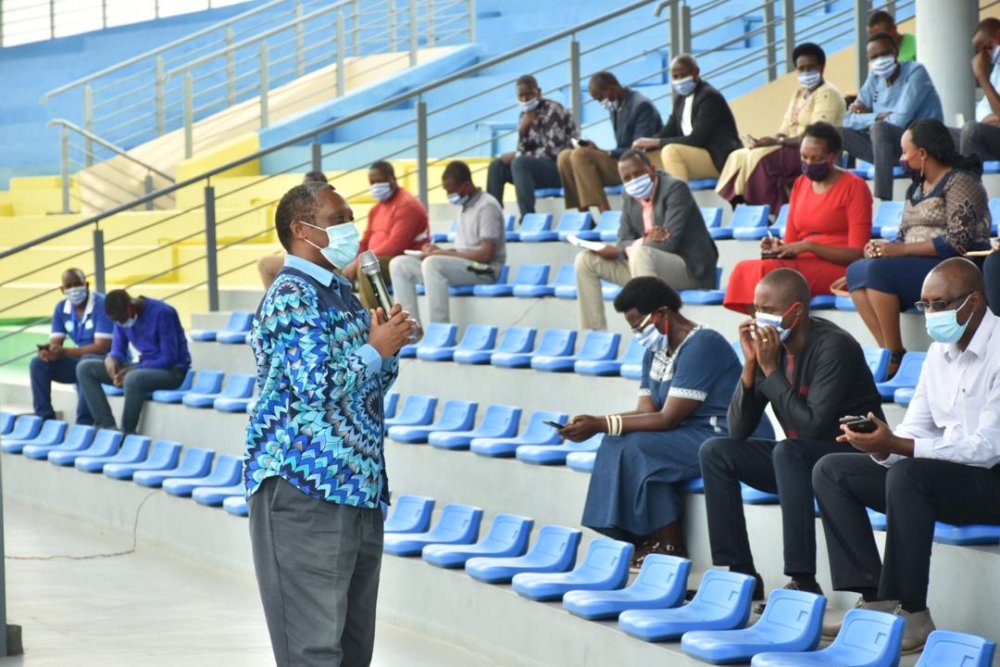
The Minister made the remarks on Saturday, September 19, 2020 during a visit to Bugesera District, where he spoke to representatives of local authorities, the private sector and opinion leaders in the area.
Shyaka told local authorities that their reputation as “Abakeramurimo ba Bugesera” should strengthen their commitment towards strategizing for inclusive development without leaving anyone in all people-life-changing programs.
“If you don’t want to be called ‘work delayers’ you should take care of these issues that are still prevalent in the community and solve them in a short time. Your district is rich compared to others; you should, therefore, act and behave like those who understand they are lucky among many others,” he advised.
So far 77.7% of the population of Bugesera District has already paid their health insurance contributions, and only 18.6% of the population has already contributed Rwf 44.7 million on their Savings while the entire district has a target of Rwf240 million this year.
On the other hand, there are still emerging issues including families with no houses, lack of toilets, malnutrition in children and poor hygiene.
Some of the leaders immediately vowed before the Minister that in two weeks’ time, they will have addressed the major challenges in the district including mobilization of the population to subscribe for mutual health insurance and child malnutrition.
The Bugesera Private Sector also committed to making a significant contribution to addressing social and development challenges.
Bugesera has a population of 479,624 living on an area of 1,337 km2; the majority are farmers, while others are involved in different activities including fishing in the lakes of Cyohoha, Gashanga, Kidogo, Rumira, Mirayi, Kirimbi and Gaharwa.
Half of the grant (Rwf72 billion) will be provided as loans, while the rest will be provided as grants.
The World Bank has been supporting Rwanda for more than 10 years in various energy-related projects under the government’s plan to provide electricity to all Rwandans by 2024, as well as a program to promote the use of renewable energy, which will be used by ‘all Rwandans by 2030.
The money will be used to expand the Ntaruka Dam, rehabilitate power lines to reduce wasted electricity, modern lumbering programs and promote the use of renewable energy.
Rolande Pryce, the World Bank Country Manager for Rwanda, said the funding came in the right time because it was in line with the government’s plans to distribute electricity to all.
“The project has come a long way in strengthening aid that has been in place for more than 10 years and the World Bank is supporting Rwanda in its energy distribution programs. It will therefore help in the government’s plan to provide electricity to all in 2024. We are proud to be Rwanda’s partners in this program,” she said.
The World Bank already supports Rwanda in other development programs including; distribution of electricity, agriculture and education among others.
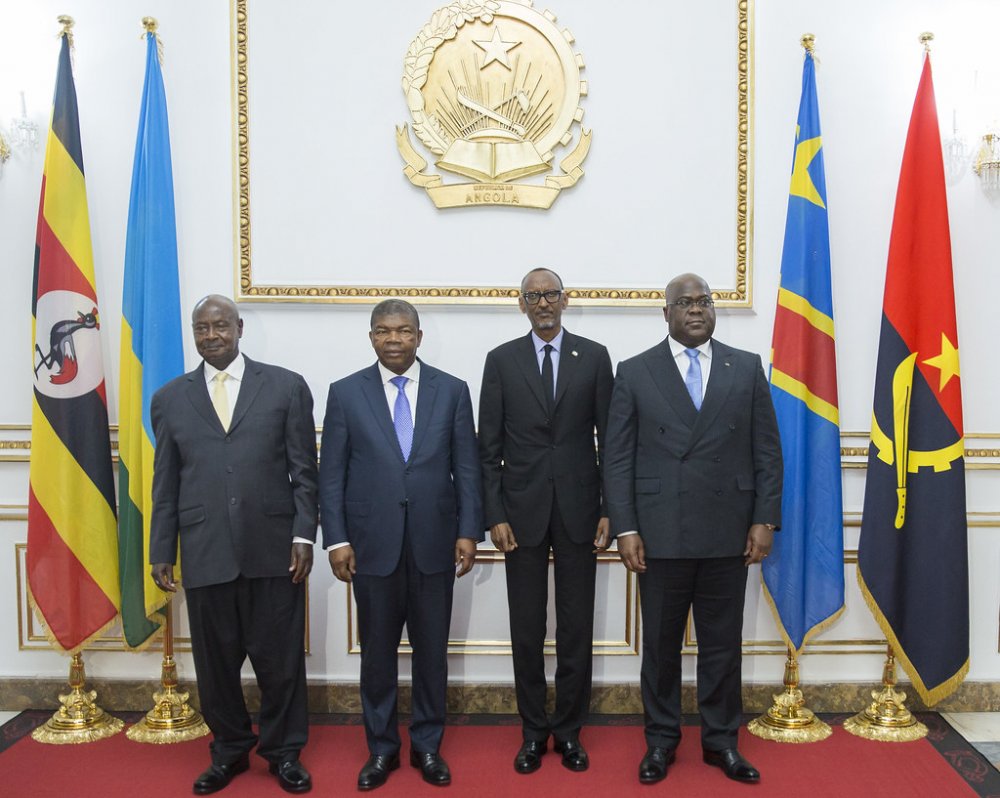
The meeting which was formerly convened by the DR Congo President Félix Tshisekedi was initially planned to be held in the border town of Goma and attended physically by Heads of State of the five countries; however, a decision was reached to hold the meeting virtually in light of the Covid-19 pandemic which has, among other things, seen land borders across the region closed.
A message issued by the Minister of Foreign Affairs of the DRC, Marie Tumba Nzeza on Thursday, September 17, 2020, said: “The Ministry of Foreign Affairs of the DRC would like to thank the fraternal countries of Rwanda, Uganda, Burundi and Angola for their cooperation in conducting the study at the scheduled meeting, which resulted in the above conclusion.”
The date of the virtual meeting is yet to be set. The key issues of common interest include regional stability, security and countering terrorism.
Angola and DR Congo are also involved as mediators in restoring warm ties between Rwanda and Uganda through the Ad Hoc Commission on the Implementation of a Memorandum of Understanding signed in Luanda in 2019.
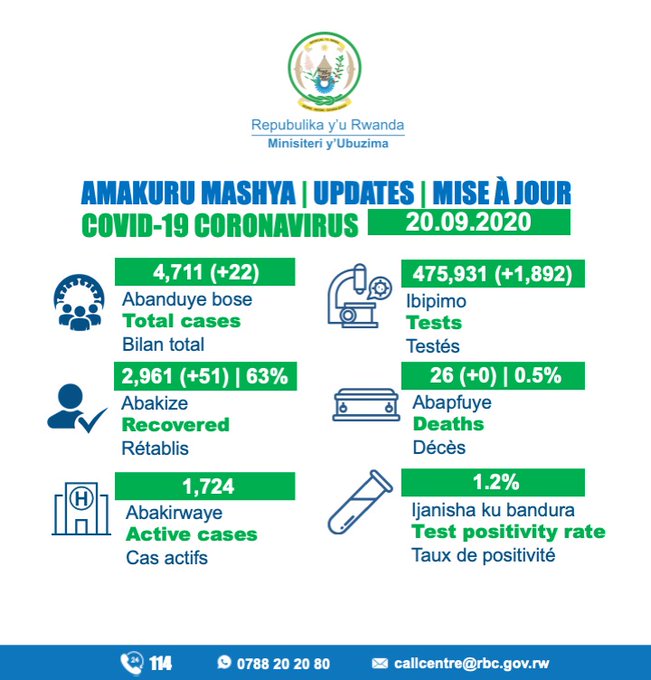
According to the Ministry of Health, on Sunday, September 20, the country also reported 22 new cases.
Of the new cases, 14 were detected in Kigali’s high-risk groups, whereas Nyamagabe and Burera districts confirmed 7 cases and one case respectively.
The results were obtained from 1,892 sample tests taken in a single day.
In total, since the outbreak of the pandemic by mid-March, Rwanda conducted 475,931 tests.
Of all tests, the country reported 4,711 confirmed cases, of which 2,961 people have recovered.
The country’s Covid-19 death toll so far stands at 26 people.
Coronavirus symptoms include coughing, flu, and difficulty in breathing. The virus is said to be transmitted through the mucous membranes of the respiratory tract.
Rwandans are required to continue complying with government regulations, especially with frequent washing of hands and water and soap, wearing masks when leaving home or in public.
Majority of the violators were the youth, some of whom were at the time found playing football while others engaged in varied sports disciplines.
Earlier on, the group first took to the road to jog before they started playing football and other body contact sports, all of which are prohibited in this period due to the risk they pose in spreading COVID-19.
At the time, they were found with no facemasks and body contact was the norm.
The violators were enlightened on the pandemic of novel Coronavirus, government directives in this period including safety practices and were, afterwards, penalised for the violations.
The acting Western Regional Police Commander (RPC), Chief Superintendent of Police (CSP) Edmond Kalisa reminded them that sports activities are not prohibited but have to follow the recommended safety guidelines to prevent catching or spreading COVID-19.
“What you did today could have exposed all of you to the virus, if one of you was infected, which could as well be a danger to your respective families,” CSP Kalisa told the group of violators.
“There are allowed and prohibited sports disciplines; football, sports done in groups or those that can lead to body contacts are prohibited. You can only do any sport activity individually but not as a group,” he added.
The mayor of Rubavu, Gilbert Habyarimana warned the youth against undermining the safety directives intetionally, adding that this will not be tolerated.
When the method is to be employed, as soon the expecting mother begins to feel labor pain, she is injected with the concoction, which protects her from pain until she gives birth.
A professor at Duke University in the United States, Prof. Ayedemi John Olufolabi, explained that the process that is going to be introduced in King Faisal hospital will assuage mothers’ pain.
“A catheter helps us to inject drugs into the muscles that cause a woman to have a lot of pain to reduce it, with medical doctors in attendance.”
Dr. Muhumuza Samuel, an expert and an Anesthesiologist in King Faisal hospital, explained that the procedure was aimed at reducing the pain mothers feel due to labor.
“This approach is complementary to what we used to do to reduce the pain caused by so-called ‘spinal analgesia for labor’, but it doesn’t remove all the pain.”
“The pain a mother has during childbirth can have a devastating effect on the baby and the mother; at times, a mother fails to breastfeed or does not want to cuddle the baby ld. because of the pain she felt while giving birth.”
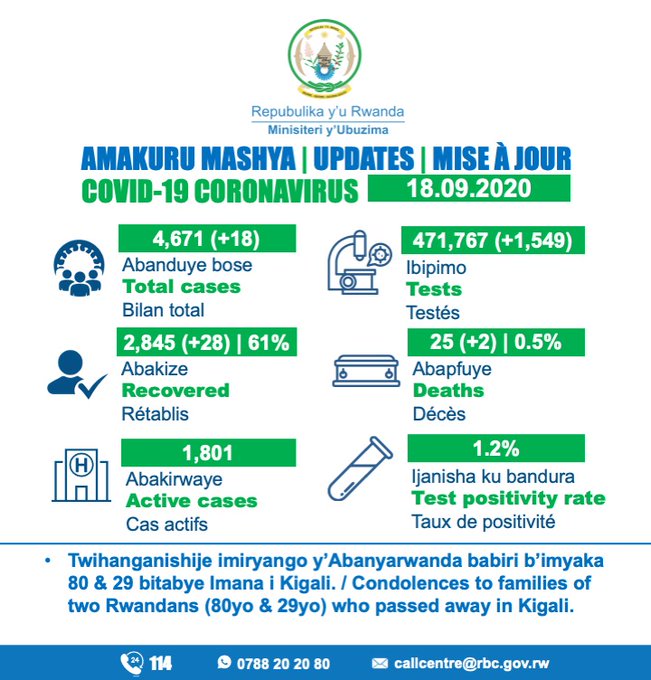
According to the daily update by the Ministry of Health, the two victims are a 29-year old and an 80-year old, all residents of Kigali.
“Condolences to families of two Rwandans, 80-year-old and 29-year-old, who passed away in Kigali,” the Ministry said, while 18 new cases were reported, out of 1,549 tests, taking the total number of cases in Rwanda so far to 4,671.
On the same day, the Ministry also reported 28 recoveries, taking total recoveries to 2,845, while the number of active cases is now 1,801.
Out of the new cases, nine patients were identified in Kigali, four in Nyamagabe, four in Rubavu and one in Bugesera district. So far 471,767 tests have been conducted since the first case was detected on March 14, 2020.
Coronavirus symptoms include coughing, flu, and difficulty in breathing. The virus is said to be transmitted through the mucous membranes of the respiratory tract.
Rwandans are required to continue complying with government regulations, especially with frequent washing of hands and water and soap, wearing masks when leaving home or in public.
More than 7.5million Rwandans currently have National IDs. It is an exciting step because for it has been 26 years that the Genocide against the Tutsi was stopped, and Rwandans are proud to have documents that do not contain racial discrimination.
Rwandan history shows that during the colonial era, what was once a wealthy class of Rwandans was transformed into ethnics and the colonists began to include it in Rwandan documents called “books” which later came out of the paper identity card.
In an interview with RBA, Antoine Mugesera, an expert in Rwandan culture and history, said that the “Book” consisted of about 10 pages.
“It was a little booklet, they called it a book. They used the book to segregate indegenous Rwandans from the twenty families, the Singas, the Zigabas, the Geseras among others,” he said.
The identity card was widely used in the Genocide against the Tutsi, where at various barriers they were set up, the Interahamwe asked for it looking for who to kill.
Mugesera says that in the aftermath of the Genocide against the Tutsi, things have changed and ethnicity has been removed from identity cards.
“I was one of the founders of the project, I was raised by the commission that issued it in 1995/96; Arusha had confirmed that the identities containing the so-called ethnicities would be removed, and that Habyarimana wanted to do so and changed his mind. It was not an easy thing to do for him”.
A 16-year-old Rwandan is currently allowed to obtain an identity card, as a proof of identity.
Mukesha Josephine, director general of the National Identification Agency, said the study of identity thesis was in line with modern technology.
“There is a program called ‘digital ID’ which means that you still have your physical ID, and can present it to access your digital information. You can even place your signature on it and there are no gaps allowing for it to be used by another person,,” she said.
In 2016, the agency announced that the digital ID would be combined with up to seven other documents including identity card itself, driver’s license, RSSB number, insurance, tin number and family members among others. It will cost Rwf15,000.
Currently, 7,586,813 Rwandans have IDs, of which about four women.