The successful operations were conducted separately in Thursday and Friday.
In Rubavu District, the duo of Boniface Subiramunama, 46, and Rafita Mujawimana, 28, were arrested on Thursday, May 20, in Rugerero Sector, Rugerero Cell with 4,300 pellets of cannabis.
Another bundle of 7,889 rolls of cannabis was seized in the morning of Friday, May 21, from two other traffickers, who managed to flee after sneaking the narcotics into Rwanda from the DRC through Myiha Cell, Muhororo Sector in Ngororero District.
Chief Inspector of Police (CIP) Bonaventure Twizere Karekezi, the Police spokesperson for the Western region, said that Police had information on the two drug trafficking rings.
“In Rubavu, Police first arrested Subiramunama, who disclosed Mujawimana as his supplier. He had just collected the narcotics from Mujawimana when he was intercepted by the Police.
Police has since established that Mujawimana has a brother working as a taxi-moto operator in DRC, who sends her the narcotics, including this specific consignment of 4300 pellets,” CIP Karekezi said.
In Ngororero District, he said that law enforcement organs are still searching for the two people, who dropped a sack containing 7889 pellets of cannabis and run away.
“Narcotic drugs are among the high impact crimes because of the related consequences including health effects and youth development since they are the majority abusers. This is why penalties are severe.”
Cannabis is classified as a “very severe drug” in Rwanda.
Article 263 of the law determining offenses and penalties in general, provides a sentence of between 20 years and life in prison for anyone convicted of dealing in “very severe narcotic drugs” and a fine of between Rwf20 million and Rwf30 million.
The majority of new cases were found in Karongi: 18, Ngororero: 11, and Nyamagabe: 11.
Rwanda confirmed the first Coronavirus case on 14th March 2002. Since then, 26 601 people have been tested positive of whom 24 967 recovered, 1285 are active cases while 349 have succumbed to the virus.
A total of 350, 400 people have been vaccinated since Rwanda began countrywide inoculation programme on 5th March 2021.
Coronavirus symptoms include coughing, flu, and difficulty in breathing. The virus is said to be transmitted through the mucous membranes of the respiratory tract.
Rwandans are urged to adhere to COVID-19 health guidelines, washing hands frequently using soaps and safe water, wearing face masks and respecting social distancing.
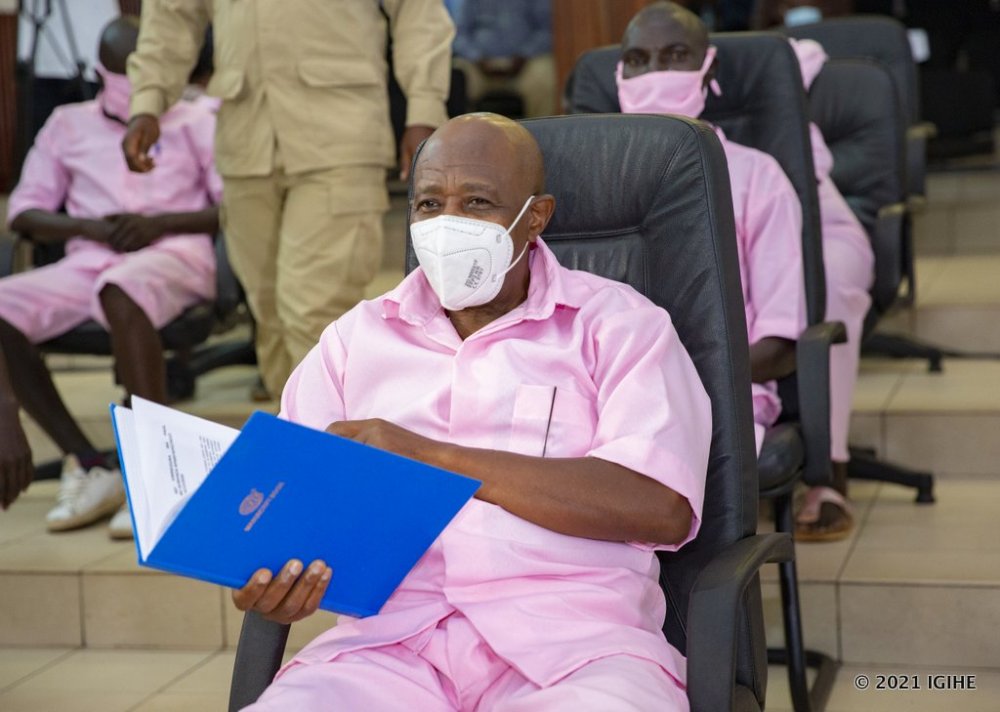
Arrested last year, Rusesabagina faces nine counts linked to terrorism, and he is co-accused with other 20 individuals who were allegedly involved in terror attacks that took place between 2018 and 2019 and claimed nine lives.
During trial proceedings, Rusesabagina has been heard claiming that he was abducted.
This prompted the prosecution to request the court to allow a Burundian Bishop, Constantin Niyomwungere, who rused Paul Rusesabagina until his arrival to Rwanda to provide testimonies showing how the latter was not abducted but tricked by his trusted friend until he arrived in Rwanda.
Commenting on why people make a lot of noise claiming that Rusesabagina was tricked into Rwanda, the President labelled him a “criminal” getting fair trial along with 20 co-accused terror suspects.
“What is wrong with tricking a criminal you are looking for? When you get him, where do you put him? If it is in a court of law, I think that is okay,” he stated.
He explained that these suspects who committed these crimes against Rwanda and Rwandans are all appearing in court highlighting that some of them are giving overwhelming evidence against him (Rusesabagina).
“So, I do not see why people make a lot of noise. He is in court of law. He is not just being, you know, hidden somewhere under arrest. He is in a court of law, like many others,” he said.
Talking about the United States and European Union’s concern about him, Kagame stressed that Rwanda has all it takes to try him fairly.
“Sure, I am calling for fair trial myself. So, it is not UK, US, or the European Union. No. I want to see a fair trial myself. Why do you think being fair belongs to Europe, or US or anybody else and not to us – why? This is how people, you see, end up being caught up in some of these useless things, and they end up being racist. It is like the only thing to be fair in Rwanda or in Africa, has to be supervised by Europe or US or some other place. No. Absolutely not,” he affirmed.
{{Excerpts:}}
{{MP: Hello and welcome on FRANCE 24 and Radio France International for an interview with the President of Rwanda Paul Kagame. With me for this interview, Alexandra Brangeon from rfi. Mr. President you are welcome. A recent report by French historians was commissioned by the French President Emmanuel Macron and the report concludes that France had an overwhelming responsibility in the 1994 Genocide against the Tutsi. The French President is scheduled to visit Rwanda in a few days, is this a watershed moment in the relationship? Are we on the brink of formalization of the relationship between France and Rwanda?
}}
{{PK }} – To begin with, with all you said, I think this is a big step forward that is welcome by Rwanda and I guess by many in France, that we can have these facts, the truth, established, by independent people, by independent commissions. Because there is a report by Duclert and another commission on our side by Muse. There is convergence as to the facts and evidence for what happened, and I think France and Rwanda have a chance now and good basis on which to create a good relationship as the case should have been. Then the rest we can leave behind us, may be not forget it but forgive it, and be able to move forward. I think that is the most important thing. So, I think we are really moving very well forward.
{{AB: Mr. President you talk about moving forward. Now this report concluded that France bears an overwhelming responsibility, but it does not conclude that France was complicit. Do you agree with that conclusion?}}
{{President Kagame}}: I agree with many things that the two reports established, and I think more work can still be done moving forward, but the most important thing has been covered, and that is when you talk about the overwhelming responsibility. That is loaded, it is huge, it means a lot. So, it Is not up to me to conclude and say this is what they should have said, or this is what it is. But it is something I can accommodate, and say okay, let us go with the most important thing that has been established by both – that overwhelming responsibility.
{{AB: You say ‘accommodate’, but less than 10 years ago in an interview in 2014, you said France was not only complicit but actively participated in the execution of the Genocide. So, what has changed between now and then?}}
{{President Kagame:}} For me I am entitled to my own opinion, because I also lived this situation, I was in it, so I said what I said, and I may even believe what I said then, or even now, but we are talking of independent commissions that went into what they did, and the fact they did not come to the same conclusion one way or the other, well that’s their problem, not mine.
{{MP: United States, United Nations, Belgium – former colonial power, have all formally apologized for what they did or did not do back in 1994. France has not done so; would you like France to do so as a gesture of good will to build this new relationship that you are describing?}}
{{PK –}} All that matter is up on France to decide what they think is best for them. The worst thing I can do, which I would not actually wish to do, is to ever ask anybody to apologize or to do this or do that. I leave it to them because that is when it comes out honestly, genuinely, and people, the world judges, not just me.
{{MP: But it would be an important gesture. I understand you would not go for it, but if it happened you would deem it as an important…}}
PK – I think so. If anybody recognizes a problem and does something about it, I think that would make the best outcome, and absolutely I would appreciate that.
{{MP: As you would appreciate the French Ambassador going to Rwanda after years of not…}}
{{PK – }} Yes, we are in the process of normalization…
{{MP: You think this is on the horizon, I mean very soon?}}
{{President Kagame:}} I would wish that was the case. Again, that is a matter for France to decide.
{{MP: A few months ago, France had Felicien Kabuga arrested. He was the financier, if I may use that expression, of the Genocide. Does this signal in your eyes, that France is really, finally willing to go after these so-called Genocidaires on its soil?}}
{{PK }} – Well, I think it is a good start. And may be more could be done. So, my perspective is that we can encourage more good things to happen, if France is willing to do that. There is still a number of genocide suspects here in France whose cases have not been handled the way they should.
{{MP: Let us take an example of Agatha Habyarimana, the former wife of the killed President. She is in legal limbo here in France. Would you like France to kick her out, extradite her? This would obviously be a very symbolic gesture. It has been hanging over the relationship for years now.}}
{{PK:}} I think we can continue to get things done much better. Whether Agatha or other individuals, they are many here, and as I said…
{{MP: But she would be an important one, you agree with that.}}
{{PK –}} She is one of those. She is on the list, there is no question. On the long list she is at the top. But France will decide what to do. I am not going even to advise them what to do. I can only request them, may be, and that should be done officially in an official communication, but I am not going in any way to tell them what to do. I can only request them what to do.
{{AB: Staying with justice and accountability, last month the Congolese Nobel Peace Prize Winner, Dennis Mukwege was in Paris. He called and he asked France to help bring justice to those responsible of crimes in Eastern Congo, some of them were committed by soldiers of the region – Congo’s neighbors, that is according to UN experts. Would you agree to have Rwandan officers prosecuted for crimes committed in Eastern Congo in the wake of the Genocide?}}
{{PK –}} As you might be well aware, the mapping report has been extremely controversial, in actual fact, highly disputed by people in Congo and in the neighboring countries. It was highly politicized. Mukwege becomes just a symbol or a tool of these forces you don’t get to see, and he is made a Nobel Laureate, and therefore is told what to say. And by the way there are also other reports that dispute and say completely the opposite
{{AB: The opposite, that there were no crimes committed?}}
{{PK – }} That there were no crimes, yes.
{{AB: In the Eastern Democratic Republic of Congo? }}
{{PK –}} Absolutely. And not by either the individuals or countries talked about. It is the theory of double genocide playing out here.
{{MP: In the east of congo the security situation continues to be very bad, some say continues to deteriorate. The Congolese government has decreed a state of siege into areas of Ituri and North Kivu, for thirty days, may be longer; is this a good move, do you agree with it? }}
{{PK –}} The state of emergency for me was like saying there is a big problem here, lets take measures that give us a good start to deal with it. This is why I am saying it is one thing to establish a state of emergency, even me I would do that. But I would follow it up also with a well thought out planned actions to actually deal with it in concrete terms, not to come and run over things again and after five years you still have the same or even a much bigger problem. But we have also had the UN forces, and the UN from outside, for now 24 years. There are still these responsibilities for the world that are kept, you know, silent about or put under… and nobody says, yeah, but what have you been there for all these 24 years? You went there to solve a problem – what happened?
{{MP: It is a failure?}}
{{PK –}} I think it is a big-big failure. It is an understatement, to say it is a failure.
{{AB: Now talking about doing more, your country and Congo seem to have better relationship since Tshekedi was elected. You both agreed to reinforce security at the borders between the two countries to tackle the rebel groups that are operating in that region. How far are you in these talks? Are you talking about joint military operations for instance?}}
{{ PK –}} We are still having a good discussion. But the most important thing here is, at least there is that environment where we can talk to each other, which was lacking before. And then, always people working together will find a solution.
{{AB: But joint military operations could be envisaged? }}
{{PK –}} I guess that would not be out of the question. But it always depends on the situation at hand and what people see, always the two sides will talk and see if that is going to work, what are the costs, what are the benefits, and the decision can be made. I think here people need to be flexible.
AB: Because you know UN experts are saying that Rwandan troops are already intervening in the DRC and already conducting operations.
{{PK – }} Yeah, but I wish they could go beyond that, and ask themselves, meaning the UN: Why would Rwanda have to go to Congo at all, when they are the ones responsible for the situation?
{{MP: So, but does that mean that you are acknowledging that Rwandan troops are in the DRC? }}
{{PK –}} No, I am acknowledging that the UN making that report is actually a failure in the Congo. That is what I am trying to say.
{{AB: They are failure?}}
{{PK: }} Yeah, total failure.
{{MP: So, are the Rwandan troops in the DRC as we speak?}}
{{PK – }} No if we were there we would not be failing. I assure you we would not fail to deal with the problem.
{{AB: So, coming back to Rwanda and your internal problems as you mentioned them, Paul Rusesabagina is currently on trial in Kigali, and he is charged on nine accounts, including terrorism for his alleged support to armed groups. He claims that he never condoned violence.}}
{{PK –}} One, he is not alone by the way in the trial. There are over 20 people who are being tried together with him. They were together committing these crimes against Rwanda and Rwandans. They are all appearing in court, and in fact some of them are giving overwhelming evidence against him. So, I do not see why people make a lot of noise. He is in court of law. He is not just being, you know, hidden somewhere under arrest. He is in a court of law, like many others.
{{AB: You are saying why do people make a lot of noise, also I think probably because of the way he was arrested. He says he was tricked into coming to Rwanda.}}
{{PK –}} What is wrong with tricking a criminal you are looking for? When you get him, where do you put him? If it is in a court of law, I think that is okay.
{{Marc Parelman: But the US, EU and others have expressed their concern about him getting a fair trial. When they say this, they suspect that this is actually not the case because of the way he was tricked, and because they don’t think he will get a fair trial. You have to be concerned when you hear this.}}
{{PK – }} Sure, I am calling for fair trial myself. So, it is not UK, US, or the European Union. No. I want to see a fair trial myself. Why do you think being fair belongs to Europe, or US or anybody else and not to us – why? This is how people, you see, end up being caught up in some of these useless things, and they end up being racist. It is like the only thing to be fair in Rwanda or in Africa, has to be supervised by Europe or US or some other place. No. Absolutely not.
{{AB: Or may be the concern is because several think tanks or organizations have accused your regime of suppressing all types of descent. I will give you another example of the arrest of the gospel singer, Kizito Mihigo, who became a critic of your regime. He was accused of inciting hatred, and he died in police custody. The official version is suicide, but human rights organizations are doubting that.}}
{{PK – }} The concerns will be there, but who tells you I do not have those concerns myself? But everything will be cleared by investigation and through the court of law.
{{AB: So, would you accept a probe? They are calling for an independent investigation?}}
{{PK –}} Independent what? You mean we should always be having independent investigation for things that happen here in Paris or in France?
{{AB: Mr. President you have been Head of State for 21 years. Next presidential elections are in three years. Will you be running?}}
{{PK –}} You know above all, I wish God continues to give me good health, that is at a personal level. The rest about politics, Rwandans will decide, and maybe I can also decide. I can decide even when Rwandans say, no we still want you. That is something important. But I can say you know what, I feel I need to go and do something else.
{{Alexandra Brangeon: Mr. President thank you very much for agreeing to this interview. And thank you to our listeners and viewers of France 24 and rfi – Radio France International. }}
{{President Kagame}} – Thank you
{ {{Transcribed by Kabagambe R. Ignatius – on 18/05/2021. The interview was jointly conducted by Marc Parelman of FRANCE 24, together with Alexandra Brangeon of Radio France International – rfi.}}
{{Kabagambe Rwiyemaho Ignatius is the Head of Corporate Communications, University of Rwanda}} }
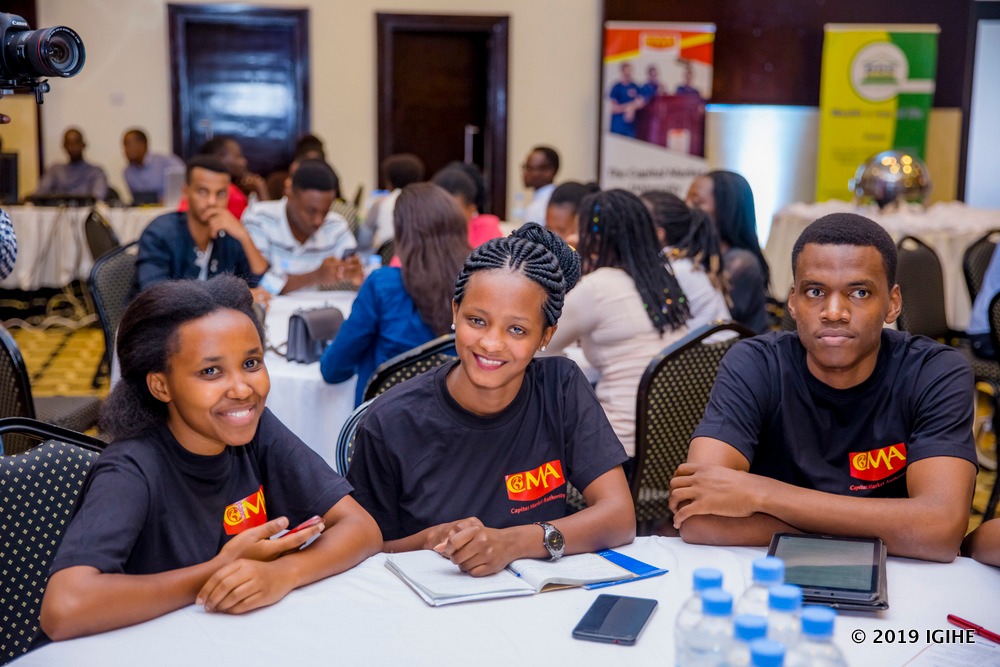
Capital Market University Challenge brings together the youth from higher learning institutions and universities in Rwanda participating in quiz and essay categories.
Awards to the winners of both categories are made available in the form of securities of one of the domestic companies listed at the Rwanda Stock Exchange (RSE).
The competition is aimed at creating awareness among the youth about the capital market and capacitates them to become future investors.
Winners of previous editions have explained that the competition unleashed their potential to explore opportunities presented by the market whereby by they started saving through shares which enabled them to run businesses.
Redempta Singiza was a university student when he participated in the competition in 2017. He was participating along with five members of his saving group which emerged among winners and secured capital to run own businesses.
“We perceived the competition as an opportunity to promote our saving group. I was part of a team of three that competed in the essay category while three others contested in quiz category. Fortunately, both teams emerged overall best performers,” he said.
Winners in quiz category received shares worth Rwf 700,000 in Bank of Kigali Group Plc while colleagues in the essay category received shares worth Rwf 400,000 in I&M Bank as one of companies listed on Rwanda Stock Exchange (RSE).
After graduating in 2018, these students founded a company dubbed ‘Reliable Immense Company Ltd’ to offer training on digital skills and software development.
In 2019, the group traded shares owned in Bank of Kigali to expand business.
“We kept shares in I&M Bank which continue to generate profit. In fact, the Capital Market Authority presents huge opportunity for long-term saving and investment,” explained Singiza.
He requested university students to participate and tap into advantages of the CMA if they are to meet aspirations to become entrepreneurs.
Theogene Kubahoniyezu, a member of the same saving group has emphasized that the competition was a gateway to create own business in Rusizi district. He is also a shareholder of Reliable Immense Company Ltd.
“The competition opened our minds. After opening Reliable Immense Company Ltd, I managed to start own business worth Rwf 2 million from profits of the capital market and our group’s company,” he noted.
The Communication Officer at the Capital Market Authority, Magnifique Migisha has explained that the competition seeks among other things to instill saving culture among the youth and investing through capital market.
“The competition is aimed at creating deep awareness among students about the capital market and instills in them the culture of saving and making investment through the market. We are optimistic that the competition will particularly prepare the youth to become future investors of the market and professionals of the capital market industry who will extend awareness to their colleagues,” he said.
Individuals will compete in both quiz and essay categories after creating an account via http://investor.cma.rw/cmuc/login/index.php
This year, the quiz session will be held virtually through the provided link: http://investor.cma.rw
The registration deadline is set on 21st May 2021.
Felicien Nziyumvira, 25, was arrested on Wednesday, May 19, in Gitwa Village, Shagasha Cell in Gihundwe Sector.
Four other accomplices escaped during the operation, Police said.
Chief Inspector of Police (CIP) Boneventure Twizere Karekezi, the Western region Police spokesperson, said that a group of five people had picked five sacks of clothes from another group of sailors on the shores of river Rusizi.
“Police had reports about chains of smugglers especially dealing in clothes. They include owners of goods, fishermen or people using traditional substandard boats hired to smuggle them from DRC across into Rwanda, in most cases at night through shared water bodies or porous border, and those who pick the goods from the first destination on the border or shores to other destinations in Rwanda,” CIP Karekezi said.
He added that in this specific case, Police received information about boatmen, who had just sneak sacks of clothes into Rwanda from DRC, through river Rusizi at about 9pm.
“The group, which used a remote road, was trailed and intercepted in a forest, four of the smugglers dropped the sacks and fleed but Nziyumvira was arrested in the process and all the sacks of Caguwa weighing 110kgs seized,” CIP Karekezi explained.
He warned that Police and the RPU in particular, has heightened operations against groups of smugglers.
He further warned fishermen against facilitating smugglers.
Under article 199 of the East African Community Management Act, which is also applicable in Rwanda, seized smuggled goods are auctioned.
{{Tax fraud}}
A taxpayer, who commits fraud, is subject to an administrative fine of one hundred percent (100%) of the evaded tax.
With exception to that penalty, the Tax Administration refers the case to the Prosecution service if the taxpayer voluntarily evaded such tax, like through the use of false accounts, falsified documents or any other act punishable by law.
In case of conviction, the taxpayer can be imprisoned for a period between six months and two years.
The statement released last night shows that 105 people have caught the virus while 76 recovered.
The majority of new cases were found in Rubavu: 28, Karongi; 23, Ngororero; 15, Nyamagabe: 12, and Kigali:11.
Rwanda confirmed the first Coronavirus case on 14th March 2020. Since then, 26 529 people have been tested positive of whom 24 884 have recovered, 1296 are active cases while 349 have succumbed to the virus.
Coronavirus symptoms include coughing, flu, and difficulty in breathing. The virus is said to be transmitted through the mucous membranes of the respiratory tract.
Rwandans are urged to adhere to COVID-19 health guidelines, washing hands frequently using soaps and safe water, wearing face masks and respecting social distancing.
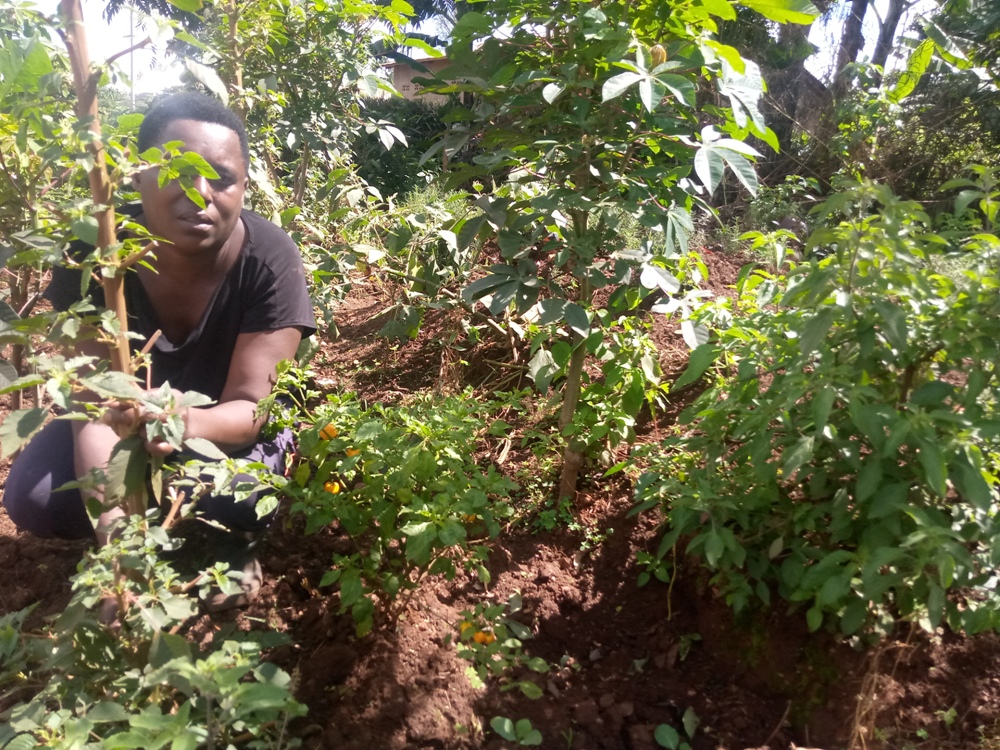
Sylvine Vuguziga is among mothers whose children suffered from malnutrition related diseases because she had no kitchen garden and lacked skills to prepare balanced diet.
“When you don’t have either a kitchen garden or money, it ends up cooking food without vegetables. This is what happened to me that my children were subjected to poor dietary intake until they suffered from malnutrition diseases,” she said.
Vuguziga was among other mothers with children suffering from malnutrition diseases taken to nearby health center from where they learnt how to build kitchen garden and were equipped with best cooking practices to feed children with balanced diet.
Since then, she has never run short of vegetables that she even makes reserve for the market.
Assia Murekatete is another mother whose child suffered from malnutrition. Through kitchen demonstrations where they are acquainted with best cooking practices at village level, Murekatete also learn to build a kitchen garden.
“The money I used to spend on vegetables is currently used to buy sardine fishes or fruits. With the kitchen garden at home, my child’s health conditions has improved for good and won’t suffer from malnutrition again,” she affirmed.
Nyirabunani Fatuma has also revealed that kitchen garden has helped her to prepare balanced diet because she crowds different crops rich in nutrients.
“I used to spend much on vegetables and ripening egg plants but I am currently used to eating fresh vegetables from my garden,” she said.
Apart from improved nutrition, Kayonza residents including Uwimbabazi have started generating income from vegetables grown in kitchen gardens.
“My kitchen garden is productive that I cannot consume all vegetables. To this end, I make reserve for the market and generate income used to cater for basic needs, children’s uniforms among others. For instance, I earn much from cassava leaves unlike the past when I would only earn Rwf 700, an amount that could not feed the family obtained from casual work ,” she noted.
Mukanyirigira Alphonsine also makes Rwf 2000 per week from vegetable sales to people who don’t have a kitchen garden.
These women share common understanding that building a kitchen garden does not require huge budget but rather commitment.
Kayonza district vice mayor for social affairs, Harerimana Jean Damasce has stressed that kitchen gardens have been very helpful to preparing balanced diet and reduced the number of children suffering from malnutrition.
“Apart from kitchen gardens, we have also embraced the Government’s policy of planting three fruit trees per household to complement existing efforts to prevent malnutrition. With these initiatives, malnutrition cases have considerably reduced compared to the previous five years,” she affirmed.
Harerimana explained that the Stunting Prevention and Reduction project (SPRP) has facilitated adoption through trainings to community health workers among others to prevent children’s stunting and malnutrition.
Today, Kayonza district registers 91, 000 households and over 70,000 kitchen gardens.
In 2019, the Government of Rwanda and Qatar Airways have signed partnership agreements that saw the latter investing in the construction of Bugesera International Airport (BIA) estimated to cost $1.3 billion at completion.
The agreement spells out that Qatar will own 60% shares of the airport while the Government of Rwanda will own the remaining 40%.
The acquisition of 60% shares went hand in hand with revised master plan to expand the airport and upgrade it to international standards.
The airport will have the capacity of receiving 7 million passengers on annual basis against 4.5 million of the initial master plan.
Recently on 17th May 2021, the Minister of Infrastructure (MININFRA), Claver Gatete told the media that COVID-19 occasioned delays but highlighted that construction activities are currently on track.
“We faced challenges related to COVID-19 whereby limited number of workers was allowed to prevent spread of the virus. As of today, construction activities are on good progress. The remaining task is to fast track the project’s implementation. Despite the fact that we are working during COVID-19, we are hopeful to complete activities next year, whatever the delays,” he said.
Minister Gatete explained that construction activities have reached nearly 40%.
“The master plan which stalled activities is available. Constructions activities are carried out in framework of the master plan. That is why we are optimistic that to fast track progress of the project,” he noted.
Developing runaways and other infrastructure required for an airplane to use the land is underway while construction of terminals will begin in the next two months.
Minister Gatete said that 13-km road to the airport is among other infrastructures set to be developed in Bugesera district.
Bugesera International Airport will be seated on 2500 hectares.
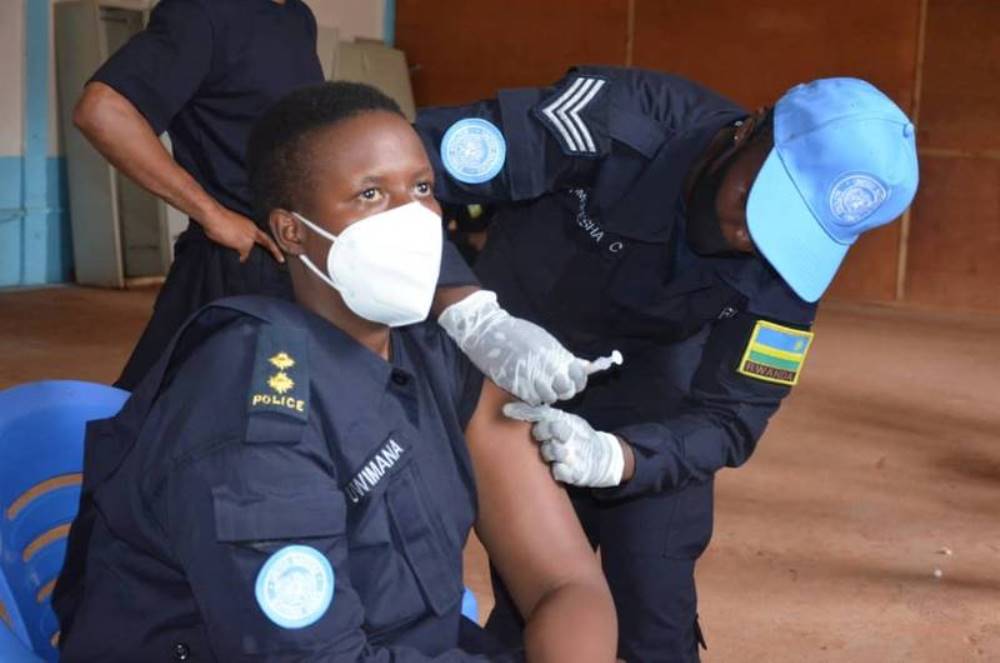
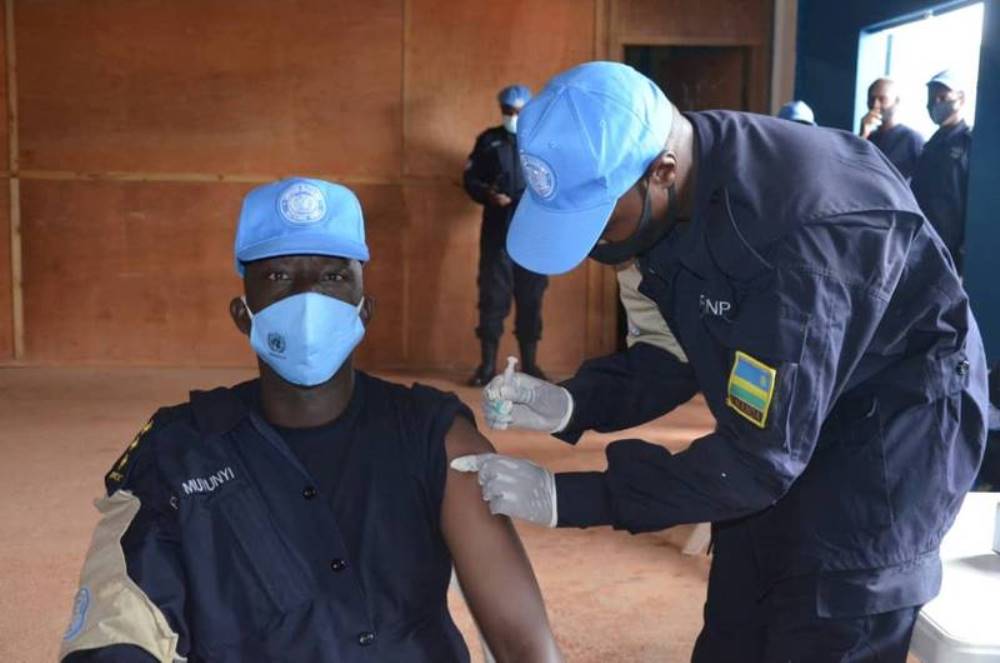
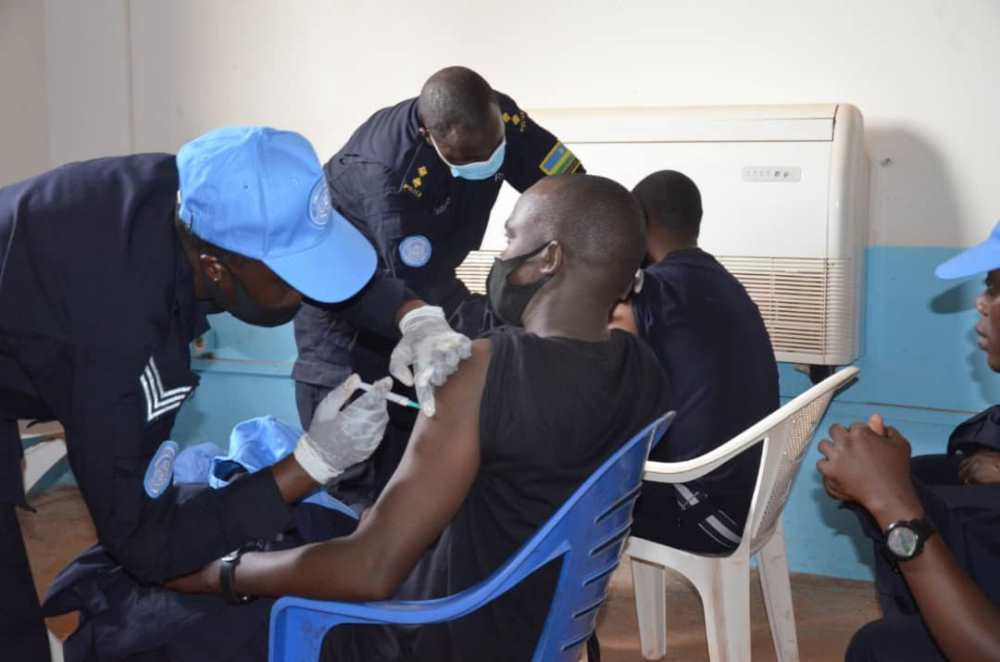
On Wednesday, May 19, officers of Rwanda Protection Unit (PSU) and Formed Police Units-One (FPU-1) serving under the UN Multidimentional Integration Stabilization Mission in Central African Republic (MINUSCA), received their second jab.
PSU1-6 contingent of 140 officers, was deployed last week under the rotation arrangement.
They are largely charged with ensuring security of top CAR officials including the Prime Minister and other government and international VIPs.
The other two FPU contingents serving under MINUSCA, have 140 officers each.
Meanwhile, in South Sudan, officers of Rwanda FPU 1 and 3, are expected to get their second jab this Thursday, May 20.
The two contingents are composed of 240 and 160 Police officers, respectively.
All officers of Rwanda FPU 2 deployed in Juba, South Sudan received their second shot, recently.
The statement released last night shows that 80 people have caught the virus while no one recovered.
Rwanda confirmed the first Coronavirus case on 14th March 2020. Since then, 26 424 people have been tested positive of whom 24 808 recovered, 1268 are active cases while 348 have succumbed to the virus.
New cases were found in Huye: 6, Karongi: 38, Nyamagabe:9, Ngororero: 7, Nyaruguru: 7, Kigali: 4, Rubavu: 4, Ruhango: 2, Rutsiro: 2, Rusizi: 1 and Nyamasheke: 1.
Coronavirus symptoms include coughing, flu, and difficulty in breathing. The virus is said to be transmitted through the mucous membranes of the respiratory tract.
Rwandans are urged to adhere to COVID-19 health guidelines, washing hands frequently using soaps and safe water, wearing face masks and respecting social distancing.