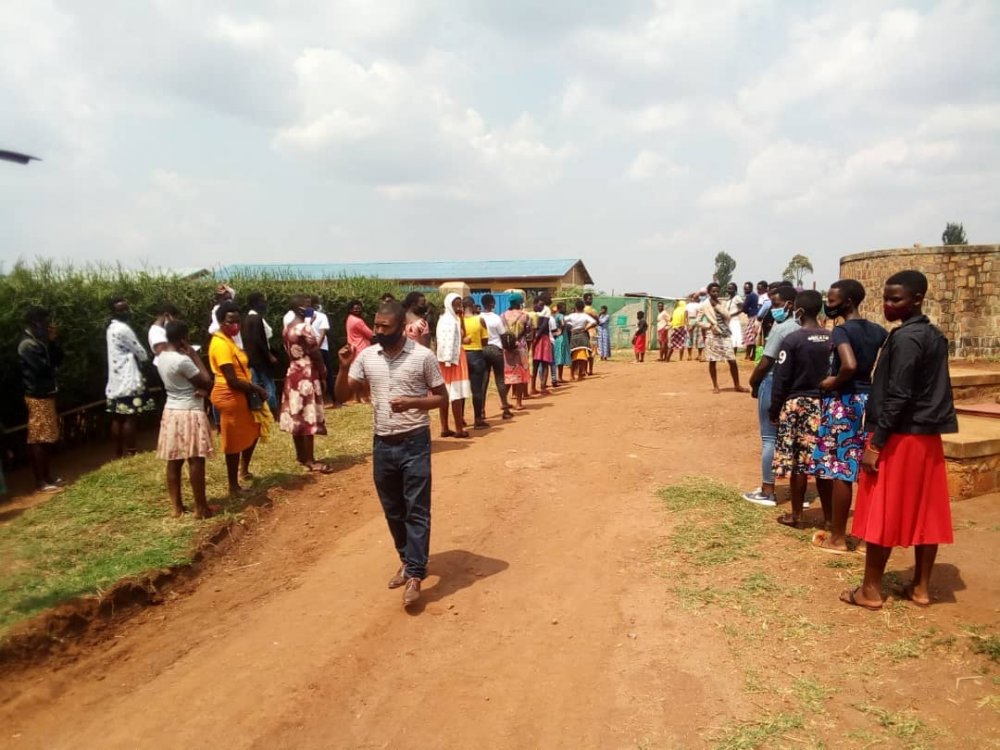
The group was also allegedly ambushing people at night, assaulting them and robbing their valuables.
They were arrested on Thursday, September 16, in operations conducted in Kazirabonde and Gishyeshye cells of Rukoma Sector.
Police also seized from the group six bags of unprocessed minerals.
The Southern region Police spokesperson, Superintendent of Police (SP) Theobald Kanamugire said that the suspects were arrested in partnership with local leaders following separate complaints from residents.
“Local residents in Kazirabonde and Gishyeshye cells have been reporting groups of people armed with machetes, who ambush them at night and rob them of their valuables,” said SP Kanamugire.
“With the help of local authorities and residents, we compiled a list of suspects, all who belong to an illegal mining racket that calls itself Abahebyi. This facilitated the successful operation in which the 12 suspects were arrested. They were found in possession with six sacks of unprocessed minerals and traditional tools their were using in mining and ambushing people,” he added.
There have also been complaints from the management of mineral concessions where the groups were illegally operating. The group include those who were either dealing in drugs of abusing drugs.
All the suspects were handed over to RIB at Rukoma station for further investigation.
Article 54 of the law N° 58/2018 of 13/08/2018 on mining and quarry operations, states that; any person, who undertakes mineral or quarry exploration, exploitation, processing or trading without a licence, commits an offence.
Upon conviction, the offender is liable to imprisonment for a term of between two and six months and a fine of not less than Frw1 million and not more than Frw5 million or only one of these penalties.
The court also orders confiscation of any seized minerals or quarry in storage, trading or processing without a license.
Article 166 of law determining offences and penalties in general states that, any person convicted of theft is liable to imprisonment for a term of not less than one (1) year and not more than two (2) years and a fine of not less than Rwf1 million and not more than Rwf2 million, a community service in a period of six (6) months or only one of these penalties.
In article 167, however, the penalty for theft doubles if the act was carried out at night or by more than one person.
The revelations came out on Wednesday 15th September 2021 as FARG appeared before the Parliament’s Public Accounts Committee (PAC) to respond to mismanagement issues reported during implementation of the aforementioned project.
During the session, it emerged that the funds provided to four group beneficiaries sheltered in One-dollar campaign complex were poorly managed.
The Auditor General (AG)’s report indicated that FARG provided Rwf81,000,000 funding to four groups comprised of 81 beneficiaries sheltered in the housing unit built under One-dollar campaign project (ODCP).
ODCP is a charity initiative started by members of the Rwandan Diaspora in 2008 to mobilise a symbolic one dollar each to raise money to provide shelter for Genocide survivors.
Initially, beneficiaries received Rwf48, 600,000 with a promise to receive more funds after presenting how best the first installment was utilized.
The previous inspection held in February 2021, indicated that two groups received Rwf12, 600,000 and 12,000,000 respectively but did not operate.
There was also a delay in implementation of projects worth Rwf12, 000,000 for one of the four groups that received funding. It is reported that the group started implementation eight months later after receiving funds.
The AG’s report revealed that beneficiaries in one of the four groups shared received funds worth Rwf12, 000,000 instead of using them for intended purpose.
The Director General of FARG, Julienne Uwacu explained that individuals who shared the money had pitched ideas of selling of agricultural produce.
FARG entered agreement with the Association of Graduate Genocide Survivors (GAERG) to follow up their project.
Uwacu said that details of sharing funds emerged when an inspection was carried out following beneficiaries’ request to get the second installment.
“They kept telling us that businesses are still operational. We visited them and refrained from releasing the remaining 40% after realizing that their businesses are not sustainable. The group did not yield intended results because it was split that every member went his/her own way to live in desired favorite places,” she revealed.
Parliamentarian Germaine Mukabalisa said that there should have been proactive measures to prevent the loss and monitor beneficiaries on daily basis.
Emmanuel Munyangondo, the Director of Planning, Monitoring and Evaluation at FARG explained that they followed up beneficiaries but failed to reach out to some of them.
“One of them submitted identifications that he stays in Ntongwe sector of Ruhango district. He gave us contacts that we planned field visits which failed at different times because the beneficiary used to switch off his phone upon arrival in the area,” he said.
The Chairperson of PAC, Valens Muhakwa questioned the response wondering how assigned team failed to reach out to a person living in Rwanda.
“Failing to reach out to people in Rwanda…how come? Does it mean that you delegated someone and came back telling you that he /she didn’t find beneficiaries?”
Mukabalisa also said that it is not reasonable ‘to provide 60% of the total funds without knowing where the beneficiaries are located’.
“How come that a beneficiary disappears when there is an inspection to follow up project implementation. Doesn’t the case involve funds embezzlement?”
The AG’s report indicated that FARG allocated Rwf1, 076,000.000 in 2012/2013 to different districts to support 1065 cooperatives involved in income generating activities.
The implementation has however been characterized by irregularities due to lacking reports on the project’s progress.
The majority of funded projects encountered losses. For instance, 393 projects worth Rwf325, 400,000 an equivalent to 37 percent of all funded projects were not successfully implemented while 35 of them worth Rwf27, 700,000 failed with no clear reasons.
FARG also allocated Rwf49, 500,000 to support 99 small income generating projects.
Each of these projects was supposed to receive Rwf500, 000 but 25 of 73 visited projects halted activities due to various reasons including sickness and use of funds to cater for household needs among others.
Among others, auditors established that 15 beneficiary groups that received Rwf7, 500,000 changed their business models without go ahead from FARG.
{{Unrecovered funds }}
The audit carried out in 2019 indicated that Rwf358, 434,000 that FARG had allocated for lucrative projects were misused and had to be recovered.
Another audit held in March 2021 showed that the funds had not yet been recovered despite ongoing efforts in collaboration with Rwanda Investigation Bureau (RIB).
The Director General of FARG, Uwacu explained that funds allocated to support projects owned by vulnerable survivors of the 1994 Genocide against Tutsi were released following a viable study.
Some beneficiaries implemented businesses different from initially pitched ones. Part of the funds was recovered waiting for the rest to return the money.
Parliamentarian Jean Rene Niyorurema said that beneficiaries used to receive funds without prior training which might have triggered inefficiency.
Uwacu explained that beneficiaries were trained before and received funds in their respective groups through collaboration with grassroots leaders.
MP Germaine Mukabalisa said that the ineffective execution should not only be attributed to beneficiaries but also the committee assigned to oversee these projects that did not fulfill their duties.
The Vice Chairperson of PAC, Beline Uwineza also raised queries to understand stakeholders behind the failure and their actions triggering inefficiency.
Uwacu admitted that FARG is also involved ‘because we would have achieved goals for which the fund was established, had we implemented projects smoothly to transform beneficiaries’ lives. We are responsible for this along with partners.
The development was revealed on Wednesday 15th September 2021 as Rwamagana district officially launched a campaign dubbed ‘Tujyanemo mu kurengera abana’ translated as ‘Let’s walk together to protect children’ aimed at fighting violence against teens and reducing street kids among others.
Rwamagana district vice mayor for social affairs, Jeanne Mutoni has explained that the main objective of the campaign is to seek a solution to problems facing teen mothers and prevent unexpected pregnancies.
“We have so far registered over 180 teen mothers. In collaboration with partners during this campaign, we are going to seek how to bring back to schools those willing to resume studies. We already have partners who committed to provide school kits and plan to work closely with parents to take care of teen mothers’ children as they go back to school,” she he said.
Mutoni revealed that teen mothers unable to return to school immediately will be linked to development partners to enroll them in short-term vocational training to spur their economic growth.
Throughout the campaign which started one week ago, local leaders and partners have been convening meetings with girls aged between 15 and 24 to enlighten them on reproductive health. Among others, parents and teen mothers were also educated while 85 families with former street children pledged to take them back to school.
In the second quarter of 2021, GDP at current market prices was estimated at Rwf 2,665 billion up from Rwf 2,177 billion of the same quarter in 2020.
The statistical report released on Wednesday 15th September 2021 shows that the service sector was the main contributor to the Gross Domestic Product (GDP) with 47%, followed by agriculture (25%) and industry (19%) while 9 % was attributed to adjustment for taxes and subsidies on products.
Unlike the past year, figures released yesterday reflect a good progress on economic recovery from adverse effects of COVID-19 pandemic due to instituted measures to prevent the spread of the virus.
Overall, the GDP grew by 20.6%, while other sectors of the economy including agriculture, industry and services grew by 7%, 30% and 24% respectively.
Overall, agricultural activities grew by 7 percent and contributed 2.0 percent to overall GDP growth.
Within agriculture, the production of food crops increased by 7 percent while the production of export crops decreased by 2 percent.
Industrial activities grew by 30 percent and contributed 5.1 percentage points to GDP growth. The main contributors in the industry sector were construction activities, which grew by 33 percent, and manufacturing activities, which grew by 23 percent. Mining and quarrying activities also increased by 87 percent.
Among others, the growth in manufacturing activities is due to an increase of 111 percent in the production of furniture and other manufacturing, 11 percent in food processing, 39 percent in production of chemicals, rubber and plastic products as well as 47 percent in metal products, machinery and equipment.
Service activities grew by 24 percent and contributed 10.8 percentage points to GDP growth.
Within services sector, wholesale and retail trade increased by 34 percent, transport increased by 48 percent, education increased by 168 percent, information and communication increased by 28 percent while financial services increased by 19 percent.
As per released report, total final consumption expenditure increased by 46 percent in the second quarter of 2021, with household final consumption increasing by 52 percent.
Government final consumption increased by 20%, imports remained constant at 0 percent growth while exports and gross capital formation decreased by 7 percent and 58 percent respectively.
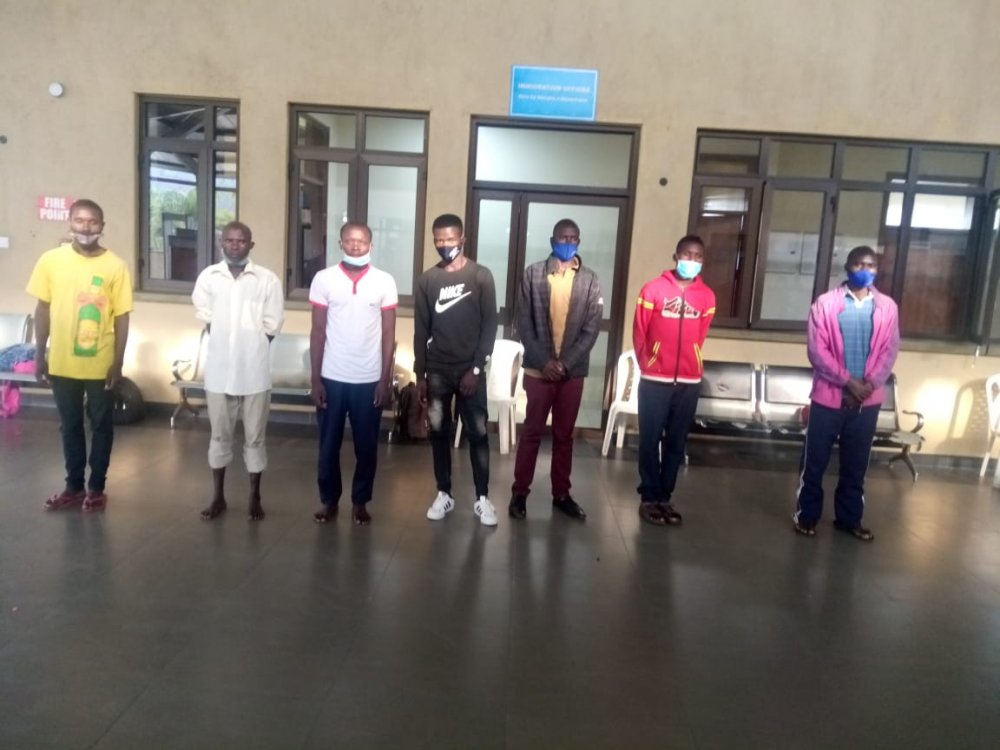
Some of deportees revealed that they were arrested by Uganda’s military and tortured on accusation of illegal entry to the country.
Cyprien Maniriho,28, hailing from Kabaya village, Nkamira cell, Kimonyi sector of Musanze district said that he has crossed to Uganda in 2018 through Cyanika border.
He was arrested in August 2021 by Ugandan soldiers in Mbarara heading back to Rwanda.
Maniriho was first detained in Makenke for one day and later taken to a detention facility in Mbarara.
He was accused of illegal entry to Uganda and spent 21 days in detention.
Bosco Nyandwi is another deportee who went to Uganda in 2018 to run business in Sambya district.
As Nyandwi explained, he was arrested on 19th August 2021 on his way to Kampala.
Nyandwi was first detained in Mbarara on the same accusation of entering the country illegally.
Their deportation follows series of circumstances under which Ugandan officials have been dumping Rwandans at borders following days of torture in detention facilities accused of being spies yet they had traveled to Uganda to run businesses or visit relatives among other reasons.
Recently on 8th September 2021, Rwanda received 16 nationals evicted from Uganda through Cyanika border in Burera district after enduring torture and dispossession of their valuables.
Rwanda, Uganda relations worsened since 2017. Rwanda has been expressing concerns over Rwandans who travel to Uganda for business purposes but are abducted, imprisoned and tortured accused of being spies.
Rwanda also accuses Uganda of hosting dissidents that are posing a threat to national security.
In March 2019, the Government of Rwanda officially advised citizens not to travel to Uganda for their security following testimonies of over 1000 Rwandans tortured and deported from Uganda.
In August 2019, President Yoweri Museveni of Uganda and his Rwandan counterpart, Paul Kagame signed memorandum of understanding ‘Luanda Agreement’ in a bid to solve conflicts between both countries.
Despite efforts to sign the agreement between both heads of state witnessed by mediators including the President of Angola, Joao Lourenço and Felix Tshisekedi of the Democratic Republic of Congo (DRC), the situation is still worsening as Uganda’s Chieftaincy of Military Intelligence continues with arbitrary detention of Rwandans who are subjected to torture in its facilities.
The Deputy IGP made the call on Wednesday, September 15, while officially opening a four-day workshop on ‘community policing approach’ for 110 Police officers held at the Rwanda National Police (RNP) General Headquarters in Kacyiru.
The workshop brought together District Police Commanders (DPCs), directors and Police station commanders.
It was conducted in compliance with the national COVID-19 prevention measures including prior negative test results for each participant.
“Human security has been the priority not only for Rwanda National Police community programmes but also to other security organs since it serves as a major pillar of good governance and security as a whole. So, RNP through its community policing structures should serve as an architecture for promoting human security,” DIGP Namuhoranye said.
He added that poverty, natural disasters and diseases are part of insecurity and that RNP looks at the wider aspect to address causes of criminality or insecurity.
DIGP Namuhoranye reminded the officers to involve the public in all policing activities adding that sustainable human security requires collective participation, identifying community priority needs and joint implementation.
He emphasized the importation of promoting and sustaining community trust and confidence in policing and to be seen as part of the solution to community challenges.
CP Bruce Munyambo, Commissioner for Community Policing in RNP said that the workshop was organized to further enrich the knowledge and skills of officers in community oriented policing.
“This course will enable police officers to have the same view and approach towards sustainable security,” CP Munyambo said.
The workshop, the second of its kind, will cover key aspects of policing including the general security situation, force discipline, impact of Ndi Umunyarwanda on national cohesion and building post Genocide society in Rwanda; stress management and counseling; role of social media in crime prevention, crime prevention strategies and the role of RNP in promoting gender equality.
The statement released last night shows that 488 people have caught the virus out of 13 035 sample tests, six recovered, 22 are critically ill while the positivity rate stands at 3.7%.
A total of 1,138,219 people have been fully vaccinated while 1,829,974 received the first dose of COVID-19 vaccine since Rwanda began countrywide inoculation program on 5th March 2021.
Coronavirus symptoms include coughing, flu, and difficulty in breathing. The virus is said to be transmitted through the mucous membranes of the respiratory tract.
Rwandans are urged to adhere to COVID-19 health guidelines, washing hands frequently using soaps and safe water, wearing face masks and respecting social distancing.
They were arrested on Wednesday, September 14, after they were found in two separate restaurants, which had been turned into bars located in Rukoroko Village, Mpenge Cell, Muhoza Sector.
They include a group of 18 people, who were found in ‘Be Well Bar and Restaurant’ and 10 others found at La Cortina Bar.
Under the government Covid-19 directives, bars remain closed.
Janvier Mutangana, 32, the manager of Be Well Bar and Restaurant admitted to the violations and asked for leniency.
“When Police officers arrived they found customers overcrowded and drinking. They were about 30 people but some of them run away,” Mutangana said.
Meanwhile, it was not the first time that La Cortina Bar and Restaurant has been operating contrary to the directives.
“I was arrested at about 8pm… I was hosting about 40 clients eating and drinking,” France Marie Niyigena, the manager at La Cortina bar and restaurant said.
The Police Civic Education Officer (RPCEO) for the Northern Province, Chief Inspector of Police (CIP) Alex Ndayisenga said that residents called the Police reporting the violations in the two hospitality establishments.
“The two restaurants had been turned into bars with so many people inside but some of them escaped in the process,” CIP Ndayisenga said.
He warned against such inappropriate behaviours and commended the role of the public in reporting violators and derailing national efforts against the pandemic.
“All national Covid-19 prevention guidelines must be observed including washing hands, maintaining social distancing, wearing well facemask and refraining from operating prohibited services,” he added
The violators were taken to Musanze stadium where they were educated and handed administrative fines accordingly while the restaurant services at the two establishements were also closed for at least 30 days.
Gihembe camp accommodates 9,922 refugees from the Democratic Republic of Congo (DRC).
Some refugees who spoke to IGIHE lamented about the decision by the Ministry in charge of Emergency Management to relocate them to a new camp which previously accommodated refugees from Burundi.
Alice Mushimiyimana is among young people born in Gihembe camp who revealed that it won’t be easy to mix with the new environemnt.
“We are not happy with the decision. We have been familiar with this area which had become our home. Relocating us to another camp seems like we are seeking refuge afresh. Moving to different camps destabilizes our mindsets because there is no assurance that we won’t be moved to another place in the near future. It affects us in no smaller part. We have been living comfortably as proud residents. The relocation revives memories and living conditions in refuge,” she said.
Mushimiyimana said that it would be better resettling them in places where they will stay until they return to their native land.
Théo Mpatswe, another young refugee said that some of refugees are to leave occupations that helped them to feed their families.
“It difficult to get familiar with a new setting especially when you had strong connections with residents. Besides, the relocation will affect us in many ways because parents who have been running businesses to feed families will be hit hard as they get integrated into new life,” he revealed.
Goretti Murebwayire, Gihembe camp manager allayed fears for refugees noting that the relocation is meant to protect their wellbeing by resettling them in a more decent place.
“They should not be worried about the relocation to Mahama because the camp has been operational. Refugees with businesses will continue to enjoy such opportunity in Mahama camp and receive existing support. I would like to assure them that Mahama is more decent than this camp,” she explained.
Relocation of refugees from Gihembe camp will resume on 20th September 2021 where a total of 500 refugees will be relocated joining more 520 families comprised of 2393 refugees resettled to the place in May 2021.
Gihembe camp accommodates 9,922 refugees from 2227 families expected to have been relocated to Mahama camp by December 2021.
This initiative consists of various interventions that will ensure all MTN services offered are more inclusive and accessible to all members of society with specific emphasis on people with disabilities.
“Here at MTN, our customers are our priority, and we are constantly looking at how we can better serve all members of the diverse communities we operate in. Today, we are pleased to be partnering with the National Union of Disabilities’ Organizations in Rwanda as we embark on a journey to ensure that the services we offer are even more inclusive and accessible to persons with disabilities.
We are currently implementing interventions within our call center, shops, distribution footprint and marketing advertisements, which fall directly in line with our core belief that everyone deserves the benefits of a modern connected life,” expressed Mitwa Ng’ambi, MTN Rwanda Chief Executive Officer.
As part of the Twese Initiative, MTN Rwanda will progressively enhance its service centres to ensure they are physically accessible and inclusive for persons with disabilities. Additionally, MTN Rwanda will with immediate effect, include sign language communication in all its television advertisements as well as have interpreters in its Call Centre to aid persons with disabilities via video calls.
Noting that unemployment rates are reported to be higher among people with disabilities, MTN Rwanda has committed to reserve 60 MTN Agent positions across the country for people with disabilities (two agents per sector). These agents will be empowered through the provision of seed capital and MTN Kiosks to allow them to start up their businesses.
Alex Bahati, Member of East African Legislative Assembly Representing People with Disabilities highlighted that Twese initiative is a game changer and we appreciate the commitments made by MTN.
“The lives of people with disabilities are about to change for the better. This cross-cutting solution is the gateway to development and the end to many missed opportunities. MTN has led the way within the private sector, and we look forward to seeing other members of the sector picking a leaf from this,” he said.
MTN Rwanda has also committed to reserve a minimum of 10% of seats on its annual Graduate Development Program, for graduates with disabilities. This opportunity will allow for skills development and prepare the graduates with the necessary work readiness tools.
Speaking at the launch of Twese initiative, Dominque Bizimana, the Chairperson of National Union of Disabilities’ Organization thanked MTN Rwanda for taking an important step in becoming more inclusive.
“As the world continues to evolve, technology advances, our community does not want to be left behind. As of 2012 consensus, there are 446,453 persons with disabilities aged 5 and above are living in Rwanda out of which 221,150 are male and 225,303 are female. Therefore, by joining forces with MTN on this great initiative, our community will be provided an opportunity to use and enjoy the services and products offered to them. We would also like to appreciate MTN for their donation to our community,” he noted.
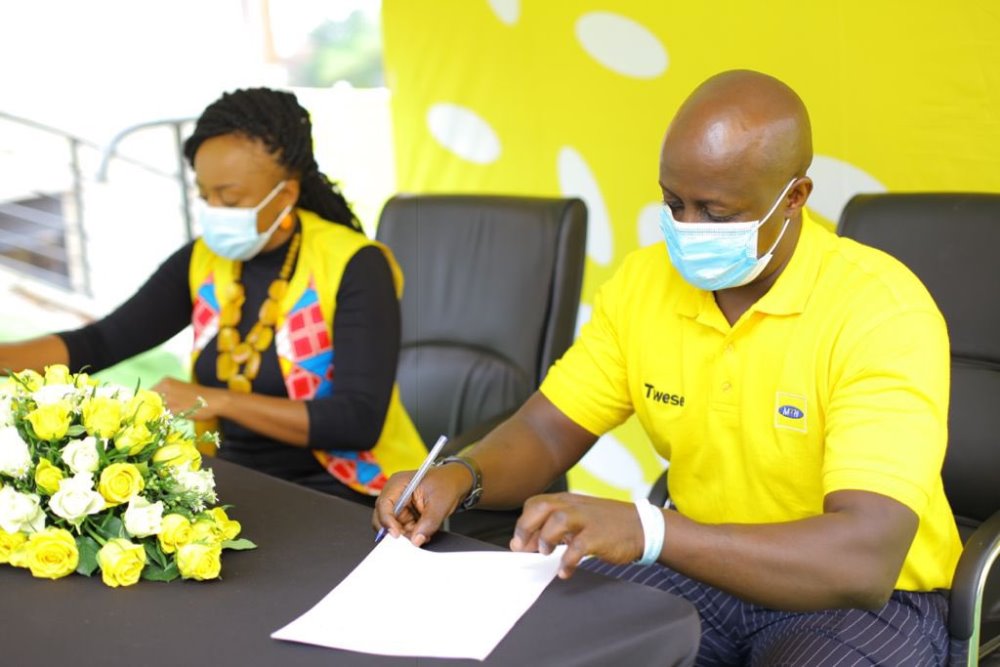
At the signing ceremony, MTN Rwanda also donated ten (10) million Rwandan Francs to facilitate the organization to procure these types of essential materials for people with disabilities.
Furthermore, MTN announced that it will be sponsoring the International Week of the Deaf Conference, which runs from 19 September 2021 to 26 September 2021, and will run an awareness campaign for other important dates such as the International Day of Persons with Disabilities taking place in December.
“We recognize that there is still a huge role that we need to play to support the continued build of inclusive and sustainable societies. It is for this reason that we look forward to working with NUDOR through this partnership,” concluded Ng’ambi.
{{About National Union of Disabilities’ Organizations in Rwanda (NUDOR)}}
NUDOR is a civil society organization established in 2010 by eight national organizations of persons with disabilities. NUDOR exists to strengthen the voice of the disability movement in Rwanda. Together NUDOR and its 13 members are working so that persons with disabilities can enjoy the equal rights to which they are entitled.
{{About MTN Rwanda}}
MTN Rwandacell PLC (MTN Rwanda) is the market leader in mobile telecommunications in Rwanda. Since 1998, we have continuously invested in expanding and modernising our footprint and are the country’s No 1 network.
MTN Rwanda offers various innovative services to consumers and enterprises, including personalised voice, data, home and fixed connectivity solutions. The company is also the front runner in Mobile Financial Services in Rwanda delivered through its FinTech subsidiary, Mobile Money Rwanda Ltd.