The racket was arrested in Police operations conducted in the district on Saturday and Sunday.
Police also recovered six cows from the group, which are among those that were stolen from different people in the district.
All the cows were found in houses of some of the arrested suspects.
The acting District Police Commander for Musanze, Chief Inspector of Police (CIP) Speciose Kayitesi said that this was a “target operation based on credible information received from some residents in prime suspects.”
She identified those arrested as Celestin Maniraguha, 21, Francine Uwizeyimana, 24, Charles Uwabareka, 34, Samuel Mugarukira, 42, Felicien Uwimana, 38, and the duo only identified as Turatsinze and Turikumwenimana.
Two cows were found in Turikumwenimana’s house.
“All the suspects were located and arrested in Sarasi Village, Rwasa Cell, Gacaca Sector where the cows were found in their houses,” CIP Kayitesi said.
One of the suspects, Uwizeyimana, who was found with one cow hidden in one of the bedrooms, said that it was brought to her by Celestin Maniraguha.
“Maniraguha had promised to pay me Rwf10,000 every month,” said Uwizeyimana.
“Last week, we received complaints from different people, whose cows had been stolen on different days. Fortunately, the victims and some residents gave clues on individuals they suspect to be connected to these series of cattle theft,” CIP Kayitesi said.
“Police conducted the operations on Saturday and Sunday, and recovered six cows in houses of some of the identified suspects, and arrested seven suspected thieves. The thieves were hiding cows in bedrooms before slaughtering them to sell meat,” she added.
She said that operations are still underway to search for other stolen cows and to arrest other members of the ring.
Two of the recovered cows have so far been returned to the owners.
The seven arrested suspects were handed over to RIB at Muhoza station for further investigation.
Article 166 of the law determining offenses and penalties in general states that any person convicted for theft is liable to imprisonment for a term of not less than one year and not more than two years and a fine of not less than Rwf1 million and not more than Rwf2 million, community service in a period of six (6) months or only one of these penalties.
In article 167 the penalty for theft doubles if the theft is carried out during the night or by more than one person.
Police seized from the dealers assorted smuggled goods and banned products, worth of Rwf1.5 million. They include skin whitening cosmetics, boxes of cigarettes and food flavours.
Jolie Nyirasafari, one of those arrested for selling skin bleaching cosmetics, said that she was buying them from other dealers.
“Police found in Gisenyi market where I was selling outlawed cosmetics. I was buying them from other dealers, who traffic them into Gisenyi town from DR Congo through illegal borders,” said Nyirasafari.
One Hakim Hakizimana also admitted that he was selling goods obtained illegally and asked for leniency.
“I was selling two different types of salsa (tomato paste), which we get from DRC because they are banned here,” said Hakizimana.
The Western region Police spokesperson, Chief Inspector of Police (CIP) Bonaventure Twizere Karekezi said that the suspects were arrested as part of the launched countrywide operations against smuggling and dealers in outlawed goods.
“If you know that you are buying and selling illegal goods, beware that you will be arrested,” CIP Karekezi warned.
He advised traders to refrain from buying goods through illegal channels and to avoid selling banned products, which is punishable by law. He further disclosed that 36 people have so far been arrested in Western Province in the past six days.
Article 266 of the law determining offenses and penalties in general, states that any person, who produces, sells, or prescribes harmful products; cosmetics or body hygiene substance or any other products derived from plants, commits an offence. Upon conviction, he/she is liable to imprisonment for a term of not less than one year and not more than two years and a fine of not less than Rwf3 million and not more than Rwf5 million or one of these penalties.
The statement released last night shows that 112 people have caught the virus out of 14529 sample tests, five recovered while 11 are critically ill. The positivity rate currently stands at 0.8%.
A total of 1,640,974 people have been fully vaccinated while 2,099,305 received the first dose of COVID-19 vaccine since Rwanda began countrywide inoculation program on 5th March 2021.
Rwanda plans to have 30% of the population vaccinated by December this year and 60% by June 2022.
Coronavirus symptoms include coughing, flu, and difficulty in breathing. The virus is said to be transmitted through the mucous membranes of the respiratory tract.
Rwandans are urged to adhere to COVID-19 health guidelines, washing hands frequently using soaps and safe water, wearing face masks and respecting social distancing.
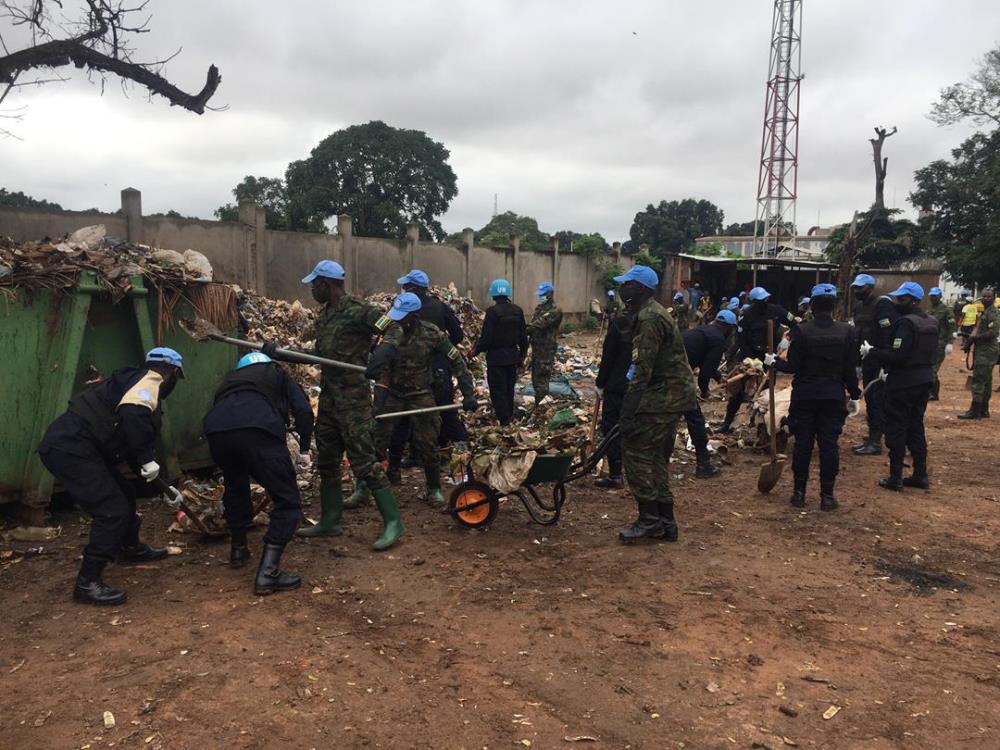
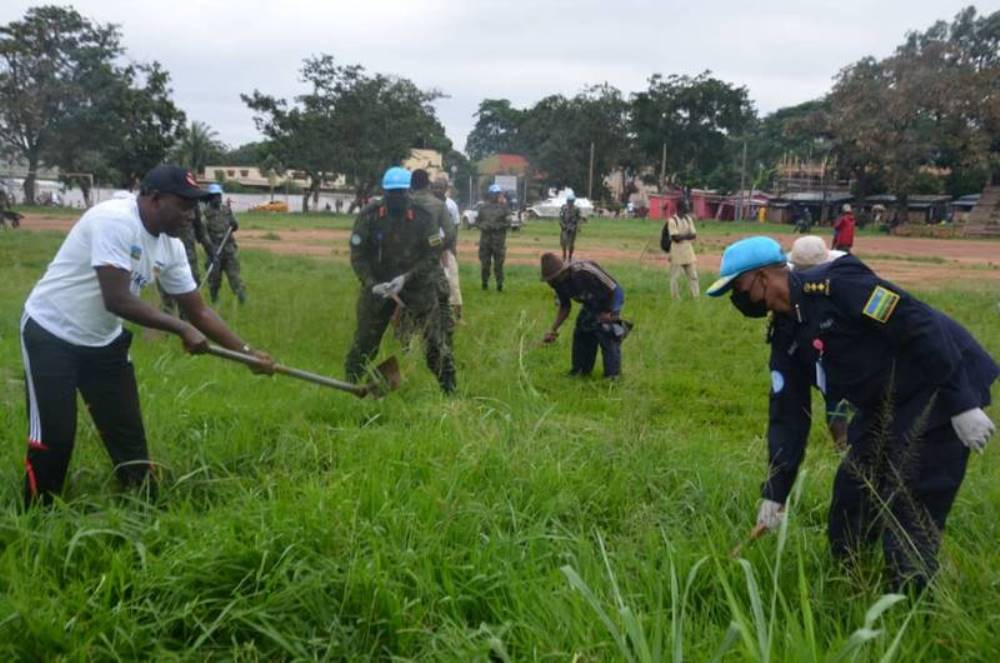
The official launch of communal hygiene exercise dubbed ‘Keep Bangui Clean’ organized by the city leadership, was presided over by Guillaume Ngobo, from the City of Bangui administration.
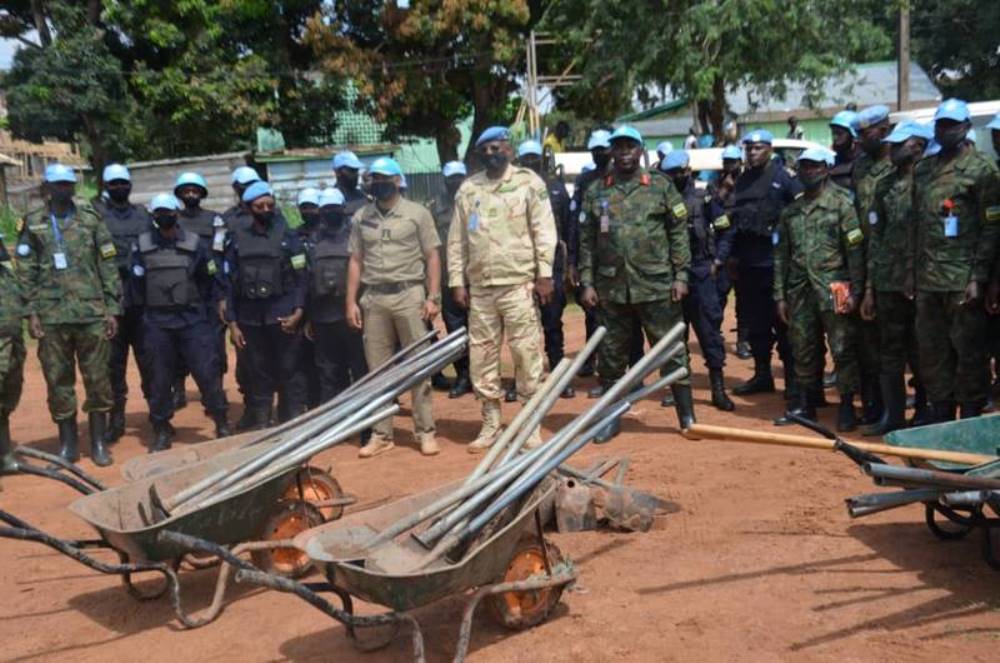
The city cleaning exercise was also attended by the joint Task-Force Bangui (JTFB) commander, Brig. Gen Ely M’Bareck Elkair.
Rwanda Protection Support Unit (RWAPSU) and Rwandan military batallions 8 and 9, all operating in the capital Bangui, took part in garbage collection, opening and cleaning water trenches, waste disposal and slashing bushy parts of the 1st and 2nd Arrondissements of Bangui city.
Ngobo thanked the Rwandan peacekeepers and Rwandan Diaspora for their continued support to restore peace, security and the wellbeing of the people of CAR.
Brig. Gen. M’Bareck from Mauritania also appreciated the cooperation and dedication of Rwandan peacekeeper to support and protect civilians.
“In peacekeeping operations, community policing and equally focusing on the health of the people is paramount,” said Brig. Gen. M’Bareck.
Police arrested the group, which had converged at the house of one Jean D’amour Mutangana, 25, at about 11pm. Mutangana is among those arrested.
The party had been organized to celebrate the birth of one Odo Nizeyimana alias Khalfan, 29, (also arrested) by his friends.
“We were arrested at about ten minutes after the start of the curfew (11pm), although we were at the time winding up for everyone to go back home,” said Nizeyimana.
“It is the first time that I have been arrested and I feel ashamed for my wrongdoing to violate the government directives,” he added.
Vanessa Umurisa, another violator, who was arrested with the group, said that at the time when Police arrived, some of them were in the house and others outside where they were engaged in various social activities.
RNP spokesperson, Commissioner of Police (CP) John Bosco Kabera said the violators disregarded the national Covid-19 directives.
“We are aware that there are people who disregard Covid-19 directives, especially in these last few days when the directives were reviewed. These people were holding a party at home without informing local leaders, they had not tested for Covid-19 but they also violated the curfew since they were caught at the time when everyone is supposed to be home,” CP Kabera said.
“Such inappropriate behaviours can fuel the spread of Covid-19, and derail the national efforts to prevent the pandemic, but be warned that Police in partnership with local leaders and public, will know these violations and you will be arrested,” he warned.
The violators were tested for Covid-19 at own cost and handed administrative fines, accordingly.
The spokeperson further warned against spreading false information especially on social media platforms on guidelines for one to reopen a bar.
“Bars are expected to resume with an authorization issued by a competent institution and hours of service are clear. We remind bar operators to follow the guidelines and their host customers in compliance with the issued protocols. Less than that, you will be penalised.”
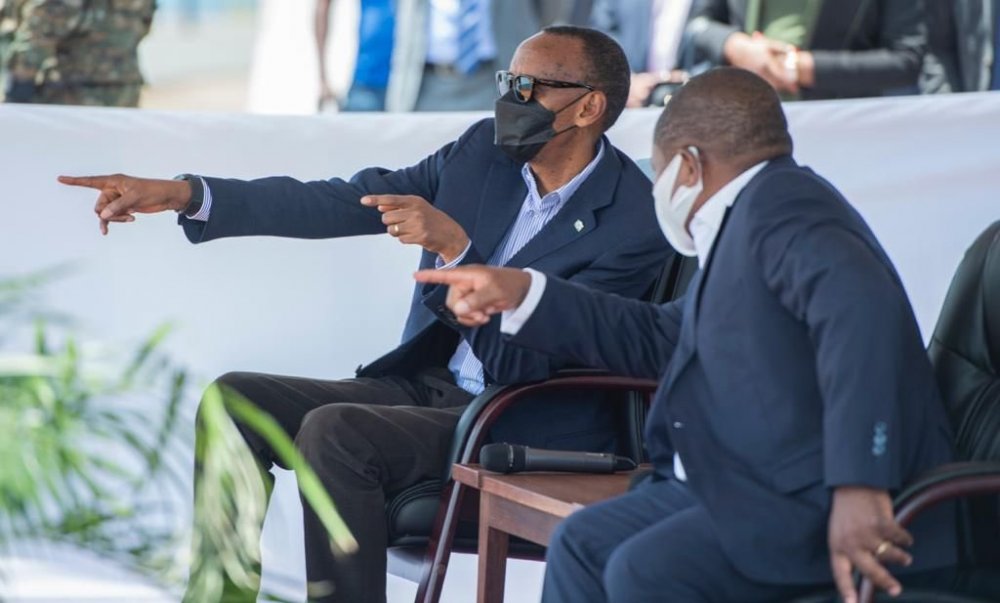
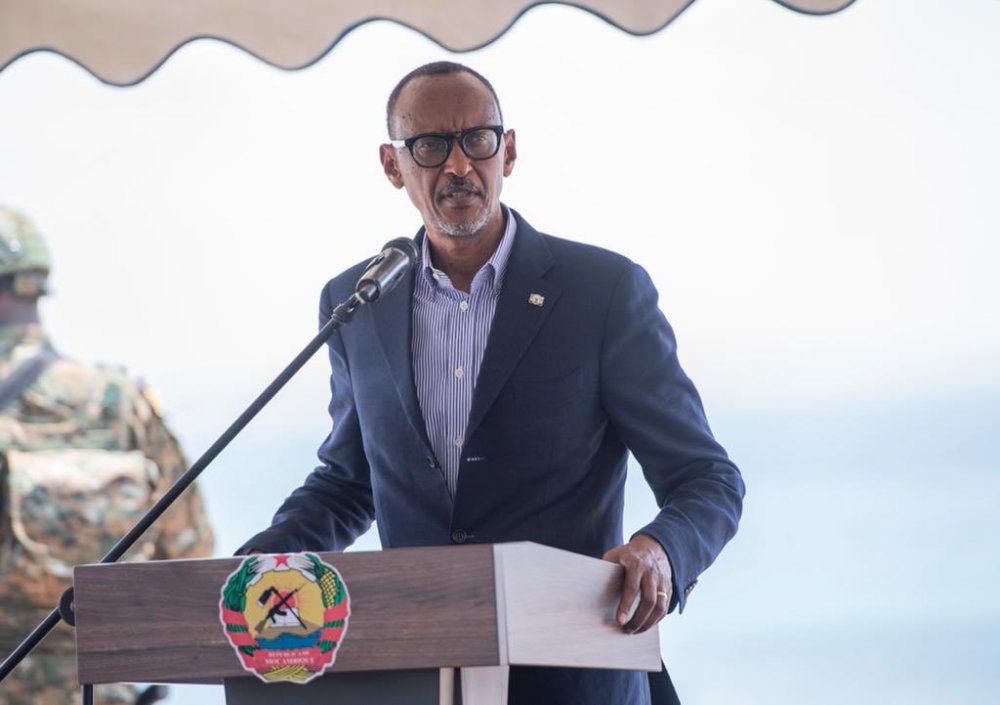
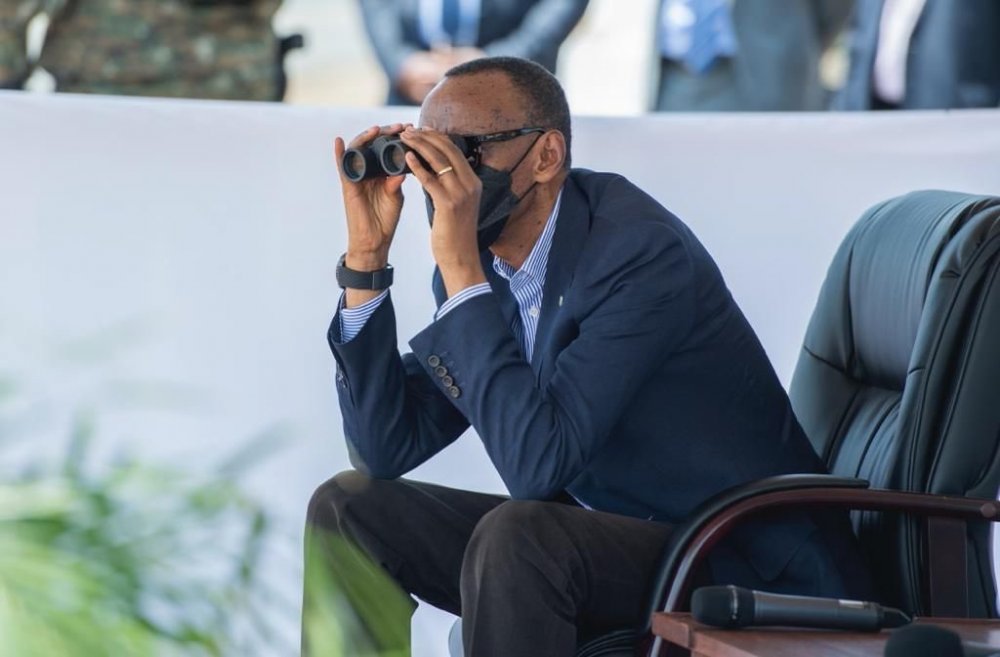
The President made the revelation on Saturday 25th September 2021 speaking to members of the press alongside his counterpart of Mozambique, Filipe Nyusi on the second day of his visit to the country.
He said that Rwanda intervened to restore peace in Mozambique as an African country committed to promote solidarity in finding solutions for difficult problems.
“Africans are capable, and by working well together, we can find solutions to even our most difficult problems. Nothing should stop us from ensuring the stability, progress and well-being of the people of Africa,” he said.
“This is why Rwanda did not hesitate, when we were asked to join our armed forces together with Mozambican forces, to bring security back to this region. Together, our joint forces have succeeded in pushing back the insurgents,” added Kagame.
The president emphasized that the presence of Rwandan troops in Mozambique is not by accident that they were invited to join Mozambicans to solve a problem.
He expressed optimism that the situation will get back to normal for good through ongoing joint efforts.
President Nyusi also commended Rwandan troops for their contribution to restore peace in Cabo Delgado noting that efforts to return displaced citizens are underway.
Rwanda started the deployment of 1000 troops of the Rwanda Defence Force (RDF) and the Rwanda National Police (RNP) to Mozambique on 9th July 2021, to fight rebel groups linked to the Islamic State of Iraq and the Levant (ISIL).
The group sometimes calls themselves al-Shabaab, although they do not have known links with the Somali al-Shabaab.
The situation started worsening in October 2017 when armed extremists linked ISIL launched an insurgency in the Cabo Delgado region of Mozambique.
Since then, Mozambique Defence Armed Forces have been battling the extremists while many civilians were displaced by the fighting.
The joint operations between Rwandan and Mozambican troops have started yielding where different regions including Palma, Awasse, Mocímboa Da Praia, Quionga, Tete, , Maputo, Nhica Do Rovuma, Quelimane, Chinda and Mumu have been seized from rebels.
As at 5th September 2021, Rwandan and Mozambican troops who were joined by the military mission of the Southern African Development Community (SADC) had captured almost all areas of Cabo Delgado Province.
The remaining work is predominantly about launching offensives to quell enemy pockets from their hideouts and resettling displaced citizens.
Before concluding his working visit, Kagame and Nyusi have also attended the Armed Forces Day ceremony at Pemba Municipal Stadium.
The Government of Rwanda targets to increase urbanization rate from 18% to 35% in 2024 to support economic growth.
While Kigali hosts about half of the urban population in Rwanda, a Housing Market Study for Kigali (2012-22) estimates that total housing needs (2012-22) reach 458,256 units, of which 344,068 are to be constructed.
The demand for affordable housing has not been thoroughly researched countrywide yet studies are in preparation where it is estimated to double the total need in Kigali.
This stresses the need to bridge the gap between housing demand and supply for people in low and middle-income segments and high end users.
It also challenges city planners, developers, and banks to seek new approaches to encourage investors to fund housing projects.
Despite existing constraints in housing finance, lending conditions have improved through the introduction of longer credit terms slightly reducing interest rates, a larger and more accessible variety in terms of down-payment options among others.
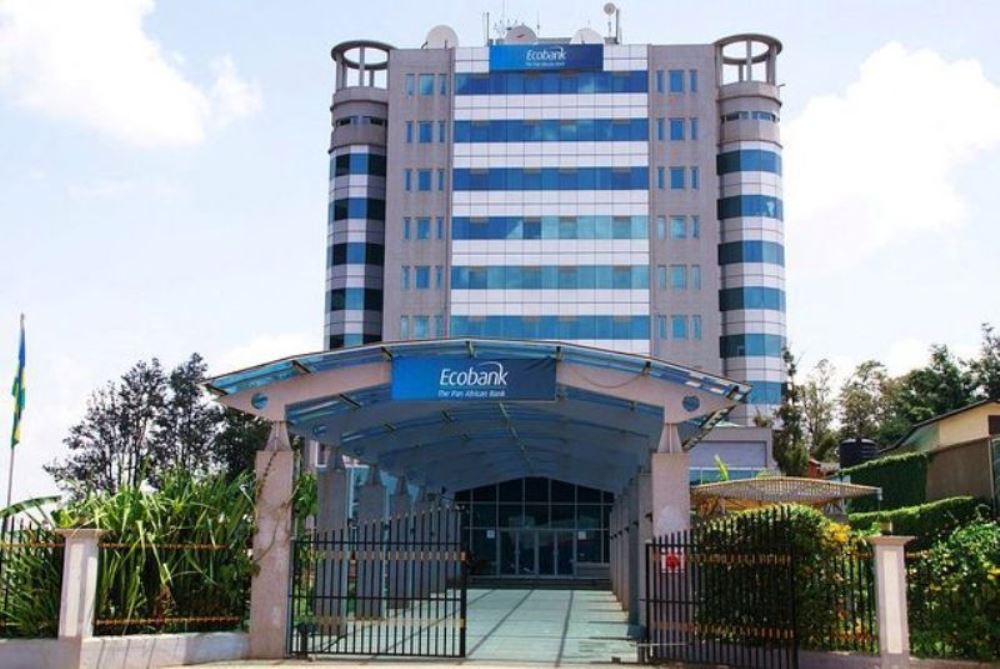
Ecobank is among other banks that have not been left behind tackling financial issues restraining people with a quest to invest in housing.
With various loan products to support people’s ambitions to grow their finances, the lender added mortgage loan to existing products to keep walking together with clients in their businesses.
Ecobank’s Mortgage Loan finances the borrower’s residential house purchase or renovation.
Every aspect of this loan has been designed to help clients realize their dreams to own homes.
IGIHE has caught up with Olivier Mpenzi, the Head of Personal & Direct Banking at Ecobank Rwanda Plc to speak more about the product promising to turn clients’ dreams into reality.
{{Excerpts:}}
{{In which context Ecobank introduced the mortgage loan? }}
When you buy a home or refinance your mortgages, it’s a big financial decision. By introducing the mortgage loan product, we wanted salaried and self-employed customers to own a house and this will help them to make large purchases.
{{What are key features? }}
{ {{Below are features of the mortgage loan facility:}} }
{{1. Outright Property Purchase}}
This variant of the product provides financing for salary account holders to buy completed properties for residential purposes. It helps our customers achieve their dreams of becoming homeowners.
{{2. Equity Release}}
This is the opportunity for homeowners to have a portion of the value of their properties released to them as cash in other to meet other financial needs.
{{3. Renovation}}
This provides homeowners the opportunity to have access to substantial cash with which they can renovate and upgrade their homes to their required taste; thereby increase the value of the property and the collateral coverage on the loan.
{{4. Estate development}}
This provides opportunity for customers to acquire properties within Estate. The property may also be semi-finished or where payment may be made based on agreed milestone. This also include where individuals come together for the purpose of creating a private Estate.
What are the unique benefits the borrower receives with Ecobank mortgage loan?
Affordable interest rate, annual management fees has been waved, dedicated relationship manager and other added services like, digital tools for customers to be transacting at any time, our goal is to help our customers to stay closely connected from anywhere in the world.
{{Which documents required applying for Ecobank mortgage loan?}}
A mortgage loan is one of offered loan products. When applying for a mortgage, one has to be an existing client channeling his/her salary to Ecobank. Once your salary domiciliation letter is provided to us other administrative documents are very easy to get.
{{How much is the monthly payment?}}
There are many factors taken into consideration while determining mortgage loan payment but we cannot exceed 50% of monthly salary as the maximum repayment capacity.
It also aligns with the regulations the Central Bank’s regulations whereby total monthly payments and other consumer financing does not exceed 50% of the net disposable income.
{{Do you require an inspection to qualify for this mortgage loan?}}
A home is a big investment. The bank will require a valuation report before they decide to finance or to service that loan. Because it’s very important to know about the conditions of the house you’re about to purchase if is in good condition or not in order to mitigate the risk. A valuer will look at the structure of the house and confirm that there are no major issues with the house. Once we have a better picture of the house’s condition, we proceed with the next step.
{{Are there pre-payment penalties with this loan?}}
At Ecobank, we don’t charge any fees for early repayment. Our purpose is not to penalize our clients. As long as you have that capacity to pay loan before, you will liquidate it without penalties.
Besides, you can complete transactions using our online service (Ecobank Online) without necessity for physical presence at the bank’s offices. This is how Ecobank is taking the lead to digitize even more complex processes by tapping into the advantage of digital technology.
{{What is your message to existing and potential clients?}}
First of all, a decision to have or purchase your dream home is one of the most important decisions you can make in your lifetime. I will strongly recommend everyone who doesn’t have a house to think about it and Ecobank will help you to achieve your dream.
Moreover, I encourage them to take advantage of our best loan products for retails meeting their banking needs like Personal Loans, Car Loan, Residential Mortgage Loans, Renovation or Land Purchase and Equity Release.
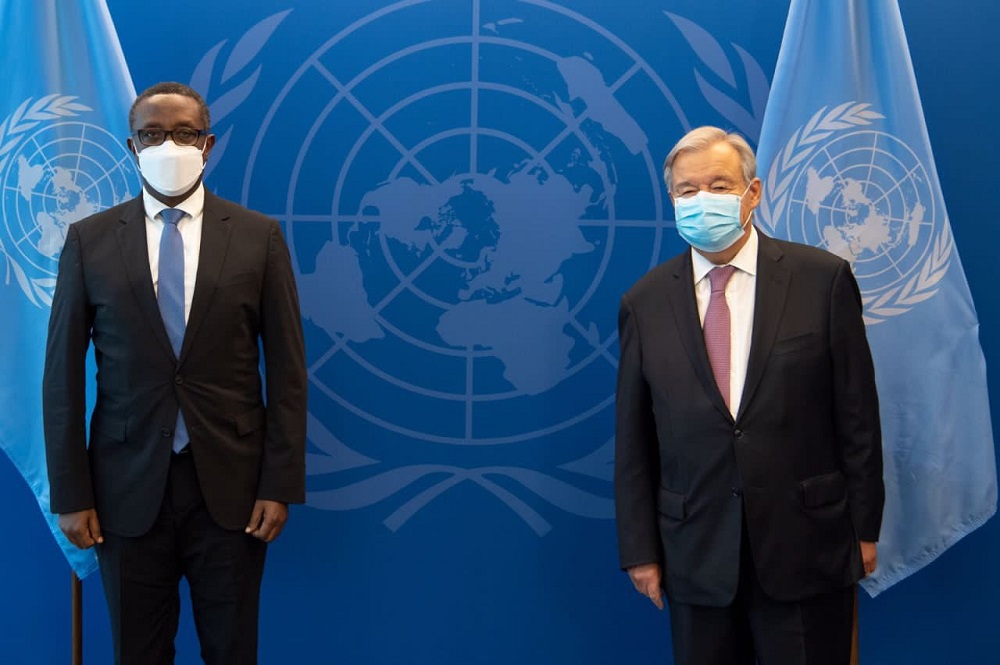
The Ministry of Foreign Affairs has revealed via Twitter handle that they discussed ‘Common Agenda, COVID-19 and recovery’.
Minister Biruta has been in New York, United States of America (USA) to attend the 76th United Nations General Assembly.
On the sidelines of the event, he also met with counterparts from different countries including Jamaica, the United Kingdom, Portugal, and the United Arab Emirates where they discussed on issues of mutual interests.
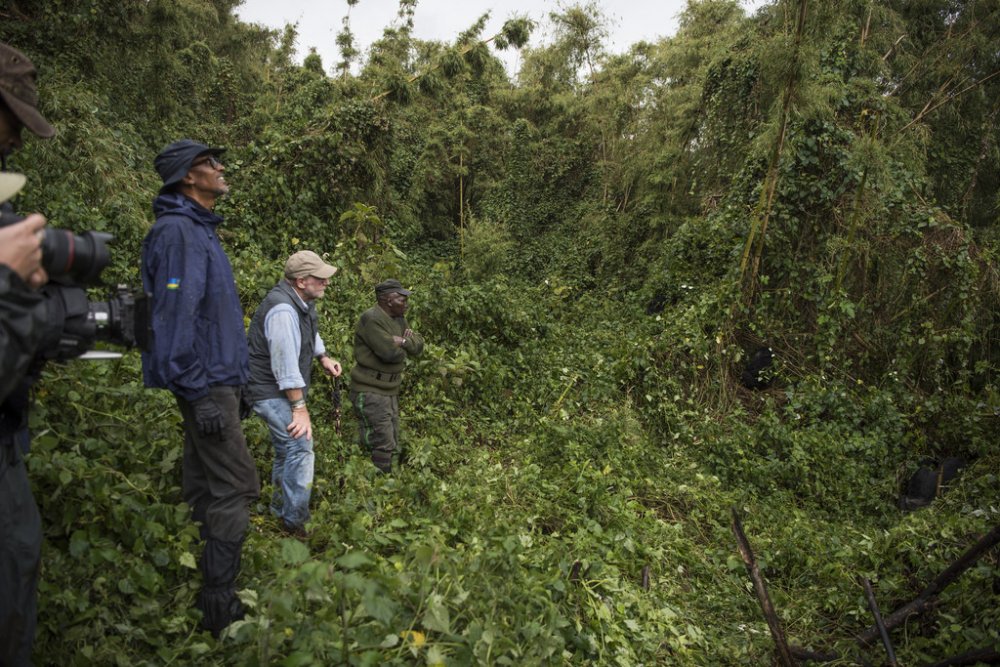
Kagame made the revelation on Friday 24th 2021 during the ceremony to name 24 baby gorillas held virtually to contain the spread of COVID-19 pandemic.
The President highlighted that the success of gorilla conservation in Rwanda shows the good that can be achieved through community participation and the right partnerships.
“I wish to thank all collaborators, in Rwanda and around the world, for sustaining this excellent work over the years. The COVID-19 pandemic has affected the way we celebrate Kwita Izina. But I am happy to see many partners and friends joining us today virtually to continue this tradition,” he said.
Kagame said that the pandemic has affected tourism where the country registered a drop in the number of visitors but assured that the important work of conservation continued.
“This includes the Tourism Revenue Sharing Program, which continues to finance valuable projects benefiting the communities around our parks. As visitors return, they will have remarkable experiences that match their high expectations,” he assured.
The President further stated that the country is testing and vaccinating as many people as possible to ensure that Rwandans and visitors stay healthy.
“Our aim is to ensure that Rwanda remains safe and inviting destination,” he noted.
The ceremony held for the 17th time attracted celebrities including players of Paris Saint Germain namely; Neymar Jr, Kylian Mbappe, Angel Di Maria, Marquinhos and Sergio Ramos who named three baby gorillas (Ingeri, Nshongore and Mudasumbwa).
Bukayo Saka playing for Arsenal was also among namers participating in the ceremony.
The Kwita Izina gorilla naming ceremony reflects centuries-old tradition in which Rwandans name their children in the presence of family and friends. For three decades before the first official gorilla naming ceremony, park rangers and researchers named Rwanda’s mountain gorilla babies to monitor each gorilla in their family and habitat.
In 2005, Rwanda began officially naming mountain gorillas in what has become a global celebration of nature. By giving a name to these majestic animals, they are given the value they undoubtedly deserve.
The ceremony is also an opportunity to thank the communities that live around the gorilla habitat, Volcanoes National Park, research partners, vets and the dedicated conservationists, rangers and trackers who protect the gorillas daily.
Since 2005, a total of Rwf6.5 billion have been pumped into 780 projects in the areas of agriculture, infrastructure, education, provision of decent shelters for vulnerable residents, building health centers, promoting livestock farming, beekeeping and crafts among others.
Despite unprecedented effects occasioned by COVID-19 pandemic, Rwf700 million were invested in 30 projects in the areas of infrastructure and agriculture this year.
Rwanda’s tourism sector earned US$121 million in 2020 down from US$498 of 2019.
Over the last sixteen years, more than 300 mountain gorillas have been named.
Today, Kwita Izina forms part of an ambitious strategy to preserve Rwanda’s natural heritage and further expand the role of tourism in the country’s transformation. As a result of the naming ceremony, Rwandans from all walks of life understand the intrinsic value of gorillas and their contribution to the country’s development.
As of today, 18% of the target population of 7.8 million (representing 60% of Rwandan population) is fully vaccinated against COVID-19.
Commenting on the development; the Minister of Health, Dr. Daniel Ngamije said that the number of vaccine recipients is a great milestone noting that the journey continues.
“The Government of Rwanda is doing the best we can to acquire the needed vaccines and we are grateful to different stakeholders who continue to contribute to the distribution of vaccines to our people. We aim to reach 30% of the target population by the end of this year,” he revealed.
So far; Rwanda has received 3,658,310 doses of COVID-19 vaccines through a variety of platforms including COVAX facility, African Vaccine Acquisition Trust (AVAT), bilateral agreements and Government direct purchases in partnership with the World Bank.
According to the Ministry of Health, Government efforts including vaccination activities have reduced the COVID-19 positivity rates from over 10% in July and August 2021 ‘to the currently manageable rate of less that 3% in September’.