{Despite global and regional economic challenges, Rwanda economy was resilient with a growth rate of 6.1% in 2016 from 6.9% in 2015. }
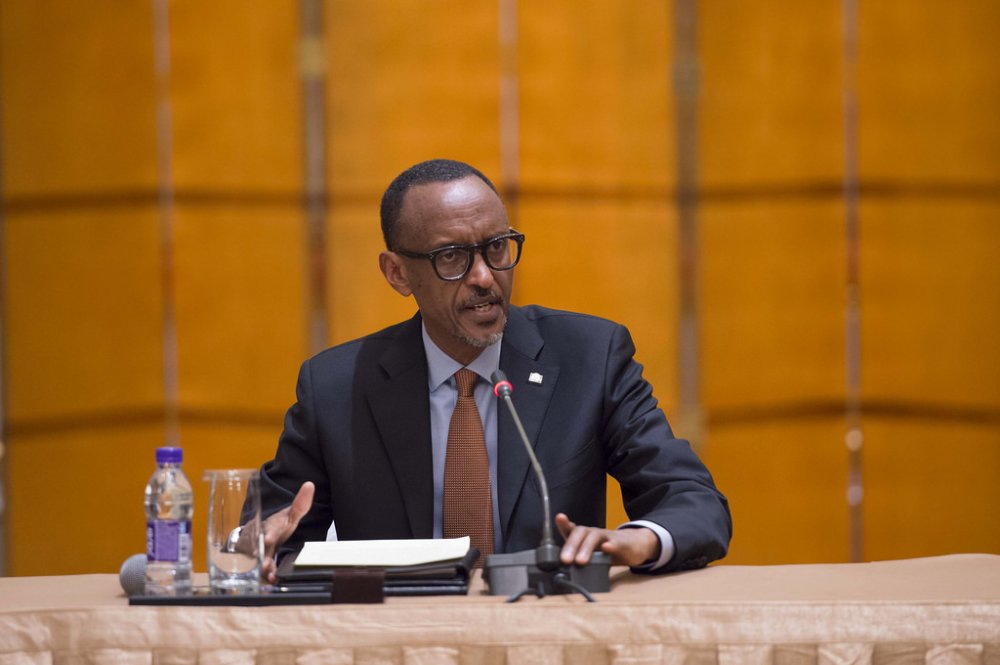
This has been revealed today by the governor of the National Bank of Rwanda (BNR), John Rwangombwa during the presentation of Monetary Policy and Financial Stability statement held in Kigali Serena Hotel.
Service sector growth in 2016 was 7.7% up from 7.0% in 2015, contributing 49.7% of GDP, followed by industrial sector contributing 14.6% and agriculture with 29.6%.
BNR has attributed the growth of service sectors to the gain in hosting events including CHAN, WEF, AU Summit and Kwita Izina among others.
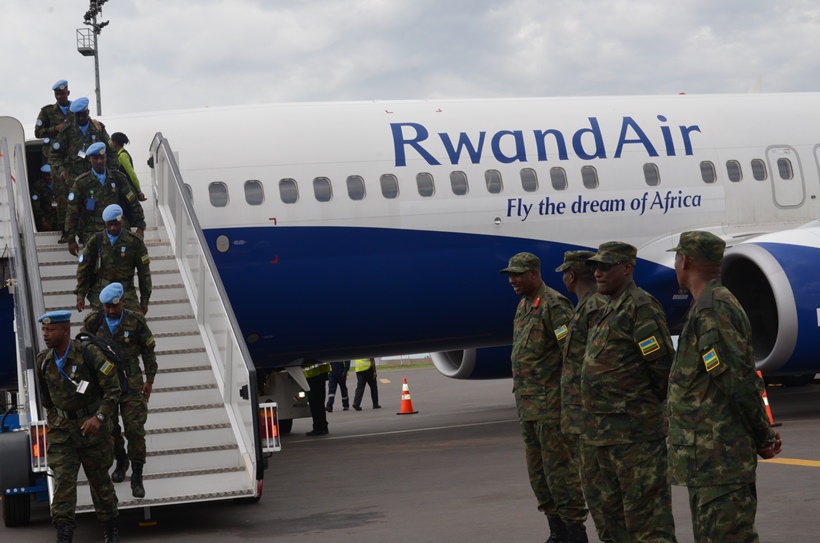
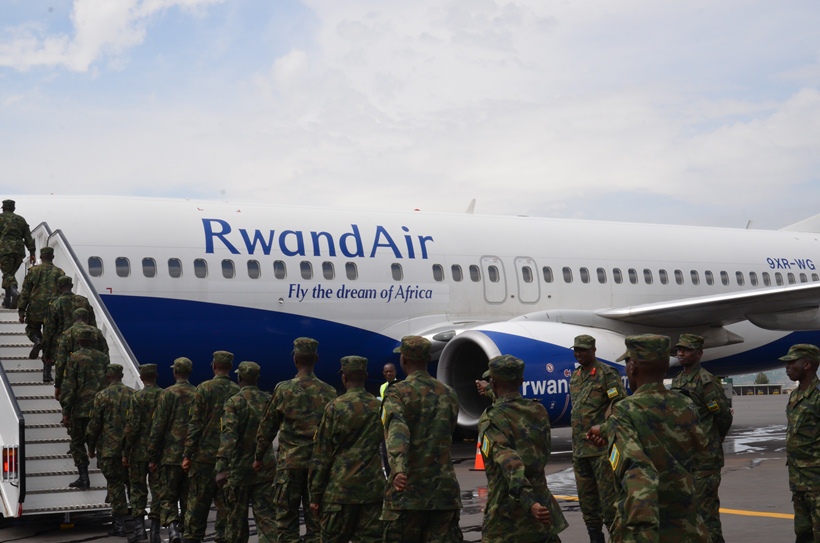
Transport has also been identified as a growing sub-sector with RwandaAir being in the lead, having opened six new routes.
Agricultural production contracted in the first three quarters of 2016 having grown by 3.7% down from 5.3% of 2015. Drought has been cited as a responsible factor for this slump.
Industrial sector grew by 5.0%, down from 6.7% in similar period of 2015. The decline is attributed to instability in the minerals market.
The gap between imports,exports is 5.9% in 2016 equaling USD1649.8 million from USD1752.5 in 2015. Authorized exports increased 7.1% while licensed imports decreased by 2.7% in 2016.
Rwanda economy is expected to rise by 6.0% in 2017.
In general World’s economy decreased by 3.1% in 2016 down from 3.2% of 2015 while Sub-Sahara Africa has seen it economy decreasing by 1.6% over the reduction of exportations, drought, Ebola in the West and political chaos in some countries.
Africa Sub-Sahara economy is expected to rise by 2.8% in 2017.
This article appeared in the January 2017 issue of Forbes Woman Africa
Rwanda, striving for gender equality, serves as an example of how a nation could be built by communities. In an exclusive interview with FORBES Woman Africa, the country’s First Lady, Jeannette Kagame, tells us how the 15-year-old Imbuto Foundation has been taking Rwanda and its people forward.
{{When does a country become synonymous with its community?}}
Just visit Rwanda on the last Saturday of any month, and you will see it here, in this hilly East African country, where the masses – from ministers to farmers, shopkeepers to entrepreneurs – rub shoulders to become one harmonious, homogeneous entity; laying roads, digging the earth, planting trees, and cleaning gutters and drains; holding broom, shovel and spade.
The only thing that counts is the richness of the earth, the fresh mountain air and a united mission to keep the streets green and immaculately clean as a contribution to nation-building and improving the living conditions of the country’s 11.5 million citizens.
It’s on one such Saturday that FORBES Woman Africa is invited to travel upcountry to Rwanda’s verdant Rulindo district, past Kigali’s bustling traffic and up the winding roads when the city’s modest skyscrapers appear no match for the country’s magnificent hills.
It’s the day the country observes Umuganda, a home-grown initiative that requires people from all walks of life – villagers and city-folks – to congregate for community work, once a month, from 7 to 11 in the morning.
Today, most of the action is in this northern province, where schoolgirls in blinding yellow and pink uniforms, rural women in colorful African dresses, and men in gum boots, form neat lines to take their turn planting saplings in the fertile earth.
Today, they are also awaiting a special visitor who will dig the earth with them under the hot mid-morning sun.
The earth is an apt way to introduce the Imbuto Foundation—the word ‘Imbuto’ meaning ‘seed’ or ‘fruit’ in Kinyarwanda, Rwanda’s local language. And the special guest is none other than the foundation’s President, Jeannette Kagame, the nation’s much-loved First Lady, wife to the country’s dynamic President, Paul Kagame.
There is collective silence and adulation when she arrives, wearing denim pants and shirt and a yellow cap, getting to work right away with a shovel. A stone’s throw away, in a classroom, young girls aged 10 to 12 are seated in a circle on straw mats, ready to welcome her.
They call this ‘the circle of friendship’, and around them are their mentors, young women themselves, aged 18 to 25.
Today is also the launch of the third year of Imbuto Foundation’s successful 12+ program in the area.
The program, in line with the national plan under the Ministry of Health, has achieved significant milestones, reaching 52,000 girls nationally over the last two years. Such milestones are significant as Imbuto celebrated its 15th year in 2016.
The girls are taught about savings, discipline and confidence, in tandem with Imbuto’s motto to ‘engage, educate and empower’. The younger girls are also taught about sexual health; ground-breaking by itself, as sex is still a taboo topic in the communities, and the girls are equipped with the knowledge about their bodies early, before they transition to adolescence.
In the classroom, the girls pass around a ‘speaking ball’ to each other, taking turns to voice their opinions in Kinyarwanda. They speak with supreme confidence – unfaltering even in the presence of the First Lady – drawing their hands on the charts in front of them, promising to never break their circle of friendship. Her Excellency listens to them keenly, before they pass the ball to her, and she politely introduces herself.
Her next stop is further down the dirt road, for a community gathering after Umuganda, where she is expected to speak to the thousands gathered on the hills, patiently waiting under cheerful umbrellas for a glimpse of their First Lady.
Greeted with music, ribbons and flowers, there is rapturous applause from the crowd when she arrives. The cool country breeze complements the convivial mood. The district mayor speaks about how the previous phases of the 12+ program have influenced the girls to open bank accounts, start kitchen gardens, and importantly, stay in school.
A 10-year-old girl, Amina Merci Dieu, steps up to the podium to speak about how she built a vegetable garden, sold the vegetables she planted and persuaded her parents to open a savings account. She speaks without fear, walking up to hug the First Lady when she is done.
I am seated next to Assumpta Ingabire, Director General in charge of Local Government Inspection, who was formerly with Imbuto.
“Our First Lady is such an inspiring role model. You can share your problems with her and she always sees things in a positive way,” she says, smiling.
“Imbuto does not work in a vacuum; it works in line with national priorities, working with communities. Without our communities, things would have taken forever [to rebuild],” says Sandrine Umutoni, Acting Director General of Imbuto Foundation.
It’s a pertinent point, as the country has had to reconcile and persevere to rebuild itself after the horrific genocide against the Tutsi that killed a million of its people in 1994. The only way it could turn around was by involving its communities.
Imbuto was initially launched as Protection And Care of Families against HIV/AIDS (PACFA) working to help families and genocide survivors with AIDS. It changed its name to Imbuto at the end of 2007, incorporating a holistic model for individual development, focusing mainly on educational projects.
One of Imbuto’s flagship programs is a girls’ education campaign called Best Performing Girls (BPG).
“The girls who graduate from high school get training in IT, and also get laptops, which the First Lady hands out every year in March,” says Umutoni.
“They call her ‘mother’,” she adds. “In Kinyarwanda, when they call a person that, it means the person has accompanied you through difficult challenges, guiding you, counseling you, and providing support at specific moments in your life.”
Imbuto also organizes a Youth Forum Series every year. In addition, the foundation works with 22 cooperatives across 13 districts, introducing women to income-generating vocations. With the money, they pay school fees and medical insurance and enter new entrepreneurial activities.
The week that FORBES Woman Africa is in Kigali to follow the First Lady’s activities is when the King of Morocco is also visiting, to sign an memorandum of understanding with Rwanda on specific health and education projects. The Princess of Jordan, Sarah Zeid, is also visiting.
As part of her packed schedule, the First Lady also attends a meeting with members of the 20-year-old Unity Club that she heads. The club brings together current and former members of cabinet and their spouses to promote unity and reconciliation in Rwanda.
The meeting with the Unity Club members takes place at Imbuto’s temporary office in the President’s office complex in Kacyiru – their office on the same grounds is being renovated – a stunning manicured setting with frangipani trees, hibiscus flowers, ferns and foliage.
The First Lady is dressed in a smart beige and black suit and sits at the head of the mahogany table in the meeting room. She listens patiently and intently, speaking softly in Kinyarwanda as the ladies consult the files in front of them. She offers solutions and better approaches for some of the issues raised. It’s an in-depth discussion that goes on for over two hours, the seriousness interspersed at times with jokes by the First Lady, displaying an effortless sense of humor.
One of the ladies at the meeting is Radegonde Ndejuru, the First Lady’s advisor, who has been with Imbuto for 10 years now.
“We have a family spirit at Imbuto,” says Ndejuru. “Her Excellency is always so respectful. Her text messages to everyone starts with ‘good morning’ or ‘good evening’. We put passion in everything we do as that is the way she does it. She also has a phenomenal memory and shows great attention to detail… I always ask her: ‘do you sleep enough?’ She is here in the morning, reads a lot and what I admire is she always follows through projects.”
In March 2016, at the 5th Kigali International Conference Declaration General Assembly in Algeria, the First Lady was presented an award along with United Nations’ Secretary-General Ban Ki-moon, in recognition of their contribution to women’s empowerment and their fight against gender-based violence.
Rwanda is a global model for gender equality. The World Economic Forum Global Gender Gap Report 2016 ranks Rwanda fifth globally for closing the gender gap in various spheres. The country has the highest representation (64%) of women in Parliament.
As part of gender mainstreaming, there is a Gender Monitoring Bureau in every institution in Rwanda, as the country works towards achieving a middle income status by 2020.
The First Lady works with a team of young, spirited, hard-working women, who exemplify the qualities of their leader. It is clear they have a great admiration for her work.
Before we settle for the interview, Mrs. Kagame, as she is also called, begins by asking how I am, with a disarming smile. And that aptly sets the tone for the rest of the conversation. It’s easy to see how this mother of four has won the hearts of Rwandans.
{Vice President Hamid Ansari on Tuesday said India was Rwanda’s strong development partner.}
“We in India see ourselves as a strong development partner to Rwanda. We are already cooperating in sectors such as solar electrification, food processing, skill development and hydropower projects,”
Vice President Hamid Ansari said in an address at the University of Rwanda.
“India’s engagement with Africa has its own unique script, based on what Prime Minister Narendra Modi has called ‘strong emotional link’ defined by our shared history of struggle against colonialism and our aspiration to bring prosperity to our people,” Ansari said.
Ansari was on a visit to Rwanda from February 19-21.
Speaking on the outcome of the visit of the Rwandan President Paul Kagame to India, Ansari said: “During President Kagame’s recent visit, an understanding has been reached for a new line of credit worth $80 million for a road project. We are also committed to continuing and enhancing the provision of scholarship for training of Rwanda civilians and defence personnel under various technical cooperation and cultural cooperation programmes.”
Kagame was on his maiden official visit to India from January 9-11.
During his visit, both sides agreed to raise the level of bilateral cooperation to a strategic partnership and India extended a $120 million credit to bring over 41,190 hectares of cultivable land under irrigation in the African country.
On the bilateral trade between the two nations, Ansari said: “Our bilateral trade has doubled over the last five years, but as $106 million, remains modest and much below its potential. Rwanda has a dynamic economy and ranks highly in the ease of doing business, providing many incentives for inventors.”
On Indian investments in the African agriculture sector and its market potential in India, he said: “The growing middle-class in urban India can become a dependable consumer for African food processing Industry.”
“India provides a long-term, stable and profitable market to the goods and services that Africa generates. For India, Africa has the potential to become a major contributor to our energy security and food security requirements. This is a ‘win-win’ situation.”
“The quantum of Indian investment in Africa has increased in recent years and is presently estimated to be about $35 billion, with a large part of it concentrated in Southern and Eastern Africa,” he added.
India has announced concessional credit of over $10 billion for Africa, over a period of next five years.
{Rwanda National Police (RNP), yesterday, received two fugitives at Gatuna border post, who had escaped prison and fled to Uganda.}
Boniface Ndimubanzi, 58, a genocide convict and Valence Ndikuryayo, 31, who was convicted for forgery and deceit, was arrested separately recently by Uganda Police Force following an Interpol arrest warrant issued by Rwanda.
Ndimubanzi was handed a life sentence in 2009 by a Gacaca court in Tovu Village Kiyombe Sector of Nyagatare district for genocide related crime he committed in former Murambi commune, currently Gatsibo District. He escaped Nsinda prison in February 2012 after serving three years.
He was arrested in Kyankwanzi in Kiboga District where he was apparently working as a casual laborer.
Ndikuryayo, on the other hand, who had been convicted for forging land titles through which he defrauded people in Kimironko Sector of Gasabo District, was arrested in Mubende District where he had since settled.
RNP spokesperson, Assistant Commissioner of Police (ACP) Theos Badege, said that following their escape, a notice was issued by Interpol Kigali through the I-24/7 communication tool, which connects all the 190 Interpol member countries.
He lauded the act by their counterparts in Uganda adding that “it materializes the existing cooperation between the two countries and respective police forces.”
The deportation comes two days before a bilateral meeting between the RNP and Uganda Police Force to be held in Kigali, which will mainly focus on strengthening the already existing cooperation in various areas of policing and fighting cross-border crimes in particular.
{Rwanda’s Minister of Foreign Affairs, Louise Mushikiwabo has sent condolences to the bereaved family of Vitaly Churkin, former Russia ambassador to UN who breathed his last in New York yesterday. }
“Heartfelt sympathy to family, friends and country, of long-time #Russia Amb. to the United Nations, Vitaly Churkin! RIP, dedicated diplomat!” said Mushikiwabo in a tweet.
The Rwanda’s ambassador to Belgium, Olivier Nduhungirehe has also expressed sympathy over the death of late Vitaly Churkin saying that he learnt a lot from him in UN Security Council.
He has died one day before celebrating 65 years.
According to reports, Vitaly Churkin collapsed after a heart attack at work.
CNN has reported that the latter was rushed to Presbyterian Hospital in New York where he died.
Vitaly Ivanovich Churkin was born in Moscow on 21st February 1952. He spoke fluently Russian, French and English.
Churkin served as Russia’s ambassador to Belgium between (1994- 1998) and Canada (1998 -2003). From 2003 to 2006 he was ambassador with special duties in the ministry of foreign affairs before he replaced Andrey Denisov as Russia ambassador to UN on1ST May 2006.
{Passengers in Kigali City and its suburbs have lamented the state of poor transportation services citing long dwelling time at stages waiting for buses to transport them. }
Passengers from Kicukiro – Gatenga – Magerwa – Nyabugogo or from Kigali town claim to wait between 30 and 1 hour and when they get aboard, they said, many stops add to their delay on the road, affecting their businesses in the process. Other passengers on the Kigali – Gatsata suburb say they do wait for buses at bus-stops for more than an hour.
Passengers on the Kimisagara route usually do wait between 30 minutes and an hour in the evening.
However a passenger from Nyabugogo-Rutonde route have told IGIHE that they sometimes arrive at 7:00pm but get the bus at 9.00pm.
The administrator of one of transport agencies in Kigali (KBS), Deo Muvunyi has said that delays are attributed to passengers who don’t use ‘tap &go’ cards.
“Giving back change delays the journey as long passengers have not yet all embraced the usage of ‘Tap &go’. Payments and waiting to receive change takes time,” he said.
He however blamed some drivers who stop at every bus stop for no reason.
Muvunyi said that they don’t have bus shortage.
Nilla Muneza, the Managing Director of Royal Express has said that the challenge is known but urged passengers to value achieved developments in Kigali public transport.
“People should consider that some problems were addressed though not all expectations aren’t met,” he said.
“We are in process of solving the problems, targeting for a passenger not to wait for more than five minutes. We are seeking solutions as we are waiting for new buses in April or May 2017,” he said.
Emmanuel Asaba Katabarwa, the head of transport department at Rwanda Utilities Regulatory Authority (RURA) has rejected claims that buses come late.
“I don’t agree with those claiming to be waiting for long. A person waits for the bus other than having the bus waiting for him/her. Queuing waiting for the bus exists everywhere around the world. No line goes beyond 30 minutes except in some few cases,” he said.
“In Rwanda, we don’t have large traffic jam compared to other countries. We don’t even wish to see passengers waiting these 30 minutes. That is why we have set a program where a bus has to arrive at public gatherings each five minutes or not beyond 15 minutes. The problem lies in the matter of having many passengers at the bus stop beyond the bus’ capacity. The matter is well known in Kimironko direction” he added.
Katabarwa explained that they are encouraging investors in big buses to address the matter.
Public transport in Kigali was revised three years ago to enhance smooth transport of passengers that saw the of small taxis known as ‘Twegerane’ leaving Kigali public transport in the management of three transport companies’ agencies.
The three include KBS, Royal Express and RFTC which took over duties to various parts of the city. The reforms brought some innovations in public transport like the introduction of payment card “Tap & Go” and installing free internet in buses.The internet is however said to be useless as it doesn’t work.
{President Paul Kagame yesterday received the vice president of India,Hamid Ansari and held talks on different areas including trade and promoting health care.}
Following the meet with president in Village Urugwiro, the permanent secretary in the Ministry of Foreign Affairs Claude Nikobisanzwe has told the media that vice president Hamid Ansari and President Kagame talked of joint projects in Rwanda like Nyabarongo I providing 28 Megawatts of electricity.
“India vice president has highlighted the need to effectively execute the second phase of Nyabarongo dam adding that Rwanda and India can cooperate in various projects especially in health sector,” he said.
“You already know that many Rwandans seek health care in India. The quality of health care services may be improved if both countries collaborate and promote economic relations,” he added.
India vice president is in Rwanda since Sunday for three –days visit supposed to end today to head for Uganda visit.
{Genocide survivors from Rugerero and Nyundo sectors in Rubavu district, Western Province have expressed concern over the incomplete Nyundo Genocide Memorial whose construction started three years ago following the destruction by flooding of River Sebeya. }
The remains have been kept in a room of a Nyundo diocese building for six years.
“We can see that local leaders are giving little attention to the construction of the memorial. We can’t manage to visit deceased relatives because coffins are piled in a room and bound to be destroyed. It is sad to see remains of our relatives not accorded decent burial,” said one of genocide survivors Mukamana Marigarithe.
District leaders, residents noted, had promised in 2014 that the memorial would be constructed within three months.
Rubavu district authorities have however said that the memorial will have been completed by the beginning of the commemoration of 23rd 1994 genocide against the Tutsi.
“We have pledged to complete construction of the memorial in April 2017. Few activities remain. We don’t know why former leaders failed to keep the promise but we hope it will have been completed by the beginning of 23rd commemoration,” promised the executive secretary of Rubavu district, Nsabimana Sylvain.
The memorial will accommodate remains of 751 people.
{Seeking to give its diaspora community in Rwanda a greater push, India will open its resident mission in the Rwandan capital ,Kigali a move that will further enhance bilateral ties.}
“We are great friends (India and Rwanda), and Rwanda has a good population of Indian community here…And, we have had a valid complaint of not having a resident mission in Kigali.
So, I must tell you that the government has already taken up the matter and in coming weeks or months, we will have a physical presence of a resident mission here,” Vice President Hamid Ansari today said.
Ansari, who is on a five-day visit to Rwanda and Uganda, was addressing a gathering of Indian community here at a banquet hosted by a diaspora group in his honour.
Rwanda has about 3,000 people from Indian community and Ansari said, they are “very purposeful, very entrenched and very well-doing.”
“Our relationship should grow further by this week end. Our government is working to build ties and give it more content. And, most important segment of that is this community. So, we want to build up and give you a little more support,” he said.
A delegation of FICCI is also here, consisting of both public and private sector representatives, Ansari said.
Sources said, the decision to open the mission has reached advanced stage and a skeletal set up will be ready in few months.
“Both countries have in principle agreed to open the mission here and modalities are being worked out,” the source said.
Ansari also said that RwandAir will soon begin its operations to India.
{India vice president,Hamid Ansari, has arrived in Rwanda for a three-day working visit. He was received by the Senate president, Bernard Makuza at Kigali International Airport last evening. }
Hamid coming to Rwanda follows President Paul Kagame visit to India when he attended Vibrant Gujarat Global Summit in January 2017.
Hamid will hold talks with President Kagame, speaker of the parliament, senate and deliver a lecture to students at the University of Rwanda.
He will also visit Gisozi genocide memorial to pay tribute to victims of the 1994 genocide against Tutsi and meet Indians living in Kigali at a luncheon with Rwanda’s Prime Minister.