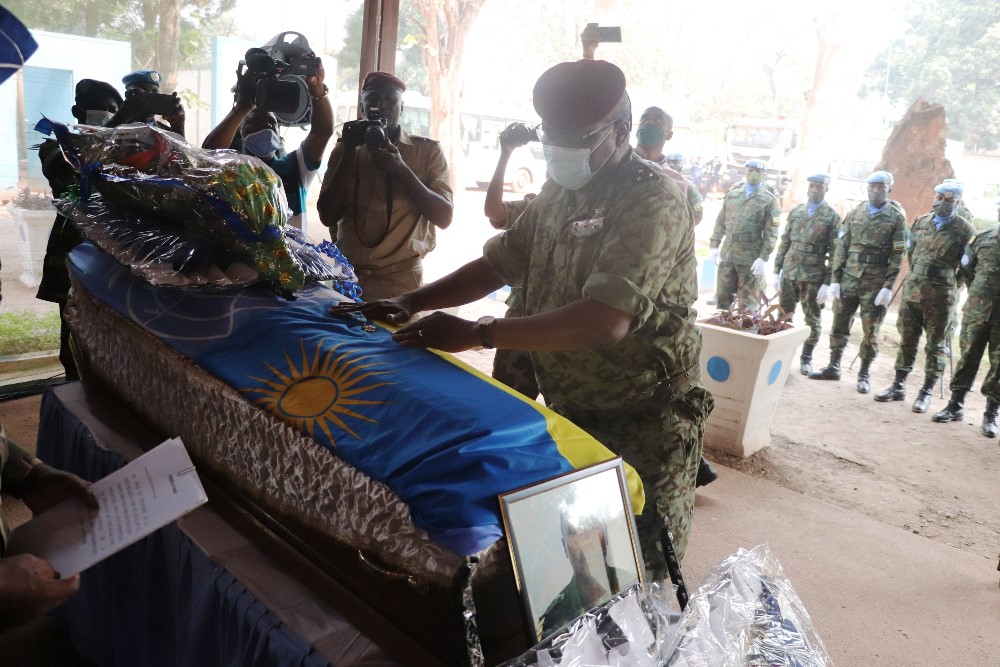
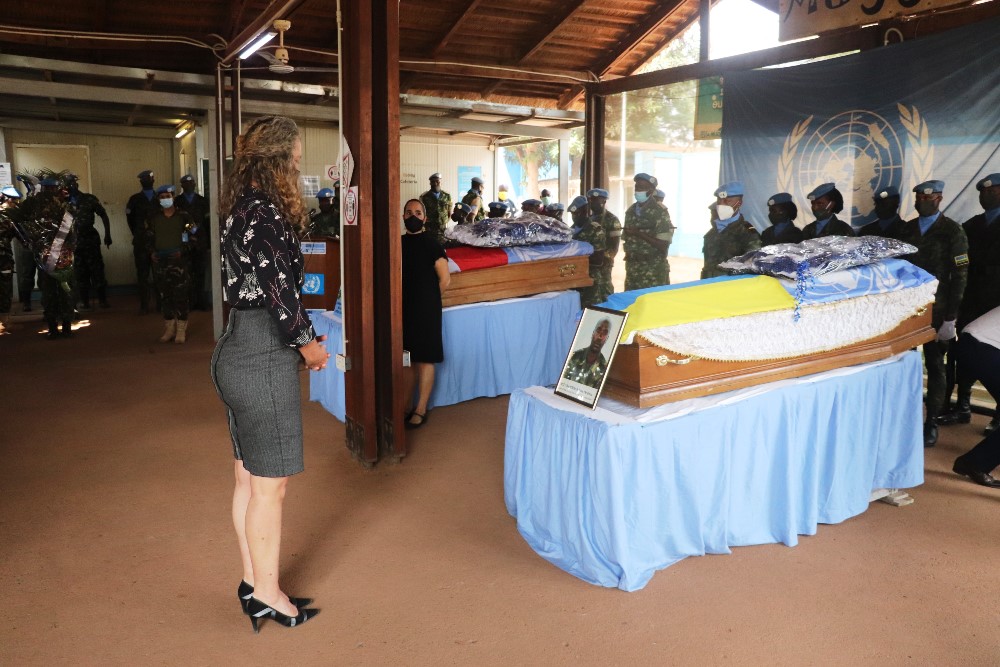
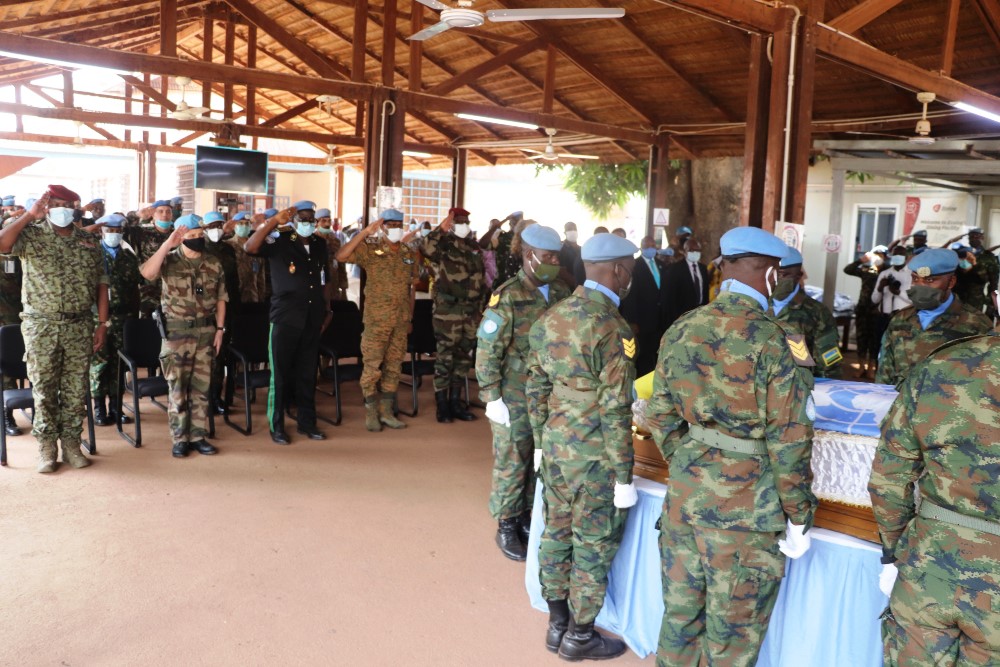
The Mission bid a final farewell to the fallen peacekeeper yesterday in a memorial ceremony held at MINUSCA force Headquarters. In attendance were the Deputy Special Representative of the UN Secretary General in CAR Denise Brown, the MINUSCA Force Commander General Sidiki Traoré and CAR Army Chief of Staff, General Zephirin Mamadou.
The Deputy Special Representative of the Secretary-General Denise Brown saluted Sgt NSABIMANA Jean D’amour: “United Nations appreciates his sacrifice to fight for the protection of civilians, peace services, stability and CAR population dignity” she said while also appreciating the dedication of Rwandan Contingent.
On behalf of the President of the Republic of CAR, the Inspector General of Central African Armed Forces, Major General Leopord Bruno Izamo, posthumously awarded Late Sgt NSABIMANA Jean D’amour ‘Medaille de chevalier d’ordre de la reconnaissance Centrafricaine’, one of the highest honor in the CAR.
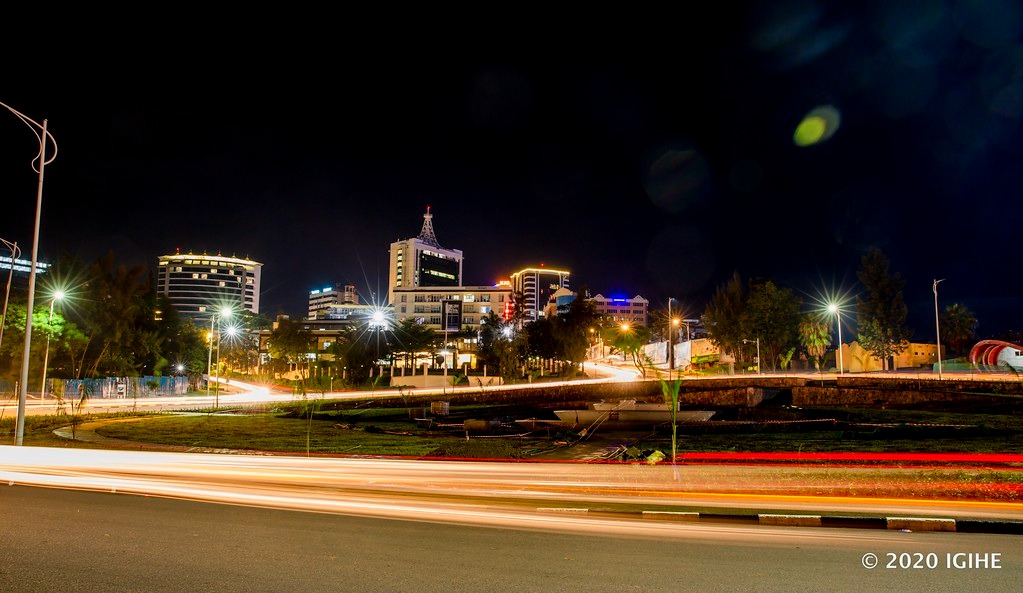
The cabinet meeting held on 18th January 2021 put Kigali city under total lockdown and called on Rwandans to heighten vigilance in observing COVID-19 health guidelines in order to slow the spread of the virus.
The meeting also decided that only essential services will continue to be offered.
In order to comply with the directives, RDB has issued new guidelines for tourism activities to be respected until further notice.
As per issued guidelines, travel for tourism within Kigali, other provinces and districts is permitted with strict adherence to COVID-19 preventive measures.
The guidelines also read that arriving and departing passengers must present a negative SARS-CoV 2 Real Time Polymerase Chain Reaction (RT-PCR) taken within 120 hours prior to arrival or departure.
Designated hotels for arriving passengers will remain open under strict COVID-19 preventive measures.
{{Other guidelines}}
Tourism activities including visits to national parks, museums and other tourist attractions as well as city tours will remain open to international and domestic tourists countrywide with strict adherence to COVID-19 preventive measures. All tourism service providers facilitating guests will be required to inform and share itineraries with RDB.
Travelers including drivers, traveling to tourism within entities within Kigali and other provinces and districts are required to fill and submit movement requests together with copies of negative COVID-19 test results to visitrwanda@rdb.rw at least 24 hours prior to the trip.
Tourism establishments are required to apply for clearance for their staff on weekly basis at least 24 hours prior to movement.
Hotels will only be permitted to host essential conferences with a written approval by RDB.
RDB has reminded the public to adhere to health and safety directives issued by the Ministry of Health to curb the spread of COVID-19.
Rwanda confirmed the first Coronavirus patient on 14th March 2020. Since then, 11 548 people have been tested positive out of 804 337 sample tests of whom 7580 have recovered, 3820 are active cases while 148 have succumbed to the virus.
Coronavirus symptoms include coughing, flu, and difficulty in breathing. The virus is said to be transmitted through the mucous membranes of the respiratory tract.
Rwandans are urged to adhere to COVID-19 health guidelines, washing hands frequently using soaps and safe water, wearing face masks and respecting social distancing.
The seminar was organized by Harvard University from the United States of America.
Rwanda’s Presidency has via Twitter handle revealed that President Kagame attended the seminar and spoke to participants.
“President Kagame is now speaking on leadership at the virtually held Africa Rising Seminar with students, faculty and members of the community of Harvard Business School,” reads the Tweet.
Other participants who delivered talks include Andy Zelleke, a lecturer at Harvard School of Business and Nigerian businessman, Hakeem Belo-Osagie. Hakeem is also the chair of Metis Capital Partners an organisation focused on brokering and delivering attractive, large-ticket transactions in Africa to select blue chip international investment partners. He was once listed by Forbes Magazine as the richest man in Africa. Hakeem is among alumni of Harvard School of Business.
President Paul Kagame is among leaders who delivered talks at Harvard University in 2016 and 2017.
In August 2017, Kagame received a delegation of 56 top African executives undergoing a special programme at Harvard Business School in the United States.
The executives were undergoing a programme dubbed Senior Executives Program-Africa (SEPA) offered in collaboration with the University of Pretoria (South Africa) and University of Lagos Business School in Nigeria.
As part of the training, participants met with President Kagame who gave them personal insights on Rwanda’s development path, leadership strategy among other things.
At the time, Prof. Srikant Datar from Havard Business School said that the team was inspired by Kagame’s approach to addressing several challenges the country faced to be where it is.
Harvard is one of top global universities renowned for training executives and acquainting other students with deeper knowledge leadership skills, politics and business.
Rwanda and CAR have been for long enjoying cordial relations whereby Rwanda is helping the country engulfed by wars to restore peace. Rwandan troops have been deployed to CAR peacekeeping mission since 2014. On 20th December 2020, Rwanda deployed more special forces to CAR under existing bilateral cooperation signed in 2019.
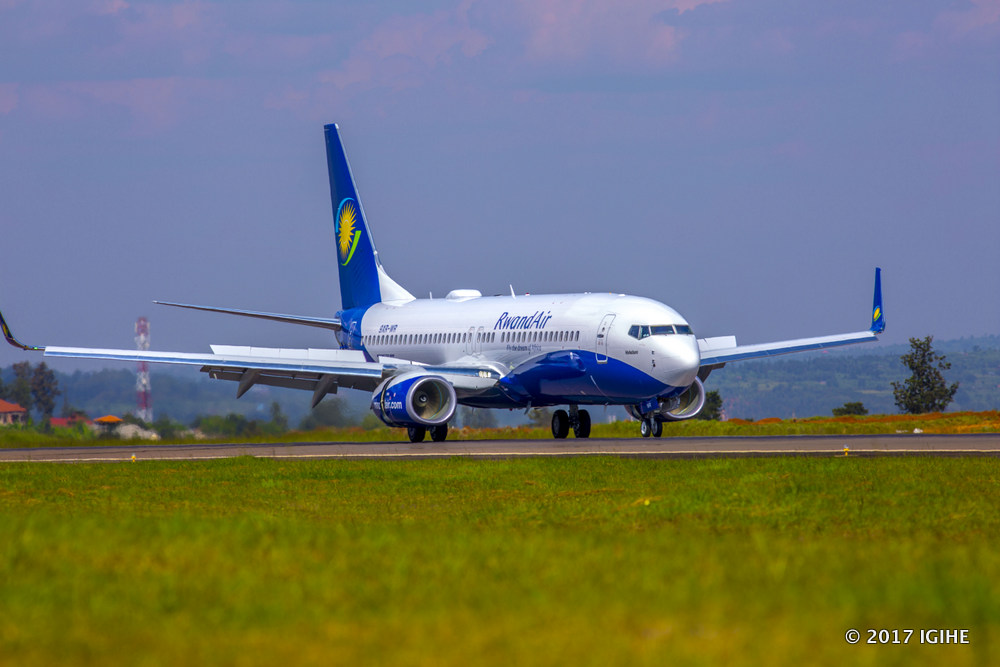
The CEO of RwandAir, Yvonne Makolo has told IGIHE that dates for the scheduled flights remain unknown because preparations are ongoing.
RwandAir will reach CAR through Douala in Cameroon.
“We are undergoing preparations that we plan to start flights next month if everything goes well. We have not yet identified the starting date because we are still trying to get all permits,” she said.
Previously, it was a complicated process to fly to Bangui. For instance, a passenger departing from Kigali with RwandAir would land to Kampala, Uganda for at least 30 minutes before resuming the flight to Kenya. Upon arrival in Kenya, a passenger would depart with Kenya Airways to reach M’poko airport in Bangui.
One of people living in CAR has told IGIHE that anticipated flights will facilitate movements to other countries.
IGIHE has learnt that RwandAir will operate the first flight to Bangui in the first week of February 2021 even though the carrier didn’t reveal it.
CAR covers a land area of about 620,000 square kilometres and has an estimated population of around 4.7 million. As of 2020, the country is the scene of a civil war, ongoing since 2012.
The Central African Republic’s economy is based primarily on subsistence agriculture, with important mining and timber industries the main source of export earnings. Diamonds are the country’s most profitable export, while agriculture occupies most of its working population.
Farmers grow cotton, coffee, and tobacco for export and crops for local markets, but economic development is handicapped by the CAR’s landlocked position, limited infrastructure, and the low education of its work-force. Poor government management and political instability have further weakened the CAR’s economic condition. The informal sector is important in the CAR, accounting for most economic activity and a large share of the diamond trade.
CAR has had a turbulent economic history. Since gaining independence in 1960, the economy has endured intermittent periods of economic decline caused in part by poor management.
The opening of flights might present a huge market opportunity for businesspersons as the country heavily depends on imports.
Related story: https://en.igihe.com/news/article/rwandair-in-new-expansion-drive
During a talk show aired on Rwanda Broadcasting Agency (RBA), the Minister of Health, Dr. Daniel Ngamije explained that people have been complacent for the past few days which triggered the surge in new Coronavirus cases.
He has revealed this following the cabinet meeting held yesterday on 18th January 2021 which took stringent measures to contain spread of the virus.
The meeting has placed Kigali city under lockdown for two weeks, a decision that will be reviewed upon health assessment. All public and private schools in the city have been also closed.
“We have registered over 142 people have succumbed to Coronavirus up to date of whom 65% died in the past 50 days. This means, the situation worsened and it is apparent to everyone,” said Dr. Ngamije.
“To slow down the upsurge in new Coronavirus cases, we need strict measures like the ones the Government has taken during a cabinet meeting chaired by President of the Republic,” he added.
To date, all schools in Kigali are closed while unnecessary movements are prohibited except for essential services including medical/ healthcare, food shopping, banking etc and for the personnel performing such services. All movements will require an approved permit from Rwanda National Police.
Travel between Kigali and other provinces and districts of the country is not permitted, except for essential services and tourism (tourists must possess negative Covid-19 test results).
Public transport in Kigali is prohibited, however transportation of food and essential goods will continue to function. Motos and bicycles are not permitted to carry passengers, but may offer delivery services.
Rwanda confirmed the first COVID-19 patient on 14th March 2020. Since then, 11 259 people have been tested positive out of 799,817 sample tests of whom 7412 have recovered, 3701 are active cases while 146 have succumbed to the virus.
Coronavirus symptoms include coughing, flu, and difficulty in breathing. The virus is said to be transmitted through the mucous membranes of the respiratory tract.
Rwandans are urged to adhere to COVID-19 health guidelines, washing hands frequently using soaps and safe water, wearing face masks and respecting social distancing.
The journalist also said that RPF Inkotanyi soldiers shot the airplane of former President of Rwanda, Habyarimana Juvenal which is considered a biased argument not informed by research.
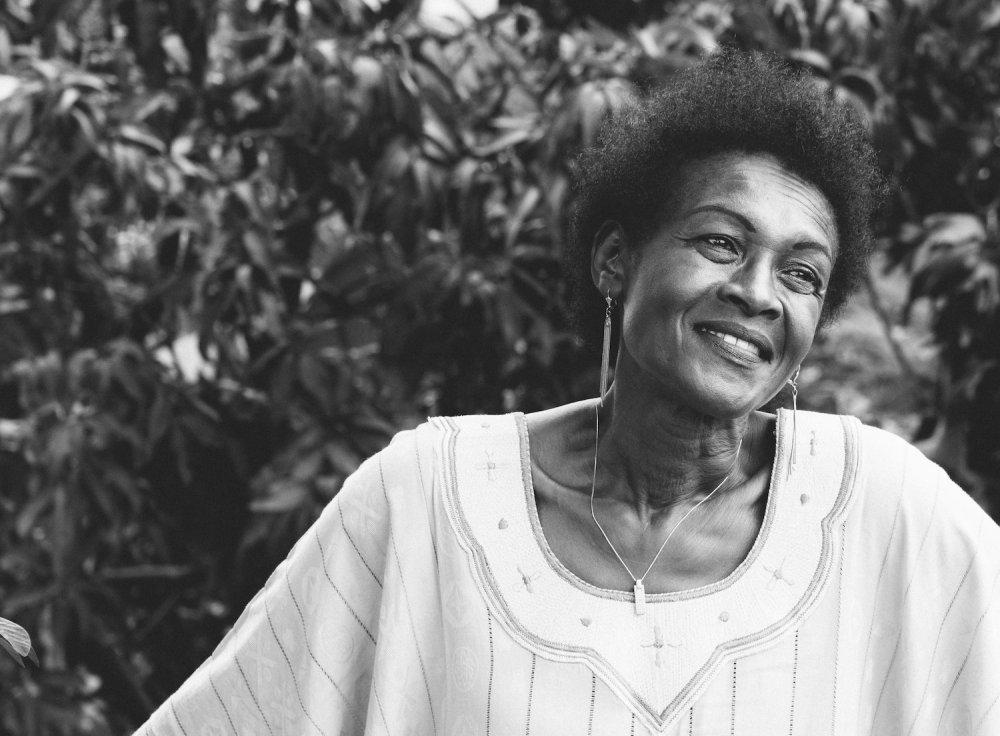
Through her foundation dubbed ‘Yolande Mukagasana’ , she has written a letter protesting acts of Judi Rever who tends to use ‘freedom of expression’ for activities that might be likened with propaganda that characterized the media before and during the 1994 Genocide against the Tutsi.
“Freedom of expression” was used as a weapon to expedite the 1994 genocide against Tutsi in Rwanda. Today, Judi Rever uses this same concept to deny the genocide.
In the years leading to 1994, media outlets and tabloids belonging to to Hutu extremists used the noble concept of ‘Freedom of Expression’ as a weapon while the world stood idly by and watched it happen.
The infamous Radio Télévision Libre des Mille Collines (RTLM), the Kangura newspaper which published the ten Hutu Commandments, and many others were used by these extremist groups.
In the aftermath of the genocide, a number of journalists were found guilty of genocide extremism related crimes by the International Criminal Tribunal for Rwanda (ICTR). The sentenced media practitioners included a foreign journalist, George Ruggiu, condemned to 12 years in prison.
Through an open letter, Yolande Mukagasana Foundation has explained that there should be no excuse for people lagging behind freedom of expression to undermine genocide.
“Today, we cannot, in no way, tolerate revisionists and genocide deniers who use freedom of expression as an excuse to manipulate historical facts by, for instance, labeling Rwanda’s liberation movement as criminals. We cannot allow 26 years of continuous lies and torture imposed on genocide survivors to go unchecked and unchallenged. Most of their manipulation and denialism amount to criminal acts that deserve to be condemned and in several cases, tried,” reads part of the letter.
The letter further states the journalist Rever didn’t prove researched evidences whereby her witnesses are deemed spurious.
The foundation recalled that the genocide against the Hutus which would have been committed by the Tutsi was announced for the first time in an article written by “l’Association des Femmes Parlementaires pour la Défense des Droits de la Mère et de l’Enfant” in collaboration with Dr. Mugesera Léon. The article, titled “The Whole Truth About the October 1990 Rwanda War” was published in February 1991.
“The war of the RPF is to restore the dictatorship of the extremism of the minority Tutsi based on a genocide, the extermination of the Hutu majority,” the article reads in part.
The authors of this article, starting with Dr. Léon Mugesera, who was sentenced to life imprisonment played a role during the 1994 Genocide against the Tutsi.
The planners of the genocide against the Tutsi devised this ideology to make Hutus fear and hate Tutsis. They then used state institutions to turn fear and hatred into the myriad acts of hunting, rape and massacres that made up the Genocide against Tutsi.
In his book “When Victims Become Killers”, Professor Mahmood Mamdani, scholar and author of several books, points out that “Most genocides have been rationalized, mobilized, organized, explained as preventive actions; do to them what they will do to you before they do it to you. ”
Judi Rever supports this conspiracy theory announced by Professor Mahmood Mamdani.
Based on such acts, Yolande Mukagasana Foundation has called for action to condemn the Canadian journalist.
“The genocide against the Tutsi was not a crime by ignorant people. It was planned and coordinated by intellectuals, politicians, and the military. Journalists contributed to it, such as Judi Rever and Stéphan Bureau, who gave it a platform by disseminating its insults and denialism without qualms, shame or scruples,” reads the letter.
The foundation also calls on Canada, through its ambassador to Rwanda to ‘make a comment on what we denounce with anger and indignation and tell us if as a country, they support genocide denial as promoted by some Canadian journalists’.
“In Canada, the country of Judi Rever and Stéphan Bureau, no one can dare claim that the Jews disguised themselves as Nazis and murdered their own families. No one would have the heart to question the testimonies of Holocaust survivors by accusing them of disseminating an “official version of history which would suit the State of Israel.” Why would this be allowed when it comes to the history of Rwanda? How can Canada allow this? We need to understand, but don’t come and tell us that it is freedom of expression because we know it from having lived in Rwanda in 1994,”reads the letter.
The Yolande Mukagasana Foundation is an independent foundation promoting research on the 1994 Genocide against the Tutsi. Among its various objectives is, in the very first line, the fight against revisionism and genocide denial, as well as a determined fight against the genocidal ideology which is hidden under these multiple acts of denial.
“Consequently, we strongly condemn both Radio Canada for having offered a platform for evil, and the shameful remarks that deny and trivialize the genocide made by Judi Rever and Stéphan Bureau: their comments, hidden behind the curtain of ‘freedom of expression’, insult the memory of genocide survivors and all Rwandans of good will,” concludes the letter.
The resolution of the virtual cabinet meeting chaired by President Paul Kagame is part of stringent measures taken to prevent the spread of COVID-19 pandemic which has been on steady rise.
Kigali city has been the major hotspot for surging Coronavirus cases where 862 COVID-19 cases and 19 deaths were recorded between 11th January to 17th January 2021.
“Upon health assessment of the recent unprecedented rise in cases, deaths and transmission rates in the community, the cabinet called on Rwandans to heighten vigilance in observing COVID-19 health guidelines in order to slow the spread of the virus,” reads part of a statement released by the Office of the Prime Minister.
“The surge in cases specifically in the City of Kigali has necessitated a lockdown. Citizens are urged to significantly reduce social interactions and limit movements only to essential services,” adds the statement.
{{Specific measures in the City of Kigali }}
a) Unnecessary movements including visits outside home are prohibited except for essential services including medical/ healthcare, food shopping, banking etc and for the personnel performing such services. All movements will require an approved permit from Rwanda National Police. A complete list of essential services will be shared by the Ministry of Local Government.
b) Travel between Kigali and other provinces and districts of the country is not permitted, except for essential services and tourism (tourists must possess negative Covid-19 test results).
c) Public transport is prohibited, however transportation of food and essential goods will continue to function. Motos and bicycles are not permitted to carry passengers, but may offer delivery services.
d) All employees (public and private) shall work from home, except for those providing essential services.
e) Businesses are closed, except distribution and delivery services as well as those selling food, medicine, (pharmacies), hygiene and cleaning products, fuel, and other essential items but will operate at 30% capacity. Businesses permitted to operate must close by 6pm.
f) Restaurants and cafés will only provide take-away service.
g) All schools (public and private) including universities are closed however remote learning is encouraged.
h) Places of worship are closed.
i) Kigali International Airport will remain open, arriving passengers must present a negative PCR taken within 120 hours prior to their first departure. Departing passengers must present a negative PCR test before departure.
j) Designated hotels for arriving passengers will remain open under strict COVID-19 prevention measures. RDB will share complete list of approved hotels.
k) Tourism activity will continue in strict adherence with COVID-19 health guidelines. This includes hotels, tour operators and transport services facilitating guests. Tourists and service providers shall inform RDB of itineraries.
l) Hotels will only host essential conferences upon written approval from RDB. Detailed guidelines will be provided by RDB.
m) Farming will continue for the ongoing agricultural season while observing COVID-19 control measures.
n) Funeral gatherings should not exceed 15 persons.
{{Measures in the remaining part of the country }}
a) Movements are prohibited from 6pm to 4pm.
b) Places of worship are closed.
c) Schools will continue while respecting COVID-19 control measures.
d) All social gatherings and events including religious wedding ceremonies, receptions, meetings, and conferences are prohibited.
e) Public gyms and swimming pools shall be restricted from the public with the exception of tested guests staying at hotels.
f) Attendance at a wake / vigil (Ikiriyo) should not exceed 10 people at any one time.
g) Funeral gatherings should not exceed 15 persons.
h) Gaming activities remain prohibited.
These measures will take effect immediately to be reviewed after 15 days upon a health assessment.
Related story: https://en.igihe.com/news/article/total-lockdown-looms-if-violation-of-covid-19-preventive-measures-persists
The decision was announced one day before pupils in Pre Primary and Lower Primary School (P1-3) were supposed to resume studies on 18th January 2021 following ten months of suspension due to COVID-19 pandemic.
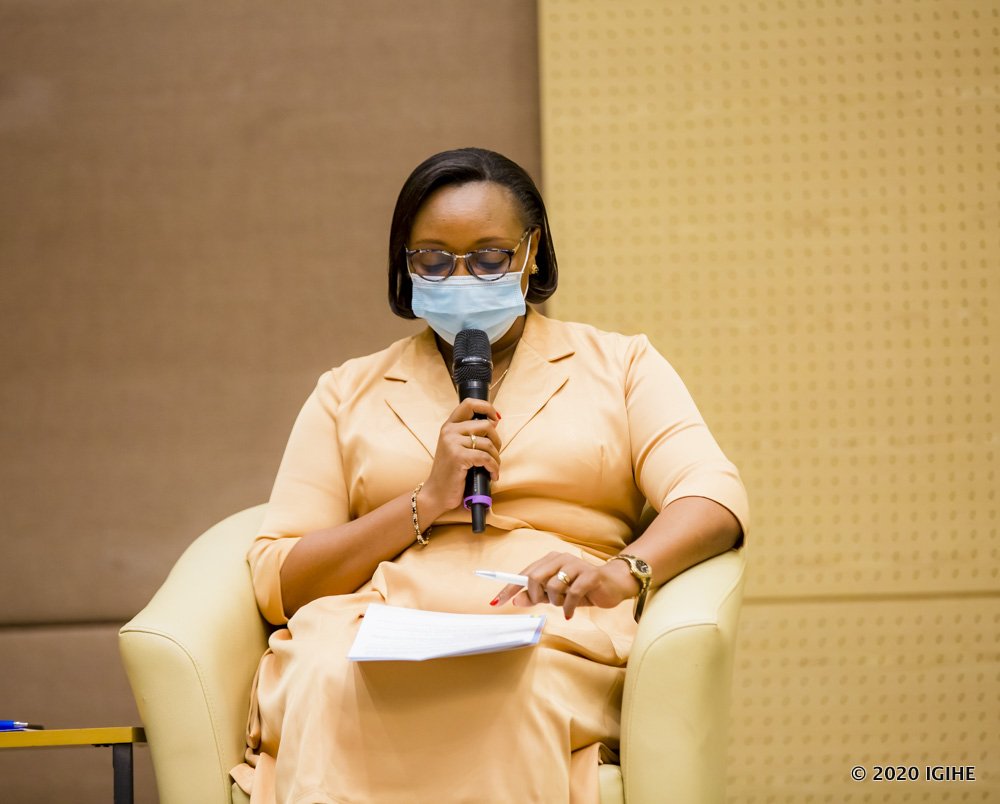
In a talk show aired on Rwanda Television; the Minister of Education, Dr. Valentine Uwamariya explained that the decision was meant to contain the steady rise of new Coronavirus infections in Kigali.
“It is true that the decision concerns the City of Kigali because new Covid-19 cases have been extremely increasing. This is additional to registered deaths,” she said.
“After an assessment in consultation with the Ministry of Health, we have established that it is necessary to close public and private schools including nursery, primary, secondary, vocational and international schools effective from Monday 18th January 2021. An assessment will be done after two weeks to decide if these schools can reopen,” added Dr. Mujawamariya.
She explained that boarding students in Kigali city will stay and continue to receive possible support to revise courses.
MINEDUC has revealed that courses will continue out of Kigali that nursery and primary schools are set to resume studies on scheduled dates.
“Studies are continuing in other parts of the country. This means, learners in this category will resume courses. Parents should continue to prepare children,” she noted.
On 7th January 2021, MINEDUC announced that pupils in Pre Primary and Lower Primary School (P1-3) would resume studies on 18th January 2021 following ten months of suspension due to COVID-19 pandemic.
Dr. Uwamariya however explained that the decision would be assessed in accordance with the prevalence of COVID-19 infections and advises from the Ministry of Health.
New COVID-19 infections continue increase whereby Rwanda has recorded 1402 cases and 22 deaths from 11th to 17th January 2021. The majority of new cases were found in Kigali city with highest figures of new infections which started increasing gradually towards the end of last year.
The Ministry of Health shows that 862 COVID-19 cases and 19 deaths were recorded in Kigali in one week.
Rwanda confirmed the first Coronavirus patient on 14th March 2020. Since then, 11 032 people have been tested positive out of 796 867 sample tests of whom 7363 have recovered while 3527 are active cases while 142 have succumbed to the pandemic.
In a statement released yesterday, MINEDUC explained that the decision concerning public and private schools must go into effect on Monday 18th January 2021.
According to MINEDUC, the directive taken after consultation with the Ministry if Health was taken to prevent upsurging COVID-19 cases especially in Kigali city.
“Boarding students in schools located in Kigali city will stay and continue to receive essential services,” reads part of the statement. “All schools out of Kigali will continue to operate as usual in adherence to COVID-19 preventive measures,” adds the statement.
These measures will be reviewed after two weeks upon health assessment.
On 7th January 2021, MINEDUC announced that pupils in Pre Primary and Lower Primary School (P1-3) would resume studies on 18th January 2021 following ten months of suspension due to COVID-19 pandemic.
At the time, the Minister of Education, Dr. Uwamariya Valentine requested parents to start preparations for anticipated reopening.
“Children from nursery schools and lower primary schools (P1 to P3) will resume studies on 18th January 2021. Parents and students should start preparations to be ready by that time,” she said.
Dr. Uwamariya however explained that the decision would be assessed in accordance with the prevalence of COVID-19 infections and advises from the Ministry of Health.
New COVID-19 infections continue increase whereby Rwanda has recorded 1402 cases and 22 deaths from 11th to 17th January 2021. The majority of new cases were found in Kigali City with highest figures of new infections which started increasing gradually towards the end of last year.
The Ministry of Health shows that 862 COVID-19 cases and 19 deaths were recorded in Kigali in one week.
Rwanda confirmed the first Coronavirus patient on 14th March 2020. Since then, 11 032 people have been tested positive out of 796 867 sample tests of whom 7363 have recovered while 3527 are active cases while 142 have succumbed to the pandemic.
In a bid to prevent the spread of Coronavirus, the Government ordered the closure of all schools that saw all students returning home in March 2020.
Universities and higher learning institutions were allowed to reopen in September 2020 under strict COVID-19 control measures.
In October 2020, the Ministry of Education announced 2nd November as the reopening date for learners in primary 5 and 6 classes. Students from ordinary level, senior 5 and 6 also resumed studies the same day.
The second batch started the second term on 23rd November 2020. This includes learners in primary 4 classes, and secondary school students from senior 1, 2 and 4.
The current MINEDUC timetable shows that students will start the third term on 19th March 2021 to end on 9th July 2021.
The second term’s holidays will run from 3rd April to 15th April 2021. Finalists in primary schools, ordinary level and senior six are expected to sit for national exams in July 2021.
New patients were found in Kigali: 128, Kirehe: 13, Gatsibo: 10, Rwamagana: 6, Rulindo: 6, Musanze: 5, Rubavu: 5, Gicumbi: 4, Huye: 2, Nyaruguru: 1, Ngoma: 1 and Nyagatare: 1.
New COVID-19 infections continue increase whereby Rwanda has recorded 1402 cases and 22 deaths from 11th to 17th January 2021. The majority of new cases were found in Kigali City with highest figures of new infections which started increasing gradually towards the end of last year.
The Ministry of Health shows that 862 COVID-19 cases and 19 deaths were recorded in Kigali in one week.
Following the gradual increase in the City of Kigali, the Ministry of Education (MINEDUC) has closed nursery, primary and secondary schools from Kigali City and advised students to attend classes online.
In a statement released yesterday, MINEDUC explained that public and private schools are required to respect the decision effective from 18th January 2021.
Students in boarding schools will however stay at school while schools out of Kigali City will continue to operate in adherence to COVID-19 health guidelines.
These measures will be reviewed after two weeks upon health assessment.
Rwanda confirmed the first Coronavirus patient on 14th March 2020. Since then, 11 032 people have been tested positive out of 796 867 sample tests of whom 7363 have recovered while 3527 are active cases while 142 have succumbed to the pandemic.