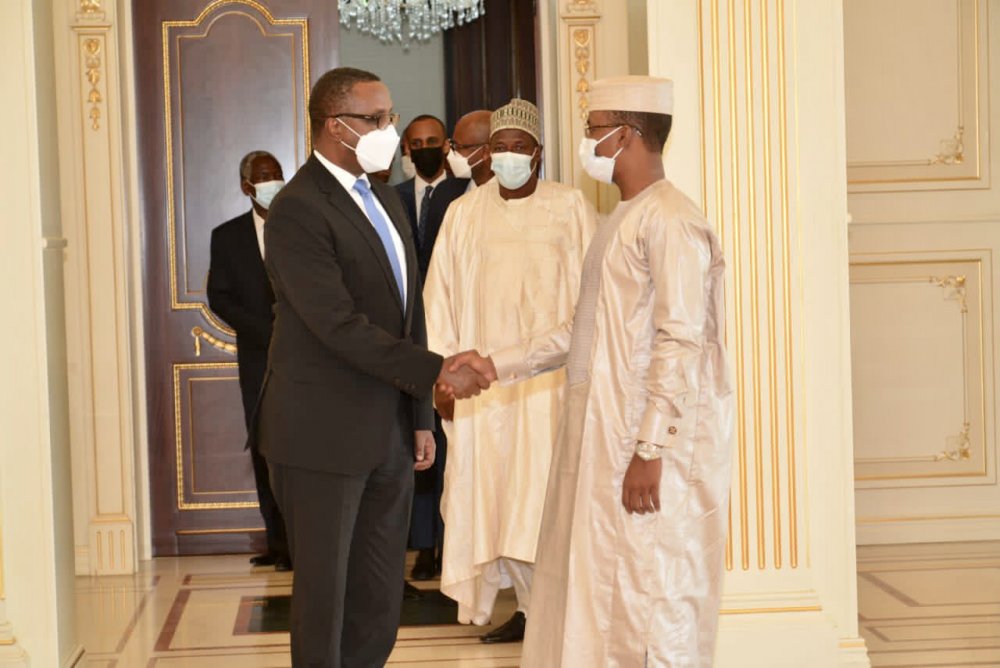
“The President of the Transitional Military Council of Chad, Gen Mahamat Idriss Deby Itno has received Rwanda’s Minister of Foreign Affairs, Dr. Vincent Biruta. He delivered a message from President Paul Kagame,” reads the tweet.
Gen Mahamat is the son of former Chadian President, Idriss Deby Itno who recently died on the battlefield after three decades in power.
Gen Mahamat has been demonstrating willingness to maintain good relations with other countries including Rwanda.
In May 2021, Gen Mahamat Idriss Deby sent to Rwanda, his brother Abdelkerim Déby Itno who serves as the Director of Cabinet and Special Envoy the President of the Transitional Military Council where he held talks with President Paul Kagame.
In July 2021, Gen Mahamat held talks with the Secretary General of Organisation internationale de la Francophonie, Louise Mushikiwabo who advised him to organize transparent elections.
He became the interim President of Chad following the death of his father who succumbed to injuries following clashes with rebels in the north of the country in April 2021.
The idea behind Assumption Day is the belief that Mary the mother of Jesus had her body, and soul, miraculously taken up to heaven by God.
The feast is celebrated for the second time in difficult times of COVID-19 pandemic which has shaken global economy and took people’s lives.
Before the pandemic, thousand believers would turn up at Kibeho Holy Land renowned for apparitions of Mary.
Located in Nyaruguru district of Southern Province, Kibeho is an important place for Catholics as it is believed that the Virgin Mary appeared to some teenagers in the area in 1981.
Three female teenagers witnessed apparitions in the following years and the message which Mary left asking people to repent and encouraging Rwandans to love each other as well.
Since then, the place receives Catholic believers every year from across the world including global celebrities and other important personalities.
This year’s celebration has been observed with minimal participation in compliance with ongoing measures to contain the spread of COVID-19 pandemic while others were encouraged to pray from their homes.
Each of the three Masses read on Sunday was attended by 330 Christians against more than 50,000 congregants that used to turn up for prayers at the land before COVID-19.
Addressing congregants; the Bishop of Gikongoro Diocese, Célestin Hakizimana said that the processions for the Feast of the Assumption was not observed due to the pandemic and urged Christians to remain obedient.
“We are lucky to have celebrated this special day of Mary’s Assumption and Vigil of the Assumption Day. We were not able to host processions for the feast but we had introspective contemplation,” he said.
Bishop Hakizimana thanked the Virgin Mary for the blessing of the day considering the fact that restrictions were eased back to reopen churches but highlighted that it should not leave the loophole for complacency to disregard government’s directives.
He explained that Christians in attendance had to register before and respect other health guidelines arriving at the holy land including the proper wearing of face masks, respecting social distancing and washing hands.
“We are taught to obey and convinced that it is our moral obligation to do so because leadership is inherited from God. Being obedient to God must go hand in hand with respecting leaders. You cannot pretend to have Godly values while disobeying leaders around,” he said.
Bishop Hakizimana also called on Christians to pray in compliance with instituted directives to mirror good examples in the society.
“We should be thankful for their obedience to instituted measures as they attend church services. We encourage them to keep it up and continue being good examples in the community so as to defeat the pandemic together,” he noted.
The event held on 30th July 2021 brought together a total of sixteen leaders of local tribes, civic groups, and youth organizations that lead the development of communities including Adam Salih Mohammed Atim, leader of Fur tribe, and Mohammed Aboshama Shata, leader of Arab tribe.
Attendees suggested the following as resolution of conflicts and peacebuilding: trial for perpetrators of genocide, disarmament of all tribes in Darfur, improving awareness of peace through peace education and workshops.
The prolonged drought in Darfur since the 1980s, has driven northern Arab nomads into southern African agricultural land. Meanwhile, the Sudanese government’s policy alienation in the western region was the starting point of the uprising. In February 2003 the conflict began in earnest when rebel groups opposing the policy alienation in the regions attacked the North Darfur and has continued to this day due to complex reasons such as racial and religious conflicts and regional inequalities.
According to the United Nations, about 300,000 people were killed in fighting between Darfur rebels and pro-government Janjaweed militias, and about 2.5 million indigenous people walked 600 kilometers to flee to the neighboring countries Chad and South Sudan, who are still refugees. Even about 237,000 refugees were reported in the first four months of 2021.
Under these circumstances, leaders attended the online forum to protect the human rights of local citizens and to build sustainable peace, announcing their ideas on conflict resolution and peace. Heavenly Culture, World peace, Restoration of Light, an international peace organization (HWPL), the host of the event, also shared how the conflict was disputed in Mindanao, Philippines, where more than 140,000 people were killed in the 40-year conflict. HWPL encouraged participants to engage in peaceful activities in Sudan through Mindanao’s positive example achieved by citizen-led cooperation.
Shams Eldien Ahmed Salih Khamis, Teacher of Shams Eldien Academy Private High School said: “Making it known to everyone the importance of peace is the best way to bring peace to Darfur. Peace is the law of nature and the only way for everyone to be a winner. These courses should be spread through the workshop.”
Abaker Mohammed Sharf Mohammed, the former engineer of UN and peace activist, emphasized disarmament as a key for peacebuilding by mentioning: “Weapons are inhumane and it causes unnecessary suffering. Citizens who are not armed are dying by conflicts between some armed groups. There is no winner from conflict by using weapons.”
Ibrahim Ahmed Idris, the former facilitates management assistant of UNAMID, said “Peace agreement, which was set by Mindanao’s leaders and the Philippine government, and HWPL is very impressive. I hope what happened in Mindanao will happen in Darfur. It may be different from what happened here, but there is no problem in the world that cannot be solved. We want peace in Darfur and we want to find the future of the people of Darfur.
In 2014, Man-Hee Lee, a chairman of Heavenly Culture, World Peace, Restoration of Light (HWPL) visited Mindanao to resolve the dispute and held a peace walk event for the first time in Mindanao with more than 1,000 people including various religious groups, college students and international youth organizations.
Chairman Lee asked participants, including religious leaders, youth organizations, and university professors, whether they want war or peace, emphasizing the need for peace. And with the consent of all participants he could finally lead a peace agreement.
In addition, he proclaimed the ‘Declaration of Peace and Cessation of War (DPCW)’ in 2016, comprising 10 articles and 38 clauses to settle all disputes in the world and leave sustainable peace to future generations.
The DPCW was drafted by international law experts in 15 countries to back up current international agreements and declarations in the changing international situation, based on the values and spirit contained in the UN Charter and the Universal Declaration of Human Rights.
Police was called in at about 9:30pm to break the illegal gathering and silent disco.
The violators were also found drinking with most of them already drunk.
Chief Inspector of Police (CIP) Bonaventure Twizere Karekezi, the Police spokesperson for the Western region, said a resident called the Police reporting the noise that was coming out of the hotel that night.
“Indeed, when Police officers arrived at Kivu Park Hotel owned by Eric Rukimirwa, they found 67 people in silent disco and drinking. 41 of them had documents as tourists from Kigali but they invited 26 friends, on arrival to Rubavu, to join them for a silent disco,” CIP Karekezi said.
“When you are given a travel clearance, use it accordingly and in compliance with the Covid-19 prevention guidelines, contrary to that you will be arrested for flouting the directives,” he warned.
The hotel proprietor, Eric Rukimirwa admitted to the violations. “We had reservations for 41 people, who had all the required documents, unfortunately when they arrived here they invited their 26 friends and the number increased to 67,” Rukimirwa said.
The violators were also subjected to Covid-19 test and fined accordingly. The hotel was also closed for operating contrary to the directives and the owner fined.
The statement released last night shows that 418 people have caught the virus out of 10102 sample tests, 10 recovered while 37 are critically ill.
The majority of new cases were found in Huye: 62, Kigali City: 50, Rulindo: 37, Kayonza: 35 and Gicumbi: 30.
A total of 889,995 people have been vaccinated since Rwanda began countrywide inoculation program on 5th March 2021.
Coronavirus symptoms include coughing, flu, and difficulty in breathing. The virus is said to be transmitted through the mucous membranes of the respiratory tract.
Rwandans are urged to adhere to COVID-19 health guidelines, washing hands frequently using soaps and safe water, wearing face masks and respecting social distancing.
They were arrested in two separate operations conducted by the Rwanda National Police (RNP) Anti-Narcotics Unit (ANU), on Friday and Saturday.
They are Jean Nepo Ngendahimana, 38, was intercepted on Friday in Runyeheri Village, Nyarushyamba Cell, Nyakiriba Sector with 2,272 pellets of cannabis and a taxi-moto operator, Venuste Nshimiyimana, 22, arrested on Saturday in Rushasho Village, Kirerema Cell, Kanzenze Sector with 275 pellets of cannabis.
Chief Inspector of Police (CIP) Bonaventure Twizere Karekezi, the Police spokesperson for the Western region, said that Police is still searching for a taxi-moto operator only identified as Clement, who was also transporting Ngendahimana but managed to flee during the operation.
“We had information from residents that the Ngendahimana and Clement were in the process of trafficking the narcotics from Busasamana Sector to Nyakiriba through Nyarushyamba cell. Police conducted an operation targeting the suspects, who were intercepted at about 6am, although the rider managed to escape in the process,” said CIP Karekezi.
The motorcycle was impounded to Kanama RIB station where Ngendahimana was also taken alongside the exhibits.
Nshimiyimana, on the other hand, was at the time riding from Mushubati Sector of Rutsiro District.
“Nshimiyimana was hired by one Nsabimana, who lives in Kanzenze Sector, to bring him the narcotics and had promised to pay him Frw50,000 after delivering the narcotics to him,” CIP Karekezi explained.
He further warned taxi-moto operators against facilitating drug dealers and added that Police and the ANU in particular, heightened operations against dealers in drugs.
The Ministerial order nº 001/MoH/2019 of 04/03/2019 establishing the list of narcotic drugs and their categorisation classifies cannabis in the category of “very severe narcotics.’’
Article 263 of law No. 68/2018 of 30/08/2018 determining offenses and penalties in general states that any person, who unlawfully produces, transforms, transports, stores, gives to another or who sells narcotic drugs and psychotropic substances, commits an offence.
Upon conviction for very severe narcotics, the offender faces between 20 years and life imprisonment, and a fine of between Rwf20 million and Rwf30 million.
The statement released last night also shows that 466 people have caught the virus out of 13356 sample tests, 13 recovered while 40 are critically ill.
A total of 888,968 people have been vaccinated since Rwanda began countrywide inoculation program on 5th March 2021.
Coronavirus symptoms include coughing, flu, and difficulty in breathing. The virus is said to be transmitted through the mucous membranes of the respiratory tract.
Rwandans are urged to adhere to COVID-19 health guidelines, washing hands frequently using soaps and safe water, wearing face masks and respecting social distancing.
The suspects were arrested red-handed with 102 pieces of assorted skin whitening products worth Rwf238, 900.
At least 47 pieces of skin whitening cosmetics were seized from the shop owned by Sinayobye located in Rukeri village, Ruhango cell while 55 others were found in Nzamurambaho’s shop in Agasharu Village, Musezero Cell.
The duo admitted that they were buying the outlawed harmful lotions from other dealers in Kigali
Nzamurambaho said that he was being supplied by a major dealer living in Nyamirambo, whom he only identified as Ndayambaje.
“Ndayambaje is the one who hires cyclists to deliver the cosmetics to me,” Nzamurambaho told the Police.
To Sinayobye, he said that he was being supplied by one Juvenal Nkurikiyimana alias Gatoya, who operates in Nyabugogo.
RNP spokesperson, Commissioner of Police(CP) John Bosco Kabera said that this is part of the ongoing operations to fight the sell and use of the skin bleaching cosmetics, which were banned in Rwanda due to their adverse health effects to users.
There are 1,342 listed cream and oil brands with hydroquinone and mercury, which are prohibited in Rwanda.
“These suspects are not the first to be arrested; many more have been caught and showed to the media before, and this should sound as a warning that even others that are still involved in this unlawful business and trying to thrive at the cost of other people’s health, will be arrested,” CP Kabera said.
He commended the public for the community policing spirit through reporting people dealing in skin bleaching products.
The suspects were handed over to RIB at Kacyiru Police station for further legal process as the search for their two alleged supplier is still underway.
The outlawed creams and oil brands contain chemicals such as mercury and hydroquinone, which can cause liver damage, reduce resistance to bacterial and fungal infections, and increase anxiety, according to the World Health Organization (WHO).
Medics suggest that the two toxic chemicals; hydroquinone and mercury react with ultraviolet rays and lead to more pigmentation and premature aging.
The more these products are used the less melanin the body produces, and this leads to an increased risk for skin cancer.
Article 266 of the law determining offenses and penalties in general, states that any person, who produces, sells, or prescribes harmful products; cosmetics or body hygiene substance or any other products derived from plants, commits an offence.
Upon conviction, he/she is liable to imprisonment for a term of not less than one year and not more than two years and a fine of not less than Rwf3 million and not more than Rwf5 million or one of these penalties.
She will co-chair the Advisory Board along with Professor Senait Fisseha, Director Global Programs, Buffett Foundation.
Buffett Foundation is an organization aimed at catalyzing transformational change to improve the standard of living and quality of life, particularly for the world’s most impoverished and marginalized populations.
Inaugurated in 2018, UGHE releases graduates with Bachelor and Master’s in global health sciences.
Its curriculum has similar course units with those of Harvard in the United States.
The Advisory Board will be instrumental to UGHE’s ambitious mission of building a robust healthcare workforce in Africa to provide equitable, quality health services to all, and supporting the continent’s path to self-reliance in health by advancing its human resource potential.
Additional to providing guidance on the institution’s strategic development and implementation, the Advisory Board will support UGHE’s efforts to expand its academic programs and its overall reach according to the needs of the African continent.
Through a statement released by UGHE today, First Lady Jeannette Kagame
stated that ‘to afford all human beings access to the quality health services and care they need, when they need them, is to afford them dignity and control over their own lives’.
“To achieve this, however, we need more than strong policies, laws and mechanisms in the health sector. We need the right people in the right places, making the right decisions at the right time, to guarantee every individual’s right to health,” she noted.
Prof. Senait Fisseha has said that advancing the human resource potential and self-reliance in African health systems, requires global health institutions like UGHE that train clinicians, passionate and compassionate global health leaders, innovative researchers, scientists and implementers, health entrepreneurs, and managers on the continent.
“Our UGHE’s new African Advisory Board of prominent leaders and experts will support our institute drive a human centered resource development agenda, and we are proud to unite their visions, actions, exhibited competency and commitment to help move this health equity forward,” he stressed.
The Advisory Board is expected to bring together eminent African leaders and global health leaders from diverse fields, sectors, genders and geographies; people whose respective careers have helped advance both human and socio-economic development on the continent. The Advisory Board will also invite selected global leaders to share their knowledge and expertise gained from their work on the continent and globally.
Many African populations face significant geographic and financial barriers to accessing basic health care, and delivery of these services is compromised by a scarcity of health facilities, modern medical equipment, and skilled healthcare professionals.
The COVID-19 pandemic has especially highlighted the need for increased research and manufacturing capacity in Africa to bolster the development of life-saving drugs, equipment, and vaccines on the continent and to achieve this, skilled professionals also need to be educated.
By educating generations of global health leaders to provide equitable, quality health services; UGHE aims to improve healthcare delivery in Africa and beyond and provide lessons that can be implemented worldwide.
To provide innovative solutions to health’s pressing challenges, students are equipped with the skills to carry out clinical and global health research, as well as the expertise and know-how to build, strengthen and manage resilient healthcare systems prepared to respond to emerging health threats like COVID-19.
UGHE was inaugurated in 2018 through the partnership of Partners in Health, the Government of Rwanda, Cummings Foundation, Bill & Melinda Gates Foundation and Havard University among others.
{{About UGHE}}
UGHE focuses on quality, innovation and scientific-based learning and requires that students learn from and live within the communities facing the aforementioned constraints to healthcare access. By situating the university in the rural North of Rwanda, it provides proximity education that exposes our students to the challenges that they will be tasked to address on the continent.
Through a community-based learning approach that leverages community members as teachers, students are equipped with a deep understanding of the needs of the vulnerable, positioning them to adequately address them in their future professional life. By applying these principles, UGHE breaks down traditional boundaries between academic disciplines, fostering interprofessional teaching and learning.