{{In Russia, a jailed member of the punk group Pussy Riot has ended her 11-day hunger strike Saturday after prison authorities met her demands, an activist said.}}
Maria Alekhina had complained that officials at her prison colony in the Ural Mountains attempted to turn fellow inmates against her with a security crackdown.
Inmates, who could previously enter and leave their workplace freely, had to wait for up to an hour for prison guards to escort them.
Pyotr Verzilov, the husband of Alekhina’s jailed band mate Nadezhda Tolokonnikova said that Alekhina called Saturday to say she has ended her action after prison officials restored the normal security regime.
Verzilov said authorities took Alekhina, who was hospitalized Tuesday, on a tour across the prison colony, so that she sees that all extra security measures were removed.
The extra security meant that inmates were denied prompt medical care when they sustained injuries during their work sewing uniforms.
“It looks improbable, it’s not in the tradition of the prison system here to make any concessions,” Verzilov said. “There must have been a political decision.”
Alekhina’s lawyer, Irina Khrunova, confirmed to the AP that she ended the hunger strike, but gave no further details.
Alekhina and Tolokonnikova are serving two-year sentences over an irreverent punk protest against Vladimir Putin in Moscow’s main cathedral.
The third band member convicted alongside them, Yekaterina Samutsevich, was later released on appeal.
Courts have denied parole to Alekhina and Tolokonnikova, who are serving their sentence in different prison colonies.
Alekhina earlier spent five months in solitary confinement after claiming that officials deliberately lodged her with hardened criminals, including a convicted murderer, and encouraged them to intimidate her.
In a complaint filed in January, Khrunova wrote that officials did nothing after seeing criminals threaten Alekhina with violence.
The lawyer said officials also wrote false psychiatric reports and pushed Alekhina into violating colony rules.
{{The Pre-Trial Chamber I of the International Criminal Court (ICC) has rejected the challenge to the admissibility of the case against Saif Al Islam Gaddafi suspected of crimes against humanity of murder and persecution.}}
The crimes were allegedly committed in Libya from February 15, 2011 until at least February 28, 2011.
The Chamber reminded Libya of its obligation to surrender the suspect to the Court.
The Libyan authorities may appeal this decision or submit another challenge to the admissibility in accordance with article 19(4) of the Rome Statute.
A challenge to the admissibility of the case is granted if the case is being investigated by a State which has jurisdiction over it, unless the latter is unwilling or unable genuinely to carry out the investigation or prosecution.
The challenge to the admissibility of the case against Mr Gaddafi was submitted by Libya on May 1, 2012 and the Chamber conducted an assessment of the evidence presented by the parties and the participants.
The Chamber concluded that it had not been sufficiently demonstrated that the domestic investigation cover the same case that is before the Court.
In addition, the Chamber recognised Libya’s significant efforts to rebuild institutions and to restore the rule of law.
The Chamber, however, stressed that the Libyan State continued to face substantial difficulties in exercising fully its judicial powers across the entire territory.
Namely, the Libyan authorities had not been able to secure the transfer of Mr Gaddafi into State custody and impediments remained to obtain the necessary evidence, and secure legal representation for Mr Gaddafi.
Pre-Trial Chamber I is composed of judges Silvia Fernandez de Gurmendi, Presiding, Hans-Peter Kaul, and Christine Van den Wyngaert.
{{In Kenya, Narok town residents on Thursday thronged the local district hospital to catch a glimpse of a couple who could not disentangle after spending a romantic night in a lodging.}}
The two, witnesses said, had met and had a drink at Ntulele Trading Centre on Tuesday evening before checking into a lodging for the night.
An attendant at the establishment said she noticed nothing unusual when she arrived in the morning to clean the rooms, although she skipped the one occupied by the two. But she said shortly after midday, she heard screams from the room and went to check.
“I tried to open the door in vain. I then raised an alarm and the public rushed to the scene and helped break the door,” she said.
It is after gaining entry that they were surprised to find the two entangled, with the woman writhing in pain.
Put on drip
They later alerted the owner of the premises, who called the police.
The two were then taken to a local dispensary before later being referred to Narok North District Hospital where they were admitted and put on a drip. When they arrived at the hospital, they were taken to a private room before being transferred to the Amenity Ward, which is the private wing of the facility with guards in tow.
Doctors at the hospital also tried to separate them in vain. The media and the public were prevented from accessing the ward.
The medics declined to talk to reporters but sources indicated the couple will be transferred to a referral facility today for doctors to try and separate them.
Area police boss Peterson Maelo also declined to talk to the press. The woman’s husband is said to be living elsewhere.
{{Albert Magwair, better known as Ngwair, a popular Tanzanian hip-hop artist, passed away Tuesday.}}
Ngwair, who was among the crop of Tanzanian artists who popularized the Bongo Flava style, was found dead in his hotel room in South Africa. The cause of death has yet to be determined.
Ngwair rose to fame in the early 2000s with his hit songs Kimya Kimya featuring Jay Moe and Mikasi.
He was also a part of the music group Chamber Squad. He has also collaborated with some of Tanzania’s biggest artists, including TID (Mimi), Noorah (Dakika Moja), Lady Jay D (Mapenzi Gani) and Dully Sykes (Napolea Simu).
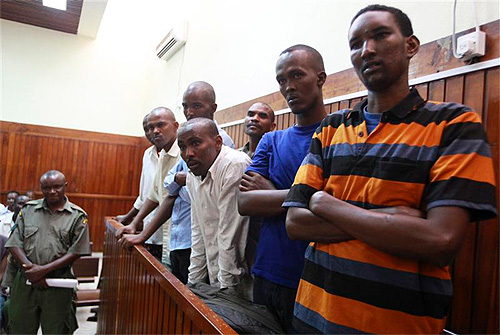
{{A UN tribunal in The Hague has acquitted two former Serbian security officials who were accused of war crimes and crimes against humanity committed during the 1990s Bosnian War.}}
Judges said on Thursday that there was insufficient evidence to show that either man had assisted soldiers who allegedly were responsible for murder and other crimes.
The verdict at the International Criminal Tribunal for the former Yugoslavia for Franko Simatovic, known as ‘Frenki’, and Jovica Stanisic, or ‘Ledeni’ – Serbian for ‘ice-man’ – follows a three-year trial.
Al Jazeera’s Katarina Drlja, reporting from The Hague, said: “As soon as the judge acquitted both of them, we could hear gasps of disbelief, of shock, from the representatives of the war victims.
“They couldn’t find the words to describe how they feel.”
They had expected a guilty verdict, she said.
Stanisic was the head of Serbia’s secret police, and widely regarded as the second-in-command of the former Serbian leader Slobodan Milosevic.
Simatovic was the head of special operations in the secret police.
Both were accused of setting up paramilitary forces dedicated to ridding Croatia, and Bosnia and Herzogovina, of all non-Serbs.
Serbia hailed the decision, with Prime Minister Ivica Dacic saying the country “has always advocated fair trials to all those accused before the tribunal in The Hague as the only way to establish the truth about the war and make conditions for reconciliation, peace and stability in the region.”
The pair are now free to leave as soon as procedures are completed.
Drlja said that prosecutors are allowed to file an appeal. “This first step has to happen within 30 days,” she said.
{{Renowned Nigerian author Chinua Achebe, who died in March, is due to be buried in his home town in Anambra state.}}
Mr Achebe’s body arrived back in Nigeria on Wednesday from the US. The author died in Boston at the age of 82 following a brief illness.
Relatives and officials were at Enugu airport in southern Nigeria as the coffin was lowered from the plane.
Mr Achebe is widely regarded as the founding father of African literature in English.
His 1958 debut novel, Things Fall Apart, which dealt with the impact of colonialism in Africa, has sold more than 10 million copies.
The writer and academic went on to write more than 20 works – some fiercely critical of politicians and what he described as a failure of leadership in Nigeria.
He had been living in the US since 1990 after a car crash left him partially paralysed and in a wheelchair, returning to Nigeria infrequently.
Cultural groups performed outside Enugu airport as the plane carrying Mr Achebe’s body arrived.
Mr Achebe’s body is due to be buried near his family’s home in Ogidi, a small town in the hills of Anambra state, later on Thursday.
{{An 80-year-old Japanese mountaineer became the oldest person to reach the top of Mount Everest on Thursday — although his record may last only a few days. An 81-year-old Nepalese man, who held the previous record, plans his own ascent next week.}}
Yuichiro Miura, who also conquered the 29,035-foot (8,850-meter) peak when he was 70 and 75, reached the summit at 9:05 a.m. local time, according to a Nepalese mountaineering official and Miura’s Tokyo-based support team.
Miura and his son Gota made a phone call from the summit, prompting his daughter Emili to smile broadly and clap her hands in footage on Japanese public broadcaster NHK.
“I made it!” Miura said over the phone. “I never imagined I could make it to the top of Mount Everest at age 80. This is the world’s best feeling, although I’m totally exhausted. Even at 80, I can still do quite well.”
The climbers were going to take pictures at the summit before starting to descend, his office said.
Nepalese mountaineering official Gyanendra Shrestha, at Everest base camp, confirmed that Miura had reached the summit and is the oldest person to do so.
The previous oldest was Nepal’s Min Bahadur Sherchan, who accomplished the feat at age 76 in 2008, just a day before Miura reached the top at age 75.
Sherchan, now 81, was preparing to scale the peak next week despite digestive problems he suffered several days ago. On Wednesday, Sherchan said by telephone from the base camp that he was in good health and “ready to take up the challenge.”
Sherchan’s team leader Temba, who uses one name, said he would congratulate the new record holder once he returned to the base camp and that Sherchan would not turn back until he completes his mission.
Sherchan’s team is also facing financial difficulties. It hasn’t received the financial help that the Nepal government announced it would provide them. Purna Chandra Bhattarai, chief of Nepal’s mountaineering department, said the aid proposal was still under consideration.
On his expedition’s website, Miura explained his attempt to scale Everest at such an advanced age: “It is to challenge (my) own ultimate limit. It is to honor the great Mother Nature.”
He said a successful climb would raise the bar for what is possible.
“And if the limit of age 80 is at the summit of Mt. Everest, the highest place on earth, one can never be happier,” he said.
Miura conquered the mountain despite undergoing heart surgery in January for irregular heartbeat, or arrhythmia, his fourth heart operation since 2007, according to his daughter. He also broke his pelvis and left thigh bone in a 2009 skiing accident.
DEALERS:{ Fatai Akinwowo, herbalist (left) and alleged suppliers of human parts. On the ground are suspected mixture of ground human head and local gin in a bottle alongside a human finger, allegedly recovered from the suspects.}
{{Emotions ran high, Tuesday, at Lagos State Police Command, Ikeja, following startling revelations by suspected members of three syndicates, who specialised in selling human parts to herbalists and persons suspected to be clerics. }}
The suspects told a bewildered crowd that human heads were sold for N8,000; hands, N4,000 and private parts N10,000.
One of them, Agboola Kolawole, who blamed his indulgence on poverty and inability to pay his children’s school fees, disclosed that he had so far sold four heads of his deceased siblings to a herbalist, who in turn sold to some persons they identified simply as Alhajis.
The Alhajis, as gathered, offered to pay one of the suspects N40,000 to get a live human being, only for the suspect, Sanni Kazeem, to be apprehended during his search for prey.
Recovered from one of the arrested herbalists, identified as Ajibade Rafiu (40), who the suspects said they supply with the human parts, was a dried human finger suspected to be that of a lady, and a concoction, which he said was made from grounded human head mixed with local gin.
The concoction, according to Rafiu, was to fortify him against spiritual attacks.
{{Arrest, confession}}
Their arrest, according to the Command’s spokesperson, Ngozi Braide, followed a tip-off from the officer-in-charge of the Special Anti-Robbery Squad, Ikeja, Abba Kyari, that one of the suspects, Jamiu Adeleke, was at the verge of selling a human hand for N21,000.
The operatives, according to Braide, who paraded the suspects before newsmen, stormed Owode town, Ogun State, where Adeleke was arrested while attempting to sell the human hand to a buyer.
She said: “Adeleke confessed that one Sanni Kazeem sold it to him for N6,000. When Sanni was arrested, he also confessed to the crime, adding that he had supplied two human heads to a dealer named Akinwowo Fatai (30), who was also arrested.
Akinwowo, on his part, confessed to have received the human heads and another four human heads from another supplier, one Agboola Kolawole (40), who was later arrested in the same Owode town.”
{{Sources of ‘goods’}}
“Kolawole confessed that he cut the heads of his two late brothers and two late sisters buried in private graves in their compound and sold them for N8,000 each. The final buyer/receiver, one Ajibade Rafiu (30), a herbalist, was also arrested.
“During interrogation, the suppliers said they got their human parts from various grave yards in Ogun State, while the middlemen doubled the prices and sell to the herbalist, who is the end user.
“Sanni Kazeem also confessed that two popular Alhajis in the same Owode town had bought one head from him before and also requested for a live human being for N40,000.”
She added that the first suspect arrested, Adeleke, jumped out of a moving vehicle in his attempt to escape and sustained fatal injuries, which later resulted in his death, adding that effort was still on to arrest others indicted in the business.
{{‘Am in it for school fees’}}
One of the suspects, Agboola Kolawole, said: “Yes, I sold my dead siblings’ parts for N8,000 each. I was tempted to do that because of poverty and inability to pay my children’s school fees.
“Just as I was thinking of how to pay their school fees, a friend approached me and asked why I should be suffering when there was a way out. When I asked how, he said I should go and get some human parts that he would pay me.
“That was how I went to my late brother’s grave at night, exhumed the bodies of two of them and cut off the heads.
“When I took them to the friend, he gave me N16,000 and told me to get him four hands. This time around, I went to my late sisters graves and cut off their hands. I was paid N8,000 for a set of hands.”
{{‘I was offered N40,000 to get a human being’}}
Kazeem Sanni said he usually went to cemeteries to exhume dead bodies and cut off the needed parts.
He said: “The cemetery I usually frequent is CMS. I usually go there at night when the guards are asleep.
“I sell skull for N8,000 to Alpha Jamiu (Muslim cleric). So far, I have gone to the cemetery thrice to cut off human parts.
“Two weeks ago, he called to say that his clients needed a human being, promising to pay me N40,000. When I asked him how that was possible, he said he would give me a charm that would hypnotise the victim to facilitate his/her abduction.
“I told him I would think about it. But I never went back to him again because I felt I could not do that.”
However, it was gathered that Alpha Jamiu, the middleman, pays the supplier N8,000 but sells the parts thrice the amount to end users.
The herbalist, Ajibade Rafiu, told journalists that he bought a human head for N8,000, with an intention to prepare a fortification concoction for himself.
He said: “I burnt the human head and later ground it, poured it inside a plastic and added local gin and other roots. I prepared the concoction for myself.
“It is to fortify me against any attack because in this job if you are not fortified people may attempt to throw spiritual arrows at you. But with this, if anybody tries it, it will backfire.”
{{A Zimbabwean man is recovering in hospital after suffering severe facial and neck burns when he was drenched with hot cooking oil by his second wife for allegedly denying her sex on Monday.}}
Zakaria Mukanganwi (29) of New Stands at Rutenga Growth Point is recovering at Neshuro District Hospital after his second wife — Loveness Shumba (16) — allegedly scalded him with hot cooking oil for not giving her equal attention with the other wives.
Masvingo police spokesperson Inspector Peter Zhanero yesterday said they had since arrested Shumba for attempting to murder her husband.
“We have arrested a Mwenezi woman who burnt and severely injured her husband after pouring hot cooking oil on his face and neck.
“We are preferring attempted murder charges on her because the husband sustained serious injuries.
“The husband is receiving treatment at Neshuro District Hospital where his condition is stable.
“The woman will appear in court soon facing attempted murder charges,’’ said Inspector Zhanero.
On the day in question Mukanganwi, who has two wives with Shumba being the second wife, was at Rutenga bus stop, along the Masvingo-Beitbridge road, waiting to receive some goods sent by a relative from South Africa.
He was allegedly confronted by Shumba who started to accuse him of not treating her equally with the first wife, especially on the issue of conjugal rights.
Shumba also allegedly accused her husband of neglecting her and demanded an instant cash payment.
An altercation allegedly arose between the two, leading to Shumba returning to her house at the growth point where she boiled some cooking oil.
Shumba returned minutes later and found Mukanganwi sleeping at the bus stop and immediately drenched him with the hot cooking oil, injuring him in the process.
Passers-by rushed Mukanganwi to Rutenga clinic where he was transferred to Neshuro Hospital due to the seriousness of the burns.
A Saudi woman has made history by reaching the summit of the world’s highest mountain.
Raha Moharrak, 25, not only became the first Saudi woman to attempt the climb but also the youngest Arab to make it to the top of Everest.
She is part of a four-person expedition that also includes the first Qatari man and the first Palestinian man attempting to reach the summit.
They are trying to raise $1m (£660,000) for education projects in Nepal.
Originally from Jeddah, Ms Moharrak is a university graduate currently based in Dubai.
Coming from Jeddah in Saudi Arabia – a conservative Muslim country where women’s rights are very restricted – she had to break a lot of barriers to achieve her goal, her climb team said.
A biography on the expedition website said convincing Ms Moharrak’s family to agree to her climb “was as great a challenge as the mountain itself”, though they fully support her now.
“I really don’t care about being the first,” she is quoted as saying. “So long as it inspires someone else to be second.”