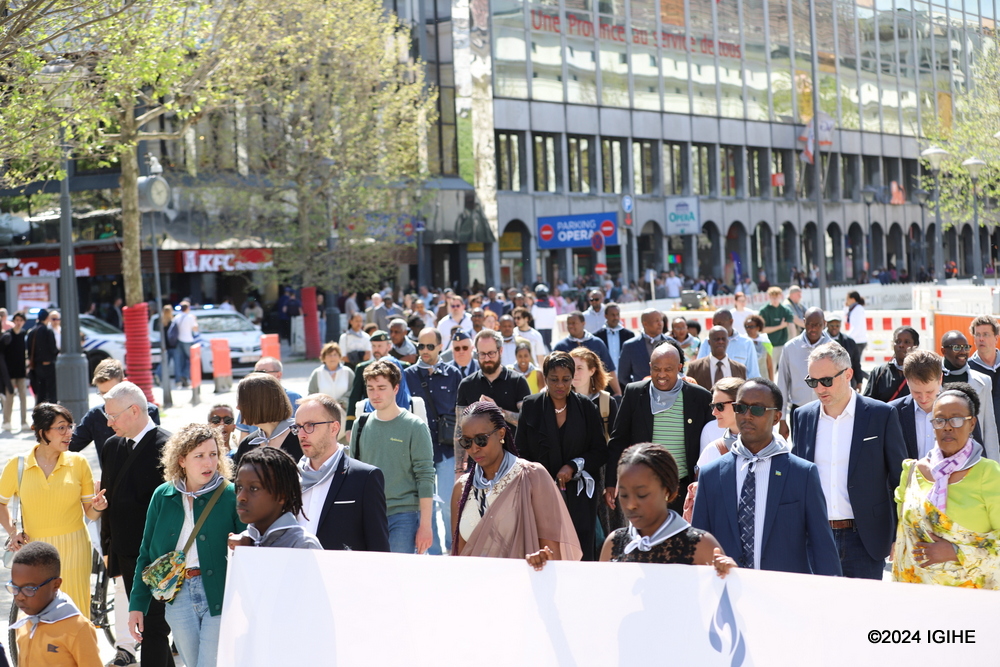
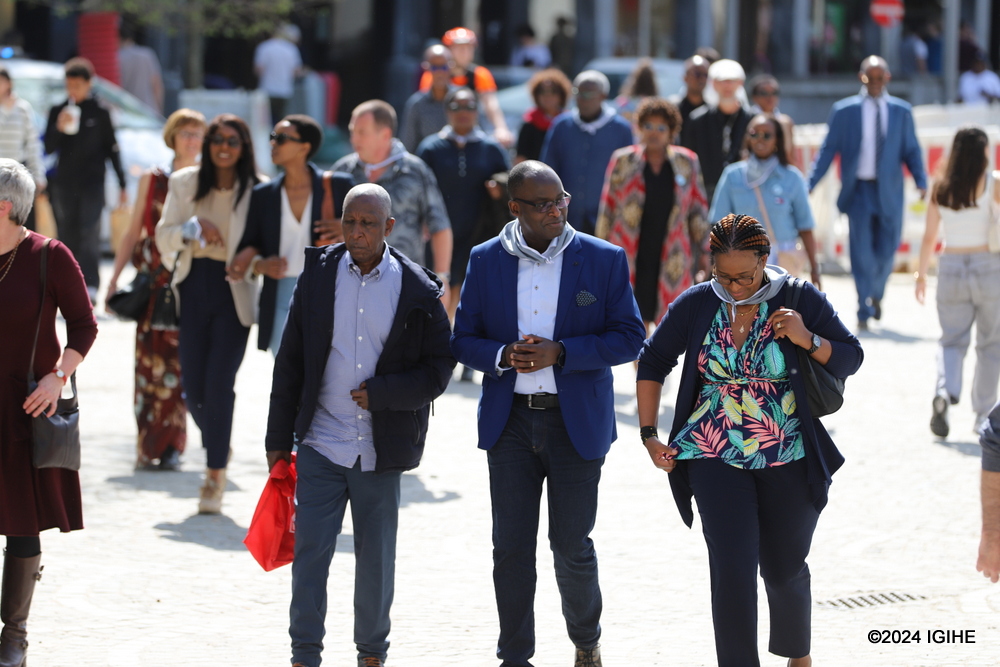
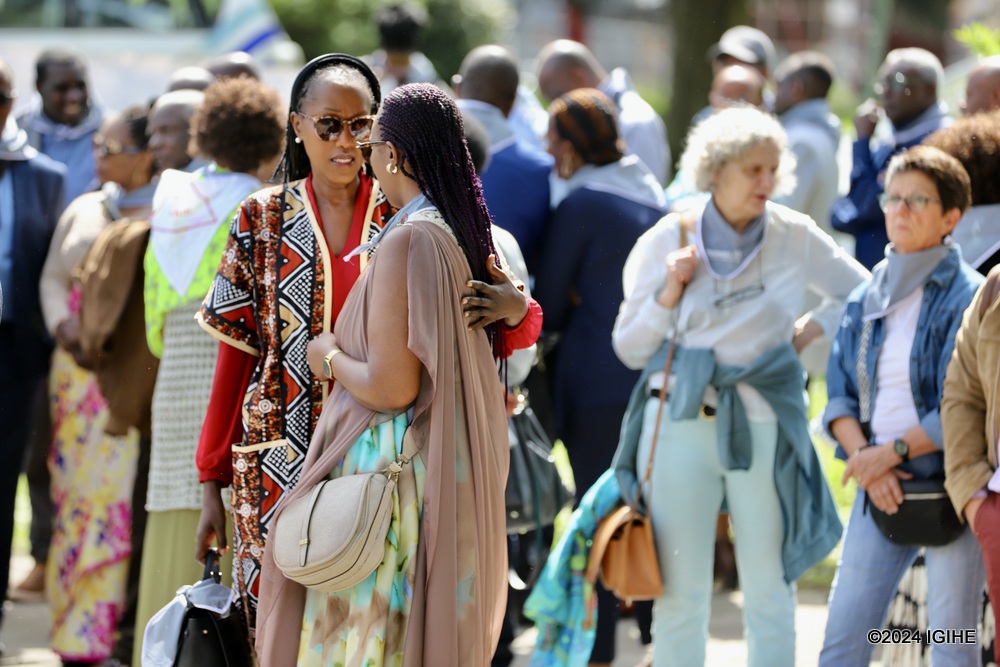
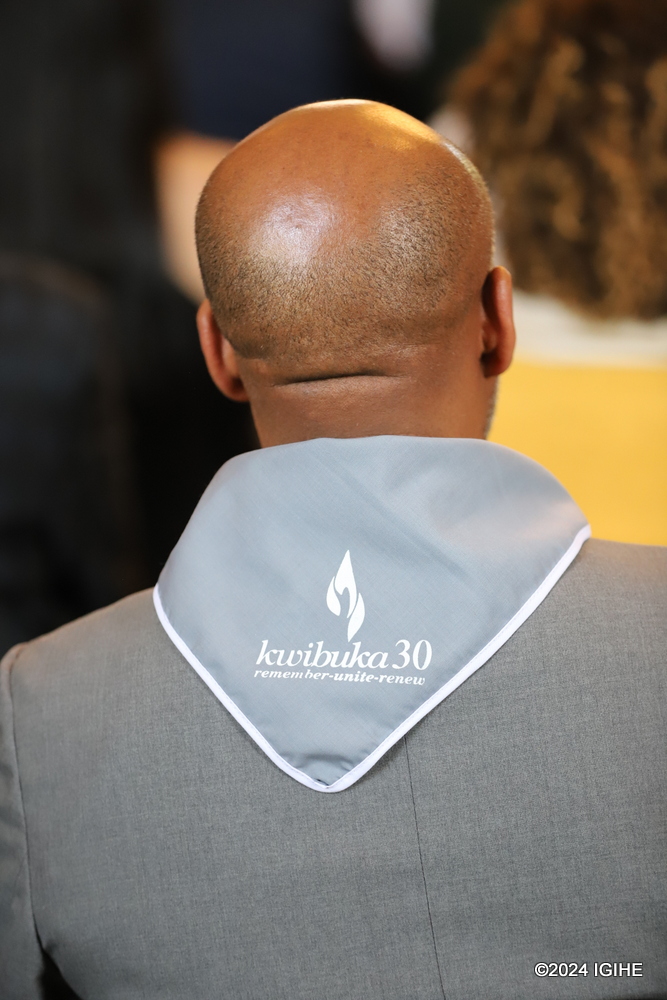
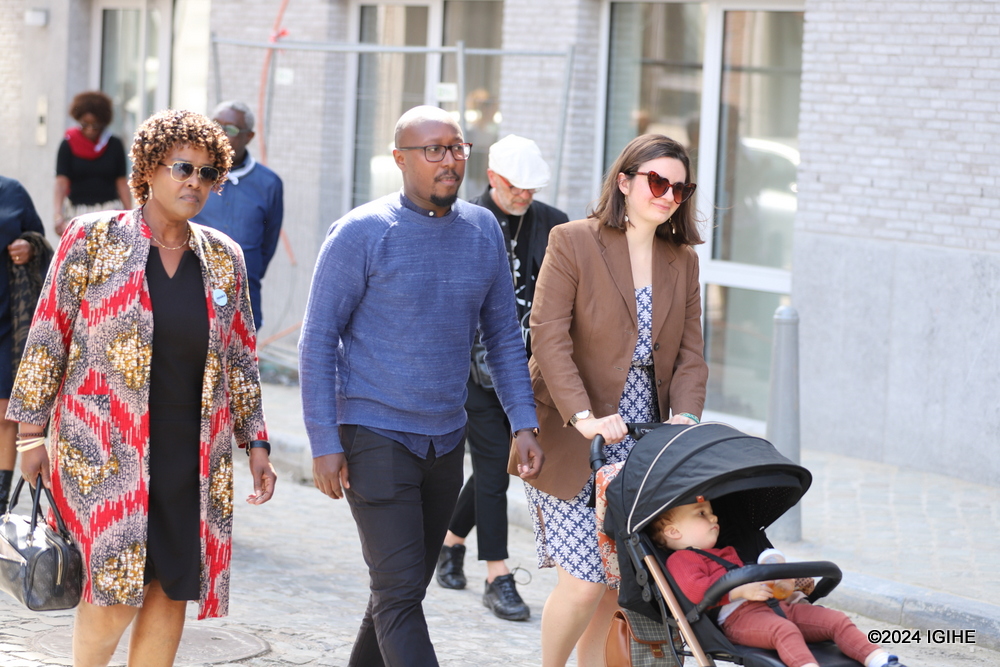
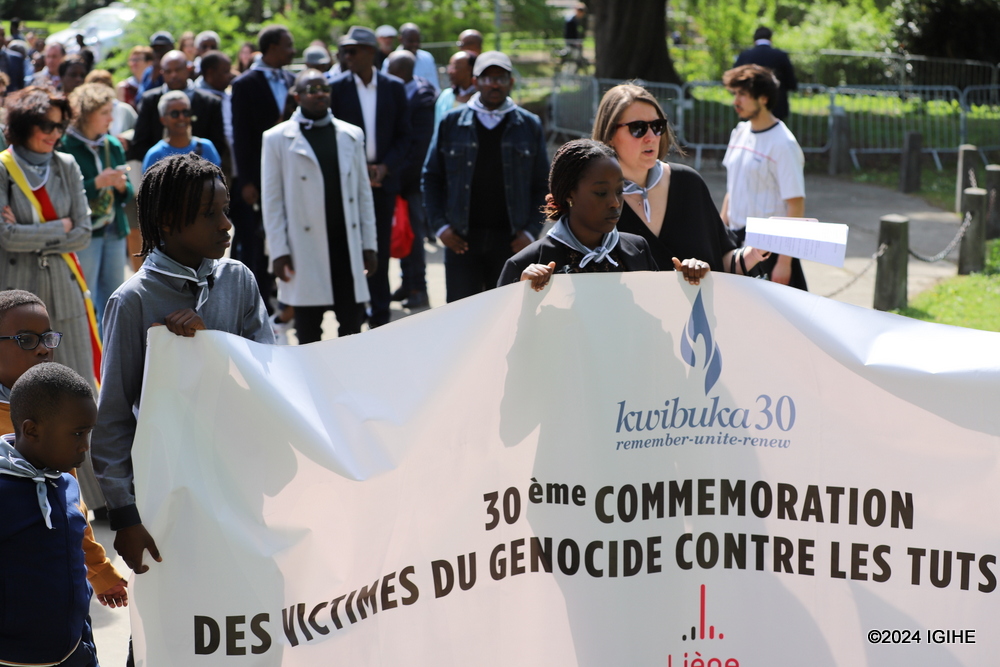
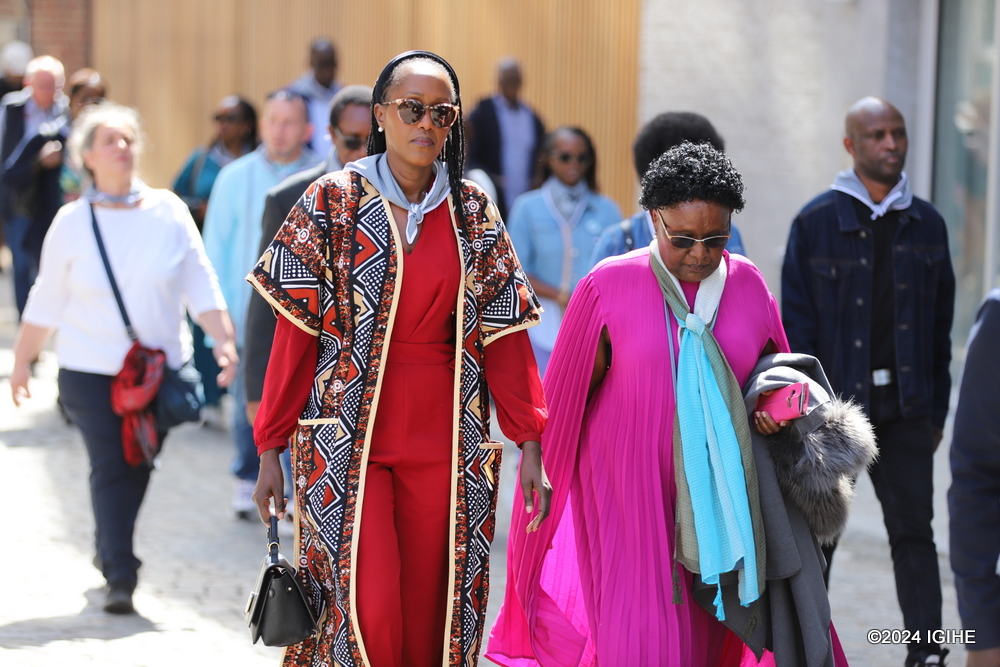
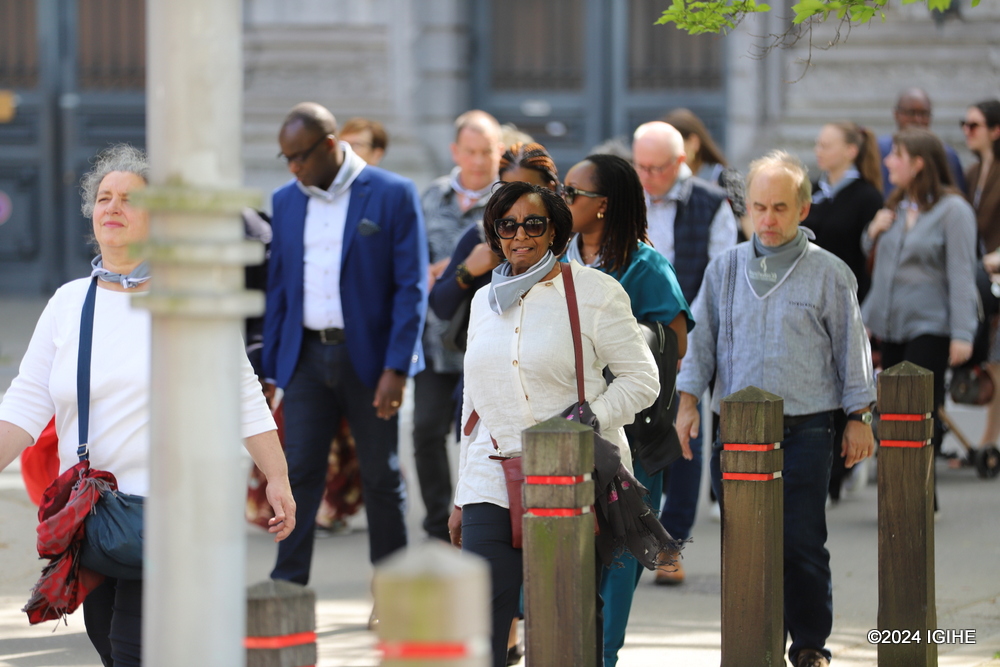
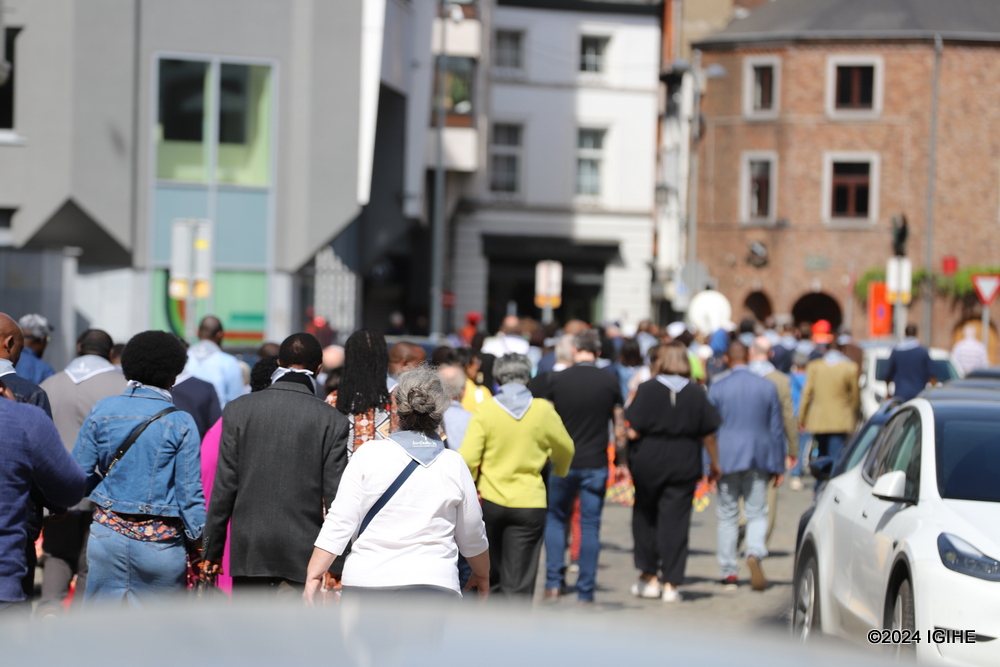
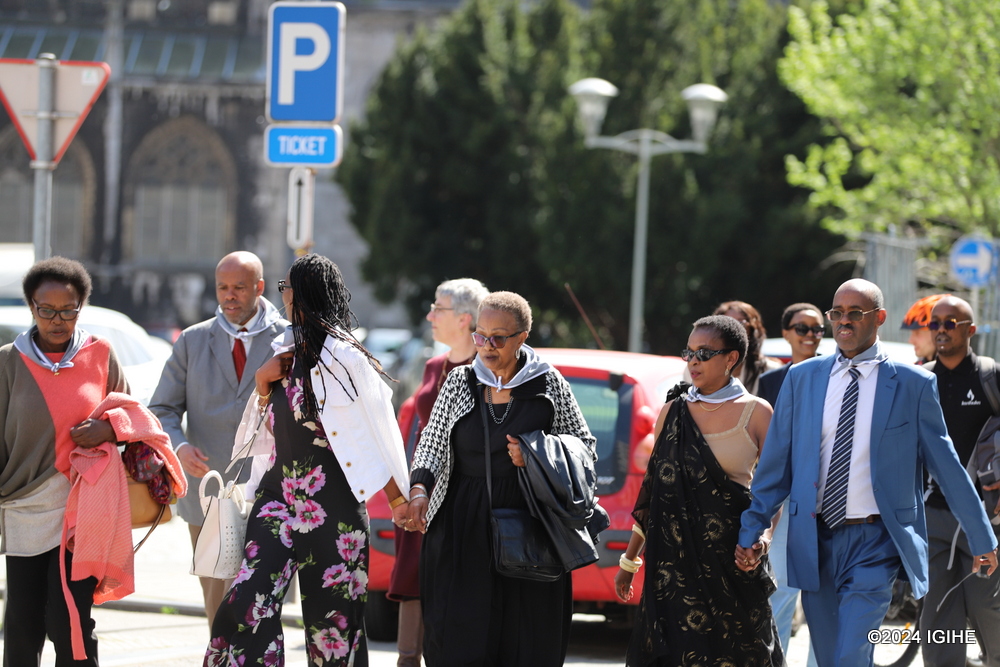
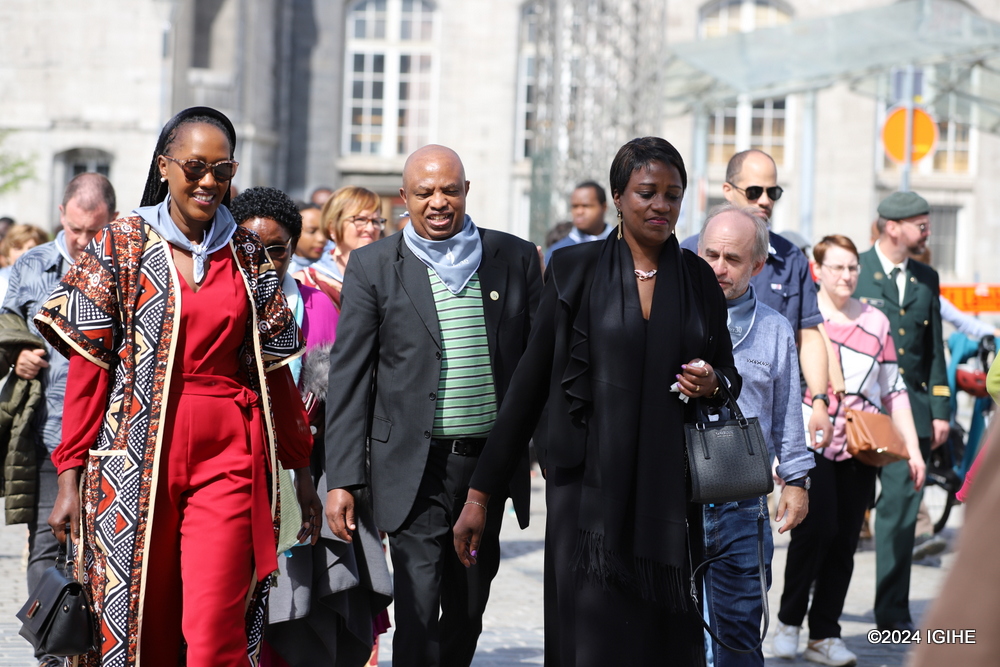
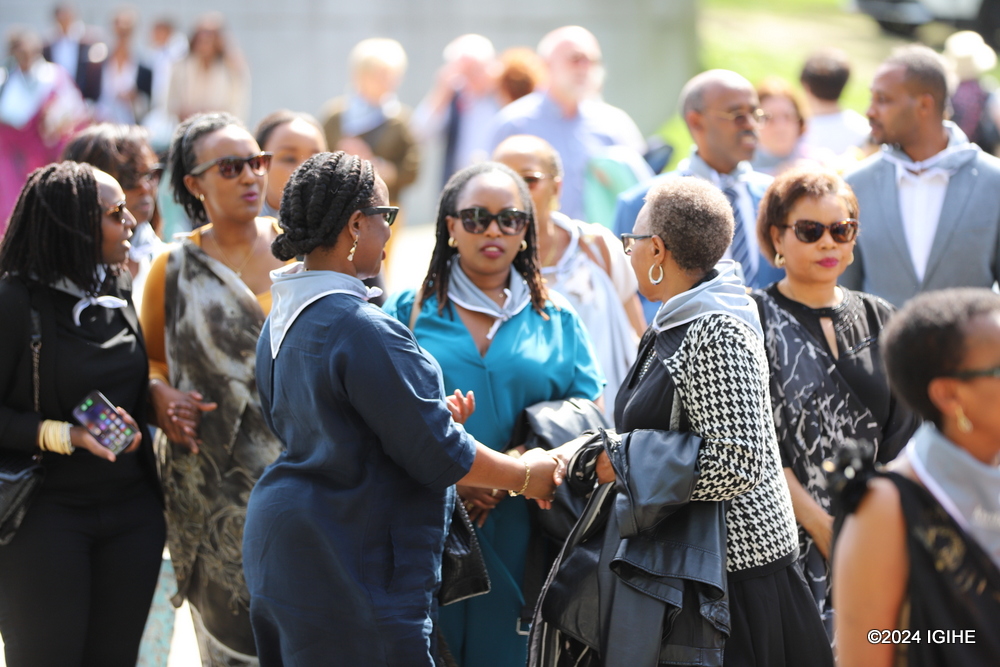
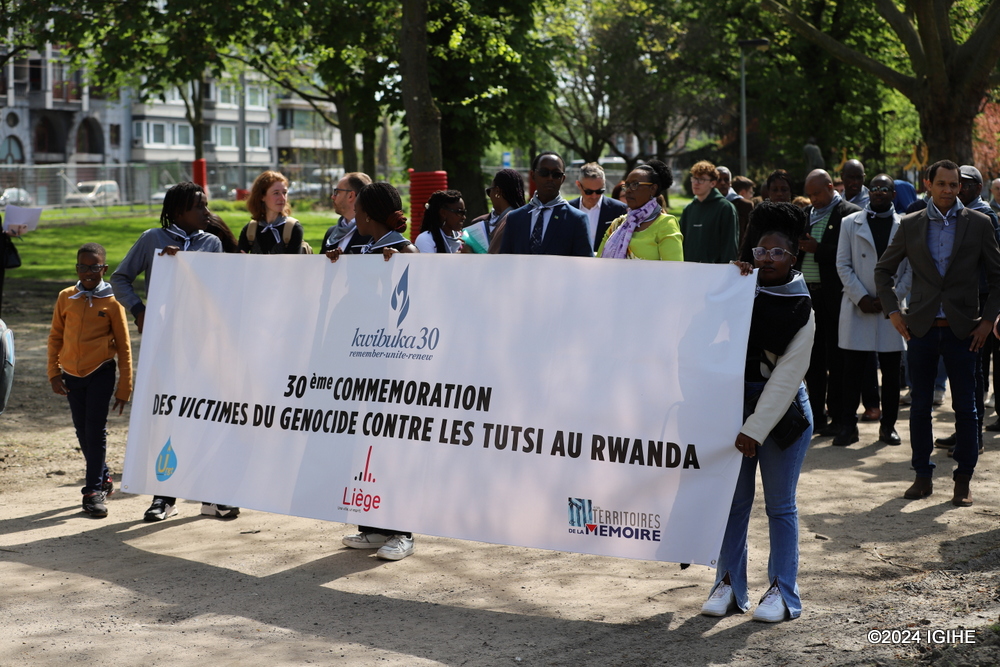
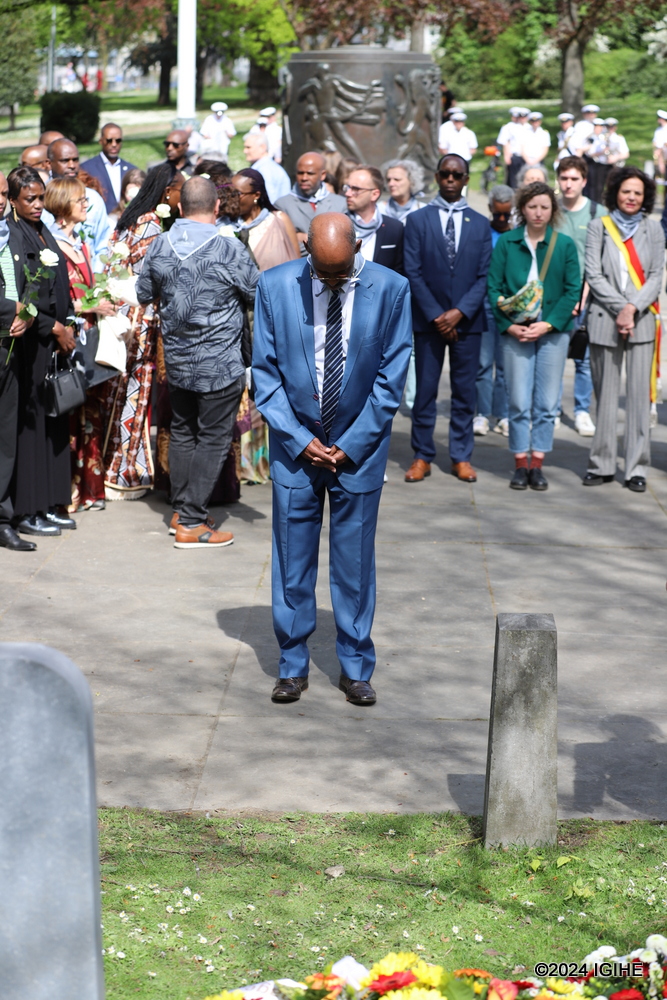
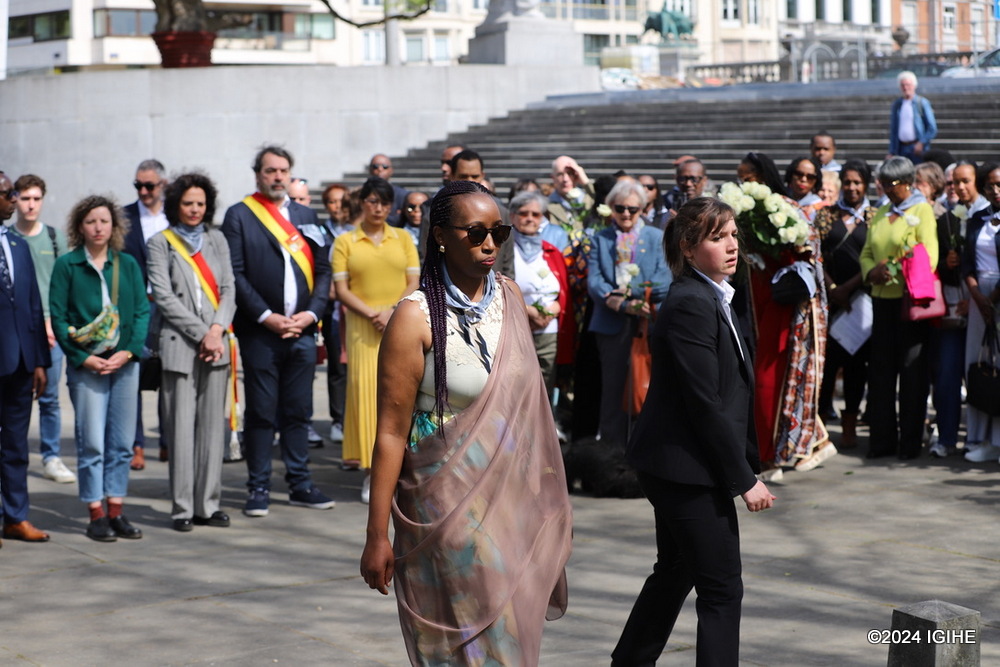
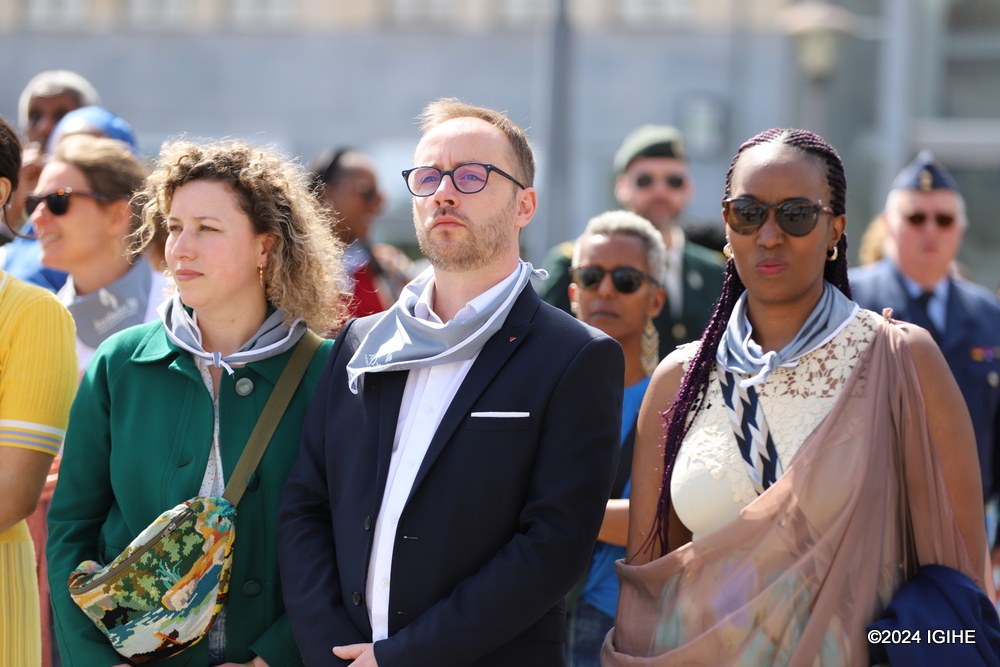
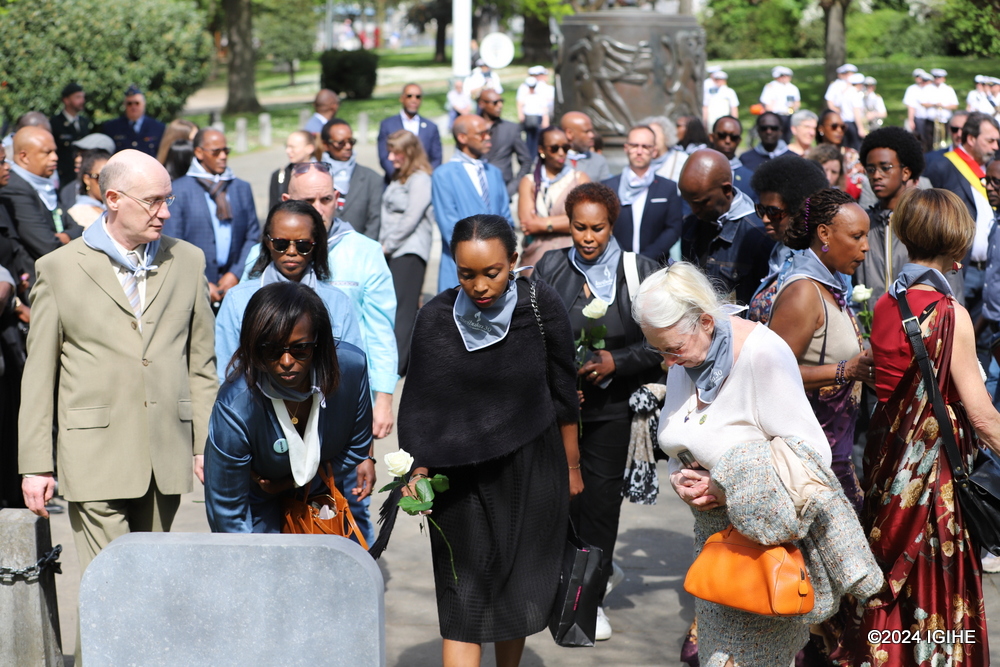
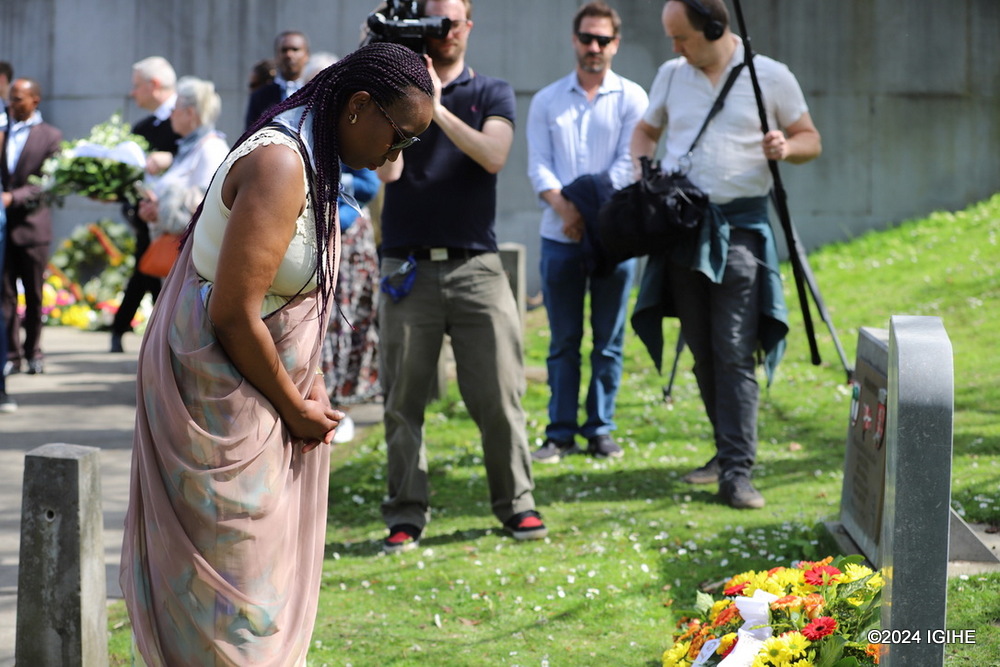
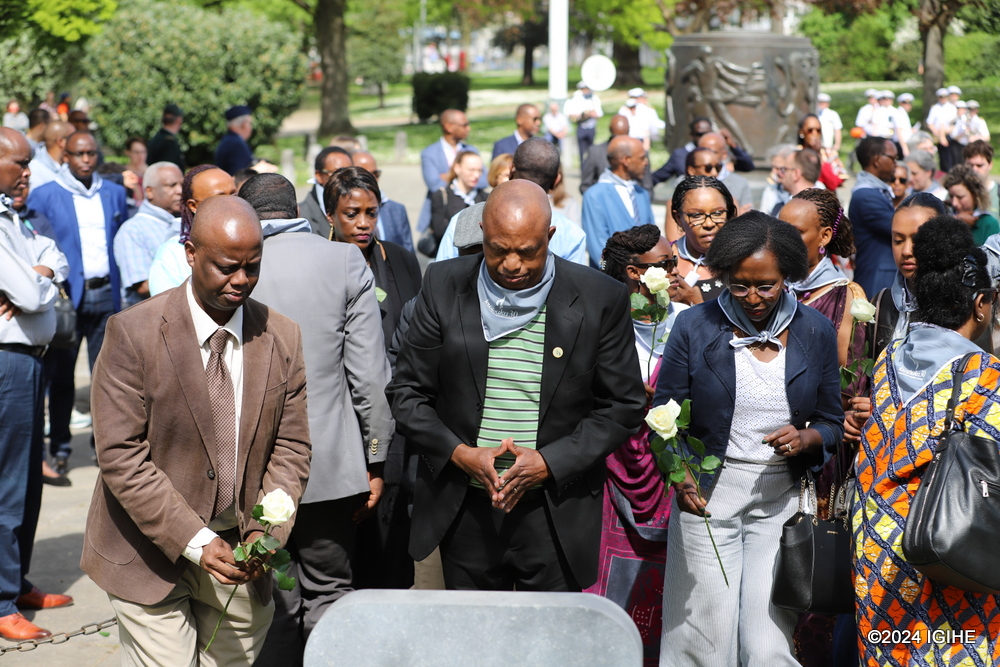
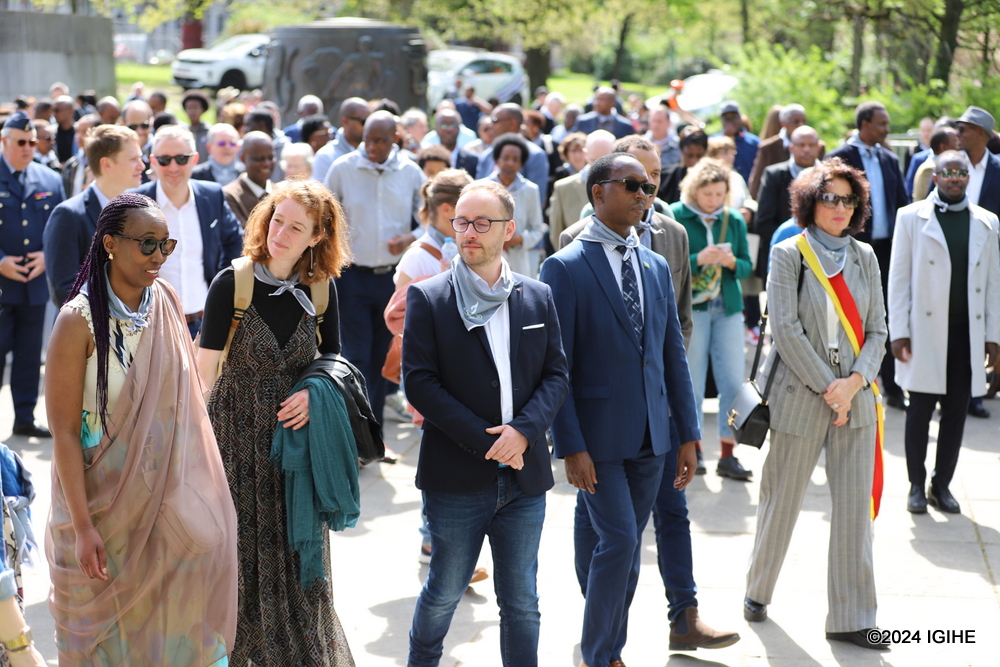
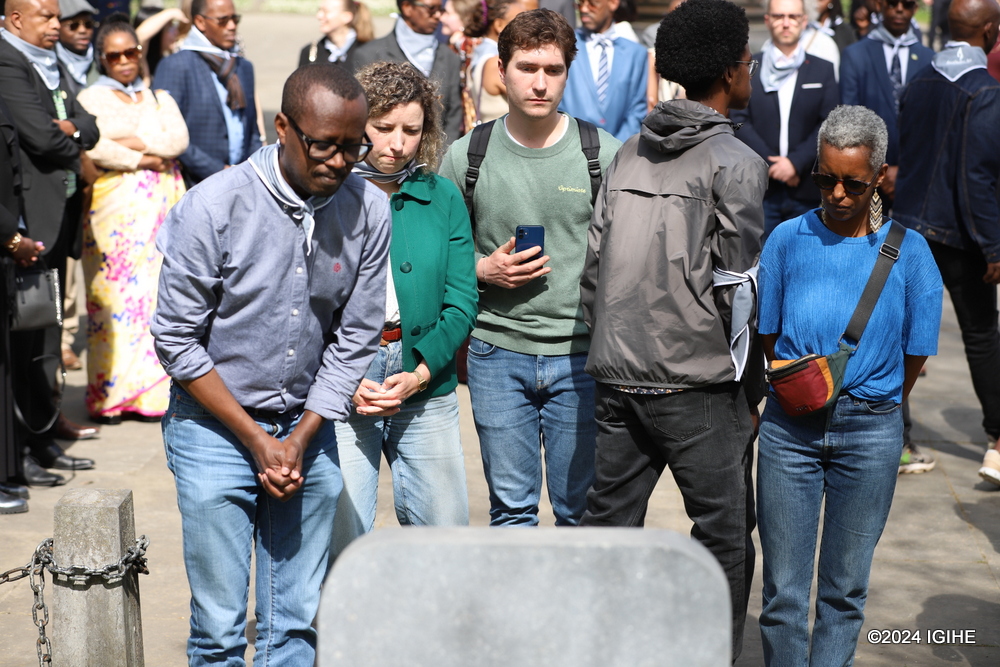
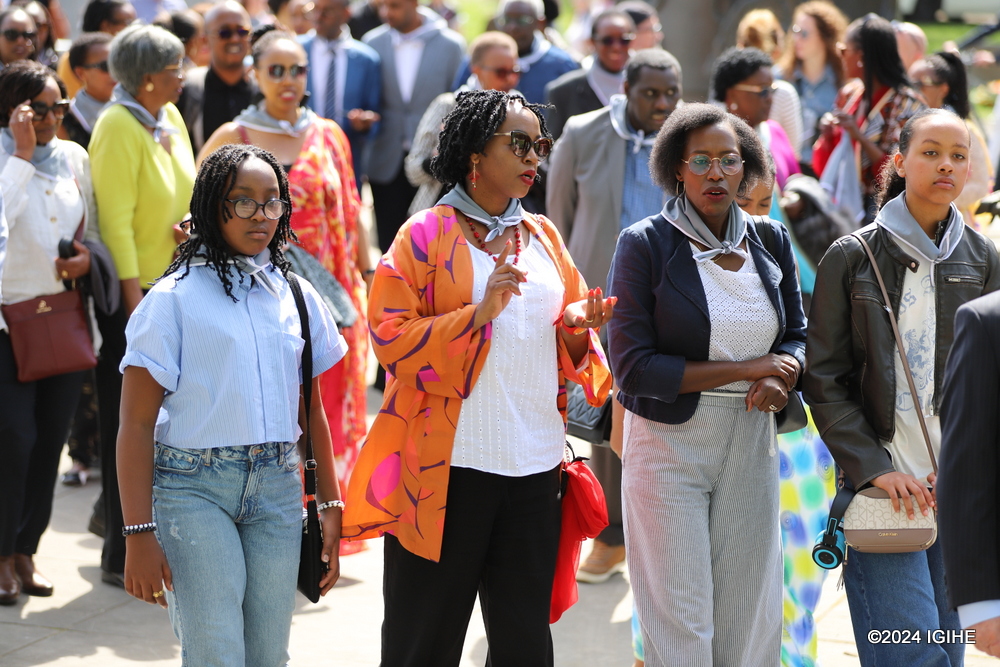
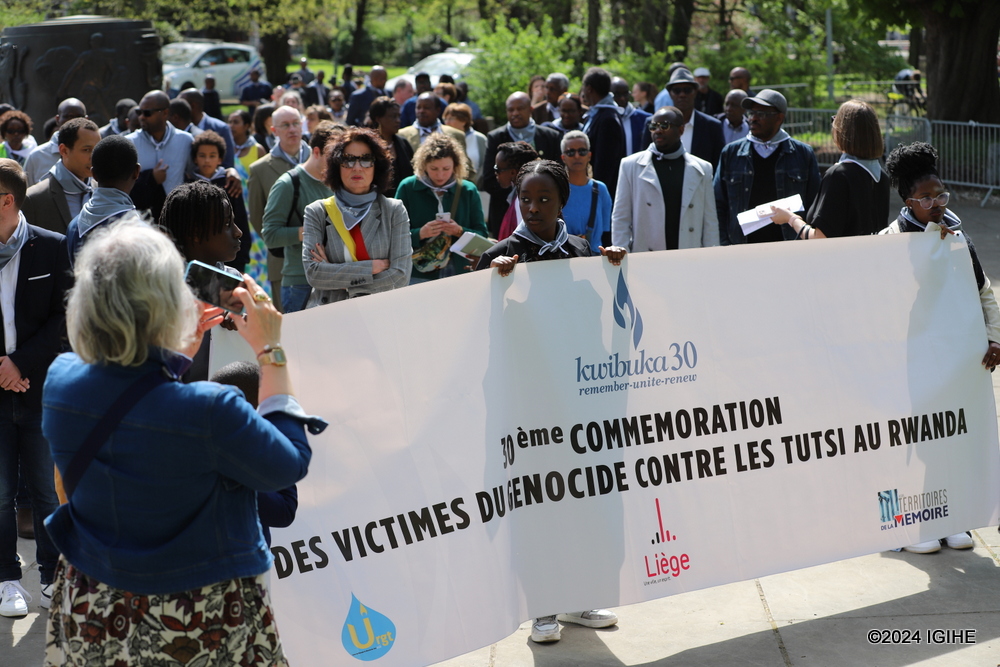
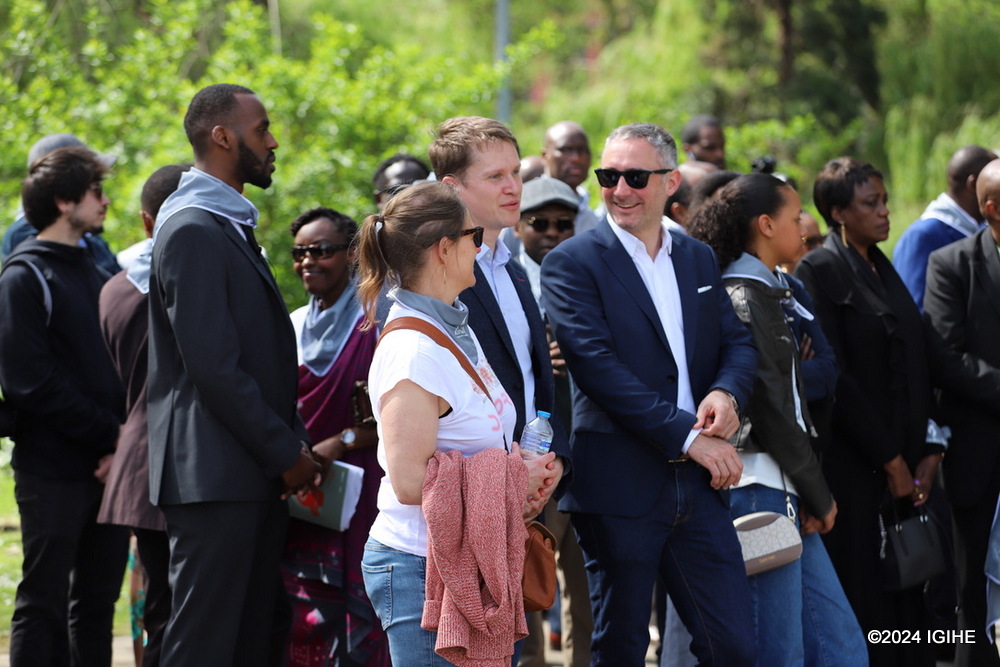
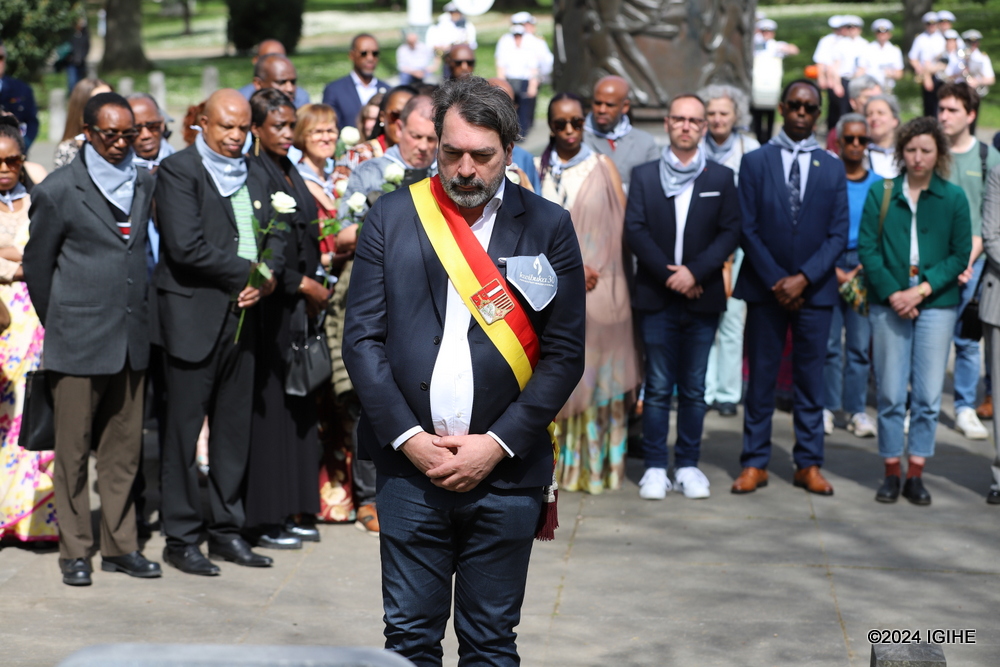
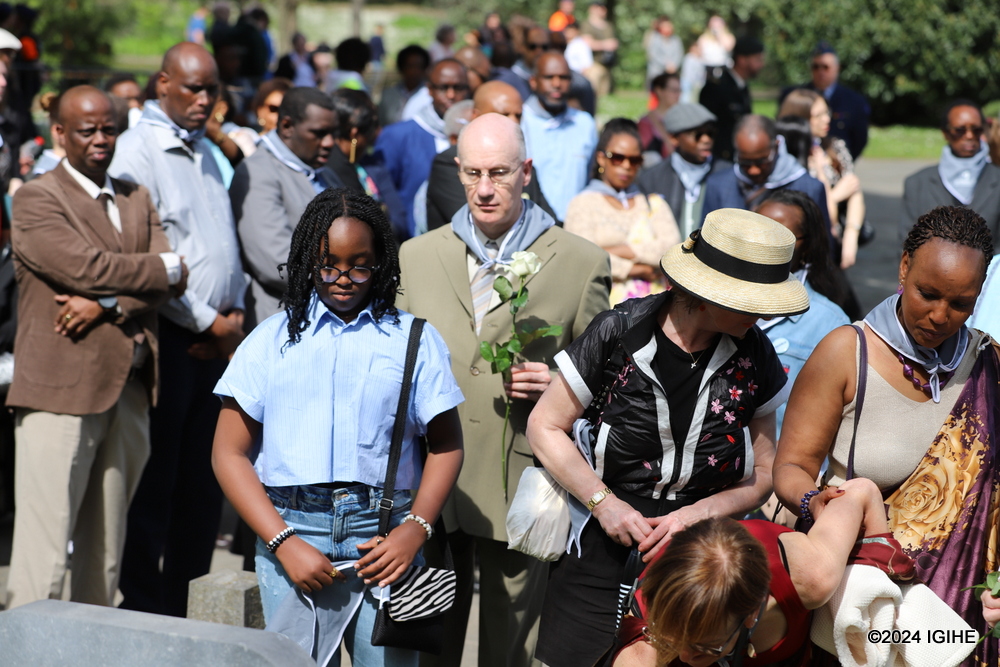
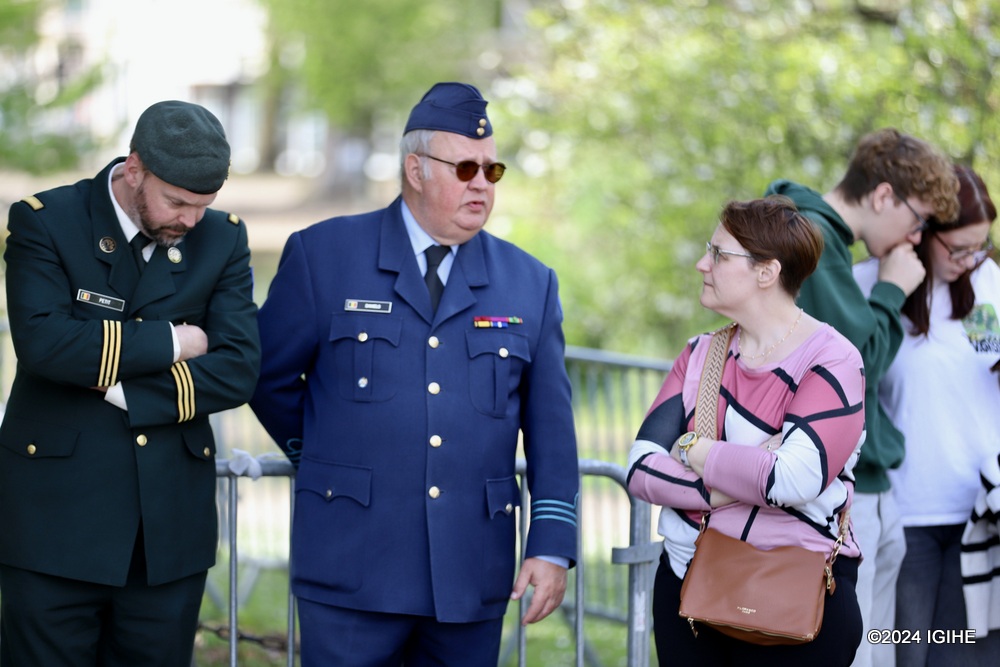
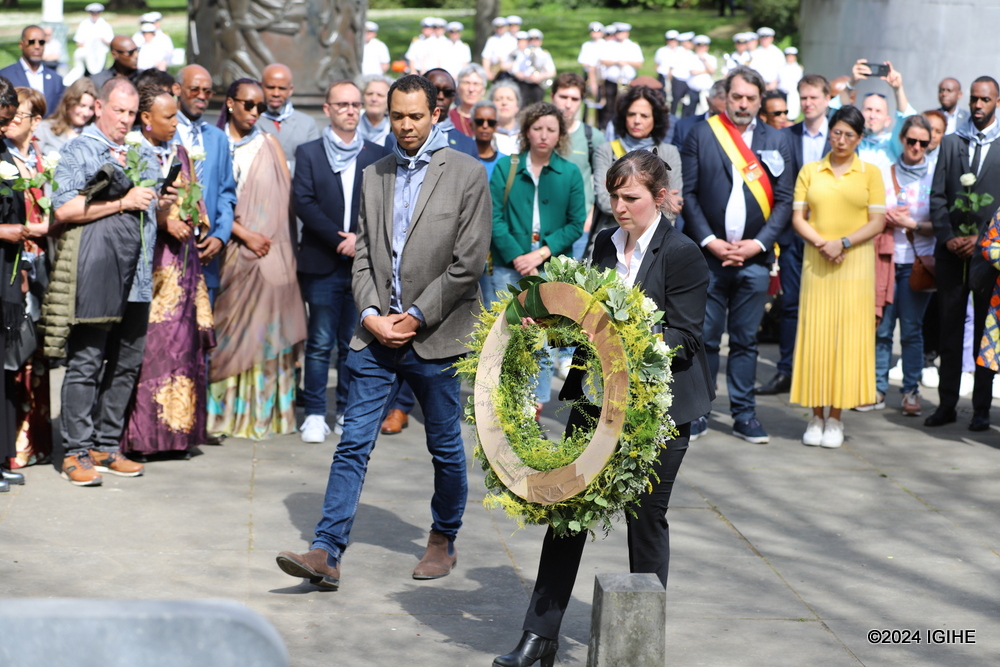
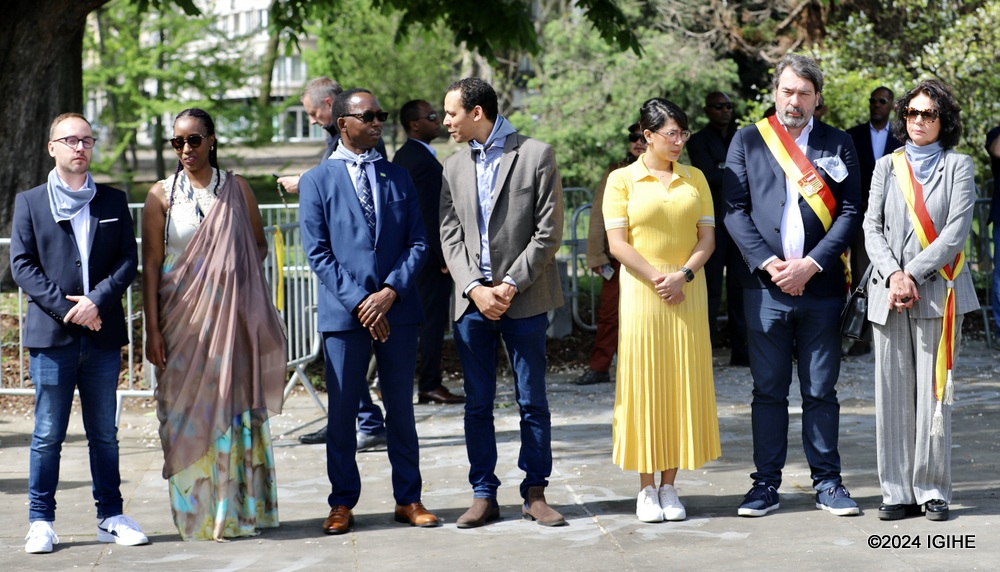
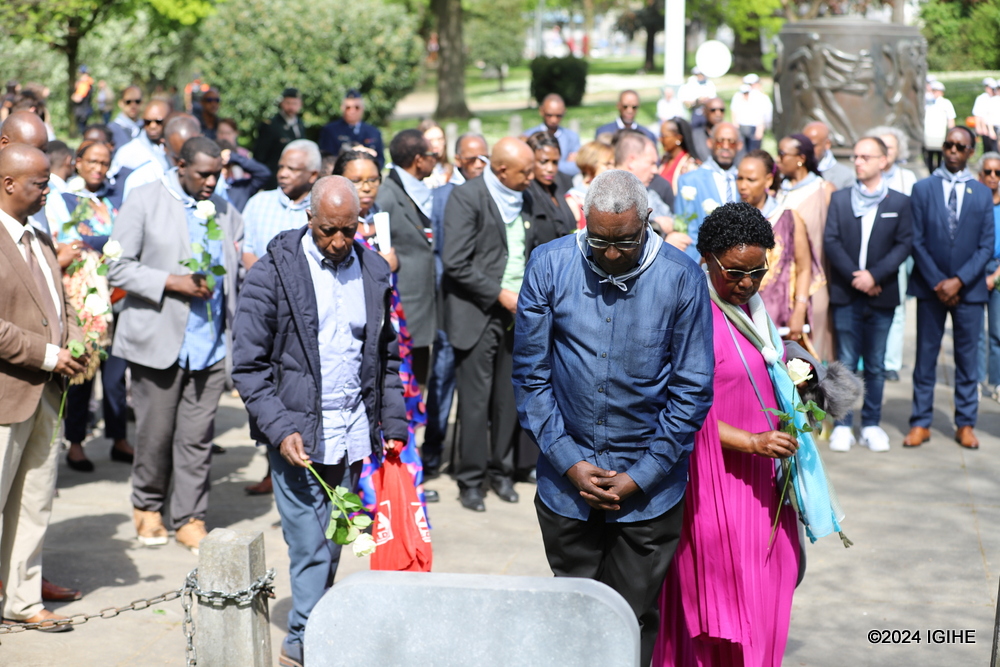
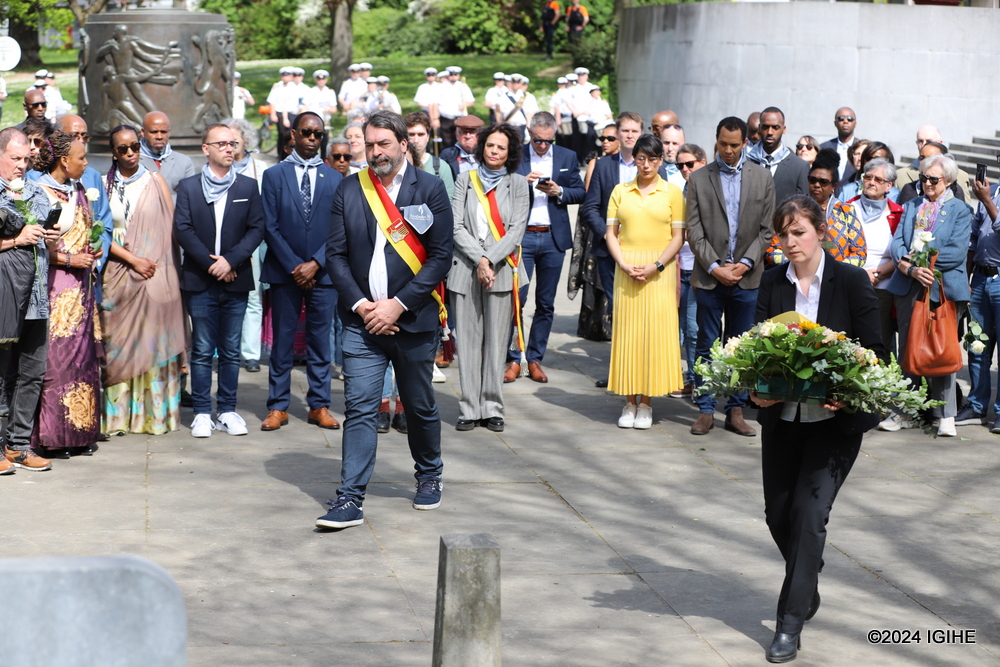
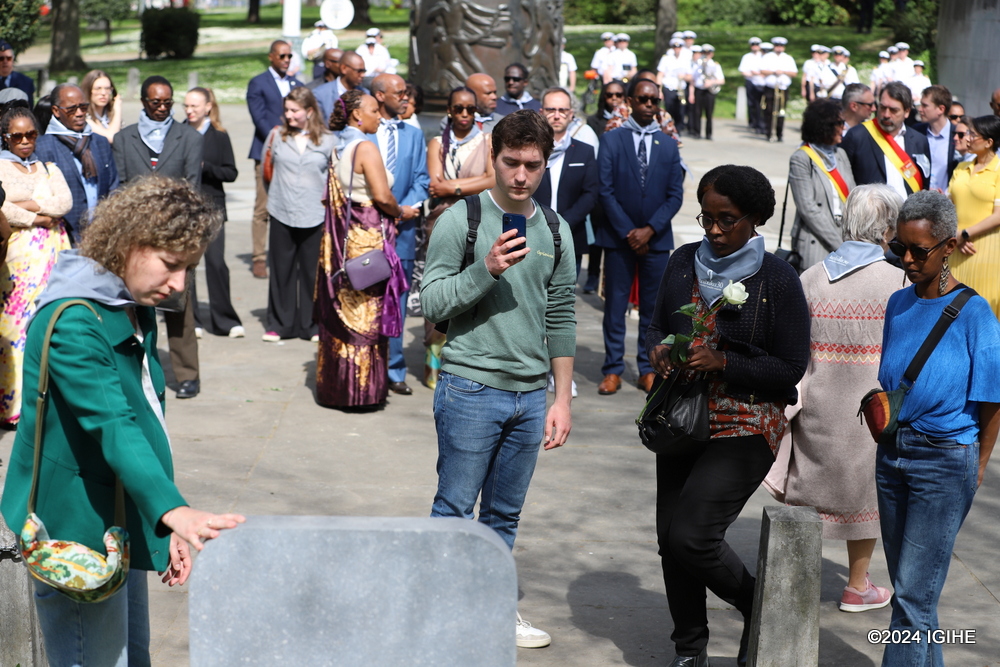
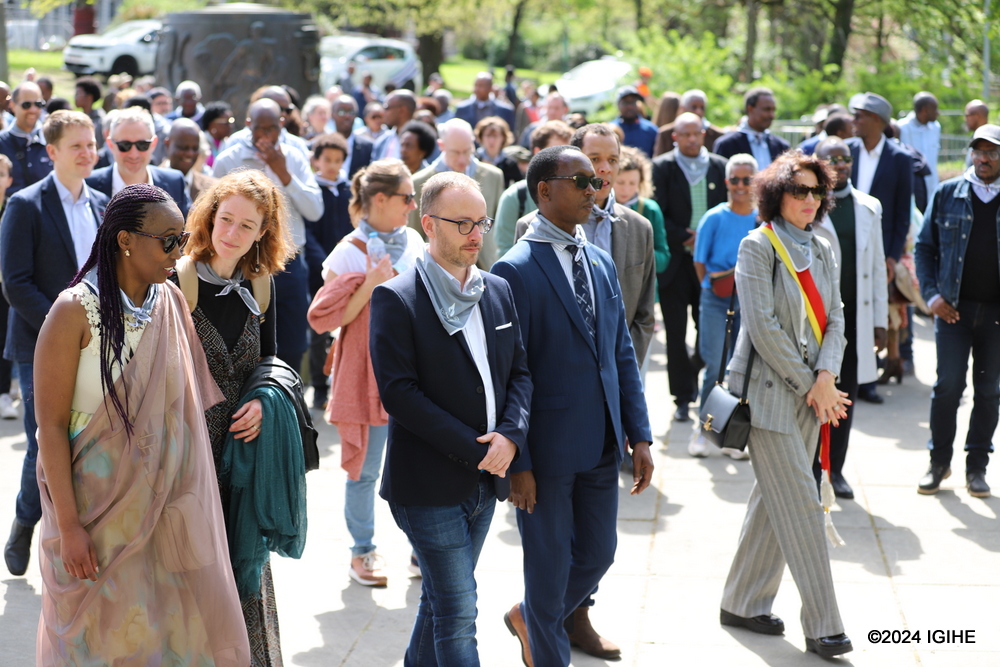
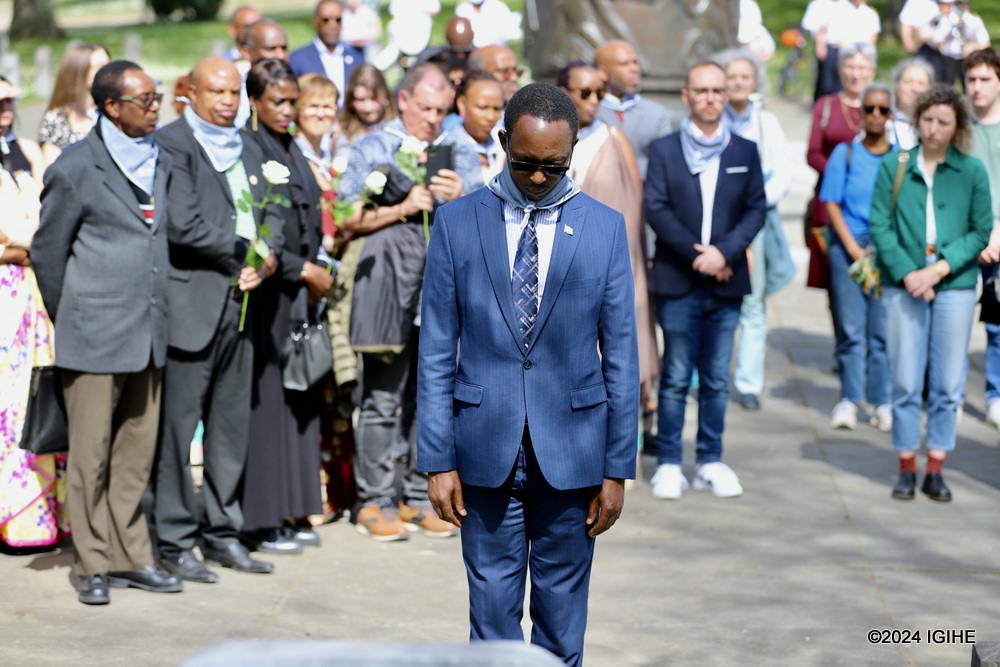
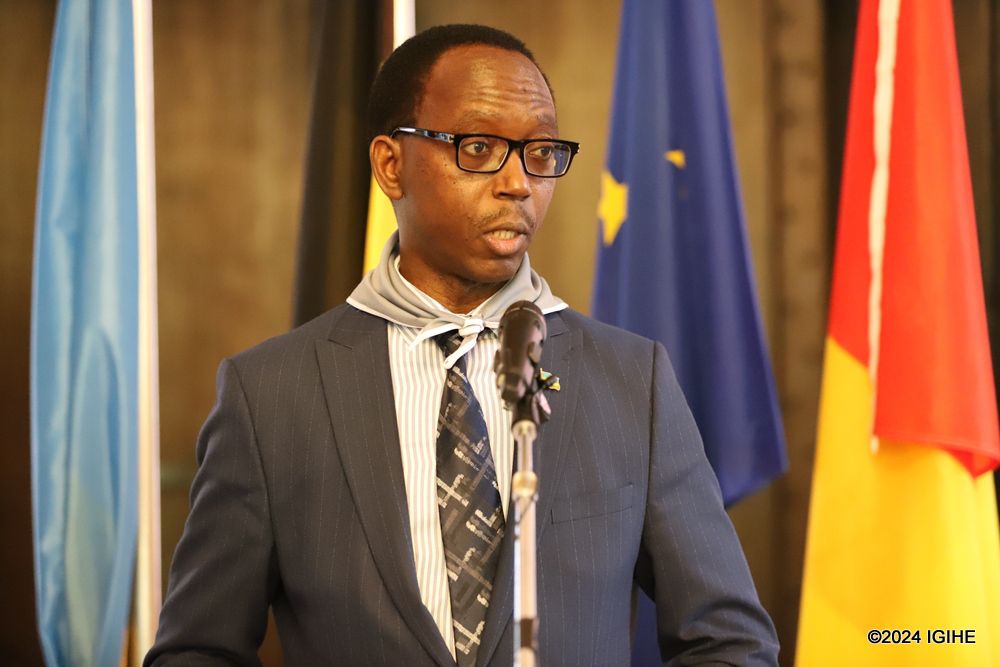
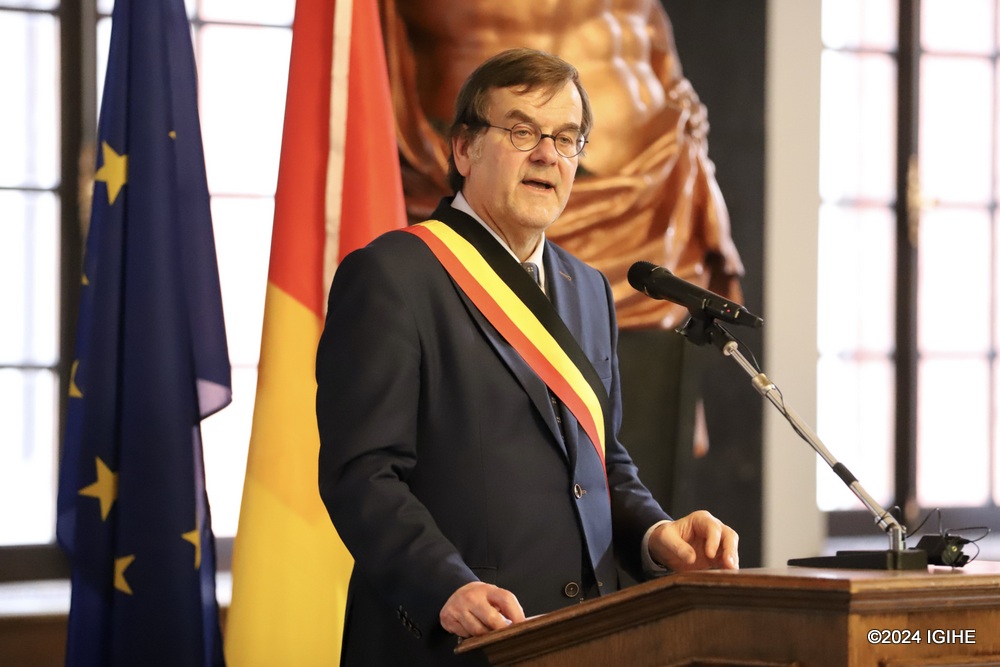
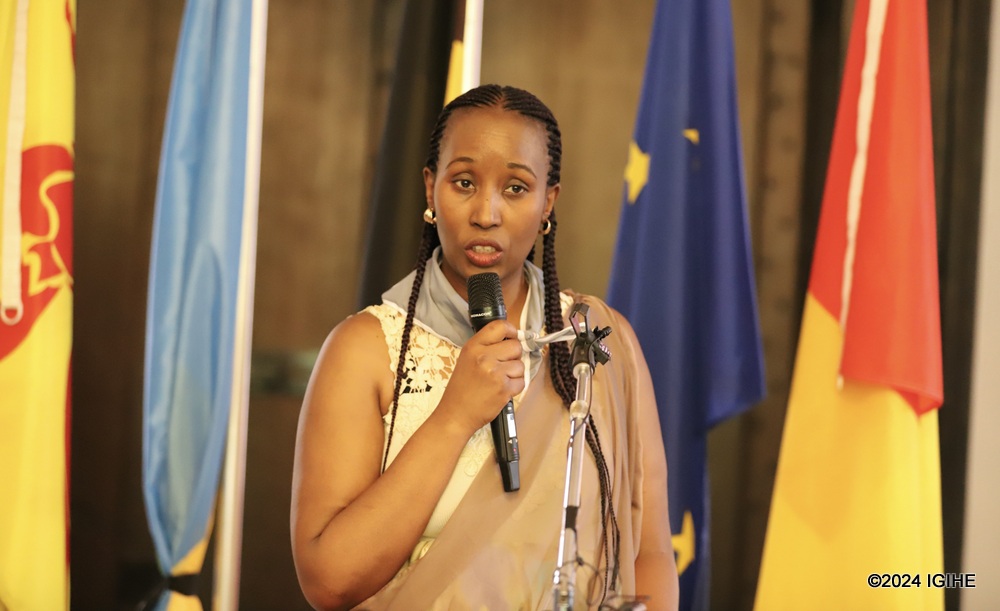
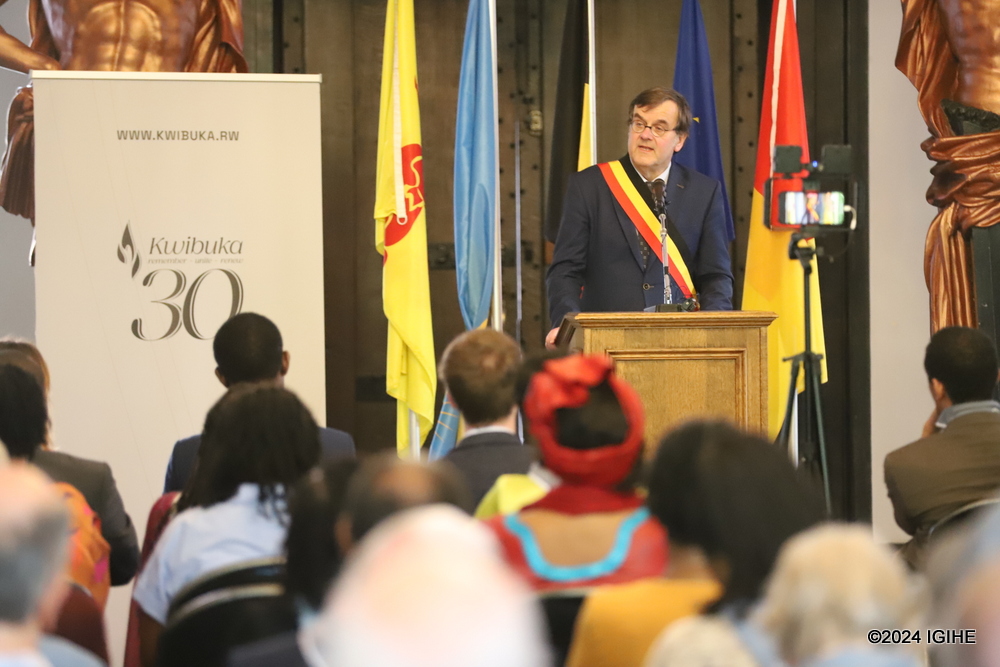
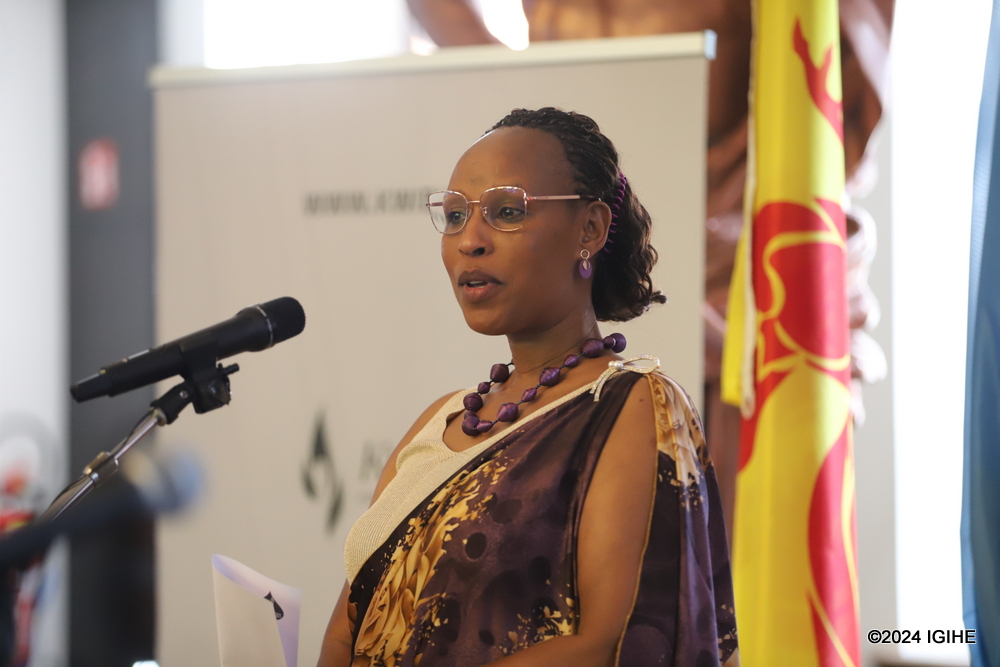
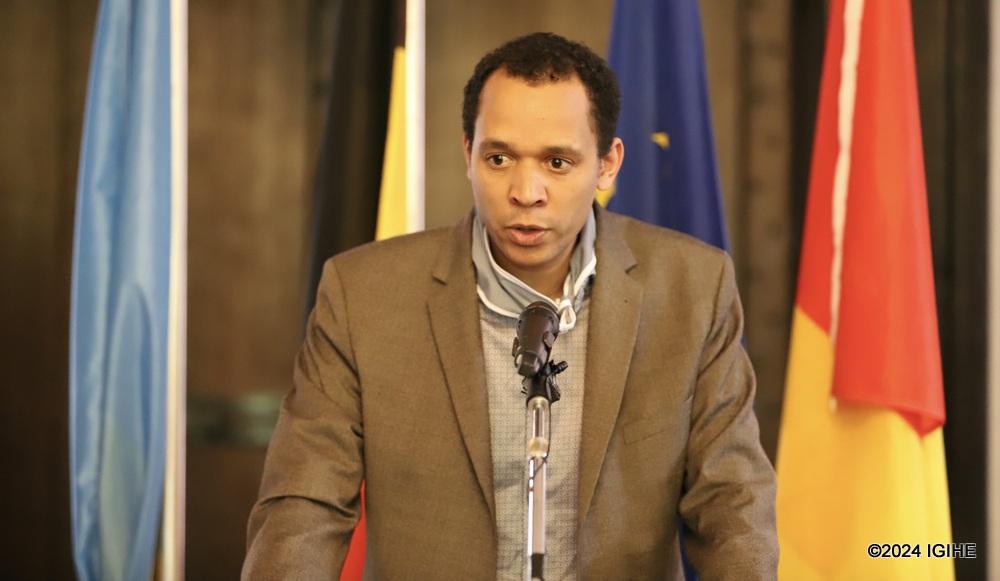
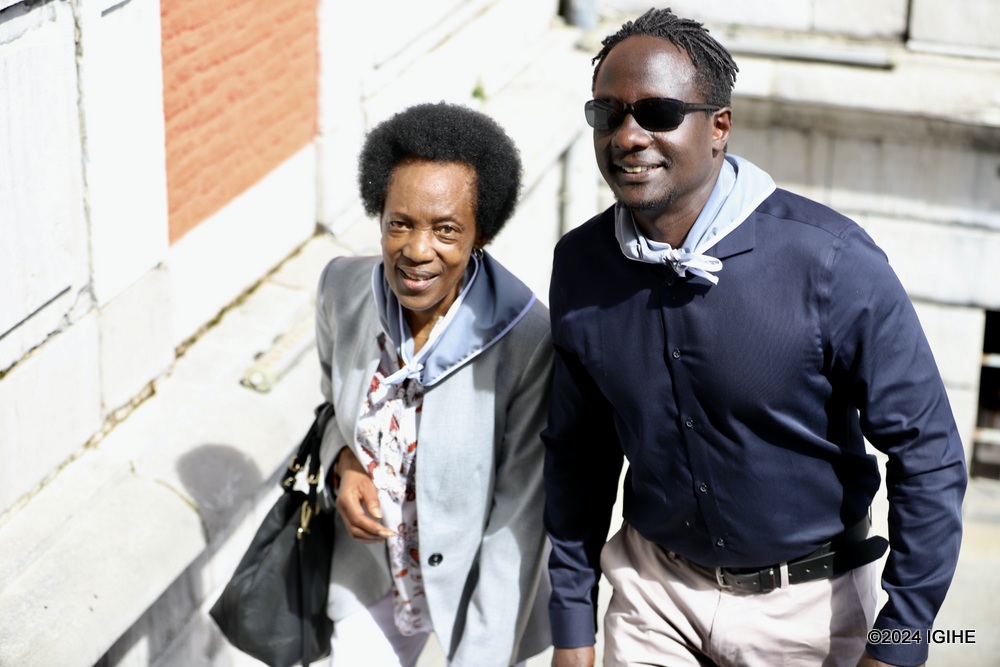
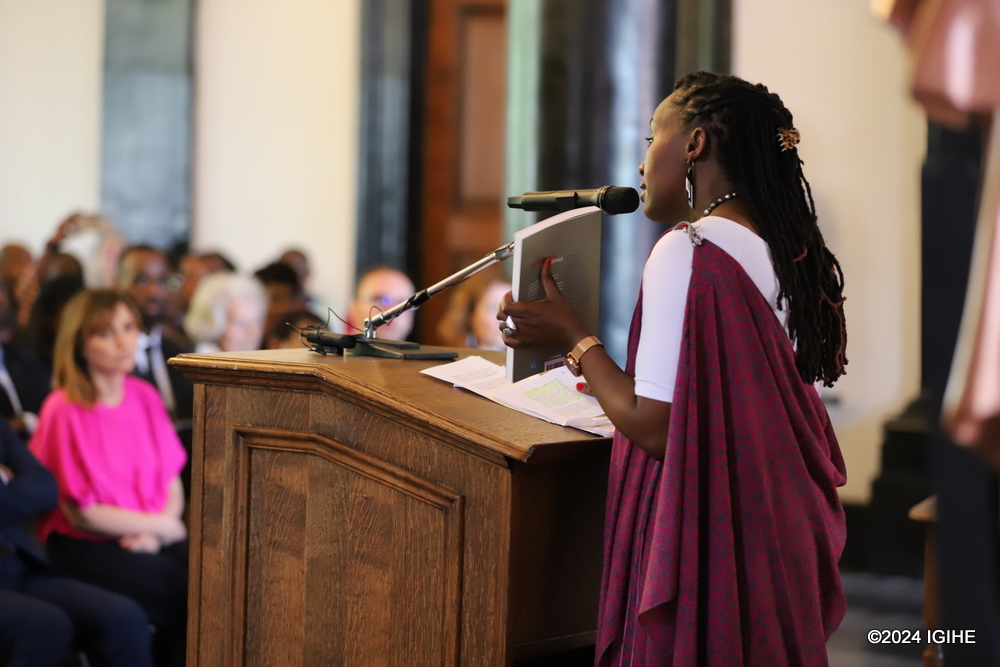
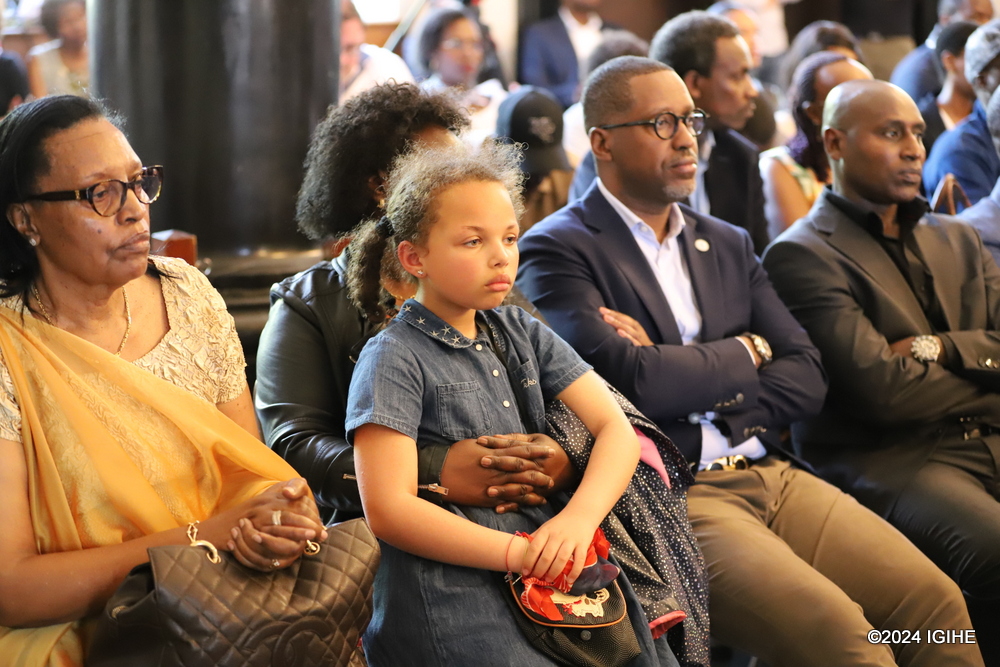
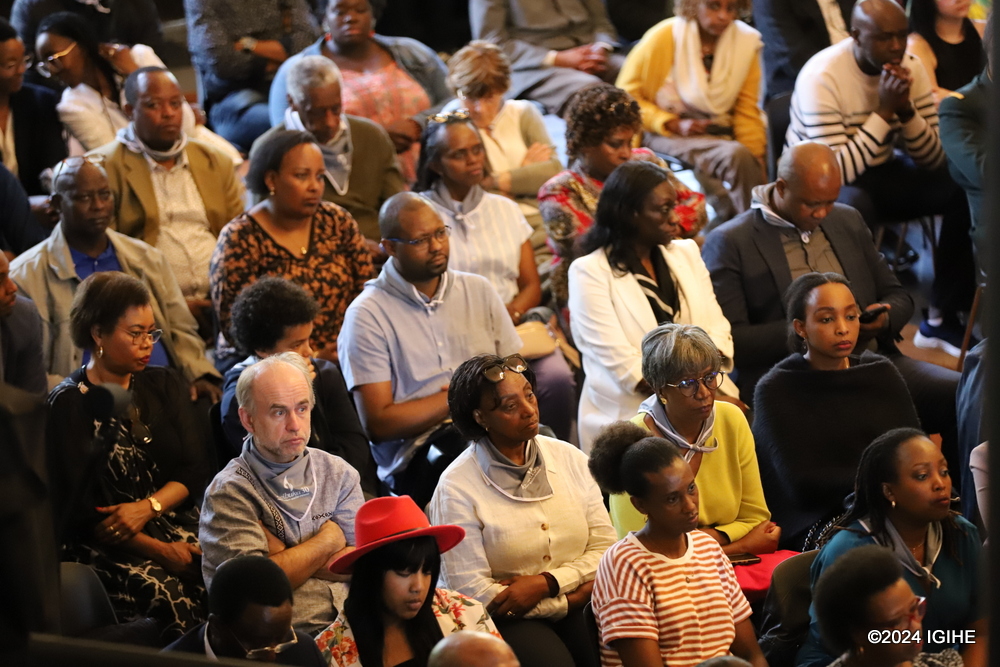
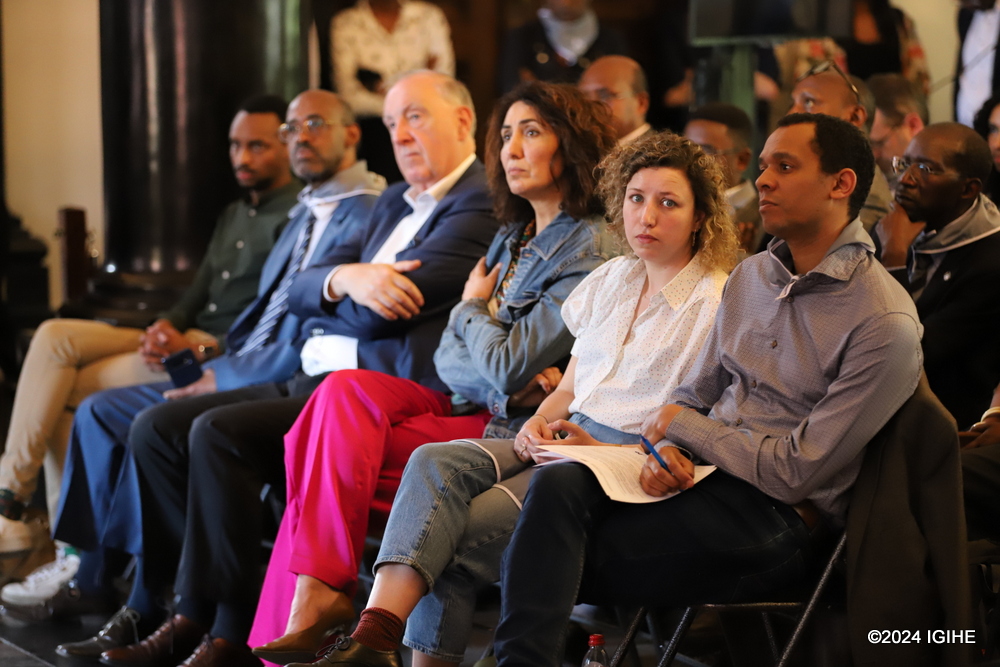
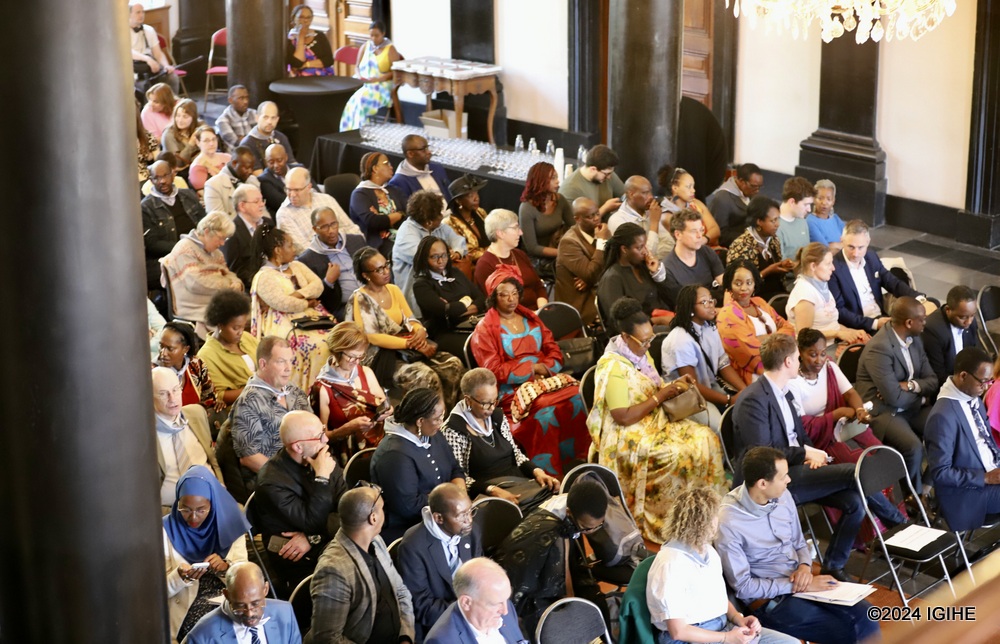
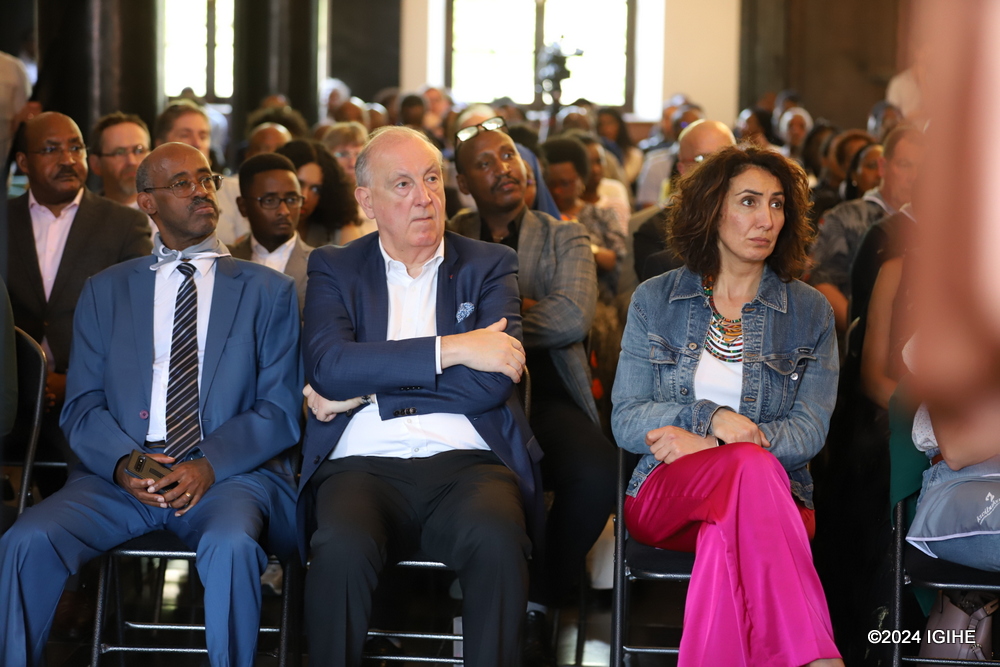
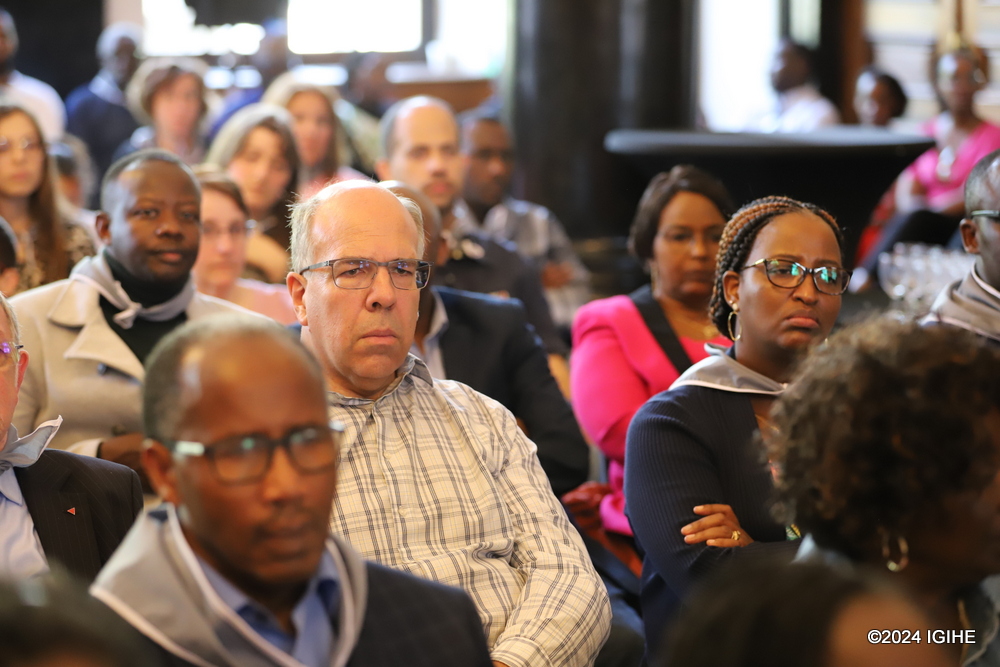
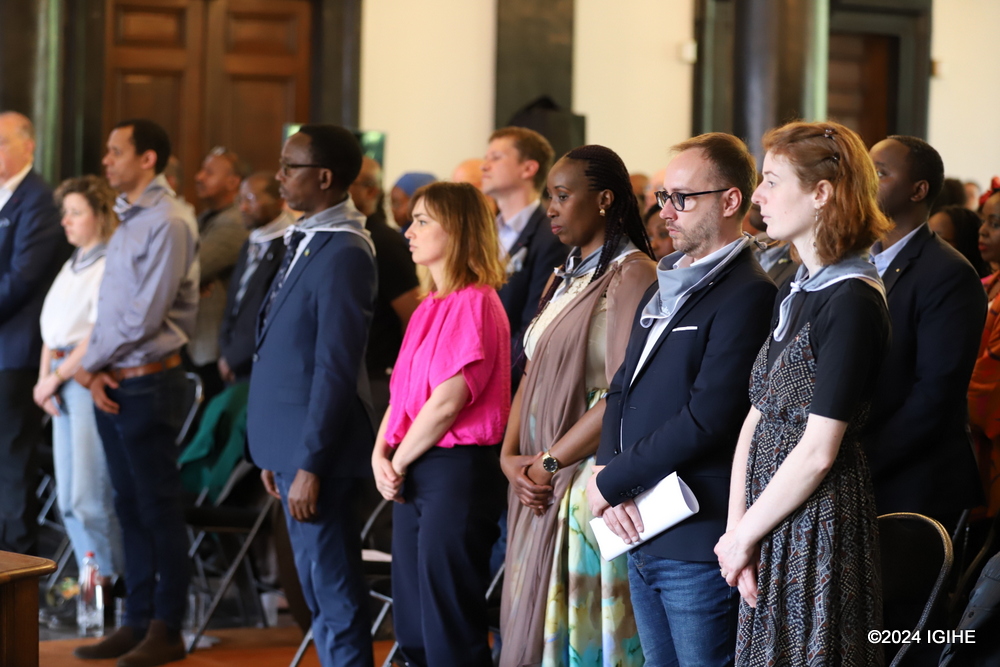
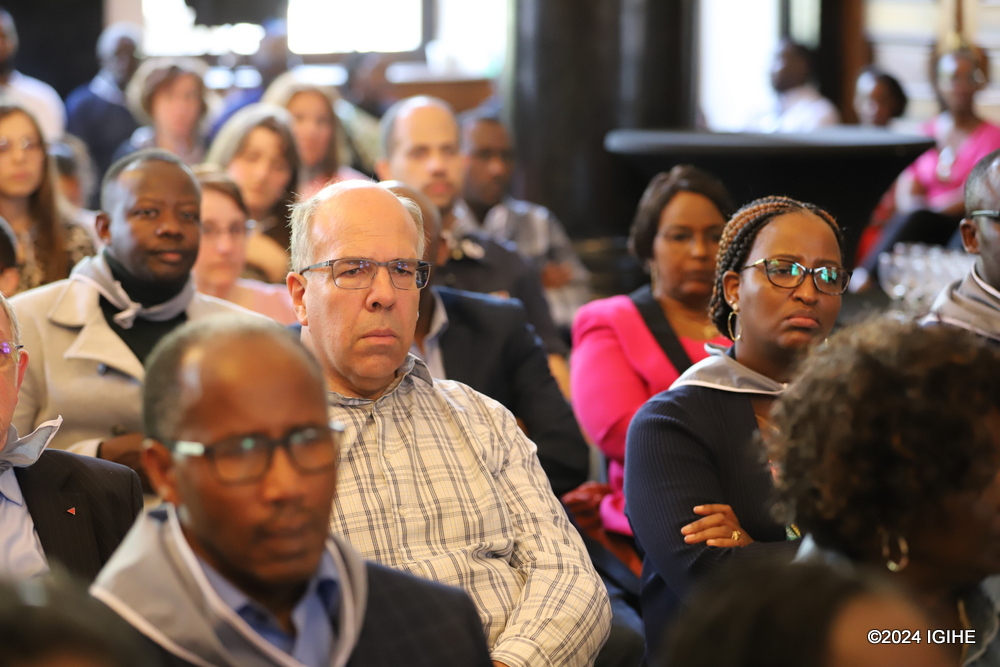
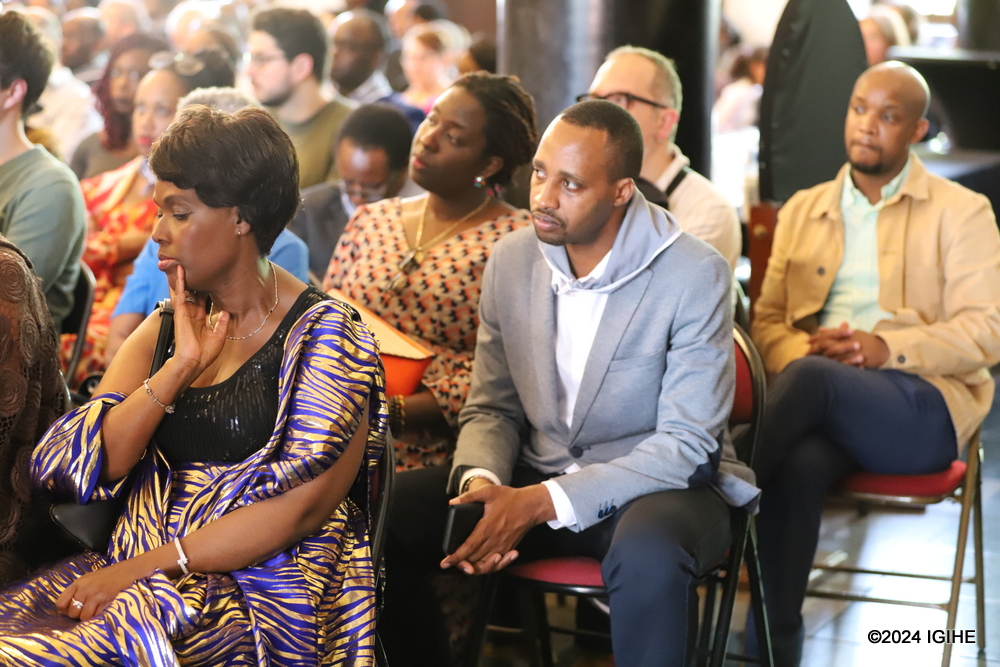
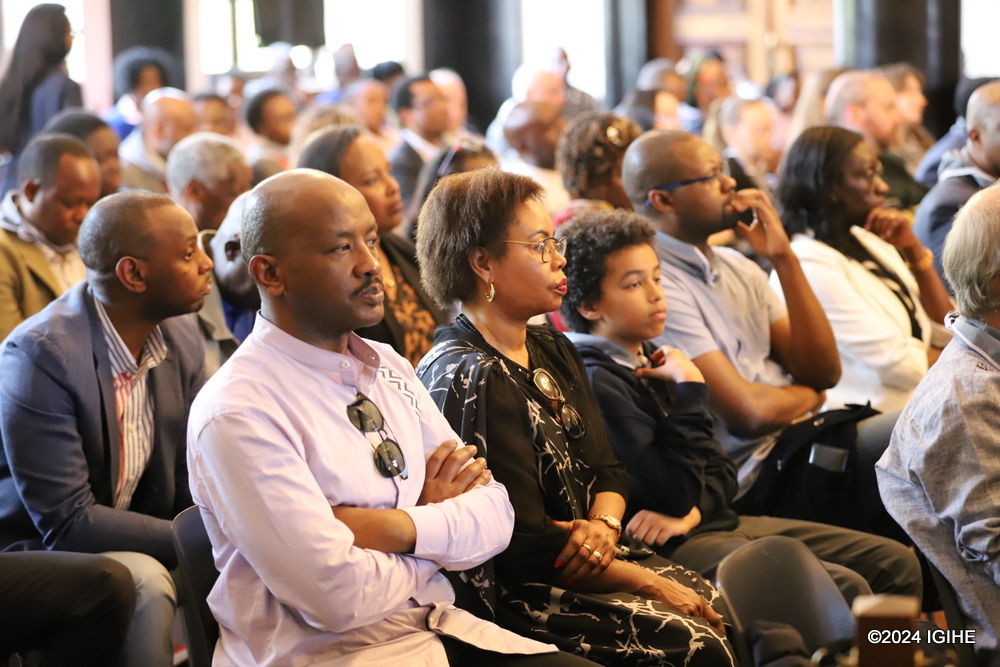
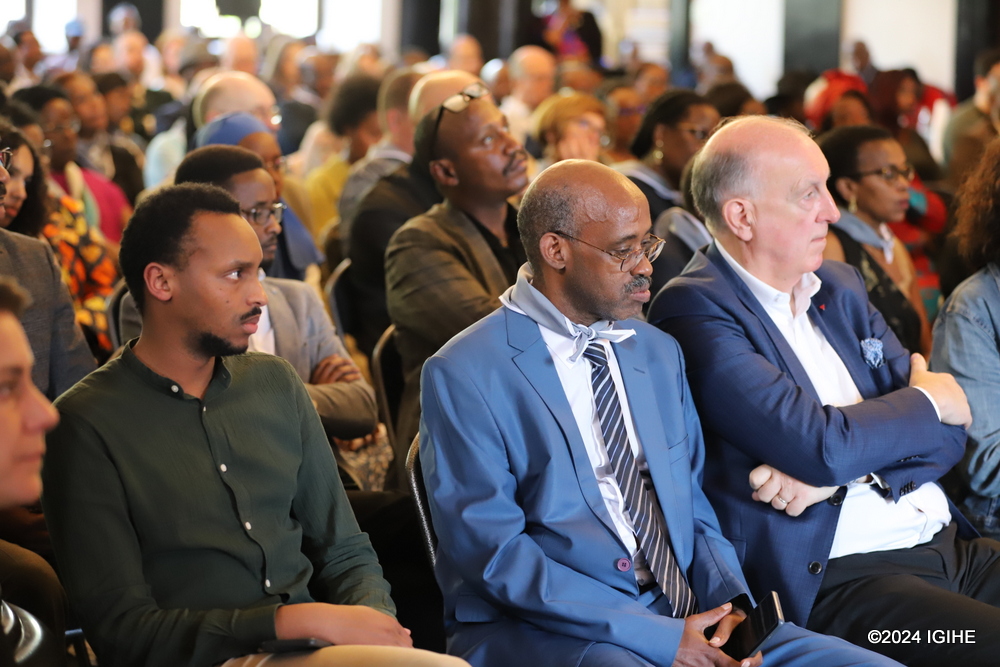
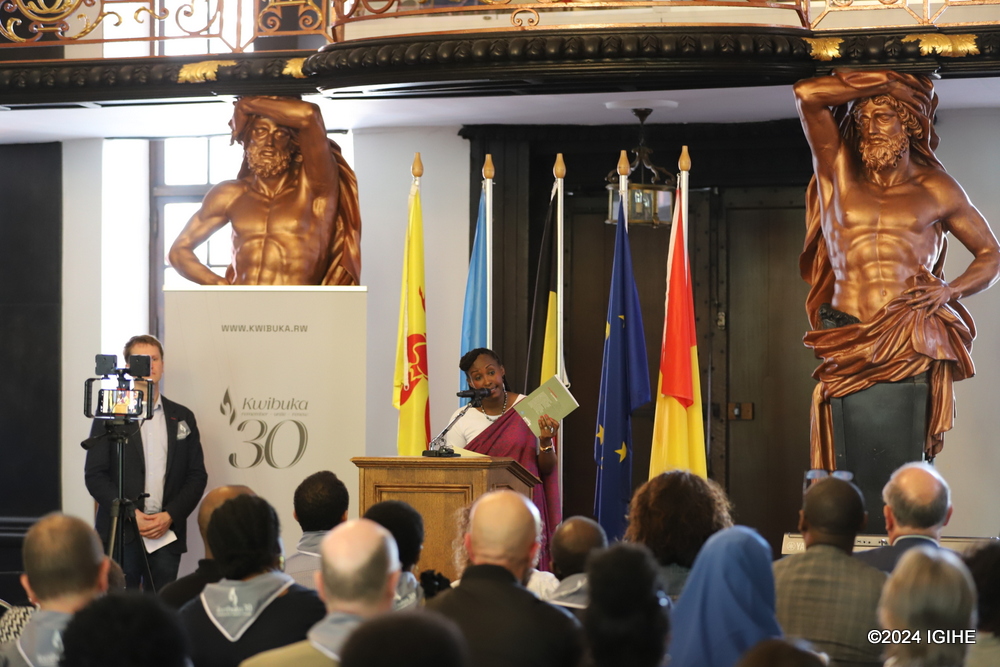
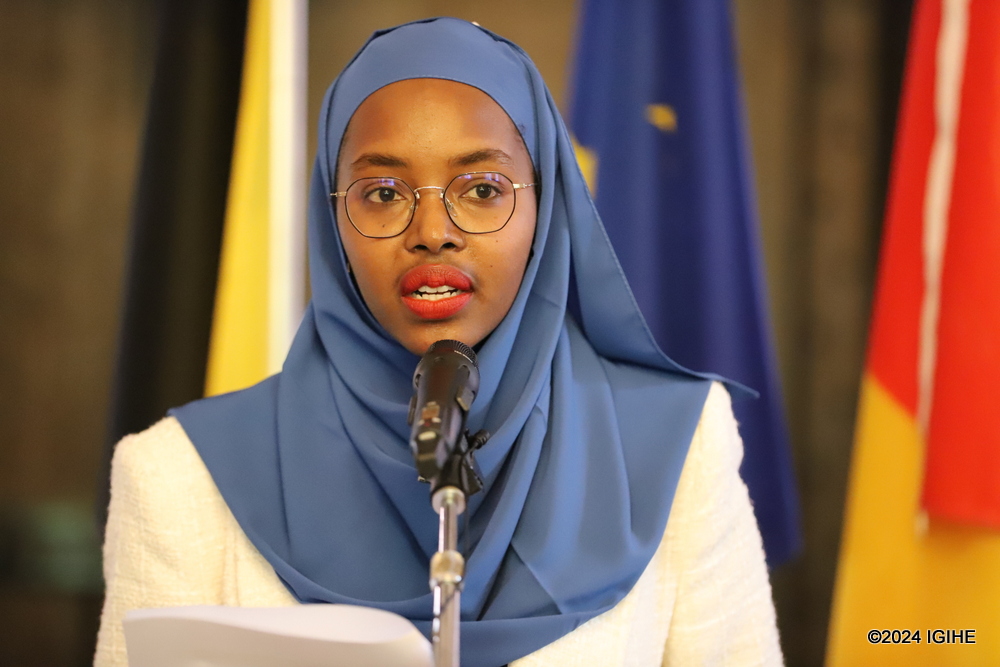
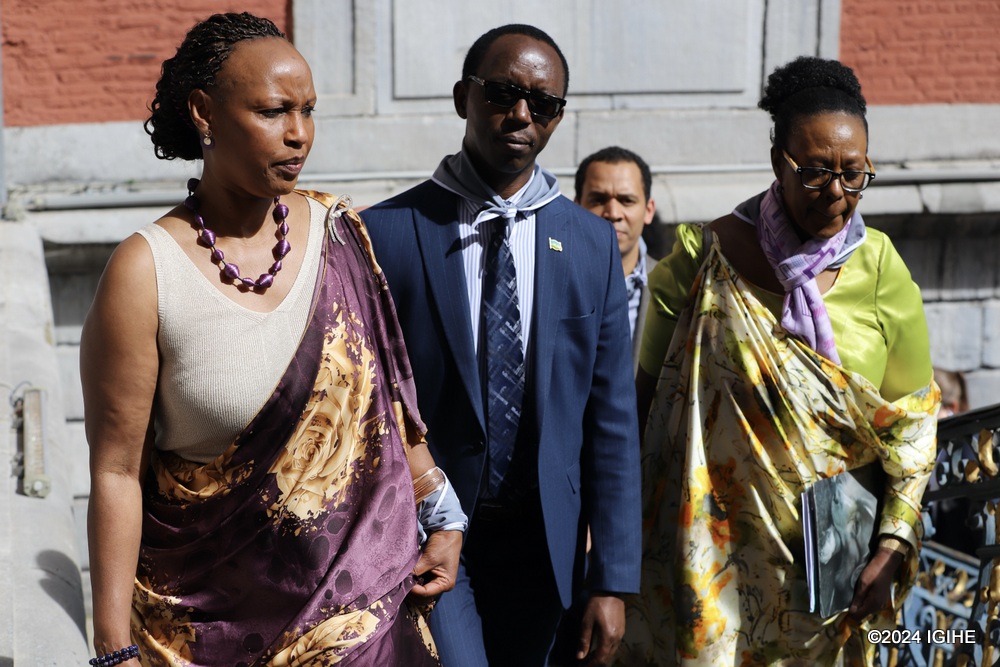
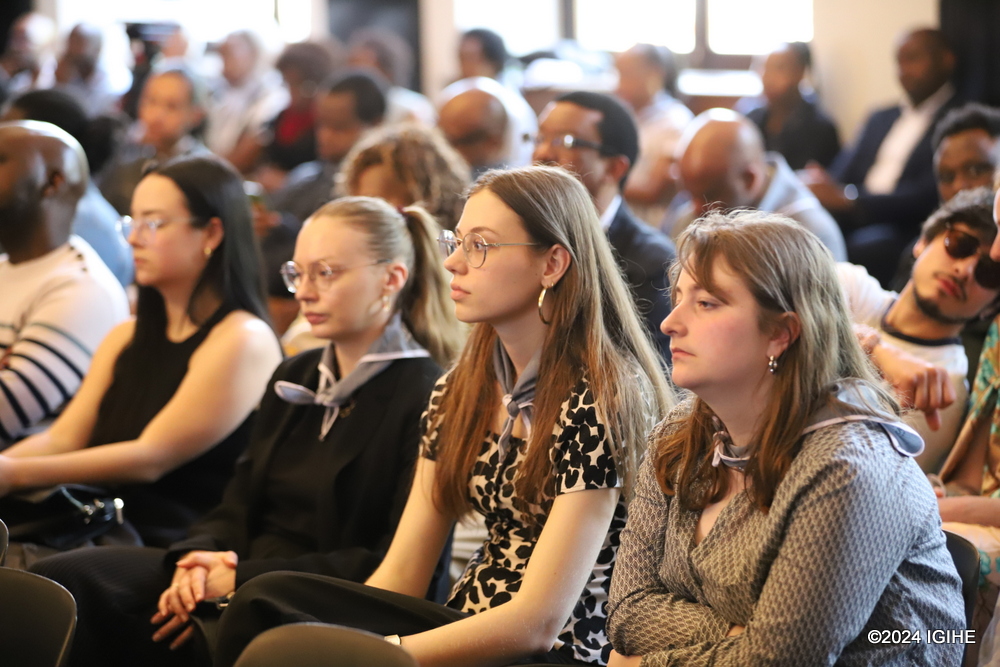
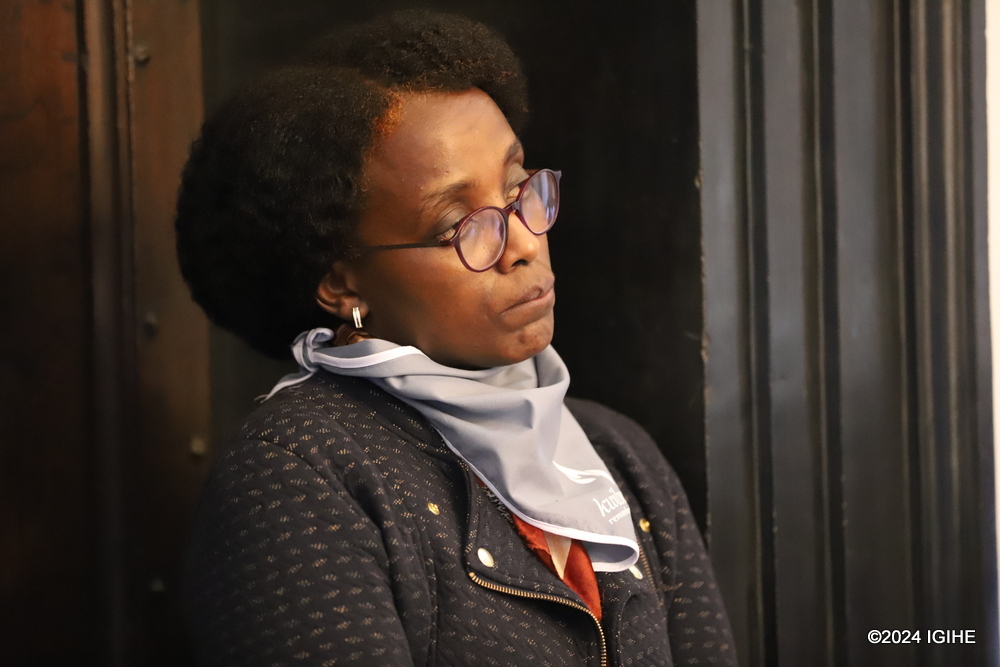
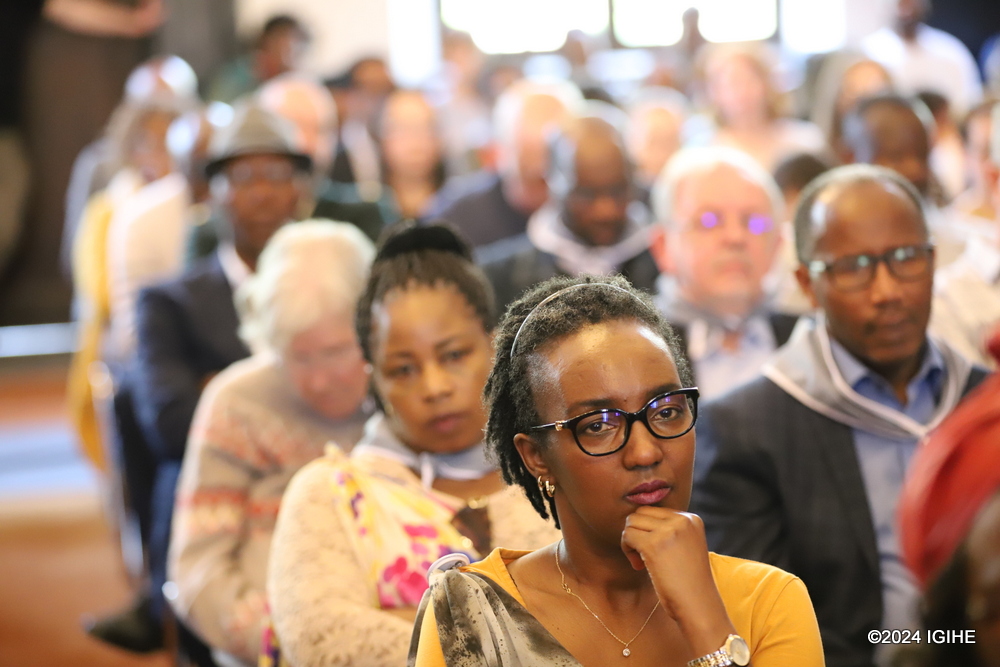
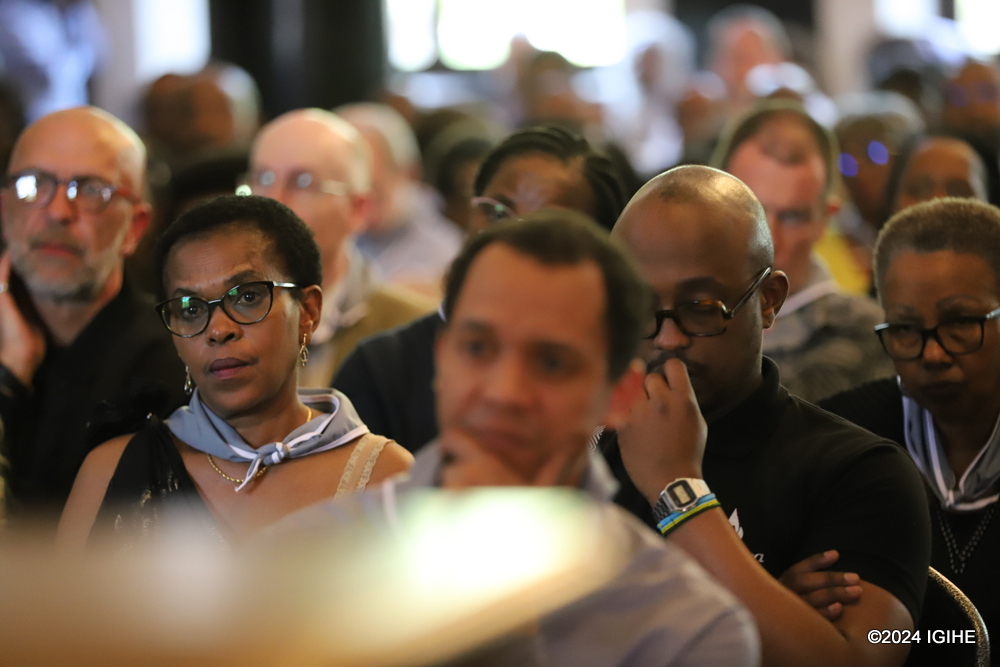
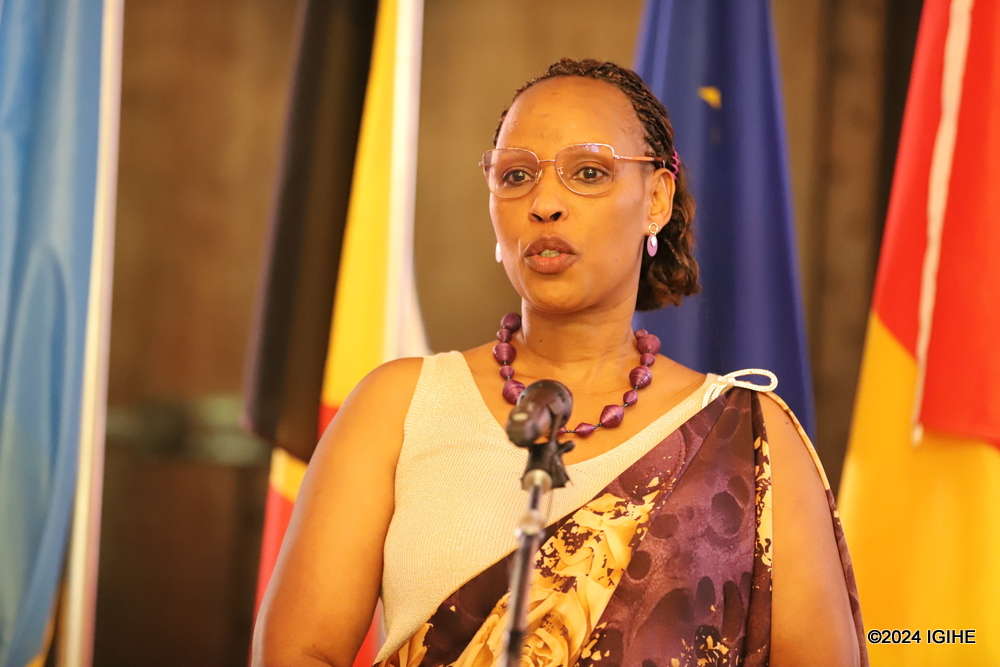
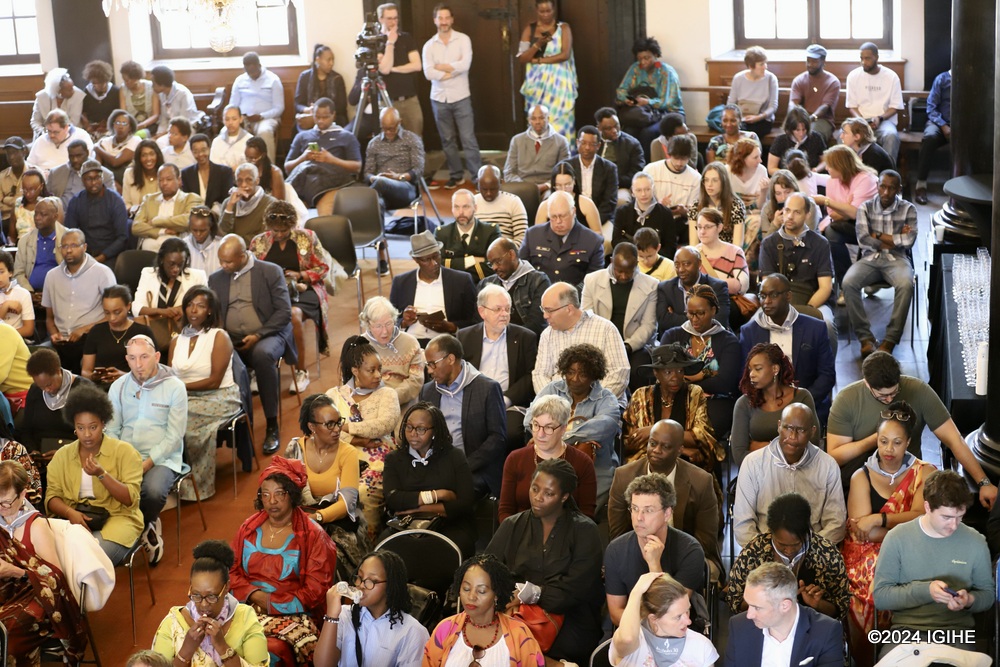
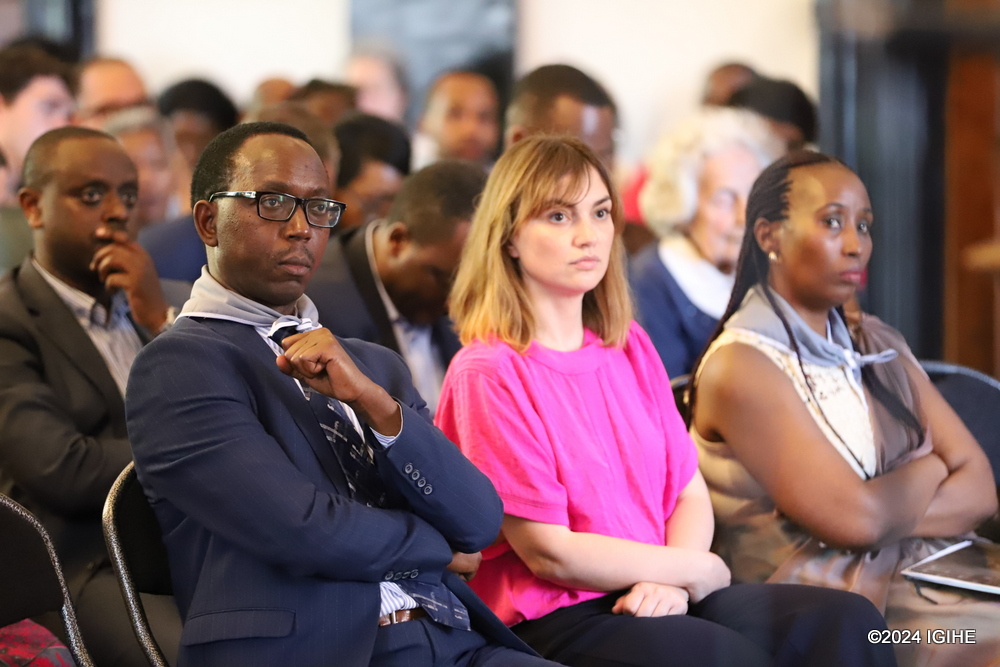
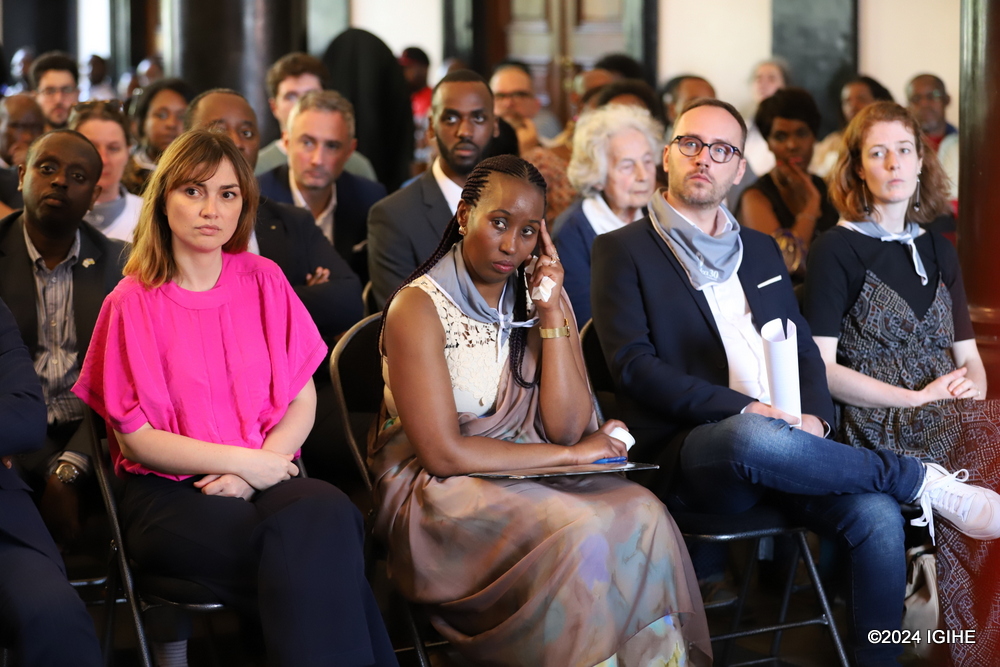
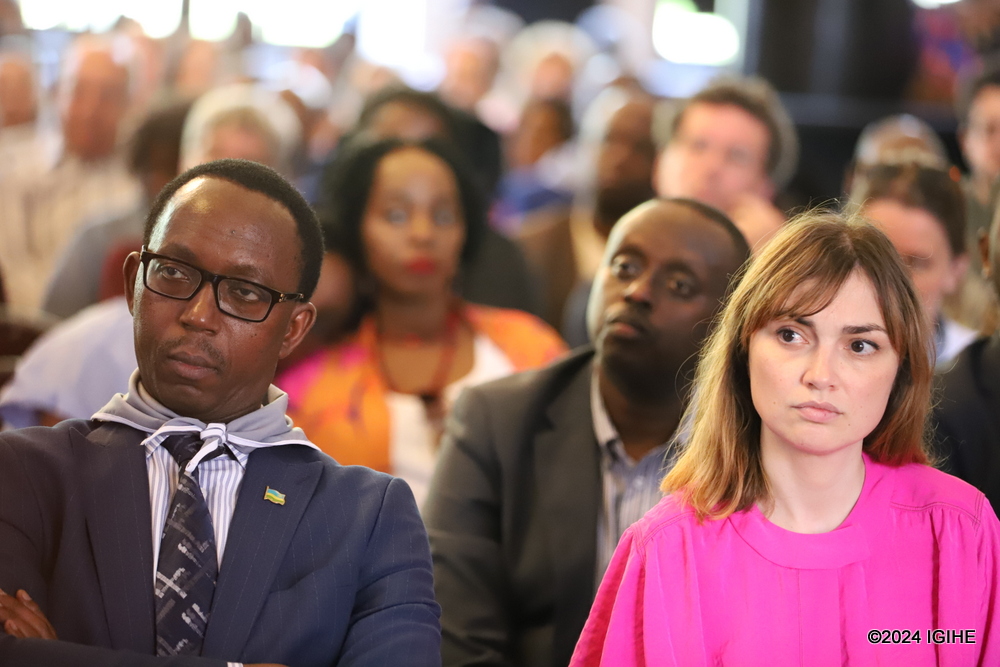
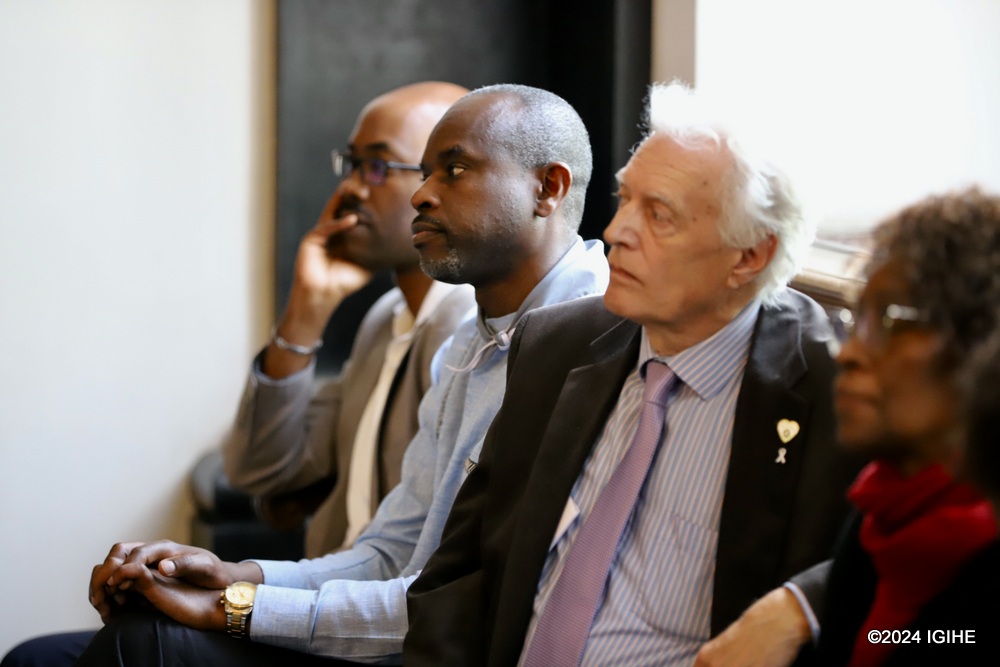
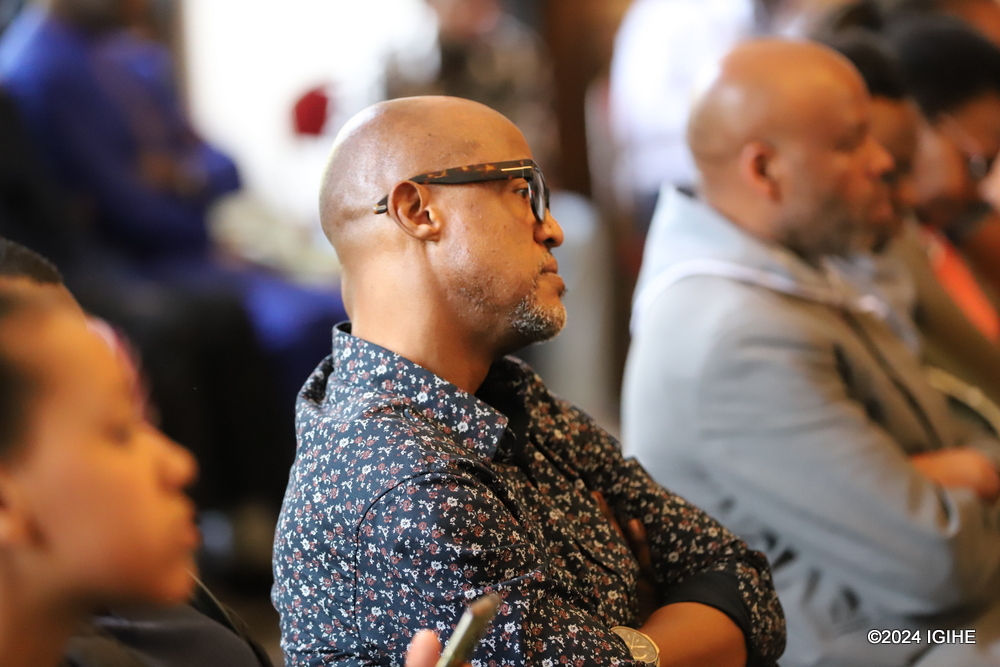
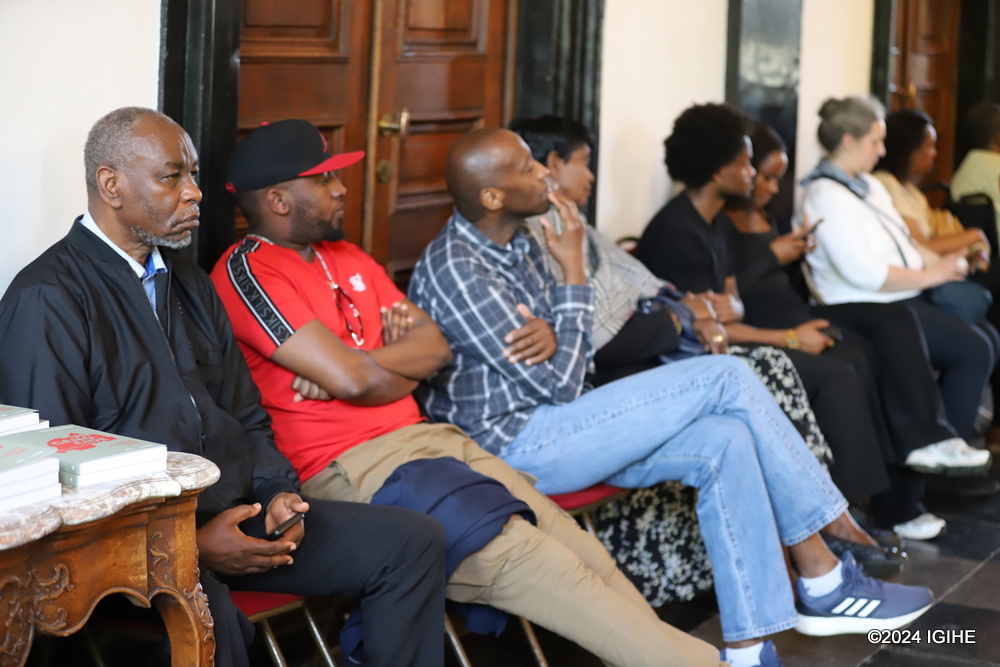
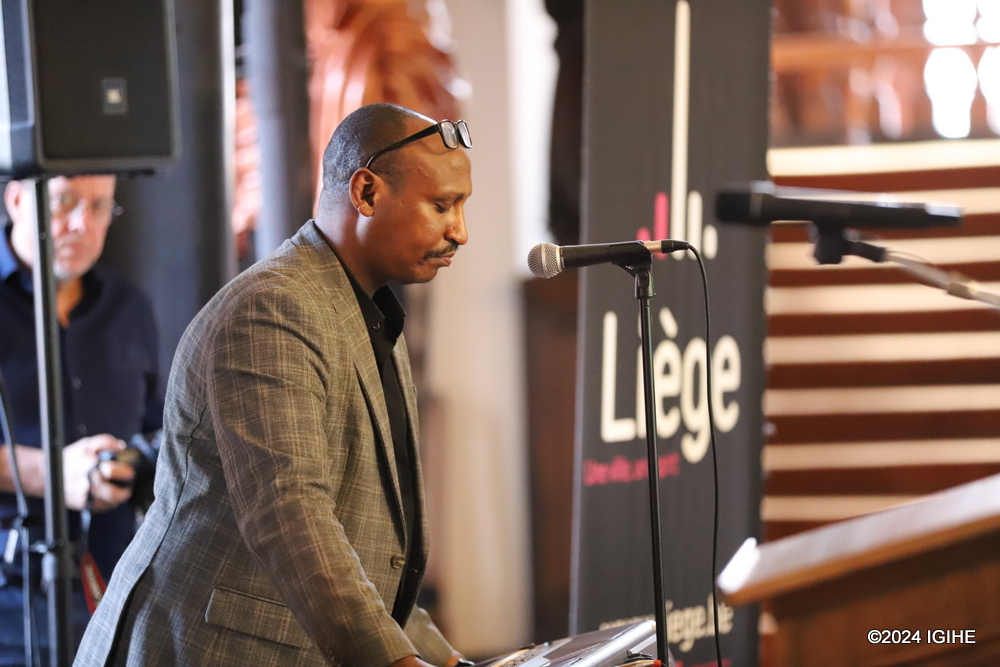
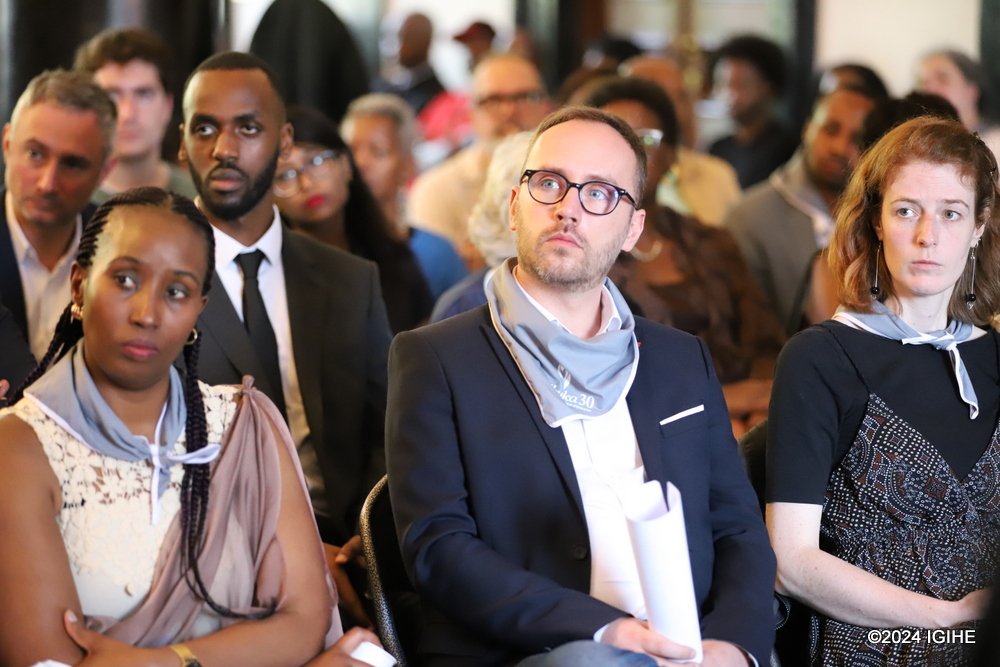
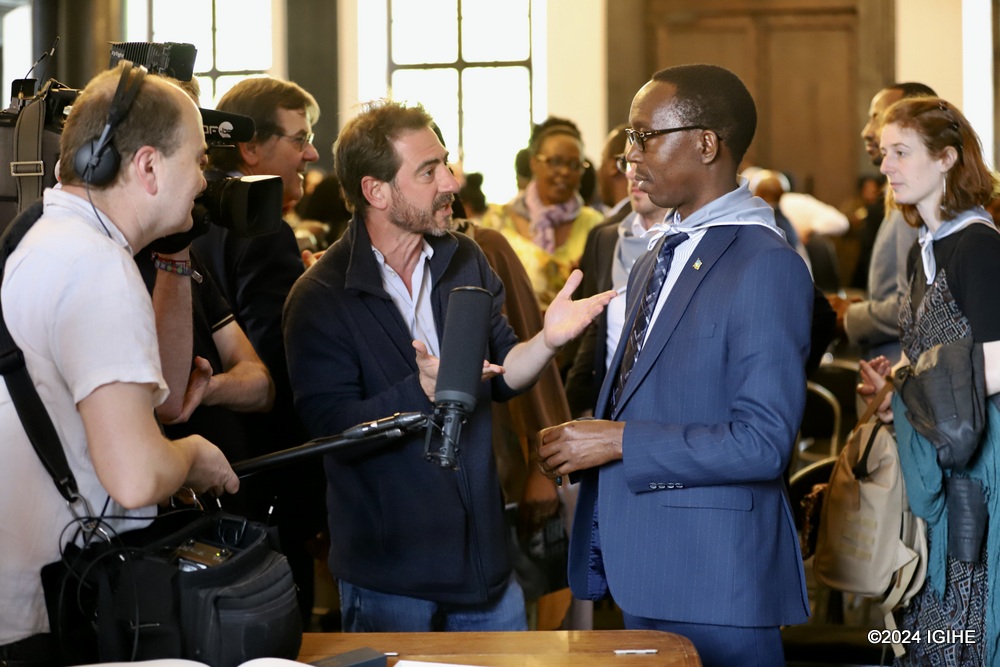
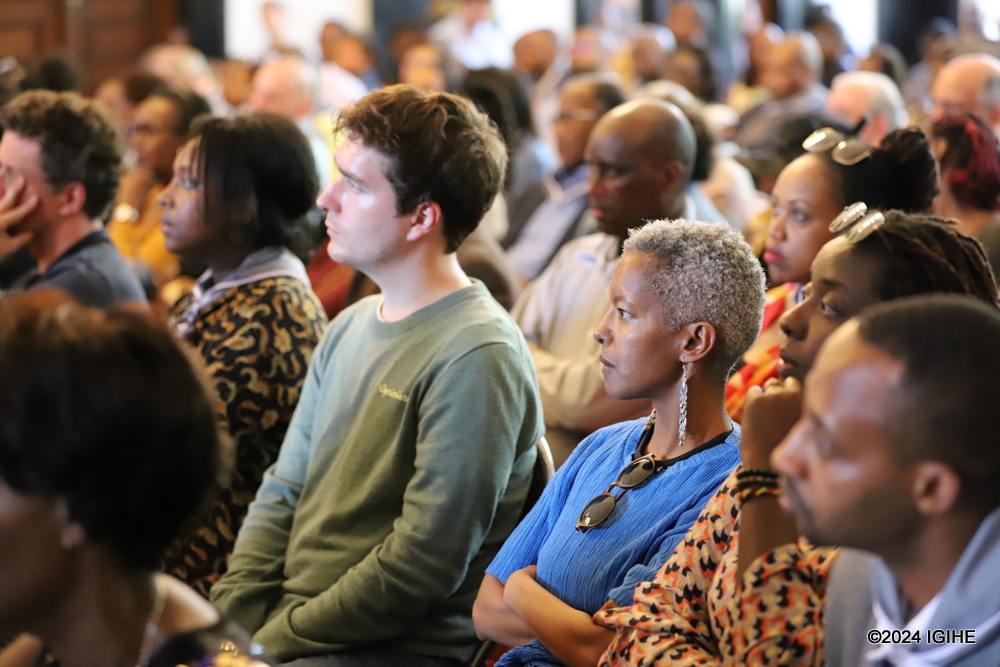
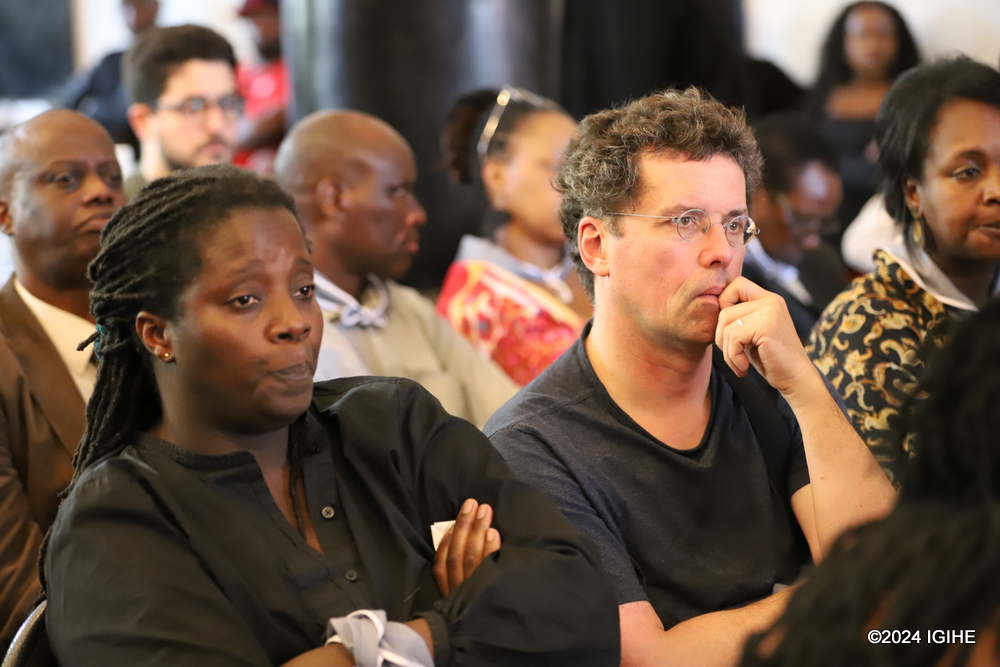
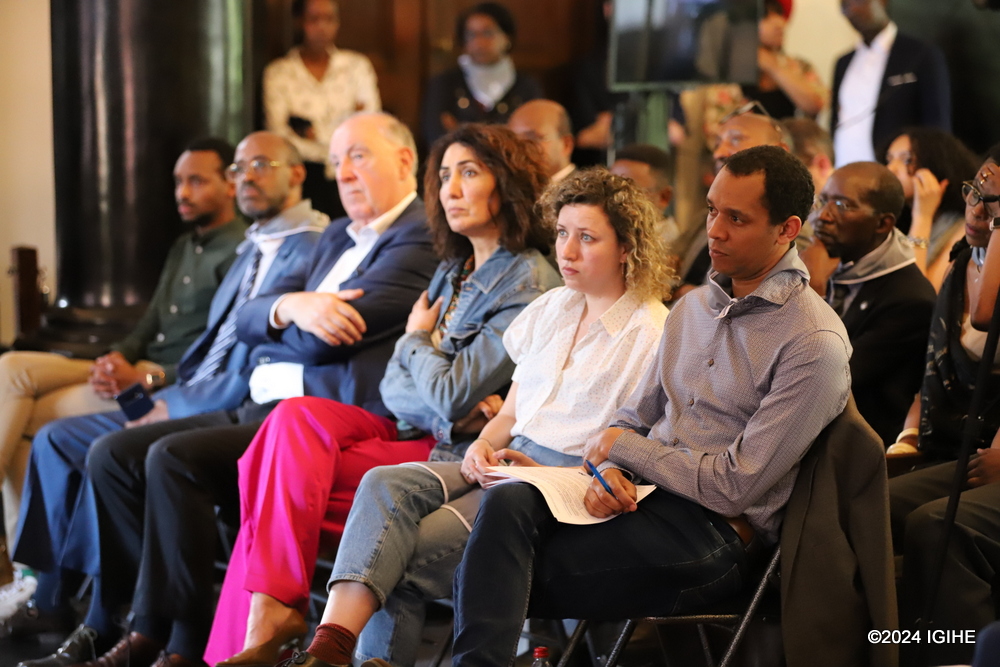
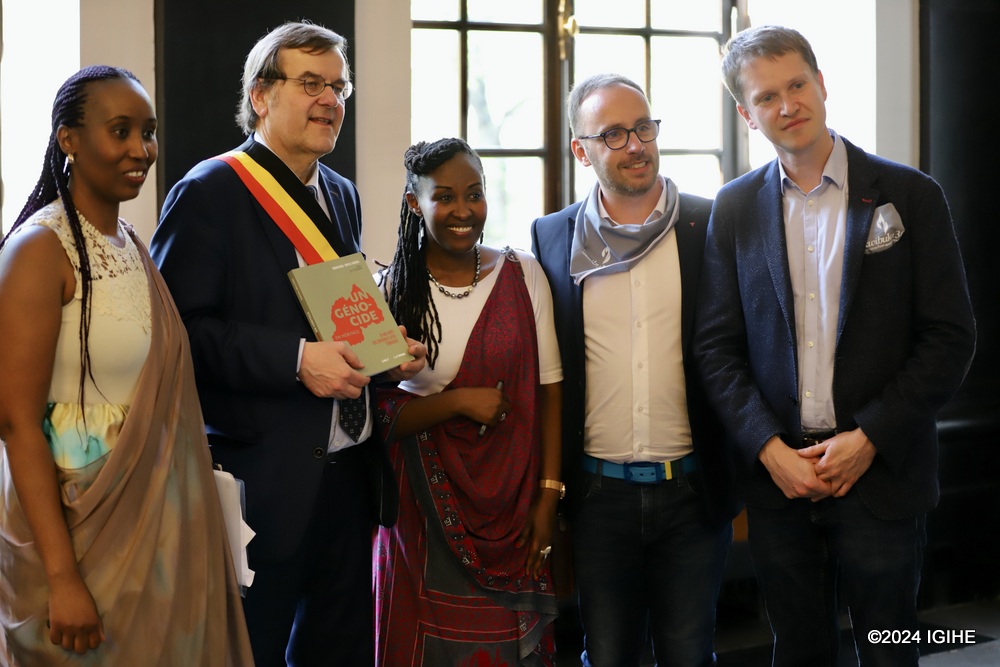
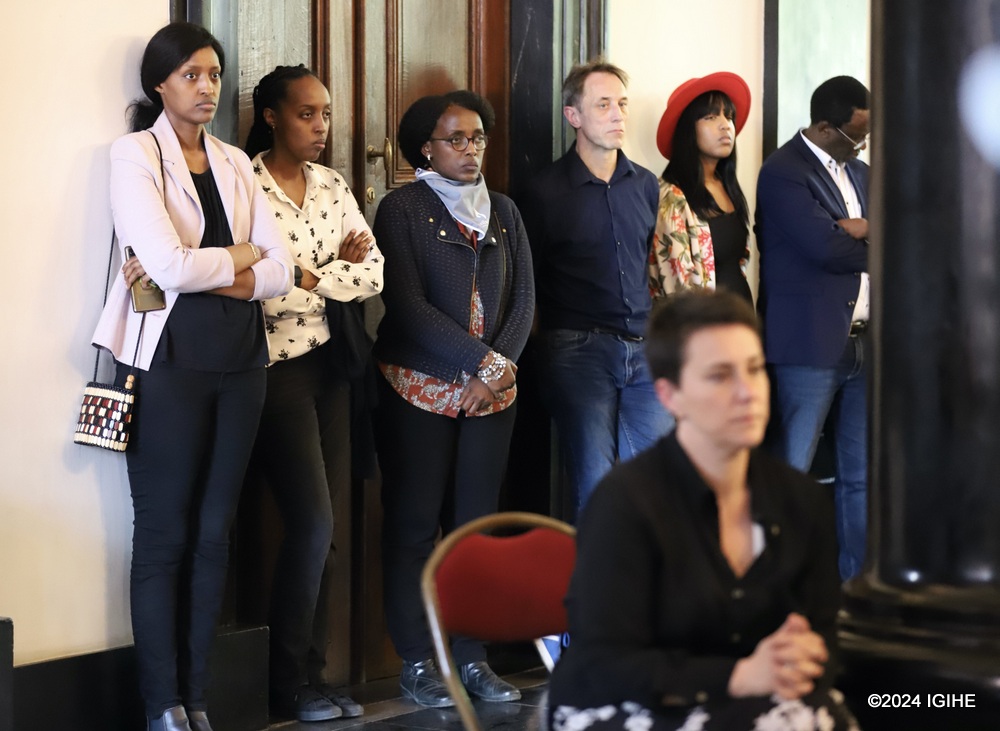
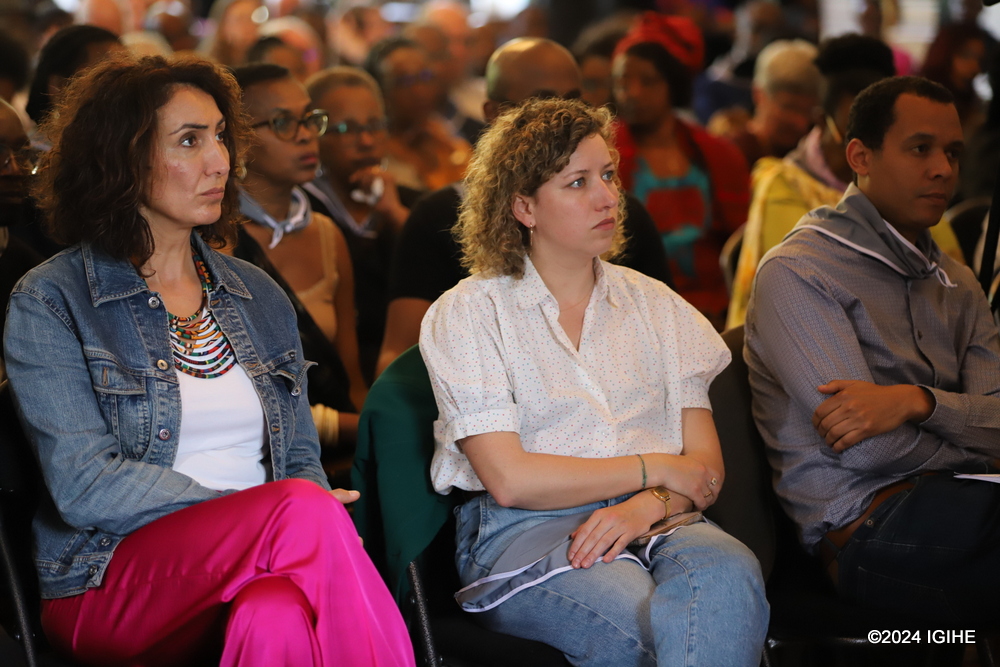
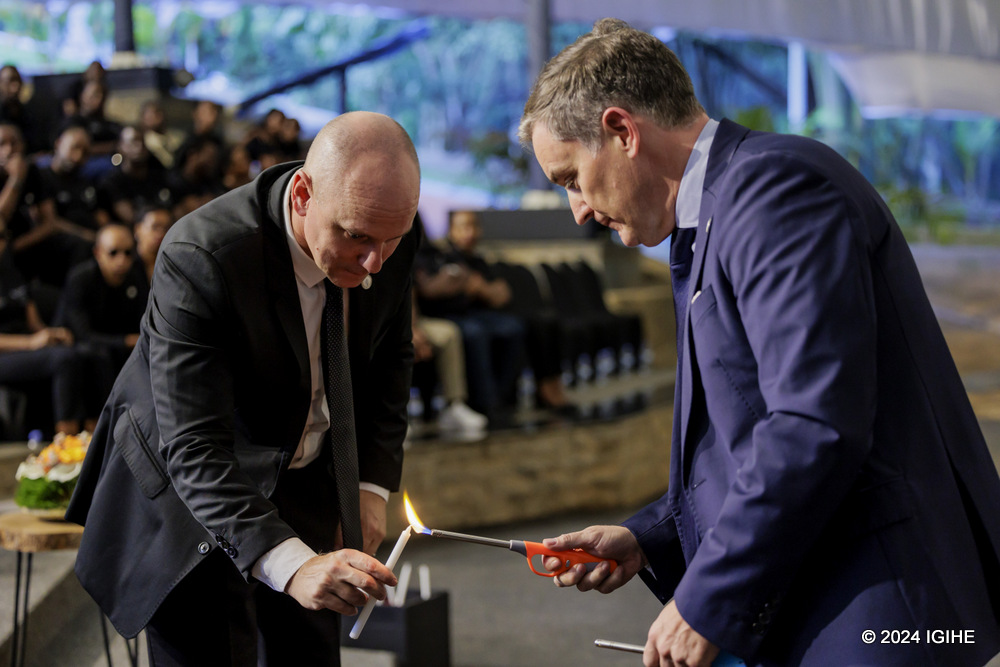
On April 13, 2024, the commemoration brought together members of the Rwandan community and their allies in Liège. Notable attendees included André Bucyana, Chargé d’Affaires a.i. of the Rwandan Embassy in Belgium; Willy Demeyer, the Mayor of Liège; and Anne-Marie Ikirizaboro, the president of URGT.
Representatives from various organizations that support genocide survivors, as well as Michaël Bisschops from “Les Territoires de la Mémoire,” were also present.
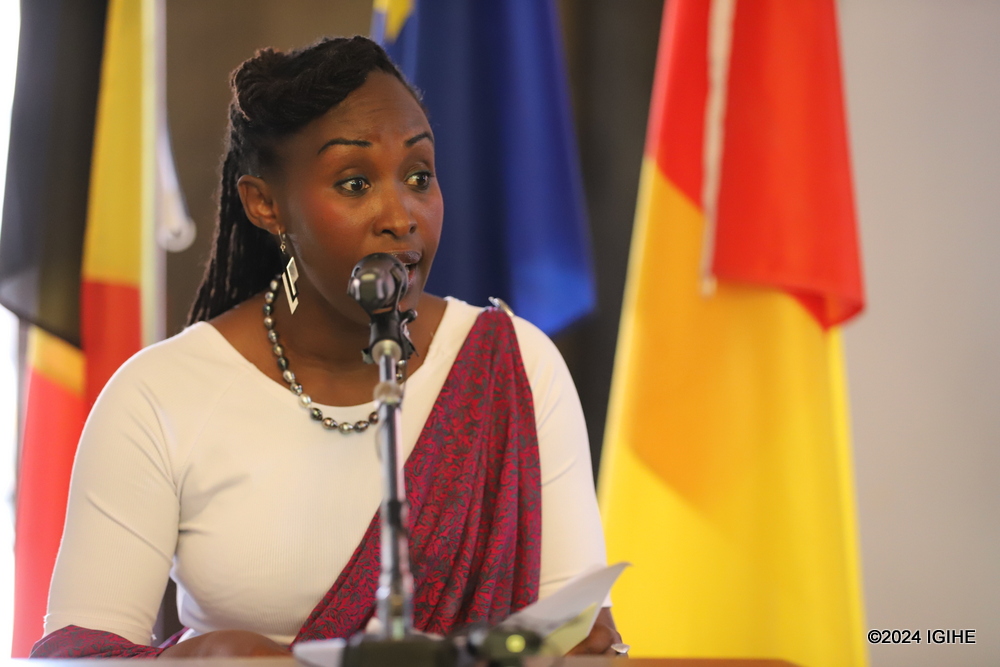
Anne-Marie Ikirizaboro underscored the importance of the commemoration, emphasizing it as a remembrance of the severe persecution of the Tutsi community based on their identity.
“They were targeted and killed solely because they were Tutsi. Countless lives were lost, and the exact locations of many such atrocities remain unknown. Those responsible continue to walk free, shielded by nations that have provided them asylum. This reality offers little solace to us, the survivors of the Genocide against the Tutsi, as we endeavor to reconstruct our lives with unwavering resolve,” she explained.
Ikirizaboro added that the 30th commemoration of the Genocide against the Tutsi also involves nurturing the children who are descendants of the survivors.
The event also highlighted the resilience of survivors through the unveiling of “Un génocide en héritage.”
This book presents 11 impactful testimonies compiled by URGT, Celida asbl, and SPF Égalité des chances, with contributions from Donatille Karurenzi and Dr. Bernard Wilkin.
André Bucyana expressed gratitude to both the organizers and attendees for their dedication to remembering the genocide annually in Liège. He stressed the vital role of documenting history to prevent the recurrence of such atrocities.
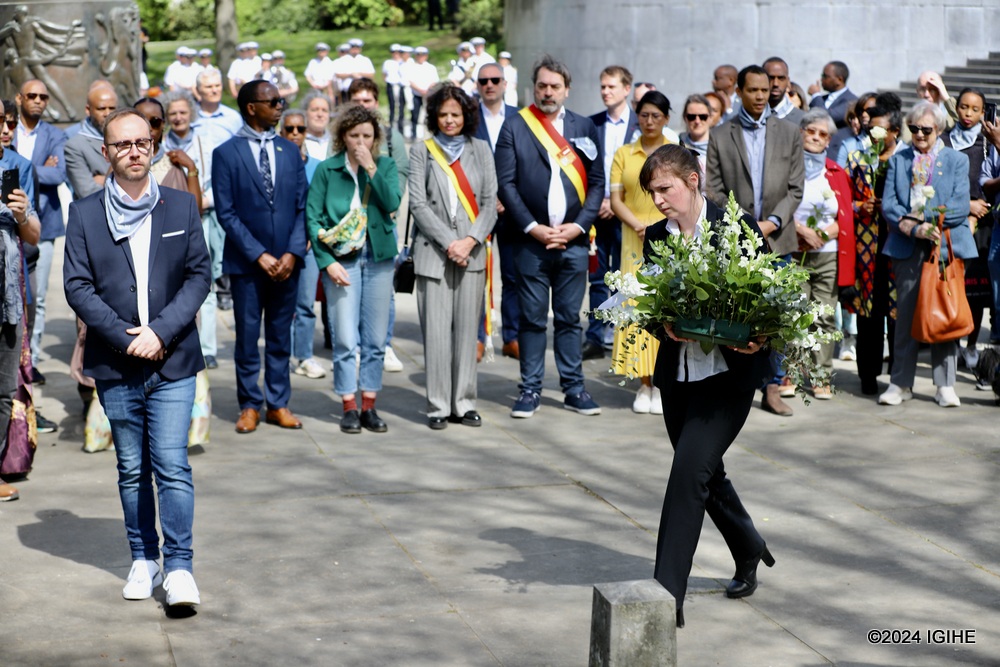
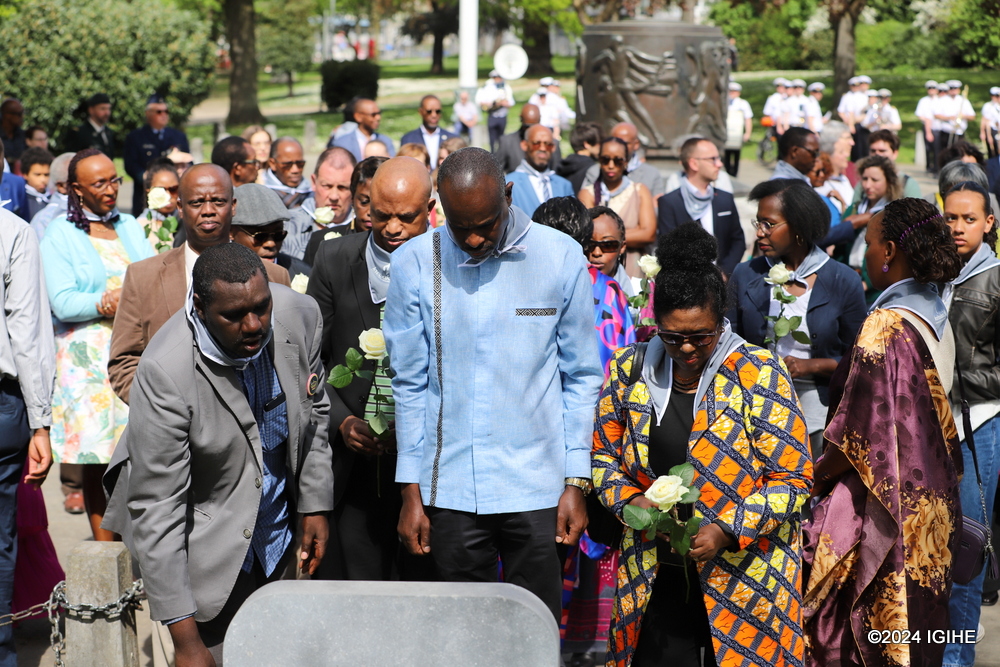
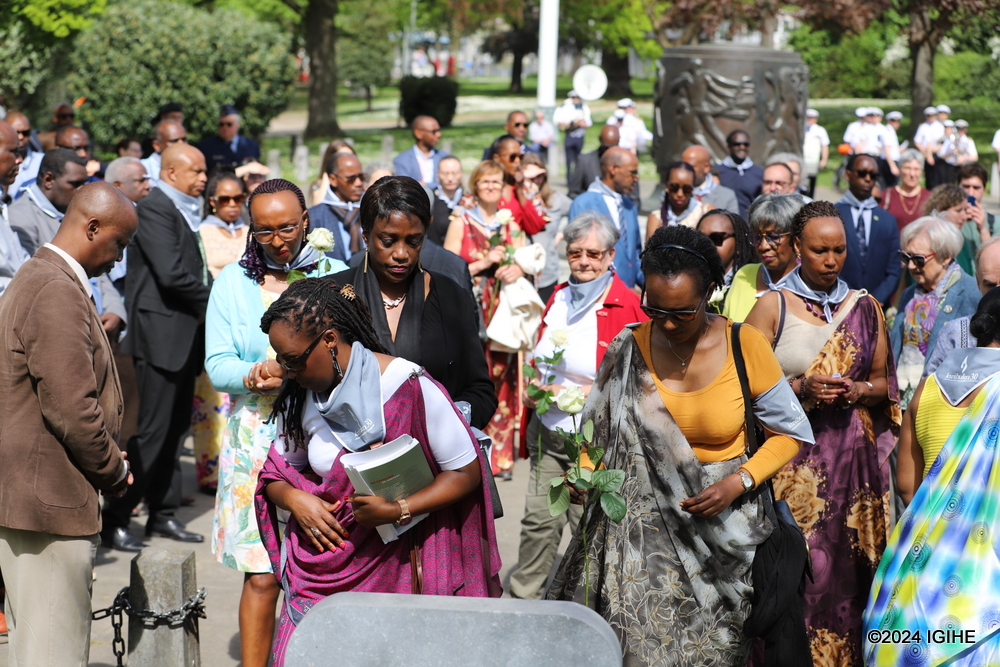
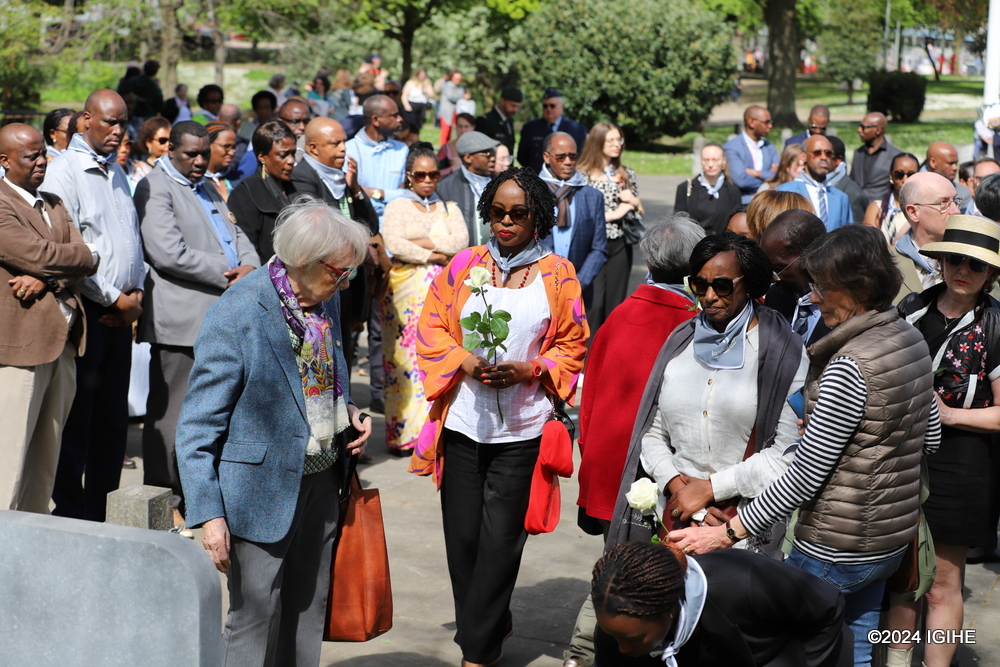
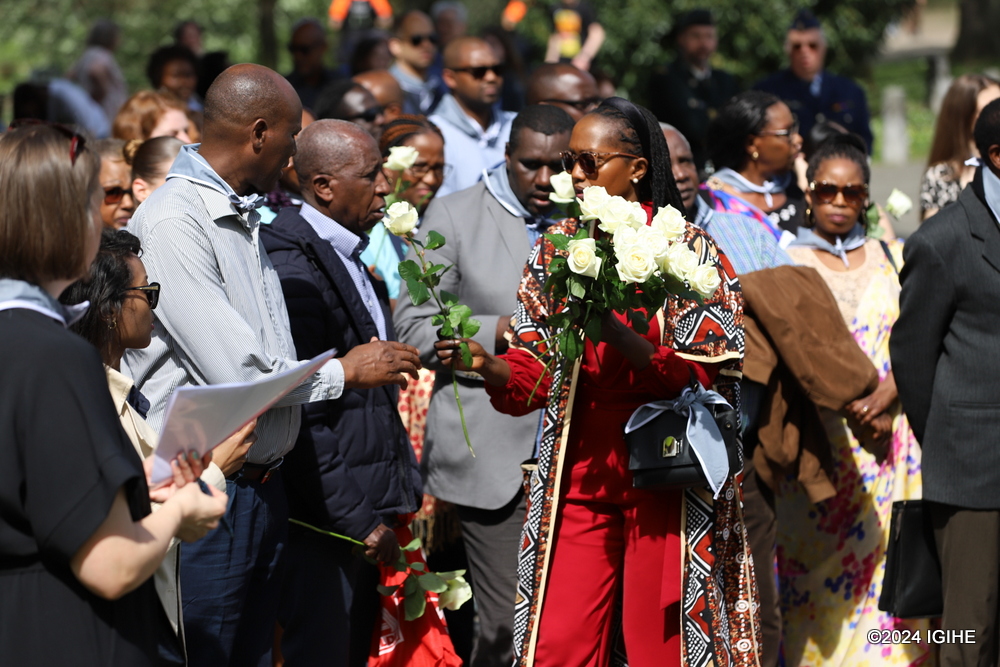
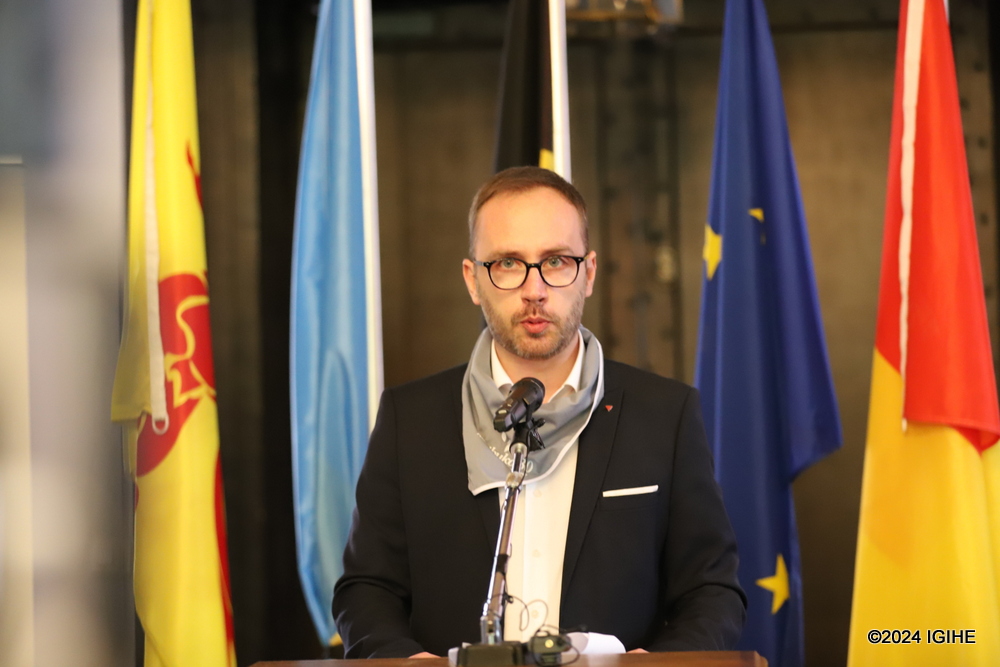
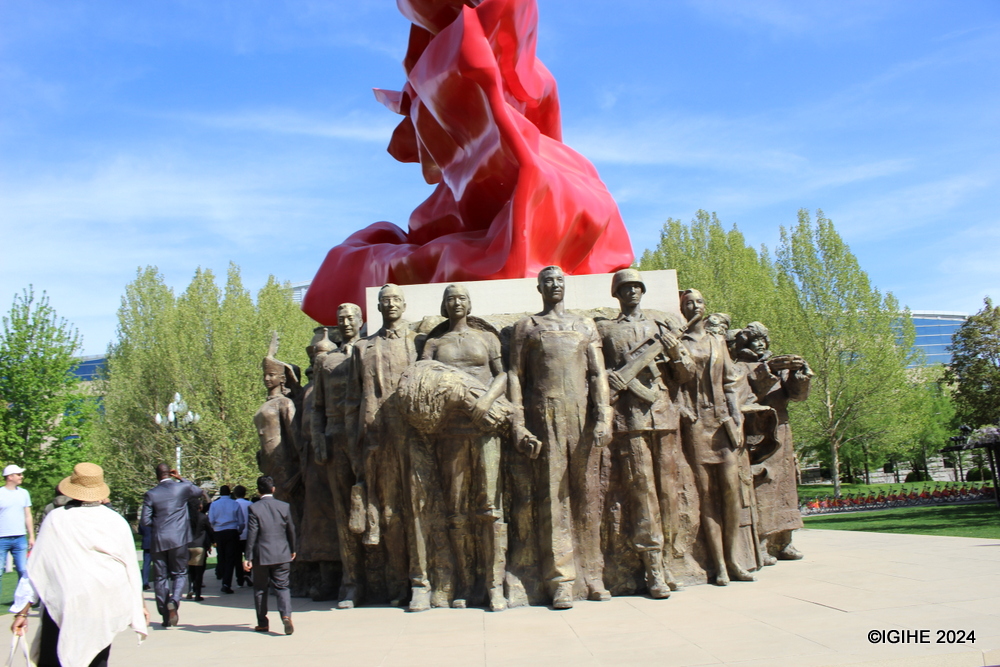
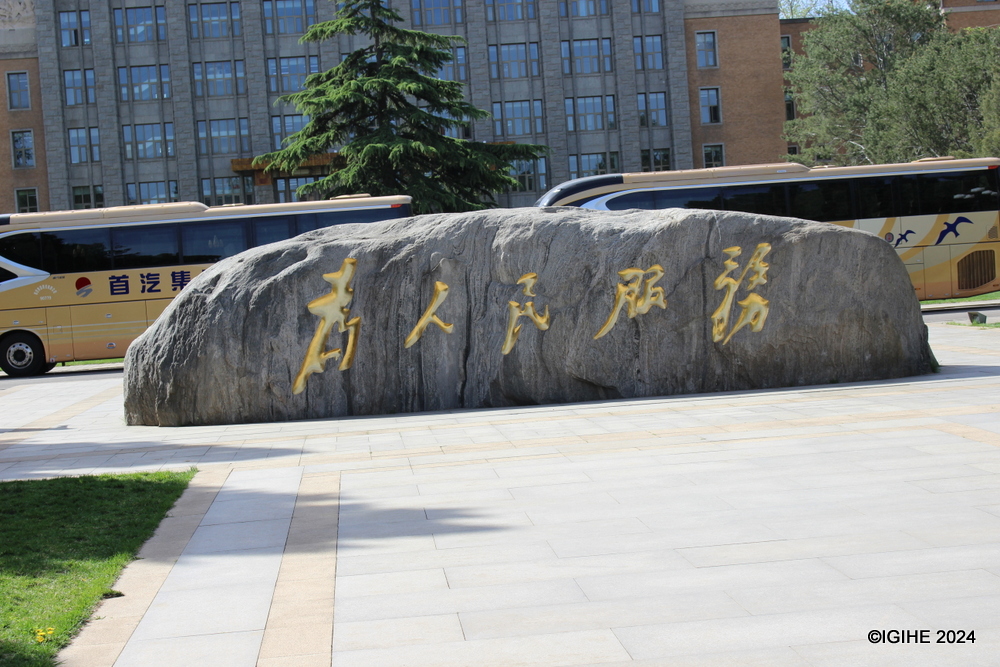
Mayor Willy Demeyer commended the Tutsi survivors in Liège for their resilience and organizational efforts. He noted the significance of public memorials, like laying flowers at the Genocide Memorial near the National Resistance Monument in central Liège, in preventing the repetition of such tragedies.
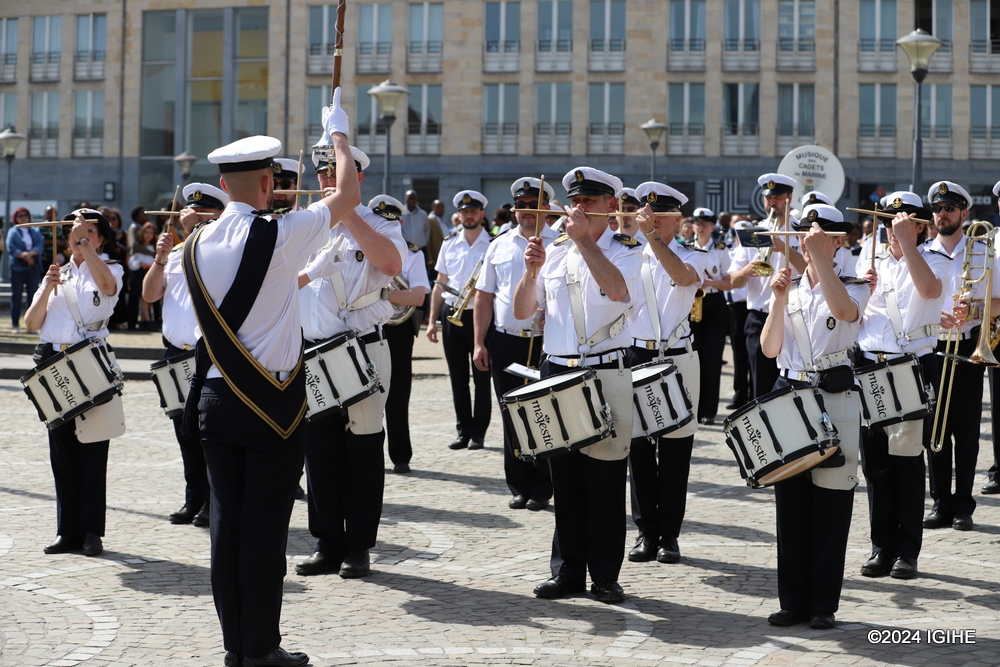
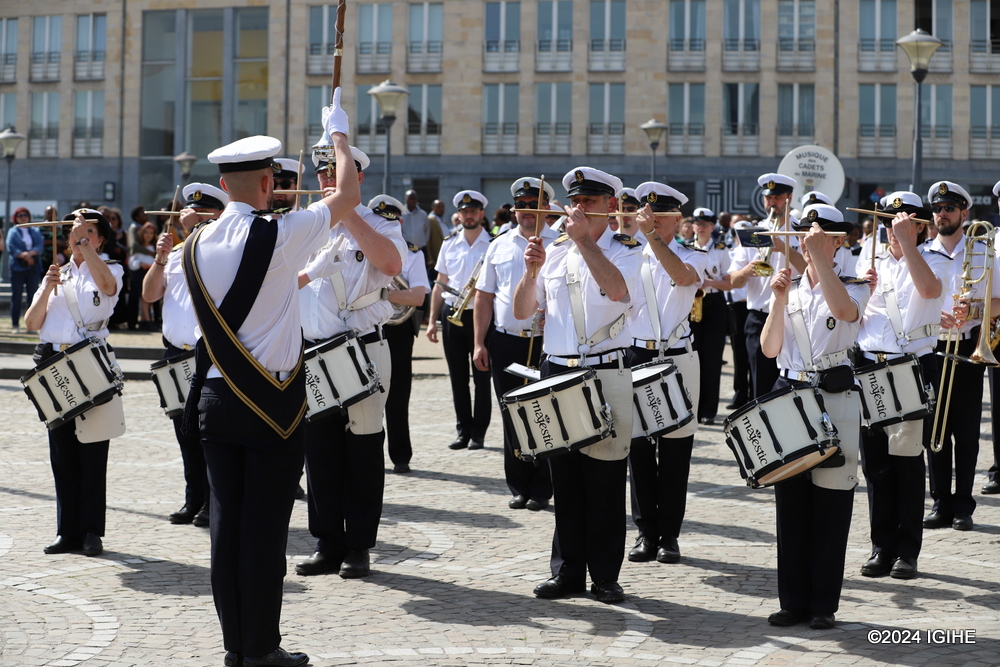
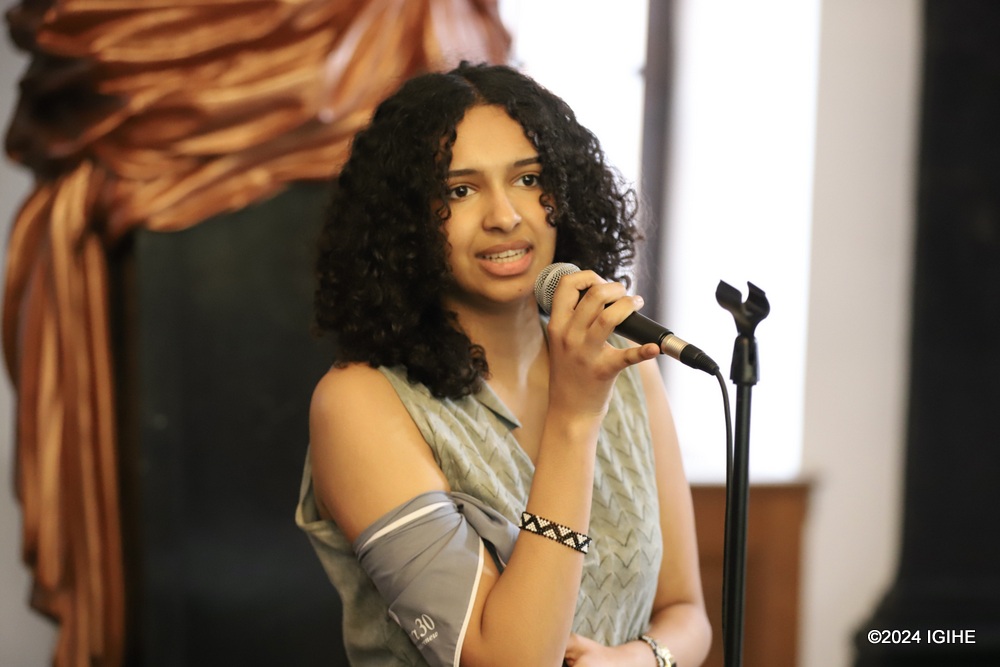
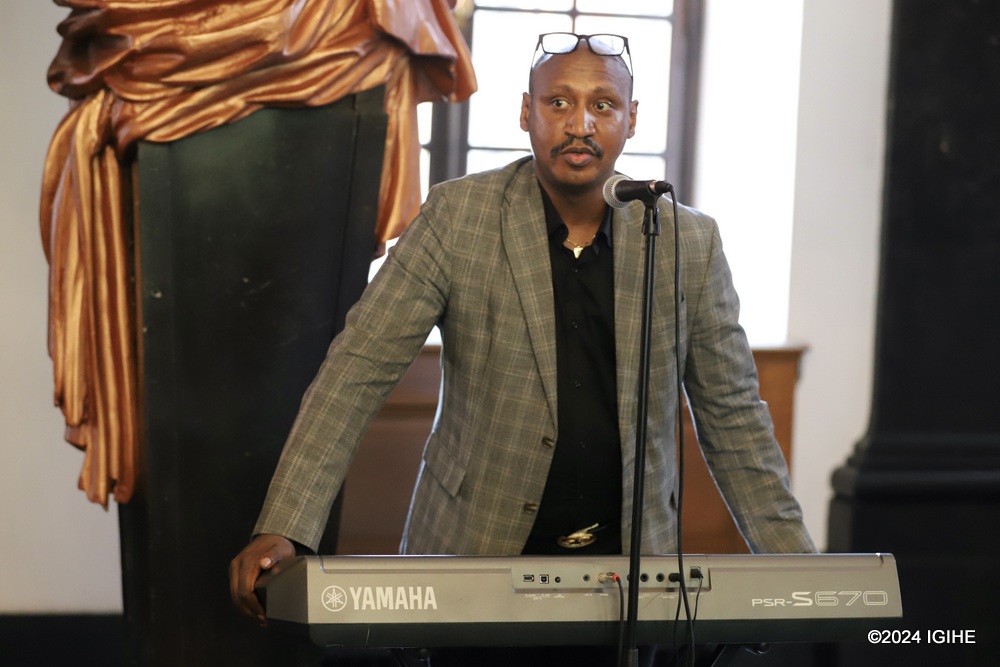
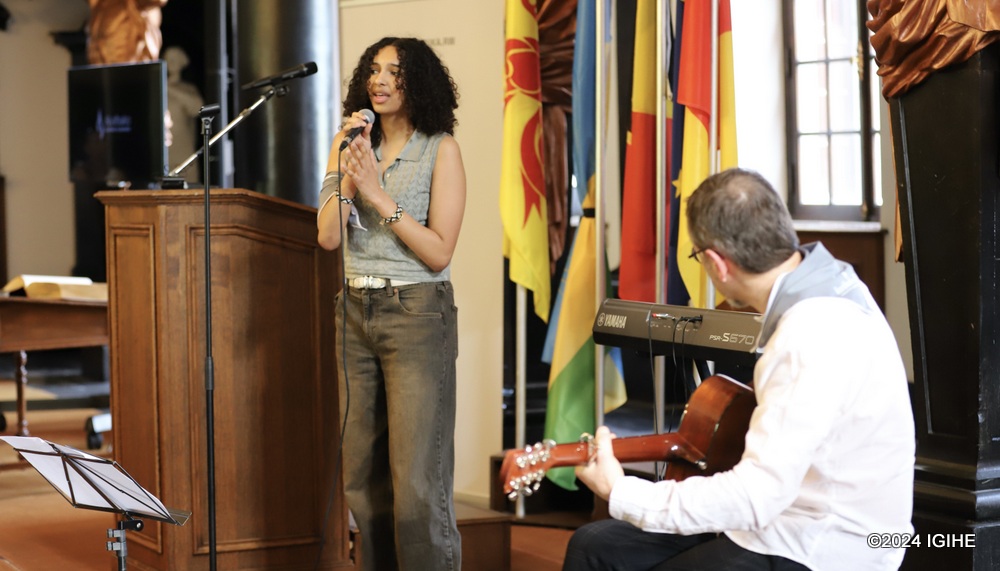
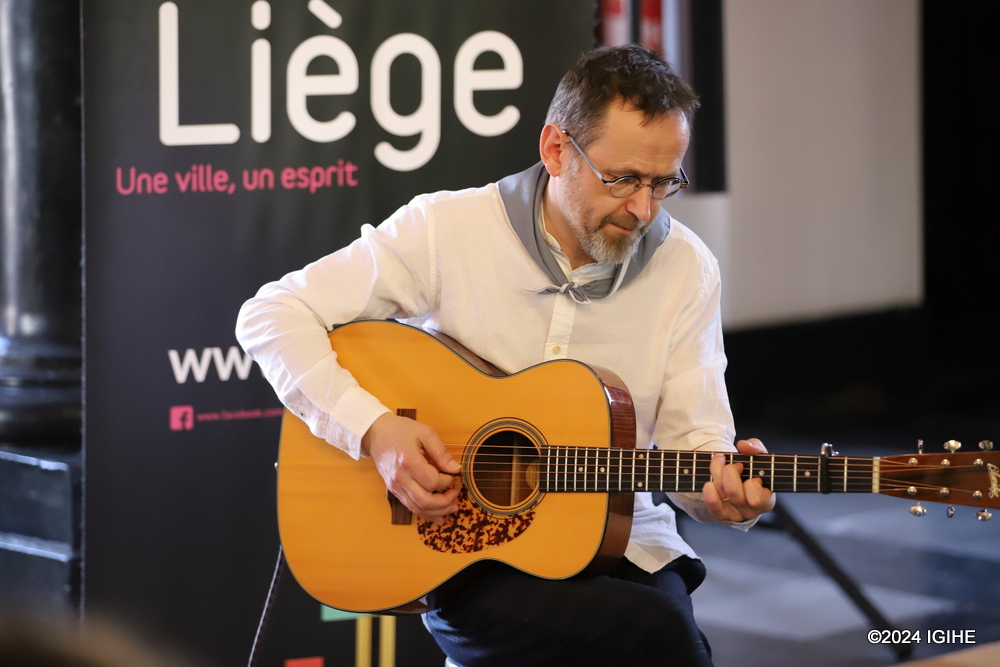
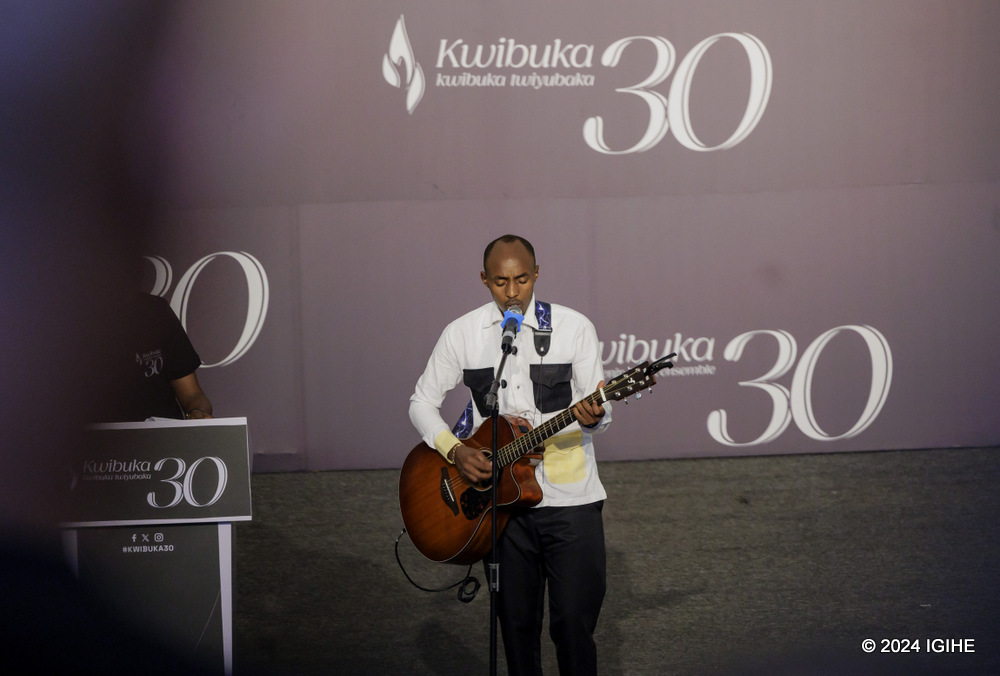
The commemoration was also enriched with cultural expressions, including musical performances by the Marine Cadet Music ensemble and poetry readings, adding emotional depth to the occasion.
With the introduction of the testimonial book “Un génocide en héritage” to the public, the event served as an essential educational tool, reminding the world of the harsh realities faced by survivors and their unyielding spirit.
{{Walk to remember and laying of wreaths at the memorial}}
The witness stated that they knew Bomboko before 1994 and often saw him with the leaders of the Interahamwe.
He revealed that he frequently observed them holding many meetings as they planned the Genocide against the Tutsi, boasting about it everywhere.
When asked about the guns it was claimed Nkunduwimye possessed, the witness confirmed seeing him with a small gun and a Kalashnikov.
He told the court that during their evacuation, they were transported in a Red Cross vehicle as if they were injured, and they particularly struggled at a checkpoint led by Bomboko, as he stopped them and held them up for a long time.
When the prosecutor asked if he knew which party Bomboko belonged to, the witness replied that he was in the MRND.
He described Bomboko as part of what they called the ‘Death Squad’ because he was more extreme than the Interahamwe.
The prosecutor then asked how it differed, to which he responded that the Death Squad was a group of selected killers tasked with murdering Tutsis, and they did so cruelly.
He said, “The Interahamwe manned the checkpoints, they would participate in attacks and kill, but there was a special group trained to kill many people and to do so cruelly.”
The witness noted that during the 30th commemoration of the genocide against the Tutsi, Bomboko was often mentioned as one of the leading figures in its execution.
Another witness, aged 64, said they worked for the United Nations and had survived at the Hotel Milles Collines.
Asked about people who frequented the Hotel Milles Collines during the genocide, he mentioned that among those he saw was Emmanuel Nkunduwimye. He observed Bomboko in the Hotel Milles Collines at least eight times.
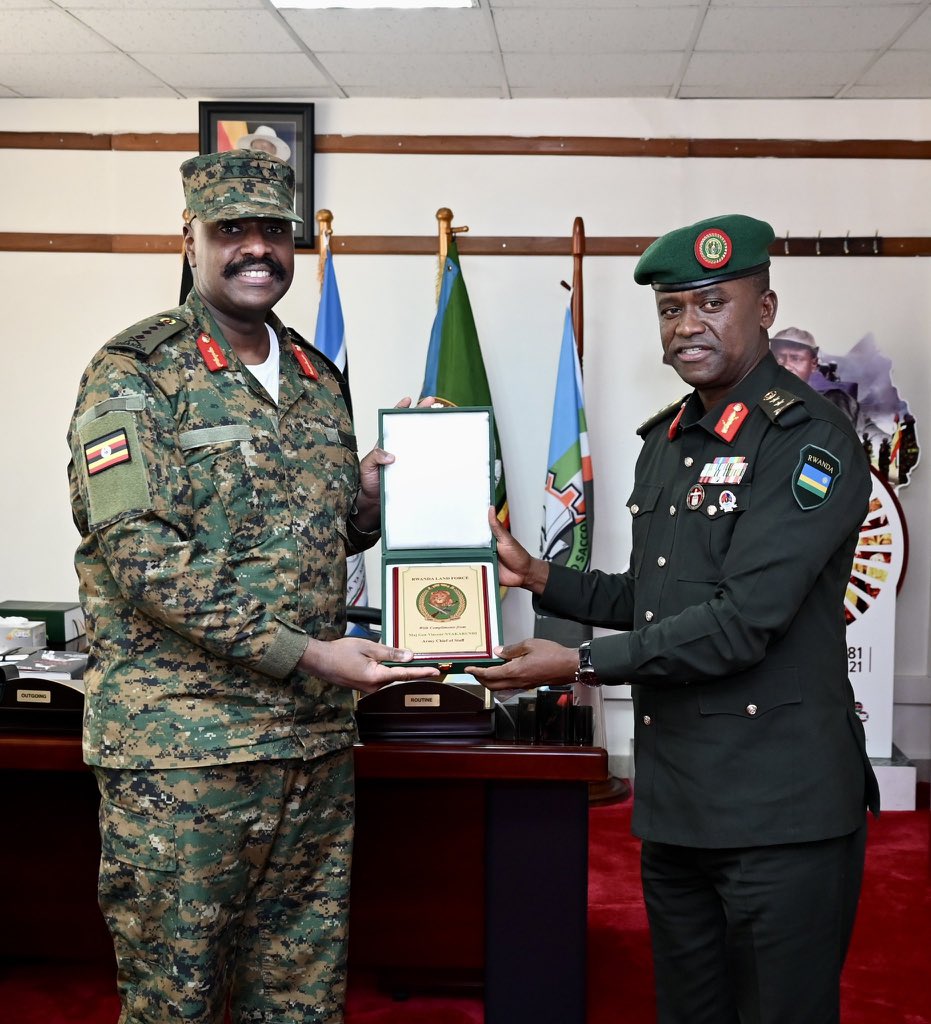
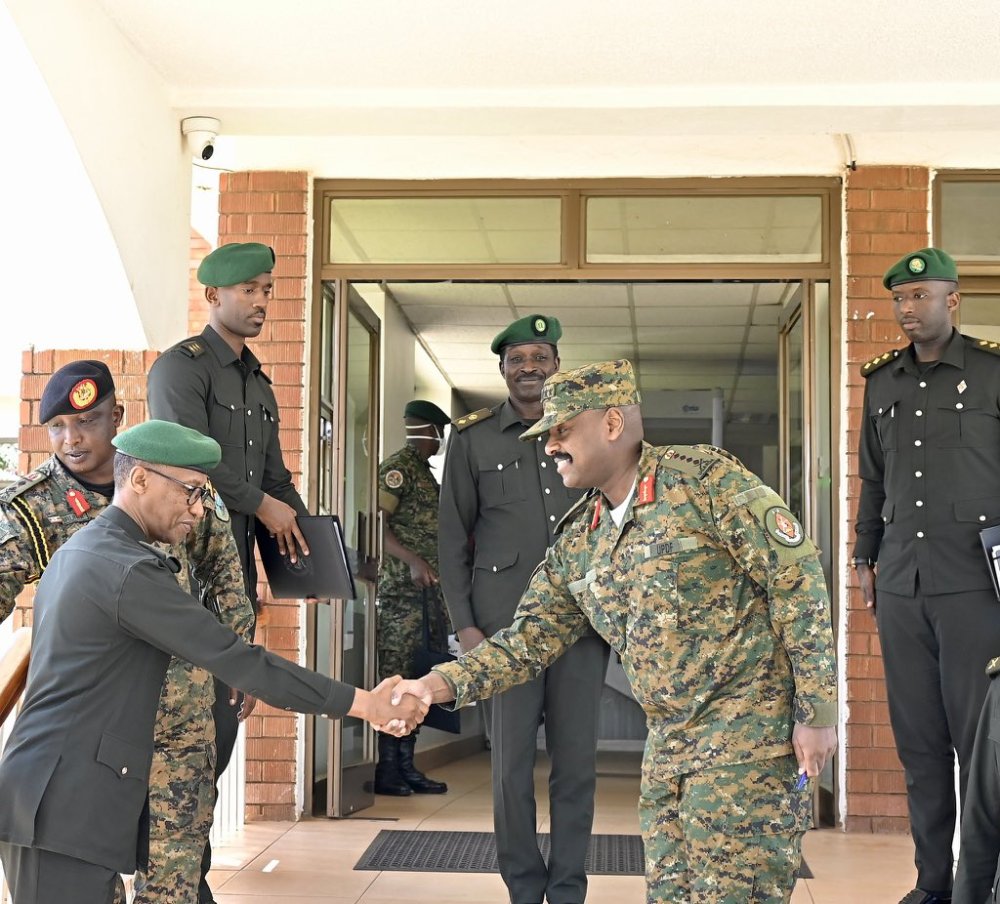
A team of five Rwandan soldiers was welcomed by General Muhoozi and the Director of Ugandan Military Intelligence, Major General James Birungi, at the military base in Mbuya on April 17, 2024.
They discussed the cooperation between the armies of both countries as well as regional security, particularly concerning the ongoing conflict in the eastern Democratic Republic of Congo.
General Muhoozi received the Rwandan soldiers shortly after nearly a month of being appointed the Chief of Uganda’s Defence Forces, succeeding General Wilson Mbasu Mbadi.
When relations between the two countries were previously strained, General Muhoozi played a significant role in revitalizing them in early 2021 by visiting Rwanda, which proved fruitful as it restored good relations.
The son of President Yoweri Museveni often emphasized that Rwanda and Uganda are brotherly nations, and thus should trade and visit each other without hindrances.
He also stated that cooperation should not stop there but that the militaries should also collaborate to address security threats to them and the region.
General Muhoozi last visited Rwanda in April 2023, where President Kagame and Mrs. Jeannette Kagame hosted him at a dinner to celebrate his birthday.
At that time, President Kagame thanked him for his role in rejuvenating the relationship between Rwanda and Uganda.
He said, “We see peace between our countries. You can have peace without being friends, but now I think we have both. We are friends and we have peace. Thank you, General Muhoozi, for your role in this, for being the bridge that connected both sides.”
In 2022, when General Muhoozi celebrated his birthday, he invited President Kagame to the festivities in Kampala, Uganda, marking a significant symbol of the restored relations between Uganda and Rwanda.
Combining cutting-edge technology, exceptional performance, and luxurious comfort, the new Teramont sets a new benchmark in the SUV segment.
Commenting on the development; Niels Wichmann, Brand Director, Volkswagen Passenger Cars said, “Volkswagen is thrilled to introduce the new Teramont into our model range in Rwanda. With its dynamic performance, cutting-edge technology, and versatile design, the Teramont sets a new standard for premium SUVs.”
The new Teramont boasts a spacious and luxurious interior, featuring premium materials, ergonomic design, and state-of-the-art connectivity options. The Teramont Trendline comes standard with electronically controlled air conditioning system and auxiliary heater, leather wrapped multi-function steering wheel including a Multi-colour Digital Cockpit, App-Connect and a Mobile phone interface.
The Trendline offers a host of innovative features designed to enhance both performance and comfort. From its regenerative braking system to its advanced safety technologies such as Anti-locking Brake System (ABS), Electronic Stability Programme (ESP) with trailer stabilisation, rear view camera system, LED headlamps including the Electromechanical parking brake with Auto hold and hill hold assist, every aspect of the Teramont is engineered to provide a seamless driving experience.
Park Distance Control, Seat trim covers in leatherette, power seats in front with seat heating and driver seat memory feature including multi-function steering wheel, Discover media navigation system and LED headlamps with cornering lights are some of the features that come standard on the Highline.
“Our goal with the Teramont was to design a vehicle that not only excels in performance but also prioritises the comfort and convenience of its occupants. With its refined design, advanced technology, and unparalleled driving dynamics, the Teramont redefines the SUV segment,” concluded Wichmann.
The new Teramont is available in two trim options: the Highline, equipped with a 2.0-liter TSI engine producing 162 kW of power and 350 Nm of torque, and the Trendline, featuring a 3.6-liter FSI V6 engine delivering an impressive 206 kW of power. Both variants come with an 8-speed automatic transmission and a 4MOTION four-wheel-drive system. According to the management, pricing will be available closer to launch even though dates have not been disclosed.
{{Photos of the new Teramont to be introduced in Rwanda}}
This message was part of Richard Collins’ address to the youth, urging them to learn from history and keep in mind their country’s expectations of them.
This came during an event on Wednesday, April 17, 2024, when employees of Kigali Marriott and Four Points by Sheraton Kigali commemorated the 1994 Genocide against the Tutsi at the Kigali Genocide Memorial in Gisozi.
“The progress of a country is in the hands of its youth. Particularly the youth in Rwanda, because they are truly remarkable. I travel extensively, but what I’ve seen among the young people here working towards advancing their country, exceeds their self-interest,” Richard stated.
“This is my fourth year visiting the Memorial, and what constantly amazes me is how forgiveness, unity, and resilience have characterized the Rwandan people and how they have learned from their history to reach a better place,” he added.
The event featured a testimony by Dusenge Dahlie Arlette, who works at the Kigali Marriott Hotel. She shared with her colleagues how her parents were killed, how she survived a machete wound to her cheek and also discussed her journey of rebuilding, supported by organizations established for survivors.
Pastor Antoine Rutayisire, who spoke at the event, noted that remembering also means recognizing the divine intervention that saved them, the soldiers who sacrificed themselves to stop the genocide being perpetrated against the Tutsi and those who saved others. He also recalled the poor leadership that led Rwanda into a profound tragedy, “From which many lessons were drawn,” and hailed the leadership that moved Rwanda beyond those dark times.
He added, “Let’s respect everyone we meet everywhere. Remembering is also about becoming better people, distinct from who we once were. You, the new generation, learn from our mistakes and do not repeat them, which is why we remember and provide you with detailed information about what happened.”
The senior management of Kigali Marriott and Four Points by Sheraton Kigali announced that in their ongoing efforts to rebuild Rwanda, they are committed to transforming the country into a tourism hub, encouraging investment, and contributing to its economy through job creation.
President Ruto, in a press statement on Thursday night said, Ogolla was among nine people killed in the crash that occurred at around 2:20 pm. There were two survivors in the crash.
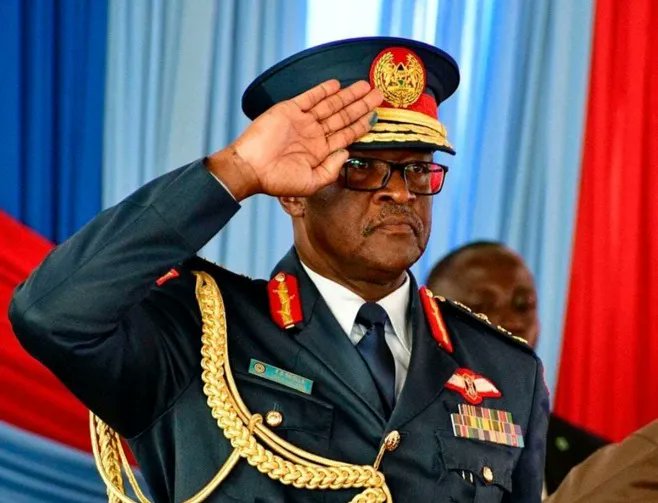
“I am deeply saddened to announce the passing on of General Francis Omondi Ogolla, the Chief of Kenya Defence Forces,” President Ruto said.
“The Chief of Defence Forces onboard the Kenya Airforce helicopter had left Nairobi in the morning to visit troops deployed in the North Rift under the operation Malisha Uhalifu and to also inspect the ongoing school renovation works in the region,” he added.
The chopper crashed before bursting into flames, killing Ogolla and the eight military personnel shortly after takeoff from Chesegon in West Pokot for the Recruits Training School in Uasin Gishu County, where he was scheduled to inspect ongoing construction works.
“This is a very sad moment for me as the commander in chief of defence forces. It’s a tragic moment for the KDF fraternity and it’s a most unfortunate day for the nation at large,” President Ruto stated.
He said a team of investigative officers from the Kenya Air Force has been dispatched to probe the cause of crash, even as he announced a three day of national mourning in honour of the fallen General.
Other soldiers who perished in the crash include Brigadier Swale Saidi, Colonel Duncan Keittany, Lieutenant Colonel David Sawe, Major George Benson Magondu (Pilot), Captain Sora Mohamed, Captain Hillary Litali, Senior Sergeant John Kinyua Mureithi, Sergeant Cliphonce Omondi, and Sergeant Rose Nyawira.
“I convey my deepest condolences to all families that are grieving this untimely loss, and our mourning nation as well. I also wish quick recovery to the two injured soldiers in this accident who are now in accident,” stated the President.
Gen. Ogolla’s death comes nearly a year after he was sworn in as Kenya’s military boss on April 29, 2023.
He took over the CDF mantle from Gen. Robert Kibochi whose term ended after 44 years in the military.
Prior to assuming the CDF role, Ogolla served as the Commander of the Air Force and Vice Chief of Defence Forces.
Gen. Ogolla joined the Kenya Defence Forces on April 24, 1984. He was commissioned as 2nd Lieutenant on 6 May 1985 and posted to Kenya Air Force.
He trained as a fighter pilot with United States Air Force (USAF) and as an instructor pilot at the Kenya Air Force (KAF).
The late military boss also trained in other fields including imagery intelligence, counter terrorism and accident investigation.
He rose through the ranks to become a Major General and was appointed as the Commander of the Kenya Air Force on July 15, 2018, a post he held for three years before former President Uhuru Kenyatta promoted him to the rank of Lieutenant General and appointed him as the Vice Chief of Defence Forces.
Previously, he held various appointments in Training, Command and Staff including Deputy Commander Kenya Air Force, Base Commander Laikipia Air Base, Commanding Officer of Tactical Fighter Wing, Chief Flying Instructor at Kenya Air Force Flying Training School and Operations Desk Officer at Kenya Air Force Headquarters.
He also served in the former Yugoslavia as an Observer and Military Information Officer from 1992 to 1993, as chairman of Military Christian Fellowship from 1994 to 2004 and co-Chair of Association of African Air Chiefs between 2018-2019.
The late army General is survived by his wife Aileen, two children and a grandson.
The Lords have insisted on amendments to the Bill that declare Rwanda a safe country, despite the members of the House of Commons overturning proposals put forth in the Bill on Tuesday.
Some of the amendments the peers are pushing for include the exemption of agents, allies, and employees of the UK overseas, including Afghans who served alongside British soldiers, from the scheme and the condition that Rwanda would not be declared safe until a report is completed.
They are also seeking amendments to ensure that the Bill complies with domestic and international law, including human rights and modern slavery legislation, and to ensure that the scheme allows appeals based on safety.
The MPs are now expected to vote on the peers proposals next week on Monday.
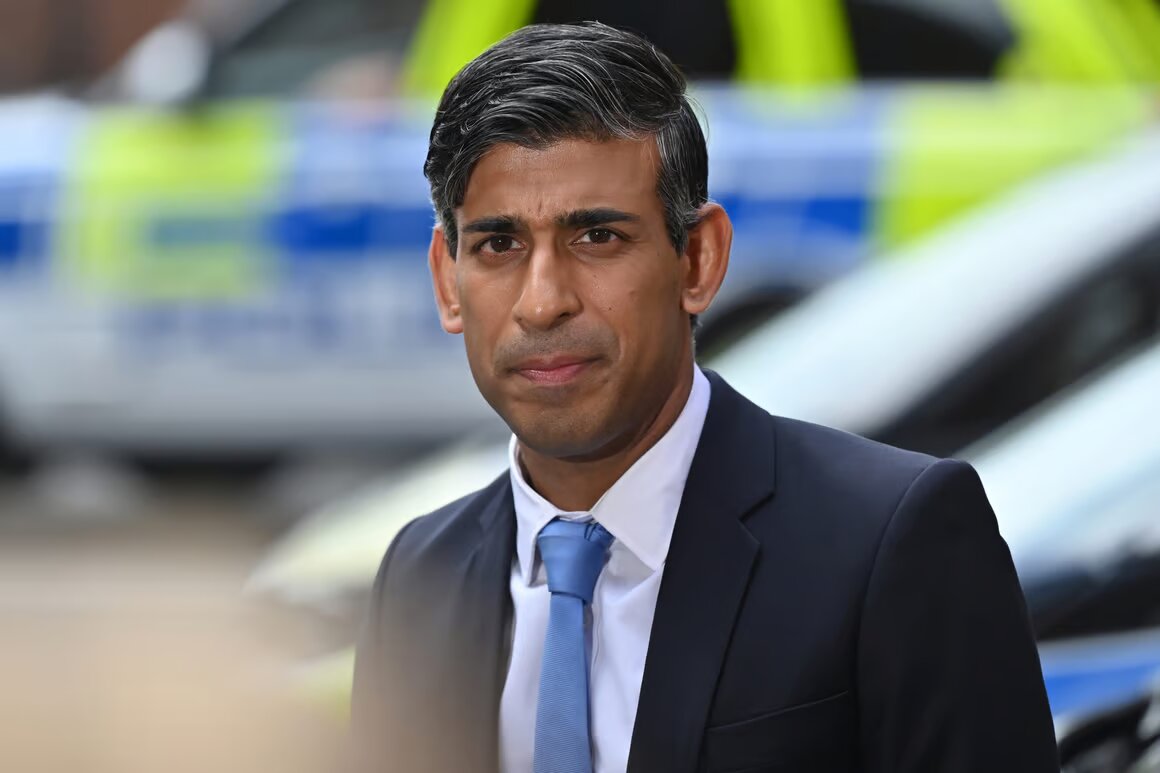
UK Prime Minister Rishi Sunak had hoped that the Bill would be passed on Wednesday to pave the way for the first flight to depart to Rwanda.
The Labour party, accused by Sunak of derailing the scheme, had opposed rushing it, stating that flights should not take off until a committee of experts, set up to monitor the scheme, determines that Rwanda has fulfilled certain safety standards.
The scheme, first announced in April 2022 by former Prime Minister Boris Johnson’s government following a deal with Rwandan authorities, seeks to act as a deterrent to persons arriving in the UK on small boats across the English Channel.
The Bill was introduced to Parliament after the UK Supreme Court ruled that the government’s scheme was unlawful.
The judges argued that genuine refugees being removed to Rwanda faced the risk of being returned to their home countries, where they could face harm.
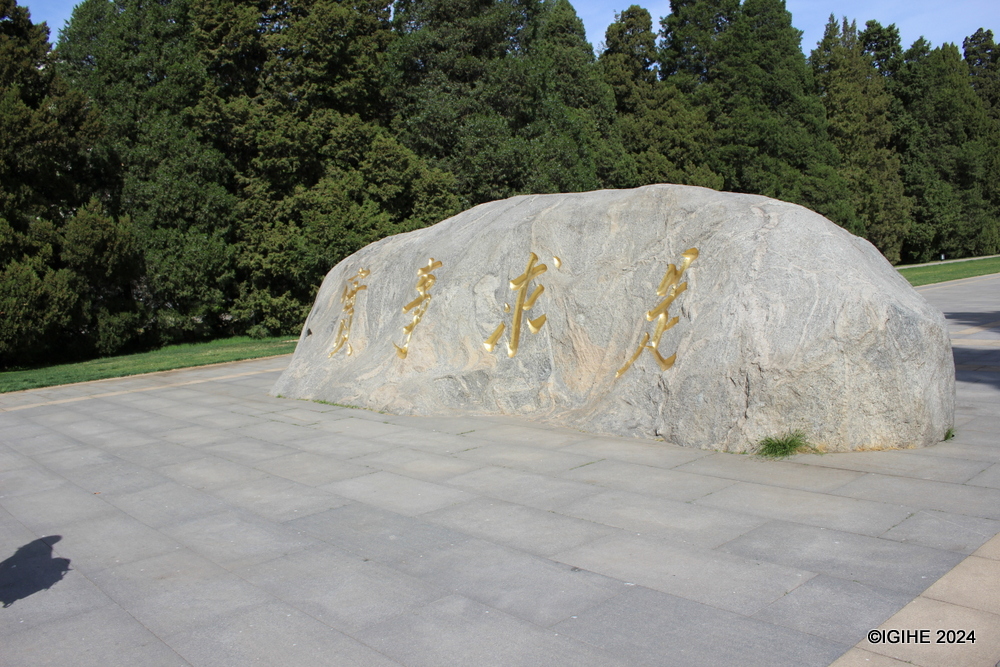
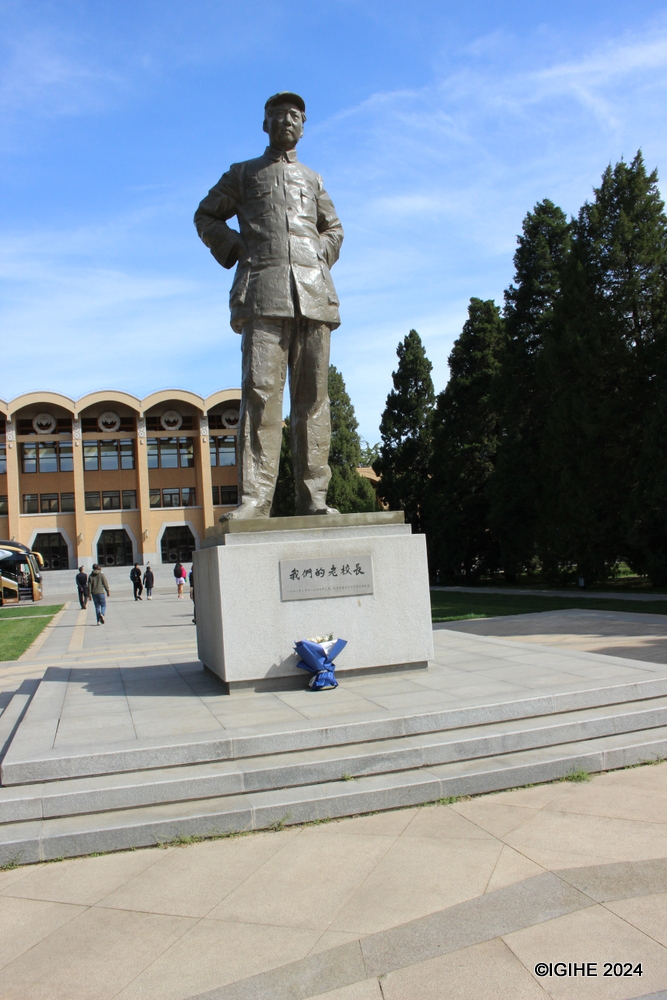
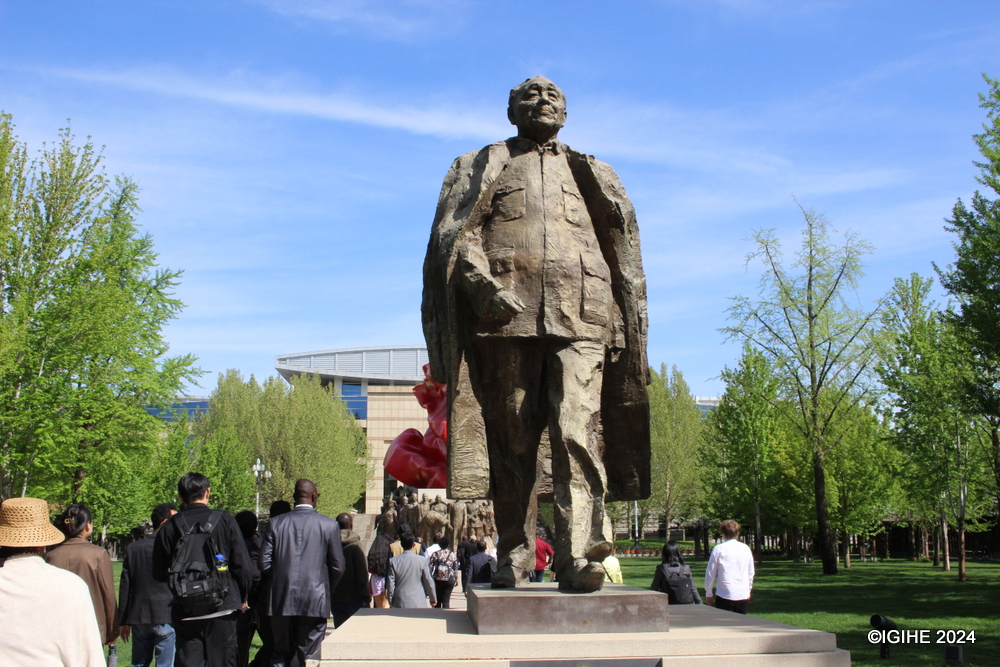
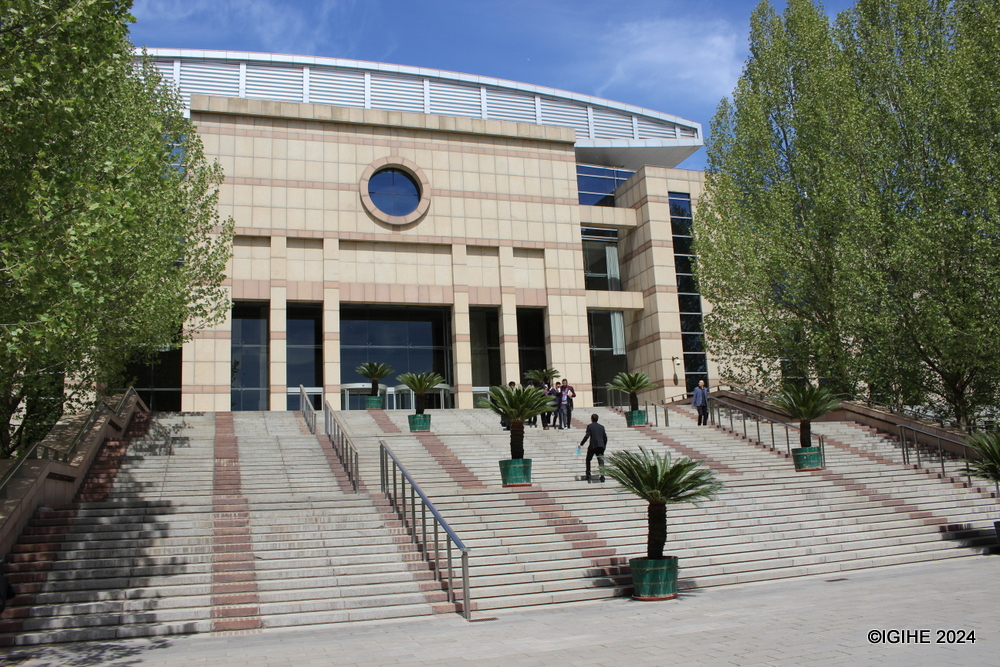
Initially founded as the Marxist Communist School in Ruijin, Jiangxi, in March 1933, the academy has experienced numerous evolutions, mirroring the ever-changing political landscape of China. By 1935, during the historic Long March north, it was renamed the Party School of the Central Committee of the Communist Party of China.
Following a period of dormancy during the Cultural Revolution, the school not only recovered but also broadened its educational reach and influence, culminating in its renaming in 1994 as the National School of Administration.
A major organizational transformation occurred in 2018 when the Central Committee of the Party merged the functions of the Central Party School and the National School of Administration.
This merger was a strategic move intended to unify the training of China’s civil servants and policy analysts within a single framework. Presently, the academy operates as a dual facility—functioning both as a traditional party school and a contemporary administration school, thereby preserving its historical significance while addressing modern governance challenges.
The primary mission of the academy is multi-dimensional. It acts as the chief venue for training provincial and ministerial-level leaders, executives of major state enterprises, and university presidents, among others. Its curriculum is expansive, covering Marxist-Leninist theory, Mao Zedong Thought, Deng Xiaoping Theory, the “Three Represents,” the Scientific Outlook on Development, and notably, Xi Jinping Thought on Socialism with Chinese Characteristics for a New Era.
On March 1, 2023, during the 90th anniversary celebrations of the Central Party School, General Secretary Xi Jinping emphasized the institution’s foundational goal—to educate and serve the Party, playing a crucial advisory role in national governance. His address highlighted the school’s ongoing dedication to ideological education, theoretical research, and the broader goals of Party development.
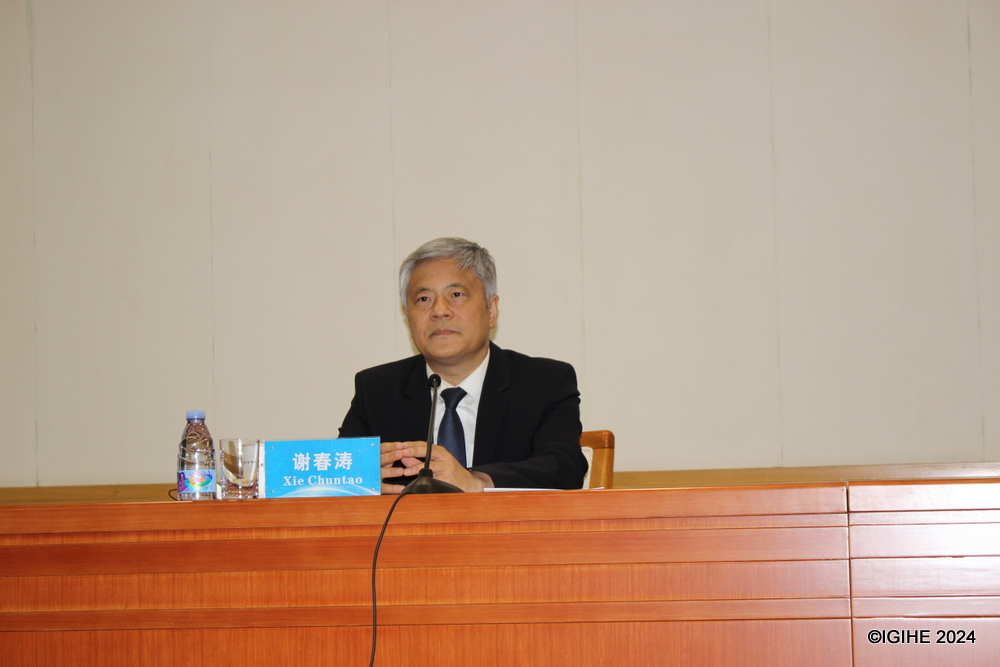
During a press conference on April 15, 2024, the academy’s Vice President responsible for daily operations, Xie Chuntao, accentuated its function as a think tank and its international influence, noting engagements with foreign dignitaries eager to gain insights from China’s governance model.
Chuntao emphasized the significance of effective governance and China’s advancements in fostering a strong governance framework marked by consultative democracy and judicial reforms to improve accountability.
Notable legislative advancements, such as the elimination of agricultural taxes in 2016, demonstrate the tangible impact of the academy’s training programs on policy formulation. The academy also promotes inclusion and representation within China’s legislature, ensuring that a variety of perspectives are considered and that governance remains attuned to the populace’s needs.
China’s advancements in regional autonomy and ethnic integration, guided by President Xi Jinping, further highlight the successful governance strategies derived from the Party School’s teachings.
This comprehensive approach to governance ensures that all 56 officially recognized ethnic groups in China support one another in creating a diverse yet cohesive economic and social framework.
The influence of the Party School extends beyond China’s borders, with its initiatives under the Belt and Road Initiative (BRI) enhancing international cooperation and creating development opportunities for numerous participating countries.
The BRI has become a pivotal element of global economic collaboration, involving 151 countries and encompassing nearly 75% of the global population. By 2040, it is projected to increase global GDP by $7.1 trillion annually, substantially improving international trade by addressing infrastructural deficits.
More than 50 African nations have benefited from Chinese-led projects, including the construction or enhancement of over 10,000 kilometers of railways, nearly 100,000 kilometers of roads, about 1,000 bridges, and 100 ports, leading to better infrastructure, reduced unemployment, and expanded trade opportunities.
China’s governance strides are also mirrored in its economic performance. In 2023, China recorded a GDP growth of 5.2 percent, reaching a total of 126 trillion yuan (approximately $17.67 trillion), reaffirming its position as a major global economic powerhouse.
With more than 98 million members and growing, the Communist Party of China continues to steer the nation under the steadfast leadership of President Xi Jinping, with the ambition to exceed 100 million members.
The Party School, at the core of this monumental effort, remains steadfast in its founding mission, adapting to the needs of a new era and contributing to the creation of a modern socialist country and the great rejuvenation of the Chinese nation.
To share with the world the events of the genocide and honor the over one million victims who perished, she authored a book titled ‘Don’t Accept To Die’.
The book encompasses various sections, detailing life before the genocide, the onset of the atrocities, the execution of the genocide, and the targeted killing of the Tutsis.
Moreover, she reflects on the aftermath in the book, exploring how survivors coped, rebuilt their lives, and the ongoing challenges the country faced.
“In the book’s second section about the Genocide against the Tutsi, I depict how we, as residents, witnessed its planning yet felt helpless to intervene. It covers the genesis and execution of the genocide, culminating in a recount of my personal ordeal,” she noted.
In her writings, Mukanyiligira revisits the harrowing experiences she endured during the Genocide, including how she concealed herself, narrowly escaped assassination, and ultimately survived. She recounts her encounters with the Inkotanyi and their role in liberating the country.
Even after surviving the Genocide against the Tutsi, Mukanyiligira remained vigilant, haunted by the fear of being pursued and expelled in broad daylight.
She expressed mixed emotions, stating, “There is happiness in survival, in the chance to live again. Yet, there is the deep sorrow and anger when recalling loved ones lost in an instant—seeking answers about their deaths, their last words. It overwhelms you.”
Mukanyiligira often questioned her faith, grappling with why she survived while many others did not, a burden that impeded her progress for a long time.
She shared, “There’s sadness and grief but also resolve. I am freed from these burdens; I set them aside. A renewed lease on life has been granted to me, to live well.”
Post-genocide, embracing life was a conscious choice, fueled by the losses she had endured.
Mukanyiligira had five siblings; during the Genocide against the Tutsis, she and two brothers survived while three were killed, partly because they were not at their home in Kibagabaga, in the current Gasabo District.
She reflects on this narrow escape: “It was an inexplicable chance. The killers had a list, and when they didn’t find someone at the house, it somehow gave us a chance to live, even though our cousins, who were visiting, and our parents were killed. Over 208 family members are remembered in this book.”
Accepting these events was challenging, but her faith in God remained central to her coping.
Furthermore, she clarifies her spiritual perspective, saying, “No priest or pastor manifested God to me; I faced a gun pressed to my cheek and survived. It wasn’t the Interahamwe militia; it was God’s plan.”
She added, “This experience reinforced my personal connection with God. I survived by His grace, and I trust that He will guide me through the rest of my days.”
{{Hiring Interahamwe}}
One month after the halting of the Genocide against the Tutsi, Mukanyiligira returned to her former home, only to find it reduced to ruins.
She discovered that her house had been destroyed, suggesting a grim reality for survivors: even those who escaped the killers would face immense challenges, partly as an attempt by the perpetrators to erase evidence.
Undeterred, Mukanyiligira persevered, intent on proving to those who had tried to exterminate the Tutsis that their genocidal plans had failed.
By 2001, as the situation began to stabilize, she found returning to Kibagabaga painful because the killers of her family were still there. This prompted her to settle in nearby Nyarutarama instead.
She expressed a poignant wish from that time: “I prayed that the Interahamwe from Kibagabaga would come and ask for work where I lived, as a form of silent revenge—without resorting to insults, violence, or wishing harm.”
“The house was flimsy, reflecting the poverty we Tutsis grew up in. For them to see that the child they couldn’t find in the bush is now building a big house and will employ them was a form of retribution.”
This approach served as a form of revenge for survivors of the Genocide against the Tutsis, aiming also to protect survivors from further exposure to their assailants.
Mukanyiligira noted that daily life for survivors involved working more efficiently, achieving more in less time, “so that if I were to die again, I’d leave a meaningful legacy.”
“There’s something profound about feeling like you’ve already died. It felt like we were living in an era of surplus, lacking essentials to sustain life. Choosing a man from five or six wasn’t based on anything substantial. If we were targeted again, at least we’d have justifiable reasons.”
Being successful, for Mukanyiligira, was not a matter of having a prominent job or coming from a powerful family; it was about her indomitable spirit and the progress she made, which nobody could hinder. This spirit fueled the reunification and empowerment of Genocide survivors.
Her determination led her and 150 others to establish IBUKA, aimed at fostering connections among survivors. “That spirit of unity and mutual support also permeated AERG, GAERG, AVEGA.
Surviving took immense effort, and we helped one another. These organizations provided a space to understand, accept, and uplift ourselves,” she said.
{{‘I Was There’}}
After the release of her book ‘Don’t Accept to Die,’ Mukanyiligira is now working on a new book titled ‘Nari Mpari,’ which translates to ‘I Was There.’ This forthcoming work emphasizes the theme that life follows death, and it explores both her personal growth and the country’s unprecedented development.
She explains, “I was there during the Gacaca courts, where murderers were forgiven. I witnessed everything that happened, everything the nation has accomplished. That’s why I’m naming it ‘I Was There.’”
Mukanyiligira highlights the responsibility of providing testimony and information to document the events, which demands not only resources, time, and skill, but also the delicacy of narrating without inflicting harm.
She reflects, “I embraced the pain because it was part of healing. After 28 years, there are memories that only resurface when recalled. But writing about them triggers something deeper, something necessary for the reader to understand. That’s when the wounds reopen.”
This book was penned during the challenging times of COVID-19. “There were nights when the echoes of past screams would surface as I wrote, reminders of the country’s tumultuous journey. Yet, I persevered because it is part of the healing process.”
Currently, the book is being translated into multiple languages, a task that Mukanyiligira says demands significant sacrifices, including time away from family and friends, but she sees it as essential to ensure that the story of what happened in Rwanda reaches a broader audience.
Following the initial English publication and last year’s French translation, a German version and an audiobook are now being prepared.
Reflecting on the past 30 years, Mukanyiligira stated unequivocally, “The fact that I survived and can honor the values of those who were killed feels like a debt I’ve managed to repay.”
She expressed gratitude towards the Inkotanyi for liberating Rwandans and for their efforts that went beyond building infrastructure like roads, hospitals, and schools.
They also transformed how Rwandans are perceived abroad, “because now when we go overseas, we are no longer seen as murderers, but as contributors to meaningful development.”
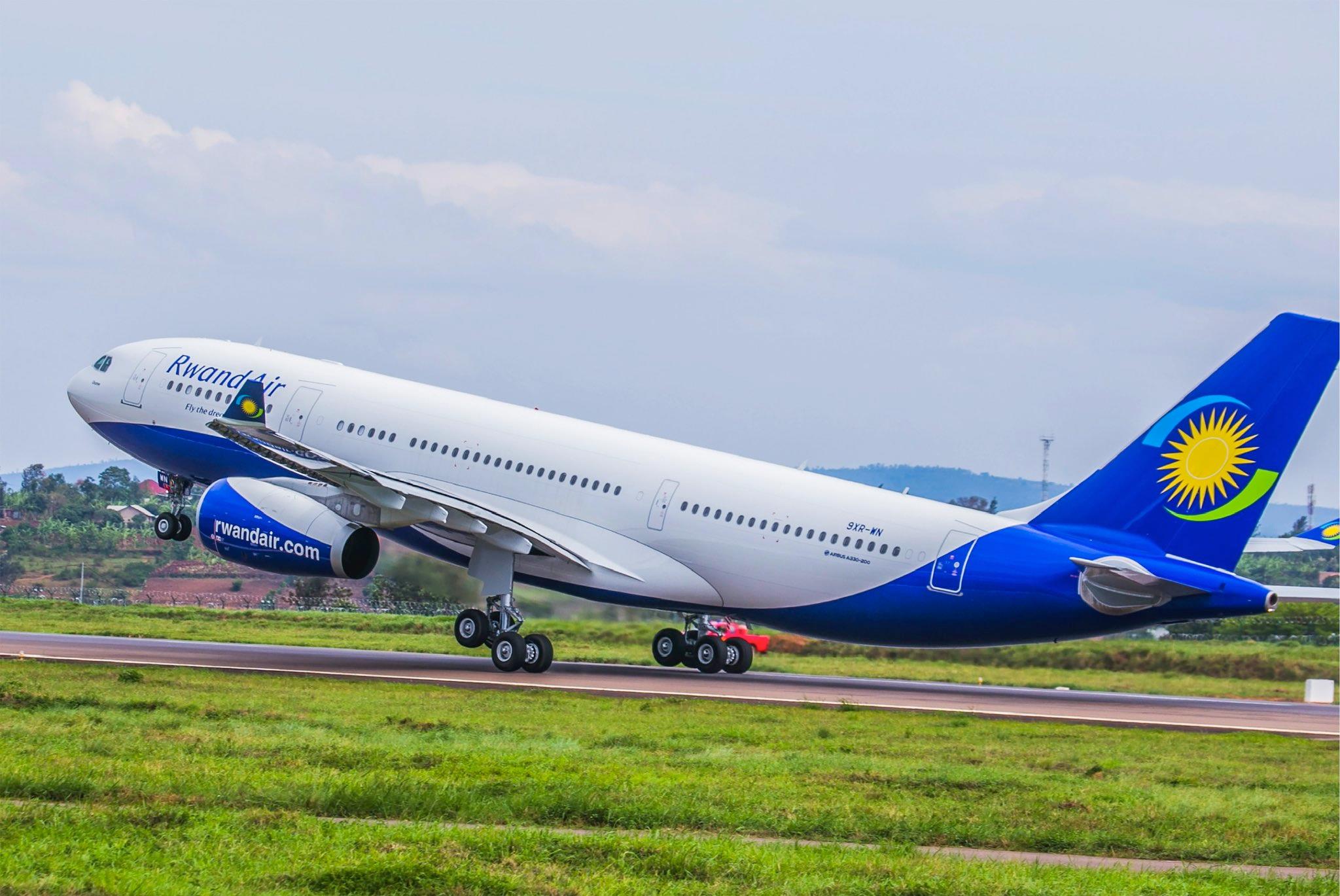
In a statement on Wednesday, April 17, the management urged the affected passengers to check their emails regularly for updates about the interruptions.
“Due to severe weather conditions in Dubai (DXB), we’re experiencing flight disruptions to and from Dubai. Passengers are advised to check their emails regularly for updates,” the airline stated.
This comes as heavy rains continue to batter Gulf States, leading to floods, including at Dubai International Airport, one of the world’s busiest airports.
Earlier on Wednesday morning, the airport authorities described the weather conditions as “very challenging,” urging passengers “not to come to the airport unless absolutely necessary.”
“Flights continue to be delayed and diverted. Please check your flight status directly with your airline. We are working hard to recover operations as quickly as possible in very challenging conditions,” the management added.
Kenya’s Kenya Aiways (KQ) and Fly Emirates are among airlines that have been forced to cancel flights due to heavy storms.
“We are monitoring the situation and are in close contact with Dubai authorities to minimise the inconvenience and disruption to our customers’ travels,” KQ said while announcing the cancellation of two flights on Wednesday.
Fly Emirates, while asking its customers to rebook their flights said, “Dubai customers with flights scheduled for today (17 April) are advised not to go to DXB, as check-in remains suspended for all flights. Your safety is our top priority.”
At least 18 people have been reported dead due to the floods in Oman, even as weather forecasts predict further storms across the United Arab Emirates (UAE).
Schools across the UAE shut before the storms, with experts saying that the rains, which began on Monday, are equal to a year and a half’s worth of rain for the desert region.