Also known as Feast of Sacrifice or Big Eid, it is one of the two major festivals of Islam but considered the holier. The other is Eid al-Fitr which marks the end of Ramadan, the holy month of fasting.
Eid Al-Adha commemorates the Koran tale of Prophet Abraham’s willingness to sacrifice his son Ishmael but God offered him a lamb to sacrifice, ruling that no human life should be sacrificed in the name of God.
Among Christian and Jews communities, they believe that Abraham is ordered to sacrifice another son Isaac.
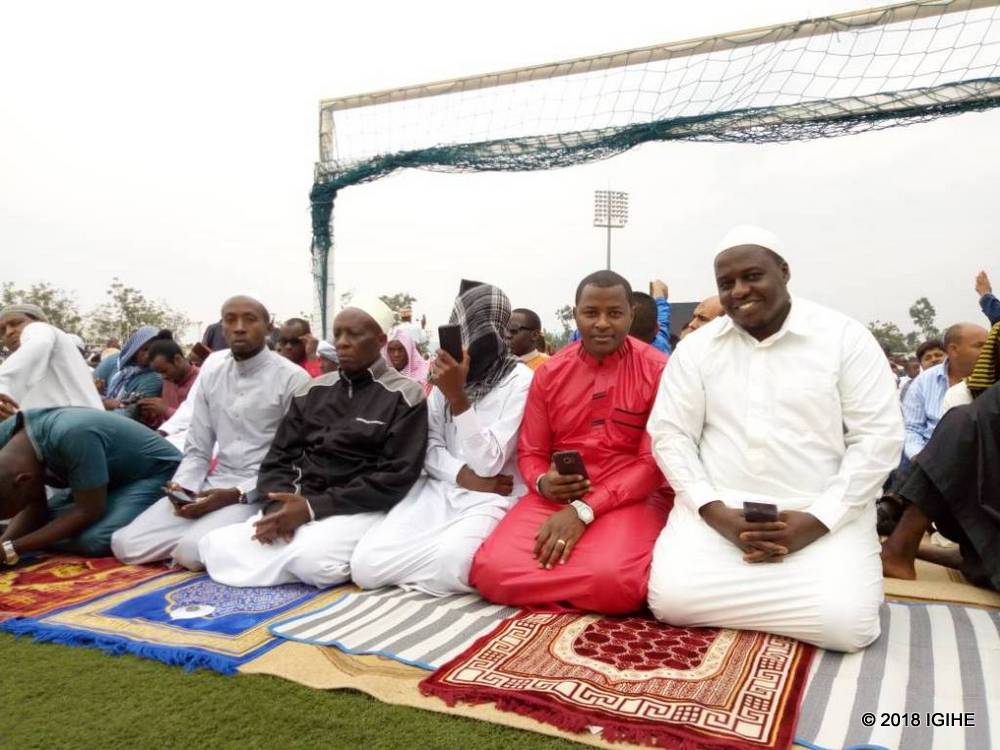
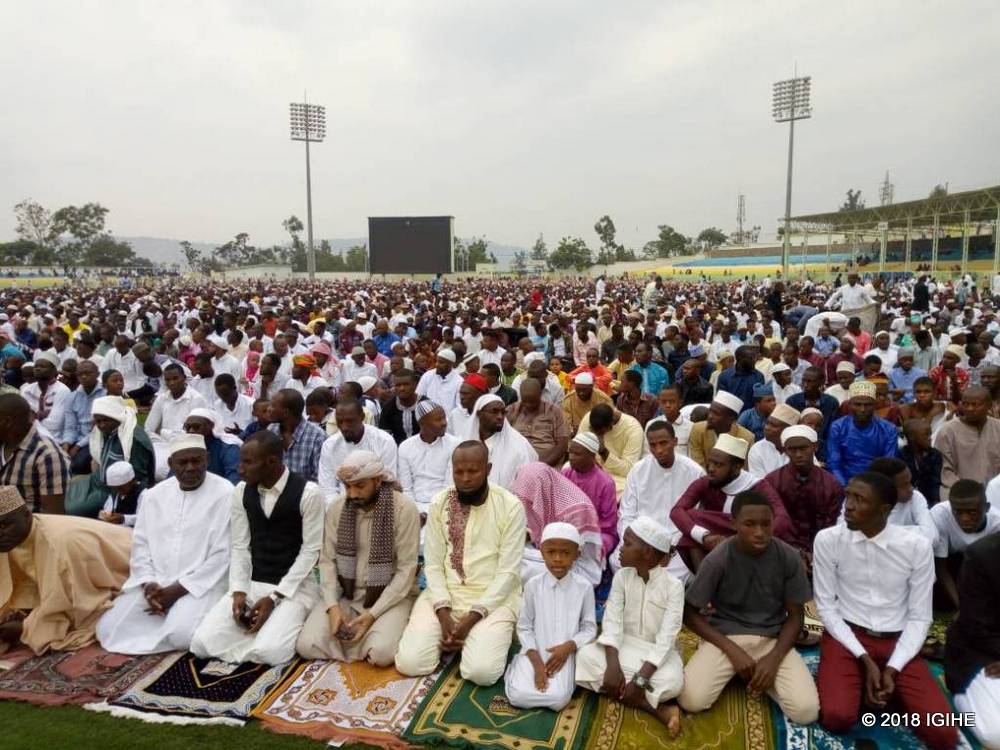
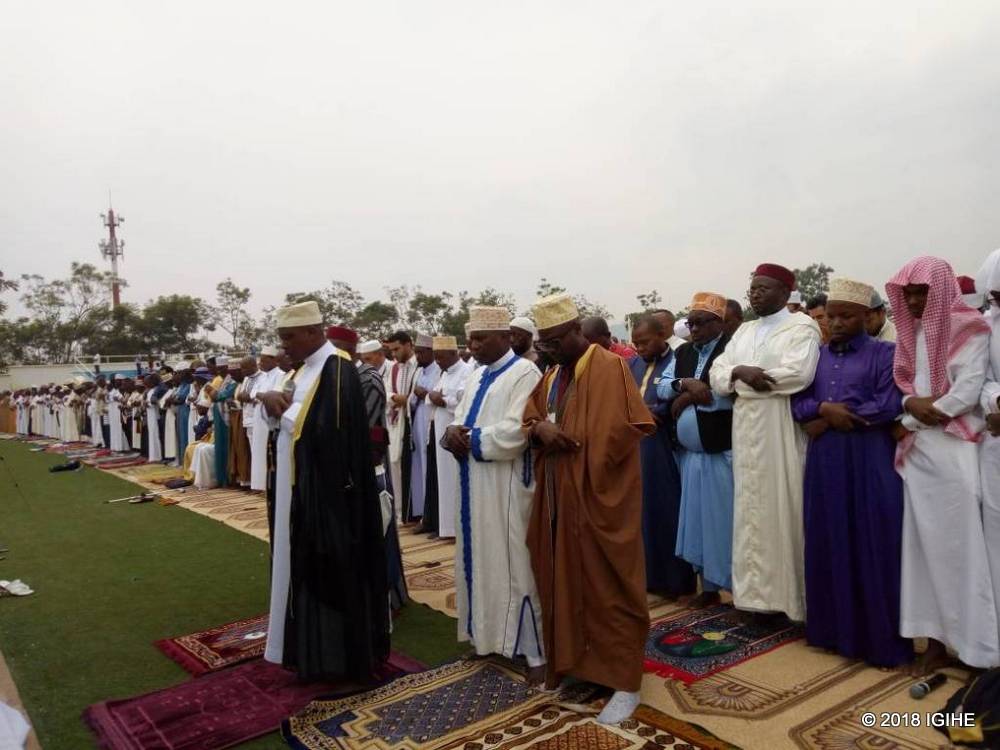
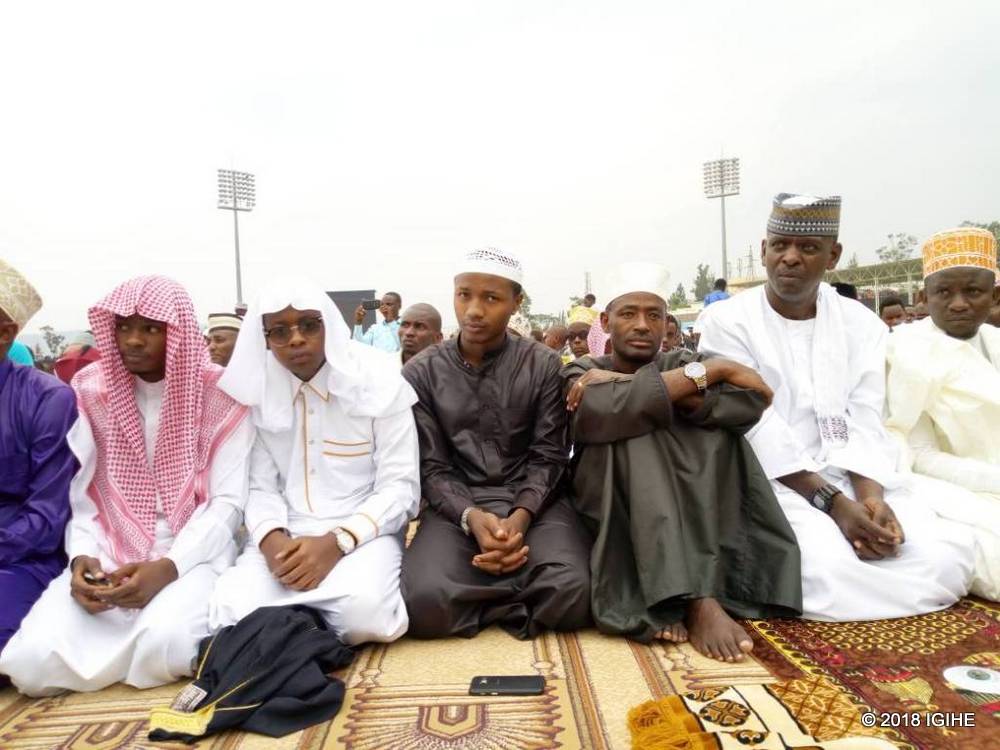
Rwandan Muslims have convened today at Kigali Stadium in Nyamirambo to offer prayers.
Eid al-Adha has come two days after the two million Muslims started annual Islamic pilgrimage in Mina and Mecca cities of Saudi Arabia.
The Holy pilgrimage started August 19 running until 26 with 79 Rwandans participating.
The Mufti of Rwanda, Sheikh Salim Hitimana, led the gathering in prayers at Kigali Stadium.
He encouraged the Muslim community to fight drugs especially among the youth and report drug dealers.
Mufti Hitimana also urged the congregation to play their role in bringing about upcoming parliamentary elections, come September 2-3.
Eid al-Adha compels all Muslims with means to slaughter cows, goats and other animals as sacrifice and distribute meat among disadvantaged around them.
Mufti Hitimana reminded all Muslims to share feasts with the vulnerable in observance of the sacrifice.
“This is a day of showing compassion and happiness that should always be reflected among the Muslims. You have to observe that, help the poor and share meals with them,” he said.
He said that Rwandan Muslims should not wait for foreign counterparts to give them animals to offer as sacrifice.
Today, Rwanda Muslim Community has offered as sacrifice 1,000 cows and 2,000 goats at the value of Rwf200 million.
Laurette Mugabo was part of the 2,000 young professionals convened for “Meet the President’ session at Intare Conference Arena in Kigali, Sunday.
The group of young people from across the country and the Diaspora presented a range of views and challenges to President Paul Kagame in an interactive session.
Ms. Mugabo said she had a problem about the ease of getting a job in Rwanda for the youth especially those from Diaspora.
“When we come here, it’s really hard to get jobs. If you don’t have connections, it’s technically hard to get them (jobs)… a connection of someone recommending you… a friend or relative recommending you,” she said.
“On top of my head, my older sister graduated from the University of Kansas and sat here for one and a half years until my mum had to pull a few strings, asked a few people.”
Mugabo said her sister applied for a job in different institutions including Rwanda Development Board recently where “they had to pull a few strings as well.”
The issue irritated President Kagame who said the nepotism must stop if it is the case in job recruitment.
“It sounds very bad to me. I want explanation about that,” said the Head of State.
Ingabire Marie Immaculée, the Chairperson of Transparency International Rwanda, has told IGIHE “what that young girl told the President is true, she wasn’t lying.”
The recruitment process in Rwanda starts with the institution announcing a job vacancy via internet platforms. Interested candidates apply and then sit for written and interview tests.
For application, people fill a form and send it to the recruiters via e-mail. The recruiting institution shortlists some candidates for tests.
Ingabire said there are gaps all along the recruitment process, making it possible for bribery and injustice. She says it starts with the job vacancy announcement and continues into tests.
“There was a case of a teacher who passed away in Gasabo District and the Sector’s Education Officer told the head teacher that they had found someone who wanted to pay Rwf300,000 to replace the deceased,” she said.
Angelina Muganza, the Executive Secretary of Public Service Commission, has told IGIHE that there are often problems in selecting candidates for the job tests.
The report of the commission indicates that among 23 issues identified in the country’s employment, some are about the recruitment of unqualified servants.
They also include malpractices in placing people in jobs before completing three years in their previous positions as required by the law.
Others were found in jobs without having presented the required academic documents.
“We cannot know why recruiters have chosen those servants but we tell those institutions that they were wrong in that recruitment,” said Muganza.
The commission also found cases where contracted recruitment consultants had close relationships with people who won the jobs, casting doubt on the recruitment.
The Presidential Order states that a candidate wins a job after securing 70% of the written and interview tests combined.
Muganza said they are reducing injustice in recruitment by avoiding candidates’ names on answer booklets and video-recording interviews during the tests.
Transparency International Rwanda suggests more efforts be put in encouraging people to report bribery as survey indicated in 2017 that graft was reported by only 15% of all who encountered the vice.
Nsengimana was attacked on Saturday night on his way home from work.
He stays in Gitega Sector of Nyarugenge District but the incident took place in Kimisagara Sector on the road to Gitega.
The Spokesperson of Rwanda Investigation Bureau (RIB), Modeste Mbabazi, told IGIHE yesterday that one suspect in the attack has been arrested as investigation continues.
Nsengimana said he was attacked when the motorbike he was riding got faulty with its tyre and three assailants attacked him with a spade and knives.
“I was on my home but the bike’s tyre got faulty nearby the petrol station in Kimisagara. I got off the bike to look for another one but all of a sudden someone beat me with a spade from behind and I fell down,” he said.
The father of four said two more gangsters followed stabbing him in the head.
He was later taken to Kimisagara Health Centre which later transferred him to CHUK referral hospital.
Nsengimana is known for his ‘Isoko y’Umunezero’ show on BTN.
The regional schools’ championship was running in Musanze District of the Northern Province from 10th to 20th August.
For the first time primary schools have participated in FEASSSA, Rwanda won nine medals. They include four gold, four silver and one bronze.
In this category, Uganda won one gold medal, one silver and three bronze. Kenya did not participate in primary schools’ category.
In general, Uganda dominated with 30 medals, Kenya took 28 while Rwanda won 25 medals.
{{Rwanda was hosting FEASSSA for the third time.
}}
Kenyan students maintained their top position in athletics in the region. Rwanda dominated in tennis and volleyball among girl and boy teams and in boys’ basketball.
Speaking at the FEASSA closing on Sunday, the State Minister in charge of TVET at the Ministry of Education, Olivier Rwamukwaya said the role of FEASSSA goes beyond competition on the pitch to become a way of strengthening relations among the regional countries.
“The games have been well played. Physical exercises play a vital role in the learning process. These games help children bring out their talents and build relations among our countries,” he said.
Father Innocent Gatete, the leader of Schools Sports Association in Rwanda, cautioned schools for using non-students players, saying measures have been taken to detect all the malpractices in the years ahead.
The progress has put the incumbent Minister Louise Mushikiwabo among the most 50 influential women in Africa.
The fame has also made her stand a chance to head General Secretariat of the Organisation Internationale de la Francophonie (OIF), generally known as La Francophonie.
Mushikiwabo has gathered support from France and 29 African countries, making her likely to win the top OIF position as the French speaking countries’ organisation counts 54 members.
She is now campaigning against the Canadian OIF incumbent Secretary General, Michaëlle Jean, for the elections slated for October 12 in Armenia.
If Mushikiwabo wins at OIF, she will have put end on her 10-year dockets in Rwanda’s Government. The 57-year was appointed Minister of Information in 2008 and took up the foreign affairs docket in December 2009.
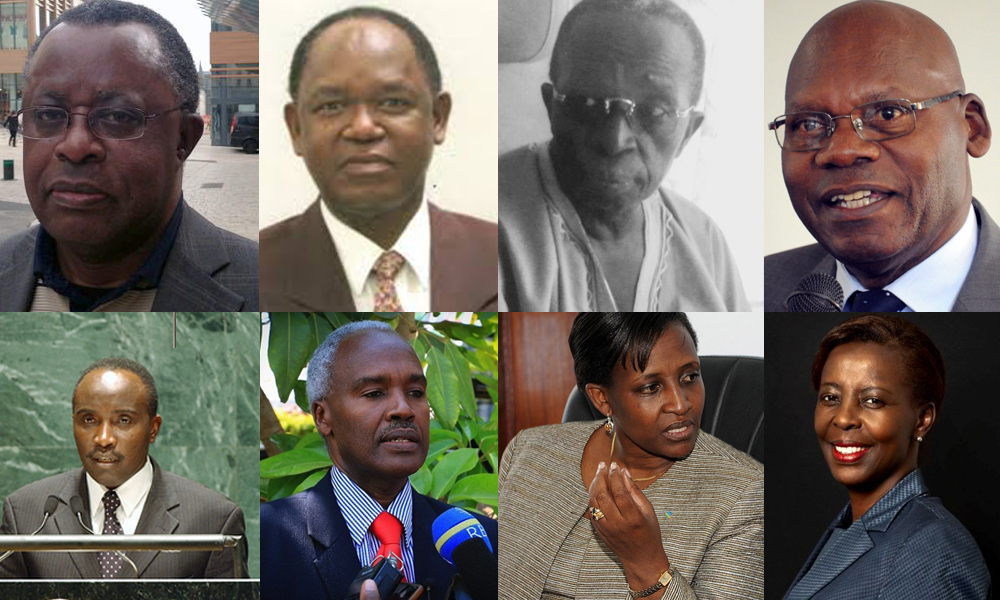
However, seven other foreign ministers preceded Mushikiwabo in the docket. IGIHE has looked back and compiled the contribution of each into the country’s foreign affairs over the last 24 years.
The compilation starts July 19, 1994 when the Government of Unity was instituted.
{{1994: Jean Marie Vianney Ndagijimana
}}
Jean Marie Vianney Ndagijimana was the first Foreign Minister in the interim government. He served for four months, running from July to October, before resigning and going into self-imposed exile.
President Paul Kagame once said part of the funds raised for liberation struggle was used to help leaders of the country to fulfil their duties after stopping the genocide.
The Head of State said Ndagijimana stole $200,000 that he had to use for opening embassies in different countries.
{{1994–1999: Anastase Gasana
}}
Dr Anastase Gasana was a lecturer of the University of Rwanda, served as Foreign Minister in 1993 and played role in Arusha Peace Accord between then Rwanda’s Government and Rwanda Patriotic Front (RPF).
Dr Gasana was appointed Minister for Foreign Affairs in November 1994.
At the time, Rwanda was struggling to step out of the genocide lens through which the world was looking at it. Building a working and firm system looked a dream at the time.
It was a very hard time for Rwanda’s diplomats. Regional and international media had all attention on what was going on in the country. Some were trying to shed light on the genocide while those with interest in genocide denial were trying to hide the truth.
For instance, Radio Agatashya that was broadcasting from then Zaire (now DRC), and then Human Right Watch Chief, Alison Des Forges, were fighting to have double genocide approved.
Minister Gasana served for four months at the time Rwanda was trying to bring back home over 3,000,000 refugees from Zaire. The tough diplomacy times continued to the time of the second Congo War.
{{1999-2008: Amri Sued, Dr Iyamuremye, André Bumaya and Dr Charles Muligande
}}
Amri Sued Ismail followed in the docket. Nothing much was said about the man who had first served as Ambassador to Egypt during the rule of President Pasteur Bizimungu.
He was succeeded by Agustin Iyamuremye who was Minister for Information before moving to foreign affairs.
In 2000, Iyamuremye was succeeded by André Bumaya who lasted longer than his predecessors. He led the country’s diplomacy until November 2002 when President Kagame appointed Dr Charles Murigande in the docket.
The three served during the second Congo War which spanned from 1998 to 2003 in which Rwanda was fighting rebels in the Eastern DRC.
During Dr Muligande tenure, media was probing if Rwandan troops were fighting in DRC. He was succeeded by Rosemary Museminari in March 2008.
{{2008-2009: Rosemary Museminari
}}
Museminari was in the docket when Rwanda got admission to Commonwealth in October 2008. The membership awoke France that was for long indifferent on Rwanda’s affairs.
Museminari was succeeded by Mushikiwabo on October 4, 2009.
{{2009-: Louise Mushikiwabo
}}
The hard times that Rwanda has faced in the time of Mushikiwabo has earned her with enormous fame for having dealt with the issues successfully.
She often faced tough questions about the war in DRC and the arrest of Gen. Laurent Nkunda in Rwanda.
She got into the docket after four years of frozen relations between Rwanda and France. The tensions started when French Judge Jean Louis Bourguière issued warrant for Rwanda’s top leaders.
In 2008, the relations seemed re-emerging when the Secretary in the French presidency, Claude Guéant, visited Rwanda.
In January 2009, French Foreign Minister Bernard Kouchner also visited Rwanda. Rwanda’s diplomacy kept growing until then French President Nicolas Sarkozy came to Rwanda on February 25, 2010.
President Kagame was later received by Sarkozy in Champs Elysée, France’s presidency, on September 12, 2011.
{{Eastern DRC, a thorny problem in Rwanda’s diplomacy
}}
At the time the rebel group M23 was fighting DRC forces, Rwanda was accused of being behind the rebels.
On December 2012, the parliament summoned Mushikiwabo to explain the stand of Rwanda on what was going on in Eastern DRC. The accusations against Rwanda had made various foreign donors stop the aid.
Mushikiwabo said Rwanda wasn’t involved in the war but had decided to guard its boundaries with DRC to prevent the fighting from spreading to Rwanda.
In November 2014, Mushikiwabo expressed fury over the remarks of then French President François Hollande who used ‘father-to-children’ approach while addressing African countries’ Heads of State. Hollande was speaking at OIF meeting in Dakar, Senegal.
After the meeting, Mushikiwabo told France 24 that Paris is not entitled to dictate African politics.
She said French President would only give suggestions as African countries’ leaders but telling Africans what to do was outdated. She reminded that it was in 2014, meaning the colonial time was no more.
Over the years, Rwanda’s diplomacy has significantly grown up, earning the country with a good image on the continent and beyond. The step is reflected in the dockets Rwanda has been taking up in the international arena.
There are now 30 countries having their embassies in Kigali, nine are represented by consulate while 39 have non-resident representation.
Rwanda also has 33 embassies representing it in 147 countries and international organisations. There are more 37 representatives of Rwanda in 17 countries.
The Head of State made the remarks yesterday during the ‘Meet the President’ session at Intare Conference Arena in Kigali, where he met over 2,000 young professionals from across the country and the Diaspora.
Albinos face a number of challenges in life because of their conditions. They require sunscreen body lotions and creams to help keep their skin in good conditions.
Presenting the problem, the Representative of the Organisation for Integration and Promotion of People with Albinism (OIPPA) in Rwanda, Dieudoné Akimaniduhaye told the President that getting protective sunscreen body lotions and creams is expensive, and that many suffer from the struggle.
“All sunscreen lotions and creams that are imported are highly taxed and that makes them very expensive. We wish that these lotions and creams would be made affordable for Albinos, so that at least each and every one of us would be able to pay for it from our Mutuelle de Santé,” Akimaniduhaye said.
President Kagame immediately heeded to his request, saying that there was no reason as to why they wouldn’t be facilitated, and further tasked officials in charge to follow-up on the issue.
“I totally agree with you and it should be considered. There’s no reason why we should even ponder on the matter, there has to be a way of facilitating people living with Albinism.” Kagame said.
President Kagame further tasked Minister for Local Government, Francis Kaboneka, and his colleagues to follow up on the issue and resolve it in a very short time.
Jayden Fikiri Uwimana, the Executive Director of Amizero Group, an association that cares for people living with Albinism, told IGIHE that the cheapest sunscreen lotion costs Rwf8,000. He further remarked that every Albino cannot afford the costs.
Uwimana added that if the lotions and creams were made affordable, the risk of getting Skin cancer would be highly diminished among Albinos.
The skin-protecting products come in different categories and prices. For a period of two months, you can find a Rwf10,000 lotion for adults and Rwf6,000 for children. Albinos request that one bottle should go down to a cost of Rwf2,000.
World Health Organisation estimated in 20116 that there was one person with albinism condition in 5,000 to 15,000 in Sub-Saharan Africa. Estimates in other parts of the world were around one person in 20,000 people but data on albinism prevalence by country remain scarce.
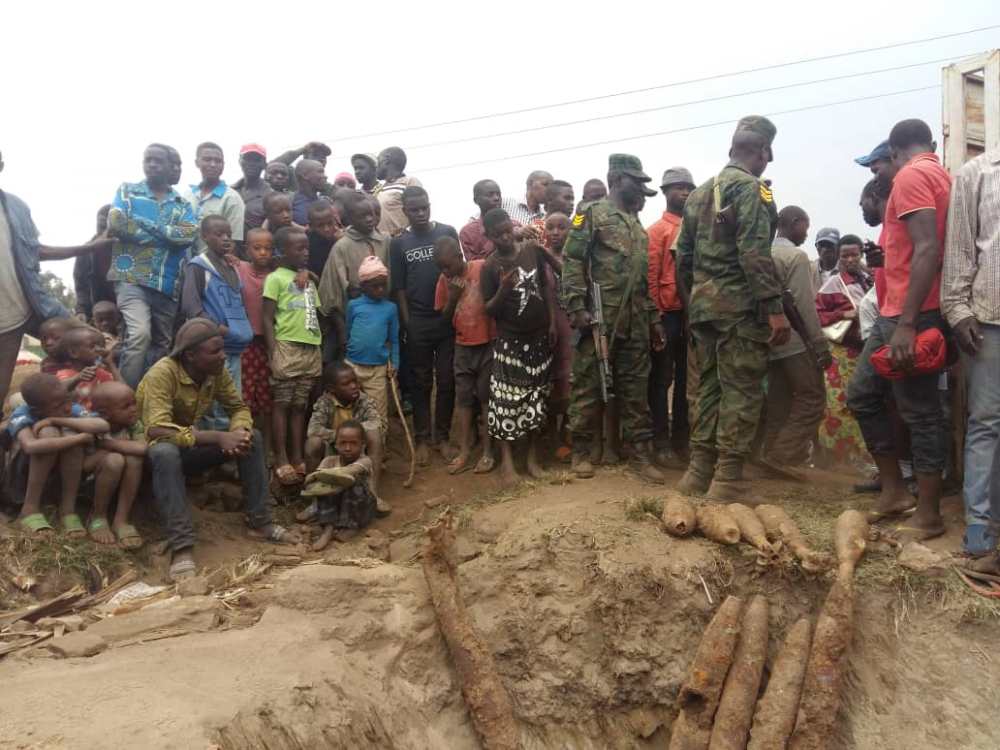
The explosives were found in Gafuku village of Gikombe Cell, Rubavu Sector.
The Executive Secretary of Gikombe Cell, Caritas Mukamuyango, confirmed the development to IGIHE, noting that on Sunday, children who were playing and searching for scrap metals discovered the site where the 58 explosives were buried.
The area is currently secured and marked by guards, according to Mukamuyango.
The explosives include nineteen ’60 mm mortar’, five Katyusha rocket launchers and others.
The incident follows three others in which grenades were recovered in the district.
In 1994, the region is believed to have served as headquarters for Interahamwe Militias, where they kept their weapons.
Locals from the area expressed their surprise, observing that the site was used for agricultural purposes and that they didn’t know there were explosives.
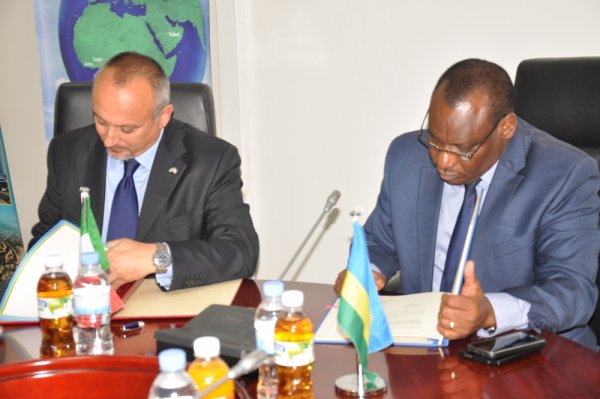
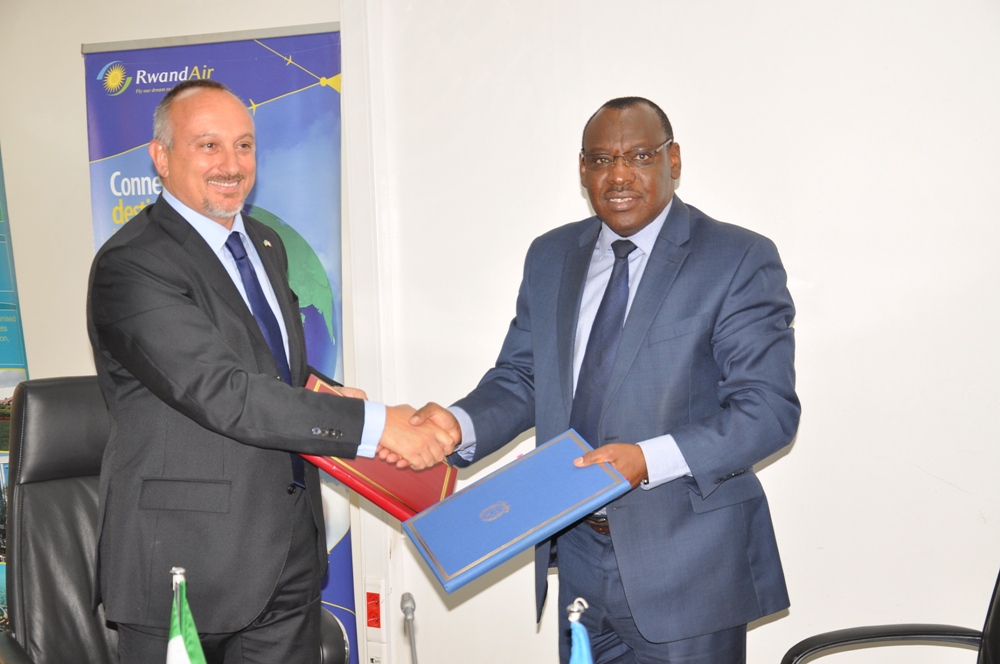
Rwanda’s Minister of Infrastructure, Amb. Claver Gatete and Italian Ambassador Domenico Fornara signed the agreement liberalizing commercial flights and airports between the two countries.
Minister Gatete said the air services agreement would ease future cooperation in trade, tourism and development between both countries.
“This will help us boost trade, economy, tourism and development between our countries.”
According to Amb. Fornara, the deal allows RwandAir to land at all Italy’s airports and vice-versa. He further observed that the move presents an opportunity to foster economic development through air transport.
Speaking to the press, RwandAir CEO, Yvonne Makolo said that the move was part of the National Carrier’s Five-year Objectives, of establishing cooperation in Air services with as many countries as possible.
RwandAir currently serves 26 destinations across East, Central, West and Southern Africa, the Middle East, Europe and Asia; with a fleet of 12 aircraft, namely; one Airbus A330 – 300, one Airbus A330 – 200, four Boeing 737-800NG, two Bombardier Q-400 Next Gen, Two Bombardier CRJ-900 Next Gen and two Boeing 737-700NG.
The Rwandan carrier also introduced flights to Abidjan, Libreville and Brazzaville from its Cotonou hub. It also flies to Abuja and Cape Town.
Dr. Diane Gashumba, the Minister for Health, said the training will be offered in collaboration with Starkey Hearing Foundation starting in the next two months.
The move was revealed in Kigali Friday after the exercise in which Starkey Hearing Foundation had treated 378 people with hearing problems.
“We are planning to have this foundation train health workers to take these services to the village level, and this is not hard to do,” said Minister Gashumba.
“Once that training is offered, we shall be assured that all Rwandans with auditory impairments will have treatment at ease.”
Dr Gashumba said the hearing problems are alarming in Rwanda and worldwide, calling for effective measures.
The 2012 census indicated that 466,453 Rwandans had disabilities with 8% among them having hearing impairments.
World Health Organisation (WHO) reports 466 million people with hearing impairments in 2018; among them 33 million are children.
Over 90% of the people with hearing problems are in developing countries.
Bill Austin, the CEO of Starkey Hearing Foundation, said the American charity targets to reach out to everyone in need of ear health care.
“We want to provide community health workers with skills they need to examine ears and treat their diseases from their communities,” he said.
The ear health care is currently offered in referral and district’s hospitals.
Reports indicate that most of the ear diseases and deafness are caused by other diseases that are not properly treated but sometimes are also innate problems.
There are currently 45,516 community health workers across Rwanda.
The Blues, arguably the most popular sporting club in the country, becomes the first Rwandan team ever to reach this far at any CAF club competition.
As Rayon started to Kenya, many did not believe they would pull it as they had left behind good players including those recently added to team such as Ghanaian Prosper Donkor and Ivorian Goal keeper Gerard Stephane Brou Kouame, among others.
Only Bimenyimana proved them wrong as he swept the ball past Gor Mahia custodian Shaban Odhoji for the opening goal barely two minutes after the referee got the proceedings underway.
On the 21st minute, Gor Mahia’s Francis Mustafa reached an equaliser scoring a goal against Rayon Sports.
As the match ended 1-1 at half time, both sides came back battling for success after the break.
Luckily for the Rwandan side, in the 54th minute Eric Rutanga beat his marker down, scored in the reverse fixture and won the game with a strike that left Gor Mahia’ Odhoji no chance of retaliating.
Last minute efforts by the hosts to get another goal bore no fruit as Rayon Sports’ players broke into jubilation after the final whistle.
Rayon Sports is now placed third with 6 points, with one match to go against Young Africans in Kigali on August 29th. Gor Mahia remains at the top with 8 points after USM Alger lost in Tanzania against Yanga, but must now avoid defeat in their last game against the Algerians to play in the quarter finals.