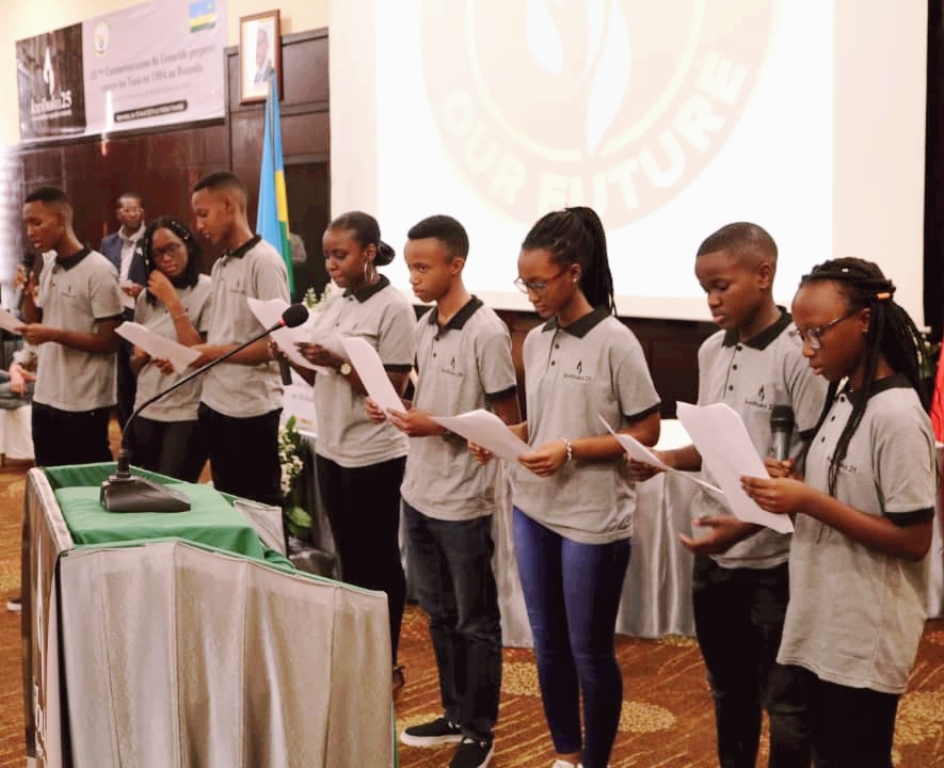
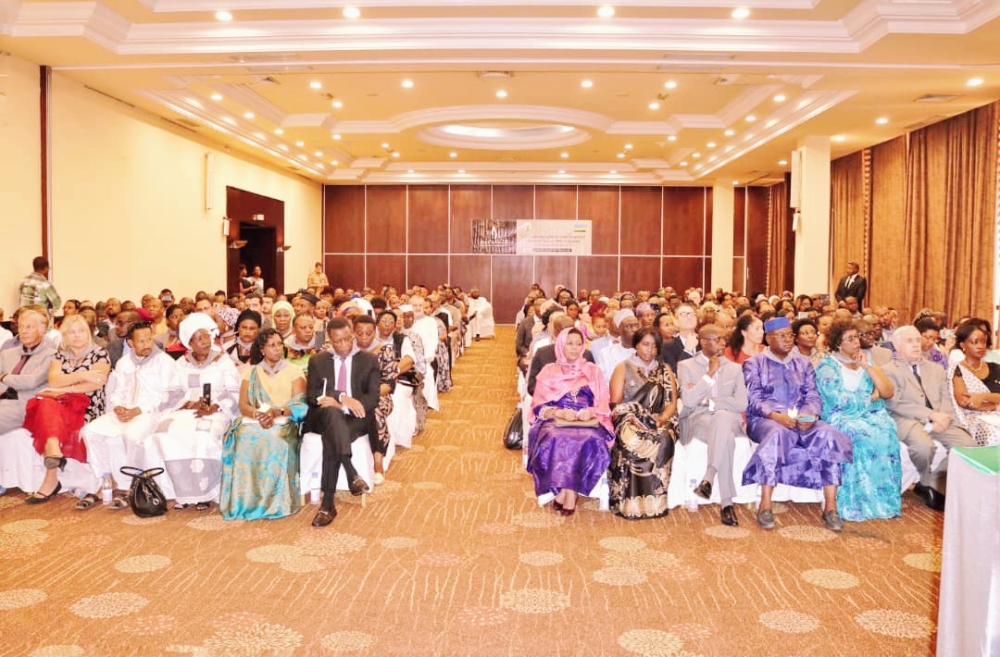
During the ceremony that attracted over 300 participants in Bamako at Amitié Hotel, the president of the Rwandan community in the country, Alice Gasarabwe reminded participants that genocide was a result of a long-term plan which took lives of over one million innocent Tutsis.
Rwanda’s ambassador in Mali headquartered in Dakar, Senegal, Dr. Harebamungu Mathias thanked RPF Inkotanyi soldiers for heroism and stopping the 1994 Genocide against Tutsi and leading Rwanda to apparent transformations.
Harebamungu said that Rwanda was an abandoned country but was resurrected, gained strength and international repute under the good leadership of President Paul Kagame.
Talking on the importance of remembrance, he emphasized that it aims at mobilizing the youth to be always on alert to ensure what happened never occurs again.
The Minister of Sports in Mali, Lawyer Jean Claude Sidibe said that his country supports and lauds what Rwandans have achieved in economic development, social welfare, security and democracy under the championship of president Paul Kagame.
Minister Sidibe revealed that Mali citizens learn a lot from Rwanda especially the process of resilience after the 1994 Genocide against Tutsi.
The Deputy Special Representative of the Secretary-General for the United Nations in Mali, Mbaranga Gasarabwe expressed delight for Rwanda’s initiative of seeking own solutions and promoting self-dignity.
He said the latter enabled the country to fast track unity and development with the aim of preparing a bright vision for its children.
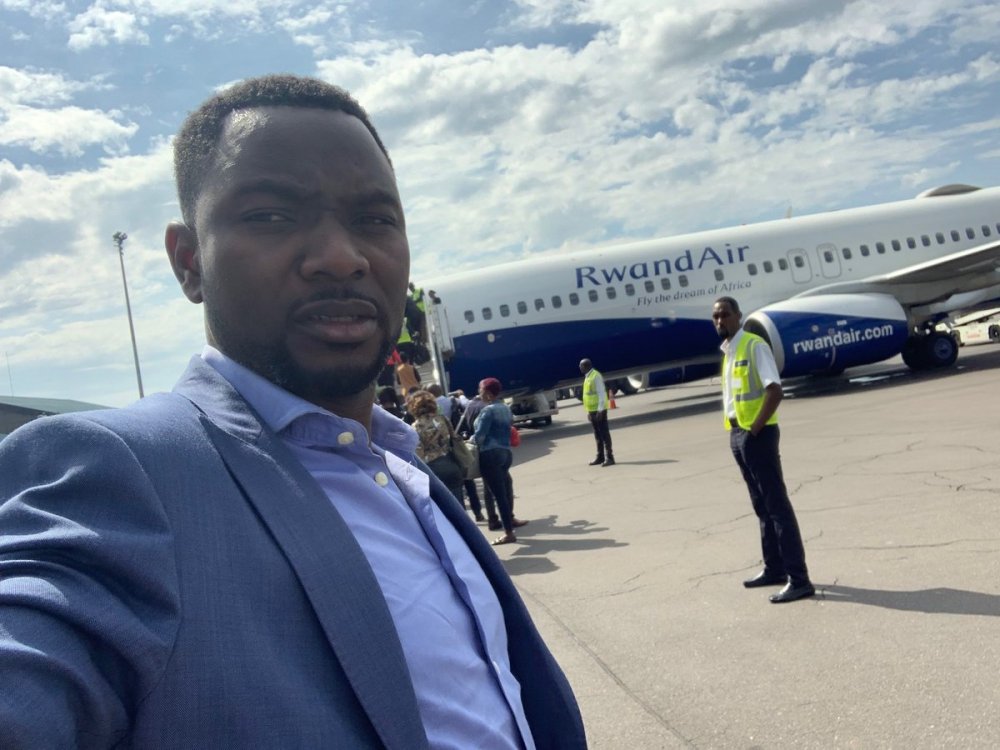
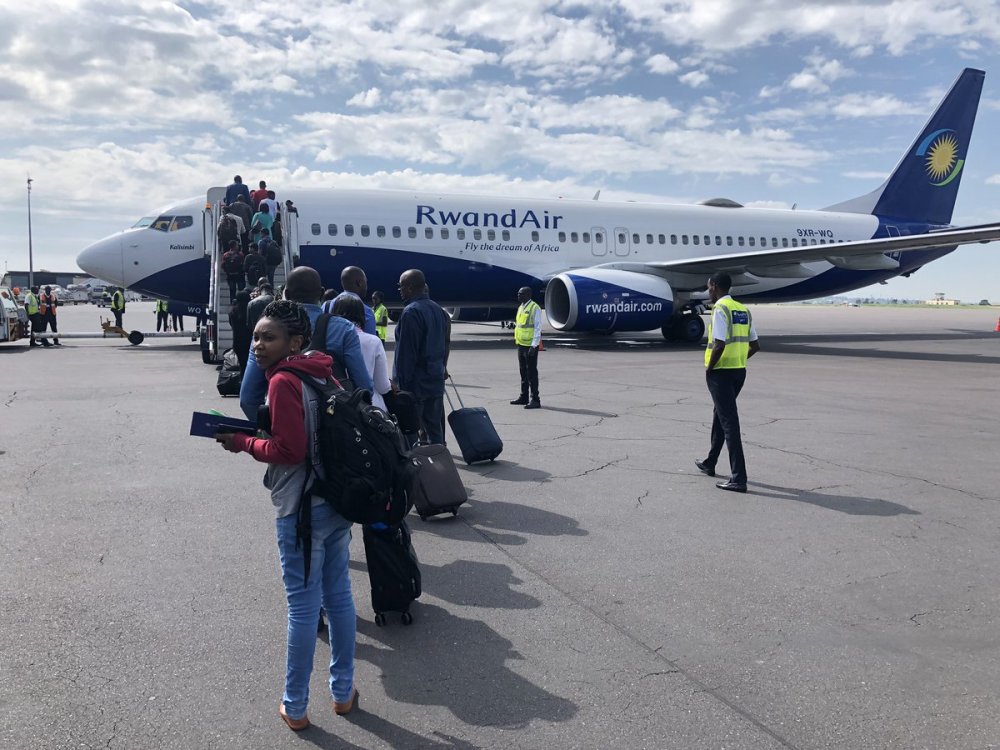
Upon arrival at Ndjili airport, RwandAir aircraft (Boeing 737-800NG) was welcomed with plumes of water salute ceremony.
The Boeing 737-800NG set off from Kigali International Airport with 119 passengers on board.
Vano Ol one of passengers expressed delight for the flight via a tweet saying it is a great milestone because “The situation was complex before as a passenger from countries like Ivory Coast or Benin had to fly through Bruxelles or Paris to reach Kinshasa.”
RwandAir will be conducting three weekly direct flights to Kinshasa on Wednesday, Friday and Sunday. RwandAir plans to increase more three-night flights effective next month.
Delegates from both Rwanda and DRC signed agreements to open airspace in March 2019 enabling RwandAir to conduct flights to Kinshasa and Congo Airways doing the same.
RwandAir flights are expected to promote cooperation and trade between citizens from both countries.
With its 12 aircrafts, RwandAir conducts flights to 26 destinations in East, Central, West and Southern Africa, Middle East, Europe, and Asia.
RwandAir also plans to launch flights in Addis Ababa, Ethiopia from April this year to be followed by flights to Tel Aviv in Israel and Guangzhou in China. It also expects to launch flights to other destinations in New York.
As we were waiting to go through the security clearance process, a very humorous lady approached me and asked me with a huge smile on her face: “Are you from here?”
I replied with a smile of my own: “Why do you want to know?”
“Because you were saying hello to people you don’t know, with an open face, on a crazy cold morning, Lady!” she said, also laughing. “We rarely do that here, you know,” she continued. “You must be from Africa,” she suggested. “You people are always happy despite the hardship we read about in the news. Gosh, how do you guys do it?”
“I am indeed from Africa and specifically from Rwanda and we also get very worried about you from what we see in the news! Media can exaggerate. We are fine as you can see.”
“A few unfortunate incidents should not define who the people of a certain country are” she concluded.
“Exactly,” I commented. Many great things happen in Africa but only the bad ones make it into the news. We are trying to change that narrative,” I informed.
Then suddenly in a tone that could be misinterpreted as an attack, she asked; “Talking about great achievements, if you are from Rwanda, what are you doing here? You do not have any dog in the fight. Your country is leading the World in female representation in the parliament.”
At that very moment, my mind started to wonder. “What would she say if she knew that also 50% of the Rwanda ministerial cabinet is made up of women, and the woman right in front of her was also one of the leaders in Rwanda? What would have been her comments if she had learned that women empowerment was reached without a struggle because the Rwandan president believed, and keeps saying that involving women in rebuilding the country, ‘just makes sense’? Everything being equal, with such a beautiful story to tell, I should not have been in that particular room. I should have looked for the one hosting a panel on a theme that would read more appropriately; “The Rwandan Women Leaders’ Challenge: What do they do to deserve the trust?”
Unfortunately, everything is not equal. As Rwanda commemorates the Genocide Against Tutsi for the 25th time, as a woman, a genocide survivor, and a citizen of the World, I now feel, more than ever, that I have a responsibility to be anywhere that peace is discussed as an alternative to violence of the kind that brought my country to ashes in 1994.
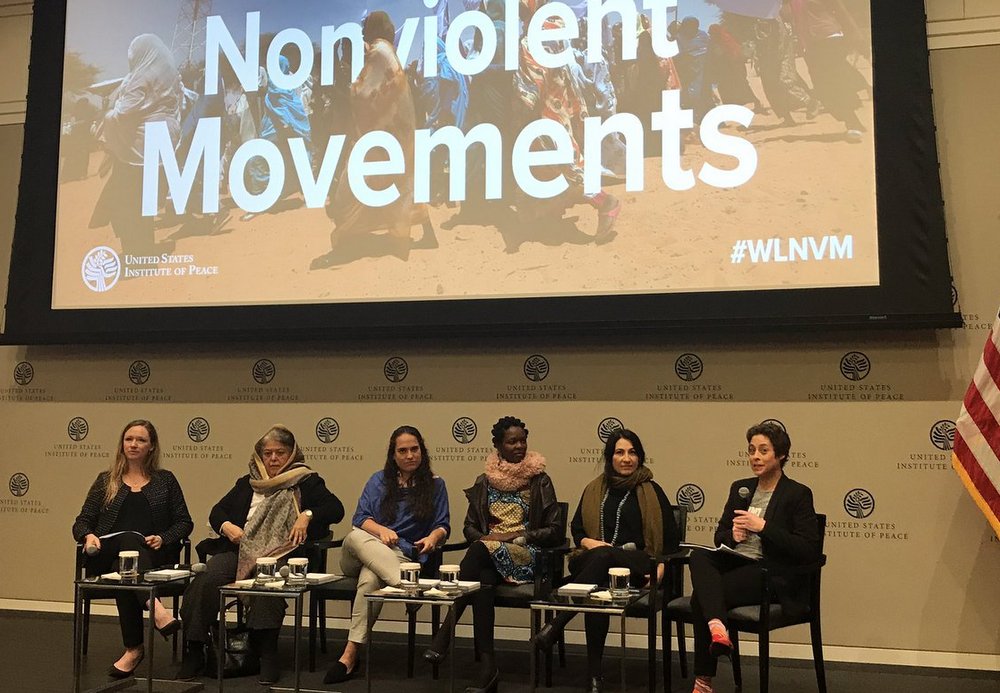
In fact, when I decided to respond to the USIP invitation, I was not intending to go there to brag about how Rwandan women are lucky to have an empowering leadership while my sisters on the panel were telling stories of their hardships and struggles for basic human rights. No. I just wanted to listen to them, eventually, hug them and inform them that even though Rwandan women presently enjoy that empowerment, they were also in painful situations in the past.
Before and during the genocide against Tutsi, Rwandan women knew the worst of human rights abuse. They were humiliated on a daily basis, unjustly incarcerated and tortured just because of who they were – Tutsi. During the genocide, our grandmothers, our mothers, aunts, and cousins were raped in public – sometimes by men young enough to be their sons. Babies were forced out of the wombs of those who were pregnant using spears and other tools before forcing flashlight batteries, needles and pieces of bottles into the victims’ private parts. My own mother, 64 years old, was cut alive into pieces before being thrown into a deep hole with my cousin, his wife and children, and our neighbors from elders to babies. Most of the women in the country from the Hutu ethnic group, forced into exile by the extremist government, were often used as human-shields and sex slaves. Twenty-five years later, some of those women still living in exile in those deadly forests, especially in Congo, are now made to watch their daughters as young as 9 years old being impregnated by negative forces and eventually dying from those premature pregnancies or suffering from fistula, HIV/AIDS, and other sexually transmitted diseases with no medical care available.
When Mahdouba Seraj from Afghanistan spoke about hoping for peace for too long- like our mothers did, while women are threatened and sometimes shot on the streets, or when Scovia Arinaitwe talked about how she was incarcerated and tortured in Uganda right after a c-section, similar images of Rwanda’s sour past rose in my mind and brought back a bitter taste in my mouth. I suddenly felt like screaming, echoing Seraj’s closing questions: “This is it? When will women’s struggles end?”
It was equally troubling to watch a young woman like Isabella Picón from Venezuela, advocating for peace like women of my generation did. Why couldn’t she be given a chance to enjoy her beautiful, tender, and inspiring age? I was also angry to see Judy Richardson on her own country’s US stage speaking of the fights for human rights since 1963. Does it really make sense that Syrian Mariam Jalabi, who has a great degree from McGill University, has to spend hours and hours in conference rooms claiming obvious rights instead of being given the opportunity to use her knowledge for the betterment of this World we share with men?
Why did this World’s setup put women like Kathleen Kuehnast, Maria Stephan, and Marie Berry in the position of going to school to “focus” on conflict, violence and the like, instead of mastering in Sharing Peace for a change? Maybe then, Bonnie and Michon who now use media to promote peace, would have the opportunity to produce a documentary about the first woman on the moon for instance? Where are all those HeForShes to reassure women of the World that this is NOT it?
{{The Author, Claudine Delucco Uwanyiligira is the Deputy Director General – Rwanda Broadcasting Agency
}}
The cabinet meeting approved the National Agriculture Insurance Scheme (NAIS) last year in November. The program is supposed, to begin with, 68,000 cows from ten selected districts; Nyanza, Gicumbi, Musanze, Rwamagana, Gatsibo, Ruhango, Nyagatare, and Burera.
It was also supposed to provide agriculture insurance to farmers in 10 districts including Gatsibo, Nyagatare, Bugesera, Gisagara, Kirehe, Gicumbi, Huye, Rulindo, Ngoma and Rwamagana.
Under the livestock insurance scheme, a farmer having a cow valued at Rwf 400,000 provides Rwf 18,000 insurance fees while the Government caters for 40% of farmers payments. The livestock value is determined by the farmer.
Lambert Niyonshuti, a specialist in agriculture and livestock insurance at the Ministry of Agriculture and Animal Resources (MINAGRI) has said that the program has already started and mobilization is underway to attract farmers.
He explained that over 200 Burera residents have subscribed for the insurance.
“We mobilized and we plan to organize various meetings with citizens in collaboration with sector veterinarians to engage with interested farmers,” he said.
Farmers hailed the program and observed that it should be extended to all Rwandans as Alphonse Ahimana from Coko sector of Gakenke district explained. “We commend the insurance for its aspect or reducing risks but it has not yet reached us,” he said.
A farmer will be required to make daily records of the livestock welfare or agricultural projects.
The manager went into hiding from April 11, after an audit found out that Rwf9,000,000 was missing from the SACCO coffers. The arrest took place in Muhanga district after a tip-off from the public.
Article 10 of the law on fighting against corruption stipulates that any person, who embezzles for personal or someone else’s interests property, funds or securities entrusted to him or her by virtue of his or her office, or any person who uses for personal gains, the staff under his or her authority commits an offense.
RIB Spokesperson Modeste Mbabazi warns the public and especially people in high institutional positions and financial managers against this crime.
“Embezzlement of funds especially in SACCOs denies other members to acquire loans and develop their projects, we therefore as RIB will continue to bring the culprits to book but also sensitize the public more on this crime,” said the spokesperson.
Upon conviction, the manager of SACCO Umutuzo is liable to imprisonment for a term of not less than seven (7) years but not more than ten (10) years and a fine of three (3) to five (5) times the value equivalent to the value of the embezzled property according to the law.
RIB lauds the continuous public partnership in preventing crimes and calls upon the public to report any acts done in breach of the law
It also reads that Akagera National Park earned USD $ 2 million (over Rwf 1.8 billion) in 2018 and expressed optimism for an increased number of tourists in 2019.
The management of the park revealed that such earnings enable the park to be self-financed at 75 % and sustain activities beneficial to neighboring communities.
“A new center is set to be launched to harbor different activities including the establishment of vegetable gardens, beekeeping, and poultry, tree nurseries, a shop for handcrafts among others to start this year. They are all meant to help neighboring residents to improve wealth, increase yields and access to markets,” reads the statement.
Concerning service delivery improvement the management has said that Rwanda Utilities Regulatory Authority (RURA) is building four telecommunications towers in the park to upgrade the network.
They are being built nearby Akagera Game Lodge, Rwisirabo, at Mutumba hill and Muhororo.
It is said that the words written on the wreath read ‘We will always Forget you.”
The wreath was laid at the memorial yesterday as residents in Ntarama sector commemorated for the 25th time the 1994 Genocide against the Tutsi, an event that was preceded by a walk to remember.
Following commemoration activities, a genocide survivor who stayed around inspecting the place where relatives are buried saw the wreath, got traumatized and started ripping the wreath. Residents rushed to the scene, assembled parts of the wreath where they found genocide ideology words.
The Executive Secretary of Ntarama sector, Marthe Uwamugira has told IGIHE that security officials were alerted and are hunting for the suspect.
“We are still searching from those who took pictures and sharing information that might lead to the arrest of the culprit. We have also alerted security officials,” she said.
Uwamugira warned residents against genocide ideology and urged them to be watchful reporting whoever is identified with such destructive ideas.
It is said the man committed the murder and suicide after attempting to kill his wife who fled the home.
The incident took place around 9 pm yesterday after heated arguments with her 26-year old wife, Tuyizere.
IGIHE has learned that after escaping the husband, Tuyizere alerted neighbors who returned to the house with her and found the man hang and the baby dead.
Police spokesperson in Kigali city, CIP Marie Goretti Umutesi, has told IGIHE that the man was known as a drug addict.
“They had no family conflicts known but the man was a famous cannabis smoker. We always advise spouses to report conflicts to family friends or seek assistance from officials to mend relations,” she explained.
The incident took place yesterday as the six mine workers were on mining activities in Mageragere sector.
The mine belonging to ETMIN Ltd was licensed six months ago.
John Kanyangira, the director of mining inspection unit at Rwanda Mines, Petroleum and Gas Board (RBM) has told IGIHE that the investigation is underway to establish the cause of the accident.
“The mine collapsed as six mine people entered it to do their work. Four died while two of them sustained minor injuries. Following the accident, we are seeking support from Rwanda.
Investigation Bureau to identify the cause. The owner of the mining company is subject to be brought to justice if there is evidence that he neglected workers’ protection,” he said.
The majority of genocide ideology cases during the commemoration week held from 7-13 April 2019 were related to hurting words compared to previous years characterized by killing livestock of genocide survivors and destroying while their houses.
RIB received 72 allegations of genocide ideology cases during the commemoration week preceding 100 days of mourning. So far 69 suspects have been arrested.
The Southern Province accounts for 25 of the allegations, Eastern has 25, Western has 3, Northern Province has 7 while 10 allegations are from Kigali city.
The spokesperson of RIB, Modeste Mbabazi has told IGIHE that prevalence genocide ideology has reduced compared to previous years.
“It is evidenced in the increased participation in commemoration talks. Even those who were reluctant came in large numbers and gave testimonies and revealed where remains of victims are located,” he said.
Mbabazi explained that there were reduced numbers of trauma cases during the commemoration period.
“Before genocide ideology was propagated by intellectuals but current suspects are not people with advanced education. They do it in bars or for other reasons. Today it is mainly manifested through spoken word. Before, they would beat genocide survivors, throw stones at them, destroy their houses or chop their livestock among others,” he said. 72 genocide ideology allegations were filed during the commemoration week in 2018 down from 114 of 2017.