He was at the time trying to use the fake notes to pay for goods at a shop located in Nyakariro Cell of Nyakariro Sector, Police said.
Chief Inspector of Police (CIP) Hamdun Twizeyimana, the Police spokesperson for the Eastern region, said that on the evening of August 4, Bizimana went to purchase goods at the shop of one Pierre Nsengiyumva, 40.
“Nsengiyumva realised that a note of Rwf5,000 that Bizimana gave him was fake. He immediately called local authorities, who apprehended Bizimana, searched and recovered on him other five fake notes; four in the denominations of Rwf5,000 and one in the denomination of Rwf2,000,” CIP Twizeyimana explained.
Local leaders, he said, called and handed him over to the Police.
Bizimana could not disclose the origin of the counterfeit currency notes.
He has since been handed over to Rwanda Investigation Bureau (RIB) at Muyumbu station for further management.
CIP Twizeyimana called for vigilance and real time information sharing on anyone suspected to be counterfeiting money or dealing in fake currencies.
Article 269 of the law relating to offences and penalties in general, states that “Any person who, fraudulently counterfeits, falsifies or alters coins or bank notes, which are legal tender in Rwanda or abroad, notes issued by the Treasury with its stamp or brand, either banknotes or alike that have legal tender in Rwanda or abroad, or one who introduces or issues in Rwanda such effects or notes with knowledge that they are forged or falsified, commits an offence.
Upon conviction, he/she is liable to imprisonment for a term of not less than five (5) years and not more than seven (7) years.
According to the Ministry of Health, of the new cases,12 were found in Rubavu District among returning residents who were isolated on arrival; four were confirmed in Kigali and another case in Rulindo District.
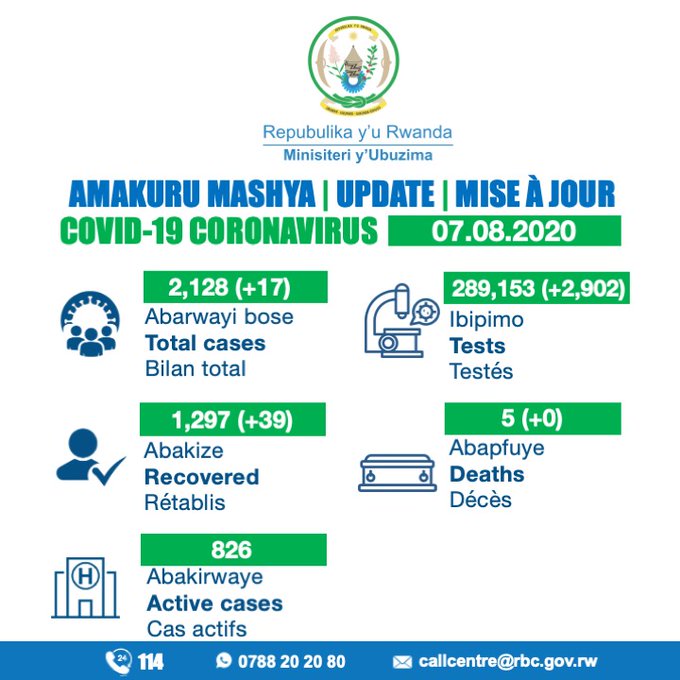
The results were obtained from 2,902 sample tests conducted in the past 24 hours.
So far, the country has conducted a total of 289,153 Covid-19 sample tests since mid-March, from which 2,128 Covid-19 cases have been found.
So far this pandemic has claimed the lives of five people.
Symptoms of Coronavirus include coughing, colds, and difficulty breathing. It is transmitted through the mucous membranes of the respiratory tract.
Rwandans are required to continue to comply with government regulations, especially with frequent washing of hands with water and soap, wearing masks when in public places.
Rwanda Biomedical Center (RBC) began voluntary testing for Coronavirus towards the end of July.
The program is designed to allow those who want to travel abroad, visit the parks, among others to get results in less than 24 hours, along with a COVID-19-free certificate.
To access the service, the user opens the Irembo website, health category and choose to test COVID-19, following the instructions. The service helps users request a day off for COVID-19 testing at RBC-designated centers.
Users are required pay Rwf 47,200 or $ 50 per person, payable through Bank of Kigali on either a Rwandan Francs or Dollars account. The fee, however, only covers part of the testing cost as a single test costs between $100-150 [ between Rwf100,000-150,000].
RBC has, again, advised all interested individuals to pay with digital currency including Mobile Money, MoMo Pay, Airtel Money, and Banking.
RBC has also announced that two permanent testing sites have been set up in Kigali, at the Petit Stade Amahoro in Remera and Gikondo at the RBC Vaccine Office.
Of the seven new cases, Kigali has 5 and Rusizi 2.
The total number of people diagnosed with coronavirus in Rwanda has risen to 2,111 out of 286,251 sample tests taken including 1,258 recoveries. Active cases 848, and five deaths recorded.
The company has secured the transmission rights of the Spanish top league, which will be broadcast in French language across its media platforms for paid subscribers in 47 territories.
“We are delighted to have secured the broadcast rights to LaLiga Santander, one of the most prestigious football competitions in the world,” said Kristen Miao, StarTimes Sport Director. “The acquiring of LaLiga Santander shows our commitment to continuously enrich our bouquets and to provide our subscribers with premium sport content.”
“This agreement provides an exciting new way for French speaking fans across sub-Saharan Africa to get closer to our competition,” said Melcior Soler, director of the LaLiga audiovisual department. “StarTimes has a strong presence in the region and a proven expertise in sports in general and football in particular, which will help us all to reach as wide an audience as possible.”
StarTimes will broadcast LaLiga Santander starting from the coming 2020/21 season.
Matches will be aired live and in HD on the StarTimes Sport channels in French as well as the StarTimes ON streaming application.
{{About StarTimes}}
StarTimes is the leading digital TV operator in Africa, serving 13 million DVB subscribers and 20 million OTT users in 30+ countries. StarTimes owns a 600+ channels’ content platform combining African local channels (75%) and international channels (25%, including Chinese channels 1.5%). The company’s vision is “To ensure that every African family can access, afford, watch and share the beauty of digital TV”.
{{About LaLiga}}
LaLiga is a global, innovative and socially responsible organisation, a leader in the leisure and entertainment sector. It is a private sports association composed of the 20 clubs in LaLiga Santander and 22 in LaLiga SmartBank, responsible for the organization of these national professional football competitions. In the 2018/2019 season, LaLiga reached a cumulative audience of more than 2.7 billion people globally. With headquarters in Madrid (Spain), it is present in 41 countries through 11 offices and 44 delegates, covering 84 countries. The association carries out its social action through its Foundation and is the world’s first professional football league with a league for intellectually challenged footballers: LaLiga Genuine Santander.
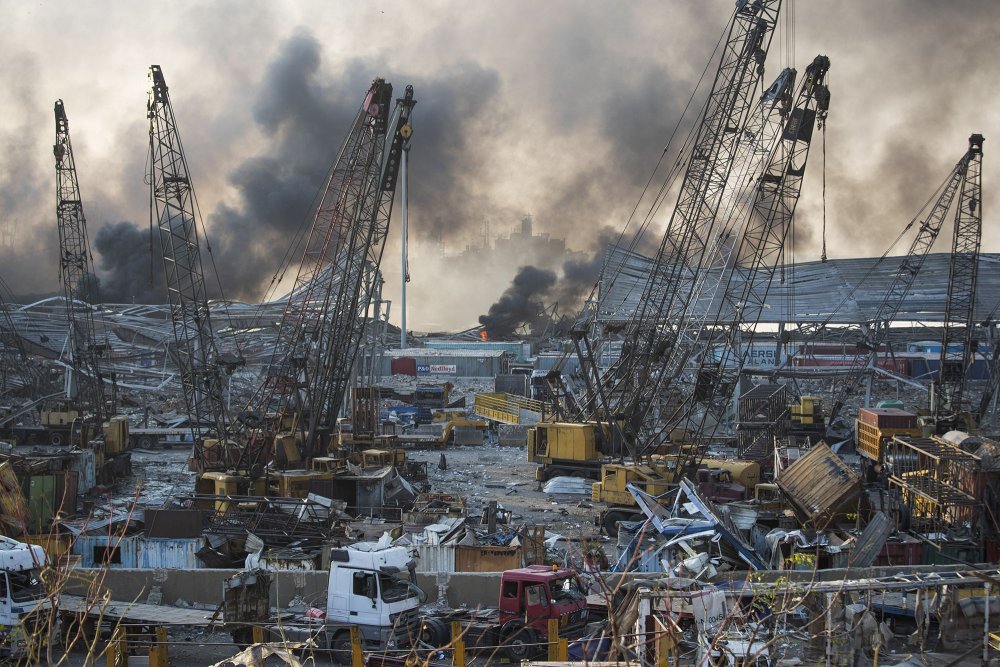
“The government of Rwanda expresses its sincere condolences to the Lebanese government and to the families of the victims,” the Minister of Foreign Affairs and International Cooperation said in a tweet on Wednesday, August 5.
It is said that the explosion may have been caused by a bomb or other military explosive device, while other schools of thought say it was caused by “ammonium nitrate” used to make fertilizers.
Lebanese Prime Minister, Hassan Diab, said the site caught by fire contained 2,750 tonnes of ammonium nitrate that had been stored for six years.
Beirut’s governor, Marwan Aboud, said the blast had left 300,000 homeless people. He added that the damage was estimated at between $ 3 billion and $ 5 billion.
The ammonium nitrate reactor exploded after a house in which various products were stored was engulfed in flames. It exploded vigorously as far as Cyprus, about 240 kilometers from there.
The tragic incident happened on Wednesday, August 5th. The Executive Secretary of Muganza Sector, Ngirabatware James, said the brick site was being operated illegally, as the owner had been fined and stopped from operating the quarry.
“They are two children, one aged 16 and the other 18, who used to make bricks. The crater caved in, killing them instantly. The site had been closed but was being clandestinely and illegally operated. It was near the river and when it rained, it flooded, collapsed, and took the young lives,” said Ngirabatware.
The Mayor of Rutsiro District, Ayinkamiye Emerance, told IGIHE that of the 16 suspects, 14 were at the sector level including five Sector Executive Secretaries and two others at the District level.
“Some officials have been suspended following investigations over misappropriation of public funds.
They are suspected of embezzling funds from VUP projects,” she said.
She added that there were projects to be done for the residents but the materials that were to be used were not found to be available during a forensic audit nor were they paid for. The materials include stones and sand that were to be used in building small bridges on the sidewalks.
They were suspended for six months as further investigations continue.
Chief Inspector of Police (CIP) Bonaventure Twizere Karekezi, the Police spokesperson for the Western region, identified the suspects as Jean Claude Tuyishime, 19, Emmanuel Sindayiheba, 25, Lionson Gasore, 19, and Jean de Dieu Nkurunziza, 22.
The quartet was intercepted in Mururu Sector, Gahinga Cell as they crossed into Rwanda with the sacks of caguwa, from the Democratic Republic of Congo through an illegal border point.
“Following information that a group of smugglers would be sneaking goods into the country from DRC through a porous border, an operation was organized and they were arrested red-handed with the six sacks of used clothes,” CIP Karekezi said.
The suspects said that they were just hired to smuggle the clothes into Rwanda by a certain trader.
“The alleged owner of the clothes, who had hired these four people, will also be located and arrested,” the spokesperson said.
The quartet was also placed under quarantine for COVID-19 tests.
CIP Karekezi thanked residents who provided information, and cautioned the public that such unlawful acts of fraud can also lead to the spread of Coronavirus.
He assured residents that operations have been intensified to fight fraud and to enforce government directives meant to prevent the spread of COVID-19, including unnecessary and prohibited cross-border movements.
Rwanda Utilities and Regulations Authority (RURA) announced on Wednesday,
August 5, that effective August 15, no commercial motorcyclists operating in Kigali will be allowed on roads without subscribing to using meters and compulsory cashless payment services.
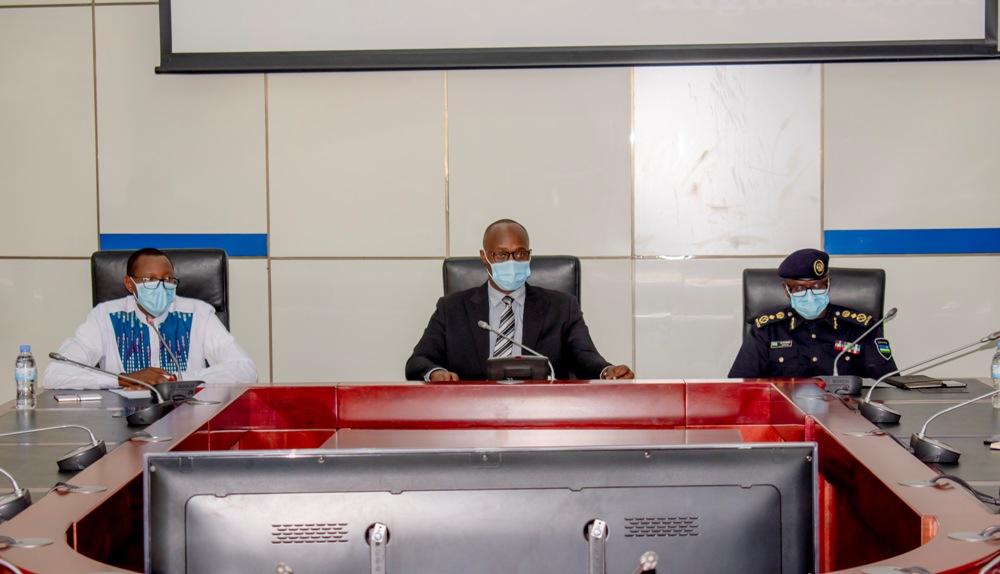
The new moto electronic transport system was announced during the press briefing, which brought together City of Kigali, RURA and RNP.
The GPS-enabled tool calculates distance and electronically generates the transport fare instantly.
RURA Director General, Patrick Nyirishema said that the deadline was well thought about including facilitating the motorcyclists to access the meters by the set deadline.
“We have taken two years to prepare this and to transform the moto transport system; we had meetings with the motorcyclists on this issue, and we hope by that date, all taxi-moto operators will be set for the new and efficient electronic services,” Nyirishema said.
With meters, passengers have options of paying using Mobile Money, Airtel Money or Tap & Go.
Currently, there are over 46,000 registered commercial motorcyclists across the country, with about 26,000 operating in Kigali.
According to RURA, about 19,500 motorcyclists in Kigali have so far acquired meters.
Nyirishema said that the mandatory electronic system for motorcyclists started in Kigali and will be decentralized to other parts of the country soon.
He said that the meters are friendly in terms of fares.
For the first 2kms, a passenger pays only Rwf300 and Rwf133 for any additional kilometers.
In case a passenger makes a stoppage along the route, he or she will have free 10 minutes after which Rwf21 will be charged per minute.
Nyirishema said that there are enough meters for all motorcyclists.
Three firms were authorized to provide the meters. These are Yego Moto, Pascal and Tap&Go.
A meter can only be used for two years, after which a new one alongside a smartphone will be given to a motorcyclist.
On the issue of the meter being expensive, Nyirishema disclosed that there will be no upfront payment as it will be paid in the course of two years.
He cleared the air that there will be no extra charges for clients using telecom payment services.
City Mayor, Pudence Rubingisa said that use of meters and shifting to cashless payment is in line with the ‘Smart City’ programme and part of the efforts to prevent further spread of novel Coronavirus.
“We are building a clean city that embraces e-services across all sectors including transport to ensure efficiency and service delivery,” Mayor Rubingisa said.
The mayor appealed to clients to also play their part by adopting the electronic payment system and to use motos with meters to prevent being cheated.
RNP spokesperson, CP John Bosco Kabera said that the force is always ready to enforce any instructions.
“This will help the Police in relation to security matters; in case of conflict between the motorcyclist and client and also when a motorcycle or its rider has been implicated in any unlawful acts,” CP Kabera said.
He added: “This is for the benefit of the motorcyclist, client and the country in general; we don’t wish to see any motorcyclist on the road on August 15, without a meter because on that very day, the Police will carry out its enforcement duties.”
He said that RNP will continue to work with City of Kigali, RURA and the federation of motorcycle cooperatives to ensure that the directives are adhered to.