Half of the grant (Rwf72 billion) will be provided as loans, while the rest will be provided as grants.
The World Bank has been supporting Rwanda for more than 10 years in various energy-related projects under the government’s plan to provide electricity to all Rwandans by 2024, as well as a program to promote the use of renewable energy, which will be used by ‘all Rwandans by 2030.
The money will be used to expand the Ntaruka Dam, rehabilitate power lines to reduce wasted electricity, modern lumbering programs and promote the use of renewable energy.
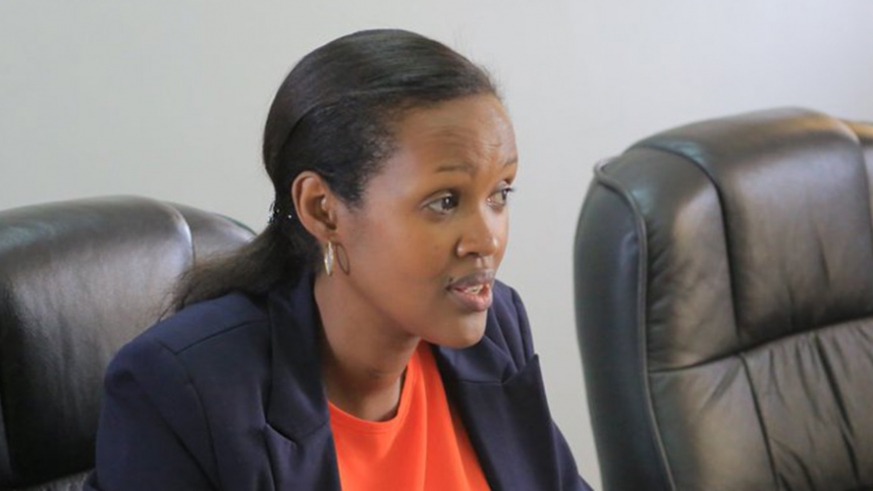
Rolande Pryce, the World Bank Country Manager for Rwanda, said the funding came in the right time because it was in line with the government’s plans to distribute electricity to all.
“The project has come a long way in strengthening aid that has been in place for more than 10 years and the World Bank is supporting Rwanda in its energy distribution programs. It will therefore help in the government’s plan to provide electricity to all in 2024. We are proud to be Rwanda’s partners in this program,” she said.
The World Bank already supports Rwanda in other development programs including; distribution of electricity, agriculture and education among others.
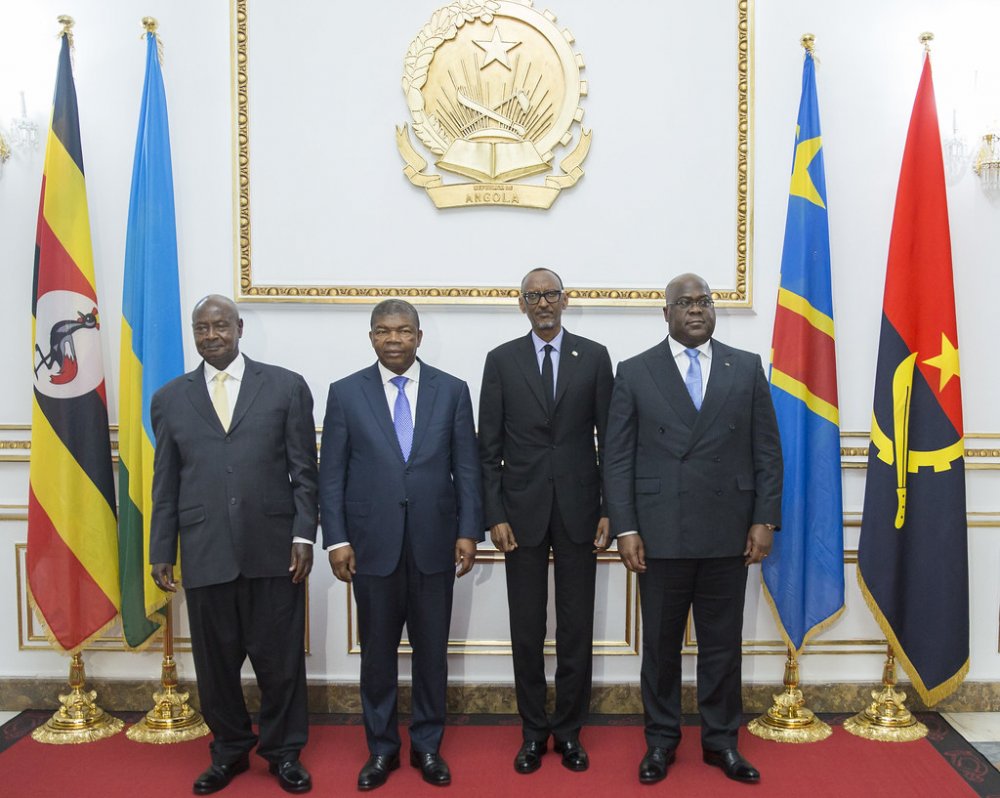
The meeting which was formerly convened by the DR Congo President Félix Tshisekedi was initially planned to be held in the border town of Goma and attended physically by Heads of State of the five countries; however, a decision was reached to hold the meeting virtually in light of the Covid-19 pandemic which has, among other things, seen land borders across the region closed.
A message issued by the Minister of Foreign Affairs of the DRC, Marie Tumba Nzeza on Thursday, September 17, 2020, said: “The Ministry of Foreign Affairs of the DRC would like to thank the fraternal countries of Rwanda, Uganda, Burundi and Angola for their cooperation in conducting the study at the scheduled meeting, which resulted in the above conclusion.”
The date of the virtual meeting is yet to be set. The key issues of common interest include regional stability, security and countering terrorism.
Angola and DR Congo are also involved as mediators in restoring warm ties between Rwanda and Uganda through the Ad Hoc Commission on the Implementation of a Memorandum of Understanding signed in Luanda in 2019.
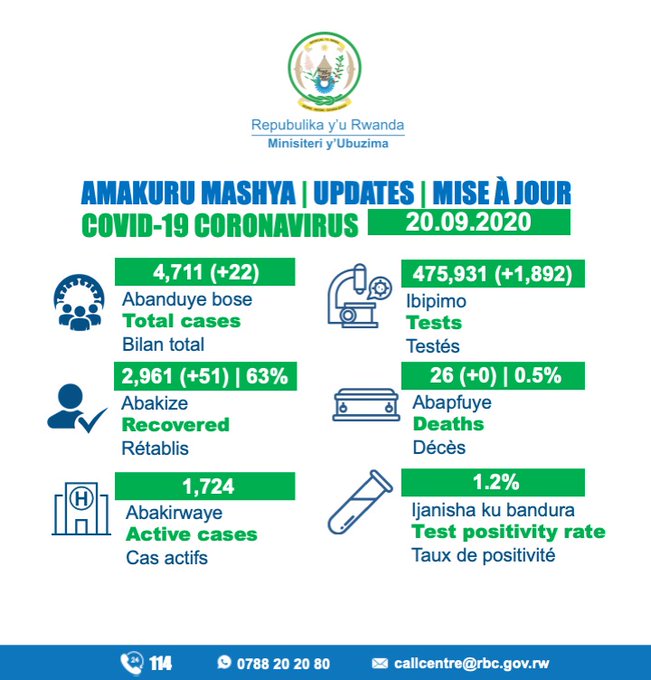
According to the Ministry of Health, on Sunday, September 20, the country also reported 22 new cases.
Of the new cases, 14 were detected in Kigali’s high-risk groups, whereas Nyamagabe and Burera districts confirmed 7 cases and one case respectively.
The results were obtained from 1,892 sample tests taken in a single day.
In total, since the outbreak of the pandemic by mid-March, Rwanda conducted 475,931 tests.
Of all tests, the country reported 4,711 confirmed cases, of which 2,961 people have recovered.
The country’s Covid-19 death toll so far stands at 26 people.
Coronavirus symptoms include coughing, flu, and difficulty in breathing. The virus is said to be transmitted through the mucous membranes of the respiratory tract.
Rwandans are required to continue complying with government regulations, especially with frequent washing of hands and water and soap, wearing masks when leaving home or in public.
This is carried out under the invitation of the health authorities in South Korea back on 24th, asking Shincheonji Church to cooperate for donating additional plasma for the development of the vaccine.
Early this year, around 5,000 confirmed cases were found in Shincheonji Church members with most infections from the city of Daegu, while most of them recovered from the virus with 11 deaths.
According to the report from the Korea Centers for Diseases Control and Prevention (KCDC), 562 recovered members from the church registered to donate plasma and 409 completed donation in July through the cooperation between KCDC and Shincheonji Church. Facing the need for “facilitation of developing a cure through plasma donation and clinical trial”, the KCDC asked another round of a large-scale donation by members of Shincheonji Church in August.
The KCDC in its official document expressed appreciation to Shincheonji Church (Chairman Lee, Man Hee) for “active participation in the collection of plasma as a group for the development of corona(virus) cure for the purpose of national health safety under the global crisis caused by the COVID-19.”
“With the cooperation of Daegu city, Daegu Athletics Center plans to provide the space, and GC Pharma plans to provide the necessary equipment and personnel from 27th August to 4th September. We express our gratitude to the city for providing a location for the group donations. We also express our gratitude to the congregation members of the religious organization, Shincheonji to be specific,” said Mr. Kwon Jun-wook, Deputy Director of the KCDC.
Research and development of the convalescent plasma treatment is underway by National Institute of Health under the Ministry of Health and Welfare in cooperation with Green Cross (GC) Pharma, a biotechnology company in South Korea.
On the same day, the US Food and Drug Administration (FDA) authorized an emergency use of convalescent plasma for the treatment of COVID-19. Experts say that more data need to be collected to see the benefit of such treatment.
Major challenges of researching the effectiveness and the development of convalescent plasma treatment come from limited supply from donors who must be recovered from the virus.
As a religious leader, Chairman Lee, Man Hee of Shincheonji in July said, “This (plasma donation) is the work that needs to be done as citizens of this country and as true believers. It is keeping the command of Jesus of loving your neighbor as yourself (Mt 22:39 of the Bible).”
Majority of the violators were the youth, some of whom were at the time found playing football while others engaged in varied sports disciplines.
Earlier on, the group first took to the road to jog before they started playing football and other body contact sports, all of which are prohibited in this period due to the risk they pose in spreading COVID-19.
At the time, they were found with no facemasks and body contact was the norm.
The violators were enlightened on the pandemic of novel Coronavirus, government directives in this period including safety practices and were, afterwards, penalised for the violations.
The acting Western Regional Police Commander (RPC), Chief Superintendent of Police (CSP) Edmond Kalisa reminded them that sports activities are not prohibited but have to follow the recommended safety guidelines to prevent catching or spreading COVID-19.
“What you did today could have exposed all of you to the virus, if one of you was infected, which could as well be a danger to your respective families,” CSP Kalisa told the group of violators.
“There are allowed and prohibited sports disciplines; football, sports done in groups or those that can lead to body contacts are prohibited. You can only do any sport activity individually but not as a group,” he added.
The mayor of Rubavu, Gilbert Habyarimana warned the youth against undermining the safety directives intetionally, adding that this will not be tolerated.
When the method is to be employed, as soon the expecting mother begins to feel labor pain, she is injected with the concoction, which protects her from pain until she gives birth.
A professor at Duke University in the United States, Prof. Ayedemi John Olufolabi, explained that the process that is going to be introduced in King Faisal hospital will assuage mothers’ pain.
“A catheter helps us to inject drugs into the muscles that cause a woman to have a lot of pain to reduce it, with medical doctors in attendance.”
Dr. Muhumuza Samuel, an expert and an Anesthesiologist in King Faisal hospital, explained that the procedure was aimed at reducing the pain mothers feel due to labor.
“This approach is complementary to what we used to do to reduce the pain caused by so-called ‘spinal analgesia for labor’, but it doesn’t remove all the pain.”
“The pain a mother has during childbirth can have a devastating effect on the baby and the mother; at times, a mother fails to breastfeed or does not want to cuddle the baby ld. because of the pain she felt while giving birth.”
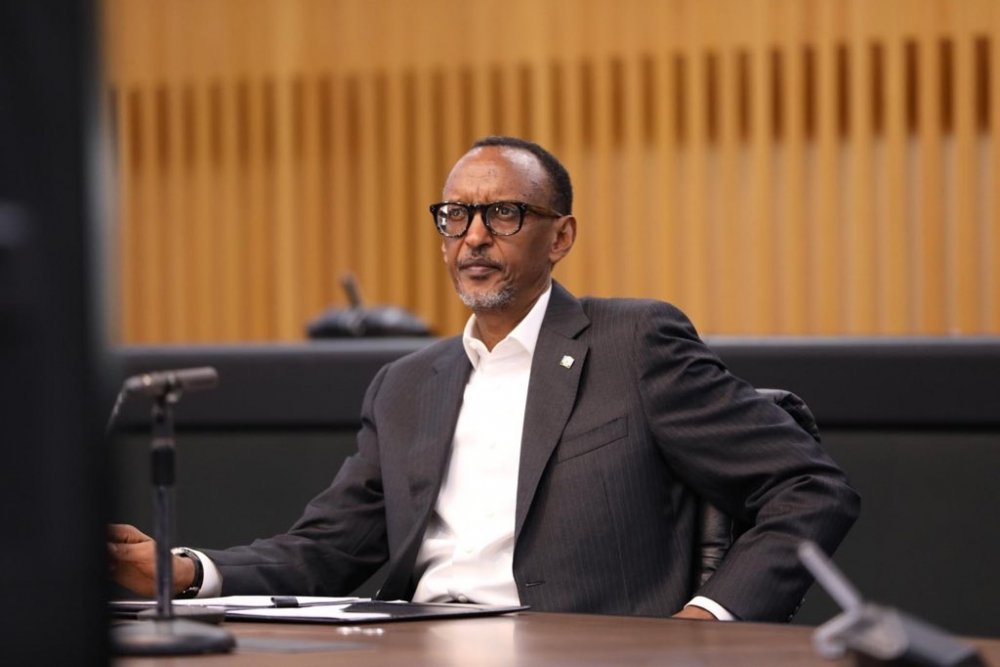
The Head of State made the observation on Friday, September 18th, while addressing a meeting of the Broadband Commission for Sustainable Development on the 10th anniversary of the commission.
President Kagame said that the first decade of the Broadband Commission has made a real impact by highlighting the transformational power of universal access to high-speed internet connectivity and smartphones.
“Ideas that seemed futuristic ten years ago are now mainstream; the next decade will be about using digital tools to speed up the recovery from the COVID pandemic and make up some of the lost ground on the SDGs.
“We must become better prepared for future global health crises. Equal access to education has been very uneven due to the remaining digital divide,” President Kagame said.
President Kagame thanked members of the commission for taking the time to join the meeting to share knowledge and experiences and for the dedication throughout their tenure serving the commission.
“Earlier this year, the United Nations Secretary-General launched a roadmap for an ambitious digital cooperation agenda. This initiative promises to further elevate the important work of the Broadband Commission, which has been made possible by the productive partnerships embodied within our diverse membership,”
“We stand ready to support the Secretary-General’s vision for digital inclusion as a cornerstone of the Sustainable Development Goals.”
President Kagame also recognized ten new Commissioners who include Erik Ekudden, from Ericsson, Filippo Grandi, from the UNHCR, Lacina Koné, the Director General of Smart Africa, Hyeonmo Ku from KT Corporation and Pekka Lundmark from Nokia.
Others include Ursula Owusu-Ekuful, from Ghana, Dongyu Qu, from FAO, Andrew Sullivan, of the Internet Society, Mohammed Al-Tamimi from Saudi Arabia and Makiko Yamada from Japan.
The Broadband Commission was launched in 2010 with a view to furthering the campaign to accelerate the spread of the Internet worldwide. It is estimated that by 2025, about 35% of the population in poor countries will have access to fast internet, which is 65% in developing countries and 75% in the rest of the world.
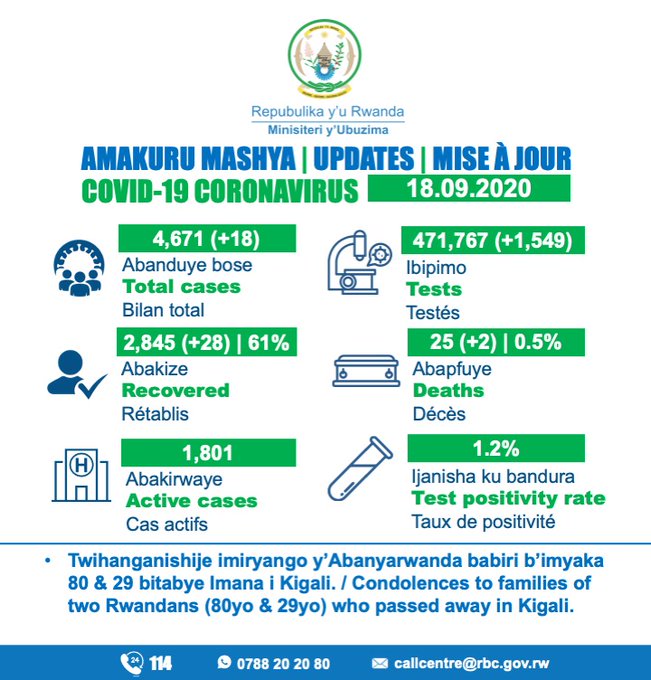
According to the daily update by the Ministry of Health, the two victims are a 29-year old and an 80-year old, all residents of Kigali.
“Condolences to families of two Rwandans, 80-year-old and 29-year-old, who passed away in Kigali,” the Ministry said, while 18 new cases were reported, out of 1,549 tests, taking the total number of cases in Rwanda so far to 4,671.
On the same day, the Ministry also reported 28 recoveries, taking total recoveries to 2,845, while the number of active cases is now 1,801.
Out of the new cases, nine patients were identified in Kigali, four in Nyamagabe, four in Rubavu and one in Bugesera district. So far 471,767 tests have been conducted since the first case was detected on March 14, 2020.
Coronavirus symptoms include coughing, flu, and difficulty in breathing. The virus is said to be transmitted through the mucous membranes of the respiratory tract.
Rwandans are required to continue complying with government regulations, especially with frequent washing of hands and water and soap, wearing masks when leaving home or in public.
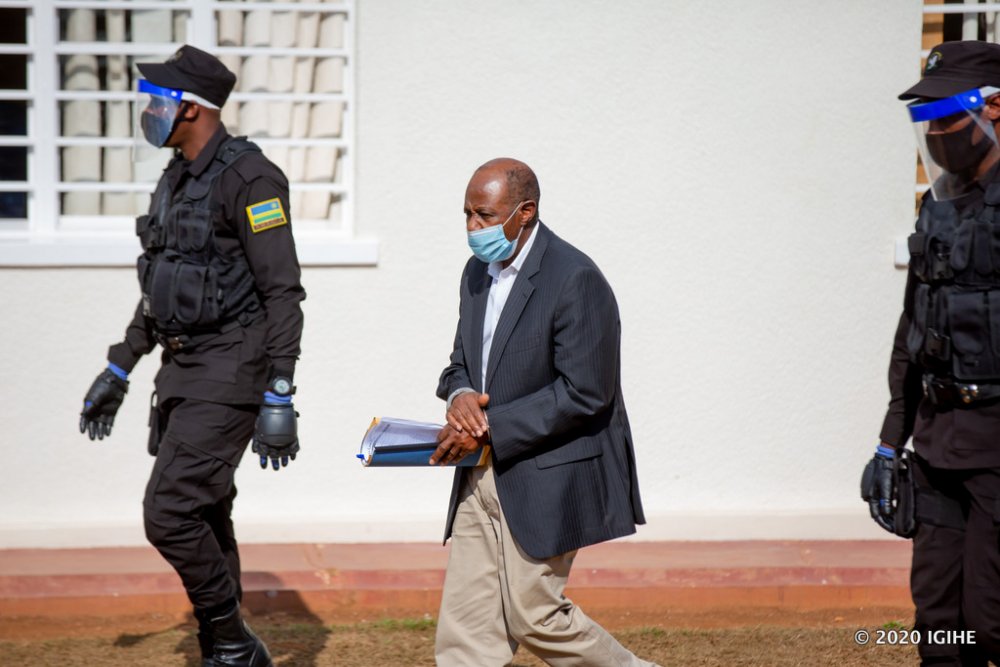
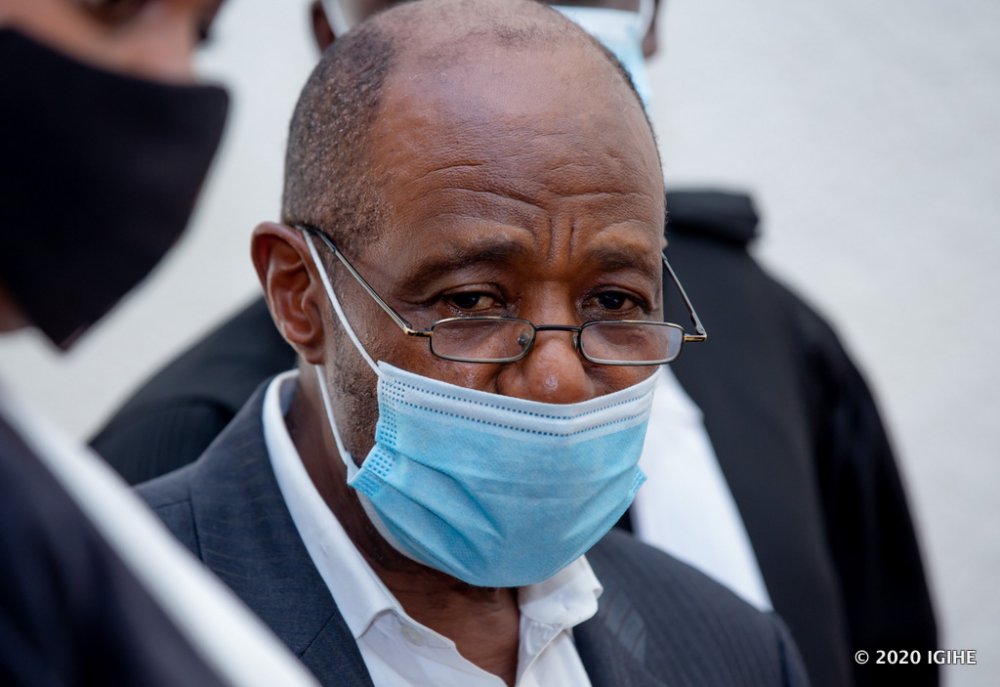
Rusesabagina told the media on August 31, 2020, that he was arrested at Kigali International Airport and that he arrived in Rwanda willingly.
His arrest sparked controversy around the world, with some claiming he had been abducted, others saying the plane was hijacked and found in Kigali. There were also reports that on August 27, 2020, Rusesabagina arrived in Dubai at 7:10 p.m.
Reports indicate that he left Al Maktoum Airport in Dubai on a private jet of the Bombardier Challenger 605 of GainJet late in the night and arrived in Kigali on Friday morning.
In an exclusive interview with the New York Times, the 66-year-old said he took the plane thinking he was going to Burundi. He made the remarks on Thursday at the Remera Police Station where he was being held, along with his two lawyers, Mr. Nyambo Emeline and Mr. Rugaza David. It was a conversation he said he gave willingly and no one forced him to.
The conversation took place in Rusesabagina’s room where he is held from, where it was reported that it was clean, with a bed covered with mosquito nets. The suspect was wearing a trouser, a jacket, shoes, and a gold watch.
Rusesabagina told reporters about his arrival in Rwanda from Dubai airport.
He said that the private plane he boarded in was meant to take him to Burundi in Bujumbura where he had plans to engage with various religious groups at the invitation of the local pastors.
He arrived at the airport on August 29. Instead of finding himself in Burundi, he found himself surrounded by Rwandan soldiers, it’s when he realized he is not in Burundi but in a neighboring country, Rwanda, where he had last been 16 years ago. He says this surprised him.
Asked how he felt after he found himself in Rwanda, Rusesabagina replied, “Ask yourself how you would feel if you found yourself in the wrong place.”
President Kagame had recently announced that there was no kidnapping in the process of bringing Rusesabagina but he had willingly brought himself to Rwanda.
Rusesabagina was recently arraigned in court on suspicion of 13 counts and Thursday, the Kicukiro Local Court ruled that he should be remanded in custody for 30 days while the investigation continues, the decision was immediately appealed.
He told the New York Times he was innocent of all the charges against him. On the first day of his trial, he told the court that he regretted the FLN’s actions in killing civilians in the Northern Territories and apologized to those individuals affected and the country as a whole.
A few days ago, his family announced that they do not agree with the lawyers selected by the 66-year-old, and so they (family) appointed seven lawyers including one Rwandan.
Rusesabagina said he was the one who chose his lawyers and he is happy to work
with them. “I’m the one who selected my lawyers and I’m happy to have them. Only my family was not notified. ”
He said that although he is imprisoned, he has a high blood pressure problem, but the Rwandan authorities always send him doctors to take care of him.
“A lot of people come and talk to me. They also clean my room. They give me food. They are good people. Everything is fine so far. ”
In this interview, he did not explain what happened in Dubai and how he found himself in Kigali but he only said that all that happened when he was tired.
“I was taken to a place. I don’t remember where. I was tired, legs, face, I couldn’t see anything. I didn’t know where I was. ”
More than 7.5million Rwandans currently have National IDs. It is an exciting step because for it has been 26 years that the Genocide against the Tutsi was stopped, and Rwandans are proud to have documents that do not contain racial discrimination.
Rwandan history shows that during the colonial era, what was once a wealthy class of Rwandans was transformed into ethnics and the colonists began to include it in Rwandan documents called “books” which later came out of the paper identity card.
In an interview with RBA, Antoine Mugesera, an expert in Rwandan culture and history, said that the “Book” consisted of about 10 pages.
“It was a little booklet, they called it a book. They used the book to segregate indegenous Rwandans from the twenty families, the Singas, the Zigabas, the Geseras among others,” he said.
The identity card was widely used in the Genocide against the Tutsi, where at various barriers they were set up, the Interahamwe asked for it looking for who to kill.
Mugesera says that in the aftermath of the Genocide against the Tutsi, things have changed and ethnicity has been removed from identity cards.
“I was one of the founders of the project, I was raised by the commission that issued it in 1995/96; Arusha had confirmed that the identities containing the so-called ethnicities would be removed, and that Habyarimana wanted to do so and changed his mind. It was not an easy thing to do for him”.
A 16-year-old Rwandan is currently allowed to obtain an identity card, as a proof of identity.
Mukesha Josephine, director general of the National Identification Agency, said the study of identity thesis was in line with modern technology.
“There is a program called ‘digital ID’ which means that you still have your physical ID, and can present it to access your digital information. You can even place your signature on it and there are no gaps allowing for it to be used by another person,,” she said.
In 2016, the agency announced that the digital ID would be combined with up to seven other documents including identity card itself, driver’s license, RSSB number, insurance, tin number and family members among others. It will cost Rwf15,000.
Currently, 7,586,813 Rwandans have IDs, of which about four women.