{ {{US economic growth slowed sharply in the third quarter of the year.}}
}
Gross domestic product grew at an annualised pace of 1.5% between July and September, according to the Department of Commerce, down from a rate of 3.9% in the second quarter.
The slowdown was partly due to companies running down stockpiles of goods in their warehouses.
On Wednesday, the Federal Reserve kept rates unchanged and said the economy was expanding at a “moderate” pace.
Low oil prices have hit US energy firms so far this year. But lower fuel prices have been good news for consumer spending, which accounts for more than two-thirds of US economic activity.
Consumer spending grew at 3.2% in the third quarter, down from 3.6% in the second but still a strong reading.
‘Underlying strength’
Analysts said that the running down of warehouse stockpiles in the third quarter was likely to be a temporary effect and they expected growth to accelerate again in the fourth quarter.
“The headline number isn’t great but this masks underlying strength,” said Luke Bartholomew at Aberdeen Asset Management.
“Inventory adjustment was a drag but final domestic demand is much stronger suggesting the fundamentals of the economy remain solid.”
For several months there has been intense debate about when the US central bank will raise interest rates, and now the focus is on its last meeting of the year in December.
The Fed has said in past statements that it expects to raise rates in 2015, and that labour market participation, inflation and the global economy would be the key factors in its decision.
In its latest statement on Wednesday, the Fed said: “In determining whether it will be appropriate to raise the target range at its next meeting, the committee will assess progress – both realized and expected – toward its objectives of maximum employment and 2% inflation.”
However, the Fed dropped comments, which had been used in the previous month’s statement, that weaknesses in the global economy could affect the US. Financial markets interpreted this as a sign that the Fed might be more likely to raise rates in December.
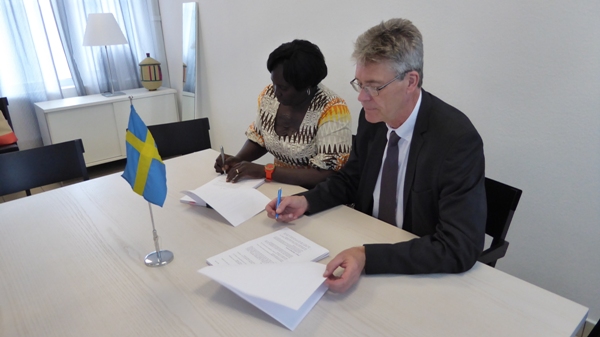
{ {{The government of Rwanda and the World Bank have signed the financial agreement of 26 million US$ dollar(Rwf19billion) to facilitate its cross-border trade between Rwanda and Democratic Republic of Congo (DRC).}} }
The loan is part of International Development Association(IDA) to provide aid and loan equivalent to 79 million US$ in the region as it was approved by the World Bank Group’s Board of Executive Directors for six regional countries.
IDA Supports anti-poverty programs in the poorest developing countries with long-term, no interest loans.
The fund will support Great Lakes Trade Facilitation Project to smooth the progress of traders including the majority of business women doing business across Rwanda and DRC border.
Throughout the ceremony of signing the contract, Ambassador Gatete Claver, the Minister of Finance and Economic Planning (MINECOFIN) said that Rwanda heads towards Western part unlike the past dominated by cooperation with Tanzania and Uganda.
Talking to the usage of the fund Ambassador Gatete said “The fund will help to renovate Kanombe airport and support cross border trade between Rwanda and Democratic Republic of Congo, which is practiced unlawfully.It is profitable for cross border traders, especially women.”
“We are looking forward to improve requirements on the border to help traders generate profit from their business.”He added.
The project will not only help Rwandans but also Congolese will benefit from it.
Carolyn Turk, the representative of World Bank in Rwanda stressed the need to prioritize trade in landlocked countries.
“I am delighted with the support Rwanda is receiving to promote cross border trade in the Great Lakes Region.It is a project of 79 million US$ of which 26 will be transferred to Rwanda to facilitate cross border investment.”He said.
She also noted that the fund will facilitate between 20,000 and 30,000 women crossing the minor border known as (Petite Barrière) in Rubavu district.
As she said, Rusizi district is subjected to be recognized within the budget of the fund.
Renovations of Kamembe airport will take 14.2 million US$ to the extent that it gets capacitated to work day and night within the region.
The fund will help in the construction of markets in Nyamasheke and Rusizi districts to ease commerce of agricultural products. Five million US$ will be spent on such activities expected to bring a powerful market and empower farmers carrying loads on their heads.
Other activities include projects providing youth’s occupation, boosting agricultural production in a bid to eradicate poverty as well as advancing service delivery across borders.
{{The National Bank of Rwanda has printed new banknotes of One thousand Rwandan Francs (1000FRW) to strengthen the banknote’s security features. {}}}
On the front there is a design of National Museum of Rwanda to represent the Government of Rwanda’s effort to promote Rwandan Culture and history; while on the back there is a monkey in the Volcano National Park to represent the Government effort to promote tourism sector.
A design of flying dove changes colour from green to blue and a bright ring can be seen moving around a central point, replacing the Holographic band on current and circulating banknote.
The new banknote of One thousand Rwandan francs (1000 FRW) will be circulating together with other existing banknotes series which are legal tender in Rwanda.
Not so long ago, I&M Bank had to emotionally bid farewell to one of its longest serving Managing Directors Mr. Anand Sanjeev. But all was not lost, as the multinational Bank ushered in yet another highly experienced Banker Mr. Robin Bairstow (in Picture) as its new MD. As the English adage goes: “Experience is the best teacher” the Bank looks to the future with enthusiasm as it welcomes Bairstow to its helm. He joins the bank with a 24 year professional banking career and has served in South Africa, Zambia, Uganda, Singapore, Indonesia and his previous job was with another international bank in Kenya where he had served for 15 solid years. He has indeed juggled well his banking profession; serving in different positions—from marketing to retail banking and so on. IGIHE caught up with Mr. Robin C. Bairstow in his office right at the heart of Kigali City at the Bank’s head office and discussed a wide range of issues concerning I&M Bank and Rwanda’s financial market in general. Excerpts follow below.
{{IGIHE}}: At 52 years, I&M Bank is arguably the oldest bank in Rwanda and incidentally one of the top performing banks. How sounding have you found the Bank and strategically where do you want to take the bank going forward?
{{ROBIN}}: Truth is, I find a well structured bank. It has been doing well over the last 5 years under the stewardship of a good leader. Indeed, he left it in good shape. Our challenge is to sustain, consolidate and even upscale what was achieved.
Looking at key indicators of a healthy financial entity like capital adequacy, assets growth rate and non-performing loans (NPL), among others. All is well. For instance, the Central Bank wants all players to be below 5% on NPL, the industry average now stands at 5.9%. I&M bank’s is at 6.4%, and we are working hard to bring it down by at least 2% in the very near future.
I found a Bank with a well developed corporate banking structure and business. A burgeoning retail and SME banking unit perfect at tapping into the available Government opportunities like the BDF (Business Development Fund) and Hanga Umurimo Programs. There are still more opportunities to explore in terms of tapping into the fast growing SME sector, the huge unbanked Rwandan population using innovative digital platforms.
The Bank is very liquid. It enjoys an asset to deposit ratio of 51% which is good by any standards. It is well capitalized; whereas minimum capital adequacy ratio set by the Central Bank is 15%, I have found I&M Bank’s at 22%. The Bank is one of the top performing Banks in terms of Return on Equity (ROE), meaning we are very profitable in the market. We are number 3 in the market and we hope to maintain or even improve that position. Going forward, future investments will be prudently geared towards the right sectors. Sustaining this growth is going to be determined by making the right investments choices in a perfect financial market. Banking is more than slick pay-off lines and running fantastic adverts. It is more about reputation and integrity within the financial market. I&M Bank is fairing quite well on both fronts and I hope to maintain that. I find it extremely important to put much more emphasis on product development and innovation. We need to get the people’s perception right—we ought to be perceived as a stable and reliable partner.
{{IGIHE}}: You join a market where over 90 % of the businesses are Small and Medium Enterprises (SMEs) who are characteristically risky to lend to. Rwanda’s financial sector is extremely competitive. Despite of the credit risk associated with the SMEs all banks seem to rush to the bottom of the pyramid. But it will probably depend on style and belief. Do you think it is a wise idea to reposition I&M as an SME Bank or Corporate Bank?
{{ROBIN:}} I&M does not position itself distinctively either as an SME or Corporate bank, it serves both segments equally. Our conviction and belief is that it is a growing curve—SMEs once well nurtured can potentially grow into good corporates much as there could be many casualties along the way . I&M Bank funds many start-ups through special programs that are run jointly with the Government (among other stakeholders). The Guarantee Scheme provided by I&M Bank buffers the shocks and mitigates risks associated with the start-ups. The Bank has witnessed consistent growth in this area and on average more than 50 start-ups are funded a year. Dealing with start-ups under this arrangement has provided the bank with enormous lessons and experiences that provide a good basis for review and improvement.
For instance, we have learnt that start-ups need education. In responding to this need, the Bank is working with partners like European Investment Bank (EIB) among others to do Financial Skills trainings for entrepreneurs. A similar training will be conducted before end of this month (October).
{{IGIHE:}} Our long experience covering Rwanda’s financial sector has shown us that competition has pushed financial institutions to roll out a lot of innovative banking products and services to benefit their customers. However there is generally less uptake of such banking products and services. A case in point is the low uptake of online banking services and products. Banks have been blamed for weak marketing and less effective communication methods used to promote products and services. What is your take, looking at the portfolio performance of I&M Banking Products and Services?
{{ROBIN:}} Looking at the uptake levels of I&M Bank’s products and services, it is satisfactory but more could be done. To improve this, the bank aims to explore possible market linkages and synergies. The bank is capitalizing on reviewing its product and services, leveraging on the available digital payment and transaction systems like Point of Sale, Online Banking, Mobile Banking, mVISA etc to ensure minimal use of cash because it has proven more expensive. Note that, the more you explore alternative, cost-effective transaction options, the more you reduce the cost of delivery and the beneficiary at the end of the day is the customer.
{{IGIHE:}} It is evident that the recent innovations in the telecom industry like mobile money services have to a large extent affected the performance and relevance of the Bank’s online products and services. Subscribers (of telecoms) who are apparently Bank Account Holders have found them more convenient, reliable and cheaper. In your view, should this cause panic among banks?
{{ROBIN}}: Banks should not be concerned about the innovations in the telecoms because they have unlocked a number of opportunities for banks. Moreover, they are bringing many unbanked citzens in the equation that incidentally end up using banking services in one way or the other. In other words, telecoms have played a complimentary role. As banks, we may lose in one area but in aggregate terms the gains are much more. Banks are increasingly exploring synergies with telecoms to serve customers better. The rise of money transactions in telecoms has nothing to do with the slow down in growth of the banking sector—keep in mind that growth in GDP has a direct correlation with the growth of the financial sector. In Rwanda for instance, where the GDP is reportedly 6.5-7%% percent (highest in the region), it is apparent that the banking sector is growing in matching terms. Banking sector in Rwanda is growing extremely well, at about 20%. Just imagine, despite of the huge volumes of transactions by telecoms, they still hold their trust funds with the banks—which is still big business for us (banks). It is a complementary service other than a competitive service.
{{IGIHE:}} Going by the trends, smart companies have now strategically started repositioning themselves as regional business entities—also aiming at tapping into a larger and more lucrative EAC market with 130+million people. A number of regional and continental banks like I&M Bank have opened shop in Rwanda. Traders trading across the borders have not been much attracted by the banking services and products offered by regional and continental banks due to high transaction costs. In your view what is the problem? What specific innovations does I&M Bank plan to deploy to improve in this area?
{{ROBIN:}} I&M continues to establish its footprint in a chain of regional economies. It is putting up very strong performance in Kenya, we are Tanzania and now in Rwanda as well and the 50% acquisition of Bank One in Mauritius allows us access to funding opportunities. The cardinal aim of spreading our operations in the region is to tap into the growing trade flows across the region. If you analyse the banking transaction statistics within the EAC, it is evident that it is not yet a homogenous market and that affects (slows down) innovations in banking services. The EAC integration agenda is progressing and the financial sector will have to match the pace (of integration) and this opens up opportunities for players and consumers. I&M Bank in 2016 will be rolling out a new operating system which will be a catalyst in getting closer to being a fully networked bank. This will allow us to run products and services jointly as one I&M Bank Family across the network in the region. The Bank offers services across counters in Tanzania, Kenya and Mauritius (as Bank One) to its customers.
{{IGIHE:}} Rwanda’s financial sector is also still faced with a number of challenges, including legal and regulatory challenges, market structure related challenges etc. Through the Rwanda Bankers Association (RBA) and other pressure groups your concerns could be heard and solved. What is your take on the state of the organization of the financial sector in Rwanda? From your rich banking experience, what more do you think RBA or Chamber of Financial Institution could do to ensure effective policy and strategy advocacy?
{{ROBIN}}: As a lobby group, you have a much better voice to the regulator. Building a common understanding of prudential guidelines issued by the Central Bank is key and we work together to achieve that. There is need for regular, informed and well-structured engagements within the structures of the (financial) chamber and the association (RBA) to responsibly and realistically engage the regulator. The advantage we have is that it is a ‘listening’ regulator.
{{IGIHE: }} A while ago, there were plans of I&M Bank listing on Rwanda Security Exchange (RSE). Although this has been delayed due to reasons beyond the public’s know. What is the latest? Are there specific reasons that stalled the move?
{{ROBIN:}} The planned IPO is not a capital raising exercise for the Bank, it is one of the shareholders looking to exit their investment. This is an opportunity to further deepen the local bourse’s financial sector and at the same time a chance for local investors to gain a share of a well-established, performing local financial institution. The timetable is yet to be agreed and a formal advisor appointed. We certainly remain excited about the prospect.
{{IGIHE: }} Looking at the values, vision and mission of I&M Bank paints a picture that you’re customer-focused, customer-centred Bank. But it is easier said than done! What do you promise?
{{ROBIN:}} Customers are the core of our business. If you look at the profile our products and services over the last 5 years they have been growing quite well at over 20%. It implies we must be doing something quite correctly. We will continue to review our processes in offering products/services; underpinning convenience and reliability. A case in point is the ATM uptime—we get to look at the efficiency of the entire process to ensure a seamless service. Our banking halls will be like our seating rooms at our homes. Customers do not just come and wait in a queue to be served. We take advantage of that moment to talk to them and generate important feedback that helps us improve and serve them better. I do believe that the tradition of opening bank branches for purposes convenience is not dead yet. Our societies have not grown to a level where we do away with branches completely. It is possible but it is going to take a little longer before we realize a totally cashless economy. In the short to midterm, majority of citizens will still need that branch next to them to physically transact. Therefore, we shall combine both; investing in more bank branches across the country and up-scaling our digital banking platforms for maximum convenience and reliability.
{{IGIHE:}} In your parting short, what promises do you give I&M Bank Customers and Rwandans in general?
{{ROBIN:}} We will continue to innovate. We will continue to grow, particularly in areas where we traditionally are known to be strong. We have a major focus on SME and consumer banking. We will be rolling out more products—watch this space. We have a very exciting campaign coming up this October—focused heavily on home ownership. Our promise is to roll out products that not only meet customers’ needs but satisfaction as well.
As member of corporate society, we have areas we would like to continue extending our support, particularly in education and health. We shall continue to concentrate our efforts in certain areas where we can make a difference and positive impact in the society.
The government has moved to set up a regulatory framework for remotely piloted aircraft, popularly referred to as ‘drones,’ following investor interest to establish the world’s first drone airport (drone port) in the country beginning next year.
Last month, Norman Foster, a renowned British architect, expressed interest by his firm, Foster + Partners, alongside business partners to build the world’s first drone port in the country to facilitate transport of urgent medical supplies and electronic parts to remote parts of the region using drones.
In their proposal, the investors said, beginning next year, they intend to begin construction of three drone ports, which will take about four years to complete.
To facilitate the planned development, Rwanda Civil Aviation Authority (RCAA) is in the process of drafting regulations that will soon be submitted to Cabinet for approval and to be made operational by 2016.
The authority found it important to have the framework in place to guide further developments in the technology, which is fast becoming popular, as well as other aspects such as port construction.
RCAA public relations officer Tonny Barigye told The New Times that the overall aim was to ensure that the uptake of the technology was done in a secure, safe and efficient manner.
“As soon as the regulations are in force, Rwanda will be able to regulate any projects related to remotely piloted aircraft systems including and not limited to drone operations and all infrastructure required,” Barigye said.
The process involves consultations with stakeholders in the aviation industry and is also guided by the international civil aviation guidelines.
Foster’s firm is looking at a facility that will not only be used by Rwanda, but the region as well, with plans of expansion to the entire continent.
In remarks that accompanied his proposal and project implementation plan, the architect said, like mobile phones-dispensed landlines, cargo drones can get past geographical barriers such as mountains, lakes and rivers without much need for physical infrastructure.
“An ‘infrastructural leap’ is essential using drone technology and clean energy systems to surmount the challenges of the future,” Foster said.
The proposal works on estimates that a specialist drone can carry blood and life-saving supplies over 100 kilometres at minimal cost, providing an affordable alternative that can complement other modes of transport.
According to the proposal, Foster’s facility will have two parallel networks; one for medical and emergency supplies, and another for commercial purposes that will transport crucial larger payloads such as spare parts, electronics and e-Commerce.
Subsequent phases of the project could see about 40 drone ports across the continent, with Rwanda’s location considered ideal for easier expansion to neighbouring countries and the entire continent.
Beyond the actual facility, the drone port will create an eco-system around it that could develop into a commercial hub. It will also host a health clinic, a digital fabrication shop, a post and courier room, and an e-Commerce trading hub.
Foster said Rwanda’s challenging geographical landscape had made it an ideal testing ground and model for the drone port project.
He noted that much of the African continent had a gap between the population and infrastructure which at times complicated provision of basics such as medical supplies as well as commercial services.
“The shortage of terrestrial infrastructure has a direct impact on the ability to deliver life-giving supplies, indeed where something as basic as blood is not always available for timely treatment. We require immediate bold, radical solutions to address this issue,” Foster said.
“The drone port project is about doing ‘more with less’, capitalising on the recent advancements in drone technology.”
Francis Gatare, the chief executive of Rwanda Development Board, said Foster’s company has been in discussions with the government to establish the port.
At the moment, the technology is already in use in the country with a few drones functional.
Most of the operational drones presently are used for aerial view photography projects at public events and open spaces such as national parks.
As Rwanda starts activities to mark the International Customer Service Week, The ServiceMag, a customer service-oriented publication, and its partners are organising an event, where the top service sector employees will be rewarded.
The Customer Service Week, that starts today and ends on October 9, is aimed at recognising the importance of customer service, and to honour the people who serve and support customers every day, according to Sandra Idossou of The ServiceMag. This year’s theme is; “Daily Heroes”.
Idossou encouraged firms and customers to nominate service industry employees, who stand to win various prizes at the October 8 event.
The event at the Kigali Serena Hotel is sponsored by Ecobank, Serena, Bralirwa and RwandAir. The events media partners are The New Times, KFM, RBA, CFM, TV10 and Royal FM.
“The radio stations will call some of the nominated workers during the week to thank them for their good work. TV crews, will also visit some of the nominated staff to appreciate them.”
Bank of Kigali’s credit worthiness and stability has received a strong boost of approval from South Africa-based agency, Global Credit Rating Company, which has affirmed Rwanda’s largest commercial bank with an AA- rating for long-term credit and A1+ for short-term credit lines.
The stock market is expected to warm up to the development with a busy BK counter on the bourse, anticipated today on account of eager investors interpreting the bank’s positive rating as a vote of confidence in its operations.
According to the rating agency, an AA- rating for long-term credit means Bank of Kigali has a very high credit quality outlook and its protection measures are in very strong position.
However, the negative (-) means that adverse changes in business, economic or financial conditions would increase the bank’s investment risk, although not significantly.
On the other hand, an A1+ rating for short-term credit lines means the bank enjoys the highest certainty of timely payment to its creditors.
It also means that the bank’s short-term liquidity, including internal operating factors and/or access to alternative sources of funds, is outstanding with credit worthiness close to that of risk-free treasury bills.
{{
What it means}}
As a listed bank, the positive rating will boost confidence of shareholders as it means their bank is in sound position to earn them more dividends.
The rating is also likely to enhance the bank’s share value on the stock market with a busy counter expected this week.
The new rating also means that the bank can easily access both long- and short-term credit lines, especially from outside the country, without the need for creditors to worry about risks of default or difficulty to get their money back.
In its latest financial stability and monetary policy statement released last month, central bank revealed that Rwanda’s financial sector is “sound and well capitalised with adequate liquidity levels and good quality assets.”
The central bank also noted a positive trend of decreasing non-performing-loans at 5.9 per cent from 6.6 per cent and manageable inflation pressures in the near future and decided to keep, unchanged, its key repo rate at 6.5 per cent to encourage commercial banks to lend more to the private sector.
However, a leading challenge in the country’s financial sector is low deposits due to a weak saving culture and even those who save do so only to withdraw their money in the short-run.
Such dynamics compel banks to seek external alternative sources of credit lines for short but especially long term lending facilities to finance private sector investments.
Favourable credit ratings therefore help commercial banks to have it easy with creditors as they (ratings) boost confidence in the bank’s ability to repay the money, in the long and short run.
A bank with positive short- and long-term credit ratings also enjoys the advantage of borrowing externally at lower interest rates which often translate into lower interest rates on loans for domestic borrowers.
“We are very pleased with the credit rating affirmation by GCR. The affirmation serves to give confidence to our customers and investors both at home and internationally,” said Dr James Gatare, BK’s chief executive.
Residents of Nasho Sector, Kirehe District, have found solution for the rampant drought in a new irrigation scheme being championed by Howard Buffett.
During his tour of Nasho II irrigation site, yesterday, Buffett, the chief executive of Howard Buffett Foundation, commended the progress of the construction works and assured residents that the project will change their livelihoods.
“Irrigation equipment will be here by December and we will start installation around the farm. We will use pivot irrigation and 63 pivot machines will run on solar energy. It is always hard to start but I am sure you will rejoice when the project starts yielding benefits,” he said.
The American philanthropist is the son of Warren Buffett, one of the world’s richest men.
Earlier this year, Buffett pledged $500 million (about Rwf345bn) toward support for agriculture initiatives in the country.
The support is aimed at transforming the sector’s productivity from subsistence to commercial farming through irrigation systems and skills development, among others.
The Minister for Agriculture, Dr Geraldine Mukeshimana, said the project covers 1,206 hectares of Cyambwe valley and it will use water from Cyambwe Lake.She said Buffett is fully funding the project with $22 million (about Rwf16 billion) in irrigation infrastructure, including roads, drainage, water tanks and irrigation machines, while the government will spend Rwf1 billion in expropriation.
Buffett said his Foundation decided to run the project in Rwanda because they are sure it will succeed for many reasons, including government support, and its commitment to development initiatives and stability.
“This area has been selected because it is prone to drought and that brings need for irrigation. The project is moving forward but it will take time because it is very big. It is a big undertaking and we want to do it on a larger scale thereafter,” he said.
“We are looking for a number of projects and apart from projects in agriculture, we also have 250 beneficiaries of a fully funded scholarship programme, now studying in the US and other countries.”Buffett took time to interact with farmers at Cyambwe valley and addressed their worries about the project before leaving for another visit to a Practical Agriculture Institute in Karama, Bugesera District.
The institute is also under construction and is fully funded by Buffett, who said it is intended to bring rural expertise, education and development in agriculture.
Minister Mukeshimana said the irrigation facility in Nasho will tackle the rampant drought that the area has been experiencing for long.
“This area often suffers droughts but relief has come as this project is going to end the problem and improve residents’ welfare. As the installation of irrigation pivots starts in December, every completed installation will start being used as the installation continues to take about a year,” she said.
Mukeshimana urged Nasho farmers to own the project and preserve the facility.
The minister said the irrigation master plan intends to cover 600,000 hectares in long term, but it currently covers only 40,000 hectares countrywide.Eastern Province governor Odette Uwamariya said the province looked to the project to boost agriculture.
“We are currently doing irrigation on 8,000 hectares and our target is to register 3 per cent annual increase. This project will significantly contribute to our targets when it starts,” she said.
Residents welcomed the project and pledged to make good use of the irrigation scheme.
September 9, 2015 Port-Louis – MFS Africa, the Pan-African fintech company and largest aggregator of mobile wallets in Africa, announced today that its first East African xP2P corridor has now opened between MTN Uganda and MTN Rwanda. MTN Mobile Money users in Rwanda are now able to send money to Uganda seamlessly and affordably through the MFS Africa Hub. The Hub connects mobile wallet customers across networks and countries in sub-Saharan Africa, enabling convenient and affordable mobile-to-mobile international money transfer (“xP2P”).
The World Bank estimates that over $160 million is sent from Rwanda to Uganda each year in remittances, through formal and informal channels. Formal channels such as banks and traditional money transfer companies can take days and charge exorbitant fees, while informal money traders and couriers carry high levels of risk and uncertainty. As such, current costs of transfers to Africa average 12%, and transfers between African countries cost on average 20% – compared to a global average of 8%. In contrast, transfers through mobile money are instantaneous, secure, traceable, and dramatically cheaper.
“The MFS Africa Hub is bringing inter-operability to mobile money platforms – across borders as well as across networks. We’re excited to take this step with MFS Africa towards regional integration,” said Serigne Ndoum, Head of Mobile Financial Services at MTN Group.
“We are excited to extend our xP2P service to East Africa with our long standing Partners MTN Rwanda and MTN Uganda,” said Dare Okoudjou, founder and CEO of MFS Africa. “We look forward to opening up more xP2P corridors in the region to enable more people and business to send money across boarders at a fraction of current costs; we remain confident that we will achieve our of reducing intra-African remittances costs to a single-digit rate by the end of the decade.”
Rwanda’s national carrier RwandAir, and Airbus, yesterday, signed a purchase agreement for the two Airbus aircraft A330-200 and A330-300.
RwandAir becomes the first airline in East Africa to acquire this type of aircraft.
One of the planes has 261 seats and the other 300 seats, and will both come in a triple-class configuration with Rolls Royce Trent 772B engines.
They are expected to be delivered in September and December next year.
The A330 type of aircraft has an operational reliability of 99.4% and boasts efficiency for all market segments, thus making it a perfect match for RwandAir, according to airline officials.
This particular purchase order, according to Dr Alexis Nzahabwanimana, the State Minister for Transport, will help RwandAir to expand its flight coverage to both Europe and East Asia by the end of next year.
“It will also enable the national carrier to take advantage of lower operating costs. This will enhance the airline’s profitability in the long run,” Nzahabwanimana said.
John Mirenge, the RwandAir chief executive, said the deal reaffirms the airline’s efforts to contribute to national economic development.
“The deal is proof of good micro- and micro-economic management and our reliability, passenger comfort, versatility and fuel efficiency, which will enhance our competitiveness in Africa and beyond,” Mirenge said.
The acquisition of these two wide-body aircraft will significantly increase RwandAir’s capacity to effectively meet growing demand and provide exceptional service quality for the ever-growing Asia-China and European passenger markets, he added.
Christopher Buckley, the Airbus’s executive vice-president for Africa, Europe and Asia Pacific, said the deal reaffirms the confidence between RwandAir and the manufacturer, which the two can now leverage to grow and thrive in aviation business.
Recently, both RwandAir and the Eastern and Southern Africa Bank (PTA Bank) signed a financial line of credit worth $160m to support the purchase of the two airlines.
There is hope that with two wide body aircraft, the airline’s capacity could grow from the current 500,000 passengers annually to more than 3 million in the next five years.
The two airlines will see RwandAir fleet grow to 12 planes.
The national carrier was early this year recognised as one of the safest airlines by the International Air Transport Association (IATA) after passing the operational safety audit (IOSA).
It later became a member of the International Air Transport Association (IATA), joining a club of 250 member airlines in more than 150 countries.
The airline flies to more than 18 destinations, including Nairobi, Entebbe, Mombasa, Bujumbura, Lusaka, Juba, Douala, Dar-es-salaam, Kilimanjalo, Johannesburg, Dubai, Lagos, Libreville and Brazzaville, among others.