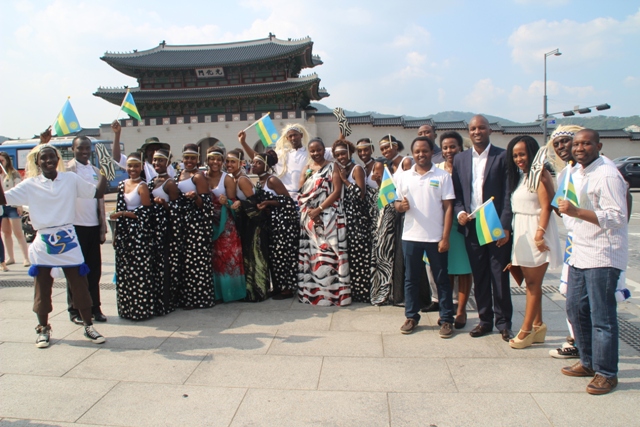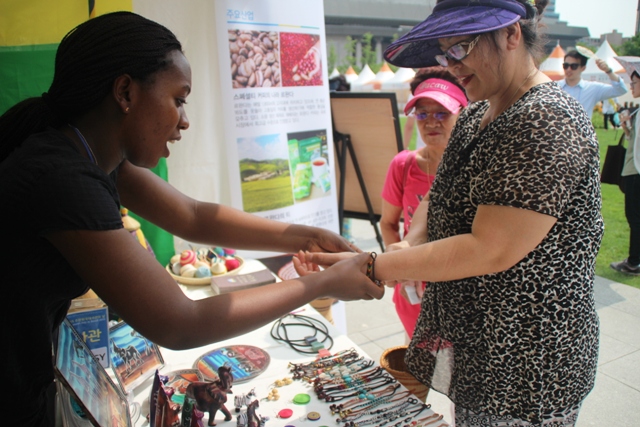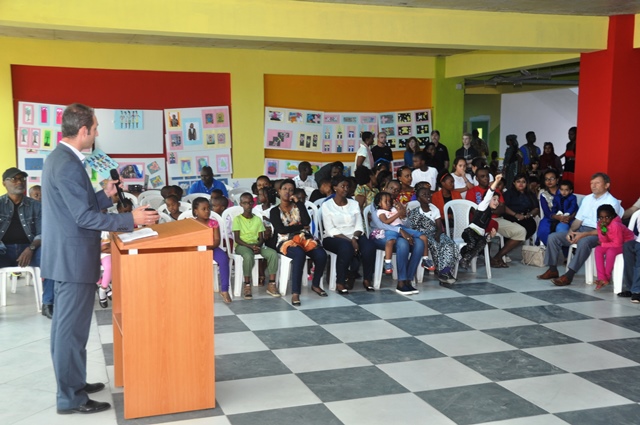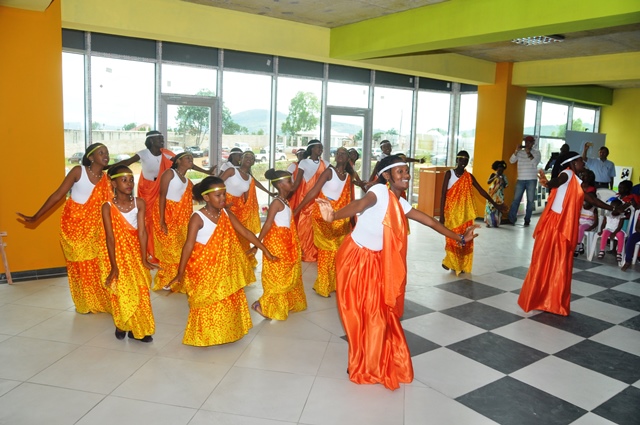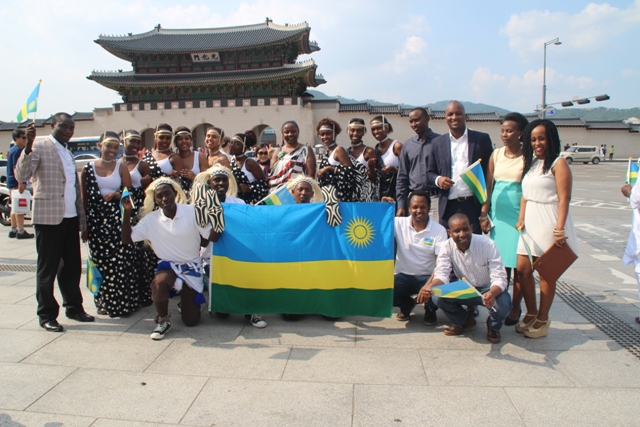
{{If the consensus seems to be that France is in a bad mood these days, one thing might cheer the country’s citizens up: despite reports to the contrary, their language is alive and well.}}
A recent study by French investment bank Natixis suggests that French could be the most-spoken language – ahead of even English and Mandarin – within 40 years.
That projection, which estimates 750 million French speakers by 2050, is based on the fact that the language is spoken in the fastest-growing areas of the world, particularly sub-Saharan Africa.
The methodology of the study has been disputed, notably by Forbes, since it counts all inhabitants of countries in which French is an official language as Francophone.
Still, the report comes as good news for defenders of the French tongue, which remains an official language of major international bodies like the UN, EU and Olympics Committee.
The Natixis report comes on the heels of a New York Times article about a French-language renaissance in New York – at least in public schools, where bilingual French-English curriculums are becoming increasingly common and popular.
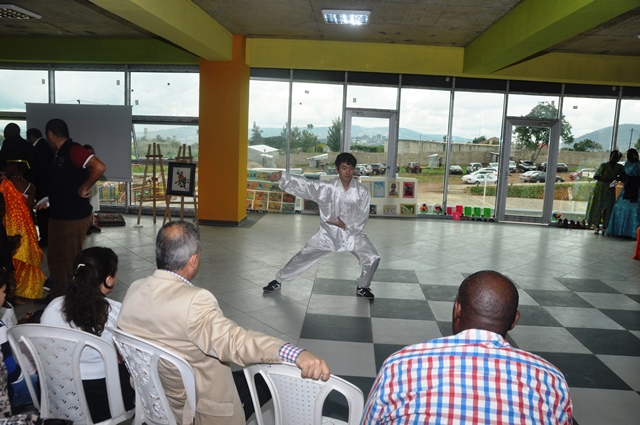
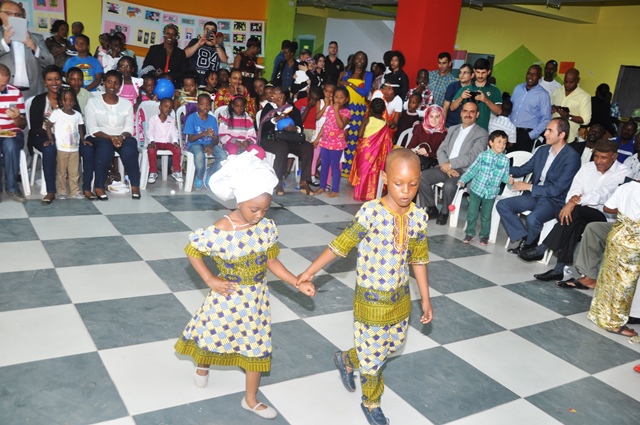
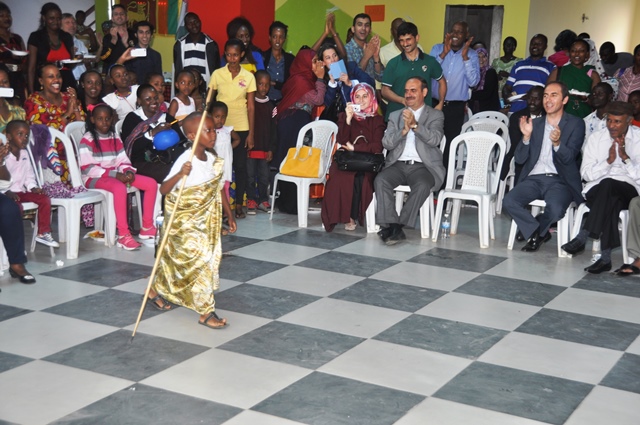
{{“As a deep expression of the human mind and as a universal art, poetry is a tool for dialogue and rapprochement. The dissemination of poetry helps to promote dialogue among cultures and understanding between peoples because it gives access to the authentic expression of a language.”}}
{In honour of the day, IGIHE presents to you a collection of poems by the late great Ghanaian Poet and Writer, Professor Kofi Awoonor in photo below}
{{OF HOME AND SEA I ALREADY SANG}}
A calm settles
at the beckon of sweet age…
Joy and hope soar
for the ultimate task
ahead written about, already
promised in the trajectories of jail,
in absence and exile…
That we will perform our duty by the people
depose the recalcitrant brutes
and march ahead of our beloved masses
to a coming kingdom…
Let the dream not die, master;
Let the dove coo at dawn again,
Let the masthead rear its head
out of the storm
and share the night with me on this sea.
Let me sing the song you gave me.
Before death comes, master,
Let me dance to the drums you gave me.
Let me sit in the warmth of the fire
Of the only native land you gave me.
{{A DEATH FORETOLD}}
Sometimes, the pain and the sorrow return
particularly at night.
I will grieve again and again tomorrow
for the memory of a death foretold….
I believe in hope and the future
of hope, in victory before death
collective, inexorable, obligatory;
in the enduring prospect of love
though the bed is empty,
in the child’s happiness
though the meal is meagre.
I believe in light and day
beyond the tomb far from the solitude
of the womb, and the mystical night,
in the coming of fruits
the striped salmon and the crooked crab;
I believe in men and the gods
in the spirit and the substance,
in death and the reawakening
in the promised festival and denial
in our heroes and the nation
in the wisdom of the people
the certainty of victory
the validity of struggle….
I will not grieve again tomorrow.
I will not grieve again.
{{GRAINS AND TEARS}}
…. Go and tell them I paid the price
I stood by the truth
I fought anger and hatred
on behalf of the people.
I ate their meagre meals in the barracks
shared their footsteps and tears
in freedom’s name
I promised once in a slave house in Ussher
to postpone dying until
the morning after freedom.
I promise.
{{SONGS OF SORROW}}
I.
Dzogbese Lisa has treated me thus
It has led me among the sharps of the forest
Returning is not possible
And going forward is a great difficulty
The affairs of this world are like the chameleon faeces
Into which I have stepped
When I clean it cannot go.
I am on the world’s extreme corner,
I am not sitting in the row with the eminent
But those who are lucky
Sit in the middle and forget
I am on the world’s extreme corner
I can only go beyond and forget.
My people, I have been somewhere
If I turn here, the rain beats me
If I turn there the sun burns me
The firewood of this world
Is for only those who can take heart
That is why not all can gather it.
The world is not good for anybody
But you are so happy with your fate;
Alas! The travelers are back
All covered with debt.
II.
Something has happened to me
The things so great that I cannot weep;
I have no sons to fire the gun when I die
And no daughters to wail when I close my mouth
I have wandered on the wilderness
The great wilderness men call life
The rain has beaten me,
And the sharp stumps cut as keen as knives
I shall go beyond and rest.
I have no kin and no brother,
Death has made war upon our house;
And Kpeti’s great household is no more,
Only the broken fence stands;
And those who dared not look us in his face
Have come out as men.
How well their pride is with them.
Let those gone before take note
They have treated their offspring badly.
What is the wailing for?
Somebody is dead. Agosu himself
Alas! A snake has bitten me
My right arm is broken,
And the tree on which I lean is fallen.
Agosi if you go tell them,
Tell Nyidevu, Kpeti, and Kove
That they have done us evil;
Tell them their house is falling
And the trees in the fence
Have been eaten by termites;
That the martels curse them.
Ask them why they idle there
While we suffer, and eat sand.
And the crow and the vulture
Hover always above our broken fences
And strangers walk over our portion.
{{THE WEAVER BIRD}}
The weaver bird built in our house
And laid its eggs on our only tree.
We did not send it away.
We watched the building of the nest
And supervised the egg-laying.
And the weaver returned in the guise of the owner.
Preaching salvation to us that owned the house.
They say it came from the west
Where the storms at sea had felled the gulls
And the fishers dried their nets by lantern light.
Its sermon is the divination of ourselves
And our new horizon limits at its nest.
But we cannot join the prayers and answers of the
communicants.
We look for new homes every day.
For new altars we strive to re-build
The old shrines defiled by the weaver’s excrement.
{{REDISCOVERY}}
When our tears are dry on the shore
and the fishermen carry their nets home
and the seagulls return to bird island
and the laughter of the children recedes at night,
there shall still linger here the communion we forged,
{{Rwanda’s popular Hiphop star Jay Polly has announced his support for Andika Rwanda, a national competition for writing stories and poems for children. }}
“I’m a writer,” Jay Polly said. “I write because I want to change people’s lives through the messages in my songs. You have to write to express yourself, you have to let people know what you think.”
The rapper made the comments at Lycee de Kigali on Friday during a surprise appearance at the secondary school’s morning assembly.
The competition, which launched last month, is a joint initiative of the Rwanda Education Board, the USAID-funded Literacy, Language, and Learning (L3) Initiative, implemented by the Education Development Center, and Drakkar Ltd.
The visit was to urge students and youth in general to adopt the culture of writing and to submit a story or poem to the competition.
Primary and secondary students—at both public and private schools—as well as adults are eligible to participate.
Winners receive tablets, books, and a trip to Kigali for a writers symposium and awards ceremony, as well as professional publication of their stories and poems.
The published volumes of winning stories and poems will then be distributed to primary schools across the country, providing children access to interesting, locally-authored stories and poems.
“Anyone can be a writer,” said Jay Polly. “Why not enter the competition?”
Primary and secondary students can learn more from their teachers, and adults can visit their sector offices for more information.
Interested participants can also visit www.reb.rw. The deadline for submissions is Friday, May 9th.
‘Dust’, the debut novel by Kenyan author Yvonne Adhiambo Owuor, is being hailed by reviewers in the United States as an “astonishing” and “dazzling” work.
A featured review in the March 2 New York Times edition says readers of Ms Owuor’s story “will find the entirety of human experience — tears, bloodshed, lust, love — in staggering proportions.”
The Washington Post noted last month that while “few American readers have heard of this 45-year-old author before, that must change.” Ms Owuor, the Post’s reviewer comments, “demonstrates extraordinary talent and range in these pages.”
Sunday New York Times reviewer Taiye Selasi, herself the author of an acclaimed novel about Ghana, further advises that ‘Dust’ is “not just for Afrophiles. It is for bibliophiles.”
‘Dust’ is a fictionalised account of Kenya’s history, as experienced through Ms Owuor’s imagined Oganda family. The book is likely to prove controversial in Kenya because of the author’s unsparing account of the nation’s failures and tragedies.
“The novel concerns itself with that country’s blood-soaked history — from the Mau Mau uprisings of the early 1950s to the political assassination of [nationalist Tom Mboya in] 1969 to the post-election violence of 2007,” Ms Selasi writes in her Times review.
Inventive prose
But the author’s inventive prose enraptures readers despite the novel’s emotionally wrenching storyline, reviewers agree, with Ms Selasi hailing “the magic Owuor has made of the classic nation-at-war novel.”
“The richness of the plot alone will challenge a lazy reader,” Ms Selasi adds. “But the visceral lusciousness of the prose will thrill a lover of language.”
“Ultimately,” she continues. “the disjointed prose mirrors brilliantly the fragmented nature of both memory-keeping and nation-building.”
The Washington Post’s reviewer, Ron Charles, offers a similar appraisal of the challenges and rewards of Ms Owuor’s writing.
The Kenyan winner of the Caine Prize in 2003 “has constructed a book that gradually teaches you how to read it,” the Post suggests. “Let the sensuous language of Dust wash over you with the assurance that its fragmentary scenes and allusive references will be visited again and gradually brought into clearer focus.”
Not every review of ‘Dust’, published in the US by Knopf, a leading New York publishing house, has been entirely positive.
A commentator on National Public Radio observes that every character in the novel “is given such ample room to wax philosophic on lofty concepts like nothingness and the idea of Kenya that it’s a struggle to actually get to know them.”
But this reviewer, too, was swept away by Ms Owuor’s writing.
“Her prose can be inventive, even breathtaking, turning phrases or fusing unexpected words in ways that confound and inspire.”
{{Can a half-Rwandan, half-Belgian French-speaking music sensation break through on an international, English-dominated music scene? Stromae took his charm offensive to London this week. }}
Attempting to break through to any English-speaking market is no easy task for a Francophone artist, yet there is something about Stromae, Belgium’s latest coolest export, that makes it more likely.
While his second studio album, “Racine Carré”, has been a chart-topper across much of Western Europe, the half- Belgian, half-Rwandan singer-songwriter still remains relatively unknown in the UK and the US.
His debut single, “Alors On Danse”, nonetheless managed to peak at number 25 across the Channel – a rare feat for any foreign-language track in the UK – giving the 28-year-old some exposure in the summer of 2010.
With 80 tour dates spanning from Berlin to Brussels, could Stromae’s (an anagram for ‘Maestro’) London gig be the springboard to greater things?
{{Charisma and charm}}
Playing at the Koko in London’s Camden last Thursday, on February 20, Stromae handily proved that wherever he performs, language is no barrier. What matters is the music, and how you deliver it.
Tickets to Stromae’s second London show sold out quickly, with venues holding over 1400, while a few desperate fans resorted to vainly seeking to buy unwanted extra tickets from the rapidly forming queue.
The vast majority of attendants were French-speaking, but a sizeable number of English speakers made their presence known, leading the Belgian star to offer multi-lingual speeches between sets.
Stromae began the show with an animated short of his younger-self on an apparent journey before emerging from a lit doorway to perform “Ta fête”, alongside three backing musicians.
His dress – a chequered turquoise cardigan, shorts and high-top socks – was no surprise to his fan base, nor his unorthodox dancing, which mainly consists of monster-like gestures and sporadic jumps. On anyone else, it might raise a few eyebrows; on Stromae, it’s part of his charisma and charm.
The stage is quite simple: a background screen is occasionally used for video imagery, Stromae’s three backing musicians are present, as well as two lit square root symbols, which reference the name of his latest album. But what material Stromae may lack on stage is made up for by his electrifying performances.
Despite the often sad and depressing subjects explored in his music, Stromae manages to keep the crowd moving. He appears genuinely moved as he sings his hit-single “Formidable”, wandering around the stage like the troubled drunkard depicted in the song’s video.
Towards the end, he looks up at a single light, eyes moist, in a shockingly genuine performance.
Even darker is the singer’s track “Quand C’est?” , about an imagined cancer striking his mother, and the vulnerability of children. A dark virus cell slithers across the background screen, and the audience falls silent.
{{‘Belgian fries’}}
Stromae pauses to give the crowd a cultural lesson, in the true meaning of his track “Moules Frites”.
“The truth is they are not French fries… they’re Belgian fries!” he jokes, encouraging the Belgian fans waving their flags along the front of the stage.
Moving onto his latest single “Tous les mêmes”, Stromae sits and begins applying make-up in order to convey the split between the male and female elements on stage – much like the song’s music video – while pink lights lit up when he starts singing the female parts, and green for the male.
The crowd goes particularly crazy when he performs “Alors On Danse” and “Papaoutai”, his most distinctive, and career-setting, singles to date.
Dancing alone on stage, singing with little fault, Stromae stood by his name’s meaning: the Belgian Maestro is a crowd pleaser.
His distinct lack of pretension makes you feel he is ‘one of us’, his modesty leaves you wanting to like him. He even took the time to thank practically every member of his production team on an individual basis.
To conclude, the Belgian star performed his non-vocal track “Merci” — a fitting closure. Supported by background visuals, the track reminded us that Stromae, beyond being simply a singer/performer, is, above all, a musician.
As the track closes, Stromae gives one last “Merci” before pulling an invisible cord, leaving the stage in darkness and fans cheering for more.
Stromae’s next tour dates see him return to France, Switzerland, the Netherlands and Belgium before two big dates in Montreal and New York in June, which may well define the rest of his career.
More than 100 copies of Anne Frank’s Diary of a Young Girl have been vandalised in public libraries in Japan’s capital Tokyo, officials say.
Pages have been ripped from at least 265 copies of the diary and other related books, they added.
It is not clear who is behind the vandalism. A US Jewish rights group has called for a police investigation.
Anne Frank’s diary was written during World War Two, while the teenager hid from the Nazis in occupied Amsterdam.
The book made her a symbol of the suffering of Jews during the war.
The head of Japan’s library council, Satomi Murata, told media that five of Tokyo’s wards had reported the vandalism so far.
“We don’t know why this happened or who did it.”
Meanwhile, Toshihiro Obayashi, a library official in West Tokyo’s Suginsami area, said: “Each and every book which comes up under the index of Anne Frank has been damaged at our library.”
The Simon Wiesenthal Center, a global Jewish human rights organisation, said it was shocked and concerned by the incidents, and called for the authorities to investigate.
“The geographic scope of these incidents strongly suggest an organised effort to denigrate the memory of the most famous of the 1.5 million Jewish children murdered by the Nazis in the World War Two Holocaust,” associate dean Abraham Cooper said.
“Anne Frank is studied and revered by millions of Japanese,” Mr Cooper added. “Only people imbued with bigotry and hatred would seek to destroy Anne’s historic words of courage, hope and love in the face of impending doom.”
The book was added to the UN Educational, Scientific and Cultural Organization’s Memory of the World Register in 2009.
{{Dozens more art works have emerged at the Austrian home of Cornelius Gurlitt, the German collector found in 2012 with hundreds of paintings believed stolen by the Nazis.}}
The latest finds in Salzburg include paintings by Renoir, Monet and Picasso.
A spokesman for Mr Gurlitt, who is in his eighties, said experts were examining the works to see if they were stolen during the Nazi era.
“After an initial assessment that suspicion is not confirmed,” he said.
More than 1,400 art works estimated to be worth $1.35bn (£846m), were discovered in Mr Gurlitt’s apartment in Munich in March 2012. But details of the find only came to light last year, apparently during a routine tax inspection.
Hundreds of the paintings were believed to have been looted by the Nazis. Mr Gurlitt’s late father Hildebrand was a Nazi-era art dealer but kept many of the works himself.
A lawyer, Christoph Edel, who is acting as supervisor for Mr Gurlitt, has arranged for the works found at the collector’s Salzburg home to be secured from any break-in or theft, German news agency DPA reports.
{Photographer and film-maker Jens Assur depicts urban Africa and challenges western preconceptions with highly topical photographic works, in an art project with the ironic title Africa is a Great Country. The exhibition will be on show at CRD Studio (former Camp Kigali) 12-22 February, 2014. “We’re constantly being fed an image of how Africa is dying,” explains Assur. “I want to show how Africa is thriving.” }
Jens Assur, one of Sweden’s top award-winning photographers and film-makers, has visited twelve African cities, including Kigali with the aim of challenging the dominant western media reporting on Africa and presenting a completely different picture of the continent instead. An Africa that is progressing and developing at a record pace, with countries that top the list of the world’s fastest growing nations.
“I’ve chosen exciting cities where growth and development can be seen clearly. One example is Kigali in Rwanda, which is associated in most people’s minds with the genocide of 1994. Today, the city is almost like a cross between Beverly Hills and Switzerland – prosperous, orderly and green. Or Gaborone in Botswana, a country that conjures up images of the No. 1 Ladies’ Detective Agency, with its red earth roads and its picturesque landscape. You could take a slice of the city and put it down in Los Angeles, and no-one would notice the difference.”
{Colombe Akiwacu, 19, was elected to represent the Eastern Province in Miss Rwanda 2014 competition. The event which took place on December 28, 2013, sees Akiwacu being crowned followed by Ruth Uwera as first runner and Fiona Ishimwe, second runner for the Eastern Province.}
The competition was held in Rwamagana District.
Colombe Akiwacu who studied in Stella Matutina was loaned to questions from the jury to reveal her future plans in case she is crowned Miss Rwanda 2014.
She says that she would ensure the interests of young people in the Province of East, she will be their spokesperson, she will fight the consumption of drugs among young people and that she will also fight for the protection of the rights of young Rwandan girls.
“I am proud to be recognized for my beauty. I wanted it so much. I trust myself to become Miss Rwanda 2014 because I met all the requirements of beauty and intellectuality “she told IGIHE’s reporter who was on the ground to witness the event.

National VIPs were invited to this event with the guest of honor, the Minister of Sports and Culture, Protais Mitali and the Governor of the Eastern Province, Odette Uwamariya.
IGIHE also noted the presence of Miss Rwanda 2012 Liliane Mutesi Aurore.