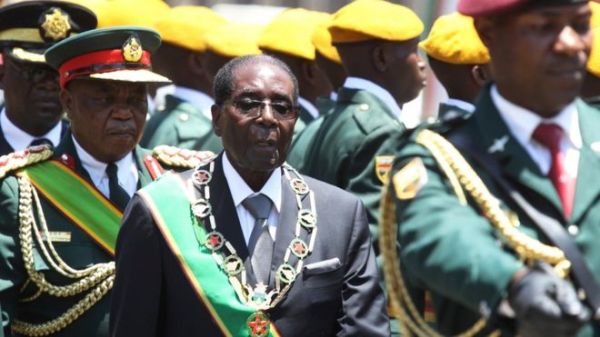
{Zimbabwean President Robert Mugabe has announced plans to water down a contentious law obliging foreign companies to hand over most of their shares to black Zimbabweans.}
The “indigenisation law” has been blamed for choking off investment.
It has never been fully implemented and Mr Mugabe has previously said many sectors of the economy are exempt.
But it has been widely criticised, including by the IMF, for contributing to the collapse of the economy.
In March, Zimbabwe threatened to close all companies that failed to comply with the legislation, which was passed in 2008, before later saying banks would be exempt.
The government says the aim of the law is to empower the majority black population who were disadvantaged by colonial rule.
But critics say it has benefited Mr Mugabe’s allies.
Speaking at the opening of parliament, Mr Mugabe also said the government would debate a bill on cybercrime.
Political activists say this could be used against opposition supporters using social media as a way of circumventing security laws banning gatherings without police permission.
There have been a number of protests against the government in recent months, largely because of the worsening economic situation.
{When Ethan Suglo was born with his organs outside his abdomen in Ghana, his parents worried he may never live a full, happy life. But thanks to the kindness of strangers he has had life-saving surgery in Oxford and has returned to Africa to be reunited with his family.}
As the sun set over Kotoka International Airport in the Ghanaian capital of Accra, a minivan pulled up filled with laughter.
Ethan’s welcoming committee had arrived – grandmothers, brothers and friends who drove two-and-a-half hours from their village to bring him home.
It had been three months since they last saw him, with his mother Bless telling me how “very, very happy” she was, because it was the longest the family had ever been apart.
“They left us and we prayed for them but now they are coming back,” she said, relieved.
Tearful hugs followed father Charles and Ethan’s appearance at the arrivals gate, among cries of “He looks good!” and “His English is really good!”
Mr Suglo tells me: “Travelling for so long and coming back is good, most especially seeing my wife and the other children.
“We’ve been through a lot. It’s going to be a new beginning in a positive direction.”
Ethan has exomphalos, which can be fatal but is routinely treated in the UK.
{{‘Been privileged’}}
Last year, Mr Suglo met doctors David and Jacquie Williams in Ghana and asked them to examine his son.
In March, the couple, from Stretton-on-Fosse, Warwickshire, started raising the money needed for air fares, surgery and nursing care, through the likes of bake sales and marathons, so he could have an operation at the John Radcliffe Hospital in Oxford.
The Willing and Abel charity, which helps children in developing countries receive treatment, also pledged £10,000 to help.
“For the past three months we’ve been privileged,” Mr Suglo says.
“We can thank God and the people of the UK, the surgical team at John Radcliffe Hospital, just everybody who contributed to saving Ethan’s life. It’s going to give us peace.”
We drove back to their home village of Akatsi that night in the dark, so it was hard to get a sense of the place.
But, as the sun rose I was struck by how green the surroundings were, with so much farming in the Volta region and so many lakes for fishing.
Along the roadside stalls of people sold phone credit, food, handkerchiefs, and even coffins.
At a party for Ethan, his compound was full of friends and family who came to celebrate his homecoming and successful operation.
It has given me an insight into what it means to be different and to have a disability in Ghana.
I met one teenage girl who was being driven out of her home because of her severe facial tumours, with her family being shunned.
{{‘Achieve dreams’}}
Willing and Abel says it’s about educating the elders, but the generosity of a Cotswold community has meant Ethan – a young boy thousands of miles away – has been given a chance of a new life.
Mr Suglo says the operation was “to save his life but to also give him a better life”, one “starting from scratch”.
“It’s to achieve his dreams,” he said. “He tells us he wants to be Doc. And that’s what we call David Williams – he’s Doc.
“I hope to see Ethan one day with his stethoscope diagnosing his father. We bought a toy stethoscope for him so he remembers.”
With £70,000 raised and counting, the charity intends to help other children in countries like Ghana who desperately need operations.
Exomphalos occurs when a child’s abdomen does not develop fully in the womb.
During pregnancy, the intestine develops inside the umbilical cord and then usually moves inside the abdomen after about 10 weeks.
In Exomphalos the intestines and sometimes other organs, such as the liver, remain inside the umbilical cord but outside the abdomen.
There is no known cause and about half of all babies with the condition will have problems affecting other organs, particularly the heart, lungs and kidneys.
Surgery is essential and takes place in either one go or over several weeks, depending on its severity.
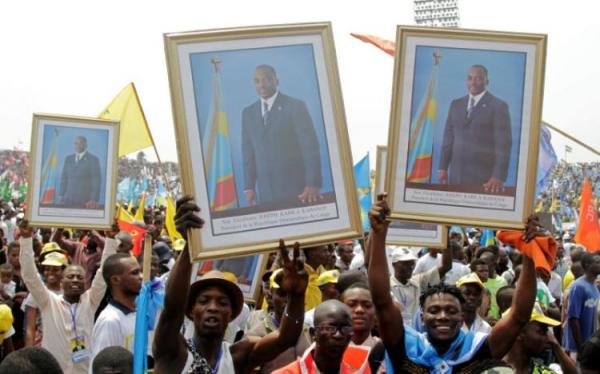
Shortly after Congo President Joseph Kabila came to power in 2001, the U.S. embassy in Kinshasa sent cables to Washington exuding quiet confidence in the 29-year-old who had replaced his recently assassinated father, Laurent.
In one, released later by Wikileaks, the ambassador described an articulate but shy man, seemingly weighed down by the burdens of leading Democratic Republic of Congo. Days later, Kabila spoke on television for the first time.
“Kabila’s address is encouraging, reflecting a shift toward the reform and moderate elements in the Congolese power structure,” the ambassador wrote.
Fifteen years later, with an election due but Kabila showing little sign of being ready to relinquish power, an incident at Kinshasa’s airport highlighted how much has changed.
Tom Perriello, the U.S. envoy to Africa’s Great Lakes region, was accosted on the tarmac by several angry, finger-wagging Kabila supporters, including a member of parliament. One of the men shouted, “Be careful of the Congolese. We no longer need you!”
For years one of Kabila’s firmest backers, Washington is now driving international efforts to prevent any bid to extend his time in power when his second term runs out in December.
Last month, the U.S. government imposed further sanctions on Congolese security officials after dozens of people protesting against election delays were killed in Kinshasa.
“At this point it, is clear the government has not been willing to move towards an open or participatory democratic election,” Roger Meece, a former U.S. ambassador to Congo who also ran the U.N. peacekeeping mission there, told Reuters.
“Private discussions are not working so you get to the point where public comment is the only way forward. The tools are pretty limited but we should be doing more with sanctions and specific actions.”
U.S. determination to see Kabila stand aside is rooted in a constitutional ban on him seeking another term. But the unprecedented intensity of the pressure stems from changes in both the United States and Congo.
For years, many in Washington saw Kabila as Congo’s best bet.
His 2006 election win against ex-rebel Jean-Pierre Bemba was credible, despite the street battles that followed. A 2011 election was widely criticized but Washington held its nose and recognized Kabila as winner over Etienne Tshisekedi, a veteran opposition leader whose fervent popularity at home is often matched by deep distrust among Kinshasa-based diplomats.
“American policymakers appear to have concluded that accepting Kabila, although ignoring democracy promotion, was the wiser course,” Anthony Gambino, a former head of USAID in Congo, wrote in 2012 for African Futures, a digital forum.
“It is not at all clear that accepting the fraudulent outcome leads to longer term stability.”
“OIL ON THE FIRE”
Coming from the Swahili-speaking east, Kabila has always been seen as an outsider in mainly Lingala-speaking Kinshasa, surrounded by political and family groups competing for access and influence.
Augustin Katumba Mwanke, one of his closest advisors, juggled these networks for years. But after he died in a plane crash in 2012, advisors multiplied and diplomats say it has become harder to decipher Kabila’s plans.
Many of those in Kabila’s close circle now appear mainly preoccupied with holding on to power, rather than ruling in a coherent way, some diplomats say.
As a result, issues have often been handled clumsily. For example, in 2015, security forces broke up a press conference organized by a small band of pro-democracy activists and partly sponsored by the U.S. government. A U.S. diplomat was caught in the swoop, angering Washington.
Accusations of U.S. interference have become increasingly common from the Kabila camp.
“We don’t need people throwing oil on the fire to try to blow up Congo,” Jean Thierry Monsenepwo, head of a pro-Kabila youth organization and one of Perriello’s airport critics, said to the cameras. “That is why we told this man that he is not welcome in this country.”
Kabila’s drift toward authoritarianism has also splintered his ruling alliance, the most significant loss being Moise Katumbi, the millionaire former governor of the mining province Katanga. In him, the opposition has someone with deep pockets and a favorable reputation in Washington.
{{REGIONAL SILENCE}}
The tough U.S. line is also an attempt to arrest a broader trend of regional leaders clinging power, after heads of state in Republic of Congo, and Burundi tweaked or sidestepped laws to extend their mandates.
Crucially, Congo has caught the attention of a number of senior U.S. officials, many of whom are becoming increasingly open about their frustrations over Kabila.
Senators of both major U.S. political parties have worked together on sanctions legislation. The creation of a special envoy post has seen administration officials with high level support jet in and take a more robust approach than when they relied solely on resident diplomats.
The U.S. Department of Justice also announced results of a long investigation that exposed how a U.S. hedge fund funneled $100 million in bribes to top Congolese officials in return for access to mining concessions.
In the case, the first U.S. foreign bribery case against a hedge fund, a subsidiary of Och-Ziff Capital Management Group pleaded guilty in federal court in Brooklyn last week to participating in a scheme to bribe Congolese officials. Och-Ziff will pay $412 million to resolve U.S. probes into its actions there and in other African countries.
With commodities prices low, U.S. businesses are less interested in Congo than they have been in the past. Phoenix-based Freeport-McMoRan Inc agreed earlier this year to sell its stake in Congo’s Tenke Fungurume copper and cobalt mine, part of efforts to cut its debt load. That means there are no longer any major U.S. economic interests in the country.
But Washington provides more than $400 million in aid every year to Congo on top of $300 million for the U.N. peacekeeping mission, bringing it clout. U.S. diplomacy has been active in the region, especially cracking down on Rwanda for backing rebels in eastern Congo.
For now, the U.S. position toward Kabila is far more hard-line than Western and African counterparts. Europe has ratcheted up rhetoric against Kabila but not yet found a common position on sanctions.
Jason Stearns, a Congo expert, said there was a reluctance in Europe to follow such an aggressive approach but the mechanics of pushing sanctions through the bloc were also a factor in EU foot-dragging.
In previous crises, Kabila has also been able to rely on the support of regional African powers such as Angola and South Africa for diplomatic and military support. So far, leaders have stressed the need for calm without stating a clear position.
Stearns questioned how much regional countries will appreciate Washington throwing its weight about on their patch. Meanwhile, emboldened by U.S. policy, Congo’s opposition is threatening further protests unless Kabila stands aside.
“People are growing more worried and lowering their expectations for what might be possible in terms of an orderly change of government there,” a U.S. Congressional staffer told Reuters, asking not to be identified. “In Congo, we are trying to avert a worst-case scenario.”
{Burundi plans to withdraw from the International Criminal Court, a deputy to President Pierre Nkurunziza said on Thursday, six months after the court’s prosecutor said it will investigate violence which killed hundreds of people.}
Burundi slid into political crisis last year when Nkurunziza announced his intention to seek a third term in office, which he went on to win in an election boycotted by opposition parties.
The Hague-based International Criminal Court’s prosecutor, Fatou Bensouda, said in April the court would investigate incidents of violence in Burundi that have killed at least 450 and forced hundreds of thousands to flee abroad since the crisis erupted in April 2015.
“We have sent to the national assembly a draft law for adoption … to withdraw from the ICC,” First Vice President Gaston Sindimwo said after a cabinet meeting.
“We found that it was necessary to withdraw from that organization so we can really be free,” he said in comments broadcast on state-run radio.
A notice of a cabinet meeting held earlier in the day in Gitega, some 100 km (60 miles) from the capital Bujumbura, said among the items to be discussed were a draft law revising a 2003 law that Burundi ratified to be a signatory of the Rome Statute of the ICC.
Opponents say Nkurunziza’s decision to seek a third term violated the constitution and a peace agreement that ended a civil war in 2005. The president and his supporters cite a court ruling that said he could run again.
Preliminary examinations at the ICC, based mainly on publicly available information, can last months or years before leading to a possible full investigation. Only then can criminal charges be brought against individuals suspected of war crimes or crimes against humanity.
On Tuesday, Burundi dismissed a U.N. decision to establish a commission of inquiry to identify perpetrators of killings and torture, saying it was based on a one-sided account of events in the African nation.
{The homes of opposition leaders were surrounded as early as 6 am on Friday}
Kampala- Police have this morning besieged homes of opposition politicians ahead of their “first independence day rally”.
The homes of opposition leaders were surrounded as early as 6 am on Friday. The Bweyogerere-Kirinya home of Kira Municipality MP, Ibrahim Ssemujju Nganda, the convener of today’s rally is surrounded by police.
However, Kampala Lord Mayor Erias Lukwago has been allowed to leave his Lubaga-Wakaliga home but with police trailing him. The home of Dr Kizza Besigye, the former presidential candidate of the Forum for Democratic Change remains under police siege.
A Thursday statement by Mr Andrew Felix Kaweesi, the police spokesman confirmed receipt of the opposition politicians’ letters informing them on the planned rallies but said the force was “resolute on ensuring the national celebrations are not disrupted” and instead invited the opposition to the function.
“The FDC party has been advised to attend national celebrations and desist from conducting any parallel celebrations. The general public is advised to avoid any parallel celebrations that are conducted outside the national celebrations,” Mr Kaweesi said in the statement.
Opposition politicians, however, remain defiant that their planned rallies will go on as scheduled.
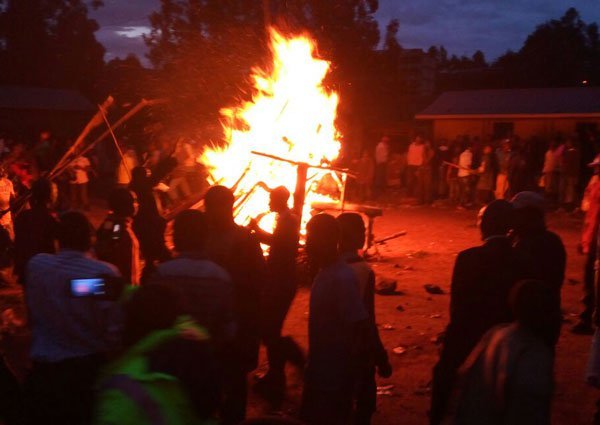
{Two women were shot dead by police in Daraja Mbili market, Kisii County, in evening chaos after boda bodas blocked Kisii-Kisumu highway.}
According to Dennis Ogero, an eyewitness, police officers driving along the highway stopped to disperse boda boda operators parked alongside the road.
A fight between the police and the operators broke out leading to the women getting shot.
Edna Osoro, 27, was selling tomatoes when she was struck and killed.
The officers had a hard time trying to retrieve the body.
Her death, along with another woman yet to be identified, sparked off chaotic scenes as stone throwing protesters engaged police in running battles.
Kisii Teaching and Referral Hospital (KTRH) chief executive Enoch Ondari said the woman died on arrival at the facility.
Edna’s father, Mr John Osoro, was inconsolable as he wept over the death of his daughter.
“I have just seen the worst day of my life. How could my daughter die in such an unnecessary manner?” He said.
Police finally managed to retrieve Edna’s body at 9:30 p.m. They also partially removed the fiery barricades along the highway before taking the body to the KTRH morgue.
{The Ministry of Industies, Trade and Investment has established a special desk where investors and businesspeople have direct communication in the quest to explore investment opportunities.}
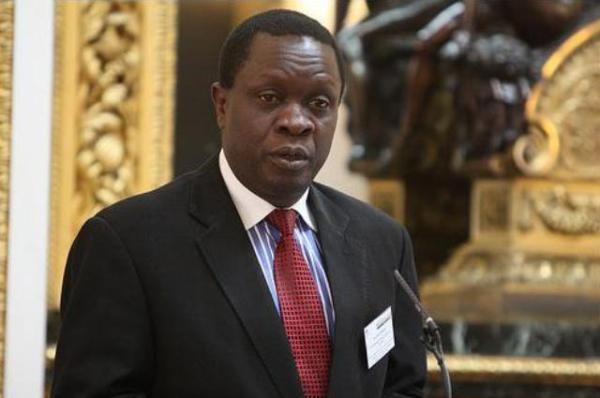
Industry, Trade and Investment Minister Charles Mwijage revealed this yesterday at Mwandege area during an official inauguration of the new Bakhresa Food Products Limited, a new company.
“I am a receptionist for all investors and businesspeople, therefore investors should not hesitate to come to my office,’’ he told the gathering led by President John Magufuli. According to the minister, as per June 2016, 64 business licences were issued by his ministry.
Mwijage was optimistic that in implementation of an industrial economy agenda, more farmers will produce more and bring to the country an industrial revolution. He added that already there is an investor who is set to establish the tiles producing industry that is expected to produce high quality tiles in the East and Central Africa, adding that the completion of that industry will ease the burden of importing tiles from outside the country.
On his part, Coast Regional Commissioner Eng Evarist Ndikilo said he intends to make his region an industrial zone as it had a large portion of land compared to other regions. He said his region had a greater advantage as it was just few kilometres from the commercial centre of Dar es Salaam that has a population of more than four million.
In his strategies he said every District Council shall allocate special plots for industries insisting that all districts had already started implementation of the directive. According to him, Kibaya District had allocated 3,366, Mafia 4,440, Mkuranga more than 7,000, Rufiji 25,000 and Kisarawe 4,500 hectares respectively.
Eng Ndikilo added that his region had 88 small and large industries including the biggest industry that shall be producing the best tiles in East and Central Africa.
According to Mkuranga Member of Parliament Abdallah Ulega, 53 industries are expected to be operational in his constituency. “Citizens are well prepared to explore opportunities in the industries because of the gas pipeline from Mtwara to Dar es Salaam,’’ he said. On his part, Dr Magufuli reiterated his quest for transforming Tanzania into an industrial economy, calling for more investors in the country.
Dr Magufuli said in Mkuranga District, Coast Region that his government wants the industrial sector to contribute 15 percent of the country’s Gross Domestic Products (GDP) as well as employing more than 40 percent of the country’s population. “As more people secure jobs the standard of lives of our people continue improving,’’ he said.
The president visited the two industries and witnessed the production process at the US Dollars 120 million (240bn/-) project where he was briefed how the industries run their operations.
The Head of State thanked the country’s tycoon Said Salim Bakhresa for putting up the two industries in the new company saying he was among the businesspeople he wants in transforming the country into an industrial economy.
“I need businesspeople like you who pay tax, create employment opportunities and I hate those who evade tax,’’ he said adding: “Since I was elected president of this country, this is the first industry I am launching… I need more industries and I will be ready to officiate official launching even if invited at night,’’ he added.
According to him, Tanzania was among the African countries with fast growing economy saying it was the second in Africa after Côte d’Ivoire.
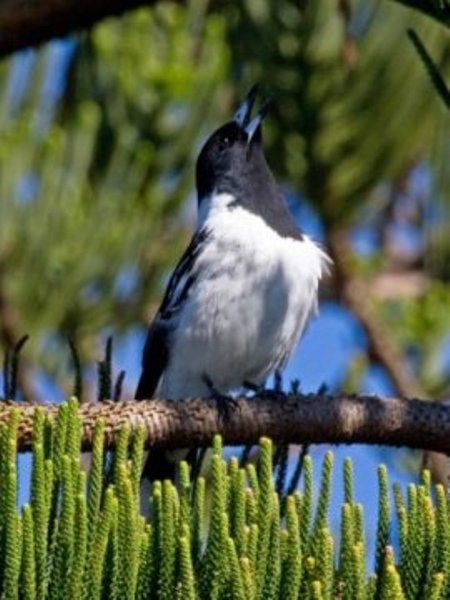
{The tuneful behavior of some songbirds parallels that of human musicians.That’s the conclusion presented in a recent paper published by an international team of researchers, among them David Rothenberg, distinguished professor of philosophy and music in NJIT’s Department of Humanities. Other members of the team are from the City University of New York (CUNY), the Freie Universität Berlin and Macquarie University in Australia.}
“Temporal regularity increases with repertoire complexity in the Australian pied butcherbird’s song” was published online in Royal Society Open Science.
{{A Very Musical Species}}
The pied butcherbird, a very musical species, provided a wealth of intriguing data for analysis by co-author Eathan Janney, a Ph.D. candidate in the Department of Psychology at CUNY’s Hunter College. Janney based his analysis upon years of data collected and also analyzed by violinist and biomusicologist Hollis Taylor of Macquarie University, who has previously published extremely detailed analyses of butcherbird songs. “Since pied butcherbird songs share so many commonalities with human music,” Taylor writes, “this species could possibly revolutionize the way we think about the core values of music.”
In the past, claims that musical principles are integral to birdsong were largely met with skepticism and dismissed as wishful thinking. However, the extensive statistical and objective analysis of the new paper demonstrates that the more complex a bird’s repertoire, the better he or she is at singing in time, rhythmically interacting with other birds much more skillfully than those who know fewer songs. The accompanying video includes a sample of a butcherbird’s solo song, as well as the song of another butcherbird and an Australian magpie.
Co-author Ofer Tchernichovski, professor in the Hunter College Department of Psychology, finds that the butcherbirds “balance their performance to keep it in a sweet spot between boredom and confusion.” Constance Scharff, a co-author who directs the animal behavior laboratory at the Freie Universität Berlin, says “pied butcherbirds, not unlike jazz musicians, play around with their tunes, balancing repetition and variation.” This finding suggests that such musical virtuosity may signify more than just the evolution of a way for birds to establish territorial dominance and facilitate mating. It may also provide evidence that musical ability in birds was a precursor to the evolution of the many dimensions of musical ability in humans.
{{Inclusive Multidisciplinary Research}}
The paper is the product of inclusive multidisciplinary research. It integrates input from biologists, neuroscientists, musicians and engineers, including co-author Lucas C. Parra, a member of CUNY’s Department of Biomedical Engineering.
Rothenberg, who provided his unique perspective, says, “Science and music may have different criteria for truth, but sometimes their insights need to be put together to make sense of the beautiful performances we find in nature.”
Rothenberg has written extensively about the bond between humans and our surrounding natural world, a world we share with myriad other creatures. An earlier paper that he co-authored, “Investigation of Musicality in Birdsong,” published in Hearing Research touched upon aspects of the same topic explored in the recent Royal Society publication. Rothenberg’s book Why Birds Sing is an in-depth look at the subject that challenges neuroscientists to seriously consider music as a tool to help understand birdsong.
As a musician — he plays the clarinet and saxophone — Rothenberg has added the dimension of music to research connecting the living sounds of the natural world to traditions of global rhythmic innovation and improvisation. His book Thousand Mile Song is about making music with whales, and Bug Music, How Insects Gave Us Rhythm and Noise offers the provocative premise that listening to cicadas, as well as other humming, clicking and thrumming insects, fostered an innate sense of musical rhythm and synchronization over the long history of human evolution.
{Street children are accusing their parents of making their life hard to stay at home citing corporal punishments and endless harassment and torture as some of the reasons they have decided to abandon their parents to hustle on streets.}
On October 6, Rwanda National Police (RNP) received at least 12 street children including girls, who were mobilized and convinced to abandon the street life.
This was after one of the girls aged nine years, a day before, was approached by the director of Political and Civic Education in RNP, Chief Supt. Rose Muhisoni, in the city centre, sensitized and counseled her to get off the street.
The girl then volunteered and mobilized eleven others, who were picked and taken to Gitagara rehabilitation centre in Bugesera District.
The children, who spoke to the media at the RNP General Headquarters in Kacyiru, before being transported to Gitagara, expressed their disappointment to their parents, whom they say mistreated them while others were fade up with domestic conflicts between their parents.
“My mother would leave me at home alone and she would come back drunk late in the night, beats me for nothing using any object she came across,” Uwamariya (not real names), one of the children aged 9, who hails from Gikondo in Kicukiro district, said.
She recalls one night when her mother came home and hit her with a mingling stick which affected one of her arms. She can hardly use the affected arm to lift anything.
“I was in primary two and performing well in school. I have been on the street for almost a year but life there is not easy; you have to bear days and nights without anything to eat; sometimes you are beaten or sexually abused at night by people you even don’t know. I want to go back to school and I hope this is my turning point,” Uwamariya says.
Uwamariya’s ordeal is shared with Thiery, 14, who has been on the street for more than two years.
To Thiery, together with her young brother, they decided to leave their parents in Gicumbi District after their father subjected them, together with their mother, to beating every night accusing them of either cooking little food or eating and leaving him little.
“He wasn’t contributing anything to the family and yet the food our mother could afford to work hard to get was little for his way of eating, and we could all be answerable when he returned home late at night and drunk,” Thiery, the eldest in the family of seven, said.
The mother also separated from their father.
He also accuses their mother of not being stable to look after them noting that since she left their father, she has been remarried three times.
Almost all the children share the same story.
According to Chief Supt. Muhisoni, getting children off the streets is in line with the implementation of the national policy, which was also discussed early this week during the RNP senior commanders’ meeting, which was also attended and addressed by the Minister of Gender and Family Promotion on the protection of child rights.
“This is an exercise we conduct as police in partnership with other line ministries including the Ministry of Gender and Family Promotion,” she said.
She emphasized that most of the children that have been taken off streets blame their parents for their fate.
“Some parents have forgotten or care less about their responsibilities; these children are innocent, they don’t deserve to be on streets but life at home where they face various forms of torture that arise out of their parents’ domestic conflicts, drives them out of their homes,” she noted.
“Abandoning children or subjecting them to any form of torture is a crime. When you decide to give birth, you have accepted all the responsibilities as a mother or father. You have to provide basic necessities like shelter, food, education.”
Child abandonment or neglect, under article 231 of the penal code, is punishable with an imprisonment of up to five years.
CSP Muhisoni appealed to the general public and grassroots leaders in particular to work together to protect and promote the rights of children and identify families that could be facing domestic conflicts to address them before they escalate or turn violent.
Rwanda National Police is currently engaged in awareness campaigns against domestic and gender based violence, and child abuse, through which it also identifies, reconciles and reunites disputed couples.
The establishment of Isange One Stop Centre, which has since been scaled up to 28 other district hospitals across the country, has also been vital in offering free medical, psycho-socio and legal services to victims of GBV and child abuse.
Chief Supt. Muhisoni also appealed to the public to utilize the available police communication channels to report abuses in their localities.
The toll-free lines include 116 for child abuse, 3512 for GBV, 3029 for Isange One Stop Centre and 112 for emergency.
{American professional golfer Tom Kite said two things about distraction that sum up the findings of a new study on the subject: First, “You can always find a distraction if you’re looking for one.” And, second, “Discipline and concentration are a matter of being interested.”}
The new research offers evidence that one’s motivation is just as important for sustained attention to a task as is the ease with which the task is done. It also challenges the hypothesis, proposed by some cognitive neuroscientists, that people become more distractible as they tackle increasingly difficult tasks.
A report of the new study appears in the Journal of Experimental Psychology: General.
“People must almost continuously balance their need for inner focus (reflection, mental effort) with their need for attending to the world,” write the authors of the study, University of Illinois psychology professors Simona Buetti and Alejandro Lleras. “But, when the need for inner focus is high, we may have the impression that we momentarily disengage from the world entirely in order to achieve a heightened degree of mental focus.”
Buetti and Lleras designed several experiments to test whether people are more easily distracted when the mental effort required to complete a task goes up, as is generally assumed in their field.
The researchers first asked participants to solve math problems of varying difficulty while photographs of neutral scenes — for example, cows in a pasture, a portrait of a man, a cup on a table — flashed on a computer display for three seconds, enticing the subjects to look at them. An eye-tracking device measured the frequency, speed and focus of participants’ eyes as they completed the math problems.
The results showed that participants who were engaged in an easy version of the task were more likely to look at the distractors than those engaged in an extremely challenging version. These results run counter to current theories, the researchers said.
“This suggests that focus on complex mental tasks reduces a person’s sensitivity to events in the world that are not related to those tasks,” Buetti said. This finding corroborates research on a phenomenon called “inattentional blindness,” in which people involved in an engaging task often fail to notice strange and unexpected events.
“Between the inner world of solving a problem and the outer world — what’s going on around you — there seems to be a need to disengage from one when heightened attention to the other is required,” Lleras said.
“Interestingly, when participants completed a mix of easy and hard tasks, the difficulty of the task did not seem to affect their distractibility,” Buetti said. This finding led the researchers to hypothesize that the ability to avoid being distracted is not driven primarily by the difficulty of the task, but is likely the result of an individual’s level of engagement with the endeavor. They call this concept the “engagement theory of distractibility.”
The team did further studies to test this idea, manipulating subjects’ enthusiasm for the task with financial incentives. To the researchers’ surprise, this manipulation had little effect on participants’ distractibility. However, there were large differences between people in terms of their distractibility.
“The more participants struggled with a task, the more they reflexively avoided distraction, irrespective of financial incentive,” Buetti said. “So, the take-home message is: Characteristics of the task itself, like its difficulty, do not alone predict distractibility. Other factors also play a role, like the ease with which we can perform a task, as well as a decision that is internal to each of us: how much we decide to cognitively engage in a task.”