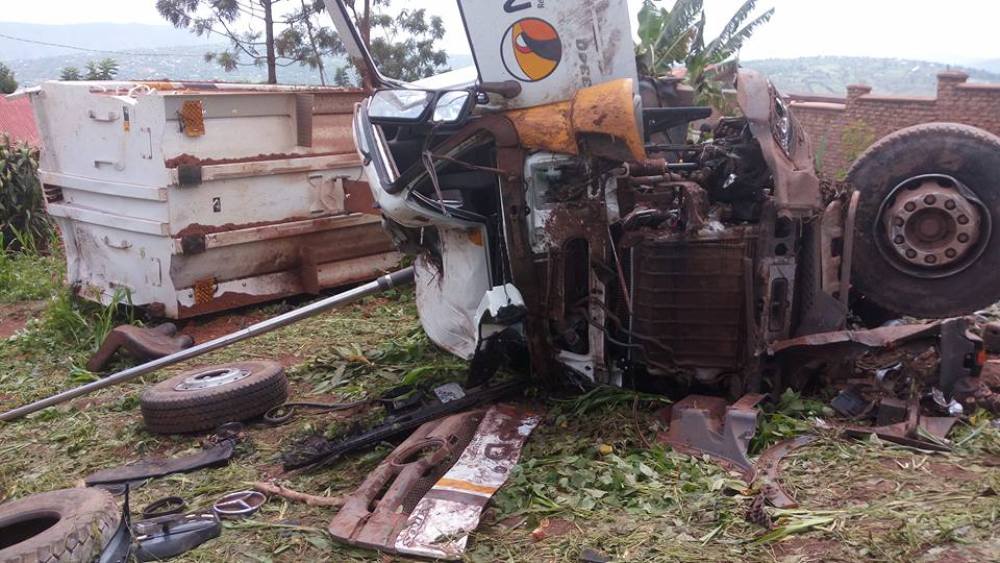
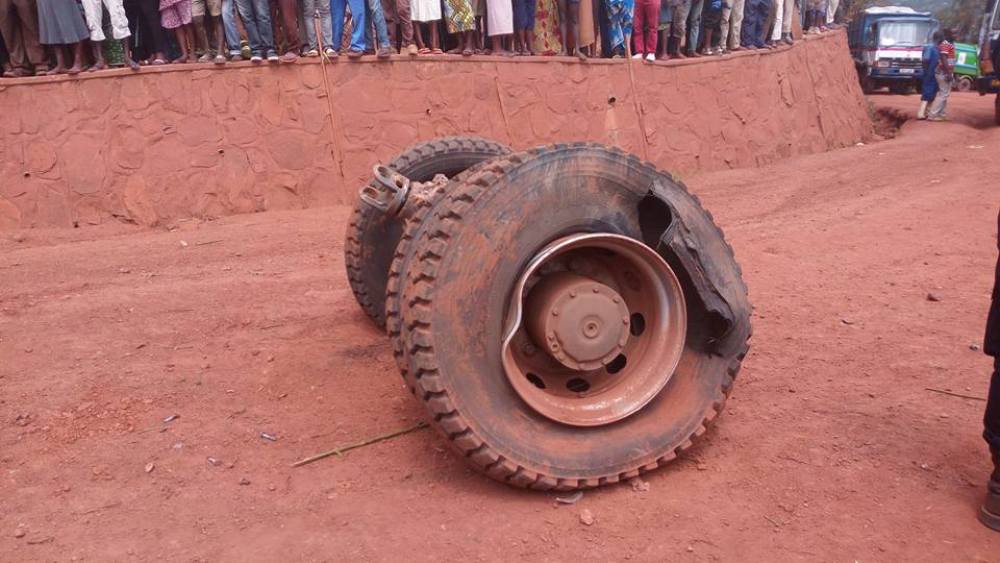
{A truck of NPD COTRACO carrying murram in Nduba sector of Gasabo district has killed three students while the driver died on arrival at hospital.}
The executive secretary of Nduba sector,Providence Musasangohe has told IGIHE that the accident took place in Gasanze cell around 12:00 hours yesterday saying it may have been caused by brake failure.
“The truck that belongs to NPD COTRACO carrying soil is suspected to have experienced brake failure and hit three students to death,” she said.
“The truck driver was pronounced dead on arrival at Kabuye Health Center,” she added.
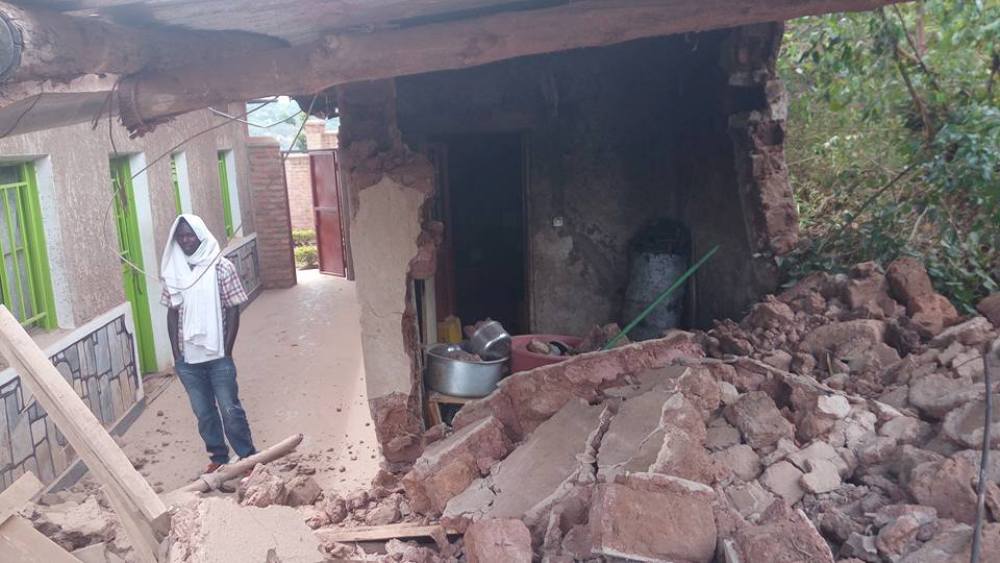
The truck also destroyed a house on the roadside but no one was inside.
Traffic police spokesperson,CIP Emmanuel has confirmed the accident but the cause has not yet been established.
Governments across Africa, private sector actors, donors and development partners have been urged to step up efforts to accelerate Africa’s path to prosperity, inclusive growth and decent jobs creation by moving from agricultural commitments to action.
The call was made at the official unveiling of Côte d’Ivoire as the host of this year’s African Green Revolution Forum (AGRF), hailed as premier continental agriculture gathering, to be held on 4-8 September 2017.
The west African nation, a leading agricultural powerhouse and a hub of expertise in improving smallholder farming, will be the first francophone African country to host the annual Forum.
Chosen for its leadership in placing agriculture at the heart of its economic transformation, Côte d’Ivoire is among a few select African countries that have made the biggest investments in agriculture resulting in sizeable increases in both farm productivity and overall economic performance.
These countries provide a shining example of agriculture’s potential to turnaround the continent’s economic fortunes.
Under the leadership of His Excellence President Alassane Dramane Ouattara, the AGRF 2017 will focus on Accelerating Africa’s Path to Prosperity: Growing Economies and Jobs through African Agriculture.
MamadouSangafowaCoulibaly, Minister of Agriculture and Rural Development, Côte d’Ivoire, emphasised his country’s commitment to continually improve the agricultural sector which is key to its economic development.
“Five years of significant investments through the National Agricultural Investment Plan have enabled the country to empower farmers and place them at the heart of Côte d’Ivoire’s economic transformation. The first phase of the NAIP contributed to a significant boost in our agricultural production, with more than 17 million tons of food crops in 2015 compared to 11,886 million? Tons in 2012. We are delighted to see that our efforts are being recognized internationally. We are confident that Phase 2 of the NIP, based on a more integrated approach that includes water resources management, health, electricity and education, will help to lift farmers out of poverty and further stimulate our economy. Côte d’Ivoire is committed to developing its agricultural economy, this needs to be consolidated. ”
Agriculture is the backbone of Côte d’Ivoire’s economy and its robust growth is driven by sustained investment in agriculture and smallholder farmers. The sector contributes 26 percent of GDP, 40 percent of all export revenue, close 75 percent of non-oil export revenue and employs close to 60 percent of the population. The 2016-2020 National Development Plan (PND) aimed at guiding the country into emerging nation status by 2020, considers agriculture as a key pillar and specifically calls for an increase in agricultural output.
Speaking at the launch event in Abidjan, Agnes Kalibata, President of the Alliance for a Green Revolution in Africa (AGRA), said “Agriculture is now back at the top of Africa’s development agenda as an economic driver for inclusive and sustainable development. After Seizing the Moment at AGRF 2016 and securing political, policy, and financial commitments of more than $30 billion. As agriculture is the surest path to Africa’s prosperity, we now need to harness this surge of support for agriculture and ensure it creates decent jobs and drives economic growth across the continent.”
Similar sentiments were echoed by the President of the African Development Bank, AkinwumiAdesina. Highlighting the Bank’s prioritization of the agriculture sector against its $24 billion Feed Africa strategy, Adesina said “AGRF 2017 will bring together stakeholders in the African agricultural landscape to share lessons on countering the challenges being experienced in the agricultural sector across the African continent.
The forum, expected to host African Heads of State, ministers, farmer organizations, private agribusinesses, financial institutions, researchers, development partners, and implementing organizations, will provide a platform where delegates can discuss and advance policies, programmes, and scalable investments for the enhancement of agricultural transformation and food security. Through its Feed Africa Strategy, the African development Bank will raise its financing of agriculture to over USD24 billion in the next 10 years”
{Police in Huye District have arrested three people including a female nurse for allegedly conniving and throwing a new-born baby in a pit.}
The Southern Region Police Spokesperson, Chief Inspector of Police (CIP) Andre Hakizimana identified the trio as Louise Uwamariya, Jean Baptiste Sindikubwabo and Claudine Mukankusi.
They were arrested on April 17 following investigations after retrieving the body of the baby, which has since been taken to the University Teaching Hospital Butare (CHUB) for postmortem.
Police said the mother of the baby connived with the Uwamariya, her relative to throw the baby in the latrine soon after birth.
CIP Hakizimana said that after carrying out the crime, the mother of the child was taken to hospital.
“She sought medical attention because of bleeding. While at Ngoma health center, doctors discovered that the cause of the bleeding was associated with child birth or abortion but could not see the baby,” explained CIP Hakizimana.
He said that the hospital management immediately contacted police.
“After investigations, it was revealed that the trio had conspired to throw the baby in the latrine where it was discovered.” he said.
It is alleged that the mother of the baby had travelled from Kigali, where she was residing, to Huye where she sought help with her accomplices.
“This is an inhuman and criminal act; this baby had a right to live, and as a nurse, she should have also stood by ethical standards and give some professional advice to the expecting mother on the best way to save both the baby and the mother,” he said.
The criminal action which is classified as infanticide under section one of article 143 of the panel code, sets a life imprisonment upon conviction.
{Your teeth are important to your mouth, and a toothache will only just remind you why your teeth are important and why you ought to take proper care of them.}
These are some important rules you must not ignore.
{{1. Brush your teeth at least twice daily }}
This is a tip that’s taught from elementary school, and brushing your teeth at least twice daily will help reduce the impact of bacteria on the teeth.
Remember to brush thoroughly in an up and down motion.
{{2. Don’t brush too hard }}
Scrubbing your teeth vigorously can damage your gumline, lead to toothache and is even a waste of time, as all the teeth need is a gentle up and down motion across the surface.
{{3. Avoid caffeinated rinks }}
Food acids can cause severe damage to the teeth in the long run. Try as much as possible to limit your intake of sugary foods, tea, coffee and soda. Try as much as possible to use a straw.
{{4. Use a toothpaste that contains fluoride }}
Fluoridated toothpaste are the best for your teeth, as they help harden the tooth enamel and reduce the risk of decay.
{{5. Avoid using your teeth as a tool }}
A lot of people use their teeth as a bottle opener, a nail cutter and to do all manner of things. This is very harmful to the teeth, and avoid chewing ice blocks as well; the temperature is too extreme for your teeth.
6. Don’t fail to visit your dentist regularly for checkups, especially when you notice pains or anything strange.
If you want your teeth to serve you well till old age, then you must take care of it from your young age.
{Rwanda National Police (RNP) has advised the public against keeping large sums of money in their house, which can influence house break-in and theft.}
The call comes in a wake of recent incident in Kigali where a househelp broke into his employer’s bedroom and stole Rwf1.4m and US$100 before fleeing.
Police spokesperson for the City of Kigali, Supt. Emmanuel Hitayezu, said that the, suspect Pierre Ngirababyeyi had made a copy of the key to his employer’s bedroom, thus gaining access.
Eddy Fernand Habimana had made copies of his (Habimana’s) bedroom, opened it and stole the money.
“On realizing that the money was stolen, the victim, Eddy Fernand Habimana reported to Police. Immediate investigations led to the suspect in Musambira of Kamonyi District where he was hiding, and brought him back to Kigali where he committed the offence, and currently held at Kacyiru Police Station,” said SP HItayezu.
“Of the stolen amount, the suspect had only spent Rwf84, 000, but the rest of the stolen money was recovered from him at the time of arrest, and two smartphones – Samsung S7.”
“We highly recommend that people resort to smart transaction and not keep or walk with such amounts as it makes them soft target for robbers… By keeping or moving with bulk of money, you are also exposing yourself but also fueling criminality,” said the spokesperson.
The money and the phones were handed back to the owner, Habimana.
Habimana hailed Rwanda National Police for the quick intervention and recovering his stolen monies and items.
“I am very thankful to RNP for the professionalism they exhibited. As soon as I informed them about the theft, they immediately started investigations that let to the recovery of my money and my phones and arrested the prime suspect ,” he said.
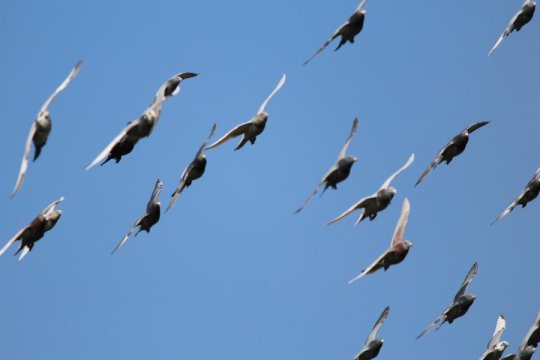
{Homing pigeons may share the human capacity to build on the knowledge of others, improving their navigational efficiency over time, a new Oxford University study has found.}
The ability to gather, pass on and improve on knowledge over generations is known as cumulative culture. Until now humans and, arguably some other primates, were the only species thought to be capable of it.
Takao Sasaki and Dora Biro, Research Associates in the Department of Zoology at Oxford University, conducted a study testing whether homing pigeons can gradually improve their flight paths, over time. They removed and replaced individuals in pairs of birds that were given a specific navigational task. Ten chains of birds were released from the same site and generational succession was simulated with the continuous replacement of birds familiar with the route with inexperienced birds who had never flown the course before. The idea was that these individuals could then pass their experience of the route down to the next pair generation, and also enable the collective intelligence of the group to continuously improve the route’s efficiency.
The findings, published in Nature Communications, suggest that over time, the student does indeed become the teacher. The pairs’ homing performance improved consistently over generations — they streamlined their route to be more direct. Later generation groups eventually outperformed individuals that flew solo or in groups that never changed membership. Homing routes were also found to be more similar in consecutive generations of the same chain of pigeon pairs than across them, showing cross-generational knowledge transfer, or a “culture” of homing routes.
Takao Sasaki, co-author and Research Fellow in the Department of Zoology said: ‘At one stage scientists thought that only humans had the cognitive capacity to accumulate knowledge as a society. Our study shows that pigeons share these abilities with humans, at least to the extent that they are capable of improving on a behavioural solution progressively over time. Nonetheless, we do not claim that they achieve this through the same processes.’
When people share and pass knowledge down through generations, our culture tends to become more complex over time, There are many good examples of this from manufacturing and engineering. By contrast, when the process occurs between homing pigeons, the end result is an increase in the efficiency, (in this case navigational), but not necessarily the complexity, of the behaviour.
Takao Sasaki added: ‘Although they have different processes, our findings demonstrate that pigeons can accumulate knowledge and progressively improve their performance, satisfying the criteria for cumulative culture. Our results further suggest that cumulative culture does not require sophisticated cognitive abilities as previously thought.’
This study shows that collective intelligence, which typically focuses on one-time performance, can emerge from accumulation of knowledge over time.
Dora Biro, co-author and Associate Professor of Animal Behaviour concludes: ‘One key novelty, we think, is that the gradual improvement we see is not due to new ‘ideas’ about how to improve the route being introduced by individual birds. Instead, the necessary innovations in each generation come from a form of collective intelligence that arises through pairs of birds having to solve the problem together — in other words through ‘two heads being better than one’.’
Moving forward, the team intend to build on the study by investigating if a similar style of knowledge sharing and accumulation occurs in other multi-generational species’ social groups. Many animal groups have to solve the same problems repeatedly in the natural world, and if they use feedback from past outcomes of these tasks or events, this has the potential to influence, and potentially improve, the decisions the groups make in the future.
{Members of Community Policing Committees (CPCs) in Gasabo District have been urged to strengthen their role in curbing crimes by enhancing their cooperation with the Police to ensure maximum safety.}
The call was made by Inspector of Police (IP) Theogene Mugabo, the District Community Liaison Officer (DCLO) for Gasabo while meeting with about 115 CPCs of Gisozi Sector, on April 15.
The meeting that was attended by local leaders and community night patrols.
It intended to enhance partnership between Police and stakeholders in implementing community policing initiatives.
IP Mugabo noted that drug abuse remains one of the challenges affecting security, which he said should be given special attention to break other crimes it fuels.
“We find most crimes are related to drug abuse, like domestic and gender based violence, assault and theft; so endeavor to work with the residents to identify drug dealers and abusers, and facilitate easy means to fight them,” IP Mugabo said.
He further urged them to involve the public on matters of security through neighborhood watch and vigilance to identify and prevent anything that can impede on the safety and security of the community.
He also urged them to lead by example and desist from anything that can tarnish the image of their activities.
Joseph Murangwa, speaking on behalf of the CPC’s hailed the collaboration with police mainly through giving them skills on maintaining security and arousing them about security consciousness.
He reiterated their commitment to ensuring security prevails in their localities.
{A man’s sperm is an important part of him, and if the sperm is negatively affected, fertility would become difficult.}
Doctors and medical experts have warned that these six things are a must if you want healthy sperm:
{{1. Work out }}
Harvard researchers found that men who worked hard the most had a 33% sperm count than men who exercised the least. This is because exercising helps burn fat and boost testosterone.
{{2. Maintain a healthy weight }}
Being overweight or obese can negatively affect your sperm health. Another important reason to visit the gym.
{{3. Avoid excessive alcohol intake }}
Health experts have warned that excess alcohol consumption can have adverse effect on your sperm health. Excess alcohol intake can affect your liver function, testosterone, libido and sperm in diverse ways.
{{4. Eat healthy }}
The quality of your diet can also have a good impact on your sperm quality. Foods like vegetables and whole grains and foods rich in proteins are good for your sperm. Foods rich in lycopene like tomatoes are also good for your sperm quality. Whereas junk foods have detrimental effect on your sperm quality.
{{5.Beware of your mobile phone }}
In a Cleveland clinic study, men who used their phones more had decreased sperm mobility than men who didn’t use it that much. Be wary of putting your phones in your front pocket.
{{6.Reduce stress level }}
Stress is a sperm killer; so you must try to reduce your stress level and observe more rest. Stress can lead to erectile dysfunction, which will make it harder for reproduction to occur.
{President Paul Kagame and First Lady Jeannette Kagame yesterday arrived in Djibouti for a two-day State Visit. They were received at the Airport by Djibouti President Ismaïl Omar Guelleh and Djibouti First Lady KadraMahamoudHaid.}
President Kagame’s visit is reciprocal, following the Djibouti President’s two-day visit to Rwanda in March last year.
Upon arrival, the two Heads of State met for a tête-à-tête before holding bilateral talks and meeting members of the press at a joint press conference at the Djibouti President’s Office.
In their statements, both Presidents highlighted the need for stronger African ties and the belief in a dignified Africa.
In his opening statement, President Kagame said: “Rwanda and Djibouti share close bilateral ties as well as a belief in the importance of a strong, dignified Africa. Our two countries desire closer collaboration on issues of common interest, in particular trade and investment. Our cooperation is not limited to these areas but extends to many others that our two sides find mutually beneficial. We will continue to work together to advance integration in the region and continent particularly through ongoing AU reforms and continue to advocate for greater unity. The goal being increased prosperity for Djibouti and Rwanda, our region & Africa.”
Resident Omar Guelleh welcomed President Kagame and his delegation to their ‘second home, Djibouti’ and expressed solidarity with the people of Rwanda as they commemorate the 1994 Genocide Against the Tutsi for the 23rd time.
“Rwanda and Djibouti are bound to shape special relations, thanks to our common willingness and commitment to promote trade and business and cultural ties. As I am sure, you know that there are many opportunities that we have not exploited so far in order to strengthen our economic ties and foster growth in our countries. Among many, transportation remains a key sector to the business community, indeed the free movement of good and people between the two countries is necessary to enhance trade between our countries and would be a model between the rest of the countries.
Rwanda and Djibouti enjoy good bilateral and working relations. The Ambassador of Djibouti to Ethiopia based in Addis Ababa represents his country to Rwanda.
Likewise, Rwanda’s Ambassador to Ethiopia is accredited to Djibouti. About 30 Rwandans live in Djibouti, most of who work as engineers in different military bases, while three have lived in Djibouti for almost 30 years and are teachers.
Djibouti’s President Ismael Omar Guelleh held a two-day State visit to Rwanda in March 2016. During the visit, a General Cooperation Agreement that provided a foundation for future technical agreements and cooperation, as well as a MOU between Djibouti Ports Authority and the Rwanda Development Board were signed.
Other agreements previously signed include: A MoU on education in 2007, and a trade agreement between the Private Sector Federation and the Chamber of Commerce of Djibouti following a trade mission in February 2014. Our two countries also cooperate in the East African Standby Force, which conducts many of its trainings in Djibouti.
Tomorrow President Kagame is scheduled to address the Djibouti National Assembly- Parliament as well as Visit the Port of Doraleh, marking the end of his two-day visit.
{The National Electoral Commission has condemned acts of people claiming to be presidential candidates and mobilizing funds to support their presidential campaigns even before registration is done. }
At the end of February 2017, Mpayimana Philippe arrived in Rwanda from France for presidential campaigns and has been asking Rwandans to raise funds for him to finance his presidential campaigns.
Mpayimana declared his chief fund-raiser and phone numbers where the money can be sent.
In March 2017, Green Party held a General Assembly and approved Dr Frank Habineza as its flag bearer in presidential campaigns during which he requested members of his political party to raise Rwf 1.5 billion to support his presidential campaigns.
NEC has condemned such acts saying it is not allowed to raise funds before eligible presidential contenders are confirmed.
“ It is prohibited. First , we don’t even have eligible candidates. We will start receiving presidential candidates from 12th to 23rd June 2017.We will release eligible candidates’ list on 7th July 2017.We will have no candidates before the said date” NEC executive secretary Charles Munyaneza has told IGIHE.