{{Two unidentified bodies were found Friday, December 5, in Ndera Sector in Gasabo district. The two bodies were respectively found in the cells of Mukuyu and Cyaruzinge.}}
One body has been found in a mine pit located in Gashure village, Cyaruzinge cell while another was found undressed in Mukuyu cell.
A local official says they are yet to source the address of the duo due to the fact that the later are not residents of the said cells.
Meanwhile Kayitankore Alphonse who heads Cyaruzinge cell told this websites that one of the deceased had an ID card that was issued in Kimironko Sector.
He said the person was not killed by the sliding mine adding that his lifeless body had no injuries.
Residents suspect that the man was strangled and later thrown in a mine pit.
The police spokesperson confirms the incidences adding that investigation on the matter is being carried out.
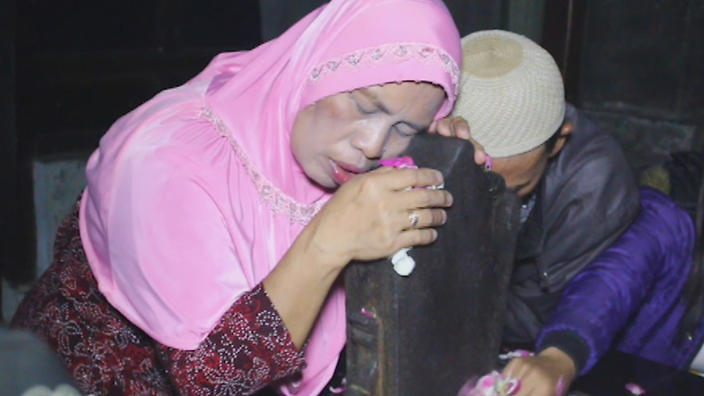
Sex Mountain in Indonesia attracts thousands of Muslim pilgrims, who believe having sex out of wedlock at this holy site will bring them wealth and good fortune. Dateline follows them as they take part in this unusual ritual.
Married men, cheating housewives, government officials and prostitutes revelling in a mass ritual of adultery and sex. This is what happens on Gunung Kemukus in Indonesia, otherwise known as Sex Mountain.
“I come here to seek good fortune,” regular visitor Mardiyah told me as I follow her journey on tonight’sDateline at 9.30pm on SBS ONE.
She is one of thousands of pilgrims who journey to a mysterious hilltop in Java to perform this ancient ritual. Most of those who take part in the ritual consider themselves devout Muslims
Mardiyah prays at Sex Mountain, in the hope that the ritual will help provide money to pay her debts.
There are several versions of the mythic tale that date back to the 16th century. Legend has it a young Indonesian Prince Pangeran Samodro had an affair with his stepmother.
They ran away and hid on Gunung Kemukus. One day, while mid-coitus, they were caught, killed and buried atop the mountain. It’s now an Islamic shrine where this sex ritual takes place.
The story goes: pilgrims must copulate on the mountain every 35 days for seven consecutive times and blessings and wealth should come their way.
But for the magic to work and the money to flow, it’s believed their sex partner for the ritual should not be their spouse.
Gepeng travelled hundreds of kilometres to reach Gunung Kemukus, or Sex Mountain.
I meet Gepeng, who like many others has travelled hundreds of kilometres from across the archipelago to get to sex mountain.“You go there to look for a different partner, not the one you have at home. Historically that’s how it works,” he said.
Another man travelling with him explained: “I don’t tell my wife. There’s no way my wife will find out.”
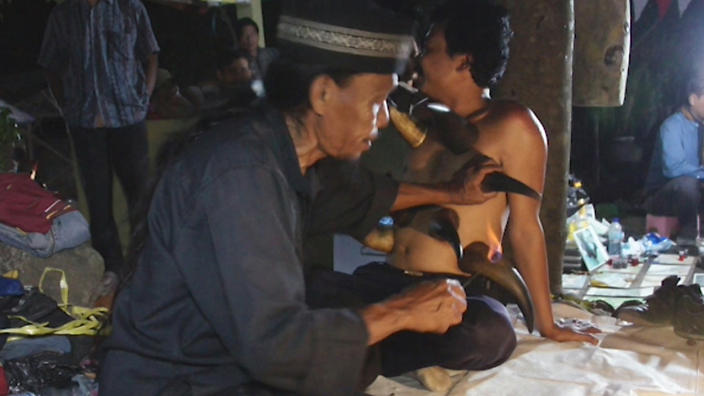
Pilgrims first pray and make offerings at the grave. They then must wash themselves at sacred springs nearby and once that’s been completed, they have sex.
This ritual isn’t seen anywhere else in Indonesia or the rest of the Muslim world. It’s a very Javanese blend of religious ideals with Islamic, Hindu and Buddhist influences.
A visit to Sex Mountain includes rituals combining Islamic, Hindu and Buddhist influences.
Professor Keontjoro Soeparno, a social psychologist from Gadjah Mada University in Yogyakarta, has been studying the ritual for more than 30 years.
“It’s a strange thing. A paradox: there’s a mosque, shrine – but outside – there’s a place for having illicit sex,” he said. “The fact is – it’s hypocritical.”
It’s impossible to ignore that the ritual is riddled with contradictions. Islam views adultery as a sin, so the ‘out of wedlock’ sex clearly goes against the mainstream law of the religion.
Karaoke bars and ‘sex shacks’ line the hillside. Some are privately owned, others built and funded by the local government. But they’re loathe to publicly admit there is any sex going on at Gunung Kemukus.
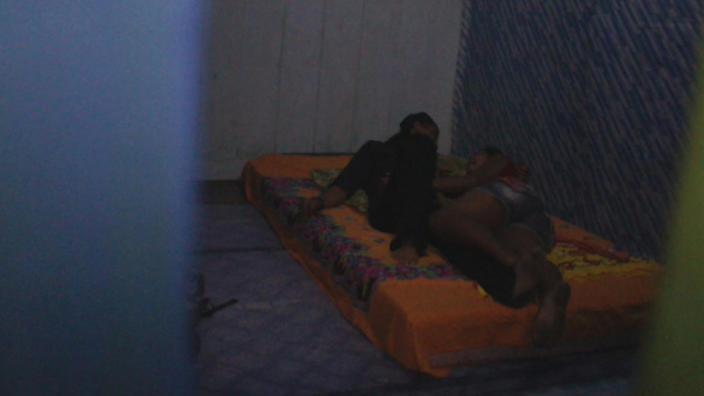
‘Sex shacks’ offer rooms by the hour for those who’ve found a new partner to have sex with.
“Pilgrims should come here with pure hearts and clean bodies,” a gatekeeper employed to look after the mountain shrine said.
“We’ve never said the sex is a condition of the pilgrimage. It’s what they want to do.”
The territory has become prime real estate for commercial sex workers. Professor Keontjoro estimates about half of the women who show up now are prostitutes.
“The government facilitated the rise of prostitution. The Islamic religion forbids all this, but the government would rather not know about that. Because they’re more interested in profit – they leave their religion behind,” he said.
Some say if you pay for sex the ritual doesn’t work. The reality is the local government makes a sizeable profit from sex mountain. They charge the stalls to set up shop and the pilgrims pay a toll to enter the site.
With up to 8,000 pilgrims arriving on the busiest nights and an entry fee of around 5000 rupiah, or 50 cents, a time, it’s big business in Indonesia.
So it’s not surprising officials and religious leaders turn a blind eye.
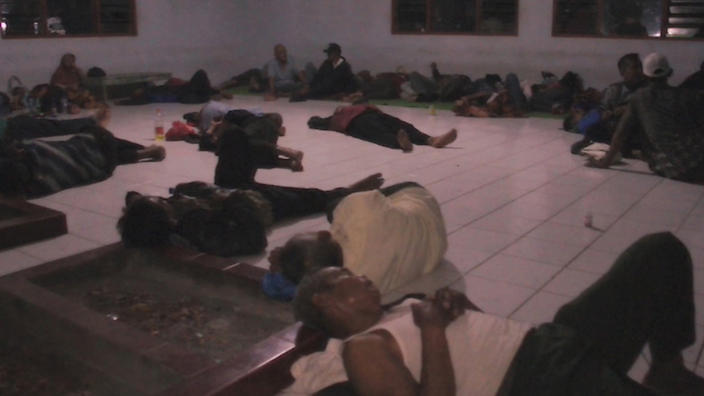
Up to 8,000 people visit Sex Mountain on its busiest nights, with seven visits required to complete the ritual.
The question remains though – how do we know this ancient tradition actually works. Does sex with a stranger really boost your bank account?Mardiyah genuinely believes it does, attributing sex mountain and its spiritual powers to her recent success.
“Praise be to God, after coming here, even though I have a few debts, my business is making a bit of a profit. Even though it’s small, I still give thanks that I’ve received blessings from here,” she said to me.
I don’t know how willing I am to believe in the legacy of Prince Samodro and his stepmother lover, but I can understand the attachment to the myth.
{China has condemned eight to death for attacks in the Xinjiang region. Five others were given suspended death sentences – a penalty normally commuted to life in prison – with another four jailed.}
On Monday, the state broadcaster China Central Television reported that a court had sentenced eight people to death for involvement in two attacks that killed 46 people earlier this year in the far western region of Xinjiang. The sentences, handed down by the Intermediate People’s Court in Urumqi, represent the Chinese government’s latest move in a harsh crackdown on unrest in the vast resource-rich region.
In one incident (pictured), assailants armed with knives and explosives attacked a train station in the regional capital, Urumqi, in April, killing one person and wounding 79 on the final day of a visit to the area by Chinese President Xi Jinping. Two assailants also died.
The following month, attackers killed 39 people and wounded 90 when they threw explosives and plowed two vehicles through a market in Urumqi, state media reported. Police killed four attackers on the scene.
In October, China sentenced another dozen people to die for their roles in a July melee with police that left up to 100 people dead. At least 200 people have died in a year of clashes and attacks in and around Xinjiang, including four people just last month in an attack on food stalls – and 11 assailants killed by police immediately after.
Beijing blames “separatists,” but rights groups charge that China’s repression of cultural and religious minorities has fueled unrest in Xinjiang, which borders Central Asia and is home to the Uighurs, a largely Muslim group who speak a Turkic language. Chinese authorities argue that the country’s policies have boosted economic development in Xinjiang and that Beijing has upheld minority and religious rights in a country that has 56 officially recognized ethnic groups.
In September, China sentenced Uighur scholar and prominent dissident Ilhan Tohti to life in prison for “separatism.”
{Armed men have freed more than 200 prisoners from a jail in central Nigeria, in the third mass prison break in the country since November, police said.}
More than 200 inmates were freed in the attack in Tunga, 250km northwest of the capital Abuja. At least 10 were recaptured by Sunday morning, Deputy Superintendent Ibrahim Gambari told the Associated Press news agency.
Saturday’s incident was the third of its kind in the past two months in Nigeria, where jailbreaks are frequent and police only find a fraction of those who escape.
More than 300 inmates broke out of a prison bombed by gunmen in southwest Ekiti state this month and 144 escaped from south-central Kogi state on November 3 when gunmen bombed a prison wall.
Blame for many of the attacks has been levelled at Boko Haram. It is not known how many hundreds of Boko Haram suspects are held in Nigerian jails.
Herman Cohen, former US Assistant Secretary of State for African Affairs, told Al Jazeera it was what unlikely Boko Haram were behind the raid, and since it was outside of the groups geographical area of operations, it was most likely orchestrated by corrupt officials and involved pay-offs.
“It looks like a standard prison break, organised from within,” Cohen said.
“Ever since the civilian government came to power in 1999, the military and police have been neglected, with salaries not being paid… there needs to be a re-organisation otherwise the security situation will continue to deteriorate,” he added.
Only 18,042 of 56,785 inmates have been convicted of a crime, according to statistics dated June 30 and posted on the website of the Nigeria Prisons Service.
Officials have said how appalled they are about conditions in the jails, where inmates often sleep on cement floors without mattresses or bedding, food is in short supply and most medical services are non-existent.
The vast majority of people held in Nigerian jails are awaiting trial, some of them for many years, even though it is illegal to hold someone for more than 48 hours without bringing charges or presenting them to a magistrate.
{Master Records boss and Crackers comedy CEO Alex Muhangi has vowed to kill all Rwandans living in Kigali with his rib cracking jokes come December 13, at Kigali Serena hotel.}
“Am pleased to perform in Kigali again but this time I will kill everyone with an overdose of laughter from my fresh rib cracking jokes,” Alex Muhangi exclusively revealed to Red Pepper online snoops.
Alex will be curtain raised by Rwanda’s local based comedians led by the comedy president of Rwanda, Kagame.
Burundi’s best comedian Kigingi will also be in the house to set the audience ablaze with his hot crazy jokes.
Alex is one of the most travelled comedians in Uganda and he has performed in countries like US, UK, Kenya, Ghana, Nigeria and United Arab Emirates.
{A Ugandan housekeeper pleaded guilty Monday to torturing a baby, a case that has shocked the country after a video showing her abusing the child was made public.
}
The 22-year old househelp, Jolly Tumuhiirwe, faces up to 15 years in prison for the crime.
Worried parents, who secretly installed a CCTV camera to monitor the house while they were away at work, were shocked to see images of the maid pushing the 18-month-old baby girl to the floor.
She then kicked the child’s face and stomach before putting her entire weight on the girl’s back, and then dragging her out of the room apparently unconscious.
The baby was left bruised and shaken by the abuse.
The disturbing video has been seen or shared hundreds of thousands of times on social media.
After her arrest, police said they would charge her with attempted murder, but in court Monday she faced torture charges alone.
State prosecutor Joyce Tushabe said the maid, who had no lawyer, “was remorseful” in court.
“She said she was sorry for the act.
“She asked for forgiveness from the parents of the child, the nation, and those she said were affected by her acts,” Tushabe said
Tumuhiirwe was remanded in custody and will be sentenced on Wednesday.
{{Arusha}} — {For some reasons Rwanda has opted not to participate in the ongoing 5th East African Community Parliamentary Games taking place under the coordination of the Arusha-based East African Legislative Assembly (EALA).}
The EALA spokesperson, Bobi Odiko, confirmed yesterday that Rwandan Legislators will not be coming to Arusha for the weeklong Games that kicked off on Saturday at the Sheikh Amri Abeid Stadium.
The Games, which have drawn teams from Kenya, Uganda, hosts Tanzania and EALA, were flagged off by the Acting Arusha Regional Commissioner, Nyerembe Munasa Sabi.
Odiko, however, pointed out that Burundi are expected to jet into the city and will participate in the remaining soccer and netball matches, having missed out on the preceding athletics and tug-of-war events held over the weekend.
Defending netball champions Tanzania won a walkover against Rwanda who failed to turn up for the match. EALA who performed badly in all preceding athletic events also got a walkover against Burundi.
The netball series continue today when Tanzania face Uganda and Burundi take on Kenya. EALA play Kenya tomorrow while Rwanda are pitted against Uganda.
{Towards the end of November of every year, leaders of the five East African Community member states convene in one of the five regional capitals to hold their summit, called the Heads of State Summit. And this has been the case since 1999 when the East African Cooperation treaty was signed. }
This year was supposed to be special because the region was marking 15 years since the treaty was signed. Surprisingly, the presidents did not meet on Nov. 30 and the summit was postponed indefinitely.
The official reason is that Tanzania’s President Jakaya Kikwete—who only arrived in Tanzania on Nov. 29—was unable to attend because he is recovering from prostate cancer surgery—a medical procedure he underwent at the Johns Hopkins Hospital in the US state of Maryland on Nov. 8.
Although medical procedures like a prostate surgery are usually scheduled, the postponement of the summit appears to have been abrupt. The venue of the summit had been set, pavilions built, sitting areas arranged, and decorations put up in Nairobi.
According to Richard Sezibera, the EAC Secretary General, consultations are now underway with Kenyan President Uhuru Kenyatta, the current chairperson and his counterparts across the region to reschedule the summit. Sezibera told The Nation that the summit had many issues on the agenda besides handing over the chairmanship from Kenyatta to Kikwete.
And according to the now suspended Margaret Zziwa, the summit being postponed to a later date is valid because only two of the five members had confirmed attendance, so the Secretariat had to postpone the event.
However, Phyllis Kandie, Kenya’s EAC Affairs Cabinet Secretary told Kenyan media that the meeting of regional leaders focusing on the Northern Corridor Infrastructure is still scheduled to take place, Dec.10-11.
Yet despite the official narrative, many still wonder why the summit stalled at a critical time when the region was commemorating a milestone of 15 years.
The postponement of the summit came just days after EALA members sat in Nairobi and passed a resolution suspending Margaret Zziwa, the Ugandan Speaker of EALA whom fellow members accuse of a plethora of vices.
{On the invitation of the Ambassadors of the East African Community in the Russian Federation, representatives of the Eurasian Economic Commission (EEC) briefed EAC Diplomats on the background, advantages and opportunities in trading with the member states of the Eurasian Economic Union. }
The meeting took place in the premises of Kenyan Embassy in Moscow where Rwanda was represented by Ambassador Jeanne d’Arc Mujawamariya and Francis Karagire, First Secretary. South Sudan also participated as an observer.
The meeting aimed at learning about the EEC integration process and further development of the economic block with view of exploring available opportunities for EAC member states to get into business exchanges with the regional block.
Mr. Victor SPASSKIY, Director in charge of integration development, in his presentation highlighted much on the member states economic integration, that include the Russian Federation, Belarus and Kazakhstan focusing on the current stage of integration and initiatives to expand the block to include other countries willing to join.
The East African Community Diplomats were impressed by what they learnt and resolved to encourage EAC to take advantage of such partnership and export tea, coffee, and horticulture products to EEU. These crops, according to Diplomats would directly get into EEC market without transiting through Western Europe as it is the case currently.
Traders would also be paying custom taxes at only one entry point to the EEC block. This would contribute to boost of EAC exports to EEC that is still very little according to EEC 2010-2013 trade statistics.
Among other things, EAC diplomats are taking seriously the wide range of available opportunities within the EEC for EAC member states, including natural resources, high level of human capital, developed technology in manufacturing industry, farming machinery, etc.
Rwandan Private Sector is advised to eye into the untapped potential and opportunities to initiate new trade ties with the EEU business community.
Among other countries, the EEC bloc has entered into trade negotiations with Egypt, India, Israel and South Africa. The Union therefore remains open to any state that shares its aims and principles, EEC officials said.
The Eurasian Economic Commission (EEC) is a single permanent regulatory body (supranational governing body) of the Customs Union (CU) and the Single Economic Space (SES) of the Eurasian Economic Union of Belarus, Kazakhstan and Russia to which Armenia and Kyrgyzstan will soon join. The block is a purely economic organization and is apolitical.
{
During a recent visit to the former capital of the Ottoman Empire, the pope labored mightily to bring Islam into dialogue with Christianity. But does he really accept that God is God?}
At the famous Blue Mosque during a papal visit to Istanbul, Pope Francis stood beside the grand mufti of Istanbul and prayed for two minutes, bowing his head, closing his eyes. At the end of his prayer, the grand mufti whispered aloud: “May God accept it.”
One can’t help wondering: Did the grand mufti doubt that God would accept a prayer from the head of the Roman Catholic Church? Indeed, does Francis, or any Christian, genuinely accept that God is God, whether his name be Allah or God?
As in previous visits to Islamic countries, the busiest pontiff in recent memory had labored mightily in Turkey to bring Islam into dialogue with Christianity: not an easy thing, although both are Abrahamic religions, in theory accepting the notion that God revealed himself to Abraham and his descendants.
A long-running argument exists over whether Christians and Muslims worship the same God. In my view, they certainly do. The creator—he or she—brought the world into being. The gender business interferes in odd ways, as the Arabic word for God is apparently quite neutral, whereas God is often seen as masculine in the Judaic tradition, the ultimate patriarch, as in Psalm 89: “Thou art my father, my God.” The situation is complicated by Christianity, where Jesus becomes the son of God, though his equal as well, having a place beside the Holy Spirit as part of a Trinity—with equal weight on each foot of the tripod. (To many outside Christianity, this looks a bit like polytheism!)
Judaism, Christianity, and Islam are firmly monotheistic religions, in fact. This puts them at odds with the countless polytheistic religions, where many gods compete for prominence. The ancient Greeks and Romans were comfortable with any number of deities and were quite open to allowing conquered nations to continue to worship in whatever ways they saw fit, as long as they didn’t mind having an emperor who required taxes and tributes. Jews in ancient Palestine were, under Roman occupation, moderately free to follow their Temple-oriented religion without interference until, a few decades after the death of Jesus, anti-imperial zealots openly rebelled against the empire, drawing the wrath of a vast and well-equipped army on their heads, precipitating the terrible destruction of the Second Temple in Jerusalem in 70 CE.
The God of the Jews was known by various names, including YHWH—the vowels are deliberately missing, although we derive the name Jehovah from this combination of consonants as written in Latin letters. Other names of God were Elohim, and Adonai, although these latter are often seen as reflections of God’s attributes, not separate names. One is, of course, inevitably up against the problem of translation when speaking of names. God is God, but he has various names in different languages, and each strand of monotheistic religion has multiple ways of describing the godhead.It has never been more important for Jews, Christians, and Muslims to understand that they worship the same God and “inhabit a common moral universe.” Pope Francis would seem to agree.
The God of Islam—who has as many as 99 names, all subsumed in Allah—often seems very like the Jewish creator: a remote God, merciful but all-powerful. Allah seems unlikely to enter into a “personal” relationship with Muslims, who readily submit to the divine will. Allah can’t truly be called a male figure in Islam, so “his” doesn’t really work as a descriptor. The God of Israel did indeed enter into dialogue with human creatures, meeting Adam and Eve in Eden, speaking to Moses in the burning bush, demanding sacrifices, issuing commandments. The various writings that eventually made up the Hebrew scriptures—the five books of Moses, the books of the prophets, and the so-called writings—characterized the human relationship with God in complex ways; but it was clearly a relationship.
The Christian God is more available to his followers: the head of a family, as depicted in the roles of father and son, making him appear more human than either the Jewish or Islamic creator. One can approach a father, and Jesus could speak to God as Abba or father, encouraging his followers to do the same, as in the Lord’s Prayer. Jesus offered a way of communicating with God that felt intimate.
There has been, as one might guess, a lot of disagreement about whether Christians and Muslims worship the same God, but Miroslav Volf, a well-known professor at Yale Divinity School, has done a good deal of work on this subject, concluding that both religions “believe in one God, one God who is a sovereign Lord and to whom they are to be obedient. For both faiths, God embodies what’s ultimately important and valuable.” He suggests that it has never been more important for Jews, Christians, and Muslims to understand that they do, indeed, worship the same God and, in fact, “inhabit a common moral universe.”
Pope Francis would seem to agree. He is, in many ways, working to repair damage done by Benedict, the previous pontiff, in his infamous lecture at the University of Regensburg in Germany, where some of his remarks were taken, possibly out of context, to be anti-Islam. As if in reaction, the current pontiff has gone out of his way to forge alliances with Islam, praying that religious tolerance will ultimately prevail in the Middle East.
That is a lot to pray for, but Pope Francis is praying for all of us.
This article was published on {{thedailybeast.com}} by {{Jay Parini}}