Following the departure of head coach Dusan Dule Suljagic and the appointment of assistant coach Vincent Mashami to the national team on a permanent basis, APR have named academy coach Emmanuel Rubona as the interim coach.
Rubona is expected to handle today’s training session at the FERWAFA ground as the army side prepare for their second Azam Rwanda Premier League clash against Mukura Victory Sport tomorrow.
The youthful Rubona attended Friday’s session as APR prepared for their encounter against Etincelles in Rubavu on Saturday which they won 1-0 through a lone strike by new signing Djihad Bizimana.
Suljagic guided APR to their record 15th league title in May before losing to Police in the Peace Cup semi-finals. The army side were eliminated from the CECAFA Kagame Cup in July following a 4-0 humiliation by debutants Al Khartoum coached by former Ghana coach Kwesi Appiah.
Suljagic quit the army side without notifying his bosses but informed a close friend through a phone call from Istanbul en-route to Serbia, his homeland.
He had taken over from fellow country-mate Ljubomir Petrovic who also left APR without informing his bosses in February. Petrovic is renowned for lifting the European Cup (now UEFA Champions League) with Red Star Belgrade in 1991.
President Paul Kagame has paid tribute to fallen Ugandan former Interior Minister, General Aronda Nyakairima who died last Saturday.
The President said the former Ugandan army chief of staff, “was very instrumental and in the integration, security and stability process in East Africa.”
Internal Affairs Minister, Musa Fazil Harerimana delivered condolence message on behalf of President Kagame said; “It was with deep sadness that I, the Government and people of Rwanda learnt of the untimely passing of Gen. Aronda last Saturday. Rwanda stands with Uganda in this difficult time of grieving.”
Referring to late Gen. Aronda in the letter, Kagame said the General was “a humble and industrious leader.”
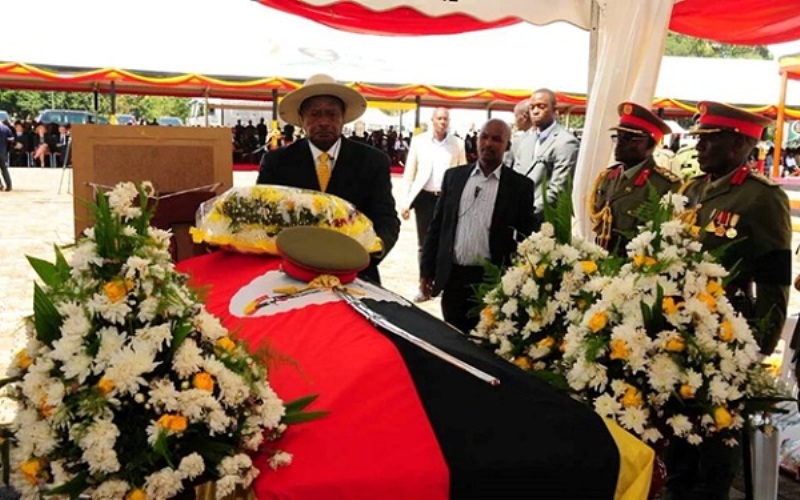
Minister Fazil led a delegation of Rwandan officials attending late Gen. Aronda’s final national prayers ceremony at Kololo grounds in Uganda’s capital Kampala.
Yesterday, Uganda Government announced a postmortem report revealing ‘heart failure’ as the cause of Gen. Aronda Nyakairima, who died while in the plane on his way back from official duty in South Korea.
President Museveni has been confirmed by the NRM Electoral Commission as the party’s official flag-bearer in the 2016 presidential elections.
“Today the 20th September, Yoweri Kaguta Museveni has been nominated as candidate for the NRM having been certified by the party’s Electoral Commission,” announced NRM electoral body’s chairperson Dr Tanga Odoi on Sunday.
The move follows a series of internal deliberations that involved the Central Executive Committee and NEC at State House Entebbe.
Museveni arrived at the party headquarters along Kyadondo road in Nakasero on a few minutes after 10:00am.
He was accompanied by his wife Janet Museveni and senior party leaders.
Museveni’s nomination papers were submitted by his long-time friend and NRA historical, Dr Ruhakana Rugunda.
Odoi said Museveni “is the only one who picked and returned nomination forms for the position of Presidential flag-bearer.”
He emphasised: “Today he has been the only candidate nominated for that position and under the powers given to me I declare him duly elected party flag-bearer.”
Museveni will have to face off with the opposition strongman Dr Kizza Besigye and possibly Independent aspirant Hon Amama Mbabazi in the 2016 presidential elections.
Odoi thanked Museveni for obeying the NRM Electoral Commission rules.
NRM Secretary General Kasule Lumumba was visibly excited by the nomination.
“I introduce the person who will hold our flag in the forthcoming elections. He is President Yoweri Kaguta Museveni,” she charged amid a standing ovation from supporters.
Lumumba introduced Ruhakana Rugunda, Northern Youth MP Evelyn Anite and Hajji Abdul Kiyimba as seconders.
The NRM CEC was led by Hajji Moses Kigongo and Speaker of Parliament Rebecca Kadaga.
{{Museveni speaks}}
Museveni praised CEC, NRA historicals and NEC for supporting his presidential candidature.
“The NRM is not a novice organization but one that has gone through furnace of history of Uganda,” said Museveni.
“The party has gone through fire. We have achieved a lot in liberating the country and achieved minimum recovery for the economy,” he added.
The President who has been in power since 1986 said NRM has launched many developmental programs, ensured peace, stability and “entrenched the culture of democracy” in the country.
“I want to pledge that the next phase of our history will ensure the banishing of poverty in homes. We want many homes get out of poverty and get at least a minimum income of Shs 20m per year,” he added.
President Museveni said the next target will be industrialising the country.
“We should have local industries so that each area has a nucleus of industries. This way we shall add value to products and create jobs. We want to create jobs for the youth,” said Museveni who seized power after a protracted guerrilla war almost 30 years ago.
He further vowed to eradicate corruption, insisting only NRM can banish graft that costs taxpayers over Shs 500bn every year.
“I say that because it’s only NRM that doesn’t kneel down for any person like other parties do. Other parties have nothing to show,” he hit at the opposition which accuses NRM of presiding over deeply entrenched corruption that continues to hurt delivery of public services.
Museveni also seemed to be attacking former Prime Minister Amama Mbabazi, arguing that, “When you get out of the queue, we don’t kneel for you.”
He also talked about preserving wildlife to promote tourism, saying poaching in national parks has been controlled.
On security, Museveni said, “There used to be road blocks on roads by soldiers confiscating property from people but we stopped it.”
Museveni said corruption continues to thrive in ministries and parastatals due to lack of effective investigative machinery.
{{Future
}}
“The only problem now is not fighting corruption but investigating those who are involved in such acts. The remaining problem with corruption is corruption and the judiciary who still have some problems,” he added.
In what appeared a move to paint a picture of a prosperous future, Museveni assured his supporters that “things are going to be better than where we came from. This is because we have now got a stronger foundation than in the past.”
He concluded: “We are now stronger than ever before.”
Lumumba said President Museveni was passed unopposed as the NRM chairman.
The NRM National Delegates Conference will sit at Mandela National Stadium to officially flag off Museveni for the 2016 presidential race.
This Monday , Rwanda will free doves into the sky as a symbol of peace as the capital Kigali hosts the International peace day celebrations under the theme; ‘Partnerships for Peace – Dignity for all.’
In 1994, Rwanda was brought onto its knees following a genocide against ethnic Tutsi that claimed a million lives in just a hundred days; but the world looked on as such mayhem took place.
For the past 21 years after the genocide, the country has reunited, built peace and contributed to peacekeeping missions around the world.
“This country will never be the same again,” President Paul Kagame said during the 21st commemoration of the genocide.
Bishop Rucyahana President of the National Reconciliation Commission told KT Press; “It’s a day for peace, but again a day of recognizing those exceptional individuals who sacrificed themselves to put Rwandan where it is today.”
The national unity and reconciliation commission says Rwanda was selected to host the day because of its unmatched level in restoring peace and security, 21 years after a devastating genocide.
Rwanda maintains over 4500 uniformed men and women in different peacekeeping missions around the world.
Ban Ki Moon the United Nations Secretary General, in honour of this day, calls for ceasefire and peace across conflict-stricken countries.
“I call on all warring parties to lay down their weapons and observe a global ceasefire. To them I say: stop the killings and the destruction, and create space for lasting peace,” Moon said.
Bishop Rucyahana noted; “We are celebrating International peace day with a lot of excitement. In Rwanda, we have peace because we worked for it.”
A couple of activities have been organised, including a parliamentary session of 300 youth discussing their role in peace building.
Later in the day, a ‘Peace One Day Youth Celebration’ will bring together 2,500 participants at Petit Stade Amahoro in Kigali, as well as a Peace Village that will feature exhibitions by partners in peace-building, according to Johnson Mugaga, executive secretary of the national reconciliation commission.
Also, international artistes are expected to grace the celebrations including; Nigeria’s Ice Prince, Maurice Kirya and Lillian Mbabazi from Uganda, Mafikizolo from South Africa; Alikiba and Wangechi from Tanzania and Kenya, among others.
Rwanda’s First Lady Jeannette Kagame has told an audience in Los Angeles (USA) of the special place cows hold in Rwandan society – as they have pulled thousands out of poverty.
“Heifer donations of cows hold a special meaning, their worth represent social ties deeply rooted in our traditions,” said Mrs Kagame at a ‘Beyond Hunger’ gala hosted by Heifer International on Friday evening.
The organisation hosted the 4th Annual “Beyond Hunger: A Place at the Table,” gala event in Los Angeles. The celebrity-filled event brought together advocates in the fight against extreme poverty.
Sharing a personal story, the First Lady told her audience that it was “a glass of milk” that brought President Paul Kagame and her together.
“I lend my voice to the Rwandans impacted by this partnership and testify that it could only be a natural fit in our values,” she added.
Since 1944 Heifer International has assisted more than 18.5 million families—79 million people—move from poverty to prosperity. In Rwanda, it has been operational for the last 15 years – and available data shows it has assisted more than 45,000 families to improve food security, a move that has helped government significantly cut extreme poverty.
Heifer International has been one of the partners to government in its ‘One Cow Per Family’ program under which, for years, the poorest homes have been given a free cow. Figures show more than 250,000 cows have been distributed.
In July this year, Pierre Ferrari, the chief executive officer and president of Heifer International, was in Rwanda.
“We are proud to have Her Excellency the First Lady of Rwanda, Madam Jeannette Kagame at our Beyond Hunger Gala,” said Ferrari at the event in Los Angeles yesterday.
Meanwhile, at the gala, Chris Gero of Yamaha Entertainment, emerged as the 2015 ‘BeyondHunger’ Noble Globe awardee.
“When sleeping women wake, mountains move,” he told guests.
Presidents Omer Hassan Al-Bashir and Yoweri Kaguta Museveni held meetings on bilateral relations and South Sudan peace immediately after the arrival of the Ugandan leader.
Sudanese presidential assistant Ibrahim Mahmoud on Monday expected that Museveni’s visit will create a breakthrough in the bilateral relations between the two countries, adding that an agreement on this respect will be signed .
The two Presidents reiterated their support to the peace agreement in South Sudan, and vowed to exert the necessary efforts to bring stability to the new nation.
The Ugandan president concluded on Wednesday a two-day visit to Khartoum where the discussions focused on the regional efforts to bring the two warring parties to implement a peace agreement they inked last August.
The Sudanese and Ugandan leaders stressed in joint communiqué issued at the end of the visit that their tow countries are directly affected by the 20-month conflict in South Sudan and vowed to spare no effort to prevent the resumption of hostilities in the neighbouring country.
A Bashir and Museveni “expressed their willingness to work together under the umbrella of IGAD and the African Union to maintain peace, security and stability in the region and in the Republic of South Sudan,” says the communique, which was inked by foreign ministers of the two countries.
In a closed-door meeting, the two leaders also discussed accusations of support to rebel groups but the two sides avoided to speak about what agreed in the discussions in this respect.
However, the final communique said the two countries agreed to enhance security cooperation and to reactivate a joint security committee. They also agreed to promote joint military training and cooperation between the two countries.
Al Bashir and Museveni further directed the intelligence and security services in the two countries to strengthen their cooperation and coordination in order to overcome the differences between the two sides.
Ghandour told reporters that the two presidents discussed the issue of rebel groups
President Museveni gave a lecture about the challenges facing economic development and peace in the Lakes region attended by president Al-Bashir.
Before leaving Sudan he extended an invitation to Al-Bashir to visit Uganda.
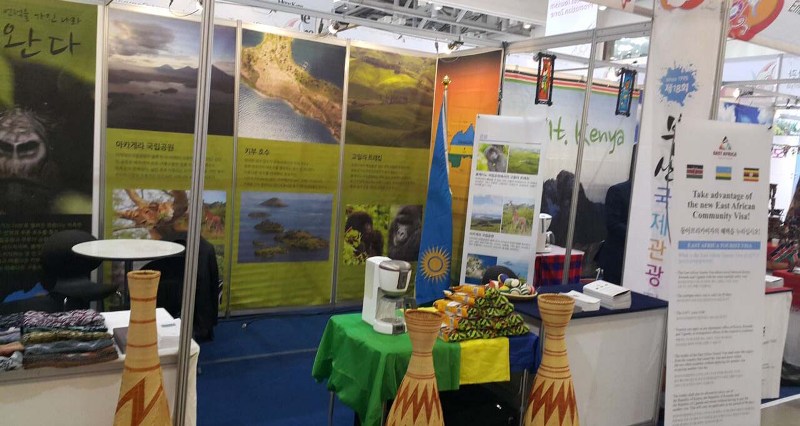
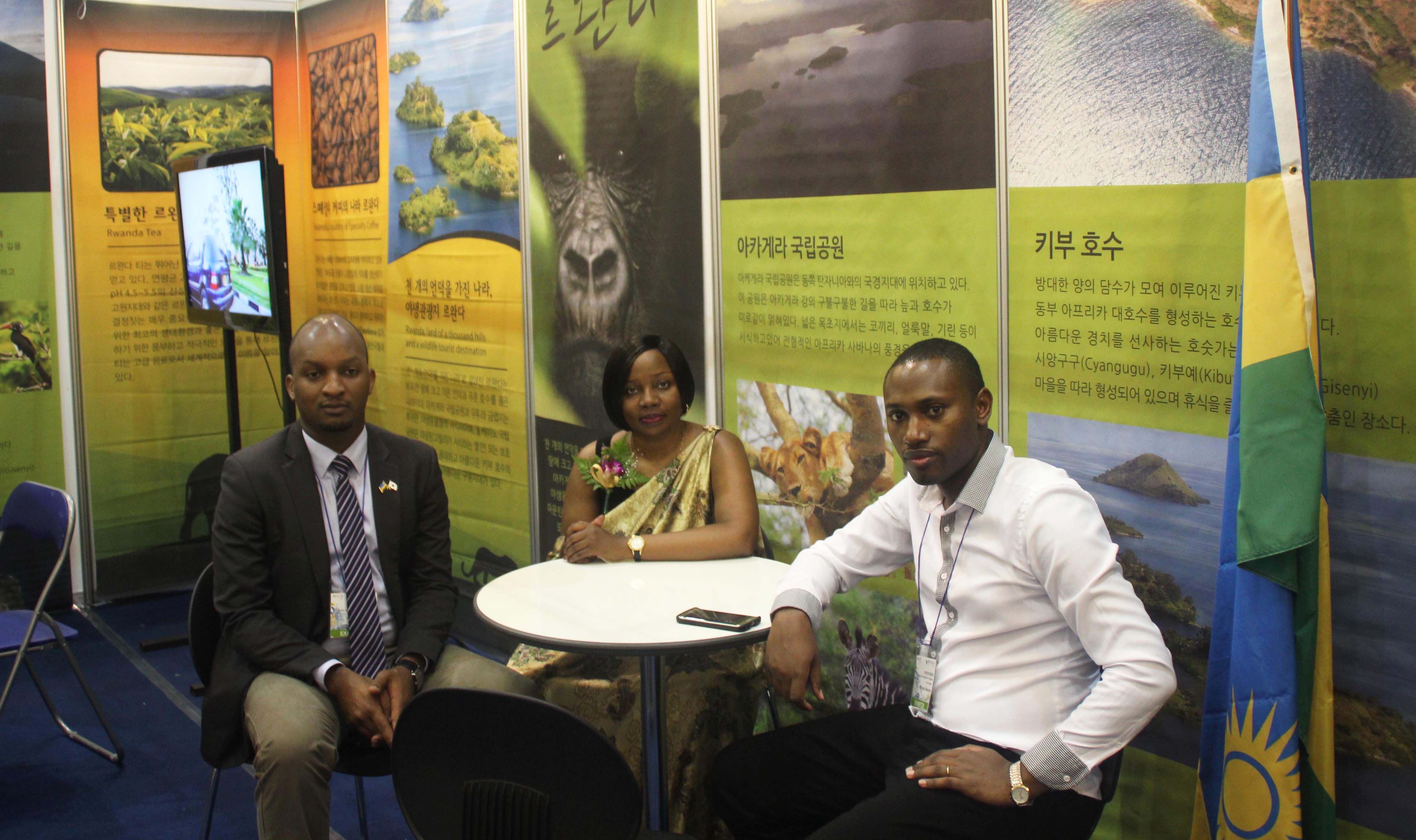
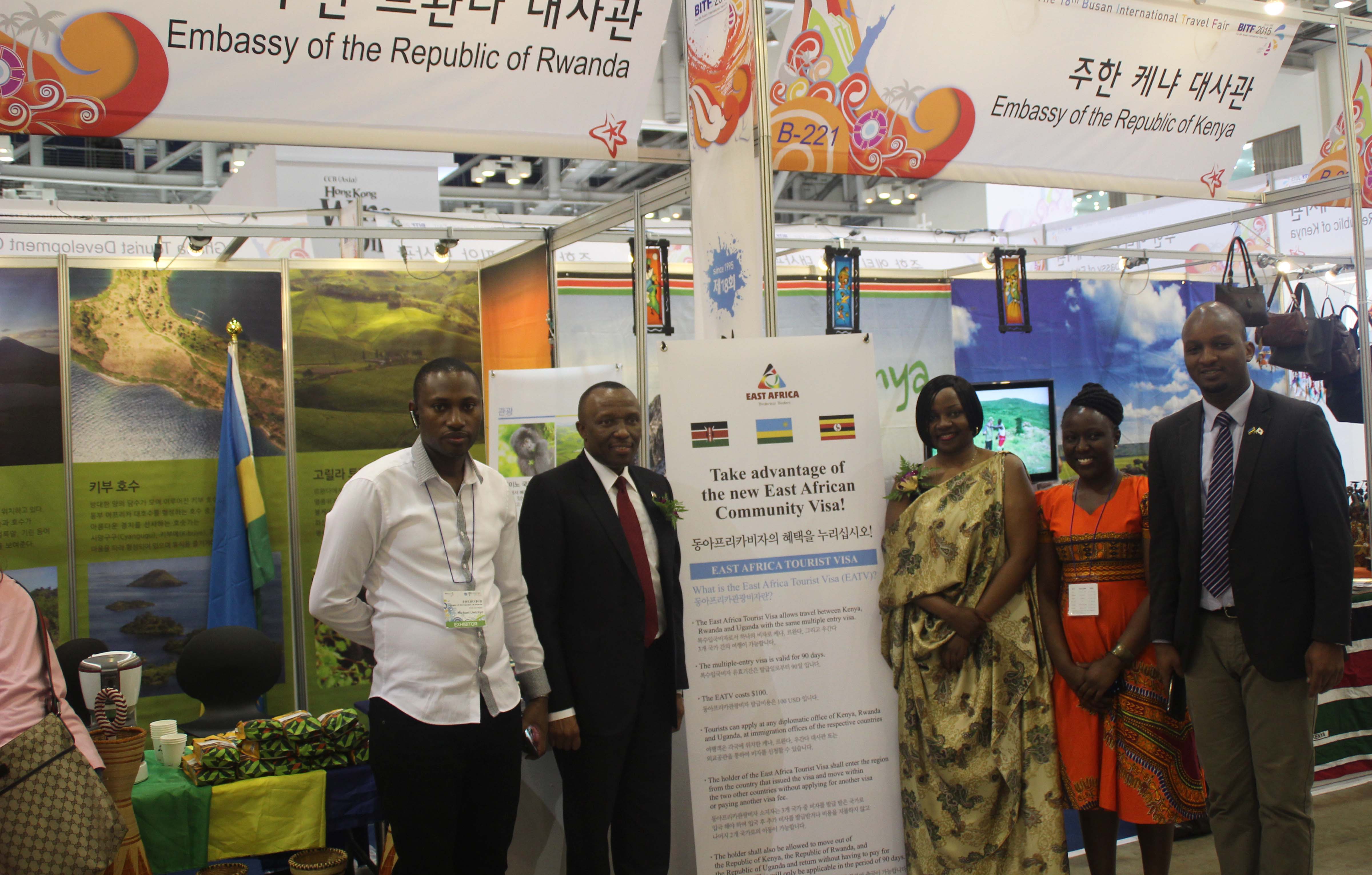
Busan, 15th September, 2015: Rwanda through its Embassy in Seoul has participated in the just-concluded 18th edition of the Busan International Travel Fair, from 11th to 14th September, 2015.
The Fair brought together International and Korean tourism-related industries, local governments as well as foreign missions and international organizations accredited to the Republic of Korea. It was an excellent opportunity to showcase Rwanda’s numerous tourist attractions by displaying the country’s unique wide range of tourism products available including its rich culture as well as the country’s safe and healthy environment.
It has been also an opportunity for the Rwandan embassy officials led by the Ambassador Emma-Francoise Isumbingabo to network with the Busan Metropolitan City’s authorities, Executive directors from Korean Tourism associations and business representatives in the tourism industry.
During this tourism fair the Embassy of Rwanda together with the Embassy of Kenya worked in collaboration to promote the region as a single destination under the East African Tourist Visa initiative.
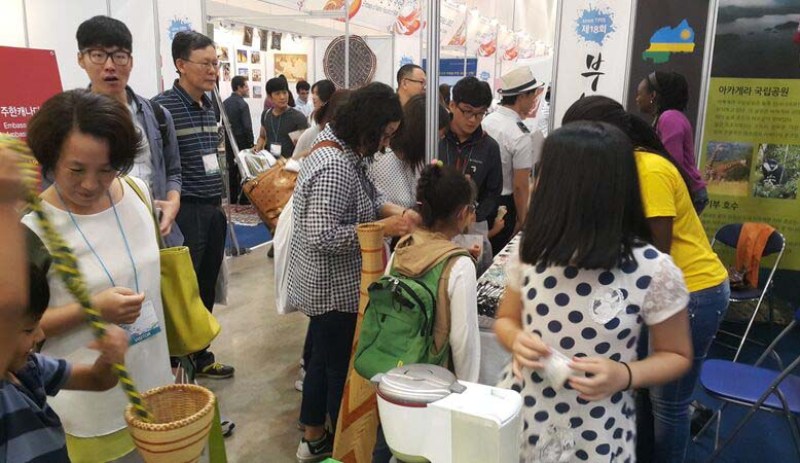
In order to give the visitors at the stand a flavour of the Rwanda experience; Rwandan coffee was offered to visitors during the four-day event and therefore it was promoted for the same occasion.
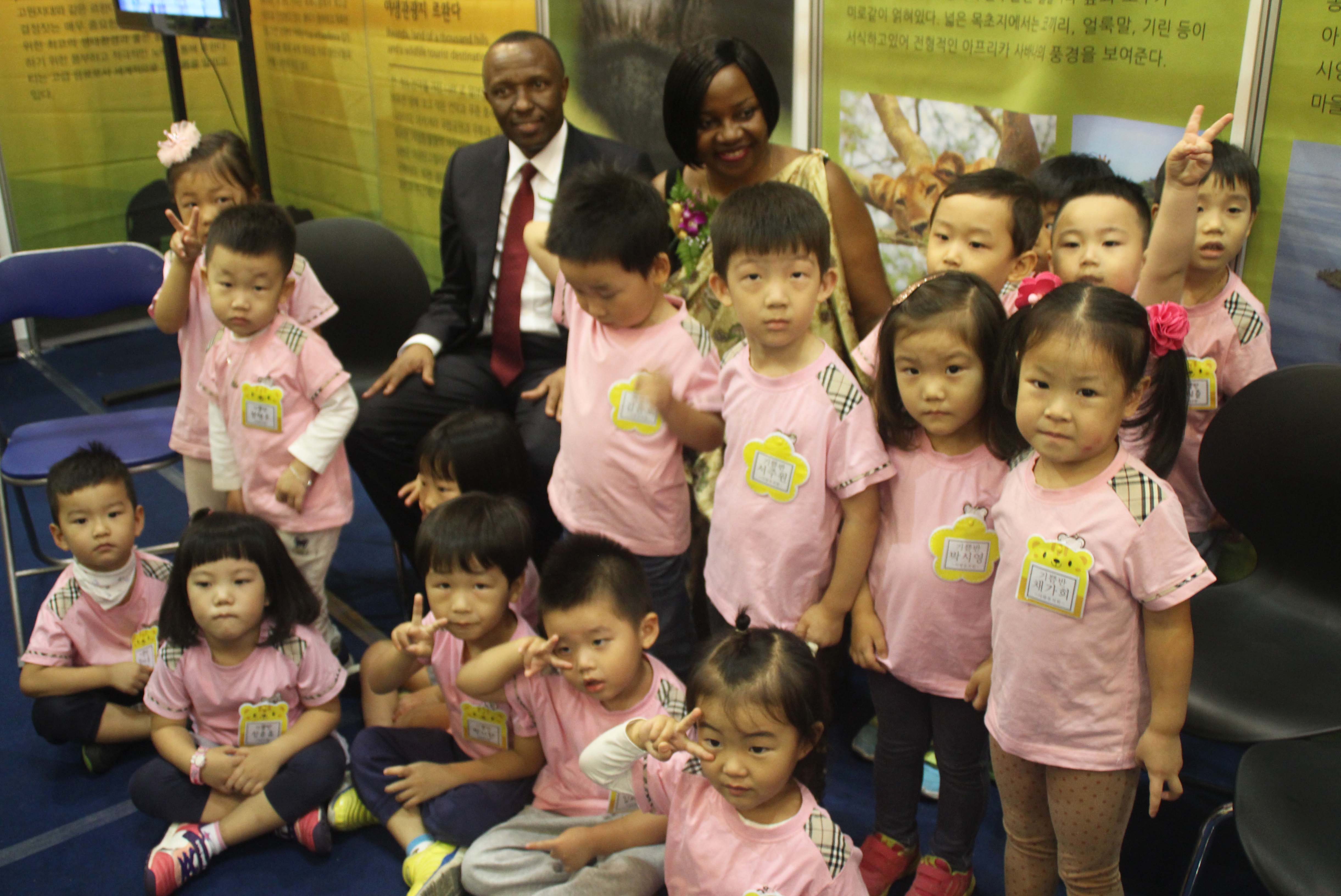
Rwanda’s exhibition stand received many visitors who were interested and curious to discover more Rwanda through pictures and videos as well as explanations about Rwanda. It emerged that generally a big number of Koreans have very limited information about African countries. Overall the Busan International Travel Fair was a success for the Rwandan Embassy in its mission to promote Rwanda.
Further to the BITF 2015 exhibition, a networking session between the Embassy officials and Korean tour and travel companies is being organized to exchange information on the various attractions and what it takes for Korean tour companies to market the Rwanda destination. It is also planned to link the tourism companies from the Republic of Korea with those operating in the Republic of Rwanda through the Rwanda Development Board.
Mechanisms have been put in place to ensure the monthly stipend given to needy students at higher institutions of learning is disbursed on time to avoid any inconveniences, the Minister for Education has said.
Dr Papias Malimba Musafiri made the statement on Friday at University of Rwanda, Huye Campus, as he officiated at the closing ceremony of the induction week for freshmen.
The decision follows students’ complaints about the delays in disbursing of living allowances, with some saying the delays forced them to live on one meal per day and struggled to get academic materials they need.
The Rwf25,000 monthly stipend could delay for three to five months, students said.
{{Students’ concerns}}
Students have also expressed concerns over the new change in scholarship scheme, whereby the living allowances will be channeled to beneficiary accounts and the student will be paying directly for all the necessities.
This is different from the previous arrangement where the student could get meals from campus-based restaurant or accommodation in campus hostels and the payment would be deducted from the living allowances once disbursed.
This helped the needy students who depend on the allowances to meet their basic needs.
“We are being asked to pay for the accommodation and meals by ourselves. This could affect us in case of delays as has been the case. Under the old arrangement, we were at least assured of a meal and accommodation,” said Valentine Mukarushema, a first year student of Economics at Huye Campus.
{{Change of system}}
Students had suggested that the allowances be delivered on time or that some expenses like accommodation or meals be deducted from the allowances to facilitate the student’s learning in case they cannot get the money.
Musafiri assured the students that those entitled to the stipend will henceforth get it on time and there should not be any cause for concern.
He said effective this year, the allowance will be disbursed in two or three installments, unlike in the previous system where the money was disbursed on monthly basis.
“I would like to assure you that the money will be disbursed soon; there will not be delay like that which we have seen in the last years,” Musafiri said.
He said last week, a law allowing the Ministry of Education to put the bursary funds in the bank and the bank directly transfers the money to the students’ accounts was promulgated in the Official Gazette.
{{In defence of new system}}
Musafiri defended the decision to let students take care of all their subsistence needs, saying this was also good for their personal development as they will use it to nurture the culture of saving and taking care of themselves.
The minister urged those who are yet to open bank accounts to open them, noting that there are banking services in the campus.
The tuition and living allowances scheme for university students, which has been run by the Ministry of Education, were transferred to the Rwanda Development Bank effective the start of Academic Year 2015 this month.
At least 200 eye patients with eye cataracts selected from across the country are set to receive free eye treatment at Ruhengeri Hospital in Musanze District.
The weeklong operation, provided by Barraqueur Foundation, an international organisation whose goal is to provide eyecare to help improve visual health, started yesterday.
The move aims at finding long lasting solution for people who suffer from cataract and to reduce blindness which is mostly caused by the cataract, according to Dr Elena Barraquer, an ophthalmologist and leader of Barraquer Foundation.
The 200 beneficiaries were selected from the over 1,000 cataract patients who were initially screened.
“Our goal is to try to eradicate blindness caused by cataract, since this is the leading cause of blindness in the world. It’s something that can often be solved with a simple procedure that we can perform and that offers a huge improvement in the way people live,” Barraquer said.
She added that procedures rely on a novel technique called ‘phacoemulsification,’ which involves using ultrasound to break down the cataract and then aspirating it through a canula.
This invasive technique means that after a 20-minute procedure, the patient has a permanent intraocular lens and a new view of the world, she said.
Dr Barraquer said malnutrition and extreme exposure to sunlight are some of the causes of cataracts, whose only solution is surgery.
Dr David Muhire, the head of department of ophaltomology at Ruhengeri Hospital, said the weeklong surgery exercise and screening is of a great value to Rwandan health services since it is being conducted by specialists.
Patients were upbeat that they could regain their sight after a long time with the visual impairment.
Emmanuel Dusabe, from Kibagabaga in Gasabo District, could not believe how the removal of cataract could be free.
“I was thinking that cataract surgery operation is very expensive but now I can be operated on free of charge. I am happy because they are going to help me regain the sight I lost years ago,” Dusabe said.
Dusabe encouraged other people who have visual impairments to seek medical attention.
Similar operations were carried out by the same foundation last year, an exercise at which more than 200 eye patients regained their sight.
According to World Health Organisation, cataracts are responsible for 48 per cent of cases of blindness around the world and many countries still do not have medical resources needed to remove them.
Over 40 million people around the world suffer from curable blindness caused by cataracts.
The clinic was organised by the Ministry of Health in collaboration with Barraquer Foundation.
Members of the Rwanda Hotel Group (RHG), have urged financial institutions to give a grace period of at least a year to members who seek loans before they can start paying back.
RGH is an association that brings together owners of medium-sized hotels in the country.
But this seems to be a lost battle for members who have defaulted on bank loans as banks have placed auction notices in the media to sell off these hotels.
Several RHG members are now desperately trying to save their investments from being sold off cheaply to the highest bidder while banks are also doing their best to recover several billions of francs in non-performing loans (NPLs) held by these hotels.
Between hotels and banks is Private Sector Federation (PSF) which finds itself with an unattractive role of a mediator between disgruntled hoteliers and the banks.
“Hotels and banks are both our members and all we are trying to do is get them on the table to agree on an amicable way out because our interest as PSF is to ensure businesses succeed, not fail,” said Stephen Ruzibiza, PSF’s chief executive officer.
According to PSF, there are at least twenty distressed hotels trying to appeal against being auctioned off, not over one hundred as recently reported in the media.
Sylvester Mupenda, president of the RHG who talked to press in earlier interviews about the issue involving his hotel as well, declined to comment on the matter when contacted. When pressed further for a comment he said.
“We have not seen any effect, I don’t want to talk anymore.”
As the proprietor of Eldorado, one of the hotels listed for auction, Mupenda’s attitude is perhaps understandable; by talking to the press about his plight earlier, the distressed investor hoped to attract some attention to somehow halt, the auctioning of his hotel.
Apparently, the hotel was auctioned over two weeks ago.
Located on 27 KG Street, on 8th Avenue, just behind Rwanda Development Board, Eldorado employs 17 workers who had the same prayer as of last week, to be retained in their jobs by the new owner whom they were yet to meet.
The owner and hotel manager were both not on the premises at the time of visiting but according to a senior staffer, the investment is allegedly valued at over Rwf350 million (land and building).
However, it was auctioned off at just over Rwf200m to recover a loan of over Rwf260 million, apparently obtained from GroFin almost a decade ago to finance the investor to modify the place into a hotel from the apartment that it was previously.
But on Sunday, a source familiar with the transaction told The New Times that the takeover by the new owners had been halted after high level intervention although no details were immediately available to explain the development.
{{A troubled palace}}
Further deep in the city outskirts is Alpha-Palace, Kigali’s troubled palace, as it’s now quietly regarded; unlike the black couch with cracked leather covers at Eldorado, the reception area at Alpha which is listed as a three-star hotel, was much more respectable and cozy.
Lurched in one of the shiny cream leather seats was a young male Chinese guest speaking on the phone, rather loudly; the receptionist, Diana, with a calming smile, has been with the hotel for only a couple of months; she led me to the manager’s office.
“We are still in charge. The auction process was halted by court because there’s a disagreement on figures,” said the manager, a middle-aged man who has been with the hotel since 2012.
His room was a guest-suite turned into an office located on the first floor overlooking the swimming pool at the back of the hotel.
The least priced room at Alpha Palace which has over 46 rooms is US$70 a night; the hotel is three-star classified but that’s also the source of its current problems.
Alpha Palace which is valued at over Rwf2 billion is currently battling a consolidated credit facility of Rwf500 million from Bank of Kigali which was borrowed, according to the manager, to mainly upgrade its facilities ahead of RDB’s countrywide hotel classification exercise.
The hotel managed to get the stars but they haven’t translated into commercial success. “This endless story of us being auctioned has badly affected our performance, most of our clients have left us thinking someone else took over the facility,” he said.
Alex Baingana, the hotel’s proprietor has literally knocked on all doors in an attempt to save his lifetime investment from auction; he believes the bank is being unfair noting that selling off the property should be the very last resort after exploring all possible avenues.
But a source within Bank of Kigali intimated to The New Times that the hotel misused the credit and diverted it into other activities outside the planned spending.
However, the hotel blames its woes on what the manager describes as a dwindling clientele mainly because of tight competition from dozens of hotels that dominate its neighbourhood.
“Come and see what I am talking about,” he said as he guided me towards the balcony, pointing to the houses a few meters away from the hotel.
According to the manager, owners of most residential houses next to his hotel have turned them into motels which are stealthily diverting demand from Alpha Palace hotel hence contributing to its current financial woes.
The argument of stiff competition and reduced clientele is what most members of RHG will cite for their woes which they also blame on government for unfulfilled promises of a booming tourism sector that would generate incomes for these hotels.
{{Happy neigbours}}
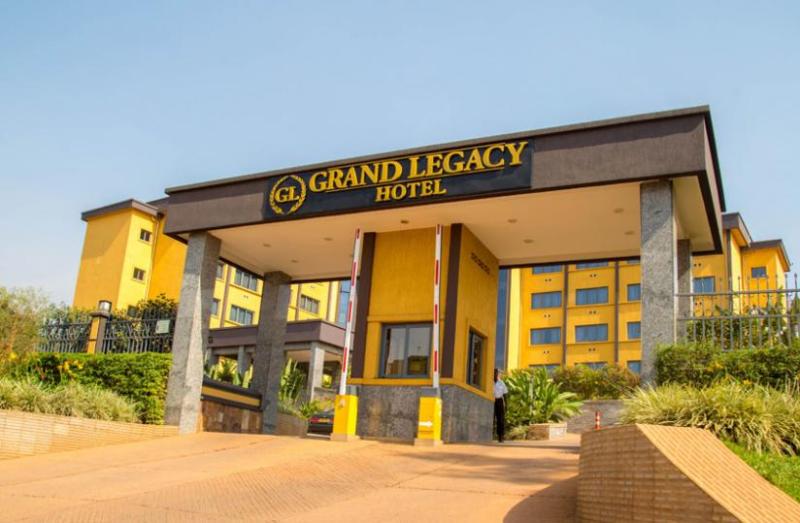
But not everyone is complaining. For instance at Grand Legacy (GL), a newly established hotel directly opposite Alpha Palace, Christian Ndagijimana, the facility’s marketing manager says they have already become market leaders after just over a year in business.
Established just over a year ago, the 5-star classified hotel has 43 high-end rooms ranging between US$240 and US$420 for a night.
Ndagijimana says that within a short period of time, GL has become Kigali’s leading facility, based on statistics compiled by TripAdvisor, an American travel website providing reviews of travel-related content.
As to why smaller hotels like the one across the road are failing, the salesman says it’s because of a general lack of proper management, dysfunctional marketing strategies and lack of passion in what people do.
“So the way out for them is to really get proper management in place and get people who are passionate about the hotel business, you definitely don’t want someone who is just looking for a pay cheque at the end of the month,” he said.
But Ndagijimana also admits that getting top managers can be quite expensive for most hotels which want to run on low budgets.
{{So what’s the way out for struggling small hotels?}}
Although PSF’s advocacy can help to temporarily protect the hotels from the auctioneer’s hammer, perhaps a more realistic solution is with Celestin Rwabukumba, the CEO of the Rwanda Stock Exchange.
Rwabukumba says most companies, small or large, are struggling with a problem of being undercapitalised something he says can be addressed through raising money on the market; it worked well for Bank of Kigali, Bralirwa and most recently, Crystal telecom.
“It’s possible that up to 90 per cent of our businesses are undercapitalised. Many businesses start off wrongly with up to 80 per cent of their operating capital obtained from commercial banks and only a small section being their personal savings, that’s dangerous,” he said.
Jean Claunde Karayenzi, the Access Bank Rwanda managing director echoes similar views pointing out that businesses like hotels need longer term capital to allow them to borrow with longer repayment periods.
Recently, African Development Bank Group extended a $6 million line of credit to Access Bank to support Rwandan small and medium entrepreneurs; the credit line is long-term and will see borrowers enjoying friendly interest rates.
Rwabukumba says equity is not what one owns as some people wrongly perceive it, but rather the cash at hand because in practice, land can’t pay bills unless it’s liquidated into hard cash.
A platform has been created to enable small and medium enterprises like hotels to raise money from stock market and improve their capital bases.
“Unlike large companies that are required to have minimum capital requirements before listing on the stock market, the SME segment doesn’t require such conditionalities,” he said.
Surprisingly, the initiative is not new as it was approved about two years ago, but no SME has been able to debut although Rwabukumba revealed that at least four enterprises are in the process to pioneer the initiative.
The biggest challenge for SMEs, according to Rwabukumba is poor governance systems and accountability and that there’s a need to build their capacity to enable them access the market with confidence that investors’ money would be safe.