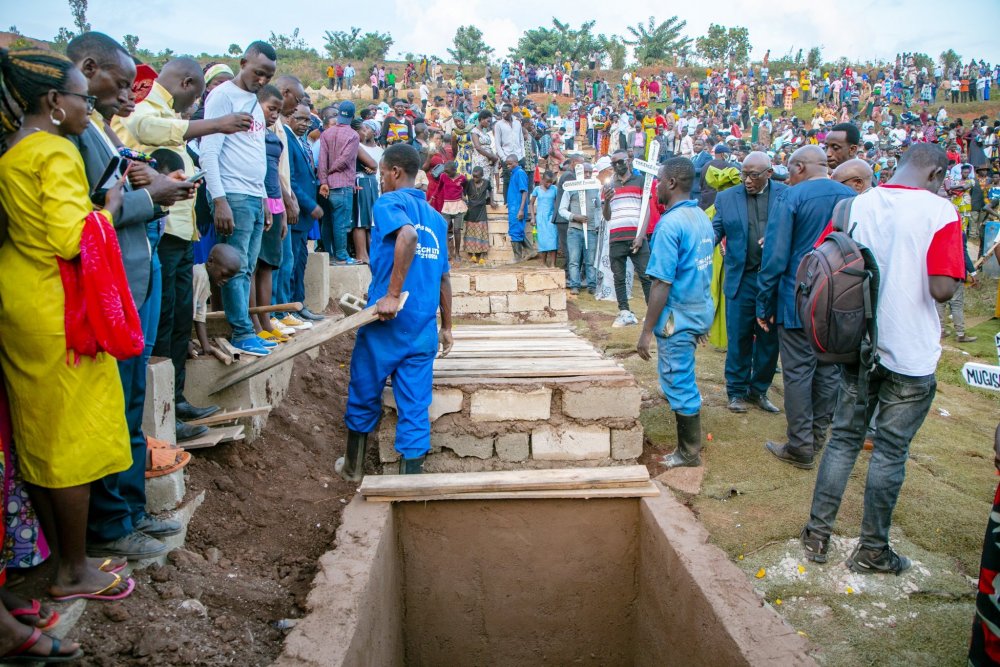
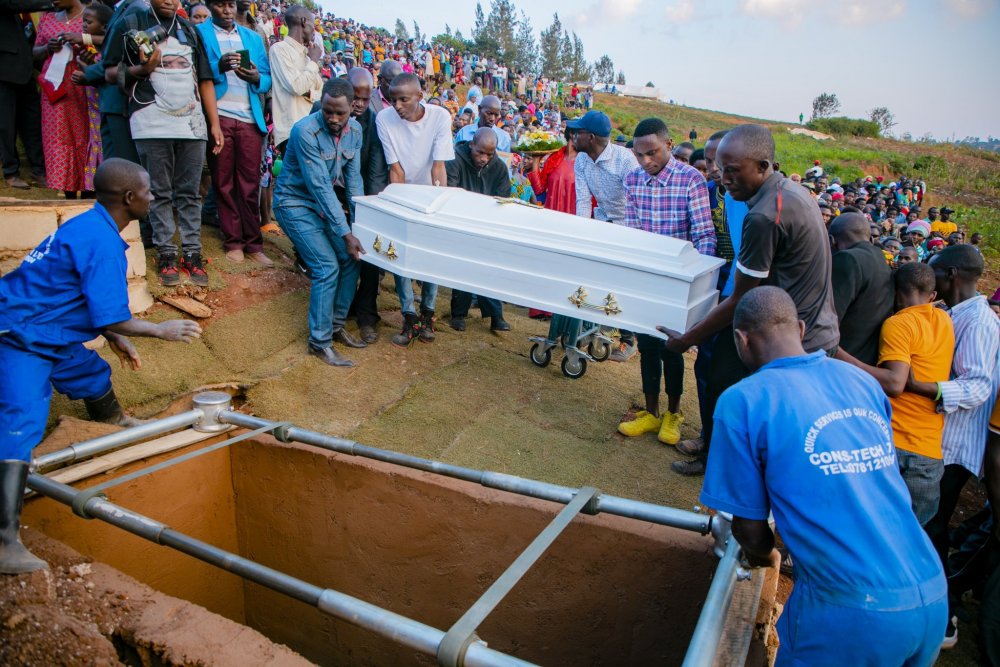
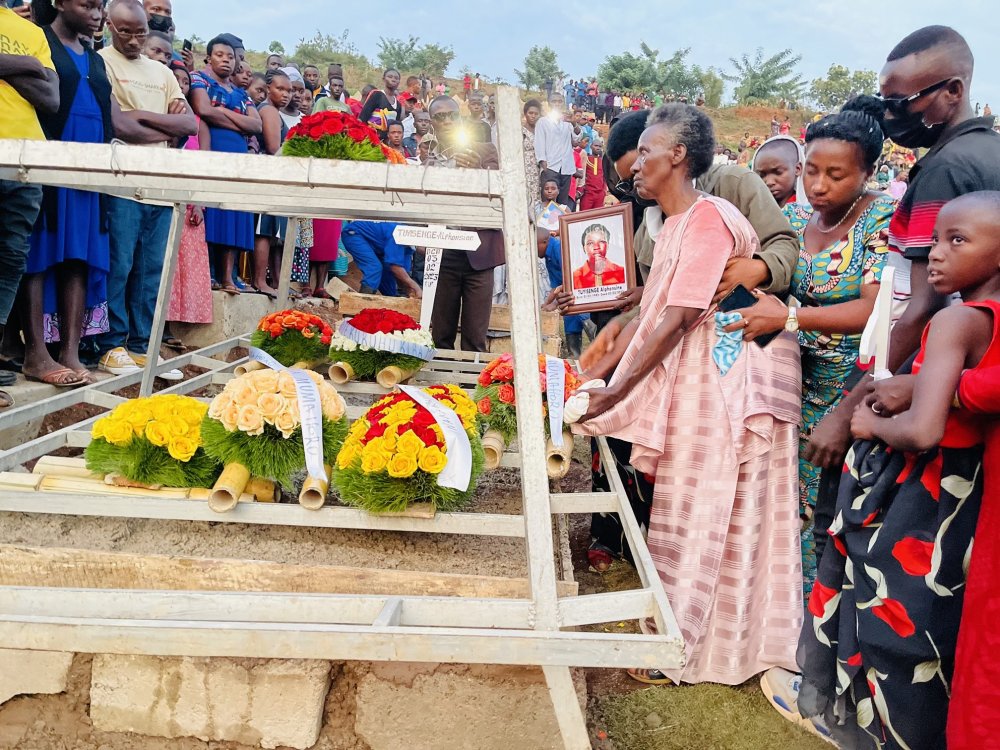
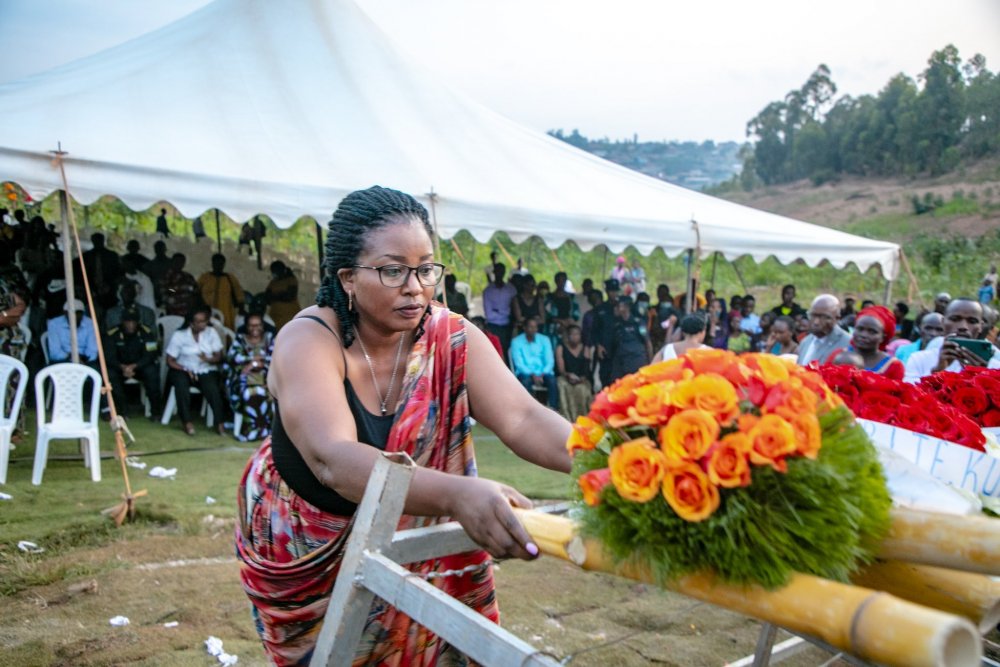
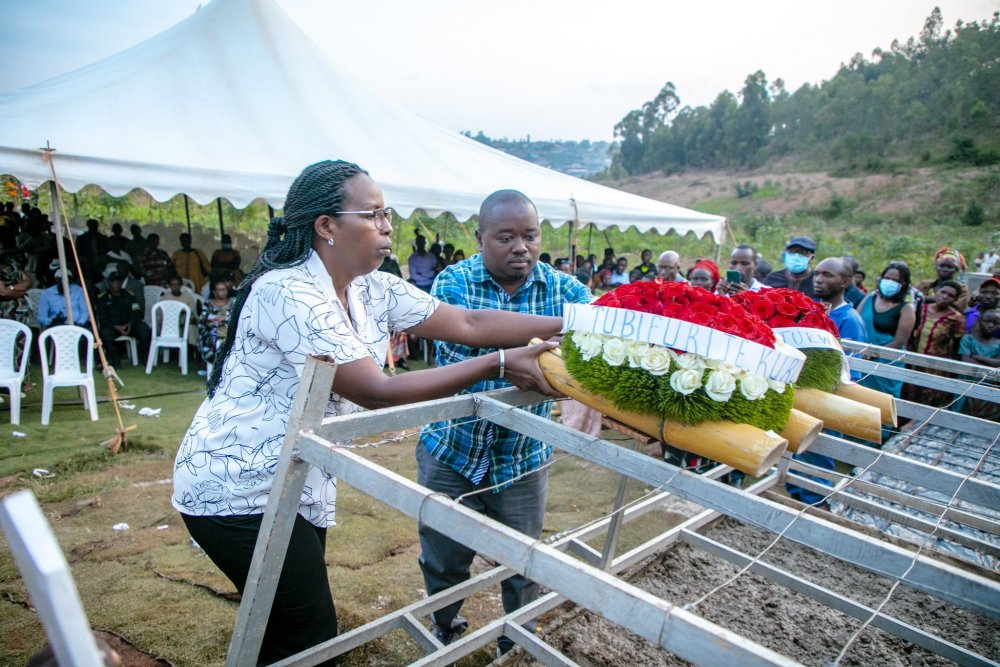
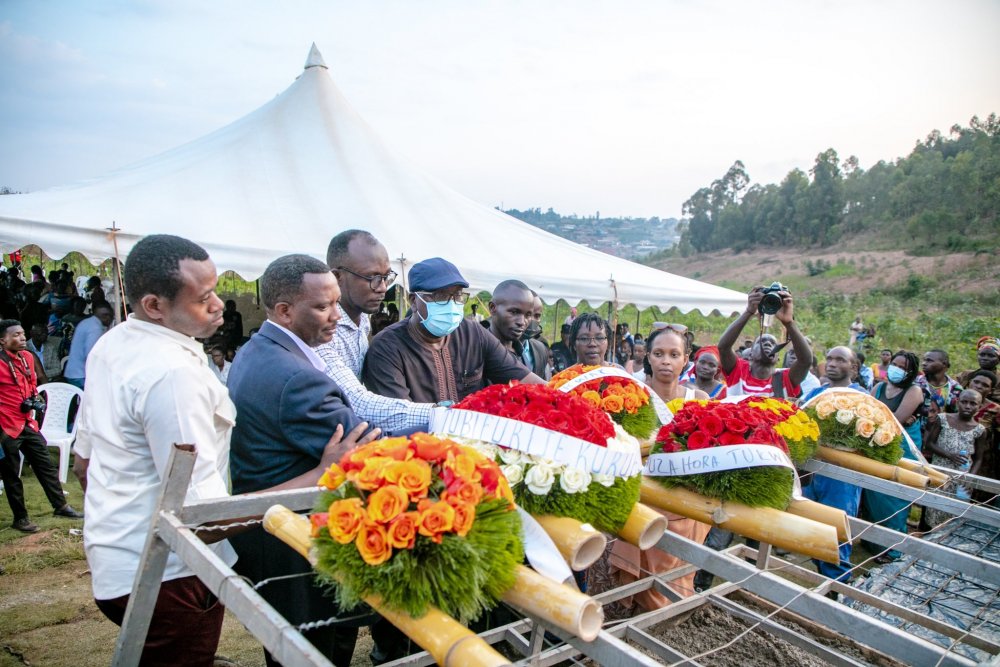
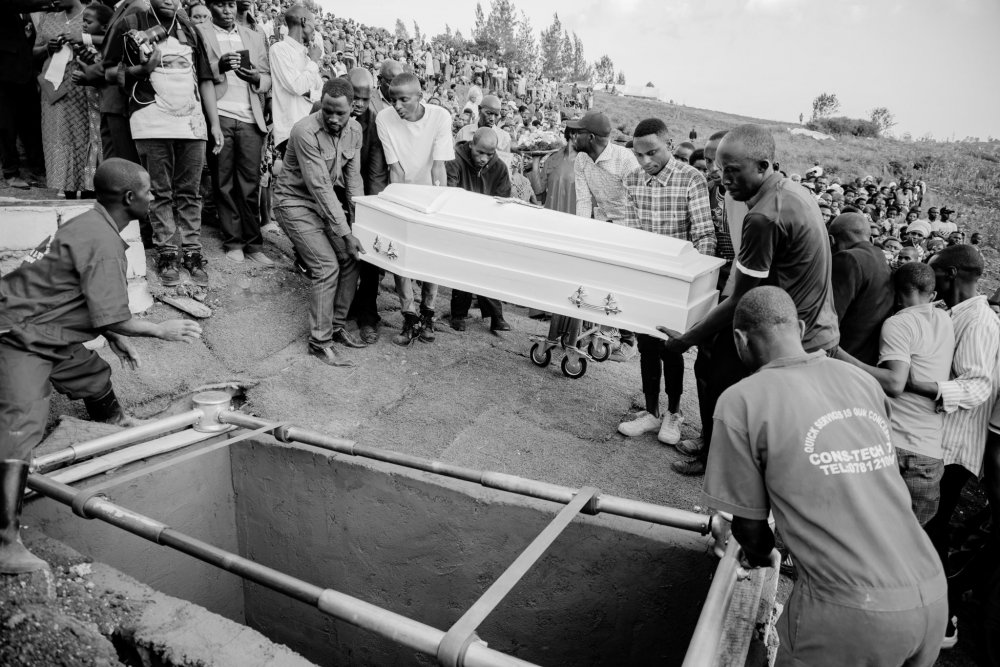
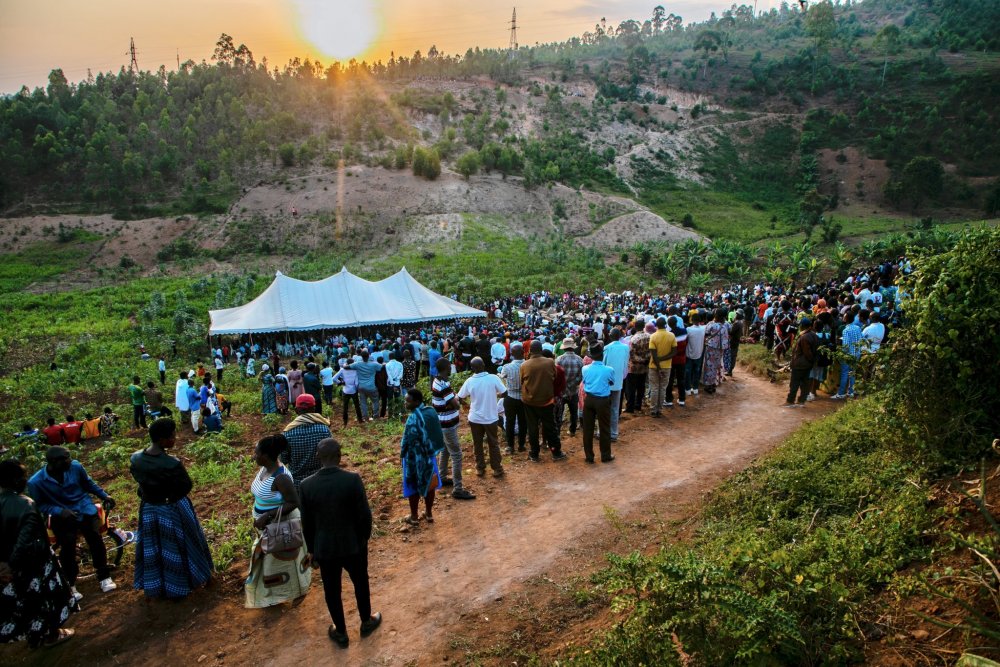
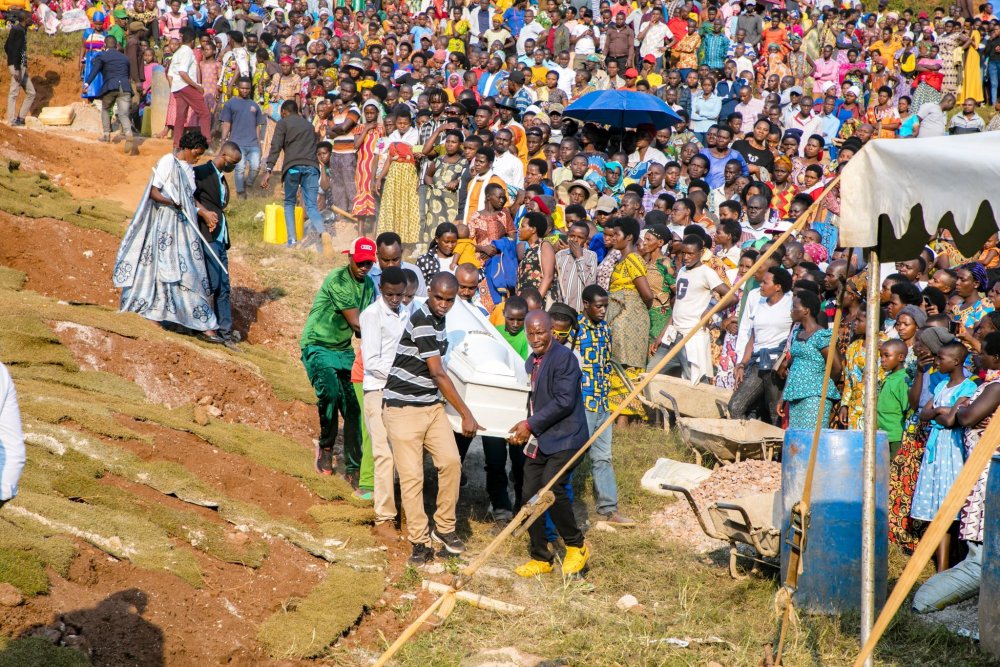
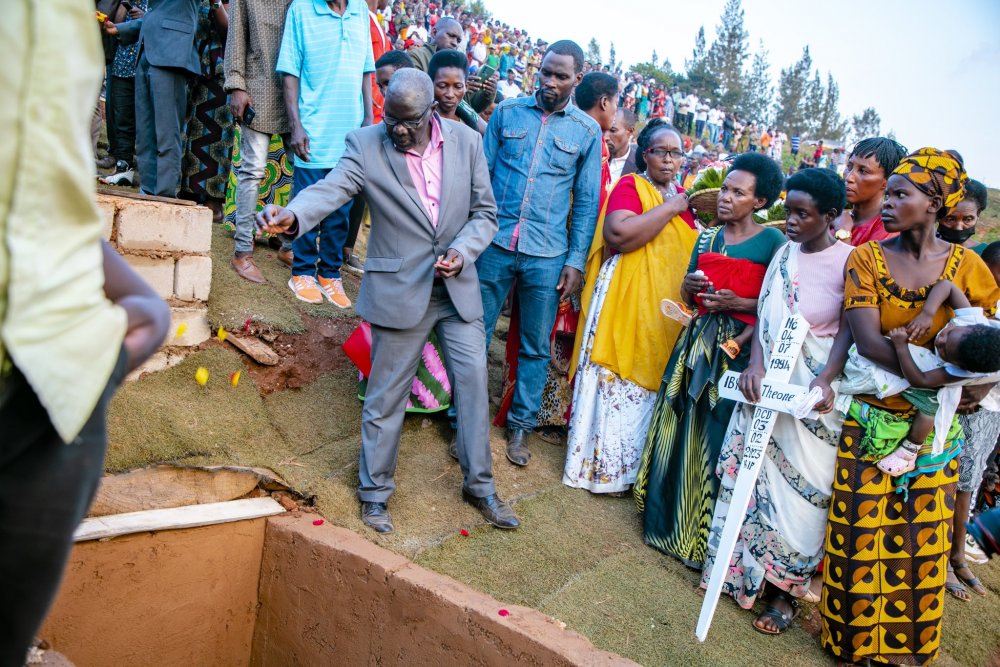
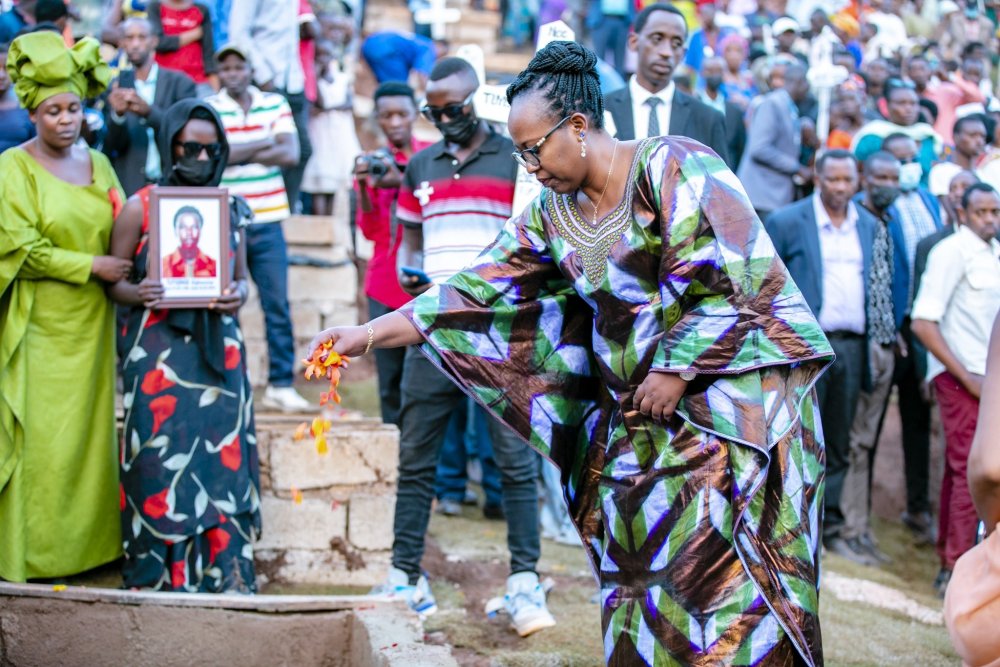
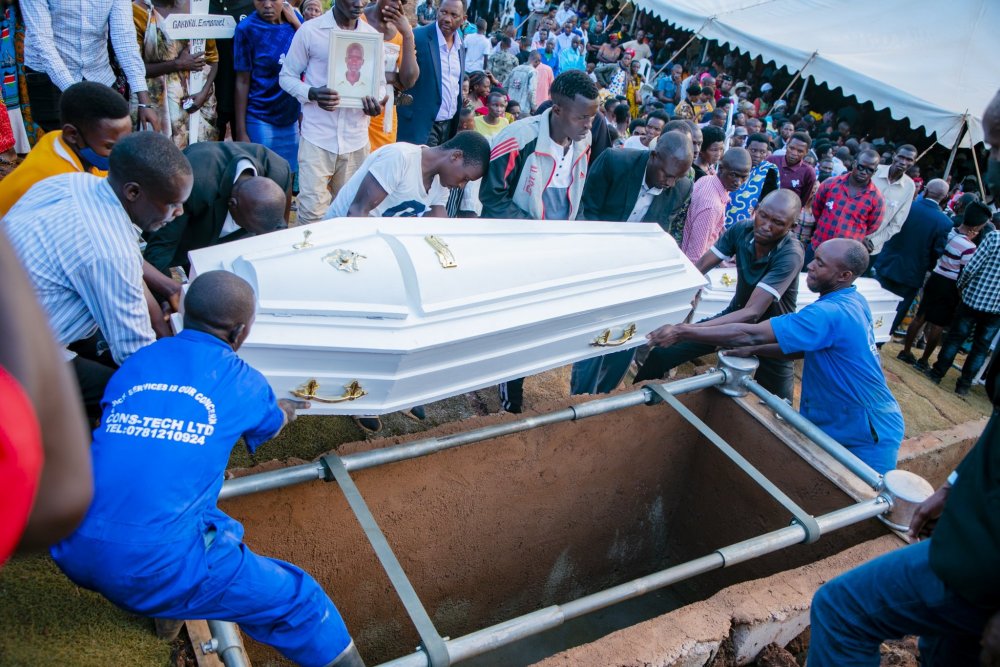
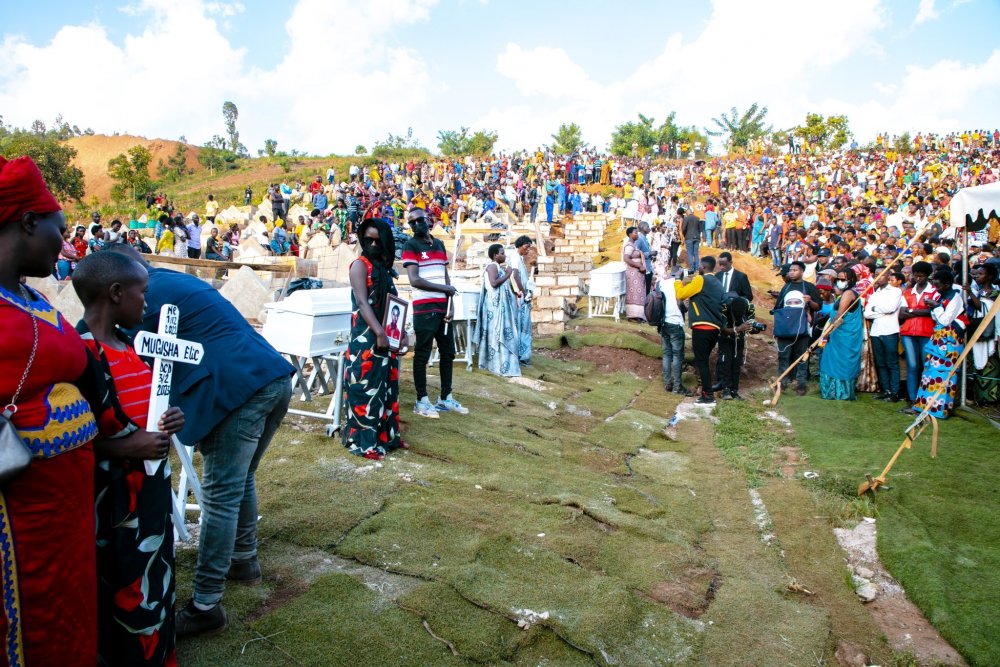
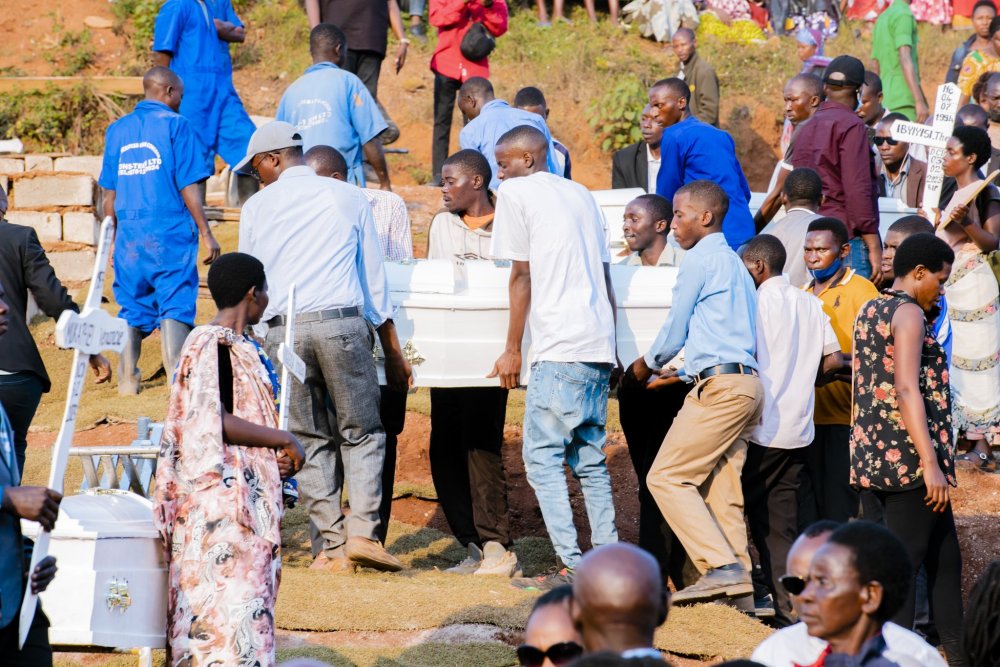
The incident occurred in the morning of Friday 3rd February 2023 when the maize drying facility which caved in, took 11 lives and left more than 30 people injured.
The drier belongs to Duharanire Ubukire – Gasagara Cooperative based in Gasabo District of Kigali City.
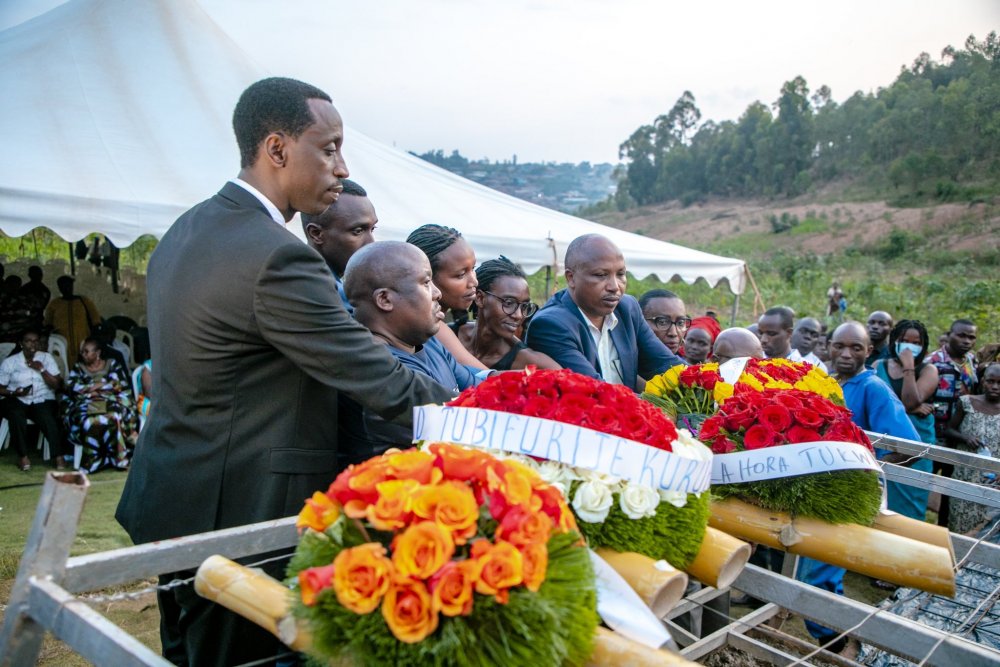
Following the accident, the government assured to take measures to ensure the safety of built up structures is reinforced to avoid similar incidents in the future. The deceased were buried on Sunday in Rusororo.
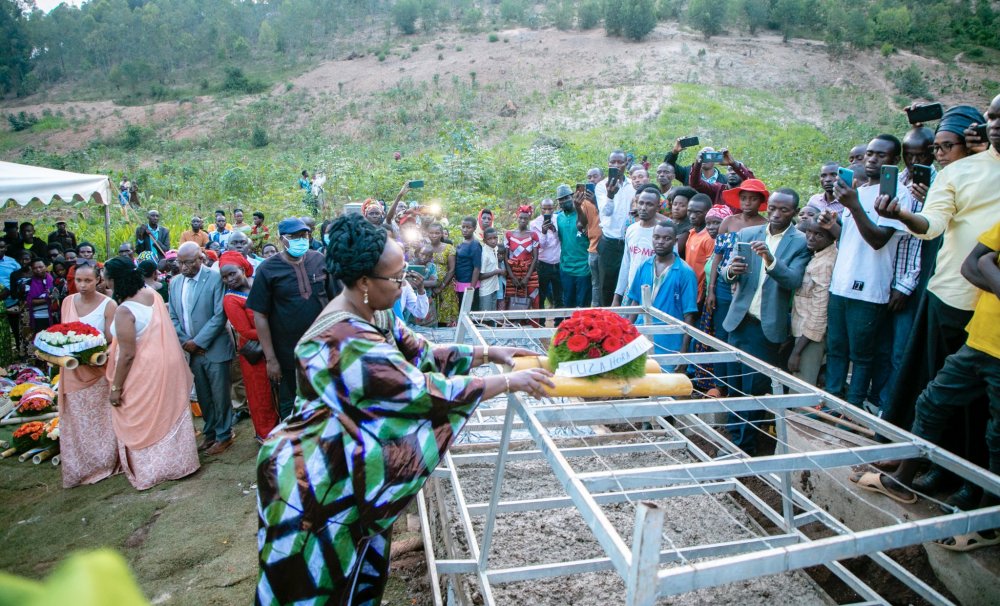
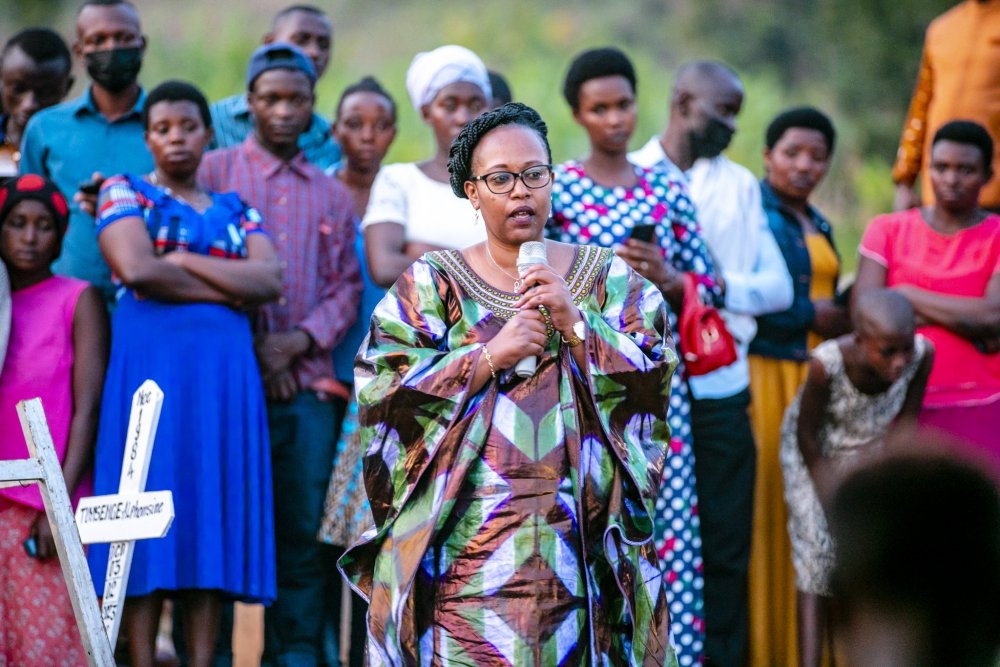
Minister of State in charge of social Affairs at the Ministry of Local Government (MINALOC), Assumpta Ingabire represented the government during the ceremony.
She condoled with the bereaved families and others whose relatives sustained injuries. Ingabire told them that the government stands with them during these difficult times and ‘will continue to stay closer to them’.
“On behalf of the Government of Rwanda, we have come here to sympathize with you. You lost siblings, children and parents but we are also saddened by the incident because it is a loss to the country. These brothers have died but they leave a good legacy – the legacy of work,” she said.
“The government will continue to stay close to you to move on with life, be it in terms of wellbeing or sustaining the cooperatives’ activities. There are recommendations to reinforce safety on facilities used by citizens and we assure that this incident won’t repeat itself,” added Ingabire.
It said that the accident resulted from heavy weight of maize on the drier’s wooden structure and wind that shook it.
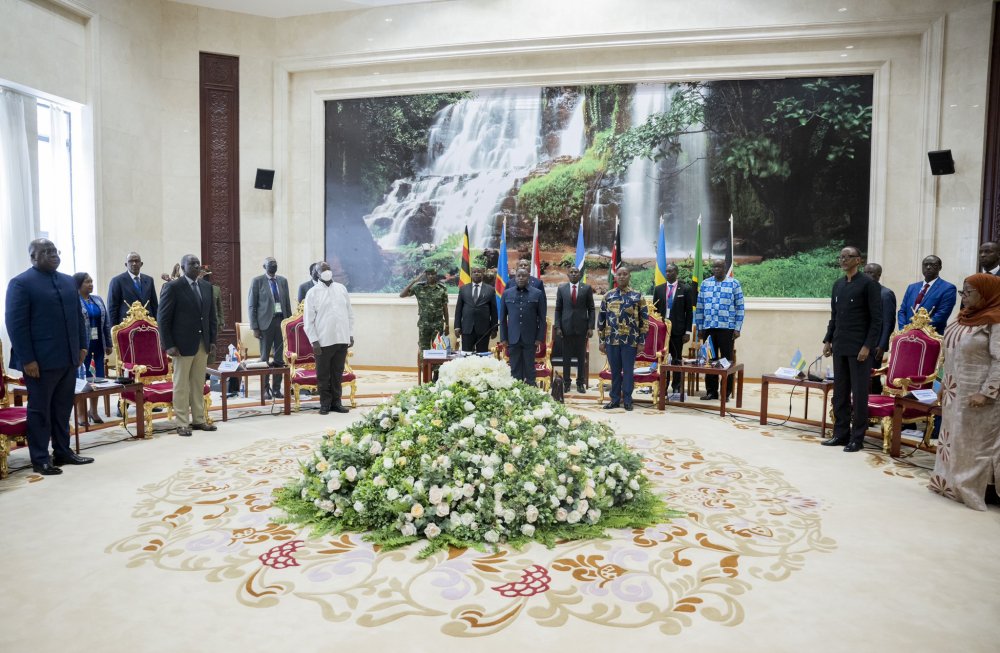
The latter is part of resolutions of the Extra-Ordinary Summit of East African Community (EAC) Heads of State held in Bujumbura on Saturday 4th February 2023.
During an exclusive interview with IGIHE, Prof. Nshuti disclosed that regional Heads of State sticked to dialogue as the ideal process that might put an end to the fighting between Congolese Army (FARDC) and M23.
“What we have agreed upon as the region and considered it to be the best solution to this problem, is that nothing is better than dialogues. They have to endorse it when the resolution is backed by the whole region; otherwise, the presence of regional forces in the country would be useless,” he said.
Even though discussions between Heads of State resolved to opt for the process of negotiations, there are footages showing Congolese President Felix Tshisekedi chatting with Maj Gen Jeff Nyagah, the commander of EAC troops deployed in DRC.
Tshisekedi is heard telling Maj Gen Nyagah that they want the troops he leads to help them in the fight against M23.
Prof. Nshuti has said that fighting M23 was not part of discussions.
“Fighting was not part of discussions because we focused on political process. It was about dialogue not fighting M23 […] They were only asked to cease fire and withdraw as negotiations go on. The option for EAC troops to fight them was not part of discussions,” he noted.
Prof. Nshuti further revealed that Tshisekedi himself also agreed to engage in negotiations with M23.
“We asked them to engage in negotiations and agreed, this time around, that they are going to do so. He [Tshisekedi] accepted it. It is about reaching consensus as a region on what should be done. Ceasefire and withdrawal going hand in hand with negotiations,” he said.
“It is about helping them to restore peace and end hostilities not helping them to fight,” added Prof. Nshuti.
Resolutions held in Bujumbura complement previous ones reached in Luanda, the capital of Angola in November 2022 where concerned parties were urged to end hostilities and engage in dialogue.
At the time, M23 was asked to withdraw from captured areas to be allowed to take part in discussions. The rebel group has so far withdrawn from several areas and handed them over to EAC forces.
However, fighting has been going on between FARDC and M23, which claims that it is protecting Kinyarwanda-speaking communities from attacks by Congolese Army.
The repatriation of foreign armed groups from DRC including the Democratic Forces for the Liberation of Rwanda (FDLR) was also part of discussions in Bujumbura.
FDLR is a terrorist group formed by individuals responsible for the 1994 Genocide against the Tutsi.
It was reported at different times that the rebel group works with FARDC to fight M23.
Christodoulides, who ran as an independent, garnered 32.04 percent of the vote, and Mavroyiannis, who also ran as an independent and supported by the left wing AKEL party, garnered 29.61 percent of the vote, Chief Returning Officer Costas Constantinou announced after the counting of all votes on Sunday.
Fourteen candidates participated in the election, but none of them won an absolute majority.
Averof Neophytou, leader of the ruling DISY party, ended third with 26.11 percent of the vote and was thus left out of the presidential race, ending the party’s ten-year-long hold on power in the eastern Mediterranean island.
Neophytou’s performance in the election was considered by political analysts as a blow not only to himself but also to his right-wing party.
Both Christodoulides and Mavroyiannis had been close associates of the outgoing president Nicos Anastasiades who will step down at the end of February.
Christodoulides served for four years as spokesman for Anastasiades and then as his foreign minister for another four years.
Mavroyiannis, a diplomat at the foreign ministry, had been Anastasiades’ negotiator in peace talks with Turkish Cypriots for a settlement to the Cyprus problem.
Political analysts said that the two presidential hopefuls would start wooing DISY voters for their support ahead of the runoff vote.
A DISY official said the party would meet on Monday to decide its official stance in relation to the runoff.
The Chief Returning Officer said that out of 561,273 registered voters 404,403 people, or 72.05 percent, cast ballot papers.
Nicholas Haysom, the UN secretary-general’s special representative in South Sudan, called on the authorities to urgently launch an investigation and hold perpetrators to account.
“This violence is unacceptable and was in sharp contrast to the message of the Ecumenical Peace Pilgrimage to South Sudan, which called for peace and reconciliation,” Haysom said in a statement issued in Juba, the capital of South Sudan.
He said at least 2,000 people, mainly women and children, have become internally displaced, including 30 unaccompanied children.
The UN expressed concern about the resurgence of killings and violence stemming from long-standing tensions between cattle-keepers and host communities in Central Equatoria State and in other parts of the country.
Over the past two weeks, the UNMISS said, escalating violence has resulted in at least 45 deaths among unarmed civilians in Kajo-Keji and Mangalla Payam, among other areas in Central Equatoria.
Haysom urged South Sudanese leaders to encourage restraint and avoid fueling any conflict, noting that the UNMISS is increasing patrols to the affected areas, and engaging the authorities as well as community leaders, to end these hostilities and seek peaceful solutions.
The UNMISS said it welcomes the government’s deployment of troops to the area to ease tensions and protect internally displaced persons
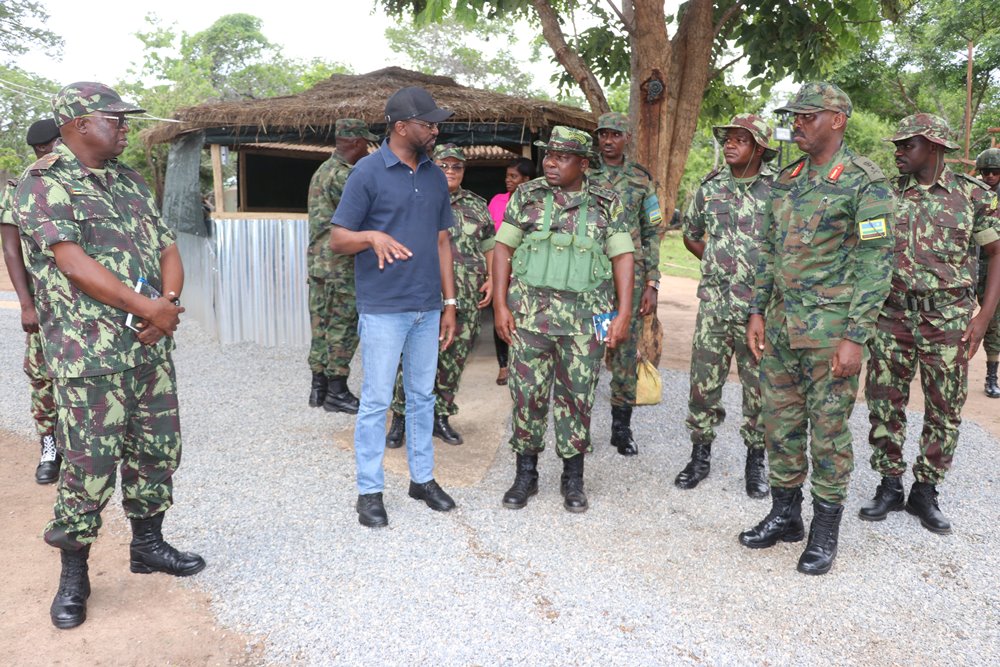
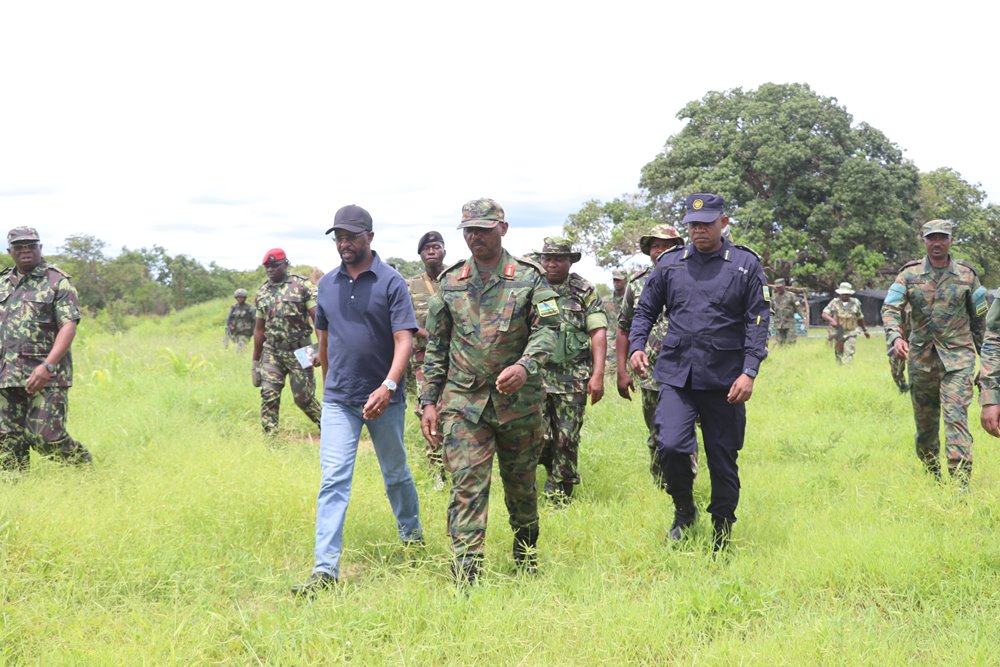
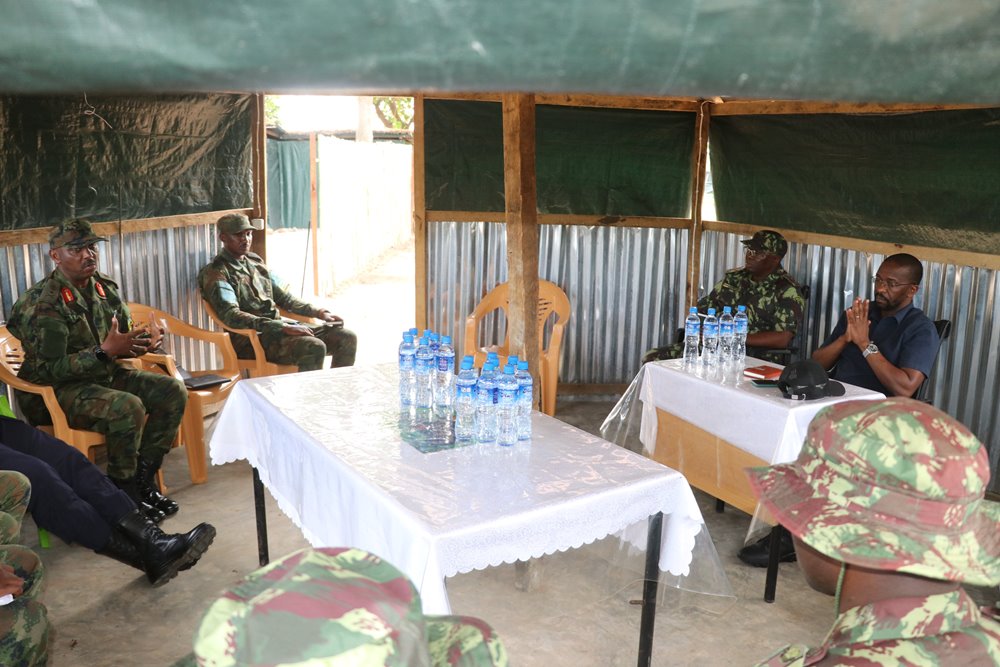
They were welcomed by Brig Gen F Mutembe, the Task Force Battle Group commander and received a briefing on the ongoing operations launched on 21st December 2022.
The Minister appreciated the work that has been done on the ground so far.7
Rwanda started the deployment of 1000 troops of the Rwanda Defence Force (RDF) and the Rwanda National Police (RNP) to Mozambique on 9th July 2021, to fight terrorist groups, honoring the request of Mozambique. The troops had increased to nearly 2000 by the end of the year 2021.
As he received oaths of new officials including the Minister of Health, Dr. Sabin Nsanzimana and Minister of State in the same ministry, Dr. Ivan Butera towards the end of last year, President Paul Kagame said that Rwanda increased troops deployed to Mozambique in connection with their new mandate.
“We have nearly 2500 troops including soldiers and Police personnel in Mozambique, working with Mozambican forces. Even yesterday, we deployed more troops. We did it because many problems have been solved in collaboration with Mozambicans since our initial deployment,” he said.
The troops have also got a new mandate to pursue terrorists and dislodge them from their hideouts.
The situation in the country had worsened since October 2017 when armed extremists launched an insurgency in the Cabo Delgado Province of Mozambique.
Mozambique Defence Armed Forces battled the extremists but many civilians were killed and displaced by the fighting.
Before Rwandan troops’ intervention, terrorists had killed 3000 civilians while more than 800,000 were displaced. The insecurity had also put to halt all development projects in the area controlled by insurgents.
The joint operations between Rwandan and Mozambican troops yielded big where different regions were seized from rebels.
Rwanda and Mozambique have been enjoying vibrant relations for many years.
On Monday 12th September 2022, President Paul Kagame and his counterpart of Mozambique, Filipe Nyusi met in Kenya ahead of the inauguration of newly elected president, Dr. William Ruto.
Both leaders discussed ways to further strengthen the ongoing bilateral collaboration between Rwanda and Mozambique.
In February last year, Kagame received Nyusi with whom they discussed the good progress that has been made between Rwanda and Mozambique in the ongoing cooperation towards securing Cabo Delgado as well as other areas of bilateral collaboration.
Rwanda and Mozambique have cooperation agreements in different areas including security, trade and investment among others.
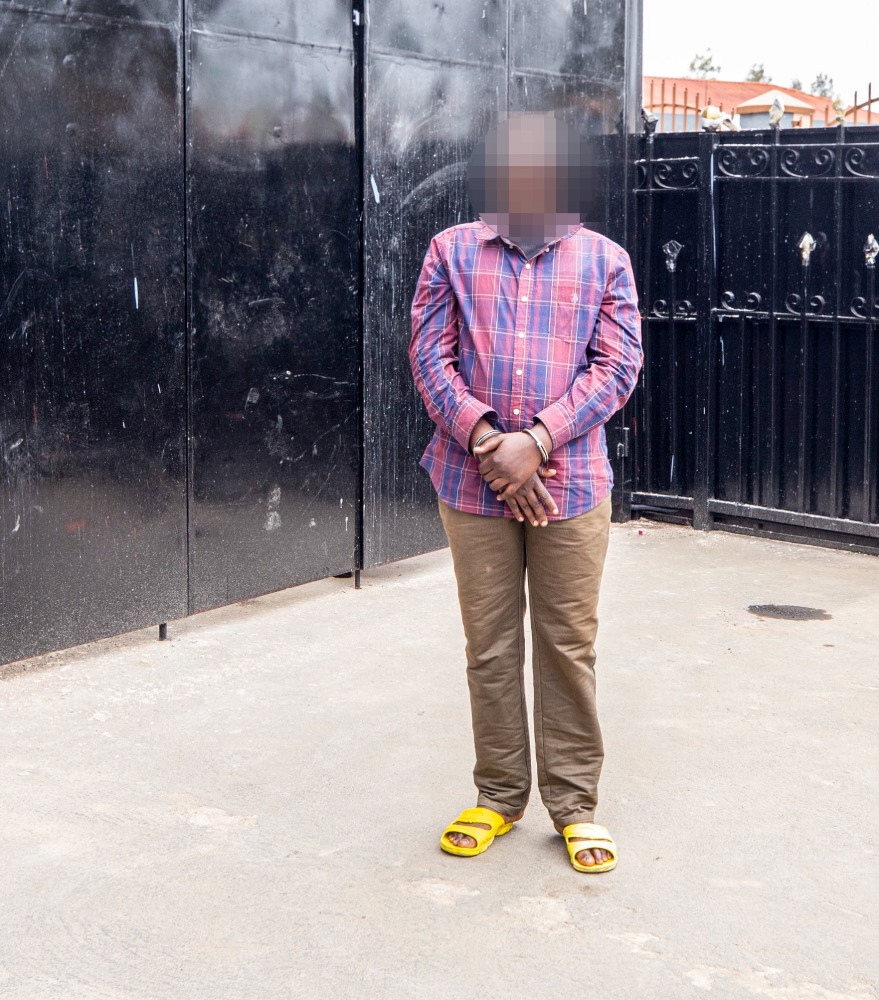
Usto Hafashimana alias Yussuf, 34, was arrested on Friday, February 3, in Nyamirambo, Nyarugenge District following two months of investigations into four separate gruesome murders and two cases of attempted murder.
He was paraded to the media on Sunday, February 5, at Kigali metropolitan headquarters in Remera, Gasabo District.
The inhuman acts were committed between December 27, last year and January 23.
Commissioner of Police (CP) John Bosco Kabera, the RNP spokesperson, said that the arrest of Hafashimana was a result of thorough investigations.
“All the four murders and two attempted murders, were committed in the same scenario, with a machete, sometimes beheading the victims. Investigations connected all these dots and information from other people, whom he was also conniving with in other criminal acts of theft, helped to identify and arrest the suspected killer,” CP Kabera said.
{{How Hafashimana was committing the murders}}
While speaking to the media, Hafashimana said that he was killing them with a machete and would kill only those he found sleeping.
“It was a random target. I didn’t know or have any history with those I killed. I would go household by household at night and anyone I found sleeping, especially security guards, I would kill them with a panga. I beheaded two of them, took their heads and dumped them in a well,” Hafashimana said.
A decapitated head of one of the victims, was recovered in a swamp in Masaka Sector, Kicukiro District.
When asked how many people he had killed, Hafashimana said: “I knew that I had killed six people, but I was told that I killed four and two others survived. The plan was to kill at least 40 people.”
{{The murders}}
On December 27, last year, Hafashimana allegedly beheaded one only identified as Matayo, in Kicukiro District, Kigarama Sector, Rwampala Cell, Uwateke Village. The decapitated body was recovered in Rwampala swamp.
On December 30, the duo of Vedaste Hagenimana, 22, and Philemon Nzabagerageza, 27, were allegedly attached by Hafashimana with a machete at a construction site in Nyarugunga Sector, Kibaya Cell in Kamashashi Village.
They both survived with injuries. Hagenimana lost his left eye while Nzabagerageza’s left hand was also cut off.
Later on January 15, one Vedaste Gafaranga, a night guard in Marembo Village, Nyarukombe Cell of Muyumbu Sector, Rwamagana District, was killed.
Hafashimana is also said to be behind the murder of one Gideon Niyonsenga, on January 18, in Kanyinya Village, Nyagahinga Cell, Rusororo Sector in Gasabo District. Niyonsenga was also a night guard.
One Leonce Nshimiyimana was also beheaded on January 30, in Rusororo Sector, Gasabo District.
Nshimiyimana was Hafashimana’s close friend. Investigations indicate that he killed him in a bush in Rusororo Sector where they were at the time hiding and planning to break into one of the houses in the area to steal valuables.
At the time of his arrest, Hafashimana was also found with assorted valuables belonging to some of the victims, including mobile phones.
The suspect, who hails from Ngororero District has a history of burglary. He was previously convicted for theft and served two years at Nyarugenge prison between 2015 and 2017.
{{Survivors narrate the ordeal}}
Hagenimana and Nzabagerageza narrated how on the night of December 30, last year, as they were sleeping, were attached.
“It was at about 01a.m, when someone armed with a machete, appeared from nowhere as we were asleep, and started cutting us. We don’t know how we survived by somehow, God was with us,” said Hagenimana.
Rashid Barinda, who was employing the deceased, Gideon Niyotwagira, said that the attack happened at about 03:45a.m.
Nzabagerageza said: “I lost my hand and the other was left injured… I cannot do anything. My worry right now is my child, who expects all the parental support, which I can no longer give. Any support to find other means of survival besides using my hands, to support my child, will be much appreciated.”
“I heard a scary sound, but at once I thought that maybe Niyotwagira had fell down. When I came out, I found my security guard lying dead in a pool of blood,” Barinda said.
Japhet Niyonshima, a twin brother to Niyotwagira, narrated how as brother came to Kigali to work.
“We came to Kigali three months ago, from Ngororero, to look for casual jobs. We were staying together in Rusororo although my brother had a night duty as a security guard, where he was killed as he was sleeping,” Niyonshima narrated.
Meanwhile, CP Kabera said that the arrest of Hafashimana saved lives of many other people.
Murder under article 107 of the law determining offences and penalties in general, is punishable with life imprisonment.
After the merger, the lender revealed, BPR Bank Rwanda Plc, the bank went through a transition from the previous core banking systems Temenos 24 Release 12 (Former BPR) and Temenos 24 Release 14 (Former KCB Rwanda) to a unified and upgraded system Temenos 24 Release 21, which is an amalgamation of all customer data in its totality.
The lender has through a released statement explained that the goal of integration and upgrade of the system is to enhance delivery of services to its customers through provision of best-in-class financial technology which is ultimately purposed to create a consistent seamless experience.
“The process of integrating and upgrading our core banking system was completed and rolled-out across BPR Bank Rwanda Plc on 23rd January 2023. While the latest platform is live, we have experienced intermittent access to over-the-counter services and alternative channels. These interruptions are periodic, and are being addressed in real time, complemented by a 24-hour Call Center to provide additional support. All inquiries are being attended to and will be resolved in due time,” reads part of the statement.
BPR Bank Rwanda has also reassured all customers and stakeholders that a detailed assessment of service delivery technology is ongoing to ensure post deployment of the new system is adequate to meet all customer requirements.
“We are grateful for the feedback we have received that is enabling us to make continuous improvements. With the core banking system upgrade, customers will experience more functionalities, flexibility, and improved service uptime. Delivery of convenience to our customers is central to our operations and we remain committed to improving service delivery,” adds the statement.
For further clarifications, customers are encouraged to reach out to the bank’s call center on 1500 or 5222 and 0788140000 or 0788187200. They can also email the lender on contactus@bpr.rw or info@bpr.rw for more information and support.
Some people think that this practice is for developed countries only that it is not possible in Rwanda but it’s not the case. As Rwanda develops in all different areas, this technology was not left behind.
In 2021, it was reported that since the start of the measures to prevent the spread of the coronavirus, the number of IT business services providers had increased by 20%.
The figures showed that food sales on online marketplaces were up 50%, baked goods were up 25%, and cleaning supplies were up 12%.
62% of the orders were worth between Rwf20,000 and Rwf50,000, while the rest were less than Rwf10,000.
[Murukali ->https://murukali.com/] is a good example of online marketplaces based in Rwanda.
Over the past seven years, it has worked with more than 650 merchants to increase online shopping.
Products include food, clothing, and various other items that a person can buy from anywhere using the internet, and, this company will deliver whatever was bought in a short time.
The CEO of Murukali Online, Yvette Uwimpaye has said said that apart from the fact that different people swear on this website without leaving their homes, they also help students by giving them knowledge about business done on the internet.
“They come and see how it is done and they understand the pathways. Until now we are happy that we benefit many people in one way or another, whether they are individuals or certain companies,” she revealed.
Uwimpaye further explained that the uniqueness of this website is that they have about three international certificates in terms of technology and providing good services and one from Rwanda that confirms it as an official website for shopping.
“We welcome clients from all over the world. We have a lot of products on the platform and help the traders market groceries on the site,”
For the seller who wants to put his products on the website, he pays Rwf50,000 as a membership fee per year and pays 10% of the sales, which is used to pay for services that include payment methods for advertising and customer support.
To improve the level of internet trading, the CEO of Murukali said that they have invested in this website where they currently have an American team that is monitoring its affairs, and they are also putting effort into providing better services to their customers.
She vows that in the next five years, they want to be the first solution for anyone who wants to shop in Rwanda without leaving their home, wherever they are located in the world, and what they want will reach them in a short time.
They intend to help people who do different jobs in business but lack a place to display their products, and it is done by developing Murukali so that it becomes an opportunity for everyone with small and large capital, which will also help to reduce poverty in the country.
It’s just that until now the companies that help people to deliver the goods bought to the customers (Logistic Companies) in Rwanda still have problems because they don’t provide the desired services that are suitable for online shopping, and with the price of 4% they say is high that the traders can’t understand.
Uwimpaye said that despite the situation, things are getting better because they have started providing unauthorized services in Rwanda where people did not know it was possible but now it is known and it has started to be used.
In the case of merchants who have not yet risen to the use of the method, they should know that today their customers are kings. It means that the merchant will have to provide the customer with information about the services they provide through all possible means and the internet sales are not left.
Uwimpaye says that their commitment and keeping up with the latest trends and innovation is what makes them one of the leading companies that helps online shoppers get the best service.
When Rwanda was undergoing difficult times of Covid-19, Murukali leveraged its technology to supply to different customers. Its platform is designed in a way that a customer gets automatic discount after shopping items worth more than Rwf1 million.
It also has a feature that reminds customers that what was previously in storage is back and so on.
E-commerce is one of Rwanda’s most important aspects in the development of technology because statistics show that Rwandans are increasingly embracing it even though it has not yet reached a satisfactory level.
The latest report of the Central Bank of Rwanda shows that the number of people using phones to make regular payments has increased by 9 percent, from 5,079,232 in June 2021 to 5,528,109 in June 2022, while the number of people using cards has increased from 4,635 to 5,263.
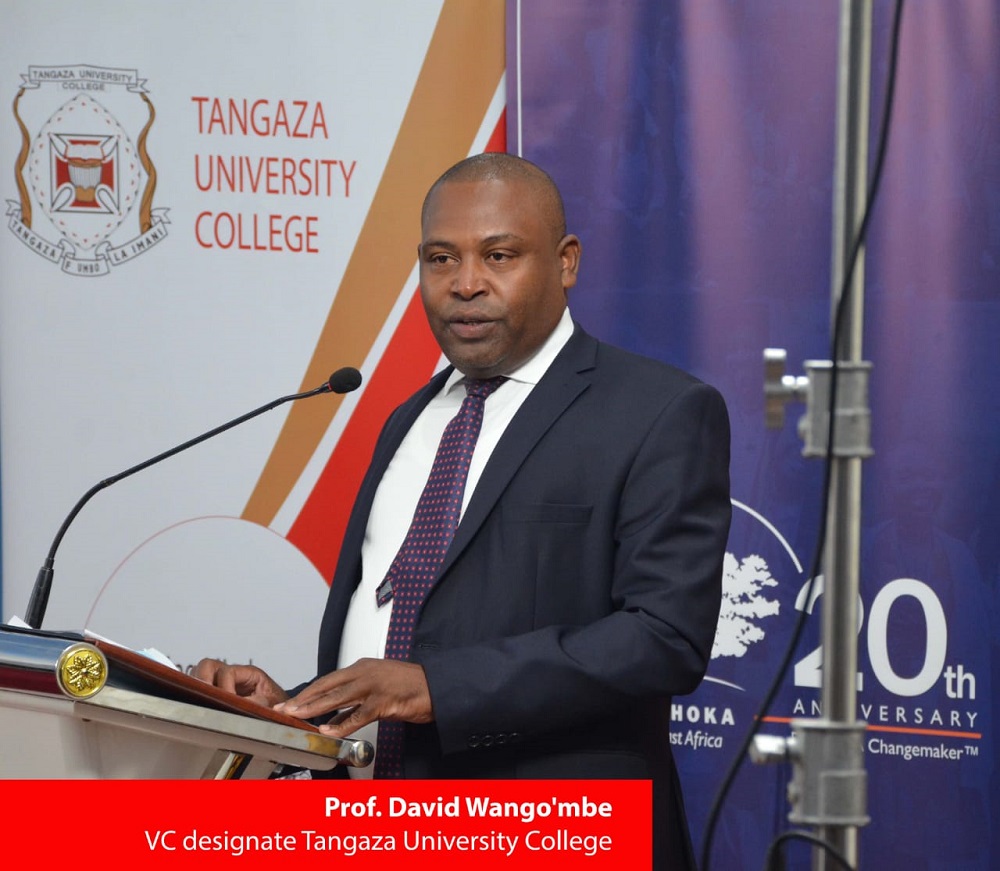
Prof. Wangombe holds a BA (Hons) and MBA from the University of Nairobi as well as a PhD and Associate Professor of Accounting and Sustainability from Strathmore University, Kenya. He is a Certified Public Accountant of Kenya (CPA(K) and an alumnus of the International Faculty Development Program (IFDP) of the highly-rated IESE Business School, Barcelona, Spain (2008) and Teaching the Practice of Management (TPM).
He brings to his new role a wealth of demonstrable knowledge and experience, having worked in various institutions of higher learning as the Dean of School of Management and Commerce at Strathmore University, Kenya for 10 years, Director of Strathmore Enterprise Development Centre and Strathmore Research and Consultancy Company, Vice Chancellor designate of Tangaza University college and a lecturer in the fields of Finance, Accounting and Enterprise Development for over 2 decades.
Prof. Wangombe has been the lead consultant in the Development of Resilience Strategies for 5 cities in Kenya, a World Bank-funded project under the State Department of Housing and Urban Development ending in February 2023. For over 10 years, Prof. Wangombe has built capacity for Healthcare Leaders in Africa under the Management Ddevelopment Institute (MDI), a joint project of the University of California Los Angeles (UCLA), Africa Medical and Research Foundation (AMREF) and funded by Johnson and Johnson.
He has further trained over 15,000 entrepreneurs with banks and enterprise centres in Kenya and over 1,000 African faculties on case methodology under the Partnership for Pedagogical Leadership in Africa (PEDAL), a program of PASGR that seeks to improve faculty pedagogical skills. He has consulted for several organizations including Strathmore Business School (SBS), Adamsmith International, Partnership for African Social and Governance Research (PASGR), Kenya Commercial Bank and Strathmore Research and Consultancy Company (SRCC).
The Board of Directors, Management team, staff and students of University of Kigali congratulate Prof. Wangombe on his appointment and commit to supporting his efforts in steering the affairs of UoK towards the achievement of its strategic goals.