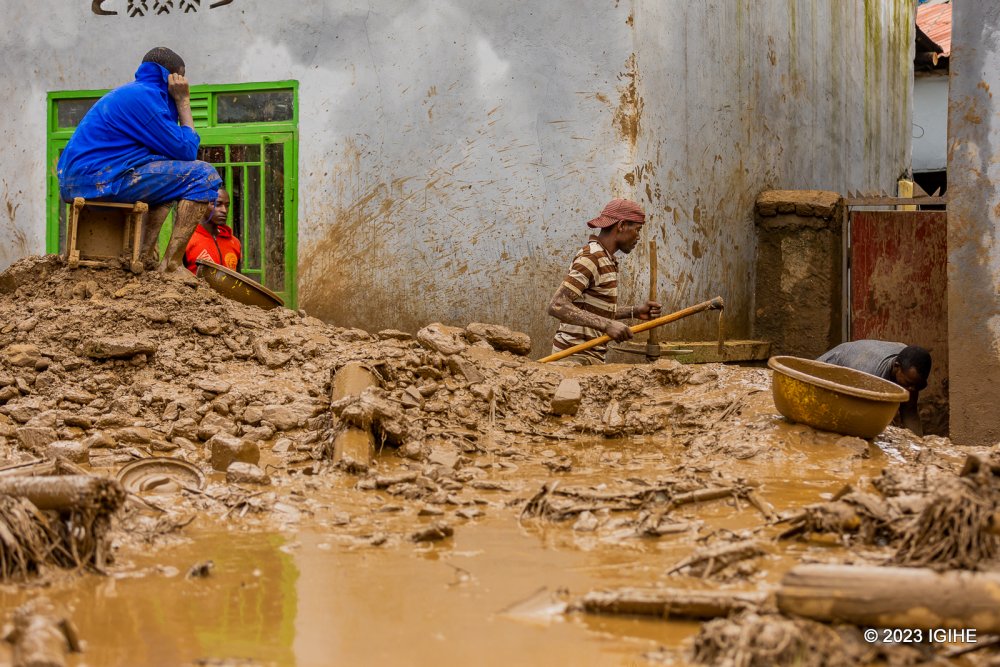
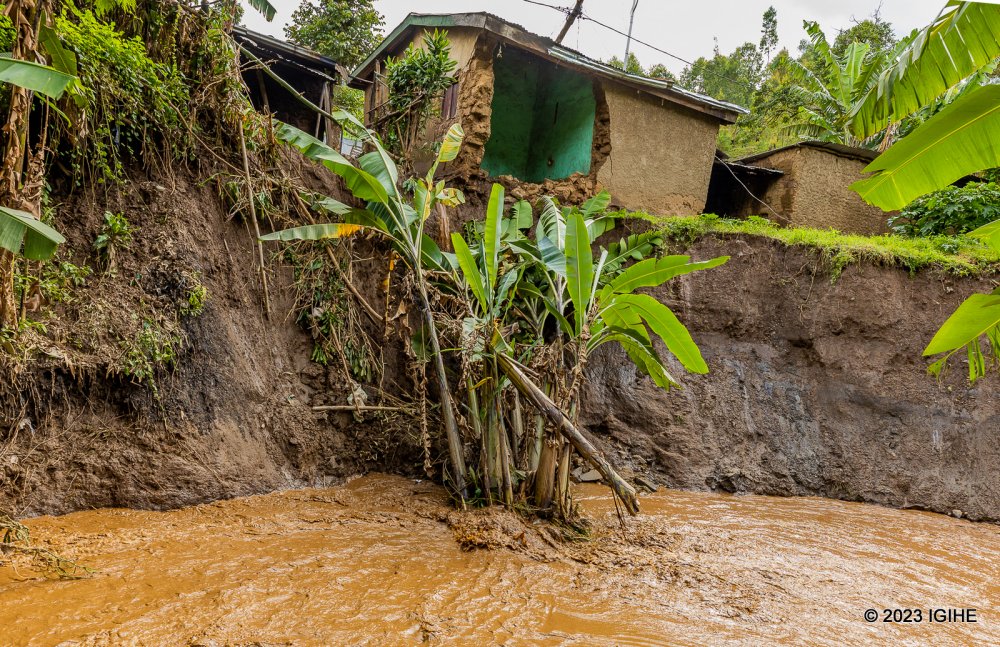
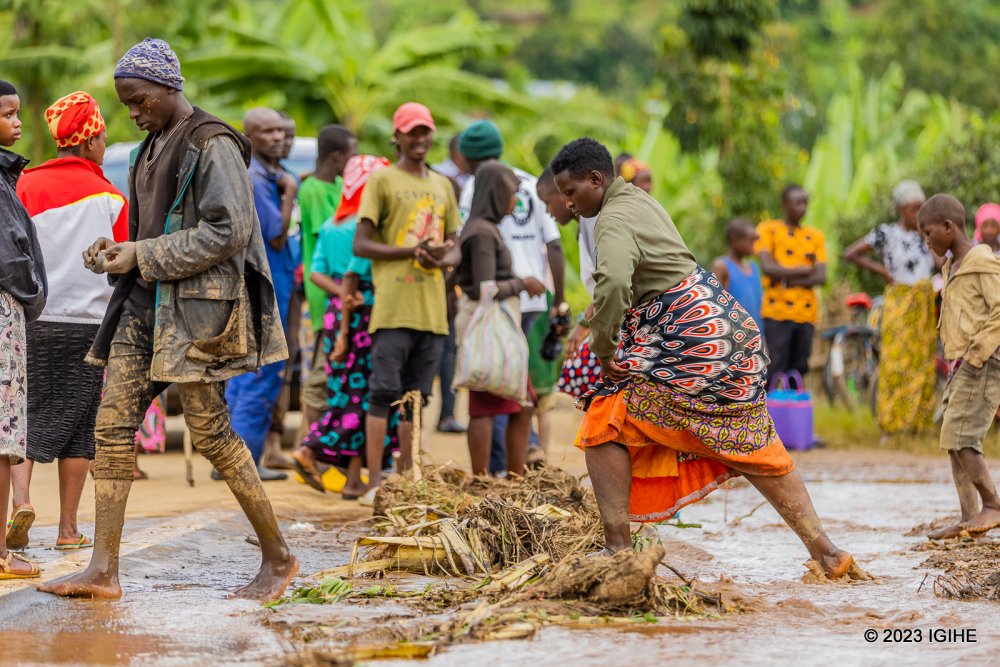
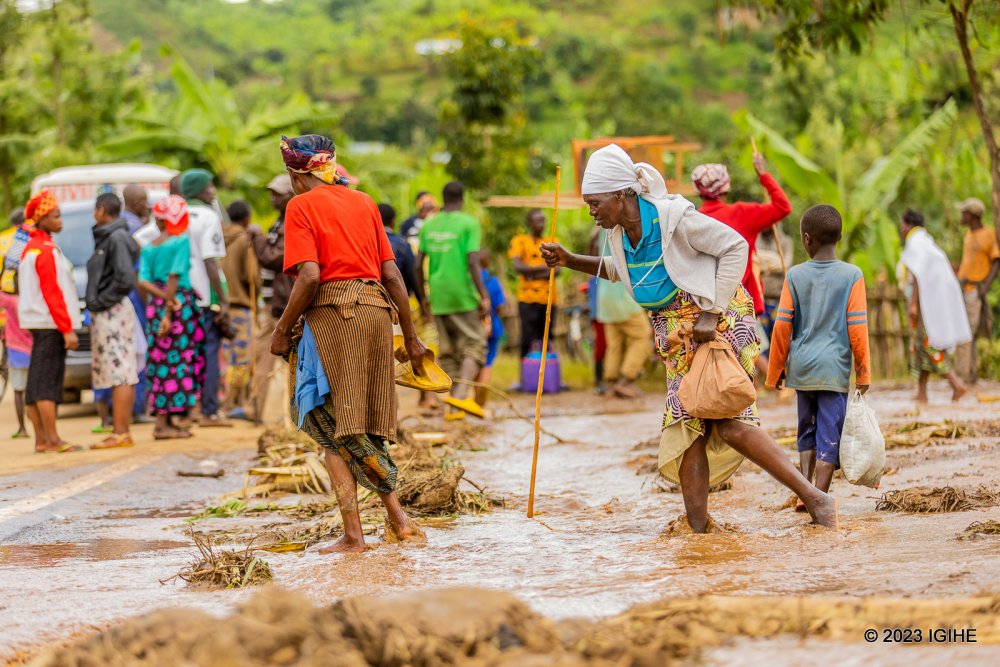
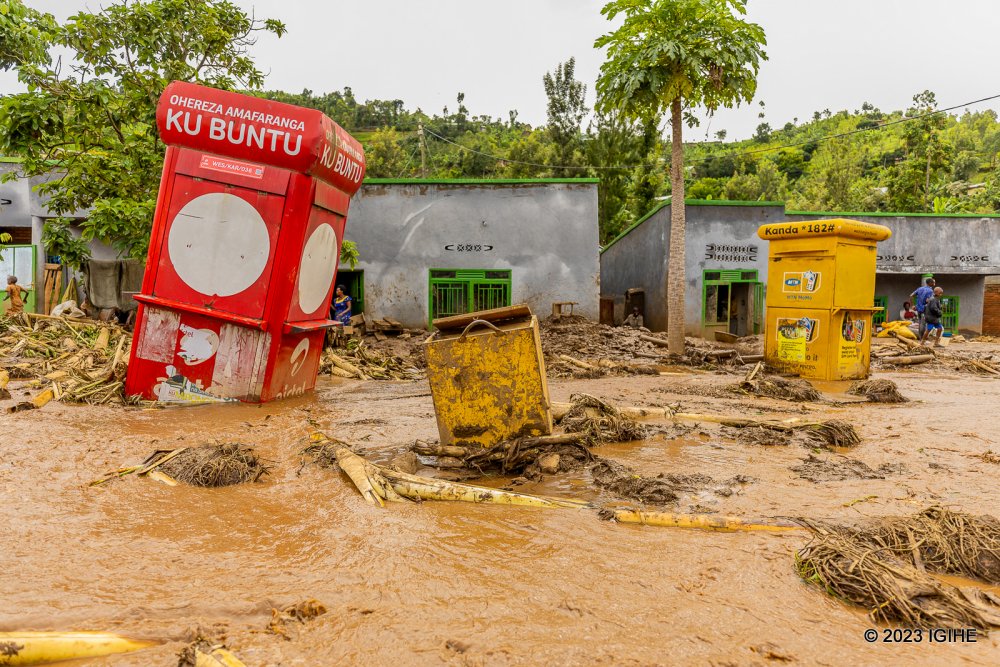
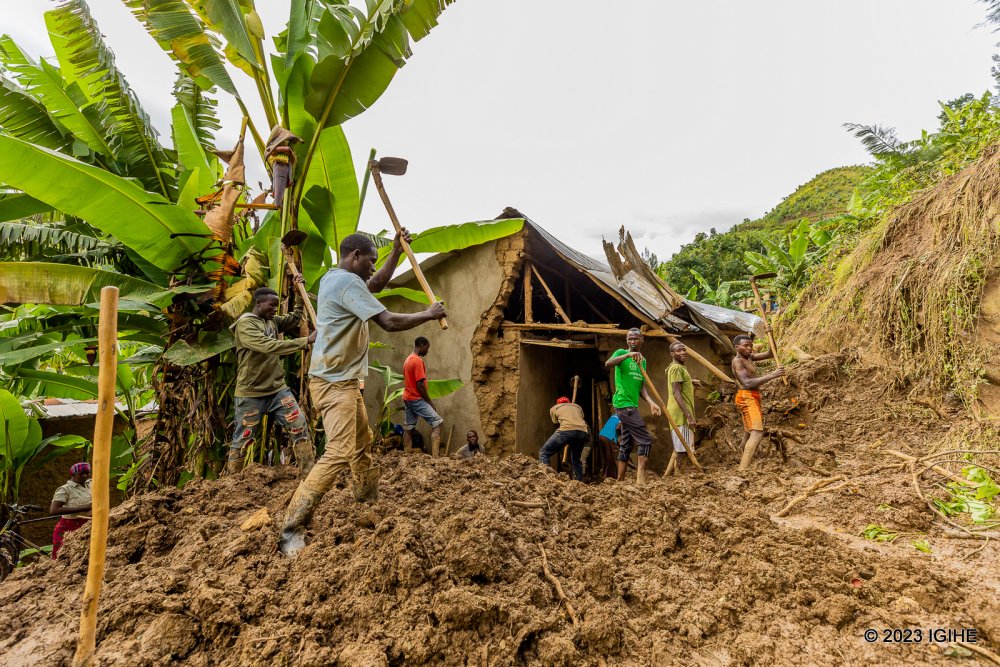
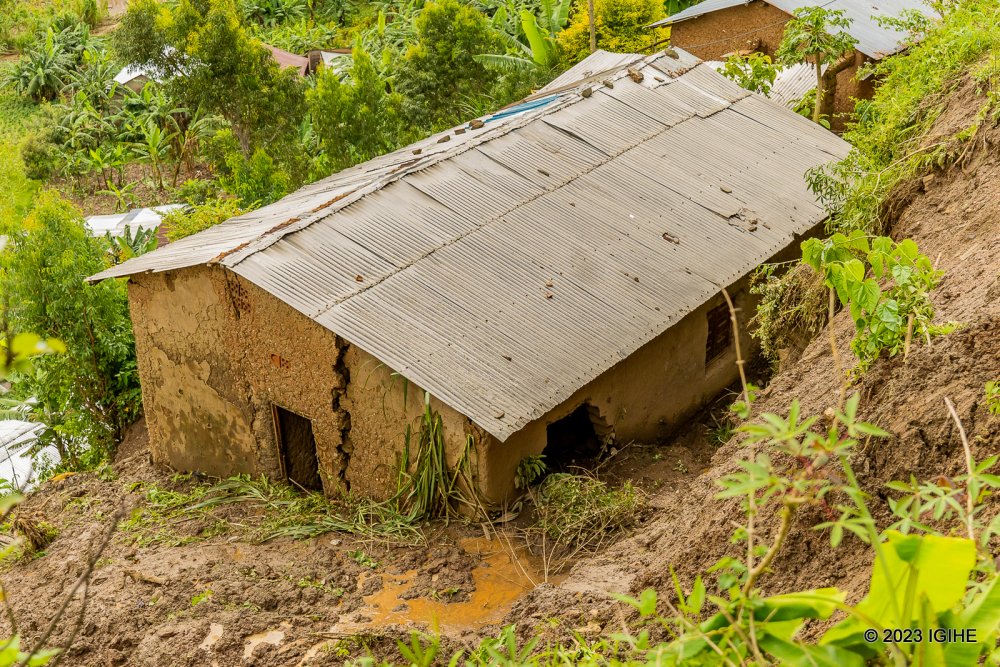
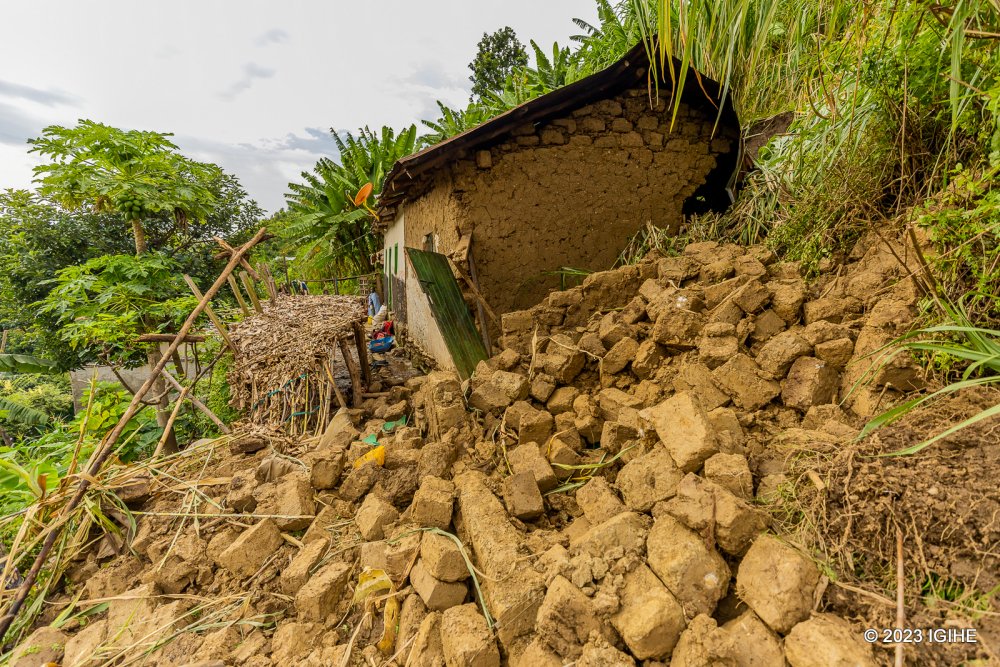
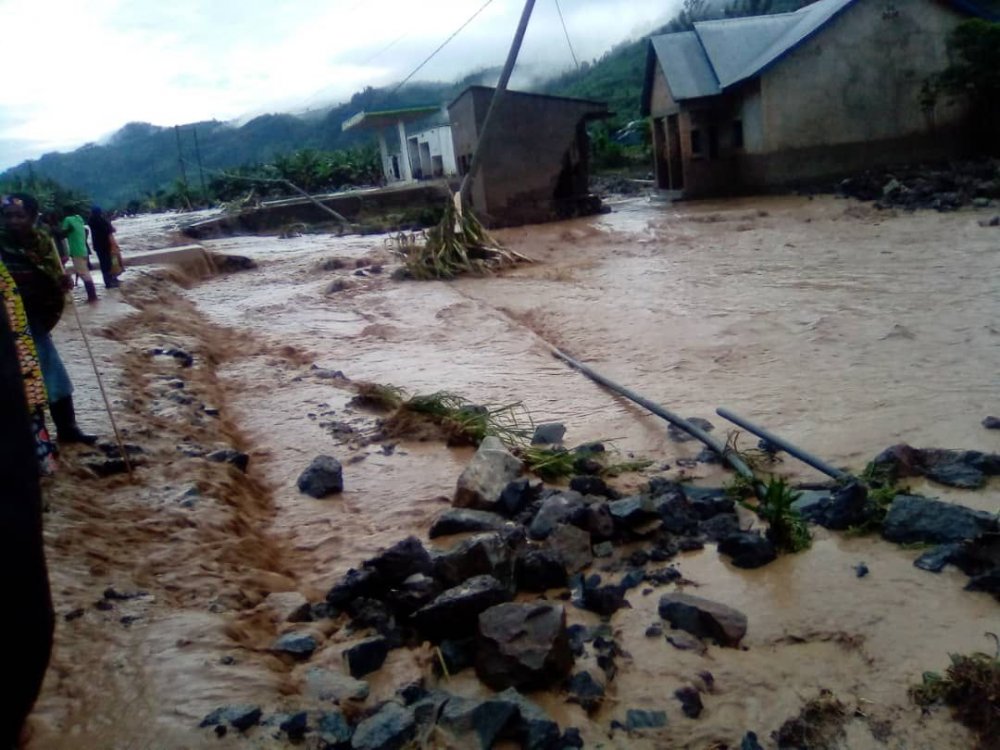
On May 2nd and 3rd, 2023, heavy rains caused landslides and floods in several districts of Northern, Western, and Southern Provinces of Rwanda, resulting in at least 130 deaths, with 77 people injured, 36 hospitalized, and 5 people still missing as of May 4th, 2023.
Rubavu, Ngororero, Nyabihu, Rutsiro, Karongi, Gakenke, Burera, Musanze and Nyamagabe are the most affected districts.
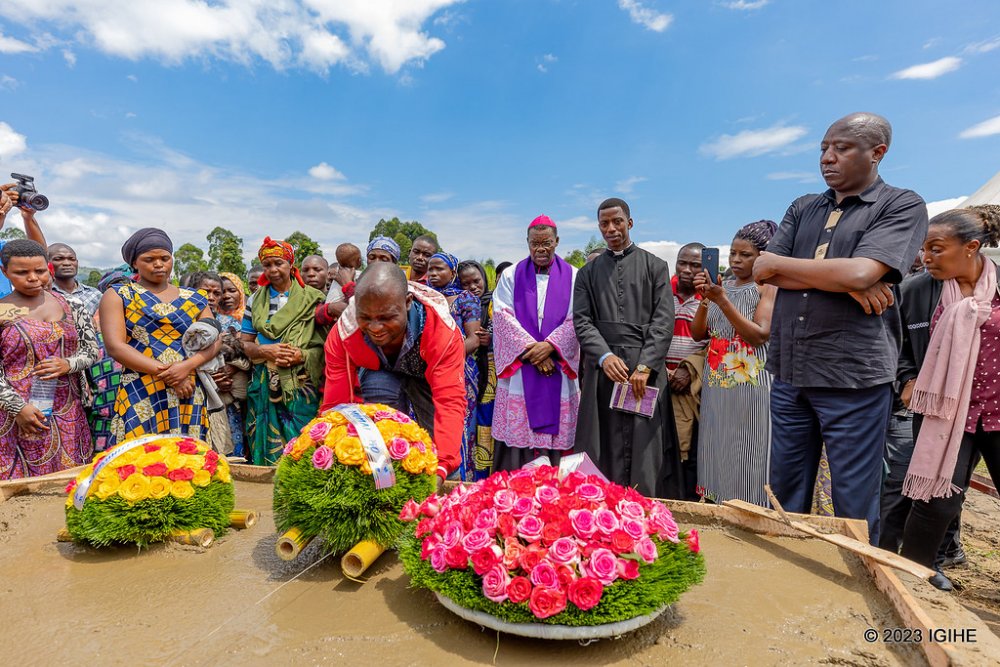
The burial was also attended by Rwanda Defence Force (RDF) Chief Defence Staff , Gen Jean Bosco Kazura, Inspector General of Rwanda National Police, DCGP Felix Namuhorany and other top government officials.
Survivors narrated their ordeal and commended the government for standing in solidarity with them during these trying times.
The government has pledged to cover the medical expenses of the victims while grieving family will also receive financial assistance of Rwf100,000 per deceased person.
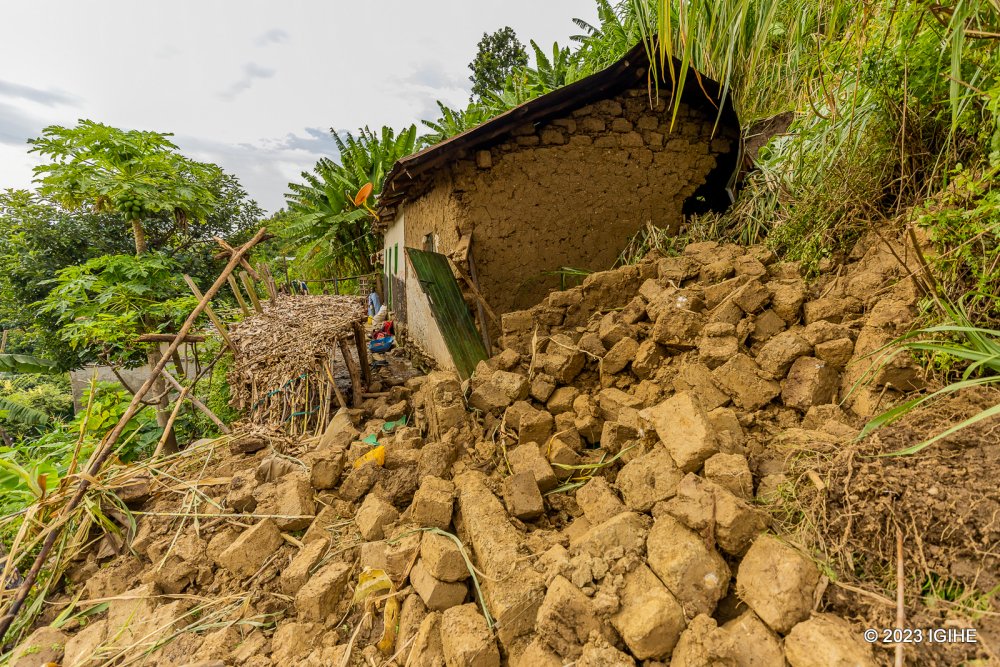
Apart from the loss of lives; the disasters destroyed over 5100 houses and ravaged 17 roads.
Out of the 5,174 houses that were destroyed; 3,371 are from Rubavu district.
It is reported that more 2,510 houses were severely damaged and may collapse soon.
So far, 1,541 evacuated individuals have been at 11 designated safe areas equipped with beddings and tents. Others have been accommodated by religious institutions, schools, or kind-hearted neighbors.
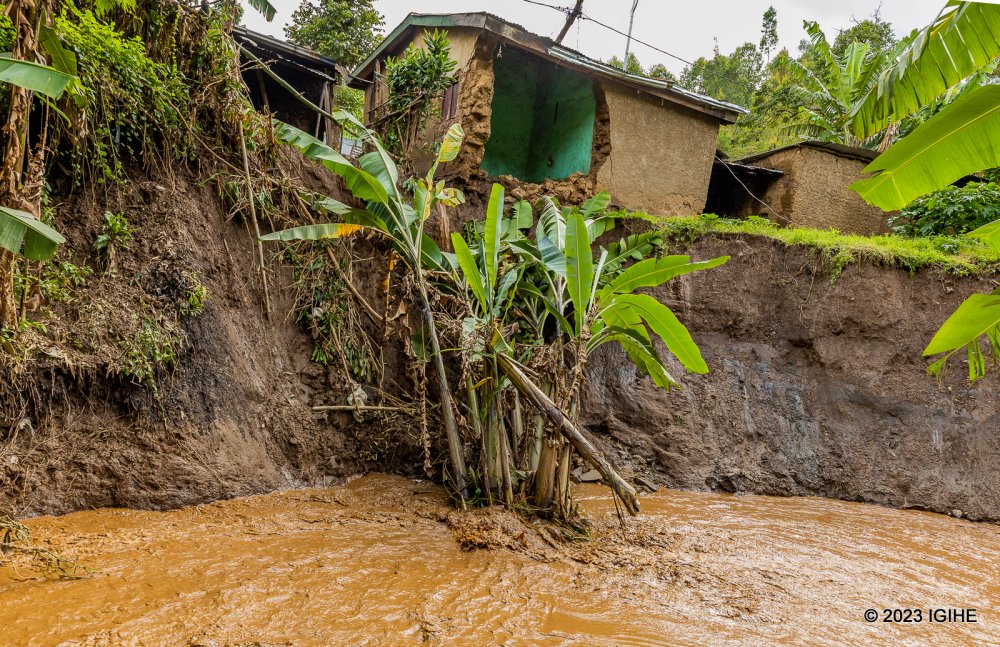
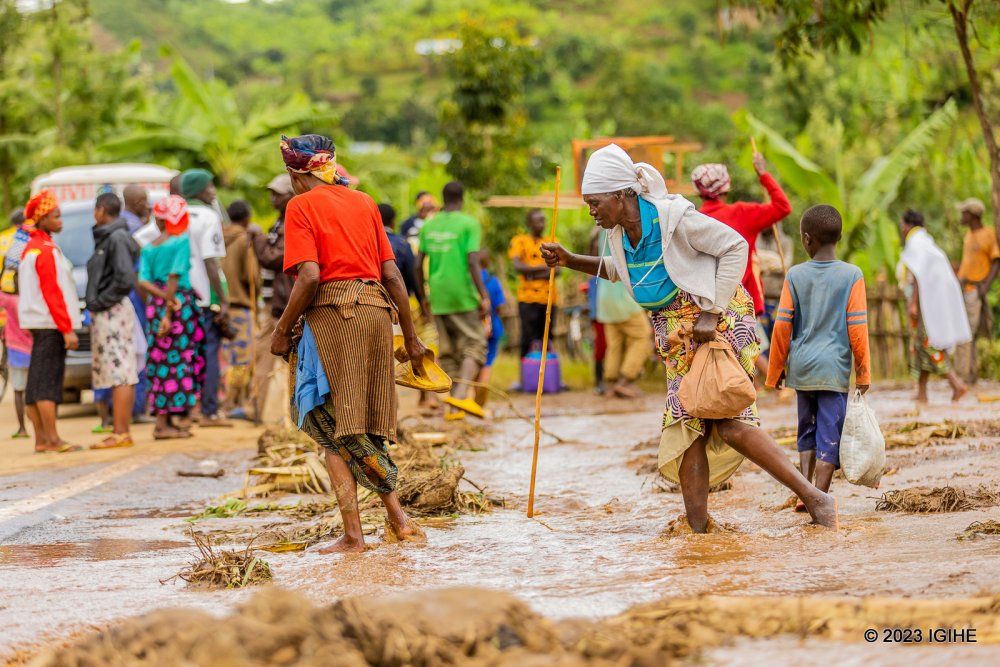
The disasters also affected several infrastructures, including eight national highways, nine roads at district level, 26 bridges, six water treatment plants, and some medical facilities such as the Shyira Hospital, five health centers, and two health posts.
The government has set up a new command center to coordinate emergency responses, including the evacuation and temporary relocation of residents in affected and high-risk areas during the rains.
The Ministry of Emergency Management (MINEMA) has started providing essential aid to people in need, including shelter, food, and other necessary supplies such as hygiene and cooking items. The first response in terms of first aid includes 30 tons of corn flour and 30 tons of beans.
The general public has been urged to remain cautious and vacate high-risk zones to prevent more losses of lives.
As the Deputy Government Spokesperson told the media on Thursday , the disasters that hit Western, Northern and Southern Provinces also left 77 people injured of whom 36 are hospitalized. The government has pledged to cover the medical expenses of the victims.
The deaths were registered in the districts of Rubavu (26), Rutsiro (27), Karongi (16), Ngororero (23), Nyabihu (18), Musanze (5), Gakenke (2), Nyamagabe (2), Burera (8), and Gicumbi (3).
Each grieving family will also receive financial assistance of Rwf100,000 per deceased person.
Among others; the disasters destroyed over 5100 houses and ravaged 17 roads.
Out of the 5,174 houses that were destroyed; 3,371 are from Rubavu district.
It is reported that more 2,510 houses were severely damaged and may collapse soon.
So far, 1,541 evacuated individuals have been at 11 designated safe areas equipped with beddings and tents. Others have been accommodated by religious institutions, schools, or kind-hearted neighbors.
Apart from residential properties, the disasters also affected several infrastructures, including eight national highways, nine roads at district level, 26 bridges, six water treatment plants, and some medical facilities such as the Shyira Hospital, five health centers, and two health posts.
Rwanda Meteorology Agency (Meteo Rwanda) recently released data forecasting a heavy rainfall in May 2023.
According to the agency’s weather forecasts, rainfall is expected to range from 50 to 200 millimeters, which is well above the usual average recorded during this time of year.
This increase in precipitation is anticipated to impact various sectors across the country.
According to a recent report by the ministry in charge of emergency management, more than 60 people were killed by disasters in the country between Jan. 1 and April 20.
Statistics also show that Rwanda loses approximately Rwf200 billion each year due to natural disasters.
The figures released on Wednesday 3rd May 2023 show that the minerals were traded between January and March 2023.
The RMB report shows that the minerals that contributed the most to the revenue were cassiterite, coltan, wolfram, gold, and other minerals.
In January, cassiterite production was 316,093 kilograms worth US$ 5,436,480, and this increased to 363,701 kilograms worth US$ 5,903,483 in March. Coltan also demonstrated a substantial increase in export revenues, reaching 213,065 kilograms worth US$ 11,415,082 in March, up from 124,514 kilograms worth US$ 5,911,646 in January.
Wolfram, which is also known as tungsten, generated 129,407 kilograms worth US$ 1,723,665 in January and increased to 231,844 kilograms worth US$ 3,261,757 in March.
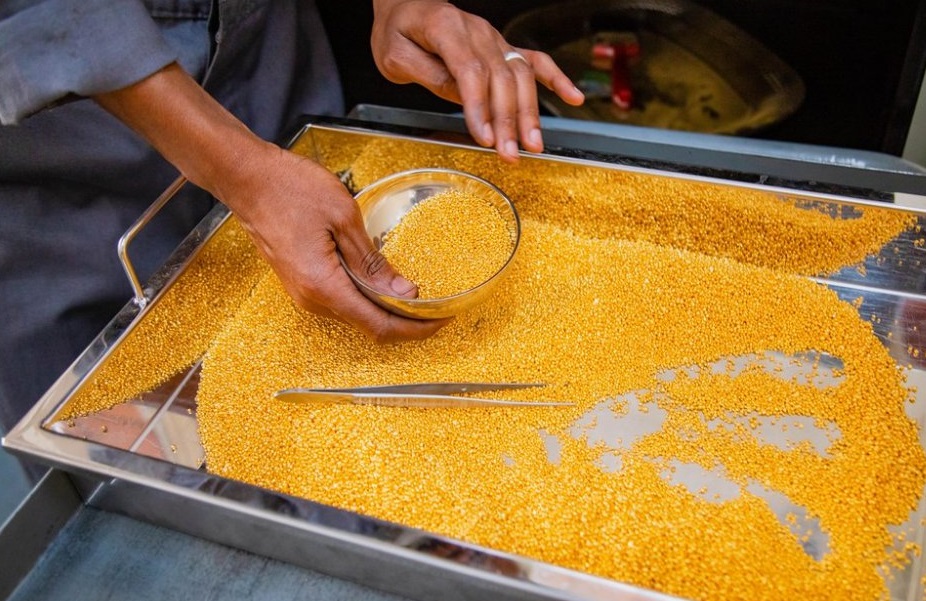
Besides, gold generated the highest revenue, with 1,465 kilograms worth US$ 90,519,870 in March, compared to 870 kilograms worth USD 53,234,196.20 in January. Other minerals also contributed to the revenue, with 827,041 kilograms worth USD 2,211,749 in March.
The report shows that from January to March 2023, Rwanda exported a total of 5,925,199 kilograms of minerals, with a total value of US$ 247,480,699.40.
The revenues generated from the export of minerals are expected to contribute significantly to the country’s economic development.
The budget for the fiscal year 2023/24 will reflect the medium term fiscal path which allows for an increased spending to reach National Strategy for Transformation (NST1) goals while maintaining public debt to sustainable levels.
Despite ongoing economic recovery, Rwanda is still dealing with COVID-19 pandemic effects, climate change, high inflation, ongoing supply chain issues caused by Russia-Ukraine war among other economic challenges.
However, the Government will continue to champion economic recovery through supporting businesses affected by Covid-19 and creating jobs. On top of that, key investments in education, healthcare, ICT, and agriculture will be at the forefront of the ongoing government effort to invest in Rwanda’s future, through the National Strategy for Transformation.
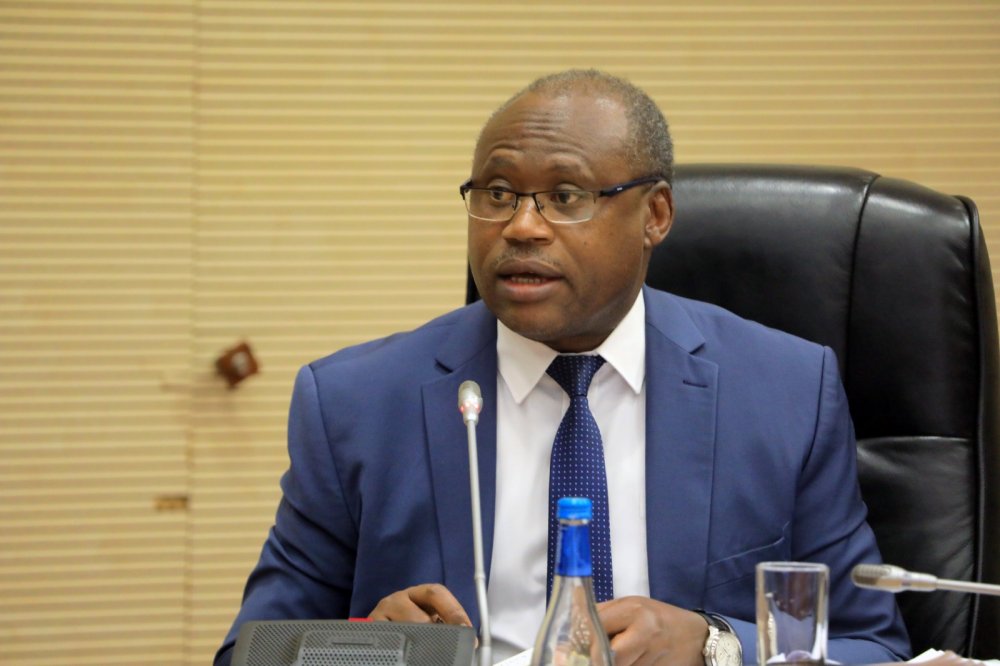
“Our economic recovery has been strong despite global shocks. Government will prioritize fiscal consolidation and focus on continued economic recovery through supporting businesses affected by covid-19, easing inflation and investing in agriculture,” Minister Ndagijimana said.
Rwanda’s economy is projected to grow by 6.2 percent in 2023 compared to 8.2% in 2022. owing to global uncertainties, and by 6.7 and 7 percent in 2024 and 2025 respectively.
{{ Proposed 2023-24 budget}}
The proposed total resources estimated for fiscal year 2023/24 amount to Frw 5,030.1 billion, representing Frw 265.3 billion or 6% increase compared to Frw 4,764.8 announced in the 2022/23 revised budget.
The projected budget is comprised of Rwf3,151 billion of revenue which represents 63% of the total budget, external grants of Rwf 652.1 billion representing 13% of the entire budget and external loans will amounting to Rwf 1,225.1 billion or 24% of the total budget.
On the expenditure front, the 2023/24 budget is projected to be Rwf 5,030.1 billion. Development budget and policy lending is projected at Rwf 2,119.3 billion representing 42% of the budget while recurrent budget is estimated at Rwf 2,910.8 or 58% of the total envelop.
Key priorities for the 2023/24 national budget will include strengthening the health system; increasing agriculture and livestock productivity; scaling up social protection coverage; improving the quality of education, creating of employment opportunities through investment in public works and support to micro, small, medium and large enterprises affected by COVID-19 through the economic recovery fund and manufacture to build and recover programs.
Other interventions will include support for Made in Rwanda; promotion of digital technologies to improve service delivery; improving access to quality education; eradication of malnutrition and stunting and strengthen disaster preparedness and management among others.
{{About BFP}}
BFP is a document outlining Government economic policies over the medium term that helps lay the foundations of the next fiscal budget. It is prepared in accordance with article 34 of the Organic Law on public finance management and outlines the Government’s macroeconomic and fiscal policy stance as well as the budget policy over a 3-year horizon. The 2023/24-2025/26 BFP provides basis for the preparation of the 2023/24 budget which will be read in June this year.
Policies and strategies over the medium term are by and large guided by Vision 2050, National Strategy for Transformation (NST1) as well as the seven-year government program.
The message of comfort sent by Turkish Ministry of Foreign Affairs reads that the country stands in solidarity with Rwandans during these difficult times.
“We are deeply saddened that more than 100 lost their lives due to the landslides and floods caused by heavy rains on 2nd May 2023 in the Western and Northern Provinces of the Republic of Rwanda,” reads the statement.
“We express our condolences and solidarity to the relatives of those who have lost their lives as well as to the friendly people and Government of Rwanda,” adds the statement.
On Tuesday evening, Rwanda’s Presidency shared a message from President Kagame who condoled with families whose relatives lost lives during the disasters.
He also expressed solidarity with those who were wounded and assured that rescue interventions were ongoing in the affected districts of Rubavu, Ngororero, Nyabihu, Rutsiro, Karongi, Gakenke, Burera, Musanze and Nyamagabe in Western, Northern and Southern Provinces.
Rwanda and Türkiye enjoy vibrant relations reinforced through cooperation in the areas of diplomacy, investment and trade among others.
Both countries are connected through daily flights operated by Turkish Airlines.
In February this year; Turkish Ambassador to Rwanda, Aslan Alper Yüksel thanked Rwanda for having stood in solidarity with the country when earthquake that hit the country took lives of around 60,000 people.
Apart from Turkey, AUC Chairperson, Musa Faki Mahamat has also expressed solidarity with Rwandans.
“My thoughts and prayers go to the families of the more than 127 people who lost their lives and those left homeless by devastating landslides caused by heavy rains in Rwanda’s Southern, Western and Northern provinces. In full solidarity with the government and people of Rwanda,” he tweeted.
Chinese Embassy in Rwanda has also took to Twitter to express ‘deep condolences over those lost their lives in the disasters caused by recent heavy rains and sincere sympathies to their families, as well as to the injured and disaster-hit people’.
“We stand with our Rwanda friends and believe Rwanda will get over the hard times,” reads part of the tweet.
Other well-wishers who expressed solidarity with Rwandans via Twitter include the Country Representative of the Food and Agriculture Organization of the United Nations (FAO) in Rwanda, Coumba Dieng Sow.
She said that she was deeply saddened by the loss of lives and destruction caused by floods in Rwanda and promised support.
“I have assured the Ministry of Agriculture and Animal Resources of Rwanda and FAO ‘s commitment to supporting their efforts to restore agricultural livelihoods affected by this disaster and protect lives,” added Coumba.
The World Bank Group Country Manager for Rwanda, Rolande Pryce, also said that their thoughts and prayers are with the citizens who experienced the severe flooding and particularly those who lost their lives and their grieving families.
“May the departed Rest in Peace eternally,” she noted.
As at Wednesday evening, the death toll had risen to 130.
Guterres, who is on an official visit to Kenya, said at a media briefing in the Kenyan capital of Nairobi that the industrial north has a moral obligation to help African countries become climate resilient.
“Developed countries must deliver on the 100 billion U.S. dollars a year promised to developing countries and the loss and damage fund agreed in Sharm el-Sheikh (Egypt’s Red Sea resort city),” Guterres said, adding that delivering climate justice in Africa is crucial for global peace, growth, and stability.
While reiterating that the transition to a green and resilient future is urgent in Africa, Guterres called on developed nations and industry to support the continent’s quest for decarbonizing key economic sectors like energy.
The UN chief hailed Kenyan President William Ruto’s commitment to a 100 percent transition to clean energy by 2030, adding that the African Union’s ambitious Green Stimulus Program will reinvigorate climate response in the continent.
Guterres noted that South Africa’s Just Energy Transition Partnership, and Egypt and Nigeria’s energy transition plans were bold moves toward low carbon transition in Africa.
The UN chief disclosed that he has proposed a Climate Solidarity Pact in which developed countries lend financial and technical support to help emerging economies in Africa and beyond hasten their transition to green energy.
Guterres observed that despite its minimal contribution to greenhouse gas emissions, Africa continues to bear the brunt of climate disasters like floods and droughts.
He added that the climate-induced drought crisis engulfing the Horn of Africa region is a wake-up call for governments, donors, and the private sector to back community-based resilient programs.
Guterres said 50 percent of climate financing in Africa should be channeled toward adaptation projects to enable communities to withstand climate-related shocks like hunger and water scarcity.
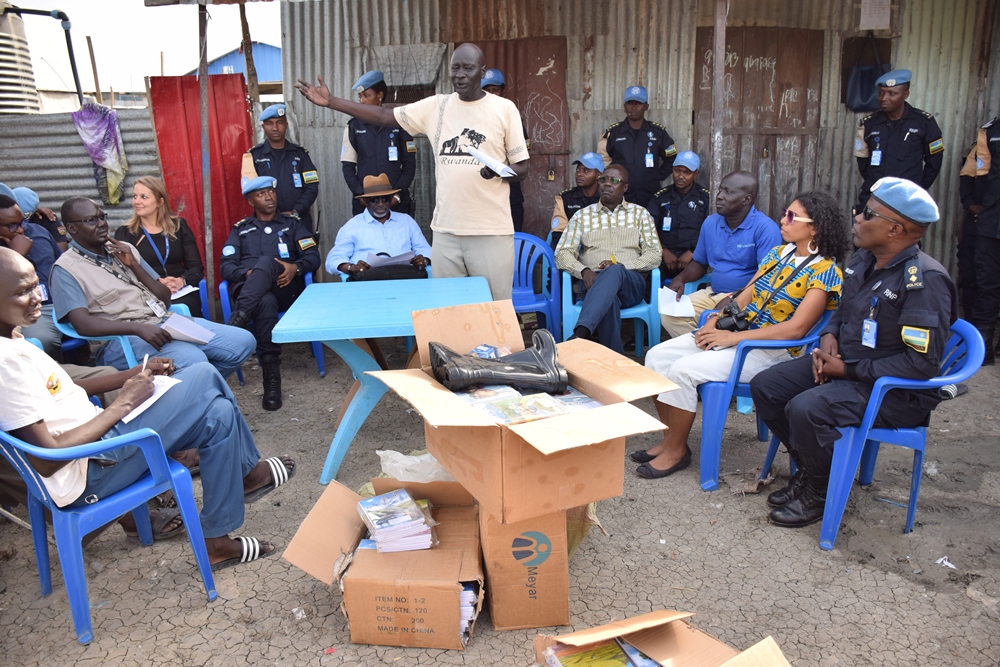
The donation, including 1200 books and 1000 pens, were handed over to West Primary School and Salam Primary School, on Tuesday, May 2, by Senior Superintendent of Police (SSP) Prudence Ngendahimana, the contingent commander for RWAFPU1-7.
The two schools are located inside the Protection of Civilians Camp (PoC), which is under the protection of the Rwandan peacekeepers.
The peacekeepers also donated 100 rain boots to teachers of the two schools and Community Watch Group operating in the camp.
Malakal is one of the areas that are heavily hit by floods during rainy season.
The donation is out of the financial contribution by each of the 240 officers of RWAFPU1-7.
SSP Ngendahimana said that supporting vulnerable students also serves the purpose of peacekeeping.
“Donating to children and teachers is supporting education for all; ensuring that children go to school and giving them hope, despite the circumstances,” said SSP Ngendahimana.
He added that the Community Watch Group composed of displaced persons, also play a vital role and partners in ensuring safety of the camps.
Daniel Pal, the chief of Malakal protection of civilian camp (PoC) thanked the Rwandan peacekeepers for the “continued support, friendly and productive working relations.”
Reath Kier, the headteacher at West Primary School said that the donation is an encouragement to the children to put their focus on education as their hope for the future.
The coalition had demanded that the government drop one of the lawmakers it had selected to represent it in the parliamentary talks before they started, noting that the member belonged to the opposition coalition.
The government side on Wednesday replaced the Member of Parliament with an agreeable one prompting the coalition to call off protests, which it had resumed after a three-week break.
“This evening, the leadership of the Azimio la Umoja-One Kenya Coalition Party met and agreed to once more suspend the mass protests that we had earlier scheduled to continue tomorrow. The coalition took this step following the decision by Kenya Kwanza (a Kenyan political alliance currently headed by President William Ruto) to accede to one of our demands that informed the resumption of mass action,” it said in a statement issued in Nairobi, the Kenyan capital.
The opposition said instead of holding the protests, they have summoned their seven-member delegation to the bipartisan committee for fresh instructions to inform further engagement with the Kenya Kwanza side.
“As a party, we express deep gratitude to all Kenyans who have participated in the demonstrations in defense of justice and democracy in our country. We also wish to reiterate that we will not hesitate to resume mass action at the slightest indication of lack of goodwill and honesty on the Kenya Kwanza side,” the opposition said.
The opposition has been holding protests over the high cost of living and alleged electoral fraud and had vowed to resume demonstrations Thursday unless their demands are addressed.
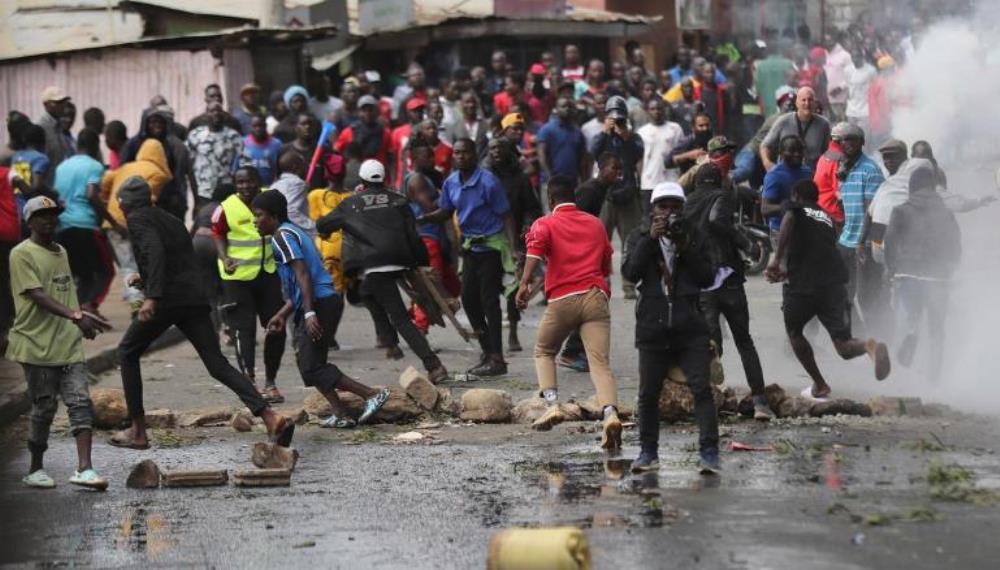
On Tuesday, at least two vehicles were burnt and fuel stations vandalized in Nairobi as the coalition held street protests to push the government to act on the high cost of living and electoral injustice. The protests that followed collapsed talks with Ruto’s government over their grievances and slowed down activities in the capital.
One of the burnt vehicles is a 32-seater commuter bus, while the other is a truck with transit goods heading to neighboring Uganda.
Kithure Kindiki, the cabinet secretary in the Ministry of Interior and National Administration, said Tuesday the protests portend grave danger to the rule of law and the stability of the country.
Kindiki said the violence, looting, and destruction of public amenities such as roads coupled with the disruption of daily activities portend imminent danger of the country sliding into irretrievable anarchy and called for the cessation of criminal acts.
“To ensure the country does not turn into lawlessness, security agencies are fairly instructed to enforce the law firmly and decisively. All criminals, irrespective of the political party or group that they support, must be neutered before they destroy Kenya,” he said in a statement issued in Nairobi.
He said 14 key suspects have been arrested in connection with the robberies, arson, and malicious damage of property within Nairobi, while 32 have been arrested in different parts of western Kenya.
All suspects will be arraigned in court, said Kindiki, stressing that only firm enforcement of the law stands between us and lawlessness and full-blown chaos. “Any aggravation of the prevailing situation would certainly set back the country. No more violent protests shall be allowed anywhere in Kenya. With or without notices, demonstrations and protests of any type which injure people, security officers, businesses and property shall be prevented at all costs,” Kindiki said.
There was a heavy presence of police across the Nairobi central business district during the demonstrations Tuesday, with officers blocking roads leading into the city center to prevent opposition supporters and their leaders from getting in.
Officers engaged youth in running battles in Mathare and Kibra, two opposition strongholds in the city.
Protests were also witnessed in four counties which are opposition bastions in western Kenya, where youth barricaded roads and lit bonfires.
Martha Karua, one of the leaders of the Azimio coalition, in a statement issued in Nairobi, blamed the police for hooliganism experienced during the protests.
Opposition leaders had also intended to present a petition to the Office of the President, with evidence that the cost of food, fuel, electricity, and fees remain unacceptably high. Police, however, dispersed them using tear gas.
On Monday during Labor Day celebrations, Ruto termed the anti-government protests as undemocratic.
He said there was no room for opposition leaders in government, adding that he had agreed to parliamentary-led bipartisan talks with the opposition, but they had chosen to go on the streets.
He added while his administration respects the rights and freedoms of every Kenyan and appreciates the role of the opposition to keep the government in check, he would not allow them to protest and destroy property, livelihoods, and businesses.
“As part of its initiative to deal with the country’s current crisis, the Inter-Governmental Authority on Development (IGAD) offered a new proposal including extending the current truce for a week and naming a representative from each side to discuss the truce,” the statement said.
“The SAF expressed acceptance of the proposal based on the principle of African solutions to the issues of the continent, and in consideration to the humanitarian aspects of our citizens, taking into account the ongoing American-Saudi initiative,” it added.
The SAF stressed that it hopes the other party would abide by the requirements of the proposed truce.
However, the RSF has not yet commented on the IGAD initiative.
On Wednesday, fighting continued in central Khartoum. The Sudanese police said in a statement that the RSF ambushed one of its patrols in central Khartoum and killed five of its personnel.
In response, the RSF said it had repulsed an attack by an army force dressed in uniforms of the central reserve police forces, which attempted to attack the RSF posts in central Khartoum.
Meanwhile, given that clashes have pushed the country to the edge of a humanitarian crisis, UN Under-Secretary-General for Humanitarian Affairs Martin Griffiths arrived in Sudan.
“Just arrived in Port Sudan to reaffirm the UN’s commitment to the Sudanese people,” Griffiths tweeted Wednesday.
He expressed gratitude for the unwavering dedication of the humanitarian community and local volunteers doing their best to help.
Regarding the local endeavors to end the armed conflict in the country, Khalid Omer Yousif, spokesman of the political process in Sudan, welcomed in a statement on Wednesday any efforts to ensure a ceasefire.
Yousif urged for coordinating the regional and international efforts to back the push for a ceasefire, saying “we call for a comprehensive ceasefire and then a return to the negotiation table.”
Fighting between the SAF and the RSF in Khartoum and other areas erupted on April 15, with the two sides accusing each other of initiating the conflict which has pushed the country to the edge of a humanitarian crisis.
According to UN statistics, thousands of Sudanese citizens have been displaced or forced to seek refuge in safe areas in Sudan and neighboring countries, including Egypt, Ethiopia and Chad.
So far, the deadly clashes have left more than 550 people dead and 4,926 others wounded, according to the Sudanese Health Ministry.
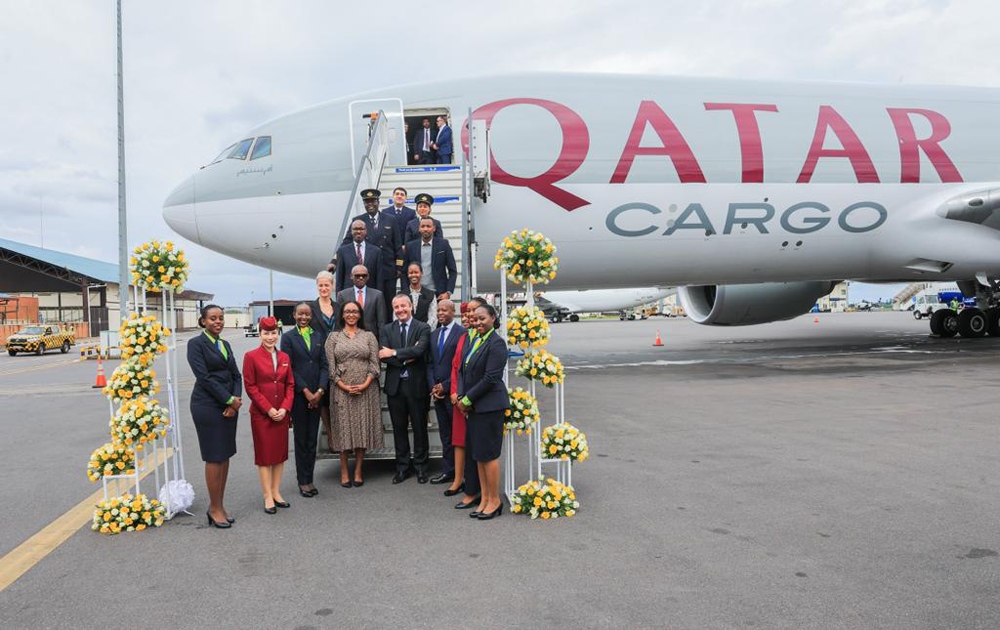
The official launch of the Kigali Cargo Hub on Wednesday 3rd May 2023 was marked with the arrival of a new Qatar Airways Cargo Boeing 777 freighter that was welcomed with a water salute
The launch was officiated by Guillaume Halleux, Chief Officer, Cargo, Qatar Airways, and Yvonne Makolo, Chief Executive Officer, RwandAir.
As an official release from Qatar Airways Cargo indicates, the Boeing 777 aircraft will operate a biweekly service from Doha to Kigali.
Qatar Airways Cargo has also introduced an intra-Africa service connecting Kigali and Lagos (thrice per week), and a weekly service from Istanbul via Doha to Kigali, both operated by an Airbus A310 aircraft. New destinations from Kigali will be announced shortly, according to the release.
In preparation for the Kigali Cargo Hub launch, QAS Cargo, a subsidiary of Qatar Airways, provided consultancy support to RwandAir Cargo to enhance its cargo handling performance.
QAS Cargo visited the cargo handling facilities and presented RwandAir with a detailed action plan for operational improvements and handling performance.
Both teams are now working together on a future roadmap, which includes a proposed improvement plan for warehouse infrastructure as part of a long-term strategic plan for RwandAir’s cargo division.
Halleux commented on the partnership, stating that Africa is one of the world’s fastest-growing economies, requiring investment in logistics infrastructures.
Qatar Airways Cargo’s support for RwandAir’s cargo ambitions is a logical step considering the long-standing bilateral trade agreements between Qatar and Rwanda.
Customers will benefit from a reliable intra-African network via the Kigali hub, enhanced service levels, and cost synergies. The partnership aims to establish Kigali as the Central African hub in preparation for the next generation of air cargo on the rapidly growing continent.
Qatar Airways Cargo currently serves 28 cities in Africa, carrying up to 2,800 tonnes to and from the continent with a combination of freighter and belly-hold services.
The airline’s freighter fleet comprises two Boeing 747-8 freighters, two Boeing 747-400 freighters, 26 Boeing 777 freighters, and one Airbus 310 freighter. Qatar Airways Cargo covers a global network of over 60 freighter destinations and 150 passenger destinations utilizing freighters and belly-hold passenger flights.
The CEO of RwandAir, Yvonne Makolo told the media that the new Kigali Cargo Hub will open up new cargo opportunities across Africa.
“Africa is home to a hugely diverse economy, with businesses and entrepreneurs looking for better connections to create new markets and expand inward investment. Together, we have created a fantastic new facility to meet this growing demand across Africa.”