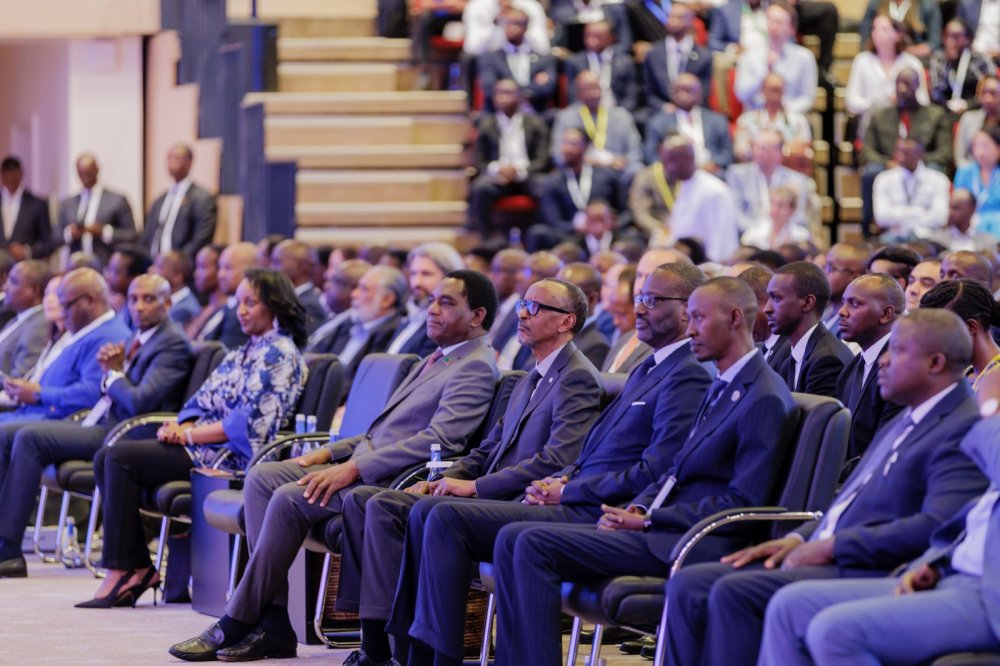
The three-day forum, that ran through Thursday, features a series of expert panel sessions and events aimed at advancing policies and regulations, and establishing long-term connections and partnerships to promote financial inclusion through fintech.
“To emphasize the importance of accelerating our socio-economic development, especially given the large young population in Africa, we must consider the significance of inclusive fintech,” said Zambian President Hakainde Hichilema at the event.
He added that providing opportunities for African youth can be achieved by paying attention to inclusive financial technology, allowing them to innovate. “It is no longer a question on our lips because we acknowledge that financial technology and access to finance capital are of utmost importance to our quest for accelerated economic and social development to cater to our population.”
Tidjane Thiam, board chairman of Rwanda Finance Limited, mentioned that their ambition, in collaboration with the Africa Fintech Network, the umbrella body for fintech companies in Africa, is to create a leading fintech event in Africa that would act as a catalyst and an inclusive platform to accelerate the growth of Africa and its fintech industry.
Thiam believed that technology presented a unique opportunity for inclusive development and economic growth on the continent. He expressed confidence that some of the most successful companies in the world would come from Africa.
Rwandan President Paul Kagame, speaking at the event, acknowledged that financial technology is accelerating Africa’s digital transformation, with evident impact.
However, compared to the rest of the world, Kagame said Africa has produced a relatively small number of unicorns, and the majority of transactions are still done in cash.
“To sustain the gains already made, we must forge stronger partnerships and build a more equitable, accessible, and sustainable fintech ecosystem,” he said, highlighting the importance of addressing inadequate levels of broadband coverage, documentation, and financial literacy to enhance the delivery of financial services.
In a video conference, Achim Steiner, administrator of the United Nations Development Programme, said fintech provided an unprecedented opportunity to align financial systems with national development priorities.
He emphasized that giving people more choices over their money through inclusive fintech would enable them to invest in critical areas that mattered to them and future generations.
The forum attracted nearly 3,000 participants, including policymakers, investors, and industry leaders.
China welcomes the launch of the Joint Appeal given that terrorism is a significant threat facing the African continent, said Dai Bing, China’s deputy permanent representative to the United Nations. China hopes the Flagship Initiative will promote synergy among UN agencies to help Africa deal with the challenge of terrorism, he added.
Dai called for efforts to strengthen counter-terrorism capacity-building in Africa.
Practices in many African countries have proved that establishing professional security institutions can fight terrorism and maintain stability. In August last year, China promoted a Security Council open debate on strengthening Africa’s capacity-building. The council adopted a presidential statement, one of the crucial goals of which is to support Africa’s security capacity-building, said Dai. “We hope the Joint Appeal will promote the tilting of global counter-terrorism resources to Africa, focusing on increasing support for capacity-building.”
He also called for efforts to tackle the root causes of terrorism.
In February this year, the UN Development Programme released a report stating that poverty and unemployment constitute the main reasons for people in the Sahel region to join violent extremist organizations. This also applies to other regions in Africa with terrorist activities. Dai said he hoped that projects under the appeal would help improve the living conditions of people in poor areas and eliminate the root causes of conflicts.
In addition, Dai called for an objective look at the challenges facing Africa’s counter-terrorism operations, including the issue of human rights.
“With regard to human rights issues, it should be noted that the AU (African Union) and African countries have made great efforts to strengthen the capacity-building of the troops and enhance the awareness of human rights protection,” he said. “One cannot just assume that there is a problem with the protection of human rights every time the issue of counter-terrorism in Africa is mentioned. This is a kind of prejudice. Human rights cannot be used as an excuse to reduce counter-terrorism support to Africa. It is hoped that relevant projects of the Joint Appeal will pay attention to this issue.”
The Global Security Initiative proposed by China takes support for Africa’s counter-terrorism as essential. It promotes strengthening the role of the United Nations in fighting terrorism. In recent years, China has supported UN agencies such as the UN Office of Counter-Terrorism through the China-UN Peace and Development Fund.
Dai said that China would actively participate in the Joint Appeal, deepen cooperation with UN agencies under the Forum on China-Africa Cooperation framework and the China-UN Peace and Development Fund, and provide more support for Africa’s counter-terrorism efforts.
The launch of the joint appeal was a side event during UN Counter-Terrorism Week.
Violent clashes between the Sudanese Armed Forces and the paramilitary Rapid Support Forces continued on Thursday in various areas of the capital Khartoum.
The clashes mainly took place in eastern Khartoum, north of Bahri (Khartoum North) city, and west of Omdurman city, according to eyewitnesses and resistance committees.
“The clashes renewed today in the vicinity of the Burri neighborhood, with warplanes flying over the area,” the resistance committees of the Burri neighborhood in Khartoum said in a statement.
“Cannon shells fell on several parts of Burri, and residential buildings were affected. No deaths or injuries are reported so far,” the statement added.
Eyewitnesses said the Sudanese army’s warplanes flew over the southern area of Omdurman, with intermittent clashes occurring in old neighborhoods of the city.
Violent clashes also took place in the Al-Kadaro camp in Bahri, a major camp of the army, with explosions heard there, the eyewitnesses added.
Also on Thursday, Malik Agar, the deputy chairman of Sudan’s Sovereign Council, declared on Twitter Sovereign Council’s rejection of the initiative proposed by the African Union to resolve the Sudanese crisis, citing the suspension of Sudan’s membership in the bloc.
Agar also expressed reservations about the recent initiative from the Inter-Governmental Authority on Development (IGAD), saying IGAD was seeking to introduce the United Nations forces into Sudan and demilitarize Khartoum through its “occupation initiative.”
As the fighting went on, residents of Bahri were suffering from continued water shortage while those in southern Khartoum were facing food scarcity.
The UN Food and Agriculture Organization (FAO) said in its report issued on Monday that the current crisis has worsened the already dire food insecurity in Sudan, with more people possibly plunged into famine.
To scale up its response, the FAO urgently appealed for funding amounting to 95.4 million U.S. dollars to reach 15 million people in need, according to the report.
About 2.5 million people have been displaced inside and outside of Sudan since the conflict broke out on April 15, according to an update of the UN Office for the Coordination of Humanitarian Affairs on Wednesday.
So far, the conflicts have left over 3,000 people dead and more than 6,000 injured, according to the Sudanese Health Ministry.
The institutions said Thursday that the risk of the deadly disease occurring in eastern Africa in both humans and livestock is high due to favorable environmental conditions and increased movement of livestock and human beings.
“During the period March-May, heavy, prolonged and widespread rains triggered severe flooding in Ethiopia, Kenya, Somalia, Western Tanzania, Burundi and Rwanda creating a suitable environment for vector multiplication,” the institutions said.
They added that extensive hotspots for vector multiplication are predicted in Kenya, Ethiopia, South Sudan, Somalia and Ethiopia while localized hotspots are predicted in Uganda, Sudan, Burundi and Tanzania.
“The suitable conditions for vector amplification are predicted to persist in the region due to favorable forecasts for June to August,” the agencies warned, asking regional governments to enhance surveillance.
RVF is an endemic vector-borne zoonotic disease that is a threat to both humans and animals and is spread by mosquitoes.
According to experts, it is a complex disease, making monitoring of the risk and carrying out efficient control measures challenging.
Heavy rains and prolonged flooding increase habitat suitability for vector populations, leading to the hatching of RVF-competent mosquitoes (Aedes and Culex), thus influencing the risk of an outbreak.
The disease disrupts livestock industries, food security and the livelihood of the pastoralist communities, the FAO warned.
This ambitious endeavor builds upon the Resilience and Sustainability Facility (RSF) arrangement with the International Monetary Fund (IMF), which has already secured USD 319 million in financing for the Rwandan government. The partnership involves the Agence Française de Développement (AFD), the European Investment Bank (EIB), Cassa Depositi e Prestiti (CDP), and the International Finance Corporation (IFC), signaling a collaborative approach to address climate change challenges and foster sustainable development.
The initiative aligns with the global efforts to reshape the climate finance architecture, moving beyond small-scale projects towards substantial long-term investments that can make a significant impact. By capitalizing on existing mechanisms and facilitating public-private partnerships, the partnership aims to attract private climate investments and contribute to the worldwide transition to a climate-resilient economy.
The primary objective of the collaborative support is to fortify Rwanda’s response to climate change and its effects on vulnerable communities. It will further enhance the catalytic effect of the IMF’s RSF arrangement by attracting additional budget support from partners. The plan also introduces a programmatic approach for climate investments and seeks to scale up Ireme Invest, a unique investment facility dedicated to private sector green investment launched by President Paul Kagame in November 2022 at the UN Climate Change Conference (COP27) in Egypt.
The initiative revolves around a three-pronged approach, focusing on policy reforms, capacity development, and financing arrangements. By implementing policy reforms, Rwanda aims to address challenges posed by climate change, integrate climate risks into fiscal planning, enhance public investment management’s sensitivity to climate issues, strengthen climate-related risk management for financial institutions, and bolster disaster risk reduction and management efforts.
Additionally, the partnership aims to support capacity development initiatives in Rwanda and attract and manage climate capital more effectively. It plans to consolidate and mobilize various climate finance resources for Rwanda, including programmatic budget support for green public financial management. The AFD will provide EUR 50 million in programmatic budget support, complemented by a EUR 3 million technical assistance grant. The International Finance Corporation, in collaboration with the Rwanda Green Fund (FONERWA), will develop long-term investment plans for climate smart agriculture and sustainable urbanization. Moreover, Ireme Invest, the green investment facility powered by the Rwanda Green Fund and the Development Bank of Rwanda, will be scaled up to facilitate private sector investments.
To ensure the success of the initiative, the European Investment Bank is expected to contribute EUR 100 million, backed by the European Union’s support under the Global Gateway strategy. Cassa Depositi e Prestiti, the Italian Development Finance Institution, is engaged in discussions with the Government of Rwanda and the Development Bank of Rwanda to bridge public and private investments in climate finance. Furthermore, Ireme Invest private stakeholders will contribute EUR 130 million in private equity, augmenting the creation of private green assets in Rwanda and attracting future private investment.
The coordinated efforts of the partnership, along with the policy reforms facilitated by the IMF’s RSF arrangement and capacity development support, are expected to strengthen Rwanda’s resilience to economic shocks and climate change impacts. This collaboration exemplifies the power of partnerships in addressing global challenges and sets a precedent for other nations and financial institutions to explore innovative financing mechanisms and work together towards a sustainable and climate-resilient world.
Moreover, the World Bank, along with the Governments of Germany, the United Kingdom, Sweden, and Denmark, has been providing substantial financial and technical support to Rwanda’s climate resilience efforts. The support from the World Bank, specifically the International Development Association (IDA), aims to enhance Rwanda’s climate resilience, protect its natural assets, promote green finance and trade, and unlock private investments.
The announcement of this collaborative initiative has garnered positive responses from key stakeholders. The Prime Minister of Rwanda, Dr. Edouard Ngirente, expressed gratitude to the partners involved and emphasized the significance of the partnership in realizing Rwanda’s Nationally Determined Contributions (NDCs) estimated at USD 11 billion by 2030.
Kristalina Georgieva, Managing Director of the International Monetary Fund, praised the partnership as a transformative shift in climate finance provision and commended Rwanda’s long-term climate action strategy. She highlighted the collaborative approach’s potential to accelerate investment for a greener and more prosperous future worldwide.
Jutta Urpilainen, European Commissioner for International Partnerships, emphasized the importance of international cooperation in addressing the climate crisis. She highlighted the European Union’s commitment to bridging the investment gap and supporting partner countries, particularly in Africa, in their efforts to mitigate and adapt to climate change. Urpilainen stressed the need for a multilateral approach to achieve a fair and sustainable green transition.
Werner Hoyer, President of the European Investment Bank, praised the close cooperation between the Government of Rwanda, the IMF, and international financing partners. He emphasized the strategic use of Special Drawing Rights (SDRs) to amplify climate action investments, showcasing the EIB’s commitment to combating climate change and supporting sustainable development in Rwanda and beyond.
Makhtar Diop, Managing Director of the International Finance Corporation, highlighted the innovative nature of the partnership, which aims to maximize public finance to attract private capital for climate-related projects. He emphasized the joint efforts to develop an investment pipeline that focuses on sustainable cities and climate-smart agriculture, fostering a resilient, low-carbon economy in Rwanda.
Remy Rioux, Director General of Agence Française de Développement, commended the cooperation between AFD and Rwanda’s financial ecosystem on climate finance. He underscored the alignment between Rwanda’s vision and the international community’s efforts to channel investment flows towards climate change mitigation and adaptation.
The partnership serves as a testament to the power of collective action and exemplifies the urgent need for international cooperation to combat climate change and build a sustainable future for all.
In partnership with the Rwanda Development Board (RDB), Ministry of Infrastructure, and City of Kigali, Vivo Energy Rwanda and RSSB will procure the buses and build a charging and maintenance depot.
The agreement follows the completion of a feasibility study by Vivo Energy, in conjunction with the Ministry of Infrastructure and the City of Kigali, on the electrification of the public bus fleet in Kigali. The parties will now work towards the implementation of the project.
Speaking at the signing, Clare Akamanzi, Chief Executive Officer, RDB said: “It’s always a good thing when you have an investor that’s already doing business in Rwanda and wants to do more. It’s a vote of confidence in the country and the environment. We very much welcome this partnership, which will improve our public transport as Kigali is a fast-growing city. We are committed to making this happen.”
On his part, Hans Paulsen, Executive Vice President East and Southern Africa, Vivo Energy said that Rwanda has ambitious green development goals that will support the country to counter the effects of climate change on people and the economy.
“With our partners, we are delighted to be supporting the Government of Rwanda to help Kigali achieve its low-carbon goals and progress its electromobility plans. The introduction of electric buses in Kigali will not only contribute to the development of sustainable transportation but also serve as an exemplary initiative for other cities in Africa to follow,” he noted.
Paulsen also thanked the Government of Rwanda for creating a conducive investment environment and went on to thank all the teams who have worked tirelessly to get to this milestone.
Pudence Rubingisa, the Mayor of Kigali City expressed commitment to the success of the project as it will ease public transport in Kigali.
“Everything that’s required for the seamless delivery and introduction of the electric buses will be in place in the coming months,” he said.
Regis Rugemanshuro, Chief Executive Officer, Rwanda Social Security Board also sexpressed delight for the partnership to invest in electric buses to improve public transport while prioritising sustainability.
“Together, we’re committed to enabling a greener future, and ensuring efficient and eco-friendly mobility for all,” he stated.
{{About the Rwanda Development Board}}
The Rwanda Development Board (RDB) is a government agency in Rwanda with a vision to transform Rwanda into a dynamic global hub for business, investment, and innovation. Its mission is to fast-track economic development in Rwanda by enabling private sector growth.
{{About Vivo Energy}}
Vivo Energy operates and markets its products in countries across North, West, East and Southern Africa. The Group has a network of over 2,600 service stations in 23 countries operating under the Shell and Engen brands and exports lubricants to a number of other African countries.
Its retail offering includes fuels, lubricants, card services, shops, restaurants and other non-fuel services. It provides fuels, lubricants, liquefied petroleum gas (LPG), and solar energy solutions to business customers across a range of sectors including marine, mining, construction, power, transport, wholesalers and manufacturing.
The Company employs around 2,800 people, has access to over 1,000,000 cubic metres of fuel storage capacity and has a joint venture, Shell and Vivo Lubricants B.V., that sources, blends, packages and supplies Shell-branded lubricants.
In a statement released on June 22, 2023, Rwanda pointed out that the report affirms the grave threat posed by the Democratic Forces for the Liberation of Rwanda (FDLR), a genocidal militia backed by Kinshasa, and highlights their increased capacity to jeopardize Rwanda’s security.
The report further reveals the financial support, weaponry, and political cover provided to the FDLR by the government of the DRC. It also acknowledges that the FDLR has been fighting alongside the Congolese armed forces (FARDC), which have repeatedly violated Rwandan territory over the past year.
Rwanda’s statement highlights that the UN Group of Experts’ report heavily relies on questionable evidence and unreliable sources that perpetuate the false narrative blaming Rwanda for the insecurity and internal problems in the DRC.
Besides, Rwanda said that the report fails to include Rwanda’s responses to the accusations against the Rwanda Defence Force where the sources used by the UN Group of Experts include the DRC Government, former combatants, anti-Rwanda Congolese civil society campaigners, and current members of illegal armed groups, including elements of the so-called “Wazalendo” coalition allied with the FARDC.
Rwanda asserts that the report disregards the ongoing regional peace efforts, where the United Nations plays a supporting role, and fails to acknowledge the documented efforts by the DRC to obstruct the Nairobi and Luanda processes, including the work of the East African Community Regional Force deployed in the eastern DRC. The report also overlooks multiple violations against Rwanda’s territorial integrity and the DRC’s potential path toward all-out war.
Rwanda’s statement expresses concern that the report downplays the risk of ethnic cleansing targeting Congolese Tutsi communities and shockingly blames the victims for their own suffering. This contradicts the findings of the UN and other organizations, echoing the rhetoric of genocide deniers and ideologues. Rwanda emphasizes that these assertions contradict the testimonies of numerous Congolese refugees who have been compelled to flee to neighboring countries, including Rwanda, over the past two decades.
Additionally, Rwanda clarifies that the report inexplicably fails to mention the statements made by the UN Special Adviser on Genocide Prevention in November 2022 and January 2023, in which the adviser expressed alarm over the killings of Tutsi in the DRC and warned of the potential for genocide if steps are not taken to protect the targeted communities.
The statement from Rwanda regrets that the UN Group of Experts continues to perpetuate dangerous distortions and fabrications that obscure the root causes and realities of the conflict in the eastern DRC. This not only prolongs the conflict but also endangers the lives of millions of people in the region while perpetuating insecurity and threats along Rwanda’s border.
Rwanda asserts that it will maintain reinforced defensive and preventive measures to safeguard its airspace and borders, and to counter any spillover from armed groups, ensuring total security for its territory and people. The statement reiterates Rwanda’s commitment to working within regional mechanisms, particularly the Nairobi and Luanda processes, to contribute to stability in the Great Lakes Region.
Emmanuel Uwarugira, his brother, confirmed the sad news to IGIHE, stating that Pastor Niyonshuti was returning from Uganda.
According to sources, the accident occurred while Pastor Niyonshuti was accompanied by two other individuals. Sadly, one person died on the spot along with Pastor Niyonshuti, while the condition of the third person in the car has yet to be confirmed.
Uwarugira expressed his grief and confirmed the incident, saying, “It is true that he passed away. I am currently en route to the location to assess the situation. He was involved in the accident with two other individuals, one of whom also lost their life instantly, while the fate of the other is uncertain. It is suspected that he may have also succumbed to his injuries.”
Details about the death of Niyonshuti emerged in the wee hours of Friday, June 23, 2023.
A member of the ADEPR Church, Pastor Niyonshuti, had gained a significant following due to his inspiring transformation and his unique approach to evangelism, characterized by his use of street language and tone.
Prior to becoming a pastor, Niyonshuti had experienced a difficult life on the streets, which was not how he envisioned his future, considering his privileged upbringing in a prosperous family.
The money was recovered from two people, who were arrested in Rwagwa village, Cyabajwa Cell in Kabarondo sector.
The recovered money is part of Rwf1, 445, 000, which was stolen the previous day from a home in Rwinyinya Sector, Nyagatare District.
One of the suspects, a 20-year old, was a house-help for the victim. He allegedly fled after stealing the money. The second suspect is a man, who allegedly helped him in orchestrating the plan and to go into hiding in Kabarondo.
Superintendent of Police (SP) Hamdun Twizeyimana, the Police spokesperson for the Eastern region, said that the suspects were arrested due to the information provided by the victim.
“The victim immediately reported the alleged theft at Nyagatare Police station when he found the money missing from the bedroom. He suspected his house-help, who was nowhere to be seen, to be the thief,” SP Twizeyimana said.
He added that the duo was arrested at about 02:00 a.m. as they came from a bar in Rwagwa village, Kabarondo sector.
“At the time of their arrest, they were found with only Rwf1,266,000. The prime suspect had used about Rwf700, 000 to buy a smartphone, bag, shoes and spent others at the bar,” SP Twizeyimana explained.
The prime suspect said that he had planned with his accomplice to start a joint business. They were handed over to RIB at Kigabiro station for further investigations .
Article 166 of Law Nº 68/2018 of 30/08/2018 determining offences and penalties in general, stipulates that any person convicted of theft is liable to imprisonment for a term of not less than one year and not more than two years and a fine of not less than Rwf1 million and not more than Rwf2 million, community service in a period of six months or only one of these penalties.
Article 167 of the same law says that; the penalty for theft doubles if: the offender committed the crime through burglary, climbing or possession of keys other than the owner; the theft is carried out in an occupied house or a building used for habitation or in its surroundings.
Rusesabagina, the former President of the MRCD-FLRN terror group, had been sentenced to 25 years in 2021 for his involvement in terrorism activities. However, in March 2023, he was released from Mageragere prison after President Paul Kagame commuted his sentence. This decision came about following Rusesabagina’s request for a pardon, which he had submitted in an October 2022 letter.
Surprisingly, just three months after his release, Rusesabagina made statements that contradicted his previous letter, in which he had pleaded for clemency, citing his advanced age and chronic health issues, and claiming that he had no personal or political ambitions anymore.
In his letter dated October 14th, Rusesabagina expressed regret for any association his work with MRCD may have had with the violent actions taken by the FLN.
“As the former head of the MRCD, I regret not taking more care to ensure that members of the MRCD coalition fully adhered to the principles of non-violence… If I am granted a pardon and released, I understand fully that I will spend the remainder of my days in the United States in quiet reflection. I can assure you through this letter that I hold no personal or political ambitions otherwise. I will leave questions regarding Rwandan politics behind me,” he wrote.
Despite this letter, Rusesabagina surprised many by claiming during the recent Oslo Freedom Forum that he was released due to pressure.
He addressed the participants, stating, “Today, I am a free man because of your voice and the voices of many others… All of you came together to advocate for my release and the release of all political prisoners. For me, you have succeeded.” He added, “My freedom demonstrates that when you stand up for what you believe in, when you come together in solidarity and are guided by the principles of human rights and democracy, you win.”
Tito Rutaremara, the Chairperson of the Rwanda Elders’ Advisory Forum, has questioned why Rusesabagina is praising human rights activists while disregarding his earlier letter requesting clemency.
Rutaremara pointed out that the letter, in which Rusesabagina himself requested a pardon from the President of the Republic and signed it, is available for anyone to see.
He emphasized that Rusesabagina had admitted to being a criminal and had confessed to his crimes, which gave no reason for him to be retained in prison.
“Why did he write the letter requesting clemency if he was released by those activists?” he wondered.
During a cabinet meeting in March 2023, the release of Rusesabagina and other individuals convicted of terrorism charges was approved on the grounds of presidential clemency.
This decision followed letters in which the individuals confessed their crimes and requested a pardon.
Rusesabagina had been arrested in 2020, along with Nsabimana Callixte, also known as “Sankara,” the spokesperson for the FLN, and 18 others connected to the same case.
They were all released on presidential clemency on March 24th, 2023. besides, additional 358 individuals convicted of various offenses were granted collective commutation on the same day.
Under Rwandan law, commutation of sentence does not extinguish the underlying conviction. If any individual benefitting from early release repeats offences of a similar nature, the commutation can be revoked and the remainder of the prison sentence will be served, in accordance with the conditions specified in the Presidential Order.