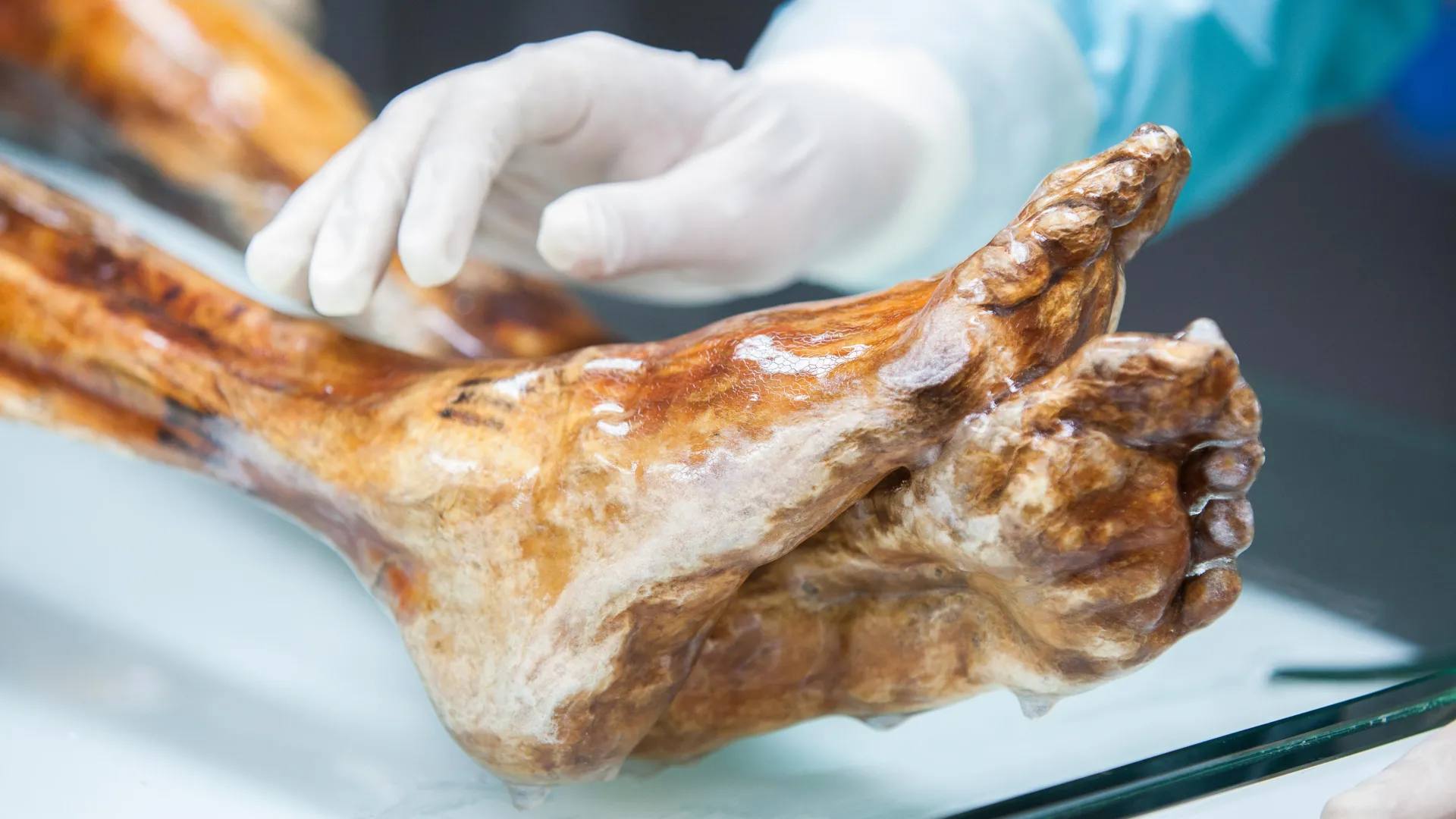
More than 5,000 years after his death, Ötzi the Iceman continues to surprise scientists.
A new study has discovered that the famous frozen mummy is still carrying a unique collection of microorganisms, including ancient gut bacteria and cold-loving yeasts that have survived through thousands of years trapped in ice.
Ötzi was discovered in 1991 by hikers in the Ötztal Alps on the border between Austria and Italy.
Since then, the naturally preserved mummy has become one of the world’s most valuable archaeological discoveries, offering scientists a rare opportunity to study the life, health and environment of a person who lived during the Copper Age.
Researchers from Eurac Research examined different samples from Ötzi’s body, including material from his internal tissues, stomach contents, surface ice and meltwater.
Their goal was to separate microorganisms that were part of Ötzi’s body while he was alive from those that arrived after his death.
The study found genetic evidence of Ötzi’s original gut microbiome, the community of microorganisms that lived inside his digestive system.
Scientists said these ancient bacteria are similar to those found in early human populations and are rarely seen in modern industrial societies.
The researchers also made an unexpected discovery: cold-adapted yeasts linked to extremely cold environments, including Antarctica.
These microorganisms appear to have come from the glacier where Ötzi remained frozen for thousands of years and may have continued surviving on the mummy.
According to scientists, the discovery changes how researchers view ancient frozen remains.
Instead of being simple preserved objects, mummies like Ötzi can be considered dynamic biological systems where microorganisms continue to interact with their environment.
“The Iceman is not just a historical object,” researchers explained, noting that some microorganisms have remained connected with Ötzi’s journey through time.
Scientists also believe the discovery could have applications beyond archaeology.
Cold-adapted microorganisms can function in extremely low temperatures, meaning they may one day help industries develop processes that require less energy, including low-temperature fermentation.
The findings also highlight the importance of protecting Ötzi’s remains.
The mummy is currently kept under carefully controlled conditions at the South Tyrol Museum of Archaeology, where experts continuously monitor its preservation.
The study, published in the journal Microbiome, provides a new window into ancient human biology and shows that even after thousands of years, life in microscopic form can continue to tell stories about the past.
Leave a Reply