
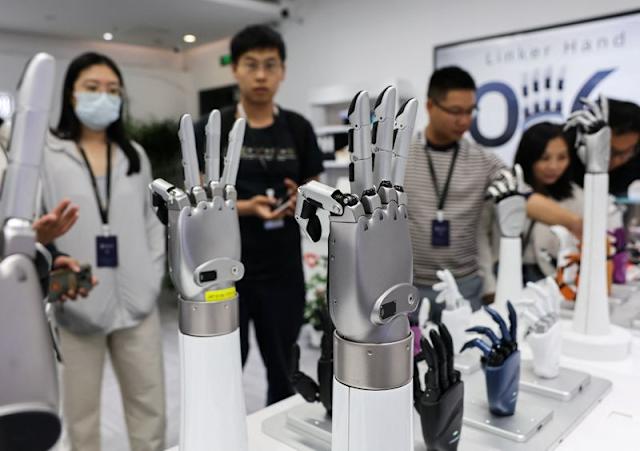
Linkerbot has become a dominant player in the niche of highly dexterous robotic hands, which are the most mechanically complex components of humanoid robots and essential for tasks requiring precision and flexibility.
The company’s products are widely used by manufacturers and research institutions, giving it a global market share of more than 80% in this segment.
One of Linkerbot’s strategic goals is to mass-produce skilled robotic hands, scaling output from around 5,000 units per month to 10,000 units monthly in the near future.
This increase in production capacity aims to make advanced robot components more accessible to factories and research labs worldwide.
Linkerbot’s CEO, Alex Zhou, says the company is focused not just on building robot parts but on replicating human craftsmanship in robotic form. Its proprietary platform, which translates hundreds of human skills into robot capabilities, sets the startup apart from competitors and highlights its commitment to advancing real‑world automation.
Investors backing Linkerbot include major Chinese tech and finance groups such as Ant Group, HongShan Group, Bank of China Asset Management, and Fosun Capital.
Although the company has not yet detailed whether the $6 billion target will be reached through private investment or a future public listing, the interest from heavyweight backers signals strong belief in its long‑term prospects.
Linkerbot’s robotic hands are seen as a cost‑effective alternative to full humanoid robots, which remain expensive for many industrial applications.
By focusing on adaptable hands that can be fitted to existing systems, the company hopes to accelerate automation adoption across sectors while lowering barriers to entry.
As the global demand for advanced robotics grows driven by needs in manufacturing, logistics, and even service industries Linkerbot’s pursuit of a $6 billion valuation underscores China’s increasing leadership in next‑generation technology.
Leave a Reply