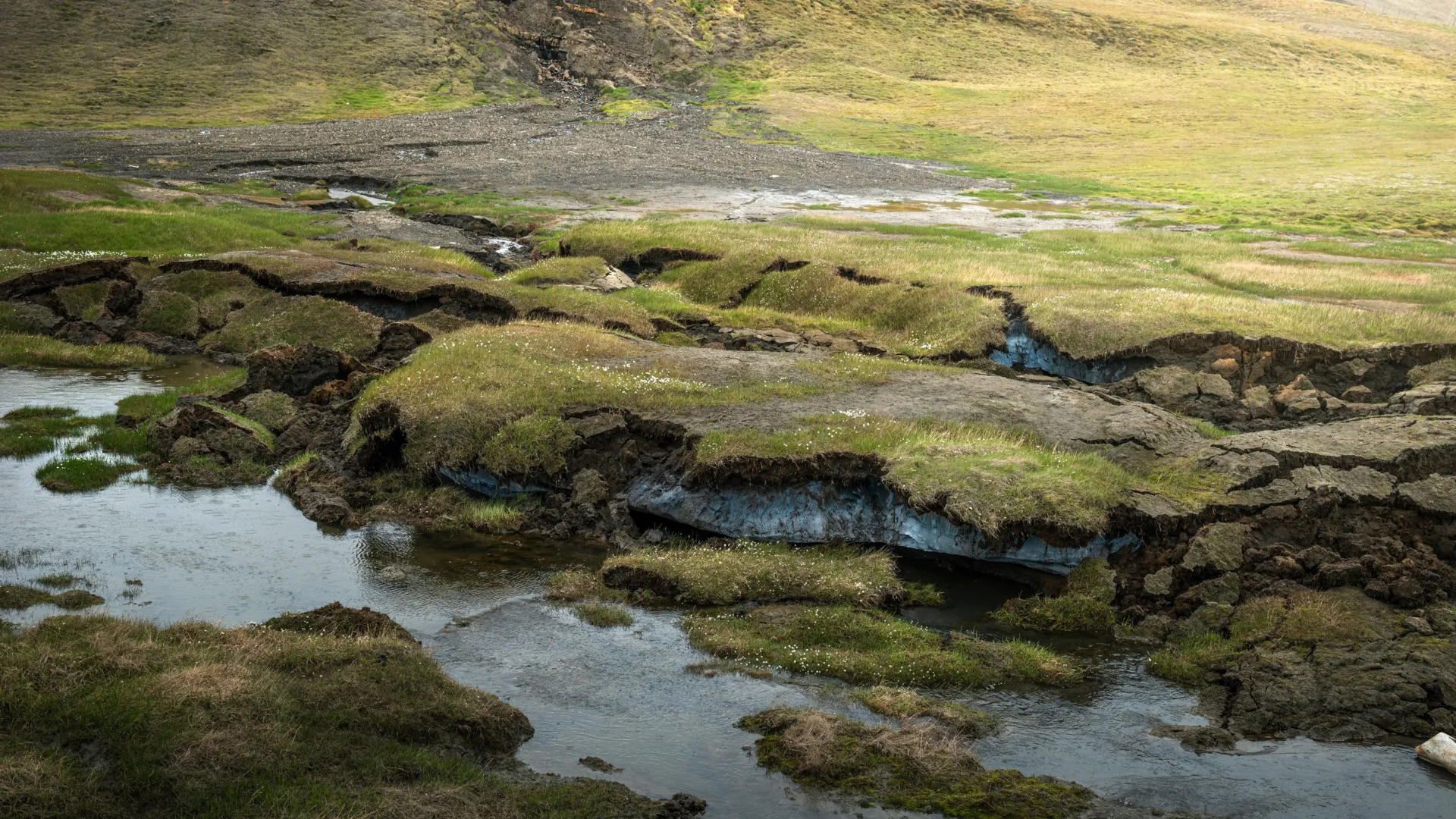
For decades, vast regions of the Arctic have remained permanently frozen, trapping organic material in the soil that built up over millennia.
This frozen soil layer known as permafrost has acted like a natural vault, keeping carbon safely stored away. But as global temperatures rise, that permafrost is melting deeper and for longer periods each year.
Scientists from the University of Massachusetts Amherst analyzed nearly 44 years of detailed climate and runoff data from northern Alaska, an area roughly the size of the U.S. state of Wisconsin.
What they found was striking: as the warming season extends into late summer and fall, more water flows through Arctic rivers and carries larger amounts of dissolved ancient carbon out to the ocean.
This matters because once that carbon reaches the ocean, some of it is converted into carbon dioxide (CO₂) , a potent greenhouse gas that traps heat in the atmosphere.
With more carbon being released from thawing permafrost, the planet could experience an amplifying feedback loop, where warming leads to more thawing, which releases more carbon, and so on.
The scientists also pointed out that Arctic rivers play a uniquely large role in the Earth’s freshwater system, delivering about 11 % of the world’s river water into the ocean despite the Arctic holding only a small percentage of the global ocean volume.
This means changes in the Arctic water cycle can have outsized effects far beyond the polar regions.
To achieve such detailed results, researchers used a sophisticated computer model called the Permafrost Water Balance Model, which simulates snowmelt, thaw depth, and river runoff at very high resolution.
This allowed them to track how both water and ancient carbon mobilize under changing climate conditions.
According to the study, unless warming trends slow, Arctic landscapes will continue shifting dramatically over the coming decades.
Increased thawing could not only impact carbon release, but also alter ecosystems, river patterns, and coastal environments in ways that scientists are just beginning to understand.
Leave a Reply