The robotic system, created by the international Project CETI (Cetacean Translation Initiative), represents a new way for researchers to monitor these large marine mammals’ social interactions without disturbing them, offering insights that were once nearly impossible to capture.
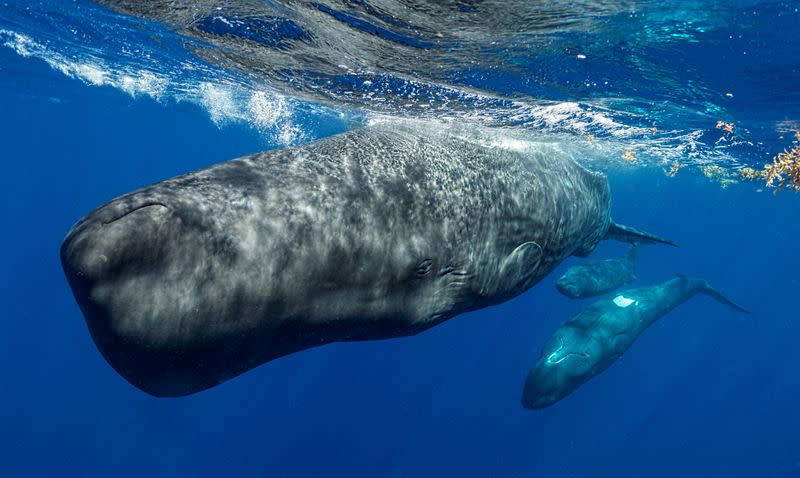
Sperm whales are known for their distinctive clicking sounds including sequences called “codas” which are believed to play a key role in their communication and social behaviour.
These clicks can travel long distances through deep ocean waters, but scientists have struggled to follow them continuously because traditional tracking methods such as suction‑cup tags or stationary hydrophones often lose contact when the animals dive deep or swim away.
The new system uses an autonomous underwater glider, equipped with four hydrophones (underwater microphones) and advanced signal‑processing technology that enables it to detect whale vocalizations.
When the glider “hears” the distinctive clicks of a sperm whale, it can automatically adjust its course to follow the animal, navigating underwater without the need for a boat or human control. This real‑time tracking capability allows researchers to observe whale behaviour over extended periods potentially for weeks or even months rather than just short moments.
Scientists believe that this development could transform the way sperm whales are studied. Extended, continuous monitoring can help researchers learn not only about where the whales travel but also how they communicate, how young whales learn vocal patterns from adults, and how these animals respond to environmental changes and human activities such as shipping traffic or underwater noise pollution.
By understanding these patterns better, conservation efforts can be more precisely designed to protect vulnerable marine habitats and reduce human impacts.
Despite the promise of the technology, there are limitations. The system isn’t yet able to pinpoint the exact location of each whale, and the glider must periodically surface to exchange data, which can temporarily interrupt tracking.
Nevertheless, scientists say this represents a significant step forward from earlier methods that could only reconstruct past whale movements from collected data.
This innovation shows how combining robotics, acoustics, and artificial intelligence can open new frontiers in understanding life in the deep sea, a world still largely unexplored by humans.
By bringing researchers closer to real‑time insights into the lives of sperm whales, the technology not only advances scientific knowledge but also supports efforts to protect and conserve these remarkable creatures and their ocean environment.
Leave a Reply