
The trip is expected to be one of the most demanding of his early pontificate, combining intense travel, high-level diplomacy, and major religious celebrations across a continent where the Catholic Church is growing rapidly.
Africa is now home to about 288 million Catholics, roughly 20.3 percent of the global Catholic population, according to the Vatican Yearbook (2024). The visit is therefore seen as both symbolic and strategic, highlighting the Church’s growing center of gravity in the Global South.
Pope Leo will travel with senior Vatican officials, including Cardinal Pietro Parolin, Cardinal Luis Antonio Tagle, and Cardinal Peter Turkson, as well as diplomatic and communications teams. Around 70 journalists will accompany the delegation. In total, the pope will complete 12 plane journeys and four helicopter transfers, delivering multiple speeches, homilies, and greetings in English, French, Portuguese, and Spanish.
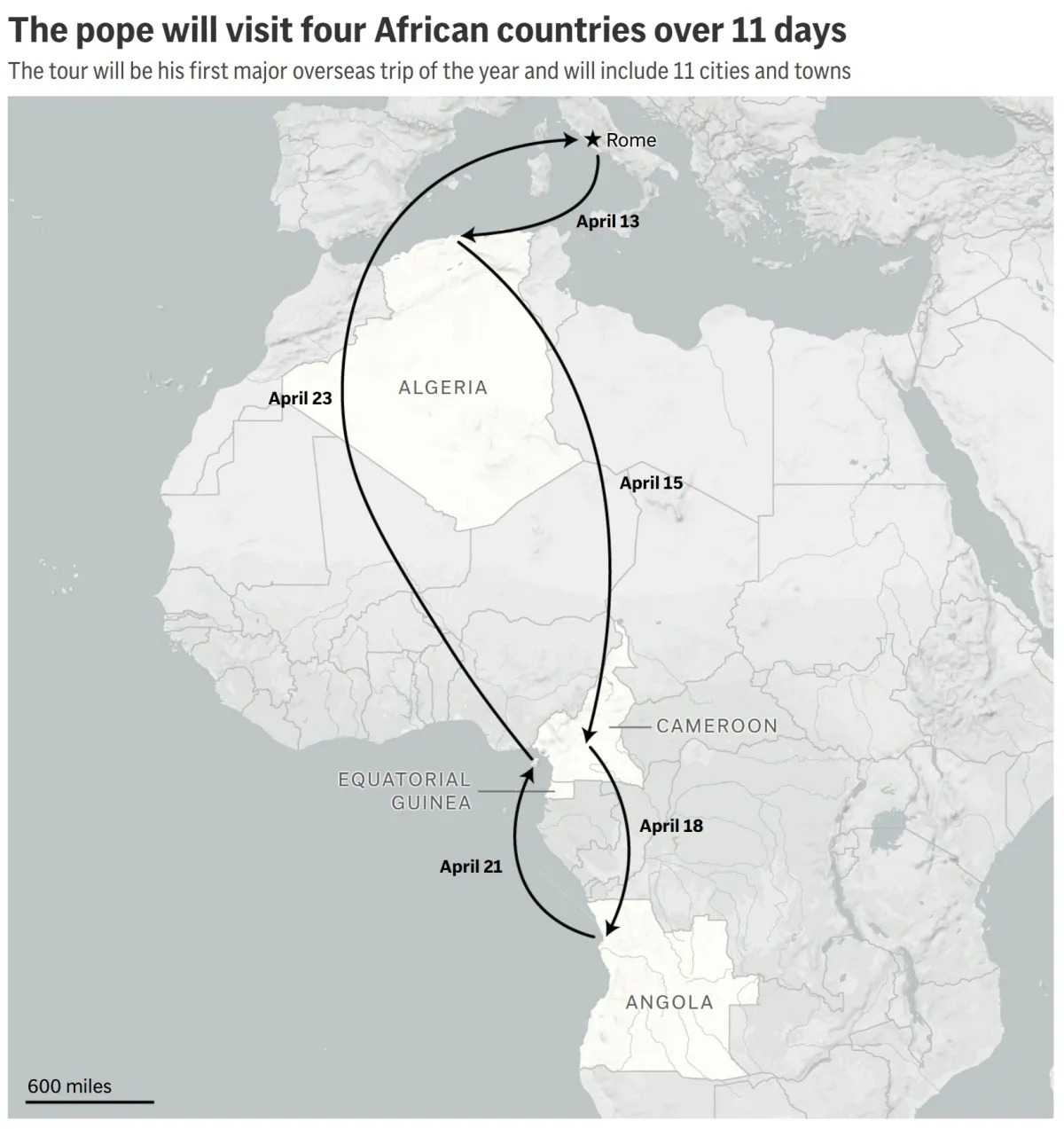
April 13–15: Algeria – Peace, memory, and dialogue
The journey will begin in Algeria, where Pope Leo will make the first papal visit in the country’s history. He will be received in Algiers by President Abdelmadjid Tebboune in a state ceremony that includes full military honors.
His program in the capital will include a visit to the Maqam Echaid memorial for Algeria’s war of independence, a private meeting at the presidential palace, and a major address to political, diplomatic, and civil society leaders. The speech is expected to focus on peacebuilding and dialogue in a country shaped by both colonial legacy and a violent civil war in the 1990s.
On April 14, he will travel to Annaba, the ancient city of Hippo and the historic seat of St. Augustine. There he will pray at archaeological sites linked to the saint, meet religious communities caring for the poor and elderly, and celebrate Mass at the Basilica of St. Augustine.
On April 15, after meetings with local bishops and the Catholic community, he will leave Algeria for Cameroon.
April 15–18: Cameroon – Calls for unity and reconciliation
Pope Leo will be welcomed in Yaoundé by Prime Minister Joseph Dion Ngute and will later meet President Paul Biya, one of Africa’s longest-serving leaders.
In the capital, he is expected to address political leaders, diplomats, and civil society at the Palace of Congresses, with a message focused on peace and national unity. His visit comes at a time when Cameroon continues to face conflict in its English-speaking regions.
On April 16, he will travel to Bamenda in the northwest, where he will take part in an “encounter for peace” with Christian and Muslim leaders at St. Joseph’s Cathedral. He will also celebrate a large open-air Mass for tens of thousands of faithful before returning to Yaoundé.
On April 17, he will travel to Douala, Cameroon’s largest city and economic hub, where he will celebrate Mass at Japoma Stadium and visit a hospital. Later, he will address students and academics at the Catholic University of Central Africa.
On April 18, he will celebrate Mass at the airport in Yaoundé before continuing his journey to Angola.
April 18–21: Angola – Healing and social justice
In Luanda, Pope Leo will be welcomed by President João Manuel Gonçalves and will take part in official state ceremonies. He is expected to address national leaders on issues including poverty, inequality, corruption, and post-war reconstruction.
Angola, still shaped by the legacy of its civil war (1975–2002), will provide a key backdrop for his messages on reconciliation and development.
On April 19, he will celebrate a major outdoor Mass in Kilamba, expected to draw around 200,000 people. He will later travel to Muxima, one of Africa’s most important Marian shrines, where millions of pilgrims visit each year.
On April 20, he will visit Saurimo in the country’s diamond-rich northeast, meeting the elderly and celebrating Mass for large crowds. He will later return to Luanda for meetings with bishops and Church leaders.
On April 21, he will leave Angola for Equatorial Guinea, marking the anniversary of Pope Francis’s death.
April 21–23: Equatorial Guinea – Youth, hope and renewal
Pope Leo will be received in Malabo by President Teodoro Obiang Nguema Mbasogo. He will meet government officials and address civil society at the presidential palace, followed by an engagement with students and staff at the newly named Leo XIV Campus of the National University.
On April 22, he will travel to Mongomo, where he will celebrate Mass in one of Africa’s largest churches before visiting a technical school and continuing to Bata. There he will visit a prison, meet victims of a 2021 explosion, and address young people and families at the stadium.
On April 23, he will conclude his African journey with a final Mass in Malabo before departing for Rome, where he is expected to hold a press conference reflecting on the visit.
Across 10 days, Pope Leo’s first African trip is expected to underline the continent’s growing importance in the Catholic Church. With a focus on peace, dialogue, and development, the visit will be closely watched as both a spiritual pilgrimage and a major diplomatic moment in the early months of his papacy.
Leave a Reply