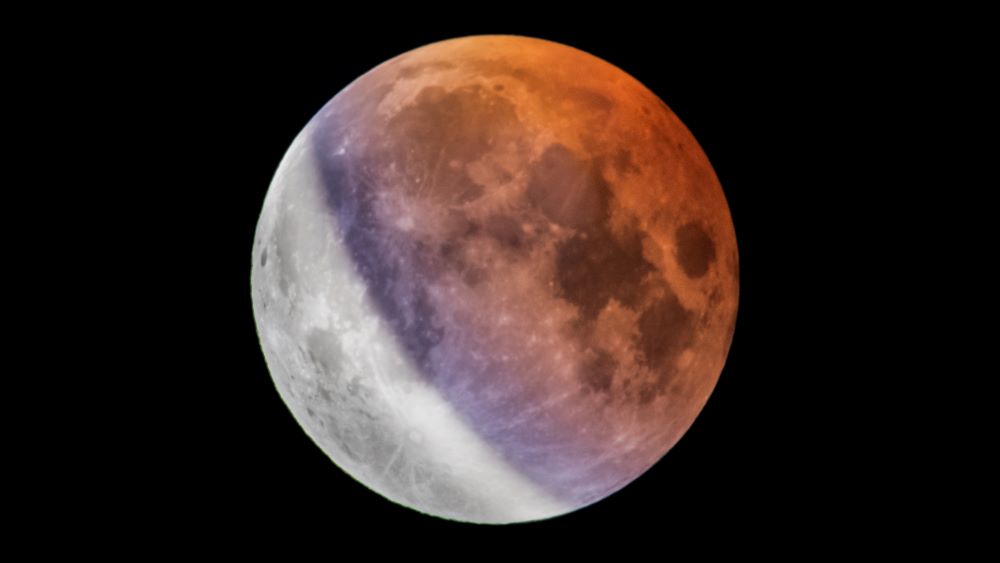
While many photographers captured the darkened lunar surface, astrophotographer Mike Shaw of Arroyo Grande, California, revealed a rare phenomenon: a thin, bluish concentric band along the moon’s edge during the partial phases.
Shaw’s image, a high-dynamic-range blend of seven photographs taken between 12:30 and 6:30 a.m., shows both the central red shadow and the delicate blue band.
On Instagram, he described the band as light passing through Earth’s upper stratosphere, where ozone absorbs red light but allows blue light to shine, contrasting with the red-orange light filtered through the lower atmosphere.
During totality, when the moon fully enters Earth’s umbra, sunlight refracted through every sunrise and sunset on the planet illuminates the lunar surface, giving it the fiery hue. The blue band, visible just before and after totality, is far rarer and highlights the interaction of sunlight with the stratosphere.
According to Forbes, Shaw carefully monitored weather and cloud cover in the days leading up to the eclipse, capturing the phenomenon without needing to travel far.
“The vivid, fiery red eclipsed moon appears suspended in space, and seems close enough you could pluck it out of the sky,” he said.
The next total lunar eclipse visible globally is expected to occur on December 31, 2028, with another visible from North America on June 26, 2029. A partial eclipse on August 27, 2026, will also offer photographers a chance to capture the elusive blue band.
Leave a Reply