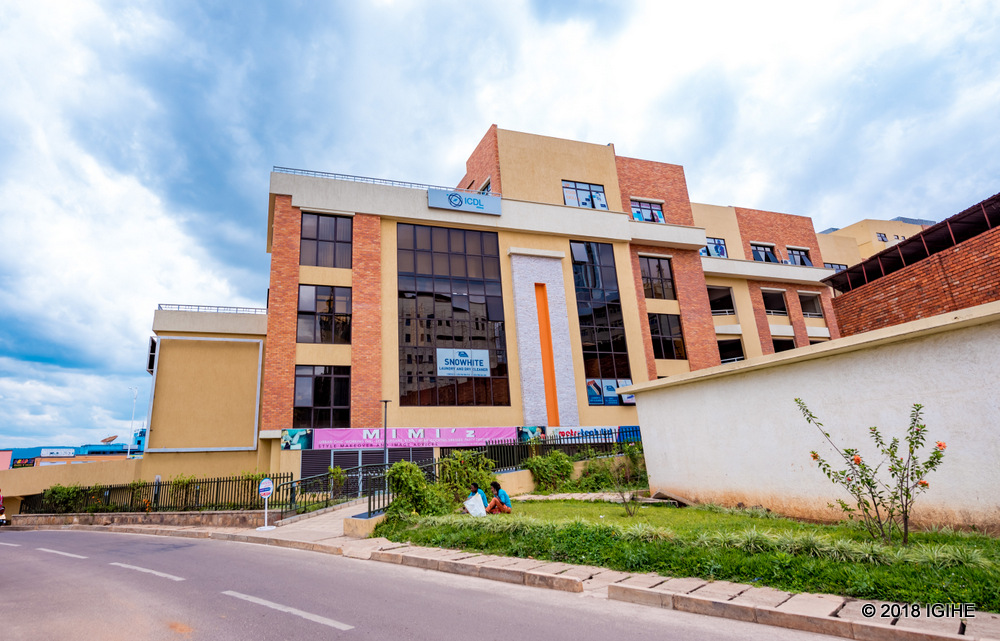
The modern market was built in Kibeho Sector, Nyaruguru District by Aimable Nzizera, a private entrepreneur contracted by Nyaruguru District after winning a tender to build it at a cost of Rwf840,193,410.
It is said Aimable Nzizera has disappeared with wages for 120 people who worked during the construction of the market, with work completed worth Rwf529,493,460 of the total tender.
Unconfirmed reports indicate that he may be detained.
Some workers who worked at the site who talked to IGIHE say they have approached the District officials who promised to pay them but nothing was done since last December.
Valentine Musabyemariya says she stopped working her gardens to offer her labor at the site, expecting to get more income. She says she would wake up at 3 a.m to get to the construction site on time. She is owed Rwf32,000.
“When the construction of the market stopped, I was owed Rwf32,000. Living far from the construction site, we used to wake up at 3 a.m, so as to get to the site early. We had stopped our daily agriculture works hoping to earn more money,” says Musabyemariya.
The Vice Mayor in Charge of Economic Affairs in Nyaruguru District, Janvier Gashema says the contractor disappeared when construction works were incomplete but the District is looking for ways of paying the workers.
“That contractor owes money to many people mostly those who supplied him with construction materials. He has problems with so many people but we just want to resolve our people’s issue,” said Gashema.
“I requested leaders of Kibeho Sector to call for a meeting with those who are owed debts so as to know the amount of money he owes them,” adds Gashema.
He says the contractor was paid money equal to the works he had completed with nothing left to compensate the workers.
Nyaruguru District Market was scheduled to be completed early 2018.
Gaston Hakizimana, Karambo Health Center Director says that they have committed to putting efforts in the initiative.
“It is necessary that when a mother has conceived, she should test and give birth at a health center. We are now going to conduct a special sensitization campaign to encourage mothers to always give birth at health centers because most of them die giving birth. There are those who die as a result of excessive bleeding, while babies succumb to pneumonia,” he noted, adding that on the contrary, when parents give birth at the hospital, those problems cannot take place.
Nemba Hospital director, Dr. Jean Baptiste Habimana says that in collaboration with ‘Impinja Ntizigapfe project’, loosely translated as ‘May Babies Don’t Die’, they committed to eradicating maternal and infant mortality. He adds that so far, they are optimistic for success.
“Every health centre and hospital has taken measures to see why in some cases, there are maternal and infant deaths. That is what we are looking for. In the lessons that we are given, we are with people who are related to the baby and the mother here, we get to exchange ideas that make us make a decision in looking for a solution, and I hope that we shall achieve it,” He said.
Gakenke District Vice-mayor, in charge of Social Affairs Catherine Uwimana says that measures to prevent maternal and infant mortality have been taken. However, she said that some parents have a negative attitude towards being tested where they claim being bewitched.
Today, Gakenke District has two referral hospitals; Ruli and Nemba. The district also has 23 health centers affiliated to the hospitals.
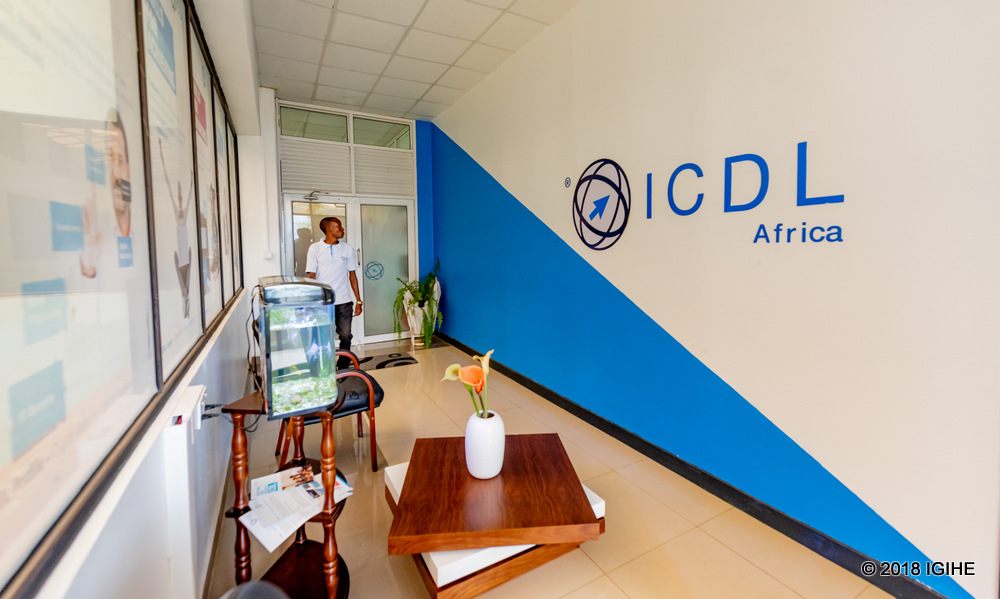
Since 2015, International Computer Driving License (ICDL) has been working with the Government of Rwanda to train Rwandans in ICDL programs to enable them to become digital experts, efficient users of the computer applications in the workplace.
ICDL provides knowledge and skills in using a computer and its applications.
ICDL Africa is a subsidiary of ICDL Foundation headquartered in Kigali, Rwanda and is responsible for the management and growth of the ICDL programme throughout sub-Saharan Africa.
ICDL Africa works directly with Governments across the continent to advocate for an international standard in digital skills among citizens in education and the workforce.
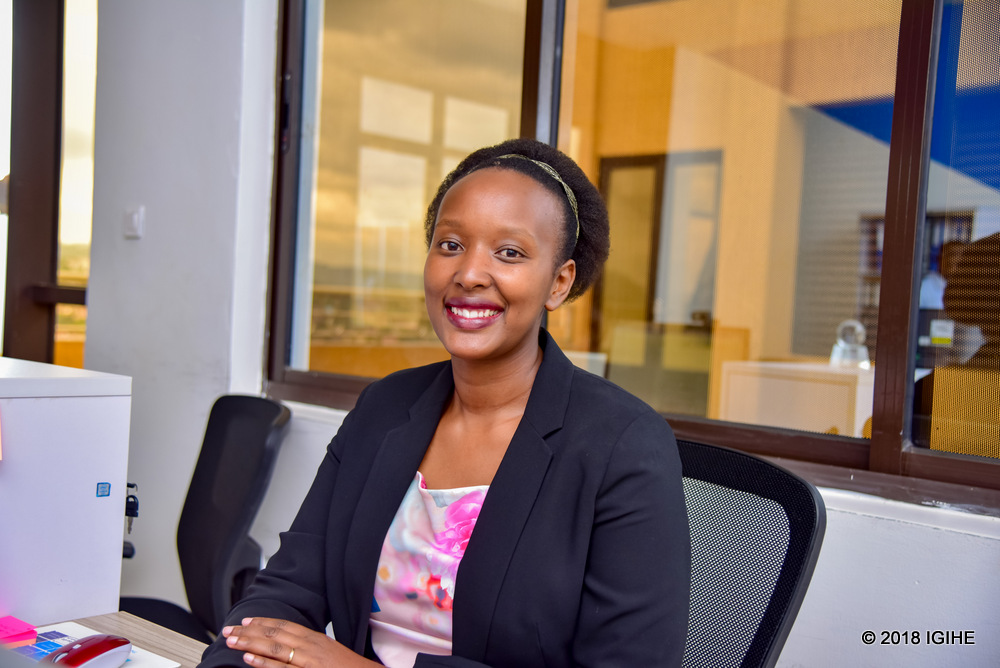
The Market Development Executive at ICDL Africa, Alice Umurerwa said that Rwanda, through Ministry of Information Technology & Communications chose seven modules that citizens can train in although the trainees can opt to learn more.
She said: “ICDL Africa office in Rwanda was established in 2015 before which the sub-Saharan African activities were being coordinated from South Africa. ICDL certificate guarantees candidates are equipped with computer skills and knowledge, being digitally competent, to successfully use computers in the workplace or for their day to day activities.”
She stated that ICDL together with its partners has experienced and knowledgeable trainers and that the skills learnt enhance the candidates’ productivity.
The skills learnt are not limited to office productivity but also helps the general population in terms of business development and sustainability plus always remaining secure while using the computers.
Ms. Umurerwa said that “we would be pleased to see the skills learnt through the programme empower and change the lives of Rwandans.”
The ICDL programme consists of a variety of modules that cover a wide range of digital skills. The modules are divided into four categories which include Introductory, Base, Intermediate and Advanced, covering the various levels of Digital Proficiency.
For the past 10 years, ICDL Africa has established a network of Accredited Test Centers (ATC) who offer both training and testing in the ICDL modules, to individuals and organizations in both the public and the private sector.
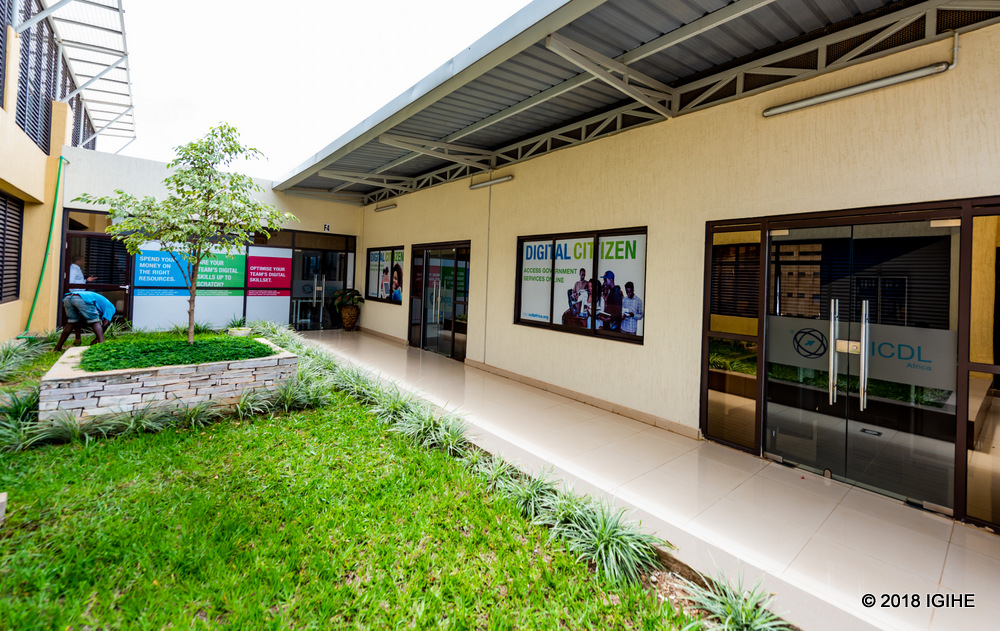
ICDL Africa has a network of 15 Accredited Tests Centers (ATC) in Rwanda among them Rwanda Revenue Authority (RRA) and University of Tourism and Business (UTB).
The Coordinator of the ICDL Programme in the University of Business and Tourism (UTB), Asher Emmanuel said that ICDL programme is in line with the government’s digital talent policy which seeks a digitally literate workforce and population in general.
“In September 2017, we signed an agreement with ICDL Africa to be an institution that provides ICDL training, testing, and certification. Eight lecturers at the university were trained and they are playing a major role in facilitating training to the student population. We held an awareness campaign with the students about that programme and they are all willing to take the programme. Starting with 2018/2019 academic year, every student at UTB is required to train and certify in ICDL,” he said.
He emphasized that “Someone who trained in ICDL programme is able to do their research and work quickly which is the focus of the institution.”
UTB will offer certificates to at least 50 students who will have completed the seven modules that the university has set as the minimum in December this year.
ICDL Africa and the government of Rwanda through the former Ministry of Youth and ICT signed an MoU to certify 85,000 employees of central and local government and the public across Rwanda.
In January 2016 a pilot project was started for a period of nine months to train Civil Servants starting with the Security Sector.
The training was funded by the government through the National Capacity Building Secretariat. 146 candidates were trained, tested, and graduated in 4 base modules and 3 intermediate modules as per the MoU.
In 2018, Rwanda Revenue Authority became an accredited Test center and they target to train all their workforce in ICDL. A group of 40 staff members have been trained and certified in seven modules. The institution is focused to have in-house training for their staff and that is why they certified 20 of the staff trained to be trainers.
ICDL also operates globally throughout the Americas, Asia, Europe and the Middle East.
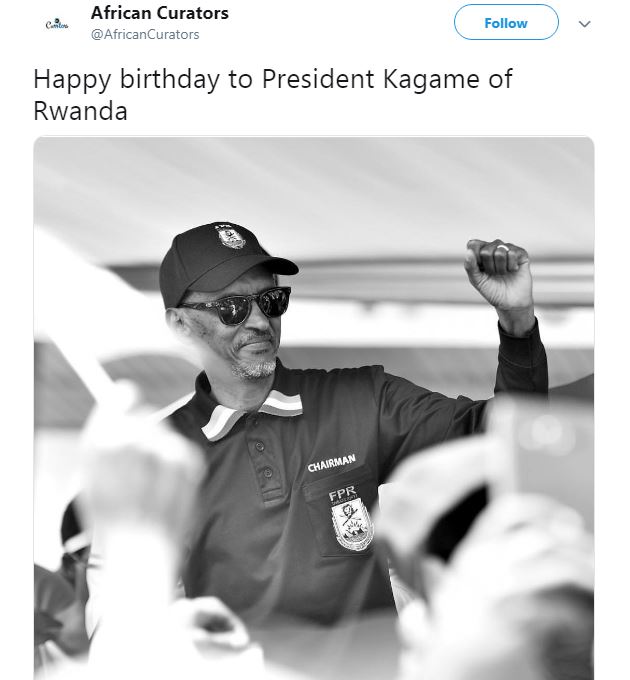
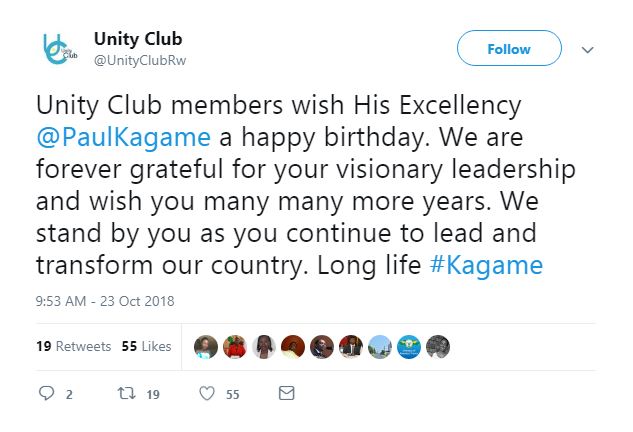
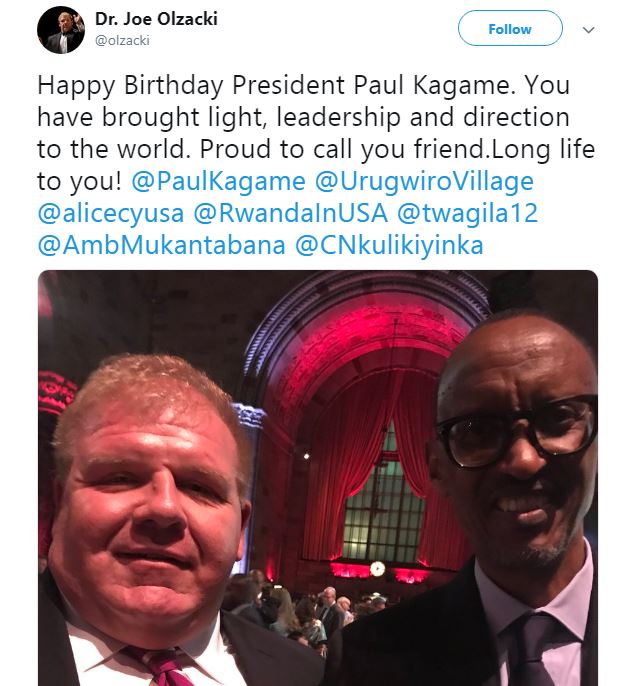
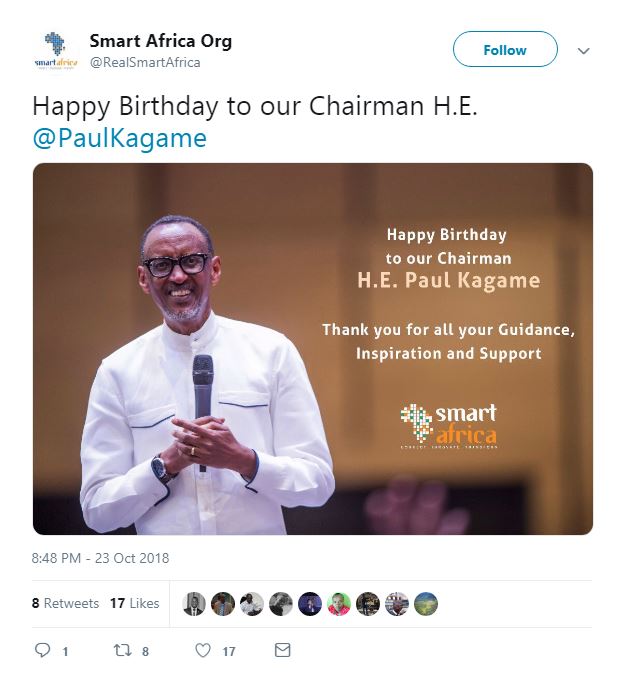
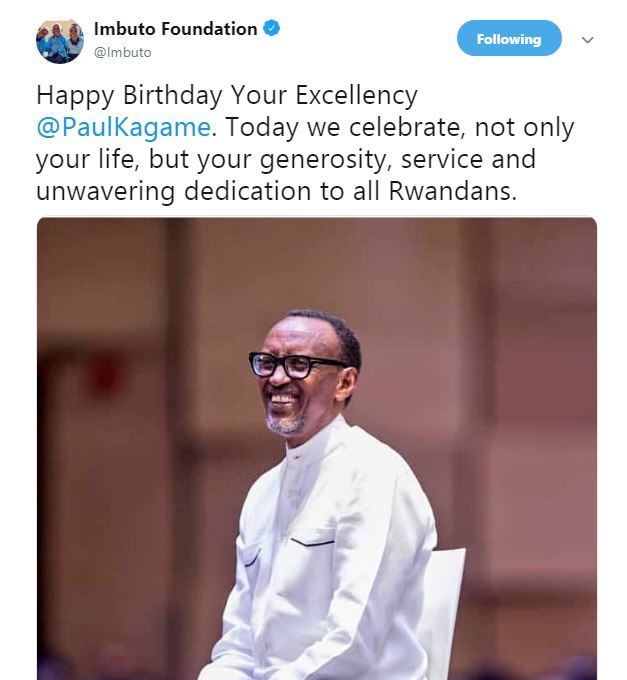
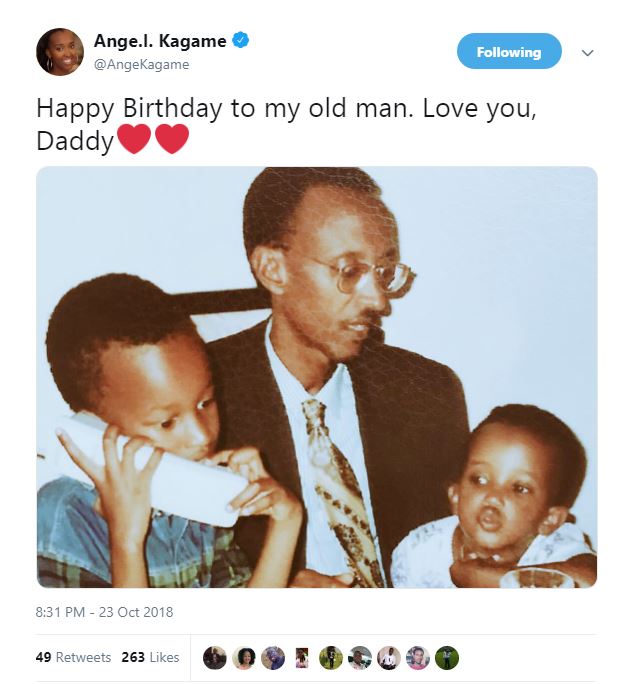
Different people have conveyed their happy birthday wishes to the president through different social media platforms.
Jean Marie Vianney Gatabazi, Governor of the Northern Province wrote on Twitter saying, “A very happy birthday to His Excellency President Paul Kagame, our role model, inspirational president, visionary and great leader. May God bless you abundantly. More candles Mr. President. Blessings to our First Lady and the entire family,” he tweeted.
Former education minister Jeanne d’Arc Mujawamariya tweeted, “Happy birthday your Excellency President Paul Kagame. May God continue to bless you and your family! Rwandan was blessed from the day you were born,”.
Popular musician and doctor Tom Close wrote, “Happy birthday to you Mr. President Paul Kagame. You are a giant of inspiration to all of us mostly the youth. We are glad to live in this era, at least we know that the present and future of our nation is assured. Long live our president,” he tweeted.
Mukashema, a senior 2 student told IGIHE that she has been saving since 2016 when she was in P6. She has now saved Rwf240,000.
“I found out that I used to spend a lot of money per day. So, I started saving. My mother would give me Rwf100 to buy myself a doughnut and kept it. Now, I have Rwf240,000,” she says.
Mukashema says that if she were to complete her ordinary level studies and lack means to continue, she would use her savings to pursue her advanced level studies.
She says that at times she grows crops for sale and saves the earnings.
She also belongs to a local dancing troupe from which she earns and saves. Mukashema’s mother Marie Rose Nyiransengimana says that apart from the savings, her daughter also rears two billy goats and three rabbits worth Rwf50,000 also bought with her savings.
“When I give her Rwf100 to buy a doughnut, she keeps it on her account. Thanks to her savings, she can now buy her own shoes and clothes on her own,” she says.
In 2016, the school located in Gihango Sector started encouraging students to save money in groups in a bid to reduce the number of students who drop out of school owing to lack of basic materials.
They formed groups in the “Mfite Icyerekezo” initiative, loosely translated into English as “I have a vision.”
The teacher in charge of this initiative Marie France Usanase told IGIHE that they have different ways of saving. For instance, she noted a student may bring Rwf5000 per week.
“If you count from last year, for instance, you’ll find out that a student who saved Rwf5000 per week would have saved Rwf500, 000.” She said.
However, she noted that at times the students may have problems and decide to withdraw the money or buy domestic animals.
The school has 12 saving groups for ordinary level students, one comprised of between 25 and 30 members.
Groupe Scolaire Congo Nil Headteacher Priest Paul Maniragaba reveals to IGIHE that since this initiative was created, students have not been dropping out of school.
He adds that even when a student does not have the money to buy something they need, teachers may lend them some money and pay back later.
The school authority posits that this initiative may be a sustainable solution to children that abandon school and serve as an example to other schools.
The school counts 25 students including 16 who dropped out of school in 2017 while this year, 4 other students dropped out while 12 among those who had dropped out last year returned thanks to the savings initiative.
“That cost was a bit high for my clients,” he recalls. Not any more. Today, his locale has been connected to the national electricity grid system, thanks to Rwanda Energy Group that has made the connections. He accesses cheap electricity, and he charges less from his loyal clients of 15 years.
“With on-grid electricity connection, I reduced the milling charges to Rwf15 for a kilogram of sorghum and Rwf40 for maize,” explains Kanyama, with a wry knowing smile of satisfaction and more hope.
Kanyama’s milling business profitability has, too, improved to great heights as he puts it.
“Before we were connected to electricity, I used to fuel the generator for powering my miller with Rwf5000 worth of fuel from which I would get a return of Rwf2000. Now that profit has doubled.”
Besides the high costs, Kanyama explains, air pollution, because of the fumes from the generator, was apparent, a complaint raised quite often by some of his neighbors. It is different now; “No pollution, no complaints, no disharmony. This is real development.”
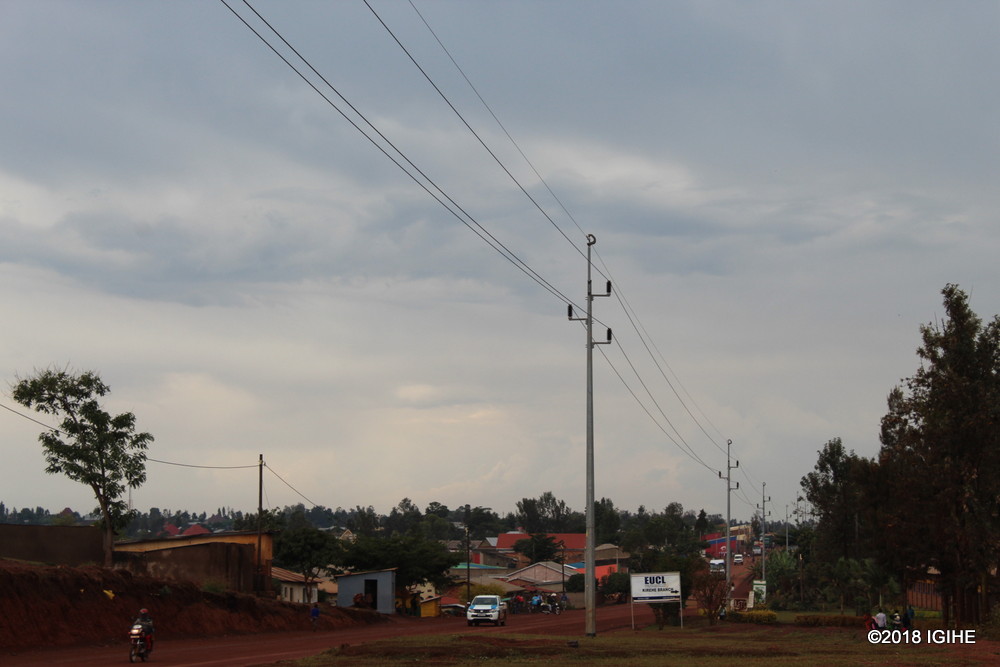
Kanyama is not the only beneficiary of the recent power connections in Kirehe District. He is among the 6,043 households that were connected to the on-grid electricity system in 2017/2018 fiscal year where the district surpassed its target of connecting 5,544 households, registering 109% performance.
This trend has been quite progressive.
In 2015, only 17,126 Kirehe households were connected to electricity but have since increased to more than 30,000 households, translating into 30% of the district population accessing electricity.
Other Kirehe residents connected to electricity on-grid system last month, say the connections have changed a lot in their everyday lives, enabling some create or get jobs that earn them an income.
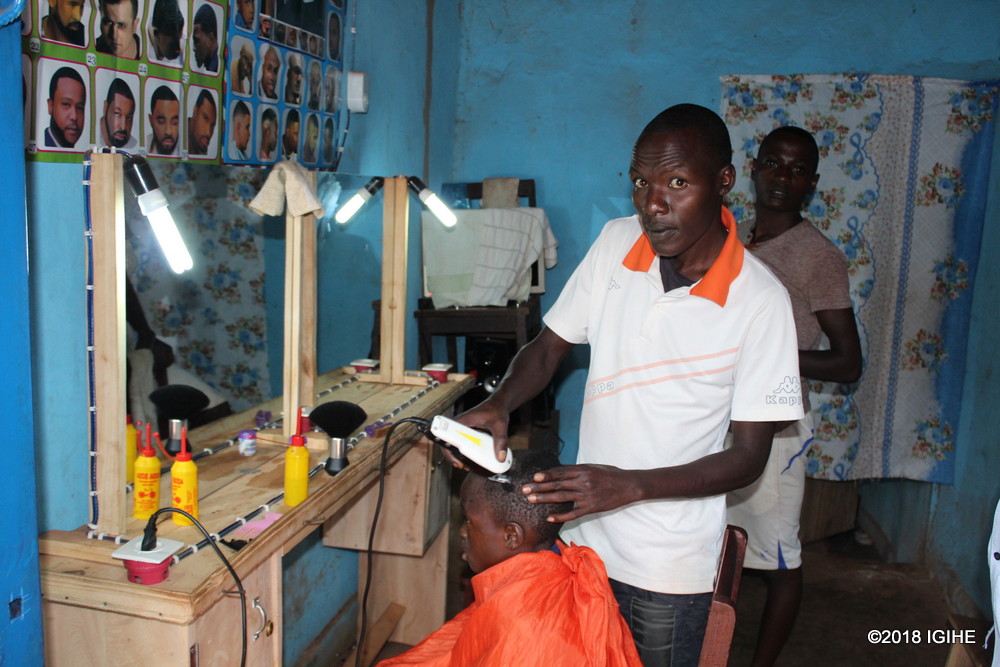
Martin Nduwubwami, another resident of Kigina Sector, says he has got a job in a hairdressing salon that was established after power connection. “It has changed my livelihood,” he enthuses, adding; “I was jobless but I can now meet my daily basic needs. Before our area was connected, I was doing cultivation that yielded almost no profit for me,” he says.
Nduwubwami, an orphan, can now earn a daily income of between Rwf1,500 and Rwf3000. And just like that, the joy permeates, the excitement spreads.
Some residents say their houses are well lit during nights and their school-going children can revise their books regardless of whether it is day or night.
Jean Marie Vianney Mazimpaka, for example, is a father of four school-going children, who, he says, now do revise their books at any time. It was dark before. We used to use a kerosene lamp which was shared from one room to another.”
Mazimpaka expresses more happiness. “We had one hair-cutting salon in the area before electricity connection; now in a very short span of time, we have two. And we no longer have to walk for 30 minutes to reach a point of charging our mobile phones, for which service we would pay Rwf100.”
And the journey continues. Statistics by Rwanda Energy Group indicate that nationwide, 46.5% of households are connected to electricity, steadily progressing towards the targeted 100% access by 2024. “This government through REG is committed to achieving just that,” says a REG official.
President who is also the Chairperson of the African Union was delivering a Keynote Address at the Opening Ceremony of the first Ordinary Session of the fifth Pan-African Parliament (PAP) underway in Kigali.
“Important changes are underway on our continent, and in the wider world, and we have to be ready to meet them. It is about getting our house in order, doing what is right for our people, and speaking with one voice to advance Africa’s interests. Working together is the only way to give Africa’s position the weight it deserves, in the wider geopolitical context. At the same time, illusions of moral hierarchy, that divided continents, and people are crumbling rapidly, as we have been seeing. Responsibility for Africa’s security and prosperity is firmly in our hands. We must meet the imperative of good governance, with innovations and solutions drawn from Africa’s rich experiences and cultures, even as we remain open to benefit from the best global insights,” President Kagame said.
President Kagame further stressed that the role of Pan African parliamentarians was key in speeding up the ratification of African Continental Free Trade Agreement, the Protocol on the Free Movement of Persons, and other key pillars of Agenda 2063, as part of their continued contribution to continental transformation.
Major General Albert Murasira was appointed following a cabinet reshuffle by President Paul Kagame recently to replace General James Kabarebe who had been at the helm of Defense Ministry from April 10, 2010. General Kabarebe was appointed to serve as a Senior Presidential Adviser on security matters.
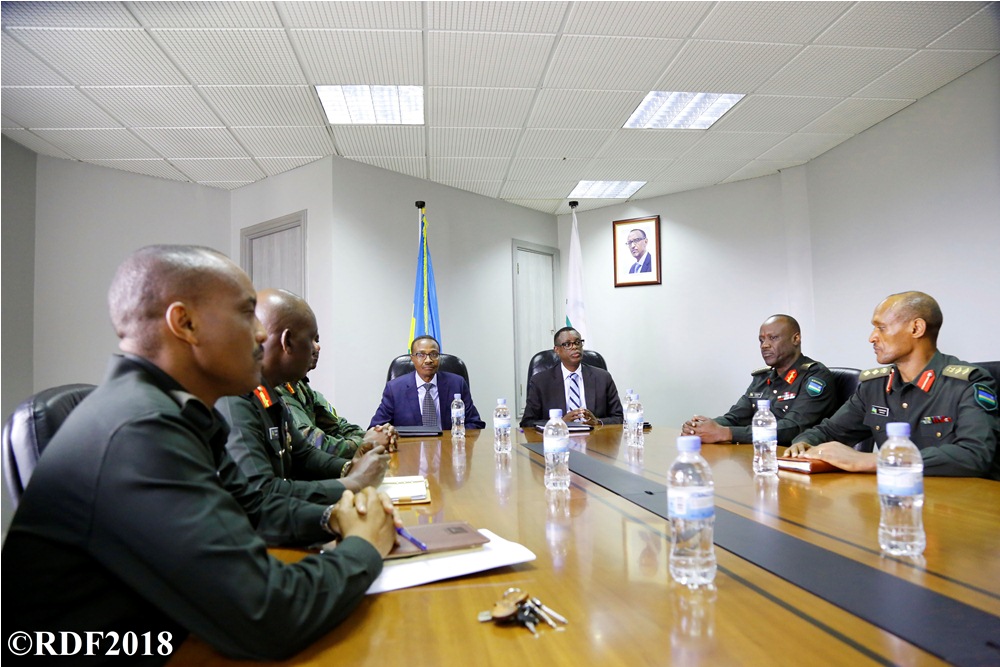
The ceremony, which took place at the ministry headquarters in Kimihurura, was witnessed by MoD and Rwanda Defense Force (RDF) top leadership including Gen Fred Ibingira, the Reserve Force Chief of Staff and Lt Gen Jacques Musemakweli, the RDF Army Chief of Staff among other high army officers.
Speaking after the handover and takeover ceremony, Major General Murasira stressed his commitment to follow his predecessors’ footsteps and the partnership between the army and the citizens that leads to the enjoyable security Rwanda has.
“We enjoy security because there has been a partnership between the military and other security organs, but most especially with Rwandans. We also work with others that include foreigners in different peacekeeping missions in the region, on the African continent or elsewhere around the World,” said Maj. Gen. Murasira.
The new Defense Minister also pointed out that Rwanda alone cannot enjoy security while its neighboring countries face insecurity, adding that in his tenure, he will ensure the sustainability of what has been achieved.
Major General Albert Murasira also handed over the office to the new Chief Executive Officer (CEO) of Zigama Credit and Saving Society (CSS), Major General Emmanuel Bayingana. The handover ceremony was witnessed by the Chairman of the Board of Directors of Zigama_CSS, Dr. James Ndahiro.
Major General Albert Murasira becomes the tenth Minister for Defense since Rwanda became independent in 1962. The Minister for Defense is responsible to the Government for all matters concerning the Defence policy, the conduct of Defence and implementation of Defence programmes.
Major General Albert Murasira holds a Master’s of Science in project management with merit from the University of Liverpool in the United Kingdom (2016). He also attended the former National University of Rwanda from 1983 to 1988 where he received a Bachelor of Sciences in Mathematics (1986) and Licence in Mathematics (1988).
Twagiramungu who served as Rwanda’s Prime Minister from 1994 to 1995 and now lives in exile in Belgium, usually posts on social media about the ‘double’ genocide in Rwanda and that the 1994 genocide against the Tutsi was never deliberately prepared by perpetrators.
Individuals and officials have been requesting to investigate and pursue Twagiramungu pay for his ‘statements’ that are considered to have the plot to deny and minimize the 1994 genocide where more than million people were killed.
In a tweet, Tom Ndahiro who is a Genocide scholar appealed to Rwanda and Belgium’s criminal investigation organs to open a case file against Twagiramungu whose ‘senility has led to severe criminality’.
Tom Ndahiro was referring to a French tweet by Faustin Twagiramungu posted on October 20 this year that says that genocides in Africa have taken place in three countries colonized by Belgium in history.
The tweet in case loosely translates as, “Genocides in Africa have taken place in three countries colonized by Belgium: DRC: 10,000,000 Congolese nationals killed under King Leopold II (1887-1907) +6,000,000 by Paul Kagame, Rwanda: 1,000,000 killed by FPR and FAR in 1994 and Burundi, 3,000,000 Hutus killed in 1972 by the Tutsi Army”.
Referring to the tweet, the Genocide scholar, Tom Ndahiro tweeted, “I suggest Rwanda’s RIB [Rwanda Investigation Bureau] and Belgium department of criminal investigations should open a case file against this old man whose senility has led him to severe criminality. His denialist discourse is disgusting. His hatred towards genocide survivors and their rescuers is visceral.”
The Minister of State in the Ministry of Foreign Affairs and International Cooperation, in charge of the East African Community, Amb. Olivier Nduhungirehe said, in another tweet, that “It’s very sad to see an old Rwandan politician in his 70s, who miraculously escaped the genocide machine in 1994, who was given an opportunity by the RPF Inkotanyi to serve as Prime Minister, becoming not only a genocide denier but a real lunatic, as time goes by.”
In an interview with IGIHE, the Chief Prosecutor of Rwanda, Jean Bosco Mutangana said statements by Twagiramungu can lead to crimes of denial and denigration of the 1994 Tutsi genocide.
Mutangana said, “He (Twagiramungu) states that the genocide was never prepared and Habyarimana’s regime never planned for the genocide. This is far different from what was approved by the International Community showing that the genocide was a planned plot as the Interahamwe militias were trained and the genocide ideology was taught in schools so that Tutsis were killed for so many years till 1994.”
Mutangana further said Twagiramungu cannot hide behind what he calls freedom of speech and then say whatever he wants.
“Rwanda’s prosecution will never tolerate those statements. We are going to analyze them and what will be found as crimes to be prosecuted, a case will be opened against him. We will work with those countries he lives in as we usually collaborate,” he said.
“We are ready to start an investigation on him, with the country he lives in. If he wants to become a genocide denier, he will be put on a list of criminals to be persecuted on genocide negation,” Mutangana added.
Rwanda’s Chief Prosecutor further noted that is a responsibility for the Prosecution to pursue everybody in line of genocide denigrators and deniers “the same as others who intend to commit it like FDLR.’’
Supporting a double genocide theory for Rwanda and stating or explaining that genocide committed against the Tutsi was not planned is considered as an offense. Genocide denial contravenes the spirit of the 1948 UN Convention on the Prevention and Punishment of the Crime of Genocide.
Genocide ideology law punishes the crimes that include denial of genocide, minimization of genocide, and justification of genocide, with a term of imprisonment of not less than two years but not exceeding four years, with a fine of not less than Rwf500,000 but not exceeding Rwf1,000,000 for each count.
Born August 14 in 1945, Faustin Twagiramungu served as Rwanda’s Prime Minister from July 19, 1994, to August 28, 1995, when he resigned and exiled to Belgium.
In 2003, he came back to Rwanda and ran for the President’s office as an independent candidate and lost the elections having got 3.62% of votes while President Paul Kagame emerged winner with 95.0%.
The team with sophisticated equipment with which they will use to treat about 500 patients, will be carrying out the exercise for the second time in a week dedicated to treating digestive diseases starting Monday to Friday, October 26, 2018. It is organized by the Rwanda Society for Endoscopy (RSE).
The RSE director general, Dr. Vincent Dusabejambo said that the number of patients to be treated is bound to increase this time because previously, a team of 12 specialists treated 240 patients compared to the current team of 23.
“Last time, there were 12 specialists. This year we have got a team of 23 as well as nurses and physicians who are experts in manipulating medical equipment in gastroenterology. We were able to treat 240 patients, and this year we expect that number to double to between 400 and 500 patients during this week,” he said.
He further said that hospitals in Rwanda benefit a lot from the stakeholders both in accessing sophisticated equipment and training their fellow physicians in Rwanda about diagnosing a variety of gastric disorders, cancers and diseases of the pancreas and biliary system.
Meanwhile, Dusabejambo also said that all the specialists leave all their equipment in Rwanda. He says that when they were last in Rwanda, the team left equipment worth roughly US$250. This time around, they came with medical equipment worth US$350 plus other expensive machines that are used in that field. He noted that all this is aimed at giving Rwandans access to modern medical services during the week.
Prof. Steve Bensen, head of the team remarked that he was pleased with Rwanda’s performance in the health sector where he last led the team last year, motivating him to bring the experts again this year.
“Last year, the diseases treatment week was well completed and we committed ourselves to make it our own. But for example last year, we did not train to the extent we had wanted to. This year, we will take two days training doctors. We will also increase the number of patients we will treat because we have got more equipment, he said.