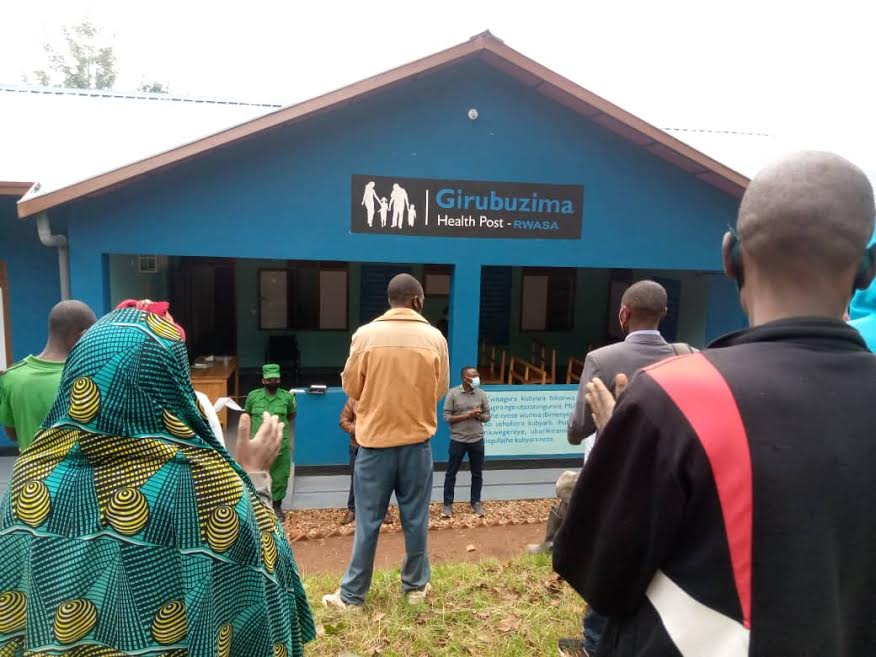
As residents explained, they hardly accessed health services in the past that they would sometimes cross to Uganda for medical attention which has become history following the construction of 57 health posts completed at a cost of Rwf1.3 billion.
Speaking to IGIHE residents from different sectors of the district said they no longer need to cross to Uganda to seek health services because they have been made available closer.
“We hardly accessed health services in the past and decided to cross to Uganda. The situation has however changed. We are currently getting such services at Kamanyana health post which also attends to patients with eye diseases,” said Banyangandora Desire from Cyanika sector.
“We were accustomed to seek health services from Uganda or traditional healers since our childhood. As of now, men get circumcised at nearby Gatebe health post that we run short of nothing. Anyone crossing to Uganda might be going there for other personal reasons because health services have been made available,” explained another resident, Niyonizeye Samuel.
The mayor of Burera district, Uwanyirigira Marie Chantal, also emphasized that the matter of residents crossing to Uganda for health services has been addressed for good noting that residents currently receive most of services closer to their homes.
“We voice our appreciation to the Government of Rwanda for good policies and support through the Ministry of Health, especially President Paul Kagame who always oversees citizens’ interests. The problem of health tourism to Uganda has been addressed definitely because they often went there for eye, tooth diseases or circumcision reasons. All these services are available at these health posts. We also collaborate with health workers from other facilities to offer such services to health posts where they are not yet integrated on specific days,” she said.
These health posts were built on partnership between Burera district, the Ministry of Health, SFH Rwanda and Partners in Health among other partners in health sector.
These include a 17-year old young lady called Ishimwe Celine, a daughter of Bicamumpaka Esiri and Mukandahiro Aurélie living in Wakiso in Uganda.
The lady was arrested at home along with her brother, Ishimwe Eliel aged 19.
Security officers from Uganda’s Chieftaincy of Military Intelligence went to their home and arrested children after missing parents.
These children went to Uganda in 2015 with their mother through Gatuna border.
They were arrested on 10th December last year and taken into Police custody in Bukasa where they spent a week and taken to court on accusation of illegally staying in Uganda.
Ishimwe Eliel said that they have travel pass but his explanations were not considered and retained in prison.
On 25th January 2021, they were transferred to the detention facility of the Ministry of Internal Security until their deportation yesterday separated with parents. The two children have a grandfather in Nyanza district where they plan to stay.
Other deportees include Murindangabo Bernatus , the husband of Nisingizwe Michelle with whom they sired two children.
He is a son of Rutaza Révérien and Mukantagara Athanasie living in Bugesera district. He arrived in Uganda from Brisbane town, Queensland State in Australia.
Murindangabo went to Uganda on 13th February last year through Kigali International Airport onboard RwandAir. He had tour operator company guiding tourists in Uganda.
Murindangabo was arrested by CMI on 4th February 2021 and detained in Kansanga where he runs businesses. He was taken to CMI facilities and later at Makindye military camp accused of being a spy.
Another businessman, Mugisha Gahungu Shadrack, 29, hailing from Nyamasheke district went to Kenya in 2010 through Gatuna border.
He left Kenya for Uganda in 2015 and later arrested on 4th February 2021 in Kansanga at a bar known as Pyramid.
He was taken to CMI headquarters in Mbuya and later taken to military camp in Makindye accused of being a spy.
Mugisha has left his family in Uganda.
Rebero Napoléon is another deportee aged 47. He arrived in Uganda in 2000 through Gatuna border.
He was arrested on 10th February 2021 in Kampala where he was running businesses. He was also detained at CMI facilities in Mbuya accused of espionage.
Gahungu was also deported yesterday. After completing university studies in Rwanda, he went to Kenya in 2013 for clothes trading business. After spending two years, he went to Uganda where he established a restaurant. Gahungu later met with another Rwandan in 2017 and established a bar known as ‘Atmosphere Lounge’.
In 2018, his bar became famous that he started working with Rwandan DJs.
As Coronavirus emerged, he moved to Kansanga and worked with another bar dubbed Pyramid. He was arrested on 4th February accused of espionage.
“I am not the only Rwandan arrested. They were held at different times for the past three years for similar accusations. People are sometimes abducted in night hours with their faces covered. I was also tortured like other Rwandans illegally detained,” he said.
Gahungu returned to Rwanda bare hands leaving or his properties.
Since 2017, Rwandans have been abducted by Uganda’s CMI accusing them of being Rwanda’s spies.
Abduction of Rwandans living or traveling through Uganda is linked to CMI’s close collaboration with Rwanda National Congress (RNC), a rebel group against the Government of Rwanda led by Kayumba Nyamwasa with intentions to destabilize Rwanda’s security.
Through the cooperation, Rwandans on Uganda’s land denying cooperation with the rebel group are arrested; tortured in CMI prisons while others are taken in Minembwe of DRC to be tortured.
Uganda has been arresting Rwandans since 2017 in different operations. The Government of Rwanda has since 2017 been condemning such arbitrary detentions and advised Rwandans not to travel to Uganda in March 2019.
Later on, Angola launched discussions to mend Rwanda, Uganda relations which led to the signing of the Memorandum of Understanding in Angola, Luanda known as Luanda Agreement in 2019.
The memorandum was signed on August 21st 2019 in a bid to solve conflicts between Rwanda and Uganda.
Despite efforts to sign the agreement between both heads of state. CMI continues arbitrary detention of Rwandans who endure torture in its facilities.
The mayor made the call on Thursday, March 11, while addressing over 20 members of CPCs from the sectors of Kibeho, Munini, Cyahinda, Muganza, Busanze and Buheru.
This was at the start of a two-day training organized by Rwanda National Police (RNP) to enlighten them on community Policing.
He commended Rwanda National Police for its continued efforts to empower the people to own their security and to support them in human security activities to improve their livelihoods.
“I thank RNP for this community policing training. This emphasizes your important role towards sustainable security by working with the people to identify and report anything that can cause insecurity,” said mayor Habitegeko.
He further urged them to work with security organs and other government entities in enforcing the National directives against the spread of Covid-19 through awareness on health and hygiene practices.
The mayor further asked them to avoid bad practices such as drunkenness and warned them against any form of corruption.
Assistant Commissioner of Police (ACP) Rose Muhisoni, the Deputy Commissioner for Community Policing in RNP reminded the CPCs about their role in enhancing the ideology of people centred policing in their villages and cells, but also to take into account the current situation of COVID-19 where their role is crucial in behavioural change and compliance with prevention measures.
“You are the first responders to guide people in your respective communities to identify, report, fight and prevent pressing security issues like child abuse, including defilement and child pregnancy, gender based violence and drug related crimes,” ACP Muhisoni told the CPCs.
Participants thanked RNP for organizing the training and pledged continued partnership to strengthen the ideals of community policing and crime prevention in particular.
Mr. Gomera was accompanied by his deputy, Ms Varsha Redkar Palepu.
During the meeting, they discussed various aspects partaining the existing partnership between RNP and UNDP.
IGP Munyuza commended the existing collaboration between the two entities especially in various areas of policing.
Mr. Gomera appreciated the “professionalism of Rwanda National Police” and singled out use of technology especially in road traffic related services.
E-traffic services include online registration for driver’s license tests (provisional and definitive), booking for motor-vehicle inspection, Computer-Based Drivers Testing Centre.
In December 2016, RNP launched the Hand-Held Terminal (HHT). With the HHT system, Traffic Police officers don’t have to confiscate traffic related documents of the offender. The device scans a driver’s licence and the offender receives an instant message indicating the offence and the fine, which can be cleared either through telecom banking systems or VISA payment. It can also detect forged driver’s license.
Still, the HHT tech also has an Automated Number Plate Recognition (ANPR) that can recognize if a vehicle is on the wanted list for certain offences, and can automatically check the validity of the vehicle’s mechanical inspection certificate, insurance, the owner and its crash or traffic offences records.
IGP Munyuza and Mr. Gomera also commended the collaboration in reinforcing people-centred policing–community policing–especially in training members of Community Policing Committees (CPC) and Rwanda Youth Volunteers in Community Policing, which has greatly contributed to crime reduction, social cohesion and other human security developmental activities.
Mr. Gomera pledged further support in policing activities and thanked RNP for its efforts in combating the COVID-19 pandemic.
The statement released last night also shows that 10132 people have been vaccinated against COVID-19 bringing the total number to 249,074 since Rwanda began countrywide vaccination program on 5th March 2021.
Rwanda confirmed the first COVID-19 case on 14th March 2020. Since then, 20057 people have been tested positive out of 1,056,416 sample tests of whom 18.361 have recovered, 1421 are active cases, 275 have succumbed to the virus while 16 are critically ill.
Rusesabagina revealed this as he appeared before the High Court Special Chamber for International and Cross-border crimes.
Rusesabagina faces nine counts linked to terrorism, and he is co-accused with other 20 individuals who were allegedly involved in terror attacks that took place between 2018 and 2019 and claimed nine lives.
Rusesabagina who has been heard claiming that he was abducted has today appeared before the court requesting six months to review his dossiers. After consultations between judges, the court rejected Rusesabagina’s request saying that the trial should proceed as usual.
Following the court’s decision, Rusesabagina made his objection saying, he won’t return to court because his rights are not respected.
“I would like to tell the court and judges that my basic rights to present my objections and fair trial have not been respected. The court failed to respect that,” he said.
“As a result, I would like to tell the court that I don’t expect justice here. That is why I will not take part of this trial again,” added Rusesabagina.
Rusesabagina’s defense lawyer, Rudakemwa Félix said he has nothing to add to what his client said.
“He is my employer. So I will respect his wishes,” he explained.
Lawyer Buhuru Célestin has told IGIHE that Rusesabagina’s decision is normal but it doesn’t halt trial proceedings.
“It is the right of the accused. He can decide to keep quiet or not to return to court. However, the court still has the power to proceed with trial in absentia,” he said.
Rusesabagina might not return to court but can allow defense lawyers to represent him during further proceedings.
“He can allow his defense lawyers to represent him. The court also has power to continue the trial despite the suspect’s unwillingness to return to court,” said Buhuru.
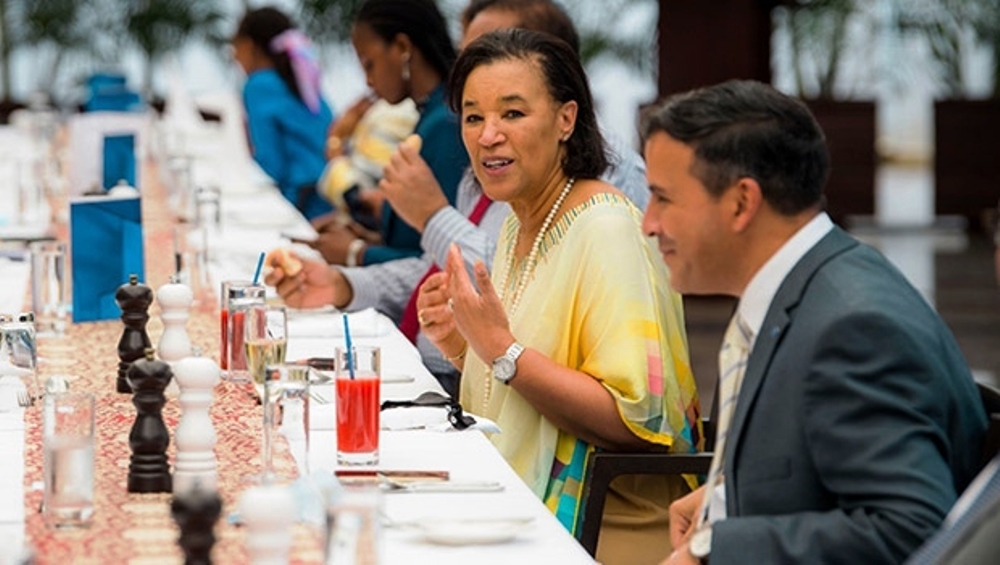
The Minister of Foreign Affairs and International Cooperation, Dr. Vincent Biruta welcomed Patricia Scotland to Kigali with a lunch in her honour also attended by High Commissioners to Rwanda.
Minister Biruta said: “In less than four months, the Commonwealth will gather in Kigali for our biennial family reunion. Our teams are working round the clock to ensure a safe and memorable event in June 2021.
“Rwanda very much looks forward to hosting the Commonwealth family in their second home and we hope that your delegations will take time to visit our beautiful country and learn more about our people and our culture.”
Thanking him for his hospitality, the Secretary-General said she was impressed by the level of commitment and preparedness for CHOGM that is already in place, and the milestones which have already been achieved since her last visit to Rwanda.
She said the next CHOGM must be a springboard for concerted action.
“As we seek to overcome the challenges before us, not least the devastating impact of the Coronavirus epidemic across the Commonwealth, CHOGM presents an opportunity to be the launch pad that propels us onward, upward and forward together,” she said.
“As we strive to live up to the ideals of the theme ‘delivering a common future’, building on the aspirations of the 2018 CHOGM, I look forward to working closely with Rwanda when it assumes the mantle of Chair-in-Office, in advancing our shared objectives, whether it be advancing the rights and well-being of women and girls;
Combatting the threat of climate change; promoting trade and good governance; championing the health, wellbeing and human rights of every one of our citizens; or ensuring that all young people have equitable access to the opportunities they need in order to fulfil their potential.”
The Secretary-General’s visit to Rwanda coincides with celebrations to mark Commonwealth Week.
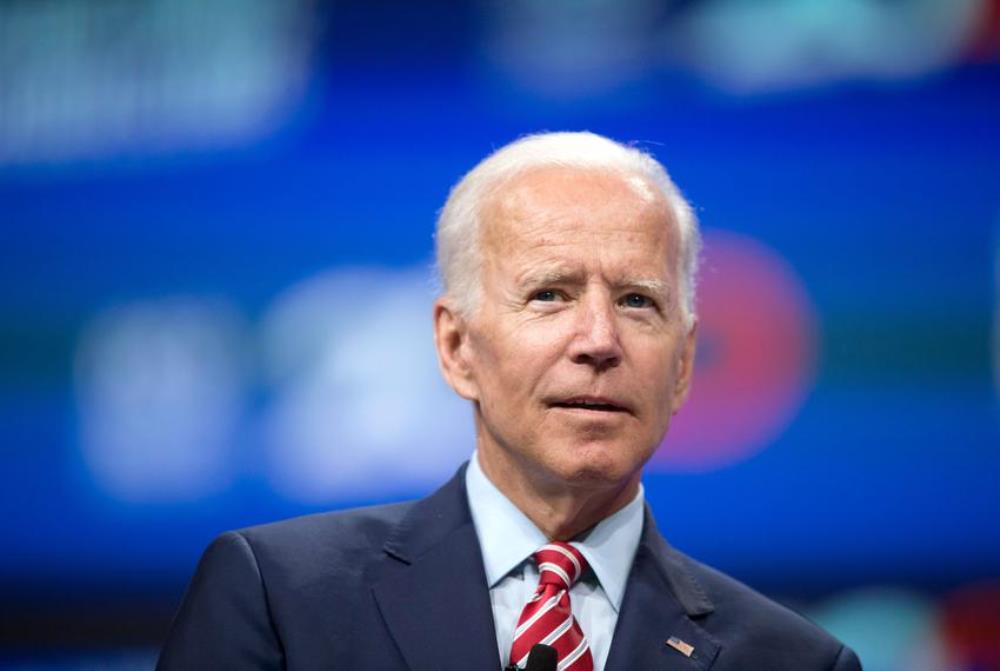
In his first primetime address as president, Mr Biden said he would order states to make all adults eligible for vaccinations by 1 May.
Current measures prioritise people by age or health condition.
Mr Biden was speaking exactly a year to the day after the outbreak was classified a global pandemic.
Half a million Americans have since died – more than the death toll from World War One, World War Two, and the Vietnam War combined.
Schools have been closed, businesses shuttered and people kept apart.
Last year many Americans were forced to forgo the elaborate parades, fireworks displays and parties that feature in the national holiday on 4 July, which marks independence from Britain.
In his speech, President Biden said he did not expect large events to be able to go ahead, but he hoped small groups could meet again.
“If we do this together, by 4 July, there is a good chance you, your family and friends can get together in your backyard or in your neighbourhood and have a cookout or a barbecue and celebrate Independence Day,” he said.
“After a long, hard year, that will make this Independence Day truly special – where we not only mark our independence as a nation but we begin to mark our independence from this virus.”
The US has by far the highest death toll in the world from the virus, but death and infection rates have been declining in recent weeks as the vaccine programme picks up.
The country’s health system is complex and individual states are in charge of public health policy. While the federal government is responsible for getting the vaccine distributed to the states, it has largely relied on them to handle the distribution.
But as part of the plans to expand vaccinations, President Biden said the number of places where people could be immunised would be increased, with veterinarians and dentists among those also allowed to vaccinate people.
Mobile units will travel into local communities to provide vaccinations in underserved communities, he said.
Mr Biden previously set a target of 100 million vaccinations by his 100th day in office. But in his address on Thursday, he said this target would be reached on day 60, which is 20 March.
He was speaking shortly after signing a $1.9tn (£1.4tn) economic relief bill, which marks an early legislative victory for his administration. It includes a $1,400 direct payment to most Americans, along with other measures to help people out of poverty and provide additional funding to local and state governments.
Despite the good news on vaccinations, Mr Biden warned that the “fight is far from over”.
He called on people to maintain social distancing measures, hand washing and wear a mask.
“Beating the virus and getting back to normal relies on national unity,” he said.
Mr Biden said last month he hoped that life would return to “normal” by Christmas 2021. Dr Anthony Fauci, the top US infectious diseases expert, described this timetable as “reasonable”.
The president’s caution is at odds with some states such as Texas and Mississippi, which are relaxing restrictions in order to boost their economies.
One year ago, the United States joined the world in facing a brutal truth. The coronavirus pandemic was going to fundamentally alter everyday life. Businesses shuttered. Citizens sheltered in their home. Life ground to a halt.
On Thursday night, in his first prime-time televised address to the nation, President Joe Biden said there was light at the end of the tunnel.
The big news from his speech was that all adult Americans would be eligible for a vaccine by the beginning of May – a pace, he boasted, that was the best in the world.
His most important message, however, may have been his urging that all Americans should get the jab when it’s their turn. “I know they’re safe,” he said.
A recent opinion poll showed that nearly half of Republicans are sceptical of the vaccine. If their doubt becomes inaction, Mr Biden’s promises – widespread school openings, an ability to travel and Independence Day celebrations – will go unrealised.
His speech was part promise, part warning. Get vaccinated, continue social distancing, wear masks – or else.
“America is coming back,” he said. But, he added, Americans needed to do their part.
This time last year, there were 1,000 confirmed cases of Covid-19 in the US and about 30 people had died.
All US major sport was cancelled and then-President Donald Trump suspended travel from Europe, saying he hoped the US would be open again for Easter 2020. This prediction was repeatedly revised.
The pandemic has now left more than 530,000 people dead in the US and has infected more than 29 million.
In his speech, President Biden criticised the Trump administration by saying the virus was initially met with “denials for days, weeks, then months, that led to more deaths, more infections, more stress, more loneliness”.
He also denounced “vicious hate crimes” against Asian Americans, who he said had been “attacked, harassed, blamed and scapegoated” for the pandemic. Mr Trump repeatedly referred to coronavirus as the “China virus”.
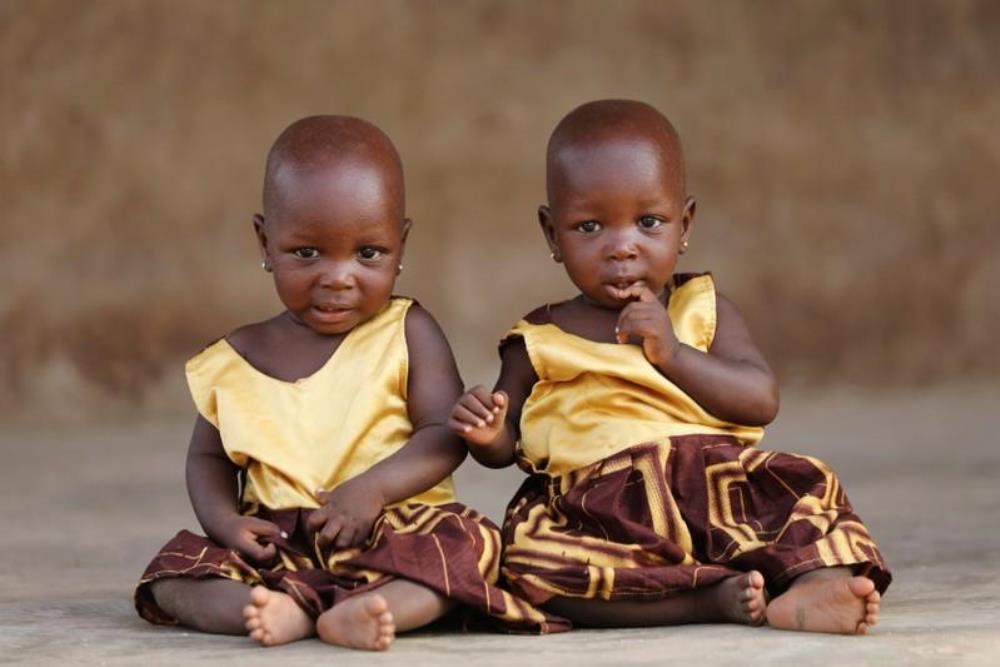
About 1.6 million twins are born each year worldwide, with one in every 42 children born a twin.
Delayed childbearing and medical techniques such as IVF have seen the rate of twin births rise by a third since the 1980s.
But it could be all downhill from here as the focus shifts to one baby per pregnancy, which is less risky.
According to a global overview in the journal Human Reproduction, the peak was reached because of large increases in twinning rates in all regions over 30 years – from a 32% rise in Asia to a 71% rise in North America.
The researchers collected information on twinning rates from 165 countries for 2010 to 2015, and compared them with rates for 1980 to 1985.
The number of twins born per thousand deliveries is now particularly high in Europe and North America – and worldwide it’s gone from nine per 1,000 deliveries to 12.
But twin rates in Africa have always been high and haven’t changed much over the past 30 years, which could be due to population growth.
{{Helping hand}}
Africa and Asia make up about 80% of all twin deliveries in the world at present.
Prof Christiaan Monden, the study’s author from the University of Oxford, said there was a reason for that.
“The twinning rate in Africa is so high because of the high number of dizygotic twins – twins born from two separate eggs – born there,” he said.
“This is most likely to be due to genetic differences between the African population and other populations.”
Twinning rates in Europe, North America and Oceanic countries have been catching up – and the increasing use of medically assisted reproduction since the 1970s – for example IVF, ICSI, artificial insemination and ovarian stimulation – have been the main reason.
These techniques all increase the likelihood of a multiple birth.
Women choosing to start families later in life, increased use of contraception and lower fertility overall also play a role, the review says.
But the emphasis is now on singleton pregnancies, which are safer, says Prof Monden.
“This is important as twin deliveries are associated with higher death rates among babies and children, and more complications for mothers and children during pregnancy, and during and after delivery,” he says.
Twins have more complications at birth, are more often born premature and have lower birth weights and higher still birth rates.
{{Survival chances}}
The review found that the fate of twins in low and middle-income countries was more of a concern.
In sub-Saharan Africa, in particular, many twins will lose their co-twin in their first year of life – more than 200,000 each year.
“While twinning rates in many rich Western countries are now getting close to those in sub-Saharan Africa, there is a huge difference in the survival chances,” said Prof Jeroen Smits, a study author.
Looking ahead, the researchers say India and China will play a major role in future twinning rates.
Declining fertility, older mothers at birth and techniques like IVF will all have a bearing on the numbers of twins in years to come.
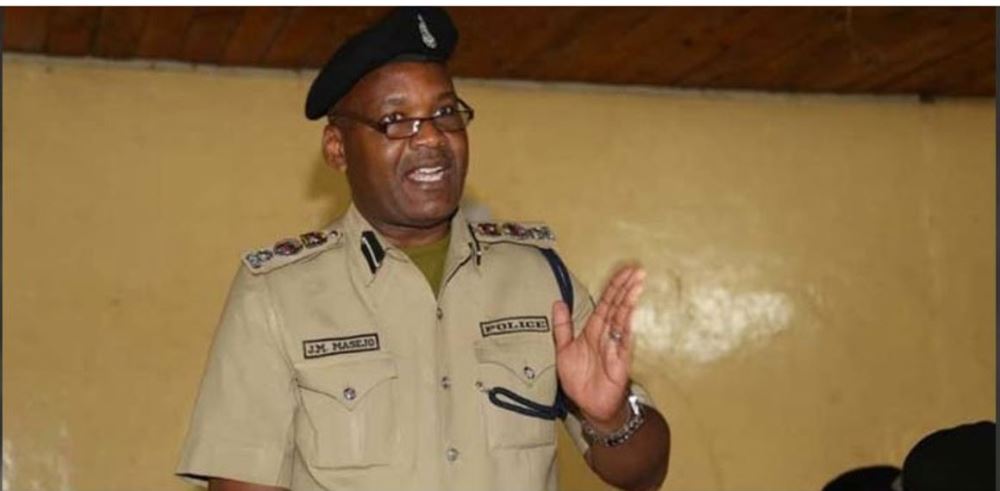
The Arusha Regional Police Commander, Justine Masejo in a press statement on March 11, said the Chinese national (name withheld) was abducted in Karatu district.
Commander Masejo said the police on Mach 7, received a report from a Chinese national, Lian Qiang (44) from Bonanza saying that one of their employees had disappeared under mysterious circumstances while working in Karatu.
The Chinese man was and his driver was in a Toyota Kluger with registration T571DLQ.
He said Giang later received a call from the kidnappers demanding a ransom of $ 100,000 for the man to be released.
The commander said after a thorough investigation the suspects were arrested at a lodge located in Ada Estate in Kinondoni, Dar es Salaam.
He said that after the search, the abducted Chinese national was found withe arms and legs tied by the suspects.
“We found them with a Toyota Kluger with registration number T 982DQA a car that belongs to Bonanza company which was stolen on February 8 and we found two knives, a hammer and drill machine and five cables all belonging to Bonanza,” he said.
However, one of the kidnappers was identified as a Chinese national who had been fired for misconduct by Bonanza Company.