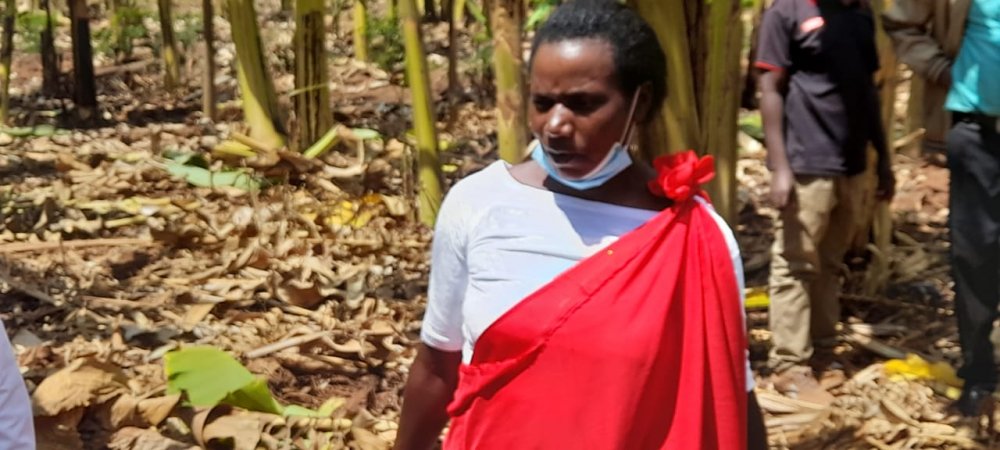
Despite the fact that she had a farmland, Niyonteze had little hope for progress and hardly fed her family due to persistent drought in the area. Her land was almost idle.
As years went by, the Government of Rwanda introduced irrigation infrastructures in the district especially in the sectors of Nasho, Mpanga, Nyamugari and Mahama to help farmers increase produce.
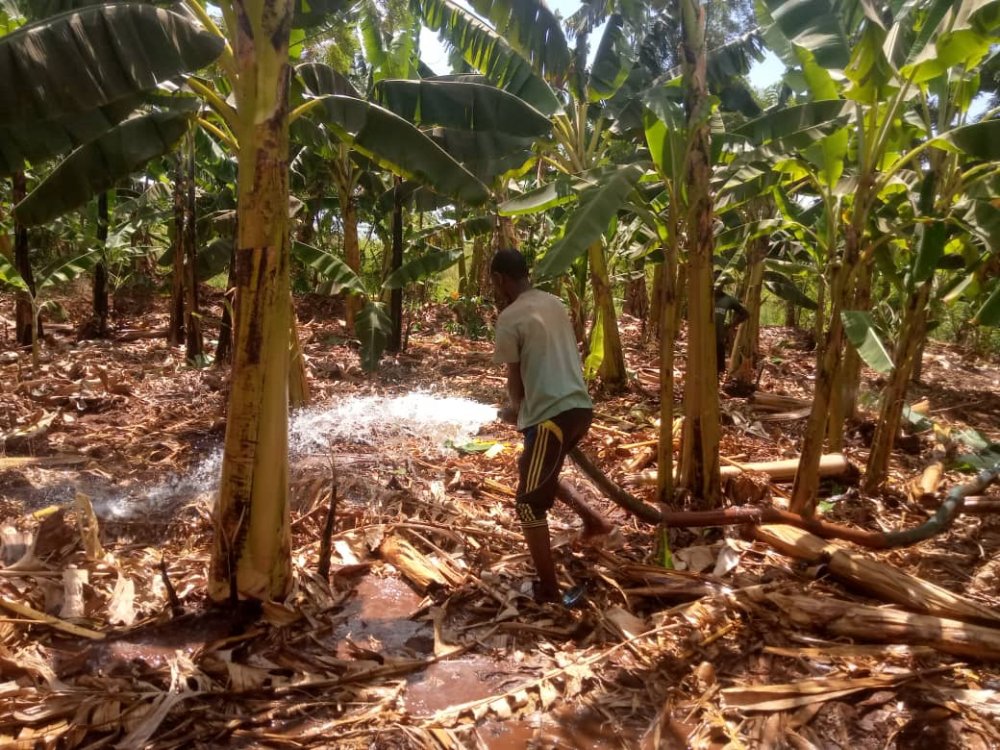
Since then, Niyonteze seized the opportunity and started growing bananas, thanks to irrigation infrastructures made available.
“Before, I was a beggar living in a thatched house. One day, people came here and urged us to take advantage of a neighbouring lake. They advised me to grow bananas and water them using the lake. They gave me an irrigation machine which I used appropriately and started yielding big,” she said.
Niyonteze says that she no longer forces meal upon hard labour because she received a cow which served as a source of manure to fertilize her field.
Few years later, Niyonteze’s produce increased remarkably that she currently earns Rwf300,000 every month.
“Today, my children study without disruptions as they are guaranteed of school fees. I have also built a new house in which I live with my children. I am proud of my living conditions because I have a regular source of income where I earn Rwf300,000 from banana produce each month,” she revealed.
Niyonteze thanked the Government of Rwanda for facilitating her to attend trainings equipping her with best banana farming practices. She plans to expand arable land, and subsequently create jobs.
The Mayor of Kirehe District, Bruno Rangira says that Kirehe District has several opportunities that will help farmers to increase yields owing to irrigation infrastructures. He urges them to seize them for a prosperous future.
Today, Kirehe District has 3754 irrigated hectares from below 100 in the past five years.
It is expected that the second phase of this project will see more than 10,000 hectares irrigated in the second phase.
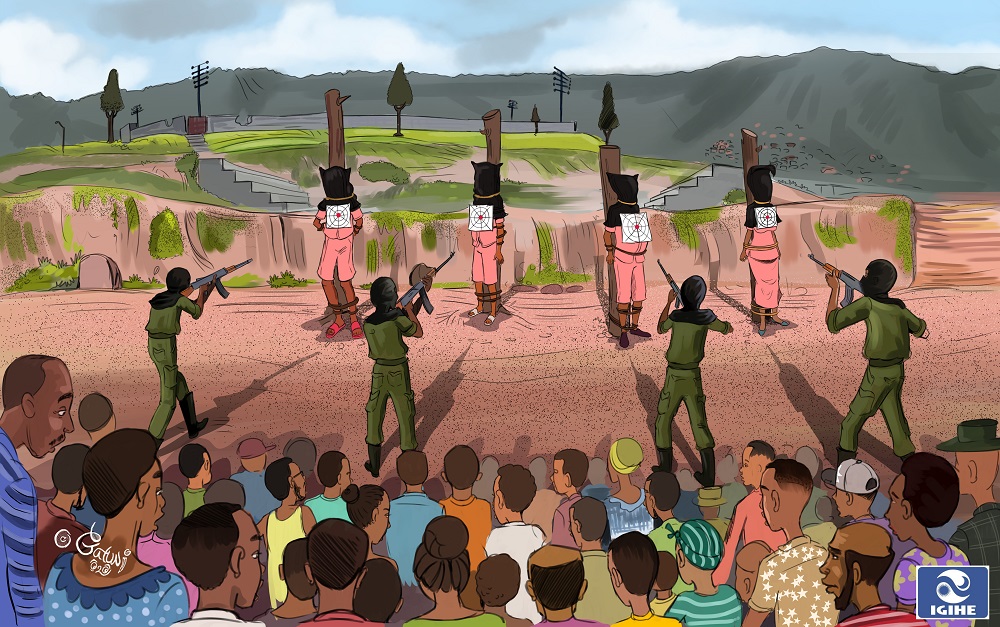
At the time, 22 individuals who had been convicted of role in the Genocide were shot dead.
The capital punishment triggered mixed reactions among foreign countries which condemned the decision taken by the Government of Rwanda.
Among the executed individuals, is Virginie Mukankusi, the former School Inspector in Kigali City during the 1994 Genocide against the Tutsi.
Reports do not provide deep details on the role of Mukankusi during the Genocide but indicate that he was convicted over persecuting Tutsi victims before killing them.
Mukankusi was also convicted of hunting and pointing out hideouts for Tutsi children to be killed by Interahamwe.
Mukankusi was handed life sentence on 28th February 1997 by Gitarama Primary Court. The convict and defence lawyers were not satisfied with the verdict and filed an appeal before Nyabisindu Intermediate Court which retained the punishment.
During trial proceedings that began in January 1997, Amnesty International revealed that Mukankusi made self-contradictory statements at different times which might have been considered by the court to pin her.
Mukankusi’s defence lawyer requested for lenient sentence of his client claiming that she was an ordinary citizen not familiar with political affairs.
However, the Prosecution said that it could not clear her of cruelty and severity of the committed crime.
The verdict was not welcomed by foreign countries and international organizations including Amnesty which considered the decision as a step backward in the judicial system.
“The public execution of 22 people in Rwanda on 24 April has further damaged hopes of peace and reconciliation in the country,” reads an extract from Amnesty’s report released on 24th April 1998.
Pope John Paul II also wrote a letter to the then President, Pasteur Bizimungu requesting the cancellation of the execution but the Government of Rwanda insisted that the decision of the court must be respected.
It also explained that the verdict served as a warning to people with intentions to abuse human rights.
On the day of execution, Mukankusi was along with a group of key masterminds in the preparation and execution of Genocide against the Tutsi including Frodouard Karamira, the former Vice President of MDR political party who played a major role in spreading Hutu Power ideology and mobilizing Hutus to exterminate Tutsis through the then national broadcaster, RTLM.
The death sentence was later abolished. The Government of Rwanda scrapped the death penalty from its penal code on 25th July 2007.
It is said that it had been handed to 600 individuals before its abolishment.
In a report released last week, Britain-based charity Debt Justice found that African governments owe three times more debt to Western banks, asset managers, and oil traders than to China, and are charged double the interest.
The report said 12 percent of African governments’ external debt is owed to Chinese lenders compared to 35 percent owed to Western private lenders, adding that the average interest rate on private loans is 5 percent, compared to 2.7 percent on loans from Chinese public and private lenders.
The new finding came after Harry Verhoeven from the Center on Global Energy Policy at Columbia University, and Nicolas Lippolis from the Department of Politics and International Relations at the University of Oxford published a new study in May, which said the rise in African debt due to Chinese lending pales in comparison with the debt burden created by private creditors of other countries over the last decade.
The new findings lay bare the absurdity of the so-called “debt-trap diplomacy” that has been for too long touted by Western politicians and propaganda machines in smear campaigns against China, experts have said.
{{Debt trap?}}
The so-called debt-trap narrative exploited by the West against China is untrue, African scholars and economists told Xinhua.
Charles Onunaiju, director of Nigeria-based Center for China Studies, said Western private creditors not only account for a third of Africa’s external debt, but also charge higher interest and offer a shorter period for repayment, describing them as manipulating and strangulating.
“The debt trap issue has always been political slander …,” he said, adding that the narrative is nothing but a distraction to absolve the West of its responsibilities.
Costantinos Bt. Costantinos, professor of public policy at the Addis Ababa University in Ethiopia, said Western administrations and media have been unable to adopt a rational perspective on China’s growing influence in Africa.
“They depict China as a predatory lender that is weaponizing capital in order to practice a new form of colonialism in Africa. However, such accusations have little factual basis,” said the expert.
Beatrice Matiri-Maisori, a senior economics lecturer at Kenya’s Riara University, said the figures and percentages revealed by the studies clearly indicate that Africa’s external debt is largely owed to private financial groups, Eurobonds, and oil creditors.
“The debt trap diplomacy … has got nothing to do with the reality of the debt structure in Africa,” she said.
“Western lenders for long have not been put on the spotlight for debt relief because they successfully managed to dupe the world that it’s only Chinese lenders that pose a threat to Africa,” Uganda-based Vision Group journalist Mubarak Mugabo said.
{{West urged to do more}}
Campaigners have been calling on Western countries, particularly Britain and the United States, to compel their private lenders to do more in helping address the debt burdens of emerging and developing countries including those in Africa.
Emerging and developing countries have been experiencing sustained capital outflows for four months in a row, said International Monetary Fund (IMF) Managing Director Kristalina Georgieva at a recent meeting, adding that more than 30 percent of emerging and developing countries, and 60 percent of low-income countries are at or near debt distress.
China has extended debt suspension to other developing countries during the pandemic, but private lenders in the West did not, said Tim Jones, head of policy at Debt Justice.
“Western leaders blame China for debt crises in Africa, but this is a distraction … The UK and U.S. should introduce legislation to compel private lenders to take part in debt relief,” he said.
Official data showed that China ranked first among the Group of 20 members in terms of debt deferral amounts. “China has done quite a lot in terms of agreeing to come to a common agreement with over 19 countries in Africa, reaching a common understanding on how they are going to pursue debt relief for the same,” Matiri-Maisori said.
Onunaiju said China has demonstrated what a responsible major country should do in this regard, adding that Africans want to see more of such examples.
At a news briefing last week, Chinese Foreign Ministry spokesperson Wang Wenbin called on developed countries, their private lenders and multilateral financial institutions to take more robust actions to give developing countries funding support and relieve their debt burden so that the world economy will achieve inclusive and sustainable development.
{{Concrete support from China}}
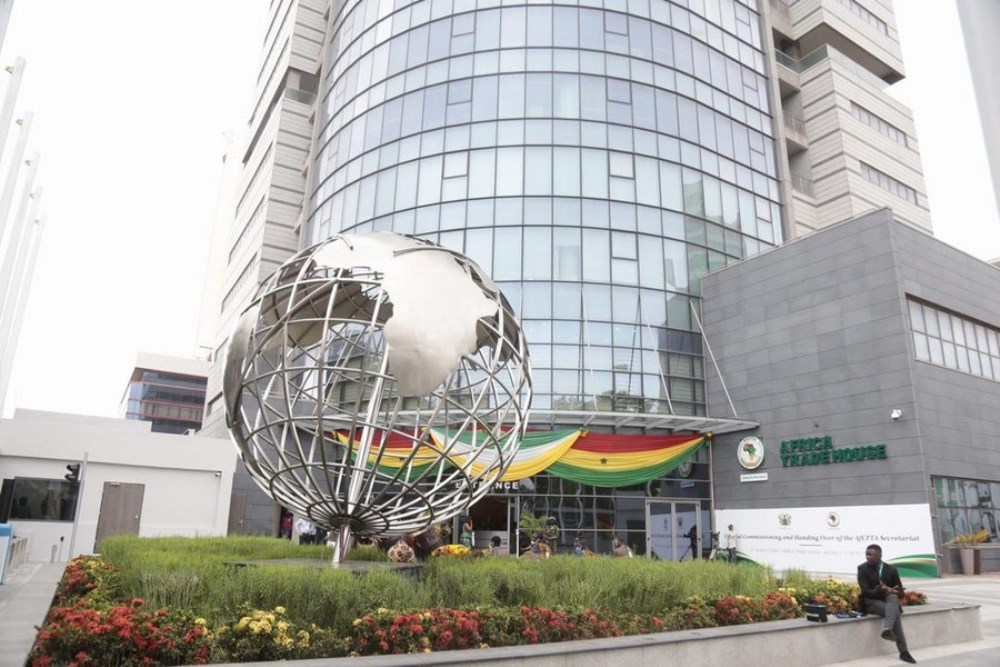
Over the years, China’s financing support for Africa, particularly in the field of infrastructure investment, has won wide applause from African governments and people, especially at a time when the ambitious African Continental Free Trade Area is being promoted.
“We are seeing connectivity, we are seeing airports remodeling, and we are seeing ports remodeling,” Onunaiju said, adding that China’s support for Africa can be clearly felt in different areas.
Referring to the Lekki Deep Sea Port in Lagos State, Nigeria’s economic hub, as an example, he said the China-funded port project will create up to 170,000 jobs and bring billions of U.S. dollars in revenues to the government through taxes, royalties and duties after being in operation.
“These are not propaganda. These are reality,” Onunaiju said.
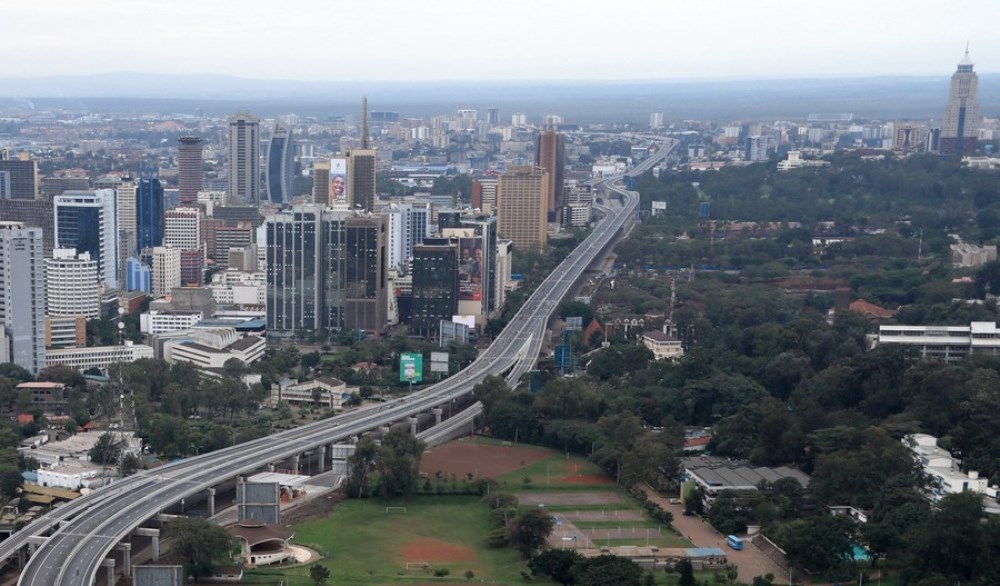
Over the last more than two decades since the founding of the Forum on China-Africa Cooperation, a bulk of Chinese financing has been quickly translated into infrastructures in Africa, which can be seen with countless connectivity projects, such as railways, roads, dams, and telecommunications, said Matiri-Maisori.
“This is very important for us in terms of pursuing our aspirations to be an integrated Africa, the Africa continental free trade area, and all the countries in Africa trading with one another,” she said.
“What is really happening is that this connectivity is aiding the future and long-term growth of Africa, so that Africa can begin to participate in the global supply chains,” added the expert.
China has provided African governments with access to good funding to support development, said Peter Kagwanja, CEO of the Africa Policy Institute based in Kenya.
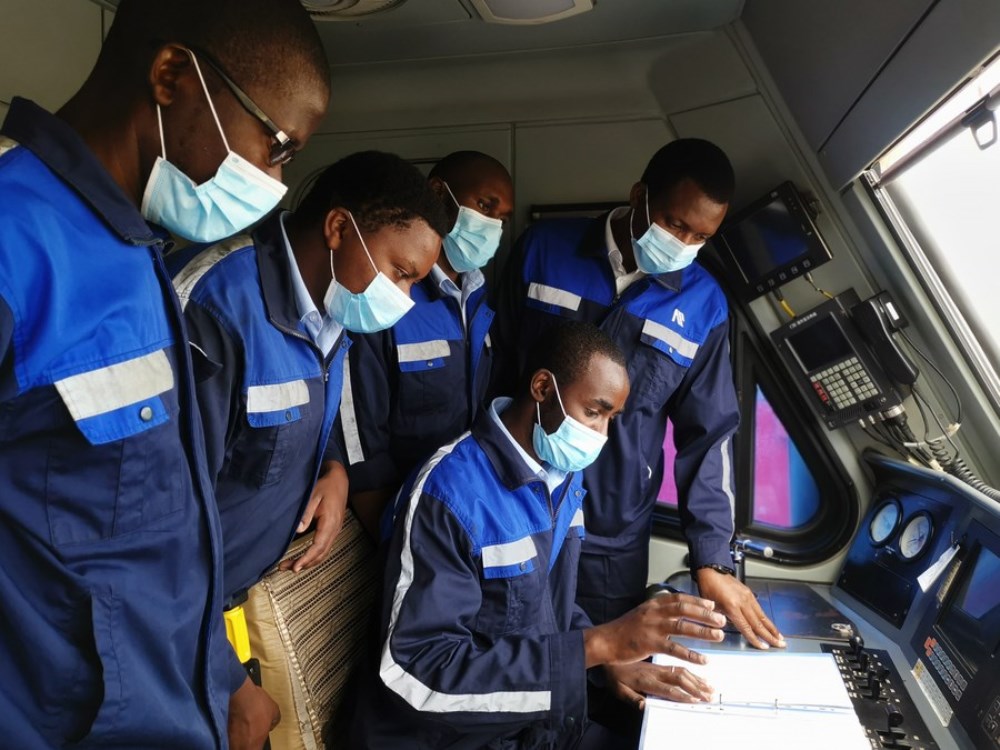
Speaking of the Chinese-built Mombasa-Nairobi Standard Gauge Railway, he said the railway “opened our country Kenya, and we have started to see industrialization growing around there, business growing around the railway line, the value of land increasing greatly around that, and people getting employment around the railway.”
“And these are things we could never, ever have dreamt about before China came into the picture as Africa’s partner,” he said.
{{(Xinhua reporters Cao Kai, Li Cheng, Bai Lin, Li Hualing in Nairobi, Guo Jun in Abuja, Zhang Gaiping in Kampala, Wang Ping in Addis Ababa, and Xu Zheng in Accra also contributed to the story.) (Video reporters: Li Cheng, Guo Jun, James Harry, Adewale Amzat; video editors: Liu Ruoshi, Cao Ying, Zhao Yuchao)}}
Launched in 1992, Euromoney Awards for Excellence are one of the most prestigious and respected awards in global banking, rewarding financial institutions for their achievements, innovations and performance over the last 12 months.
A team of experts analyses profitability, the ability to demonstrate growth, relative outperformance compared with peers and the ability to adapt to changing market conditions.
The recognition reflects BK’s commitment to keep providing world class services to clients.
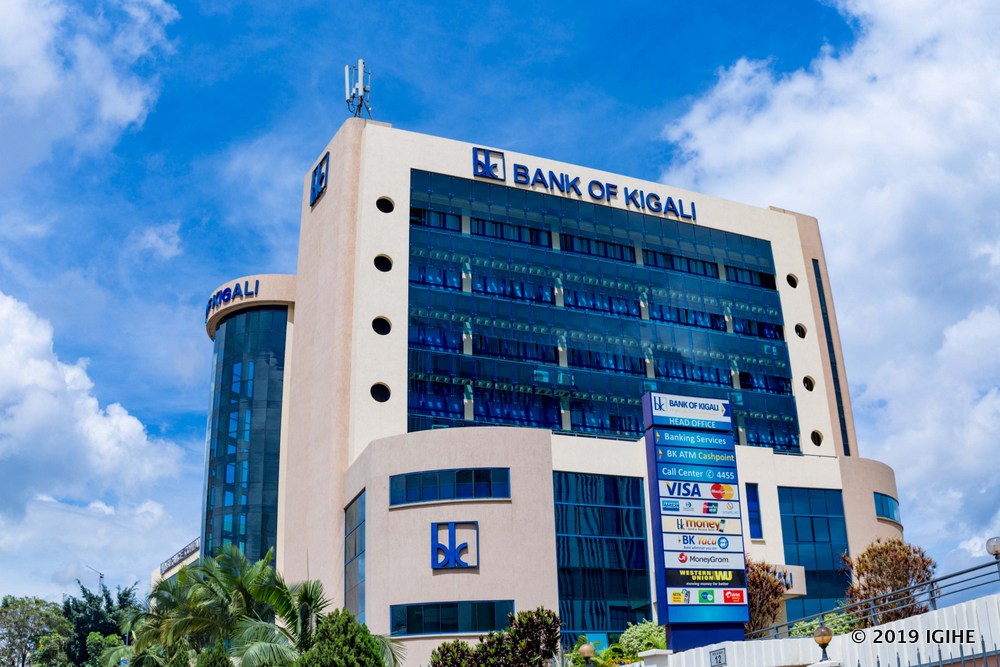
The lender, which boasts 424,000 retail customers and 36,700 corporate clients, posted a 35% year-on-year increase in net profit to Rw5.8 billion (US$5.7 million) in 2021, driven by a 20.8% rise in interest income and double-digit growth across all key performance metrics.
The bank also recorded a 41.4% growth in non-interest income to Rw4.2 billion, as trade and economic growth picked up.
Among others; pre-tax profit jumped 44.4% year on year in the first quarter of 2022, with assets up 22.4% and deposits rising 21.7%. Total assets stood at Rwf1.7 trillion at the end of last year, up 22.3% from the same period a year earlier.
Bank of Kigali also got busy on the digital front during the awards period where it launched a revamped and upgraded online platform – including enhanced security features – that caters to diaspora clients.
The lender provides a more seamless customer experience and the ability to buy foreign currency and process bulk payments.
Commenting on the development; the CEO of Bank of Kigali, Dr. Diane Karusisi said: “We are constantly working towards providing top notch financial services to our customers and winning this award shows that our efforts do not go unnoticed. We will continue to innovate and bring forth fast, easy and efficient channels of transacting. Soon we shall be launching one of a kind new BK mobile app for our customers.”
Bank of Kigali also migrated to a new core banking system, with the Temenos 24 platform helping the bank break free from legacy constraints and accelerate its digital transformation. It’s all part of an ambitious plan to double its roster of retail and small and medium-sized enterprise clients to more than one million by the end of 2022.
Bank of Kigali also won similar award in 2013, 2015 and 2021.
This year, Euromoney received a record number of submissions from banks in regional and country awards programme that covers more than 50 regional awards and best bank awards in 100 countries.
The summit is scheduled between Thursday 21st and Friday 22nd July 2022.
During a High Level Retreat on the Common Market, the Heads of State are expected to, among other things: take stock of the progress of implementation of the EAC Common Market Protocol; adopt strategic measures to unlock the lags and bottlenecks in establishment of the Common Market; agree on a roadmap for the full realization of the Common Market, and; identify key areas where Development Partners can contribute to the attainment of the Common Market.
At their 22nd Ordinary Meeting, the EAC Heads of State will, among other things: consider the Report of the Council to the Summit; assent to Bills passed by the East African Legislative Assembly; consider the report of the High-level Summit Retreat on the EAC Common Market, and; appoint Judges to the East African Court of Justice.
The tension arose from reciprocal accusations that followed the resurgence of M23 rebel group. DRC accused Rwanda of supporting M23 in the fighting with Congolese Army (FARDC).
Meanwhile, Rwanda accused DRC of collaboration with the Democratic Forces for the Liberation of Rwanda (FDLR), a terrorist group comprised of masterminds of the 1994 Genocide against the Tutsi.
The collaboration led to provocations where FARDC and FDLR shelled rockets on Rwandan territory which injured civilians and destroyed houses.
Rwanda also accused DRC of kidnapping its soldiers in collaboration with FDLR but they were later released.
Since the fighting with M23 erupted, Rwanda has repeatedly rejected the allegations highlighting that it has no interests in destabilizing the neighbouring country.
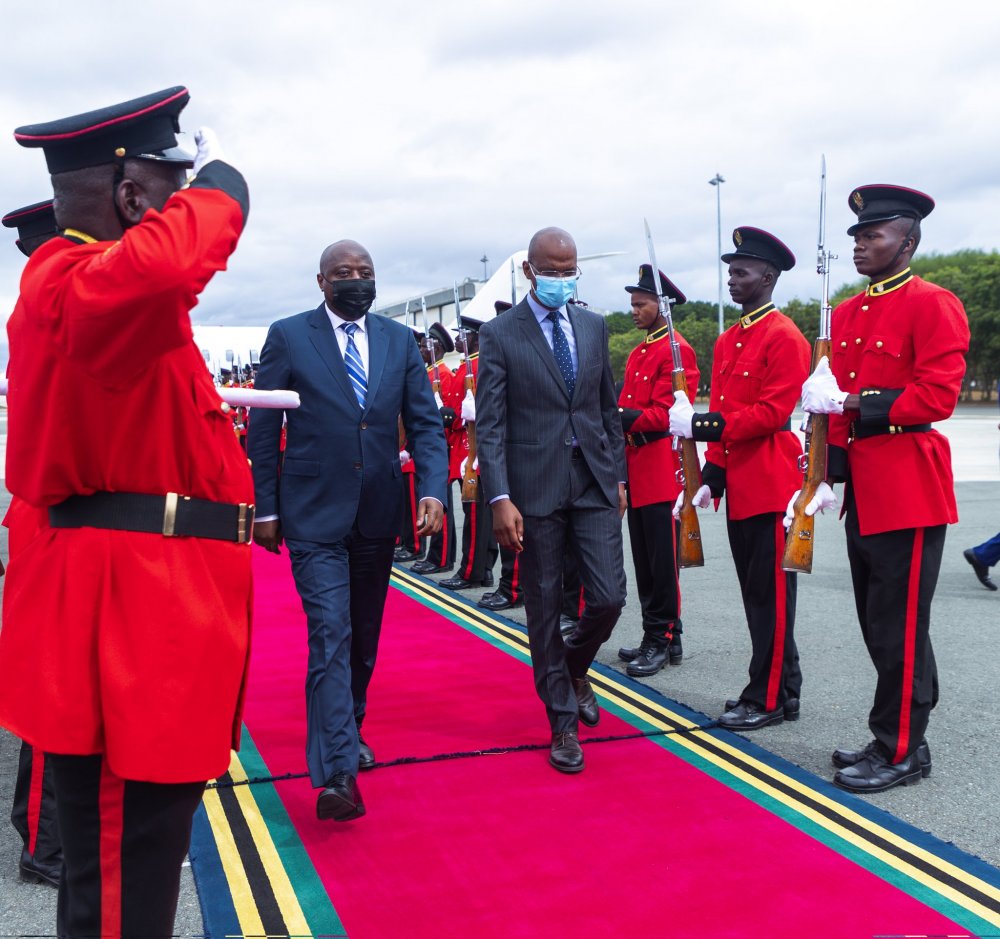
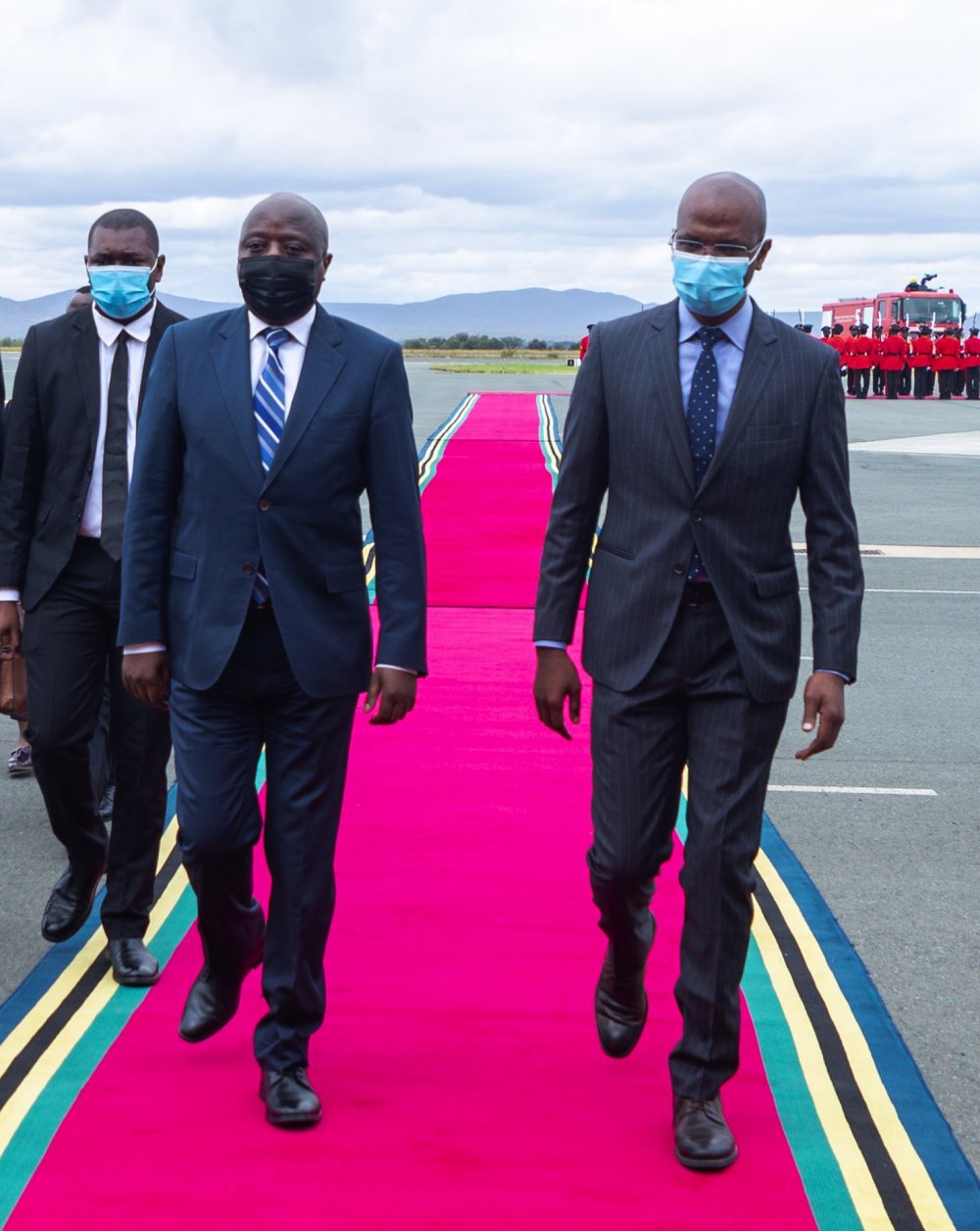
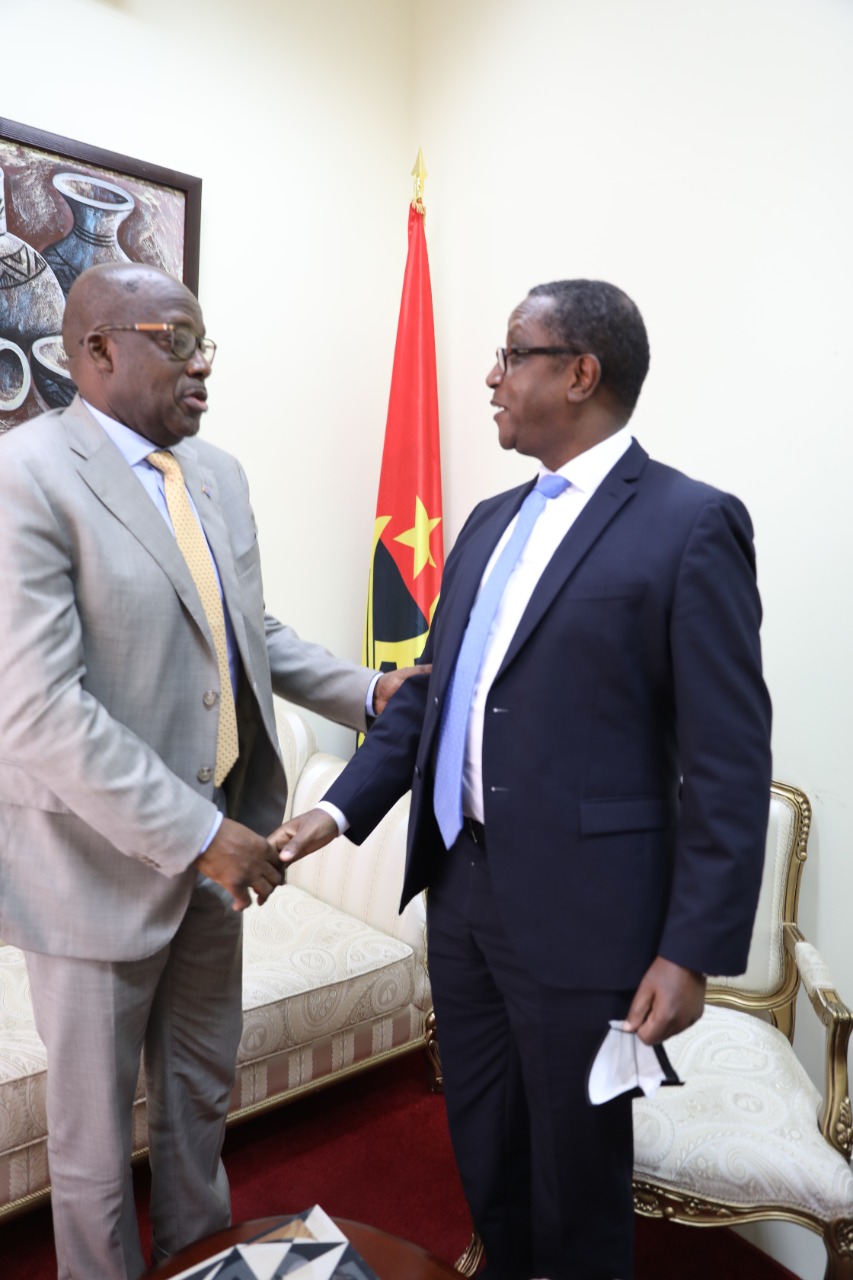
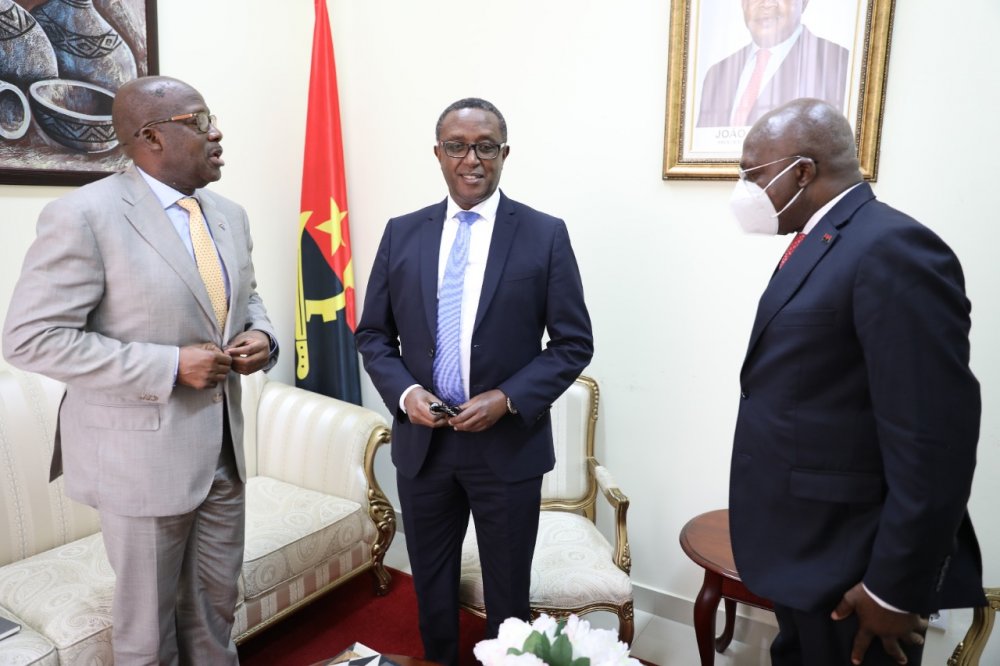
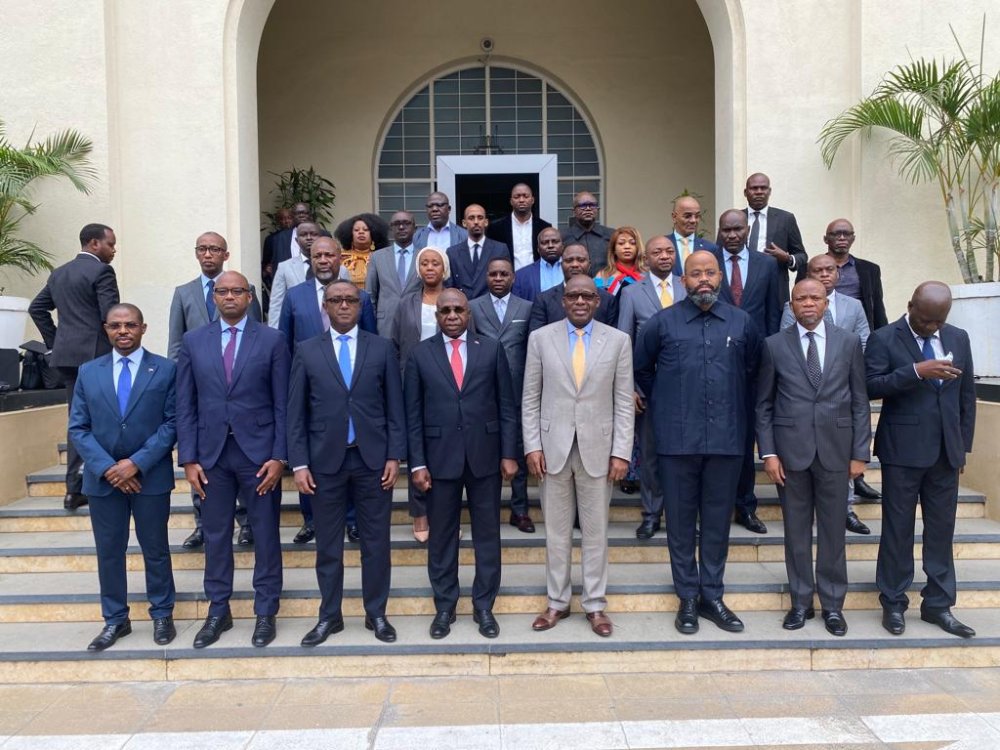
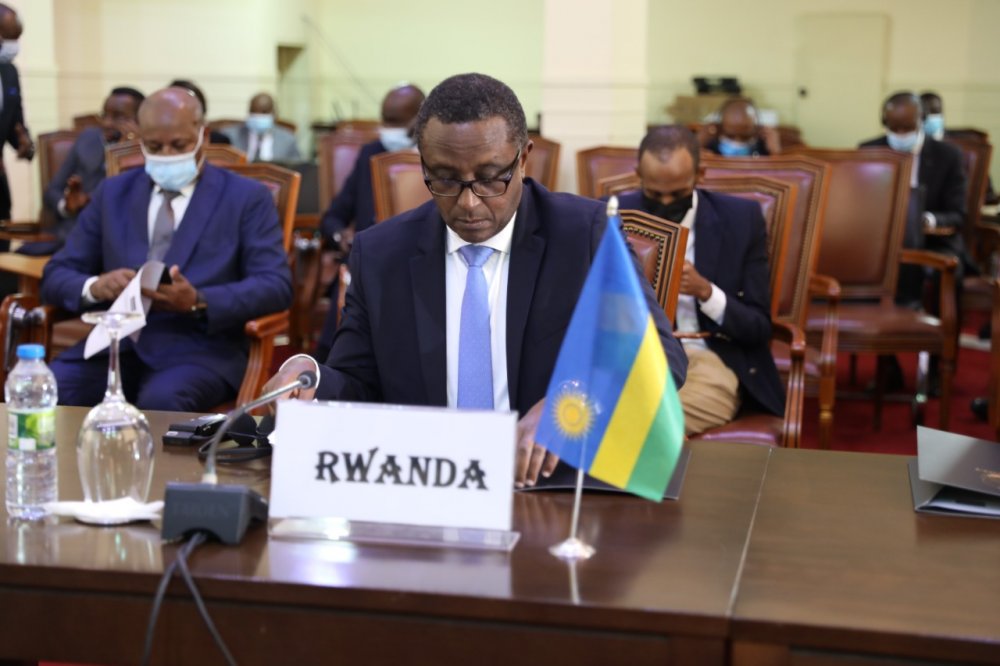
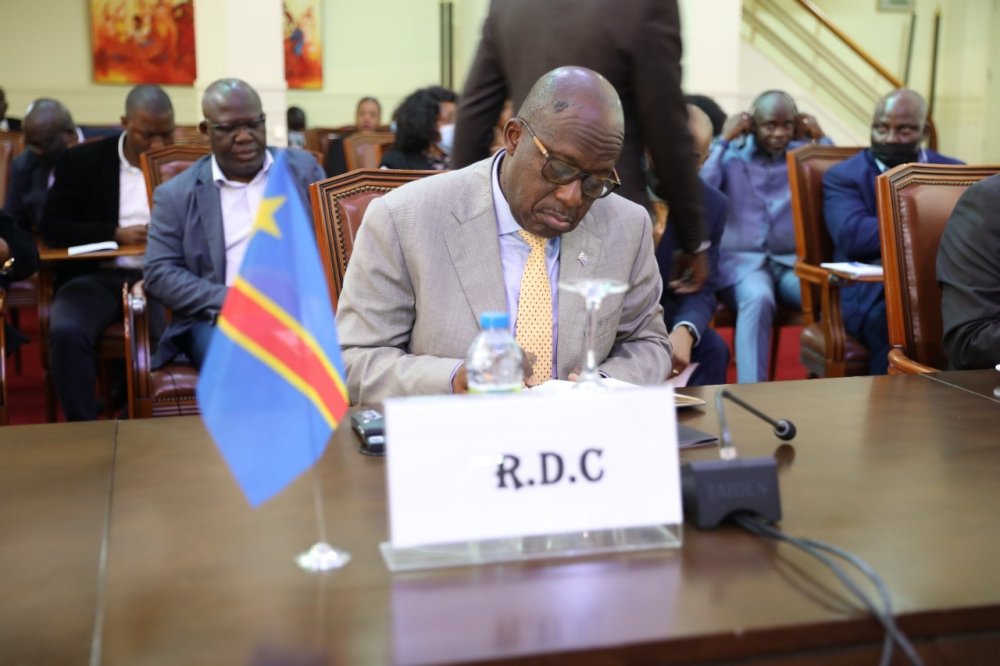
The meeting of a Joint Permanent Commission between Rwanda and DRC started on Wednesday 20th July 2022 to seek a solution on the tension with the mediation of Angola.
Rwanda’s envoys are led by the Minister of Foreign Affairs, Dr. Vincent Biruta while DRC is represented by the Minister of Foreign Affairs, Christophe Lutundula.
Also part of Rwanda’s delegation is Colonel François-Régis Gatarayiha, the Deputy Head of Defence Intelligence and Director of Technology; Rwanda’s Ambassador to Angola, Wellars Gasamagera and the Director General for Africa at the Ministry of Foreign Affairs, Shakilla Umutoni.
Establishing the joint commission is part of resolutions of the recent tripartite summit which brought together the Heads of State of Rwanda, DRC and Angola held in Luanda on 6th July 2022.
The commission had to meet the following week but was postponed due to the mourning declared by Angola over the death of former President Eduardo Dos Santos.
Angolan Minister of Foreign Affairs, Amb. Tete Antonio has expressed delight to see the meeting happening.
“Very happy to have my brothers Ministers Christophe Lutundula [DRC] and Vincent Biruta [Rwanda] who are in Luanda for Joint Permanent Commission DRC-Rwanda in the framework of the implementation of the Road Map, moving forward for the Africa we want,” he tweeted.
Recent discussions between both countries on the mediation of Angola also saw concerned parties setting a roadmap to accelerate efforts meant to achieve durable peace.
However, concerned countries have released contradictory statements following the summit. DRC’s Presidency initially released resolutions with clauses in favour of its allegations.
Later on, Rwanda and Angola released resolutions of the roadmap detailing responsibilities of each country concerned with the issues of DRC to promote peace in the region and eastern DRC.
At the time, Rwanda’s Minister of Foreign Affairs, Dr. Vincent Biruta requested the DRC to avoid distorting resolutions of the tripartite summit.
“The Luanda tripartite meeting outcome is a roadmap with clear objectives and activities to be implemented by various parties/partners. No agreement or ceasefire was signed. Misinformation/populism are undermining the overall objective of achieving peace in DRC and the region,” Minister Biruta tweeted.
DRC announced that immediate ceasefire and withdrawal of M23 from all captured areas were among resolutions of the summit.
Meanwhile, the issues that Rwanda indicated at the summit have been clearly pointed out for over 20 years. These include assurance of security at its borders and fighting the Democratic Forces for the Liberation of Rwanda (FDLR), a terrorist group intending to threaten Rwanda.
Rwanda maintained that the terrorist group should not receive any form of support to attack Rwanda where DRC is urged not to allow FDLR to shell Rwandan territory.
The roadmap on activities to restore relations between Rwanda and DRC stresses the need to defeat FDLR and its splinter groups while more efforts have to be geared towards fighting hate speech and offensive language in the region by all parties.
The splinter groups include CNRD- FLN, RUD-Urunana, FPPH-Abajyarugamba believed to be at the origin of tensions between Rwanda and DRC and play a major role in the insecurity of the DRC.
Creating the necessary conditions for the return of refugees is among outlined priorities as per released roadmap. Rwanda, DRC, ICGLR and the United Nations High Commissioner for Refugees will be in charge of implementation.
On the issue of M23, the summit resolved that all activities on the rebel group must be based on Nairobi Process.
It was also resolved that an ad-hoc verification mechanism led by an Officer General of the Republic of Angola has to be created to verify the reciprocal accusations of the DRC and Rwanda concerning the support to M23 and the collaboration with the FDLR.
The team is to be supported by the Expanded Joint Verification Mechanism (EJVM) while ICGLR will seek MONUSCO’s support in security and logistical matters.
The EJVM is a mechanism of the International Conference of the Great Lakes Region (ICGLR) composed of military officers from the 12 member countries that is charged with monitoring and verification of border violations between DRC and neighbouring countries.
The commission meets ahead of the 22nd Ordinary Summit of Heads of State from the East African Community (EAC) expected on 22nd July 2022 in Tanzania for discussions on issues including security in eastern DRC.
The regional bloc is also under the process of deploying joint troops to fight armed groups in DRC.
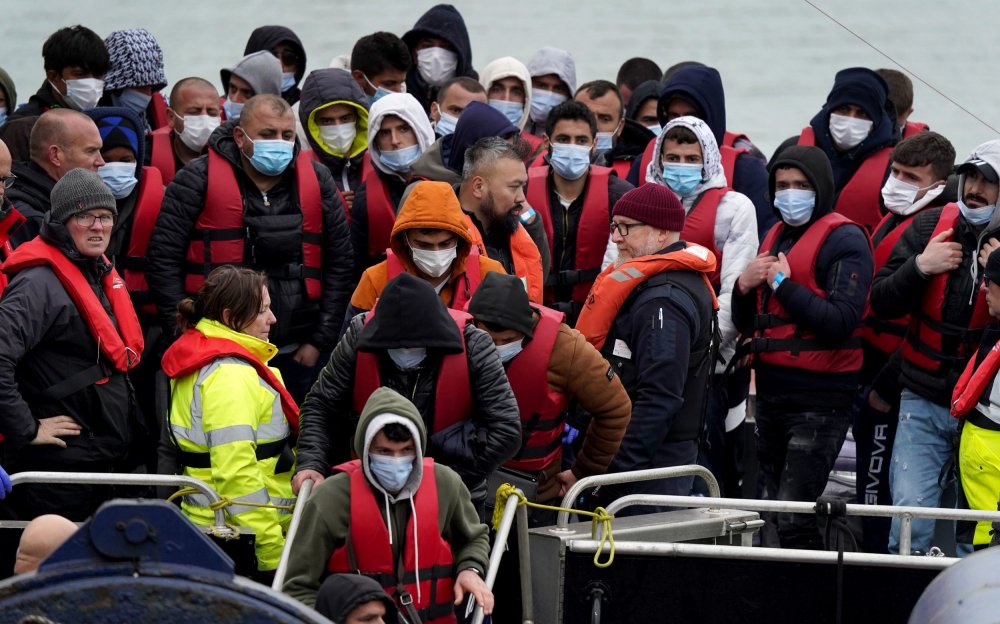
The documents include one written by the former British High Commissioner to Rwanda, Jo Lomas expressing concerns that the migrants might be recruited to conduct armed operations in neighbouring countries once they arrive in Rwanda.
The documents were submitted to court by lawyers from charities overseeing interests of individual asylum seekers from countries including Iraq, Sudan, Syria and Albania.
Their first flight to Rwanda was expected on 14th June 2022 but was cancelled at last minute after an intervention from the European Court of Human Rights (ECtHR).
The documents presented to the UK High Court feature concerns of different people about the partnership to send asylum seekers to Rwanda.
An extract from the documents indicate that on 10th February 2021, the former UK High Commissioner to Rwanda, Jo Lomas said ‘the UK should not do a deal with Rwanda because the African country had been accused of recruiting refugees to conduct armed operations in neighbouring countries’.
Eight days after the disclosures, more extracts read, Rwanda was identified as one of 14 countries assessed as presenting substantial issues in relation to asylum systems and human rights and received an amber/red rating from the government owing to significant human rights concerns.
Among others; a Foreign, Commonwealth and Development Office memo dated 20th May 2021, urged the Prime Minister not to get involved with the Rwanda deal ‘owing to significant human rights concerns’.
Another document submitted to the court is a detailed internal memo that appears to be dated 12th April 2022, the day before a memorandum of understanding was signed between UK and Rwanda. The latter stated that the “fraud risk is very high” in the deal because UK was paying so much money upfront to Rwanda.
A document from the day the memorandum was signed stated that the first group of asylum seekers due to be flown to Rwanda could “test” Rwanda’s refugee determination processes.
When the UK government conducted an independent assessment of Rwanda’s human rights record, extracts from the documents indicate, the Home Office showed it to Rwanda to comment on the final draft and allowed officials to suggest amendments.
The names of officials who made the comments were not mentioned in the documents. This created confusion among some people who attributed the concerns of UK High Commissioner to Rwanda to the current envoy, Omar Daair representing his country to Rwanda.
Omar Daair has via Twitter handle provided clarifications that he had not yet been appointed to Rwanda by the time concerns attributed to the UK High Commissioner were raised.
“There have been media stories regarding our partnership with Rwanda and documents written in February and May 2021. I became High Commissioner in July 2021. Regardless, it is normal for UK officials to brief Ministers during the course of policy development,” he tweeted.
“Ministers have repeatedly stated that Rwanda is a fundamentally safe and secure country with a track record of supporting asylum seekers. The UK government remains committed to delivering this policy to break the business model of criminal gangs and save lives,” added Omar.
It is expected that the next move will be informed by court’s decision.
The incident took place in Rugoberi Village, Gitega Cell of Gitesi Sector in Karongi District.
Details about his death emerged on Wednesday 20th July 2022 around 12:00 noon when a daughter of the old man entered their house and found the father hanging.
It is suspected that the man committed suicide after his wife and children had left home.
The Executive Secretary of Gitesi Sector, Vianney Nsanganira has told IGIHE that Rwanda Investigation Bureau arrived at the scene whereafter the body was taken for postmortem.
He revealed that they are waiting for autopsy report to confirm whether he was killed or committed suicide.
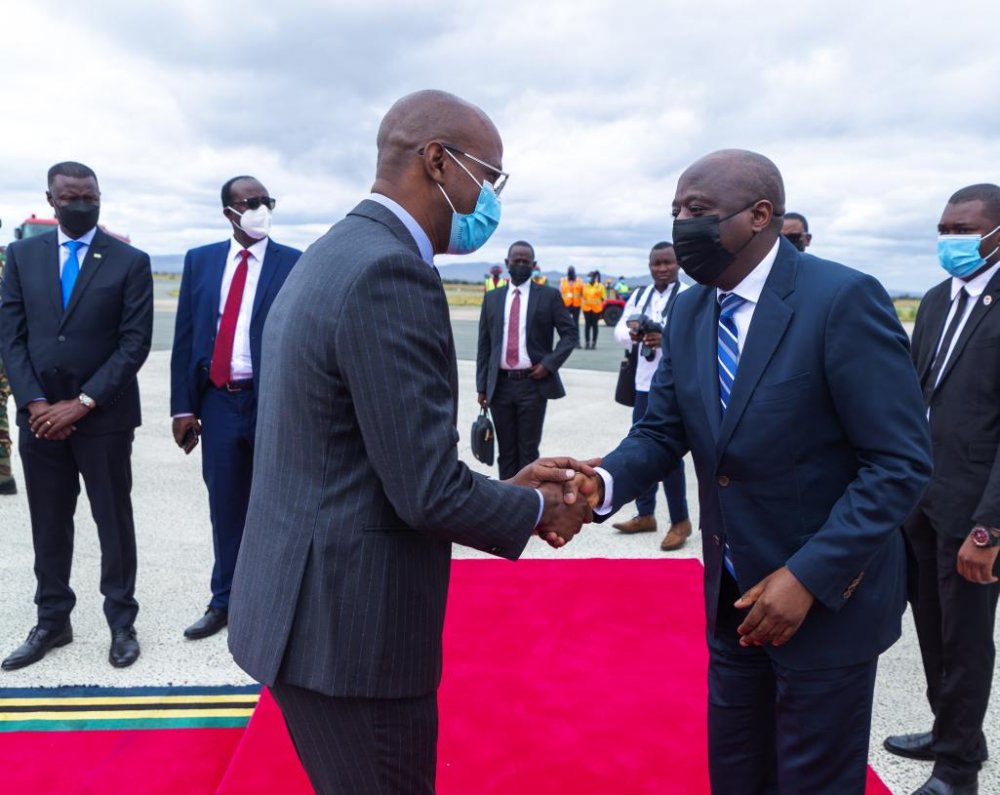
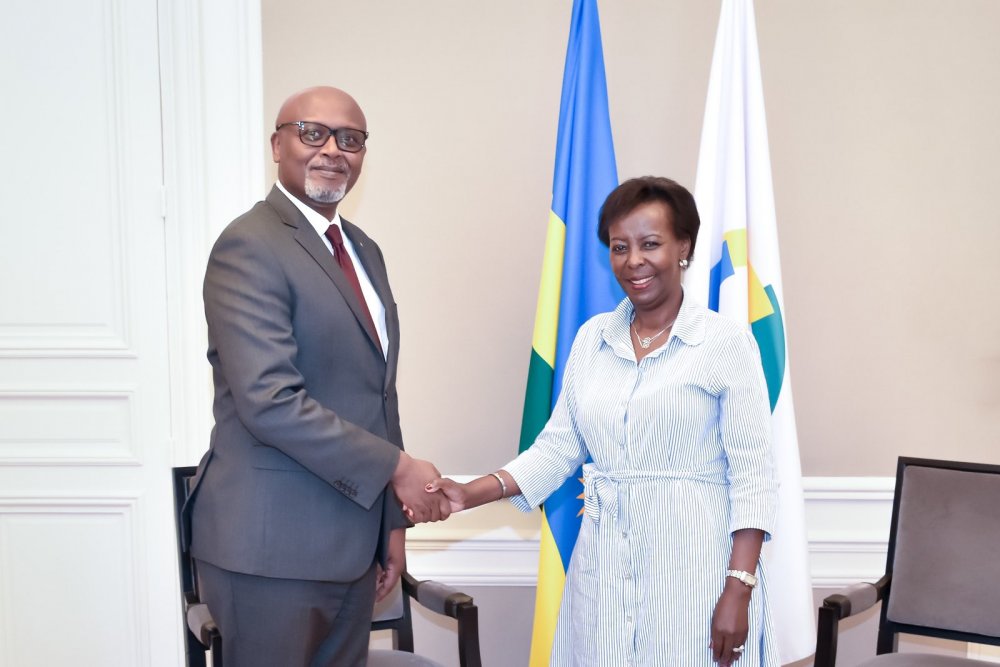
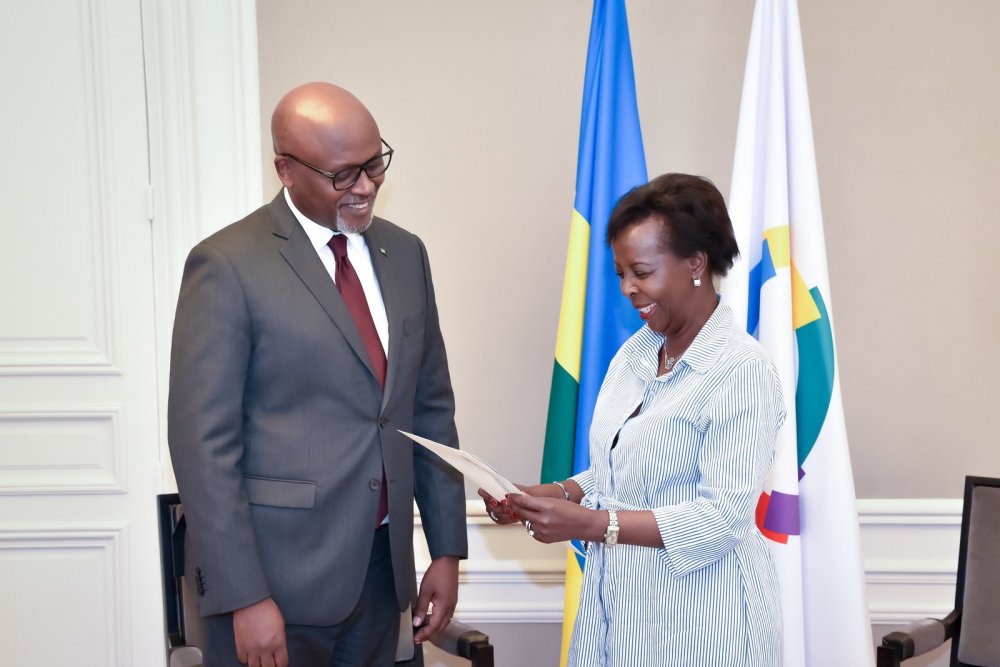
Amb. Nkulikiyimfura presented the letters of credence to OIF Secretary-General, Louise Mushikiwabo on 19th July 2022.
Nkulikiyimfura was appointed Rwanda’s ambassador to France in April 2022 replacing François Xavier Ngarambe. Prior to the this appointment, he was representing Rwanda’s interests in Qatar.
Louise Mushikiwabo was elected as the Secretary-General of OIF in 2018, replacing Canadian, Michaelle Jean.
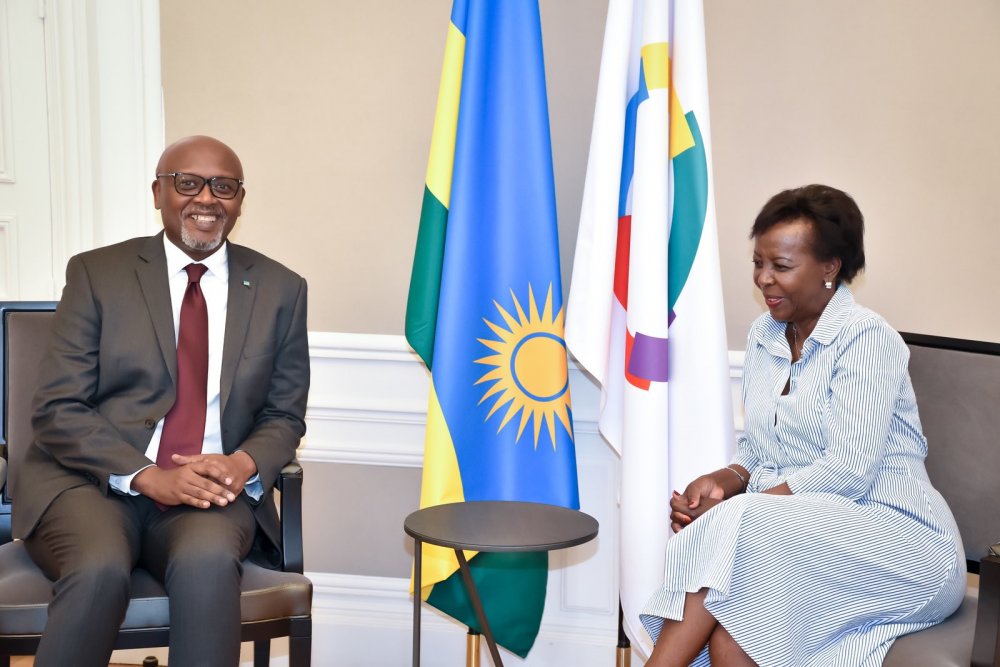
After presenting credentials, OIF has via Twitter account revealed that Amb. Nkulikiyimfura and Mushikiwabo held talks revolving around reinforcing cooperation between OIF and Rwanda, particularly the “mobility project” aimed at enhancing French language teaching among its member states.
The project which started with countries including Rwanda, Ghana and Guinea is expected to reach 10 countries.
In April this year, Rwanda received 45 French language teachers following the first batch of 25 teachers sent by OIF.
The recent teachers sent to Rwanda are from Gabon, Ivory Coast, the Democratic Republic of Congo (DRC), Guinea, Mali, Senegal, Bénin, Togo, Cameroun, Burundi, Burkina Faso and France.
The recent report of OIF show that there were 300 million French speakers around the world in 2018 expected to increase to 700 million in 2060.
On 19th July 2022, Amb. Nkulikiyimfura also presented credentials to the Director-General of the United Nations Educational, Scientific and Cultural Organization (UNESCO) to represent Rwanda.
Their discussions focused on the importance of tangible and intangible world heritage and the education of young girls.
Emmanuel Niyirora, 38, and Eric Ntagungira, 35, were intercepted in Shwemu Village, Gisa Cell in Rugerero Sector, transporting four bundles of cannabis on a motorcycle registration number RC 476A, which was also impounded.
Their arrest came five days after another drug dealer was also arrested in Rubavu transporting about 1,000 pellets of cannabis to his clients in Rugerero sector.
Superintendent of Police (SP) Bonaventure Twizere Karekezi, the Western region Police spokesperson, said the suspects were arrested due to a tip-off by local residents.
“The Rwanda National Police Anti-Narcotics Unit (ANU) had prior credible information from residents in Kageshi, Busasamana Sector about two people riding on the same motorcycle, transporting narcotics, which they had trafficked into Rwanda from Democratic Republic of Congo (DRC),” SP Karekezi said.
He added: “Police conducted an operation and intercepted the two drug dealers, who were using Byahi-Rugerero route, with the four bundles containing combined 6,000 pellets of cannabis.”
The two men were allegedly heading to Nyanza District apparently to supply their clients there.
SP Karekezi issued a stern warning against drug traffickers and local retailers.
“There is increased cooperation and collaboration with the public to break drug supply chains, this and many other previous successful operations, are the results of this strong community policing,” SP Karekezi said.
The suspects and exhibits were handed over to RIB at Gisenyi station for further investigations.
Article 3 of the Ministerial order nº 001/moh/2019 of 04/03/2019 establishing the list of narcotic drugs and their categorisation classifies cannabis in the category of very severe narcotics.
Article 263 of the law No. 68/2018 of 30/08/2018 determining offences and penalties in general states that any person who, unlawfully produces, transforms, transports, stores, gives to another or who sells narcotic drugs and psychotropic substances, commits an offence.
In case of “very severe narcotic drugs” the offender is liable to between 20 years and life imprisonment and a fine of between Rwf20 million and Rwf30 million.