MUHAZI BEACH HOTEL (MBH) located in Eastern Province, Rwamagana District, nearby the lake Muhazi would like to recruit well-motivated and qualified candidates for the following positions: JOB ANNOUNCEMENT:
Category: News
-

Rwanda celebrates 7th Global Hand washing Day
{{NYABIHU, 15 October 2014}} – {Each year, over 200 million people are involved in celebrations in over 100 countries around the world for the Hand washing day. Rwanda, too joins in the celebrations for the 7th Global Hand washing Day – in collaboration with UNICEF, NGOs and private sector partners to promote Hand washing with soap in disease prevention. }
The theme for the day is “Choose Hand washing with soap, choose Health/Tubungabunge ubuzima dukaraba intoki n’amazi meza n’isabune.”
Together with the Global Hand washing day, a 3 months national hygiene campaign in schools all over Rwanda is also being launched to – ensure that it is more than just a day –in fact an everyday routine.
“Washing hands with soap can prevent the death of millions of children around the world. Many children in the world do not celebrate their fifth birthday because of diarrhoea and pneumonia, diseases which can be prevented just by the simple act of washing hands with soap” said Murtaza Malik, WASH Manager of UNICEF Rwanda. “It is a “do-it-yourself vaccine” that prevents infections and saves lives” added Malik.
In Rwanda, the Ministry of Health in collaboration with UNICEF, NGOs, partners and the private sector such as I&M Bank and partners have organised a series of activities including the launch event, group hand washing in schools, mass media campaigns and community outreach to celebrate the Global Hand washing Day. The target is to reach over 2 million children in schools through these activities. Through community hygiene clubs and school health clubs, hand washing with soap is promoted by the children themselves – as effective change agents.
“We encourage all children to adopt hygiene practices at your early age, and instil those good behaviours in your families, communities and society in general. We know that you are effective agents of change, and you can do it,” stressed Dr. Parfait Uwariraye, the Director General in charge of planning at the Ministry of Health
Hand washing with soap is even more significant in the current context – Ebola response. As it takes its toll on the health services in the affected countries, the practice of hand washing is an important prevention method from the spread of Ebola virus.
-

Rights Groups Protest against Unlawful arrest of Rwandan couple living in Burundi
{Rwandan Civil Society raises a human right protest against the imprisonment of two Rwandan citizens in Burundi accused of illegal entry into the country.
}During a press conference, Jean Léonard Sekanyange, Chairman of CLADHO said that Rwandan Human Rights Associations are working together with Burundian Associations to influence the release of the two people detained in Burundi.
In an Interview with IGIHE, Sekanyange said “We are in contact with the Burundian associations about it. Initially they said they were not aware of the issue. On our part, we gave them basic information to know their identities and districts and areas of origin and other items necessary for their identification.”
Both Rwandan citizens have been imprisoned since September 26 in the capital of the province of Muyinga.
This is actually a couple of Zainab Yankulije, Rwandan and her husband Osman Nubahe residing in Muyinga in Burundi.
They are believed to have offered hospitality to a person not previously identified who, according to Burundian police, would have gone to take pictures of where were buried the anonymous bodies recently found in the lake of Rweru.
Meanwhile Burundian Officials have said the bagged bodies originated from Rwanda, an accusation that Rwanda denies.
The neighbors of imprisoned couple said it is unfair because these investigative authorities did that based on rumors and suspicions not sufficiently verified.
The prosecutor’s office in Muyinga states that the two Rwandans are imprisoned under judicial investigation for illegal entry into Burundi and taking pictures of where the bodies found in the lake Rweru rest.
-

Rwanda concerned about the delay of cases referred to France

{A representative of Rwanda has told the UN General Assembly that Rwanda is concerned about the delay of the two cases entrusted to the French court in late 2007 by the International Criminal Tribunal for Rwanda (ICTR).}
Rwandan diplomat Jeanne D’arc Byaje said the delay is ‘unacceptable’
Byaje was speaking on Monday at a debate in the General Assembly about the reports that had been submitted by the presidents of the ICTR and the Mechanism for International Criminal Tribunals (MICT).
Commenting on the records of Father Wenceslas Munyeshyaka and Laurent Bucyibaruta, the representative of Rwanda said that Rwanda is ‘extremely concerned “about the ‘unacceptable’ delay’ of the French courts in handling those cases.
‘Delayed justice is justice denied, “Said Byaje
Presenting his annual report, Theodor Meron, President of MTPI had announced, citing the prosecutor (the MICT) that ‘tangible progress has been made in the investigation of the cases of Munyeshyaka, which should be completed in late 2014 and could be followed by a trial which would be completed by the end of 2015. ”
Meron added that according to reports sent by the French authorities to the prosecutor, investigating the case of Bucyibaruta should be completed in late 2015, and the eventual trial ends by 2016
-

Rwanda: “The truth, right now!” for a good future,“Imbere heza”
{“Ibuka ! Ibuka ! Ntukibagirwe n’agato…” “Remember !Remember!Don’t forget for a moment…”}
The words of the Tutsi Genocide survivors’ remembrance song resound in the dry air on a hill in Bisesero. On this day of June 2014, we commemorate the 20th anniversary of the massacre.
A large crowd has gathered for the occasion, some taking shelter in the shade of the massive trees, some standing under the blazing sun, some seated on plastic chairs and the ground.
Dressed in beautiful outfits reserved for great occasions, their elegance conveys a particular dignity. Their impassive faces harbour contained emotion. French youths and their European and Rwandan counterparts have humbly come together to burry the remains of some victims, 20 years after the Genocide against the Tutsi. Standing next to the decorated coffins, young people chant in Kinyarwanda as the crowd listens respectfully. Out of modesty or respect for the foreigners, nobody dares to express their incredulity. And yet…
“Is everything here real?”“Ya minsi y’amarira, Amajoro y’amaganya..” “The nights of tears, the nights of distress”
“The French” are back, but this time to commemorate the Genocide and pay homage to almost 50,000 victims who perished in this very place in 1994.
Twenty years ago, the French were there with their military fatigues and weapons. Alerted by the village nuns, they went to seek Tutsi hidden on the high hills of Bisesero. What they found there were young men looking like old men—ragged, starving, wounded and terrorised.
The latter recounted the massacres, the fear and the death which loomed under the regular strikes by the militia surrounding the hill.
The French soldiers crossed paths with the perpetrators of the Genocide, those perpetrators who had greeted them as allies and who were proudly recounting the most atrocious of their executions.
Faced with this situation of vital urgency, these soldiers sent by France as part of Operation “Turquoise”—a humanitarian mission by the then French government ‘obeyed their orders’ and abandoned the survivors to an inevitable death. The orders were indeed not to save their lives, but to cover the retreat of France’s allies, the perpetrators.
In June 2014, the French youth and their European friends participated in the burial of the bodies of some of the “survivors” found on the hill. They are also paying homage to the soldiers who disobeyed orders to come back to Bisesero and save the Tutsi from death.
“Ya mivu y’amaraso, Ubwo abacu bashiraga…” “The blood flowed, when our own were exterminated…”
When speaking the same language, one of dignity; when living by the same values, those of human rights; when sharing the same priority, that of truth, the youth of Rwanda, France and Europe show the need to create a shared future, in spite of a historical heritage so heavy that it could be paralysing.
The realisation of hope, the construction of this “Imbere heza”, of a shared future is now possible due to the involvement of the youth. The French youth are now at the frontline, urging us to demand “The Truth” concerning the Genocide perpetrated against the Tutsi in Rwanda in 1994.
The “Truth, Right Now” demands that the French political leaders come out to explain what happened. Numerous undeniable facts reveal the extent of collaboration of certain Frenchmen, at the highest level of state apparatus, with the Rwandan perpetrators, before, during and after the Genocide.
The Rwandan survivors need to hear the truth spoken by France, a nation whose voice still resonates in a particular way in Rwanda. It is a moral debt that should be paid. We mustn’t imitate the Turkish State, which still denies the genocide against the Armenians, 100 years down the road.
Moreover, numerous French and Rwandan officials accused of participating in the Genocide continue to live in France in perfect impunity, just like the many people responsible for war crimes and crimes against humanity in former Yugoslavia. Human Rights and the Rule of Law are being undermined. We are confident the French justice system will act in a decisive manner.
“The Truth, Right Now”, equally means opening the archives so that historians can work unhindered.
WATCH THIS VIDEO:
It also means creating a Parliamentary Inquiry Commission to ensure that French institutions, and notably political organisations, can profoundly understand their role and work on their identity. It will ensure that past indiscipline is not covered up by public silence, and that it is never repeated. Belgium, where such a Commission was put in place 17 years ago, offers us a clear example of a society that knew how to examine its past with lucidity and courage.
The findings of the Parliamentary Information Mission of 1998 in France were real but too weak; their effects on society were too insignificant; their consequences for those responsible officials were shamefully inexistent. In short, the findings were thoroughly unsatisfactory. This Inquiry Commission is a sane democratic act and after twenty years it is of utmost urgency.
“The Truth, Right Now!” also means passing on the memory of this crime against humanity—the Genocide against the Tutsi—to young generations, either through formal or informal education.
This education requires a more comprehensive history for school curricula, as well as memorials, particularly one, worthy of the name, in Paris, but also everywhere in Europe. Only by such measures as these will current and future generations achieve lucidity and vigilance.
And finally, “The Truth, Right Now!” is a commitment: a commitment not to leave the survivors alone; a commitment that France will not be absent from official commemorations any longer.These practices are acts of friendship between individuals and peoples. This is why, on April 7, 2015, we will join Rwandans once again to commemorate the Genocide.
May those concerned respond to the demands we share, as if they themselves had stood on the wooded hill of Bisesero staring at the dignified, calm and resolute face of the youth of Rwanda, France and Europe, and listening to the chants of memory. That day we saw the face of the future. “…Ibuka!”
{This is a joint article by Benjamin Abtan, President of the European Grassroots Antiracist Movement; Jean de Dieu Mirindi, National Coordinator of the Association of the Genocide Surviving Students; Laura Slimani, president of the Young Socialists; Laura Chatel, Federal Secretary of the Young Ecologists; Lucas Nédélec, Federal Secretary of the Young Ecologists; Charles Habonimna, president of the Alumni Student Genocide Survivors (Rwanda); Géraldine Guilpan, president of the Young Radical Leftists; Nordine Idir, Secretary General of the Young Communists of France; Yannick Piquet, Vice-President of the Movement of Young Belgian Socialists (Belgium); Dominique Sopo, president of SOS Racisme; Marian Mandache, Executive Director of Romani Criss (Romania); Sacha Reingewirtz, president of the French Jewish Student Union; Djordje Bojovic, spokeperson of the Youth Initiative for Human Rights (Serbia); Marcel Kabanda, President of the Ibuka-France; Levent Sensever, spokesperson for Durde (“Say no to racism and nationalism) (Turkey); William Martinet, president of the French National Student Union; Corentin Durand, president of the National High-School Union and Sonia Aïchi, president of the Independent and Democratic High-School Federation.{{}}}
-

Rwanda negotiating with Uganda and Botswana on the possibility of importing the lions
{{{The Rwanda Development Board ( RDB) on Monday announced plans to restock the Akagera National Park in eastern part of the country with lions by March. }}}
Appearing before Parliament’s Public Accounts Committee (PAC) over financial mismatches cited by the Auditor General in his 2012/ 13 annual audit report, RDB’s Head of Tourism and Conservation, Amb. Yamina Karitanyi said plans are underway to import lions whose DNA can easily adjust to the Rwandan environment.
The revelation followed concerns by lawmakers over delays in importing lions which had been expected the previous year. “We had made progress towards importing lions from Kenya but conservation Non Government Organizations there complained which affected the whole arrangement,” Karitanyi said.
According to her, the complaints in Kenya stemmed from the increasing poaching whereby conservationists didn’t want to see other animals taken away. As a result, she said, “we decided to source from other countries and we should have them in the park not later than March 2015.” RDB’s Conservation Division Manager, Telesphore Ngoga, attributed farther delay of restocking the animals to lack of a fence which had to be put in place to minimize human-animal conflict.
He disclosed that they are negotiating with Uganda and Botswana on the possibility of importing the lions from there. RDB’s Chief Executive Officer, Francis Gatare noted that moving animals from one country to another turned out not to be complex than could be imagined. Official information shows that the park once had about 230 lions but after the genocide in 1994 Rwandan returnees occupied the park driving the lions out and killed others. The plan to restock is aimed to revitalize tourism around the park.
Standardmedia
-

Rwanda Genocide Courts Hold Lessons for South Sudan
{A senior official in Rwanda’s reconciliation process is calling on South Sudan to apply lessons on how Rwanda came back from the dark days of the 1994 genocide, in particular the system of the gacaca courts.}
“If you can use them and rebuild peace, rebuild unity, rebuild development, why not for them to use it before they have a tragedy?” Habyalimanana Jean Baptiste, executive secretary of Rwanda’s National Unity and Reconciliation Commission, said during a visit by traditional chiefs from four South Sudanese states last week.
South Sudan should set up programs that encourage reconciliation, Jean Baptiste said. Forgiveness is a key first step on the road to reconciliation, he added.
{{Gacaca courts}}
Rwanda’s home-grown gacaca court system was set up when officials in the country realized that the national court system was unable to handle all of the cases related to the 1994 genocide.
Under the gacaca system, communities at the local level elected judges to hear the trials of genocide suspects accused of everything except the actual planning of the genocide. The courts showed leniency in sentencing if a person was repentant and sought to reconcile with the community.
When the 12,000 gacaca courts closed in May 2012, they had tried more than 1.2 million cases throughout Rwanda. They also helped to promote reconciliation by allowing genocide survivors to learn the truth about the death of their loved ones.
The South Sudanese traditional chiefs who visited Rwanda last week were all from states that have been at the heart of South Sudan’s conflict: Jonglei, Unity, Upper Nile, and Central Equatoria where the fighting started last December.
One of the chiefs, Chief Alphonse Legge Laku Tombe of Central Equatoria state, said he thinks South Sudanese can learn from the Rwandan experience.
“Imagine: Rwandans were misled and when they recognized themselves that what they did was wrong, they came to understand. Why can’t we understand like these people?” he said.
Chief Peter Mading Thiak from Jonglei state said he learnt valuable lessons from the Rwandans, including, “that when the community sat down and discussed among themselves, they were able to have peace. We can also do this in South Sudan.”
VOA
-

Police arrest six distillers of illicit liquor in Bugesera
{Six people have been arrested in Bugesera District in connection with distilling and supplying banned alcoholic drinks in the district.}
The suspects, who include a woman, were apprehended in a Police operation conducted on October 12 in Murama cell of Nyamata sector.
The suspects are identified as Thierry Sibomana 26, Jean Bosco Habimana, 31, and Jean Chrisostome Murenzi, 42, Pierre Célestin Nzaramba, 39, Elisabeth Ntakirutimana, 28 and Flugence Habukwizera 34.
They are currently detained at Nyamata Police station as investigations continue.
At the time of their arrest, they were found distilling Kanyanga, a banned gin in Rwanda and Molasses, a locally made illicit brew, made out of sugarcane residues.
Police also recovered 210 litres of Kanyanga and 1400 litres of molasses, from the suspects, which they had already finished distilling.
Also seized are nine drums, three pipes and jerrycans the suspects were using to distill the illicit liquor.
Inspector of Police (IP) Emmanuel Kayigi, the Eastern region Police Spokesperson, said: “we received credible information from area residents about people that distill illicit liquors, so we conducted an operation with local leaders which led to their arrest.”
He warned of severe consequences to anyone that will be caught in such-drug related. He further urged the public to strengthen partnership by providing information on people making, selling and consuming these hazardous substances.
Police
-

Kagame Rebukes BBC Over Genocide Denial Film
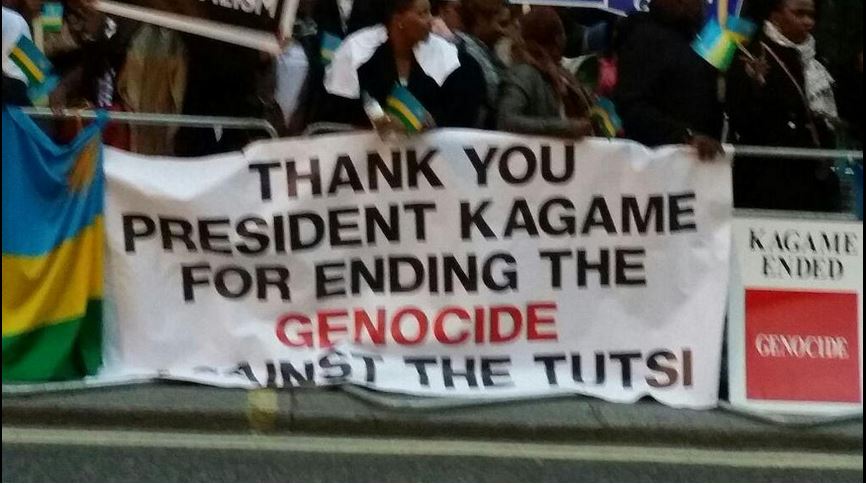
{{Chimpreports}}- {In a fire-and-brimstone speech delivered Tuesday, Rwanda President Paul Kagame has blasted the British Broadcasting Corporation (BBC) for airing what he termed as “criminal” and “genocide revisionist” documentary seeking to “distort” the country’s history; before expressing shock that the broadcaster had “turned genocidaires into victims and turned us (RPF) into killers.”}
Speaking from his heart, Kagame described as “cynicism of the highest order” BBC’s decision to provide a platform to “discredited people” to hide under the guise of “freedom of speech and press” to deny the Rwanda genocide in which over one million people mainly Tutsi were killed.
“Their freedom of speech is one that allowed the likes of RTLM (pro- extremist Hutu radio) that called on people to kill others in 1994. BBC has gone as far as denying the Genocide. This is coming from part of the world that teaches us about freedom,” charged Kagame.
The President made the remarks while presiding over the election and inauguration of the new President of the Senate, Bernard Makuza at Parliament Buildings.
Kagame had earlier warned leaders against deviating from their core mandate of serving people to pursuing selfish interests.
The President’s remarks come amid growing chorus of genocide survivors, intellectuals, researchers, politicians and journalists around the world, demanding BBC to apologise for airing a film in which it was alleged that only 200,000 Tutsis were killed and the rest (over 800,000) were Hutus.
They want the documentary, which also blamed RPF for triggering the genocide, to be removed from all BCC’s media platforms.
Some of the ‘scholars’ interviewed by BBC said had the RPF not attacked Rwanda, the genocide would not have occurred.
Some of the people interviewed included renegade Gen Kayumba Nyamwasa whom Kigali accuses of attempting to destabilise Rwanda through forging alliances with militants in the region especially the FDLR.
The BBC has in recent days come under fire for airing the unbalanced documentary.
Officials said the journalist did not interview any genocide survivor or peruse through documented records of the 1994 tragedy.
{{Africa disrespected}}
Kagame said “BBC did that because Rwandans are Africans, they wouldn’t do it on Holocaust or Bosnia.”
He said BBC claims to be independent, and hide behind freedom of press and speech to disparage Africa but not “elsewhere.”
Kagame challenged BBC to provide platform to the terrorist ISIS movement in the Middle East if the broadcaster claims being non-partisan.
“Those responsible for terrorism in Rwanda are given platform in name of freedom of expression. Would the same apply to ISIS?” wondered Kagame in reference to Nyamwasa, who is accused of masterminding a string of grenade attacks in Kigali in which several people perished.
“When people threw grenades in Rwanda, it was the first time we saw terrorism internationally supported,” said Kagame.
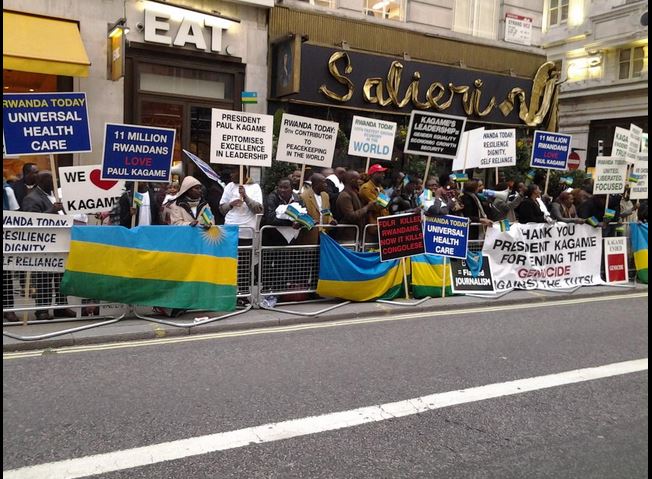
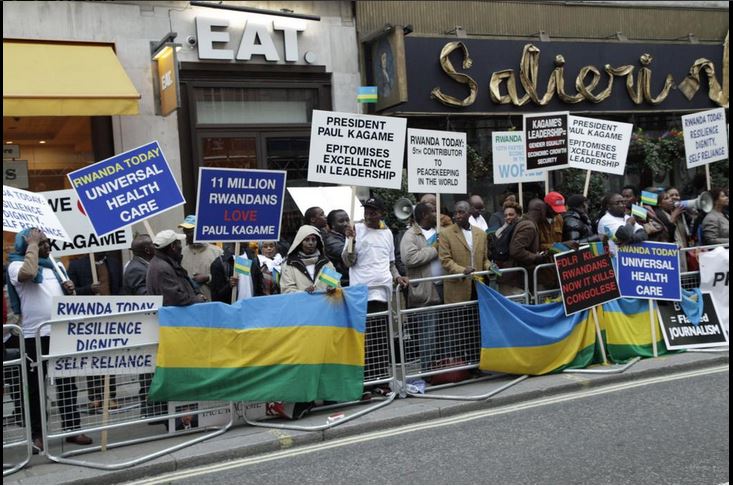
BBC remains mute on the latest scandal even after genocide survivors held protests outside its headquarters in London.
Kagame said “it’s the opposite of what they (BBC) say they stand for, not the first time; we see it every time in different forms.”
The President led the RPF rebel group in 1994 that stopped the genocide after defeating Juvenal Habyarimana’s genocidal forces.
Before Habyarimana died in a plane crash, he had mobilised and trained militias to execute a mass killing of Tutsi.
At least one million people were subsequently killed.
After seizing power, Kagame would later embark on a huge campaign of turning around the country’s shattered economy, decayed infrastructure and depleted human resource.
However, he has of recent come under pressure from the international community for not providing enough space to the opposition, a charge he denies.
Kagame said Rwandans are on their own and should therefore define their own destiny.
He further pointed out that leaders cannot afford to focus on simplistic issues, but think big.
“We shouldn’t give people the impression that we don’t know our interests. Let’s be seen as people who know what we want, so people take us serious, not for granted. Whoever thinks that Rwandans have lost focus is mistaken; Rwandans get stronger, not weaker,” said Kagame.
He said the body may get tired, but not the hearts.
“Challenges and hurdles should only serve to strengthen us, not weaken us. That’s the only way to answer the cynics,” he added.
Regarding terrorism, Kagame said Rwanda needs to think locally and globally since “what affects others affects us as well”
He also appealed to the Health Ministry to put in place mechanisms to “strengthen our systems and help others in combating the Ebola virus.”
The head of state also urged Rwandan leaders to avoid the habit of “running away from problems. Pushing back is the option. If you choose to run away, the only benefit in that is being given a platform on BBC.”
{{FDLR}}
Still on the double standards of the international community, Kagame revealed that it’s yet to tackle the FDLR threat which has been in existence for 20 years.
“But when M23 came, the whole world came down, and not only sought to demolish it, but also demolish Rwanda. And when it came to FDLR, they started giving excuses.”
Kigali recently expressed its discomfort with United Nations for not living up to its commitment of fighting the FDLR in DRC following the defeat of M23.
The UN Intervention Brigade was mandated to crush all militia groups in DRC including M23 and FDLR.
When M23 were contained last year, it was thought that the Brigade would take on FDLR, which UN accuses of committing atrocities in Rwanda ad DRC.
This is yet to happen. But UN has since given FDLR up to January 2015 to surrender of face military action.
Kagame said “challenges and hurdles should only serve to strengthen us, not weaken us as only way to answer the cynics.”
He added: “The battle ground is Rwanda and we will always prevail on the battle ground, and we feel more energized and happier to engage them (enemies).”
-

Congo-Kinshasa: MONUSCO Set to Hit FDLR
{The United Nations Mission in the Democratic Republic of Congo (Monusco) appears to be on the verge of a military offensive to eliminate the FDLR militia in Eastern Congo. Monusco Commander Lt-Gen Carlos Alberto dos Santos Cruz told the UN Security Council last week}
The UN organ commander said he believes that Congolese civilians can be effectively protected only through “proactive” operations against armed groups.
He asserted that offensive action on the part of Monusco’s combat brigade is consistent with international law despite risks of “collateral damage.”
“I am absolutely convinced that the best way to protect civilians is being proactive rather than reactive,” Lt-Gen Santos Cruz declared. “Civilian protection is far more than text in a mandate; it is a moral duty.”
The FDLR, which is accused of slaughtering and raping civilians in eastern DRC, consists largely of militia who fled Rwanda after carrying out the 1994 Genocide against the Tutsi.
The Brazilian general’s October 9 remarks followed an October 3 UN Security Council call for the “swift neutralisation” of the FDLR, the French acronym for the Democratic Force for the Liberation of Rwanda.
Noting that no progress has recently been made in the surrender and demobilisation of FDLR fighters, the Security Council urged Monusco and the Congolese armed forces to “undertake military action” against leaders and members of the group who do not comply with UN demands.
In a statement issued three months prior to the UN deadline for FDLR disarmament, the Security Council ruled out any political dialogue with the rebel group.
The Council said it was assessing FDLR’s compliance in concrete terms, including the number of fighters and leaders surrendering and weapons handed over.
Rwanda has been at the forefront of demands by some UN member states that Monusco launch military action against the FDLR following an offensive last year that eliminated another rebel group known as M23.
That was the first time in the UN’s 70-year history that its military deployment had initiated combat as part of a peacekeeping mandate. A 2013 UNSC resolution established a 3,000-member Force Intervention Brigade (FIB) within Monusco.
The United States has echoed Rwanda’s insistence that the FDLR must be destroyed. Samantha Power, the US ambassador to the UN, last week praised Lt-Gen Santos Cruz’s proactive approach.
{{News Of Rwanda}}