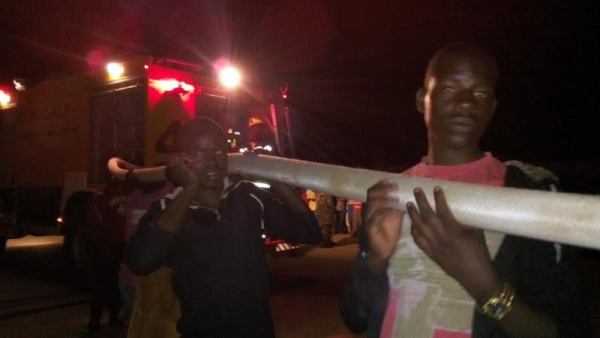
{Two commercial houses and a currency exchange office got afire last night around 8:00 pm in Rusizi city, Kamembe sector.}
Some witness who were at the scene when the incident occurred say that property worth millions have been destroyed. There was delay of emergence help but residents afforded to combine efforts and contained the fire, saving other commercial buildings in proximity.
“Power went off and when reconnected, I saw smoke billowing out with undulating motion to the sky. Soldiers whistled loud and prohibited us from approaching the inferno .The fire extinguisher was brought after 40 minutes. More things would have been saved if the fire extinguisher reached the ground before,” said Emmanuel Simbarikure.
“Even though the intervention was delayed, items from the second commercial house have been saved,” added Jean de Dieu Bimenyimana another witness.
The two burnt shops served as wholesaler of shoes, food crops including rice, juice and water. As eye witnesses informed IGIHE, the cash from the currency exchange office was rescued.
Anicet Gashamura whose shop was completely razed down said that the commercial house contained items worth Rwf 120 million with no insurance of his merchandise. Besides, he lamented, he is servicing a Rwf 30 million bank loan.
Until now the cause of the fire has not been established but residents think intermittent power supplies caused the fire outbreak.
{Police have taken custody of Uzaribara Protogène, 27, a resident of Byiza cell of Rubona sector, Rwamagana district, detained at Mabare police station over alleged murder of his pregnant wife, Mukamana Donata, 27.}
The spokesperson of police in Eastern Province, IP Emmanuel Kayigi, has told IGIHE that Uzaribara allegedly killed her pregnant wife during the night on this 1st January, 2016 at his home with blunt objects. “He accepts to have committed the offense even though we have not yet established the motive of murder,” he said.
He further said that Uzaribara and Mukamana had no child together though the latter had a child from a former relationship.
IP Emmanuel Kayigi said that the killing has no correlation with festive season ending the year but a domestic-related conflict. He appealed on citizens to be counteractive on crimes by providing information on time.
If found guilty, Uzaribara will get a life sentence in prison as per article 140 of Rwanda penal code.
{Niyomuragije Xavier, 20, resident of Mabane cell, Rubona sector of Rwamagana district is detained at Mabare police station over alleged murder of her mother.}
The spokesperson of police in Eastern province, IP Emmanuel Kayigi told IGIHE that Niyomuragije is suspected of having killed her mother aged 50 years last Friday night around 21:00 pm after buying her beers.
Kayigi says that Niyomuragije first bought drinks for her mother and led her in an unpopular path where he killed her.
“It is apparent that he has killed her mother because he asked her to go with him for a drink while she was asleep. After having the bottle, the guy killed her mother as they went back home. After the unfortunate incident, he changed his clothes immediately,” he said.
The culprit returned to the bar, ordered for a beer which he failed to drink claiming it was dilute.
Neighbors say that Niyomuragije would steal domestic animals for roasting meat or selling them, of which his mother has been warning him.
{A group of anti-government militiamen, who took over a federal wildlife center in the northwestern U.S. state of Oregon Saturday, say they are prepared to carry out an armed standoff with authorities “for years.”}
The militiamen – a loosely-organized group of ranchers, farmers, and so-called survivalists – are led by Ammon Bundy, whose family was at the center of another standoff in 2014 over grazing rights on federal lands.
About 100 people are part of the group at the wildlife refuge.
“We will be here as long as it takes,” Bundy told reporters Sunday. “We have no intentions of using force upon anyone. If force is used against us, we would defend ourselves.”
Bundy’s statements can be viewed in a video on the Bundy Ranch’s Facebook page.
Bundy and his supporters seized the offices of the Malheur National Wildlife Refuge, near the town of Burns, to protest a federal judge’s order to re-sentence two ranchers to five years in prison for setting fire on federal land in Oregon in 2012.
Court ruling at center of dispute
The ranchers – Dwight Lincoln Hammond and his son Steven – admitted they set the fires. But they say they were trying to burn out invasive plant species on their own property and that the flames accidentally spread to the federal land.
But witnesses testified that the Hammonds illegally killed deer on government property and handed out matches to other hunters urging them to light them and drop them anywhere to “set the whole country on fire.”
An Oregon court decided that the mandatory five-year prison term for burning federal land is unconstitutional and sentenced the Hammonds to much shorter terms.
But a federal appeals court ruled in October that the minimum five year terms are not too harsh and proportionate to the crime. The court ordered the Hammonds back to prison Monday, with credit for time already served.
A Hammond family statement says the two men only want to turn themselves in and serve out their prison terms. The family says no “patriot group or individual has the right or authority to force an armed standoff… against their wishes.”
Government ‘abusing power’
The anti-government militiamen who took over the wildlife center say they are infuriated by the decision to send the Hammonds back to prison.
After a peaceful protest in Burns Saturday, they took over the refuge’s offices, which were closed at the time. News photos show the militiamen moving fuel and food onto the refuge as if preparing for a long stay.
A sign in front of the occupied refuge building accuses the government of “doing what they do best, ABUSING POWER.”
Militiaman Bundy and his father Cliven held a month-long armed standoff with federal authorities in 2014 over unpaid fees for letting their cattle graze on federal land.
Bundy told CNN television Sunday he wants the federal government to restore what he calls the “people’s constitutional rights,” accusing authorities of tyranny by illegally confiscating private property for public use.
“The people cannot survive without their land and resources. We cannot have the government restricting the use of that to the point that it puts us in poverty.”
Bundy called the wildlife refuge center a “people’s facility, owned by the people.”
There are 560 national wildlife refuges in the United States. They are large tracts of land that are set aside by the federal government to protect wildlife species and their habitats. Oregon’s Malheur Refuge was established in 1908 by president Theodore Roosevelt.
Federal law enforcement officials, including the FBI, have not yet commented on the Oregon standoff. U.S. Fish and Wildlife Service Director Dan Ashe called the occupation illegal and says no employees were in the center when the militiamen took over. The Fish and Wildlife Service oversees the refuges.
Harney Country Oregon sheriff Dave Ward is urging people to stay away from the area.
Source:Voice of America:[Militiamen in US State of Oregon Threaten Prolonged Armed Standoff->http://www.voanews.com/content/militia-group-takes-over-us-federal-wildlife-refuge-in-oregon/3129114.html]
President Pierre Nkurunziza has handed the African Union an interesting problem.
In his first reaction to the AU’s plan to send 5,000 troops to stop the cycle of killings in Burundi, Nkurunziza openly declared that his troops would fight those forces.
What will the AU do? There is still room for a negotiated way out of the crisis.
It is always wisest to find a political solution before too much blood flows and the parties become too bitter to accept compromise.
But what if Nkurunziza shows no inclination to soften his position and does not rein in the security forces that have been killing innocents or stop figures like the Senate president Révérien Ndikuriyo who have been warning that regime opponents will be “sprayed like cockroaches”?
The great question is whether regional leaders will have the courage displayed by Julius Nyerere in 1978 when he sent his troops to Kampala to dispatch the Ugandan despot Idi Amin Dada to a miserable exile in Saudi Arabia.
Amin had never seen it coming. The Organisation of African Unity was widely dismissed as a “trade union of dictators” because of how much it emphasised state sovereignty and “non-interference” in the affairs of others.
So Amin felt sheltered enough to insult everyone that criticised him.
In one note to Nyerere he wrote: “I want to assure you that I love you very much and if you had been a woman I would have considered marrying you although your head is full of gray hairs. But as you are a man that possibility does not arise.”
He dismissed Zambia’s Kenneth Kaunda as an ‘’imperialist puppet and bootlicker’’ and his crude insults even flew across continents, saying during celebrations to mark Queen Elizabeth’s silver anniversary that he expected her to send him “her 25-year-old knickers’’.
WORST MISTAKE
More seriously, of course, his security forces were busy murdering tens of thousands of civilians with little logic dictating those chosen for extermination.
Amin overreached himself when he sent troops to occupy the Kagera region in Tanzania.
Nyerere mobilised his troops and pushed the Ugandan soldiers back.
He didn’t stop there. In the first development of its kind in Africa, and in total disregard of the OAU’s “non-interference” mantra, his troops marched to Kampala and toppled Amin.
Can today’s leaders show similar courage?
A new briefing paper “My children are scared: Burundi’s deepening human rights crisis” released by Amnesty International paints a very worrying picture of the situation there.
Virtually all independent voices – the journalists, lawyers, businessmen – have been forced to flee into exile and all independent media outlets shut down.
The security forces, meanwhile, are killing young men in neighbourhoods which have been the centre of protests to Nkurunziza’s third term bid with near total impunity.
Amnesty records that on December 11, hours after an abortive attack on two military installations, the police went into the neighbourhoods of Nyakabiga, Musaga, Mutakura, Cibitoke, Jabe, and Ngagara where dozens of young men were pulled from their homes and shot at close range.
Human rights campaigners who have stood up to the regime like Pierre Claver Mbonimpa have been forced into exile, in his case after gunmen shot and badly wounded him.
NYERERE’S BOLDNESS
Mbonimpa has become an unwilling symbol of the regime’s brutality after his son, Welly Nzitonda, and son-in-law Pascal Nshimirimana were killed by the security forces weeks after Mbonimpa left the country for treatment in Belgium.
This is not a genocide. It is a refreshing thing that the opposition to Nkurunziza is united across the Hutu-Tutsi ethnic divide although some in government have sought to exploit ethnic divisions.
The AU will suffer grave embarrassment if there is a turn to mass killings in Burundi.
Sending troops to take on a despot takes the sort of courage that Nyerere showed in the 1970s.
Source:Nation:[If Burundi continues killing her civilians, AU must ask: What would Nyerere do?->http://www.nation.co.ke/oped/Opinion/If-Burundi-continues-killing-her-civilians/-/440808/3019392/-/bkvds9z/-/index.html]
{Reversal of open-door policy follows acute accommodation shortage, with 160,000 people seeking asylum in one year.}
Sweden has begun ID controls as part of the government’s efforts to limit the number of refugees entering the country.
Everyone entering Sweden from midnight on Sunday by bus, train or ferry from Denmark will be checked and those lacking valid ID documents will be turned back.
Sweden, which until recently was known as one of the most welcoming countries in the world for people fleeing wars, has said it can no longer cope as the influx of refugees and migrants reaches record numbers.
With more than 160,000 asylum-seekers arriving to the country of 9.5 million in 2015, mainly from Syria, Iraq and Afghanistan, accommodation for new arrivals is running out.
“We must get the number of asylum seekers down. ID controls are one way to achieve this,” Morgan Johansson, justice and migration minister, said in December.
Of those seeking asylum in Sweden in 2015, about 80 percent lacked passports or equivalent IDs at the time of filing their applications, according to the Swedish Migration Agency.
The controls follow the reintroduction of border checks in Germany, Austria, France, Belgium and several other European countries.
The UN refugee agency, UNHCR, has said refugees will face increasingly slim chances of asylum in Europe should more countries follow Sweden and impose stricter entry requirements.
Mattias Axelsson, UNHCR spokesperson in northern Europe, said governments must understand that refugees are under tremendous strain and that those fleeing do not always have the possibility to bring ID documents.
“You can’t expect that those who have the right to asylum also have the right documents with them from the beginning, that is simply impossible,” he told Swedish news agency TT.
“We follow this with growing concern.”
Besides refugees, ID controls will have a big effect on passengers travelling from Denmark, as about 70,000 people – many of them commuters – cross the Oresund bridge each day.
The plans have been heavily criticised by operators and commuters on both sides of the strait, as the controls are expected to add at least half an hour to a journey that normally takes 35 minutes.
Rights groups have also been critical, saying that the ID controls are part of measures that limit refugees’ possibilities to seek asylum.
Sweden has seen a decrease in the number of people seeking asylum in recent weeks, following news of tighter border checks and stricter rules for residency permits.
In November, the Migration Agency said Sweden was no longer able to provide shelter for all asylum seekers, saying families with children would be given priority.
Source:Al Jazeera:[Sweden begins border ID controls to halt refugee influx->160103192940427]
{Major 6.7 magnitude earthquake hits near India’s border with Bangladesh and Myanmar, killing at least six people.}
At least six people have been died after a strong 6.7 magnitude earthquake struck northeast India near the country’s borders with Myanmar and Bangladesh, sending panicked residents fleeing into the streets.
The Indian government said on Monday morning that five people died and at least 33 people were injured in the earthquake, which struck near the city of Imphal.
Another man was reported dead in Bangladesh after apparently suffering a heart attack following the quake.
Dozens more were injured in the scramble to escape buildings in India and Bangladesh after they were woken by the early morning tremor.
Police in Dhaka said 40 people were being treated at a major hospital in the Bangladeshi capital, including one university student who jumped from a fourth-floor balcony and was in a critical condition.
The US Geological Survey said the quake hit at 4:35am local time (23:05 GMT Sunday), 29km west-northwest of Imphal, capital of Manipur state, where dozens of buildings were damaged.
A resident in Imphal told Al Jazeera that the earthquake was the largest he has ever felt.
“People came running out of their homes screaming, some crying,” he said, adding that a heavy bell at a nearby temple began ringing immediately after the quake.
Indian Prime Minister Narendra Modi tweeted that he had spoken to local authorities in Assam about the impact of the quake.
The tremors were felt as far away as Kolkata some 600km distant in the Indian state of West Bengal, where buildings shook.
{Cape Town – The US on Monday is on the verge of suspending South Africa from the African Growth and Opportunity Act (Agoa), after it missed its December 31 deadline to resolve a dispute on trade levies.}
Agoa, renewed by US lawmakers in June, eliminates import levies on more than 7 000 products ranging from textiles to manufactured items and benefits 39 sub-Saharan African nations. Total two-way trade between South Africa and the US was about R217bn last year.
However, South Africa has failed to meet a deadline to resolve various disputes and will now have its trade tariffs re-imposed.
US President Barack Obama is expected to make an announcement as early as Monday, while the Department of Trade and Industry (dti) will hold a press conference on the matter on Monday.
When the deadline expired at midnight on December 31, “outstanding issues” had not been resolved, Trevor Kincaid, spokesperson for the office of the US Trade Representative, told Business Day, which added that talks had continued late into New Year’s Eve.
The suspension will go into immediate effect once it has been announced, affecting all relevant goods not yet landed in the US, including those in transit, the Business Day explained.
Bloomberg reported on December 31 that South Africa was confident of meeting Monday’s deadline to resolve a trade dispute that will allow it to retain duty-free access for farm export.
“We are totally committed to finding a resolution,” dti director-general Lionel October told Bloomberg at the time, while dti Minister Rob Davies said “yes and no” when asked by Business Day whether he thought the negotiations would fail.
In a November 6 letter to Congress, Obama said South Africa continued to impose several longstanding barriers to US trade and had been given 60 days to take remedial action or face suspension of some of its trade preferences under Agoa.
Veterinarians from the two countries are in daily contact to try to resolve outstanding issues relating to testing of US imports of poultry and pork for salmonella and other diseases, October said. They hope to issue final protocols in the next few days, he said on December 31.
“We have made the concessions on pork and beef imports,” he said. “We and the US Embassy are getting the vets to issue the final health and safety protocols. We will issue a statement on January 4” indicating what progress has been made, he said.
To remain beneficiaries of Agoa, countries are required to eliminate barriers to US trade and investment, operate a market-based economy, protect workers’ rights and implement economic policies to reduce poverty.
The trade programme has helped South Africa more than double its exports to the US since 2000.
Shipments under the agreement accounted for more than a fifth of the nation’s exports to the US last year, according to data compiled by the Trade Law Centre, based in Stellenbosch, near Cape Town.
Source:News 24:[US set to suspend Agoa and hit SA with trade tariffs->http://www.fin24.com/Economy/us-set-to-suspend-agoa-and-hit-sa-with-trade-tariffs-20160104]
{Early results from the Central African Republic’s presidential election show ex-Prime Minister Faustin Archange Touadera taking a surprise lead.}
Thirty candidates contested the poll, which is likely to go to a run-off between the top two on 31 January. Mr Touadera was not seen as a favourite.
He was prime minister in the government of ex-President Francois Bozize, ousted in 2013 by mainly Muslim Seleka rebels.
Voting took place on 30 December, with UN troops guarding polling stations.
Thirty candidates vied to replace interim leader Catherine Samba-Panza in the former French colony.
CAR has been torn by sectarian violence since the Seleka rebels seized power in March 2013.
A band of mostly Christian militias, called the anti-Balaka, then took up arms against the Seleka.
{{
Strong lead
}}
Mr Touadera, 58, was a university maths lecturer before entering politics. He ran as an independent in the election.
With most votes counted in the capital Bangui, he is well ahead of his nearest rival, Anicet Georges Dologuele, another former prime minister.
Besides Bangui, many votes remain to be counted in CAR’s provinces, as well as those of refugees and other CAR citizens abroad.
Mr Touadera has more than 120,000 votes, while Mr Dologuele has just over 68,500.
In third place is Desire Kolingba, son of a former president, the national electoral authority says.
Source:BBC:[Central African Republic ex-PM Touadera ahead after election->http://www.bbc.com/news/world-africa-35218728]
{Prominent Ugandan urologist and former minister Dr. Henry Benjamin Obonyo has died in a car accident.
}
Obonyo, who served as health minister under Tito Okello Lutwa’s brief regime, was killed in a nasty car crash together with his wife Kevina and their two daughters Marjorie and Aliser.
He had just returned from the United Kingdom (UK) where he had been living since 1986.
The accident happened along the Kampala-Gulu highway as Obonyo and his family were on their way to his ancestral home in Madi-Opei, Lamwo district.
Their vehicle overturned at St. Thomas Moore Minakulu in Bobi sub-county, Gulu district, according to Aswa regional police commander Wilson Kwanya.
Kwanya told New Vision that the vehicle – a Super Custom van (UAU249K) – overturned several times after a tyre burst.
Four people died on spot and others were rushed to different hospitals, including the driver identified as Denis Gakumba, a resident of Kawempe division in Kampala.
The vehicle was reportedly hired from Kampala. “He had just come from the airport and was going home in Lamwo. The vehicle and the driver were hired from Kampala. I have not yet established the names of the injured,” said Kwanya.
The bodies were taken to Gulu Regional Referral Hospital mortuary before later being transferred to 4th division military barracks.
Obonyo served as a urology doctor at Mulago Hospital.
Source:The New Vision:[Ex-minister killed in car crash with family->http://www.newvision.co.ug/new_vision/news/1413963/-minister-killed-car-crash-family]