{Bones of a suspected victim of 1994 genocide against Tutsi have been found in Gataramo village of Rusambu cell in Nyakarenzo sector of Rusizi district.}
The skeleton was found as residents were digging a water canal. Information from Nyakarenzo sector indicates that the bones were found on Sunday March 13th, 2016 around 10:00 am.
“They retrieved bones of a human skeleton while digging a water canal. It is suspected that the retrieved bones are of a genocide victim based on where he was located,” said the executive secretary of Nyakarenzo sector, Nyirangendahimana Matilde.
Matilde explained that residents who suspect that the dead body is of their relative killed during the genocide have been called at Karangiro police station to provide information.
My name is Maureen Ruettgers. I have the honour of being the first Chair of Friends of Imbuto Foundation, an organization established in Boston, Massachusetts, with a mission to support the vision of Imbuto Foundation through networking and fundraising initiatives.
With the 15-year anniversary in full swing, I am excited to reflect on how my family and I became interested in Rwanda, this little country lodged in the heart of Africa, and involved with Imbuto Foundation a few years into its launchby Her Excellency, the First Lady of Rwanda, Mrs. Jeannette Kagame.
From the onset, like so many others, our family knew Rwandans just simply, as special people. Committed, resilient, visionary and dignified, even while facing the immense and daunting task of nation-building. I still vividly remember my first encounter with Rwandan women in 2001, at a Harvard’s Kennedy School of Government forum called Women Waging Peace. A short few years only after the genocide, the extent of their responsibilities and range of expertise, were impressive – Girl Scout leader, hotel owner, health worker, Minister of Gender, journalist, judge and Mayor. In ensuing years, I would reach the same conclusion when working with the Rwandan First Lady and her team.
On her end, my daughter Polly Ruettgers Fields also echoed these thoughts. She had been working in Rwanda with the Clinton HIV/AIDS Initiative and Partners in Health, in collaboration with the Government of Rwanda and the First Lady’s Protection and Care of Families against HIV/AIDS program. Polly often marvelled at Rwanda’s vision and vanguard touch in leading such a comprehensive family health approach, which saved countless lives from the AIDS epidemic.
The beginning of our family’s more than a decade long friendship with the First Lady and Imbuto Foundation, started when she hosted the first meeting of the Organization of African First Ladies against HIV/AIDS (OAFLA) many years ago. As a founding member and then President, her Excellency worked diligently to mobilize resources and gain consensus on priorities.
At the same time, OAFLA’s continental campaign “Treat every child as your own” had picked upmomentum, and the First Lady was advocating for countries to have it customized to their national contexts. As a family, we embraced this initiative and saw an opportunity to support a cause that resonated with us. This opened the door to an enduring and warm relationship that quickly extended to other Imbuto and Rwandan initiatives.
Frequently, I have been asked, “What is Jeannette Kagame really like?” My answer has always been the same: “she is first and foremost a thoughtful and terrific wife and mother. And she never relents on her intent to value the importance of respecting and supporting each and every child as your very own.”
These 15 years are a testament to the unwavering leadership of Mrs Jeannette Kagame. In her role as First Lady, she has shown not only to her country but the world at large, that she is an exemplary leader. As the Chairperson of Imbuto Foundation, she has marked her organization with a spirit of dedication and excellence, which set the tone for the strong and fruitful relationship Imbuto Foundation and Friends of Imbuto have enjoyed over the past few years. As a matter of fact, last year Friends of Imbuto was excited to fund more than 300 scholarships and equip 40 houses built by AVEGA Agahozo for widows and families survivors of the genocide.
The work of Imbuto spans a variety of needs: health, youth empowerment, and the promotion of education, which has become the trademark of Imbuto Foundation and holds a special place in my heart. Over time, more than 6,000 secondary school students have benefited from scholarshipsand over 4,000 girls have been awarded for doing exceedingly well in national examinations. In this month where we celebrate women worldwide, I find it particularly fitting to praise these young girls and Imbuto Foundation’s annual campaigns that value and reward their achievements.
With this message, I wish all of the Imbuto team a happy anniversary for 15 years of incredibly meaningful work. Partnerships and a community of support are critical for Imbuto to meet its goals and continue to expand its mission and reach, so we are happy to have been part of its journey. As a family, we are proud of Imbuto’s role in building a brighter future for Rwanda. It has been a terrific investment and it is my hope that others will be inspired to lend support. We all have the power to initiate positive change.
{Madam Jeannette Kagame will on March 19th, 2016 join Rwandans living in United States in a meeting which will discuss the Diaspora role in Rwanda’s development.}
The meeting is part of celebrations of International Women’s Day organized by Rwandan Diaspora in US (USRD) in collaboration with Rwandan Embassy in Washington DC and the international Rwandans Diaspora.
The meeting was organized after realizing the role of women involvement in governance of Rwanda and USA. It will be an opportunity of sharing ideas on women’ needs about job opportunities, seeking together how to address obstacles affecting them and how to promote women through education while keeping norms of Rwandan culture.
The meeting will also discuss achievements in governance and identify gaps that need to be purged.
{21-year-old gets 15-year punishment after allegedly trying to steal propaganda poster from his hotel.}
North Korea’s highest court has sentenced an American tourist who allegedly attempted to steal a propaganda banner from a restricted area of his hotel to 15 years of hard labour in prison.
Otto Warmbier, a 21-year-old University of Virginia undergraduate student, was convicted and sentenced in a one-hour trial Wednesday morning at the North’s Supreme Court. He was charged with subversion.
No further details were immediately available.
Warmbier was arrested in early January as he tried to leave the country after visiting as a tourist with a New Year’s tour group.
In a statement made before his trial, he told a gathering of reporters in Pyongyang he wanted the banner “as a trophy” for the mother of a friend.
North Korea regularly accuses Washington and Seoul of sending spies to overthrow its government to enable the US-backed South Korean government to control the Korean peninsula.
Warmbier was arrested while visiting the country with Young Pioneer Tours, an agency specialising in travel to the North, which is strongly discouraged by the US State Department.
He had been staying at the Yanggakdo International Hotel, which is located on an island on a river that runs through Pyongyang.
{Rumoured Lula da Silva return to office slammed by critics as a desperate attempt to save beleaguered government.}
Critics in Brazil denounced reports that beleaguered President Dilma Rousseff will name her popular predecessor to the cabinet amid a barrage of new accusations in a growing corruption scandal threatening her government.
Unnamed presidential aides told Reuters news agency on Tuesday charismatic Luiz Inacio Lula da Silva – Brazil’s first working-class president – decided to accept a ministerial position in Rousseff’s cabinet, a move that would offer him protection in the short-term from prosecutors who have charged him with money laundering and fraud.
“The appointment of Lula as minister shows Brazilians that the government’s only concern today is to survive at any cost,” opposition leader Aecio Neves said in a Twitter post.
One of the presidential aides, who asked not to be identified so he could speak freely, said Lula, a talented negotiator, would take charge of legislative affairs, where he could leverage his close ties to congressmen from the ruling Workers Party to rally votes for the government.
The possible return to public office of Lula, who stepped down in 2010 after eight years in power as one of the world’s most popular leaders, was slammed by critics as a desperate attempt to shore up support for Rousseff as she faces impeachment proceedings in Congress.
Rousseff’s popularity has been pummelled by Brazil’s worst economic downturn since the Great Depression, and the spreading corruption investigation focused on state-run oil company Petrobras.
More than a million people marched in demonstrations across Brazil on Sunday, calling for her ouster and voicing support for the investigations into kickbacks by contractors to political leaders in exchange for work with Petrobras.
Plans to announce Lula’s appointment were overtaken by the publication of damaging new allegations from a Workers’ Party senator in plea bargain testimony made public by the Supreme Court on Tuesday.
The testimony by Senator Delcídio do Amaral, a close ally of the president until he was arrested last year, accused both Rousseff and Lula of being aware of corruption at Petroleo Brasileiro SA, and said the president had tried to hamper the investigation.
In the most damaging allegations, Amaral said Aloísio Mercadante, a Workers’ Party veteran who has served as Rousseff’s chief-of-staff and is now education minister, offered to pay him to keep quiet last year.
Mercadante called a news conference to deny the accusation, that was based on a recording of two meetings between the minister and Amaral’s personal secretary.
Presidential aides said the accusations had overshadowed any announcement of Lula joining the cabinet. “We were hoping to change the mood with Lula’s appointment, but this recording is another huge blow,” one aide told Reuters.
{Argentina’s navy said four people on the boat were rescued and arrested, as China requests full investigation.}
Argentina’s navy says that it used gunfire to sink a boat Chinese-flagged boat that was fishing illegally in national waters.
China’s government said it expressed its serious concern to Argentina and called for an investigation.
The navy statement said on Tuesday the boat was intercepted a day earlier off the coast of Puerto Madryn, about 1,460km south of Buenos Aires.
The statement said the boat did not heed warning calls and instead tried to ram an Argentine naval vessel. Sailors then shot holes in different parts of the fishing boat, causing it to sink, the navy said.
Four people on board were rescued and arrested. They remained in custody and were to go before a federal judge in southern Chubut province, the statement said.
The navy said it had been 15 years since one of its vessels last sank a foreign vessel fishing illegally in Argentina’s waters.
In Beijing, Lu Kang, a spokesman for the Chinese Foreign Ministry, posted a statement on the ministry’s website saying the boat had been fishing in Argentine waters and was chased for several hours before Argentine naval fire holed the vessel.
It said four Chinese citizens were picked up by the Argentines and 28 more were rescued by a nearby Chinese vessel.
The statement did not directly address the question of whether the boat was fishing illegally or tried to ram the Argentine navy vessel.
“The Ministry of Foreign Affairs and the Chinese Embassy to Argentina have lodged urgent representations with Argentina, expressing serious concern, urging Argentina to carry out a full investigation immediately and to inform China of the details, to protect the safety and lawful rights of Chinese sailors, and to take effective measures to avoid similar incidents,” the statement said.
{Explosion rocks bus carrying government officials in northwestern Peshawar, killing 15 and wounding more than 30.}
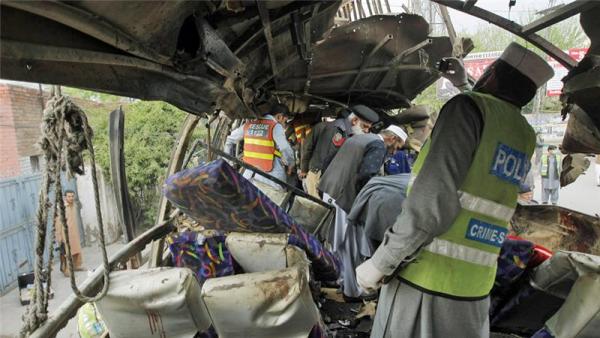
A bomb planted on a bus carrying government officials exploded in northern Pakistan on Wednesday, killing at least 15 people.
Police superintendant Kashif Zulfiqar told Al Jazeera more than 30 people were also wounded.
The bus was bringing dozens of government employees to work from Mardan when the bomb went off near Sunehri Masjid in Peshawar, a busy area of the northwestern city.
“The blast was really loud … the windows of the buildings nearby were shattered,” witness Usama Hussein told Al Jazeera over the phone.
“The roof of the bus was completely blown off by the bomb, I saw many dead bodies and severely injured people being rushed to the hospital.”
The attack was the latest in Peshawar, which has been plagued by bombings and gun assaults by the Pakistani Taliban.
No group immediately claimed responsibility for Wednesday’s attack.
A suicide bomber killed 13 people on March 8 after blowing himself up outside a court in Charsadda, in Khyber-Pakhtunkhwa province, about 30km from Peshawar.
Pakistan has fought homegrown fighters since 2004 when the Taliban, displaced by the 2001 US-led invasion of Afghanistan, began a campaign in border tribal areas.
{Zimbabwe faces its worst malnutrition crisis in 15 years, with tens of thousands of children requiring urgent treatment, Unicef said Tuesday as the government announced four million people need food aid.}
Poor rains induced by the El Nino weather phenomenon have hampered food production, and diminishing reserves have left many people in rural parts of Zimbabwe short of essential supplies.
The number of hungry families doubled in the past eight months “as nearly 33,000 children are in urgent need of treatment for severe acute malnutrition,” Unicef representative Jane Muita said in a statement.
“We have not seen these levels of malnutrition in more than 15 years and… more needs to be done to prevent this crisis from spiralling out of control.”
{{ACUTE MALNUTRITION}}
“Severe acute malnutrition” is defined as extreme hunger causing visible wasting and fluid retention. “Water scarcity is also exposing children to higher risks of diarrhoea, typhoid and other waterborne diseases including cholera,” Muita added.
Unicef is requesting $21 million in aid to meet the needs of children in Zimbabwe. Some families are saving dwindling stocks by skipping meals, while schoolchildren are missing classes due to hunger, according to local media reports.
In addition to the effects of severe drought, Zimbabwe has suffered perennial grain shortages after land reforms under which white-owned commercial farms were redistributed to landless blacks.
The state-owned Herald newspaper on Tuesday quoted social welfare minister Prisca Mupfumira as saying up to four million people required food assistance nationwide.
{Ivory Coast President Alassane Ouattara vowed Monday that the country would not be “intimidated by terrorists”, as the death toll in the country’s first jihadist attack climbed to 18.}
Armed with grenades and assault rifles, gunmen on Sunday stormed three hotels and sprayed the beach with bullets in the resort of Grand-Bassam, a sleepy town popular with expats just a short 40 kilometre drive from the commercial capital Abidjan.
The attack claimed by Al-Qaeda in the Islamic Maghreb (AQIM) left 15 civilians dead, including a German woman, as well as killing three special forces troops, the government said. A total of 33 people were injured, 26 of whom are still in hospital.
France said four of its nationals were among the dead.
AQIM’s real target was France, analysts said, punished both as Ivory Coast’s former colonial master and for hunting down jihadists in Mali and elsewhere.
“The Ivory Coast will not allow itself to be intimidated by terrorists”, Ouattara said in a statement broadcast on radio and television.
“Ivory Coast is standing up, standing up to fight the cowards and protect its people.”
He vowed to work with countries in the sub-region, on the continent and with our “other international partners to reinforce our cooperation to fight these terrorists”.
Interior Minister Hamed Bakayoko said “three terrorists were killed” in the assault.
NATIONAL MOURNING PERIOD
Asked whether more gunmen were involved — some witnesses had reported several attackers — the minister said “we’re still looking. We don’t suspect more but we’re making sure we carry out the widest possible sweep.”
Along with a three-day national mourning period starting Monday, he said the West African nation would boost security at “strategic sites and in public places… (such as) schools, embassies, international institutions… and the borders.”
In the latest such jihadist assault in West Africa, witnesses described the panic as gunfire rang out across the sand and an assailant shouted “Allahu Akbar” — Arabic for “God is greatest”.
Condemnation came from around the world with UN Secretary General Ban Ki-moon pledging to help government “efforts to bring the perpetrators of these crimes to justice.”
French President Francois Hollande’s office said his country will support Ivory Coast “to fight terrorism and considers that cooperation between all the states threatened by terrorist groups, particularly in West Africa, must intensify more than ever”.
It was the third such attack in four months in West Africa and a blow to a nation working to lure back foreign tourists to its palm-fringed beaches and rainforests as it recovers from a brutal civil war.
The German victim was named as 51-year-old Henrike Grohs, who headed Abidjan’s Goethe Institute, the German language centre’s secretary-general said. Grand-Bassam is packed at weekends with visitors drawn by its magnificent beaches and Unesco-listed colonial-era buildings.
Carine Boa, a Belgian-Ivorian teacher at an international high school in Abidjan, was at one of the beach bars with her two sons when the gunmen arrived. “We were really scared. We thought of the people at the Bataclan,” she said.
{Corruption has become so infectious in Kenya that it does not even spare the dead.}
And chances are high that the dead person whose kin will be compelled to part with some money before a death certificate is issued, lost his life due to lack of medical services, which could not be offered without a bribe.
That corruption is so malignant was revealed on Tuesday in a survey by the Ethics and Anti-Corruption Commission (EACC), which showed the level of the vice and how much ordinary folks pay bribes to be served.
The report, whose findings can be described as a bearing of the anatomy of corruption in Kenya, shows that the vice has permeated the society, deep to the bone marrow, all the way from the national government to the three-year-old counties.
The survey also found that at least 0.4 per cent of those who were interviewed said that they were required to pay a bribe before they were given a birth certificate.
A legal document issued under the Registration of Births and Deaths Act, the death certificate has become a key determinant in the rising cases of inheritance, retirement benefits, administration of estates and proof of parenthood, a fact that has not escaped the officers at the Attorney-General Chambers in Nairobi and district registries.
ASKED FOR A BRIBE
The findings show that when you are seeking a death certificate you are likely to be asked five times for a bribe before you are served both at the national and county levels.
However, a person seeking the release of his goods, which have been impounded, faces the possibility of being asked for a bribe four times while an applicant for a passport will encounter three demands for a bribe.
“Obtaining a death certificate (5.27), release of impounded goods (4.66) and application for a passport (3.15) recorded the highest bribe demands,” the survey says.
Normally, on application for a death certificate with requisite documents, it is supposed to be issued within three days in Nairobi, Mombasa and Kisumu, while at the district registries, it should take a day.
The findings released on Tuesday, show the likelihood of the cause of death could have been failure to get adequate medical services, with 20 per cent of those interviewed saying they have had to bribe before being treated.
The survey also found that at least 18.4 per cent of Kenyans pay a bribe to get a national identity card followed by birth certificates (13.4).
The two documents, first issued by the Registrar of Persons and the second by the Registrar of Births and Deaths, are closely linked — you require the second one to get the first one.
This is why the Department of Registrar of Persons was cited as one of the most corrupt in the survey.
Perhaps the high level of corruption involving the two, stems from the influx of people from the war-torn Somalia, who have been seeking Kenyan identity.
The Department of Immigration has come under the spotlight for this menace, accused of taking money to hand out Kenyan nationality to foreigners. Other services, which Kenyans are paying bribes for, are title deeds and land registration.