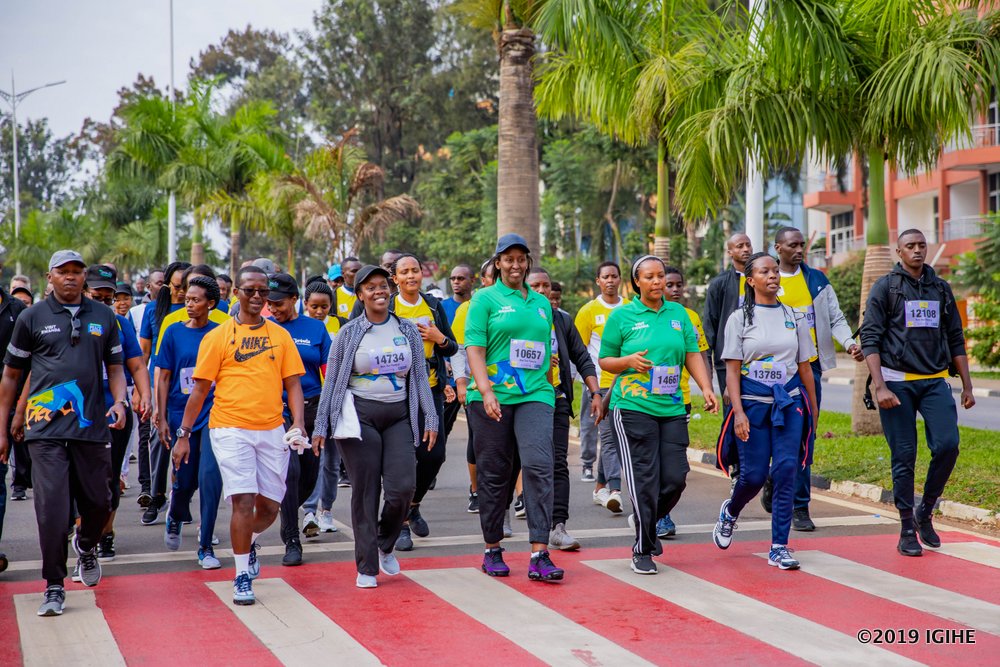
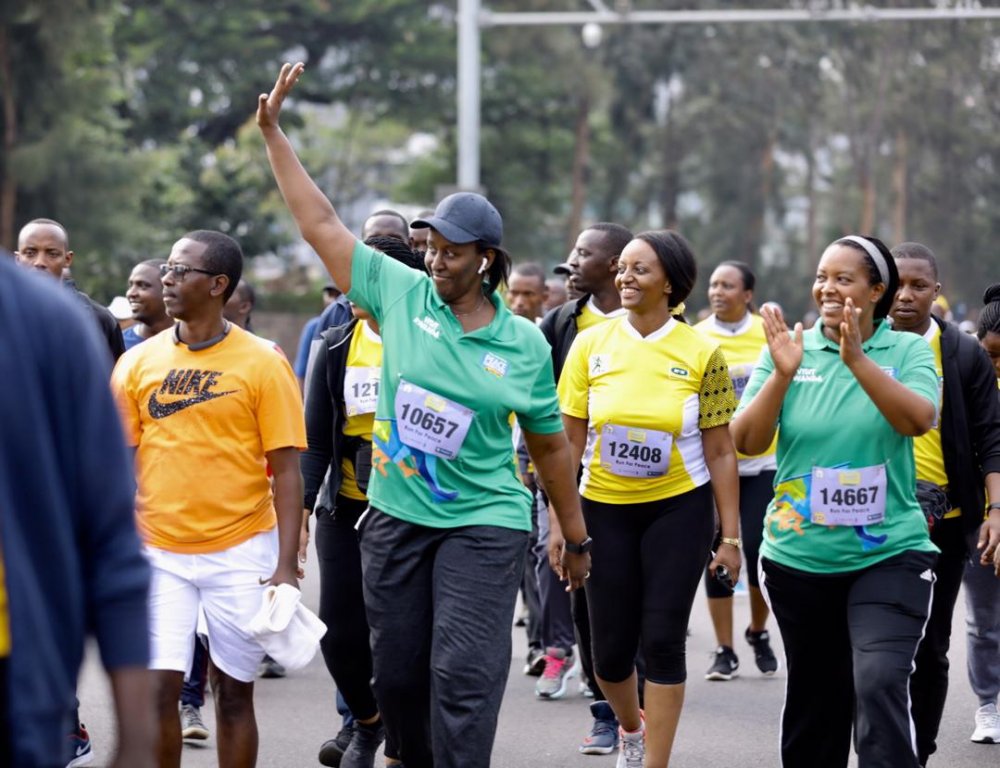
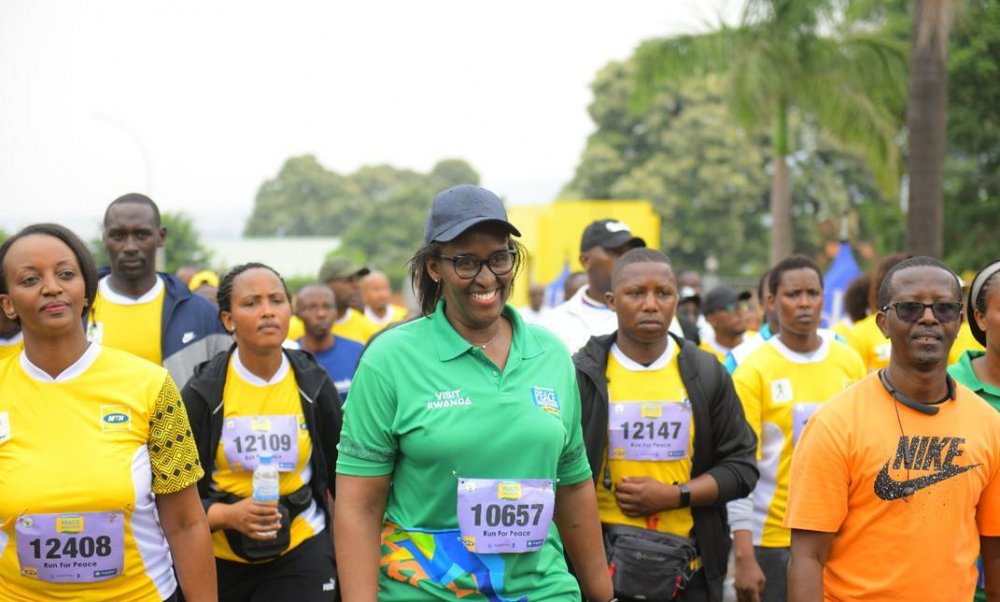
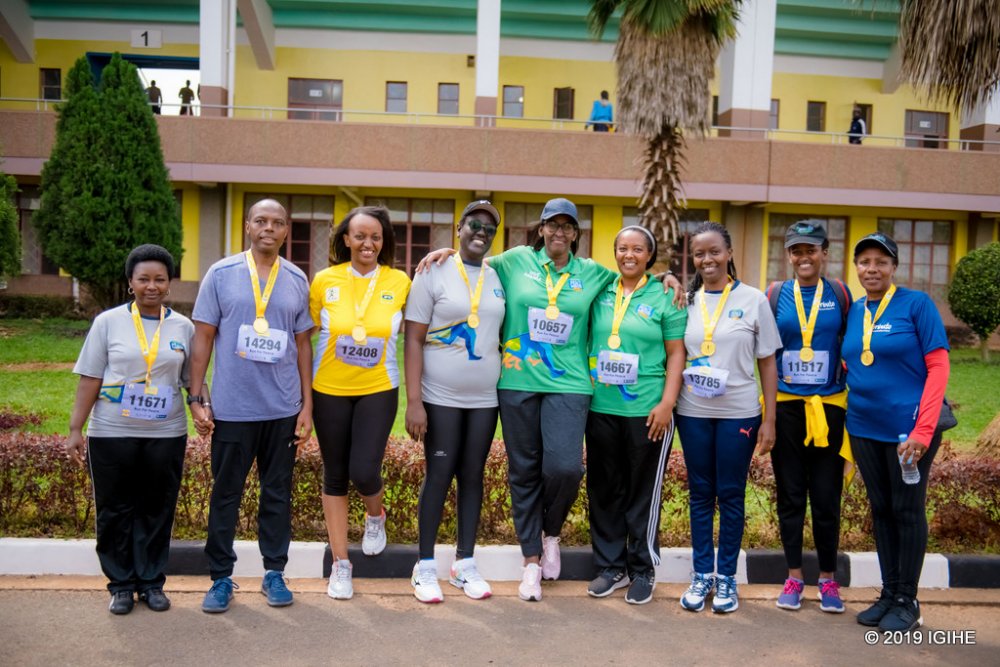
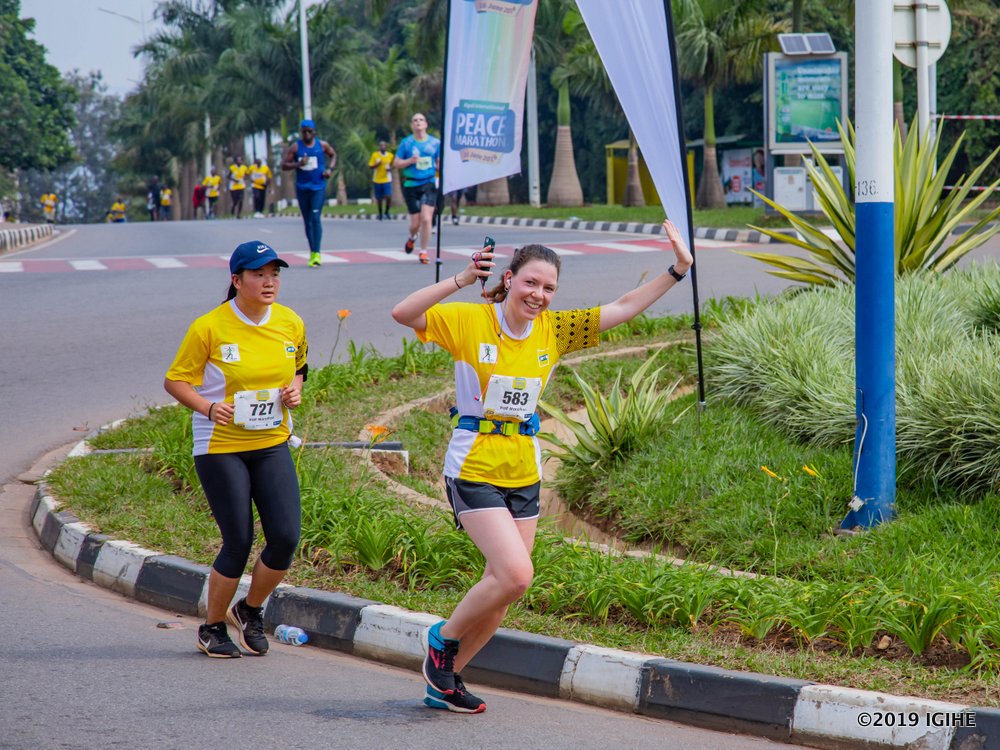
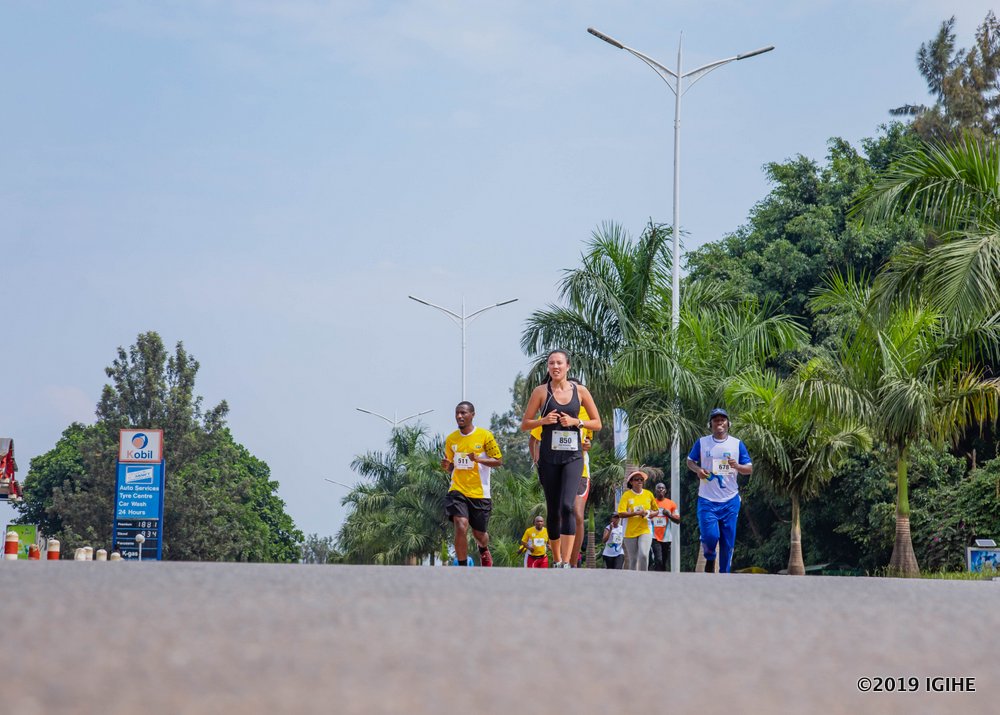
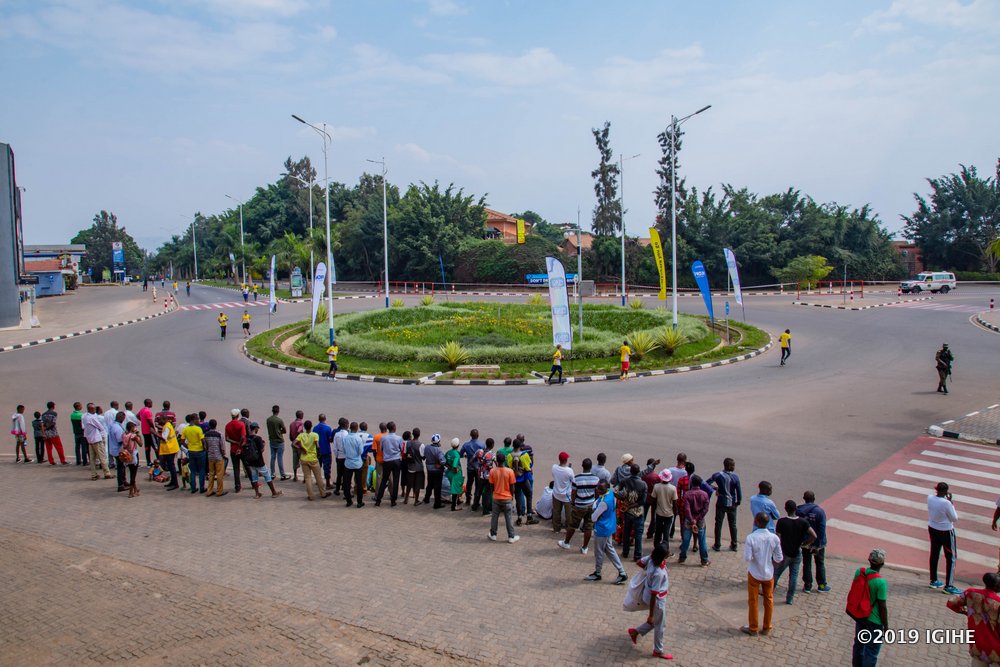
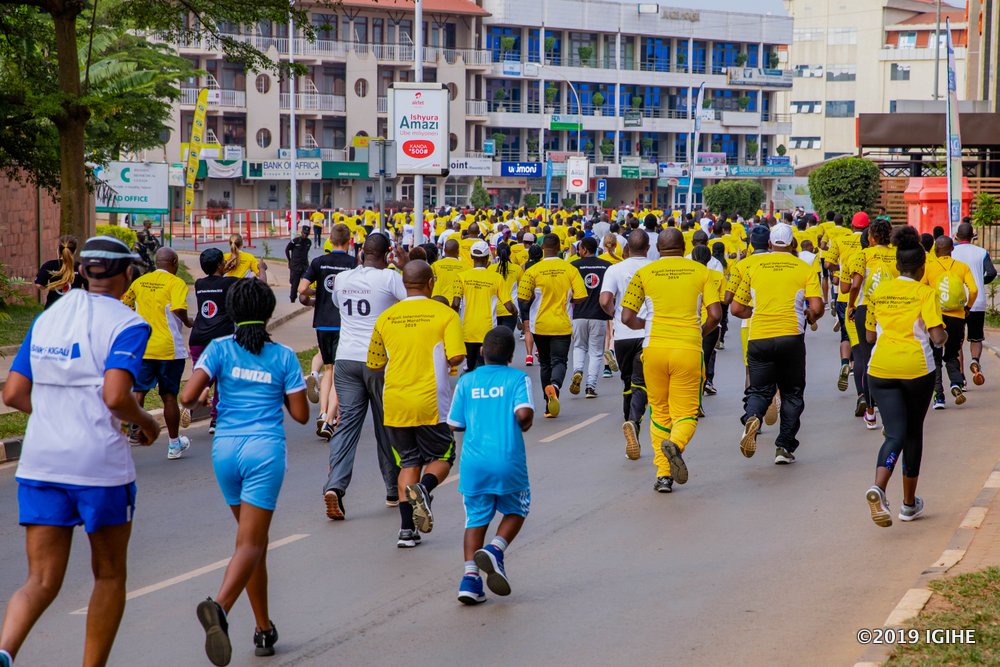
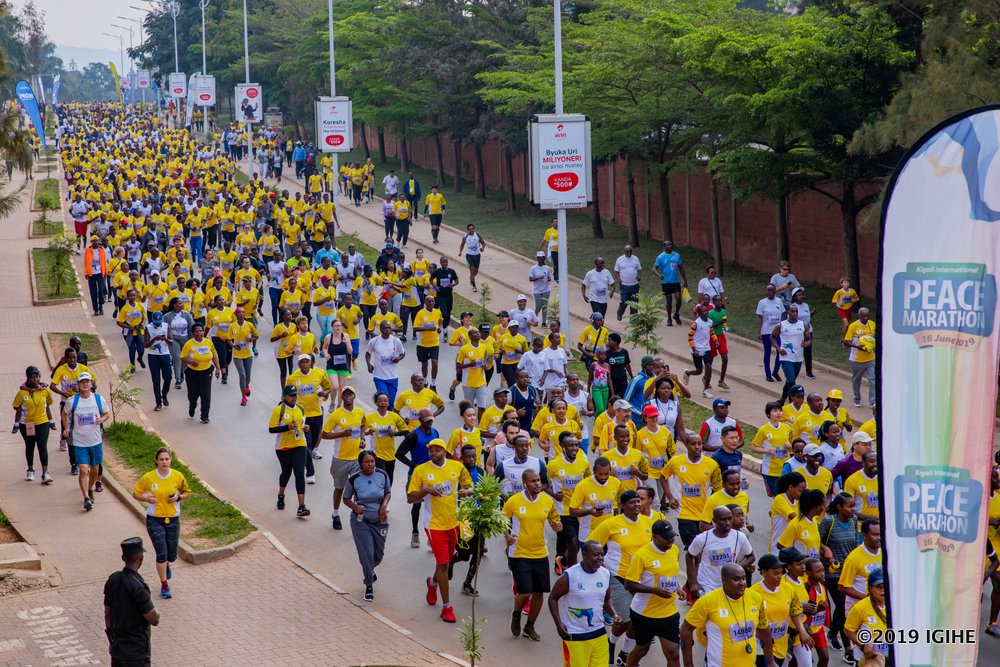
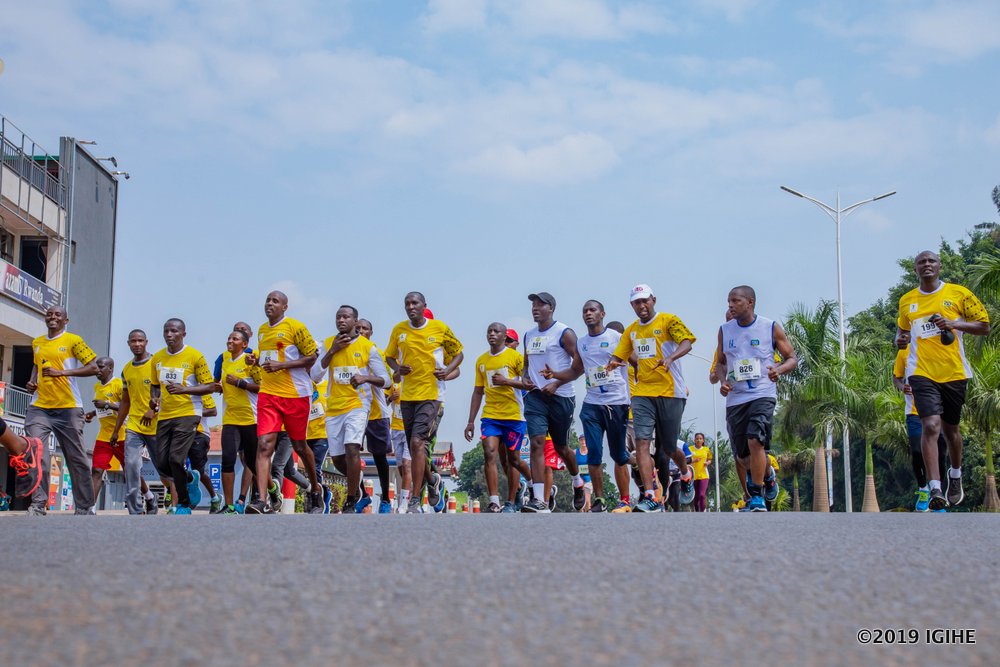
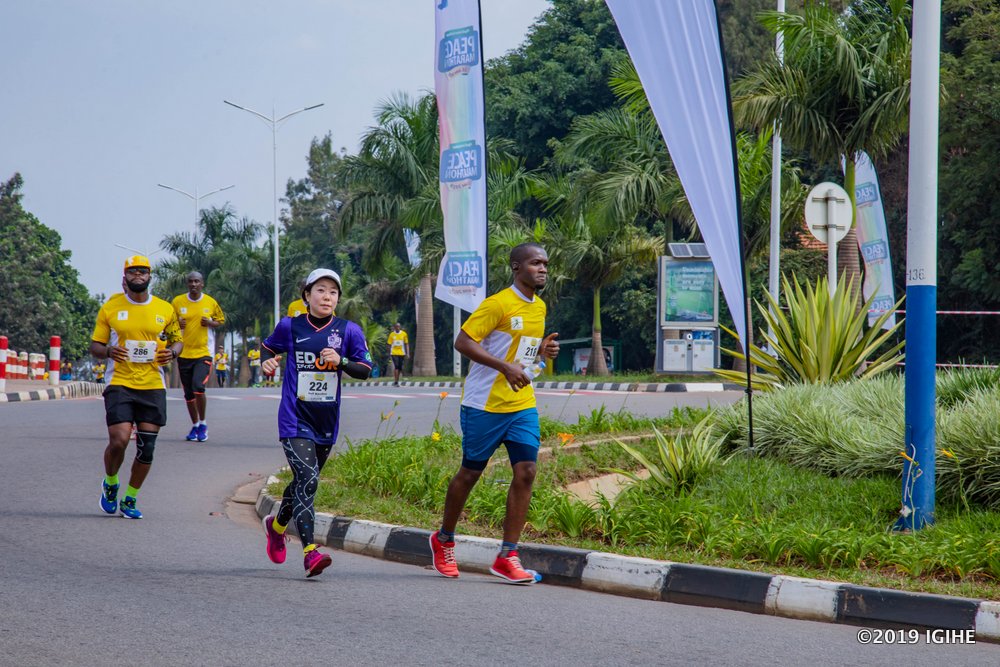
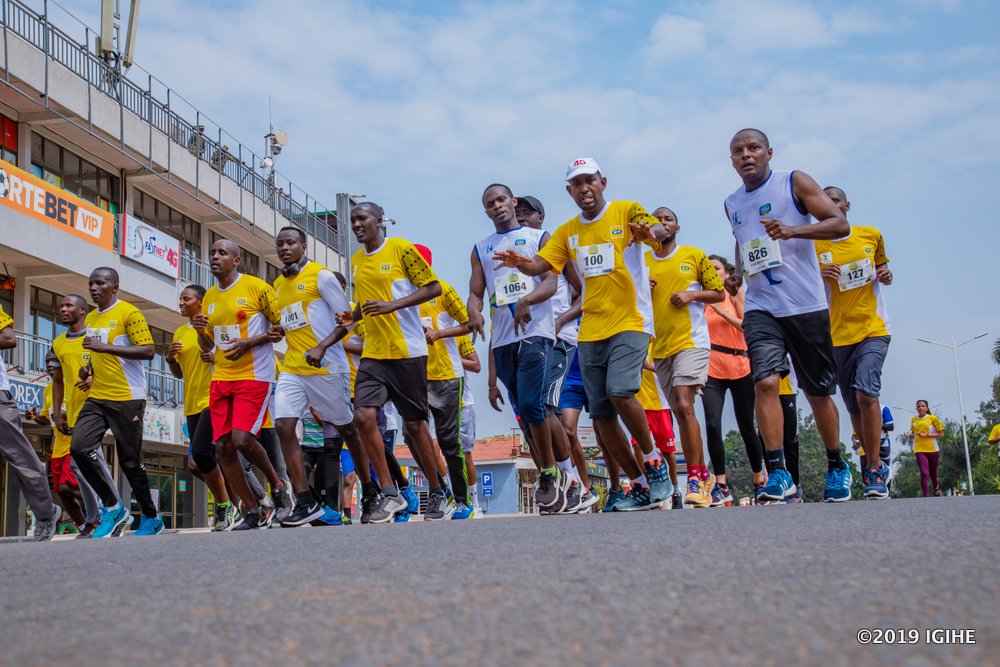
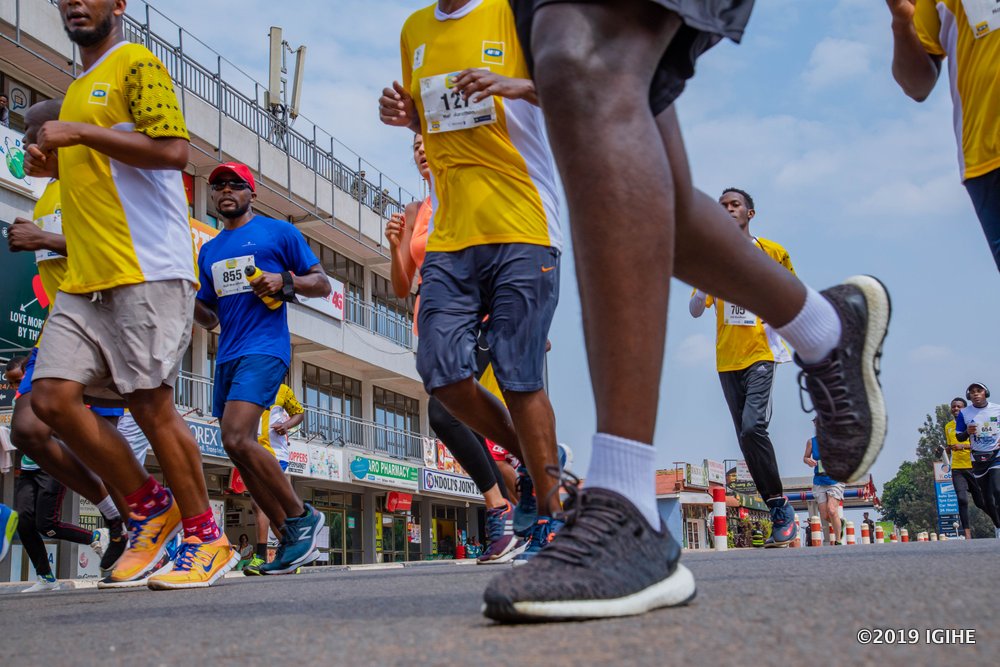
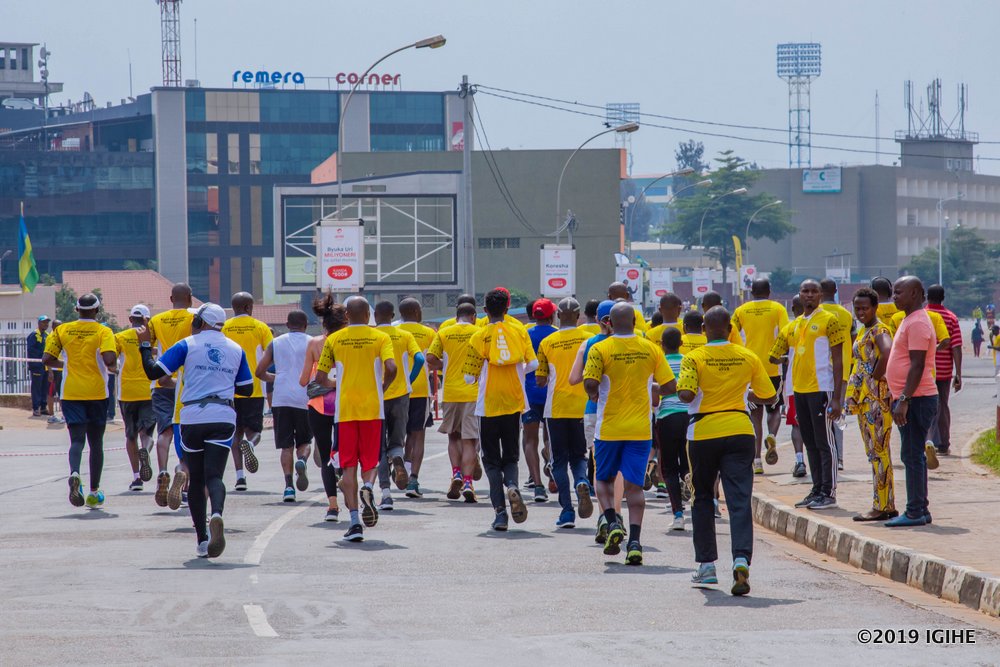
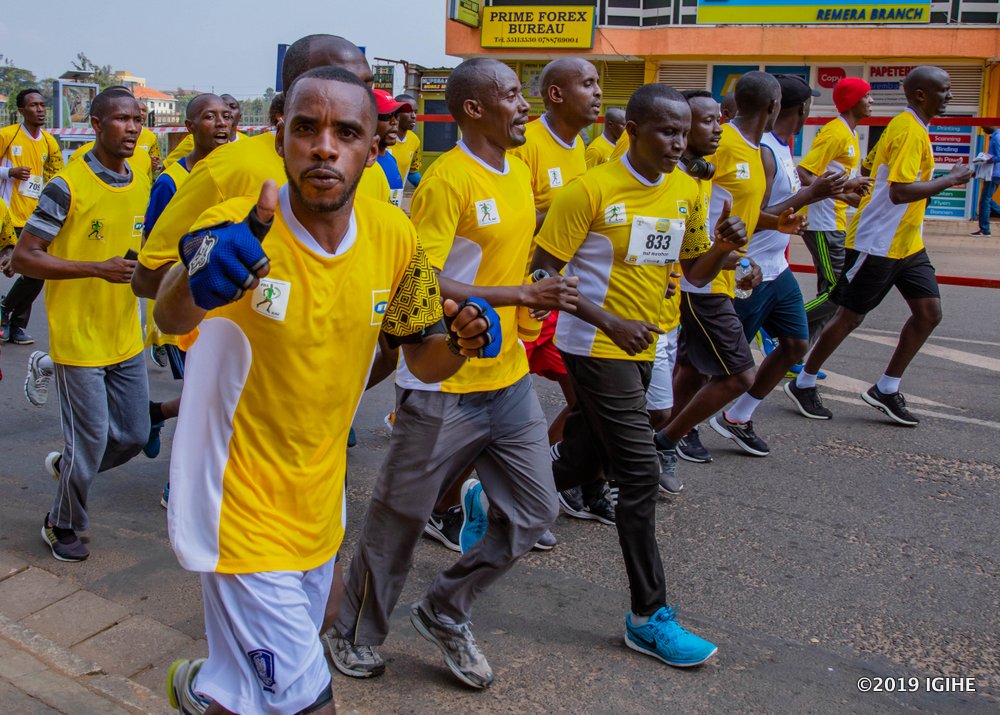
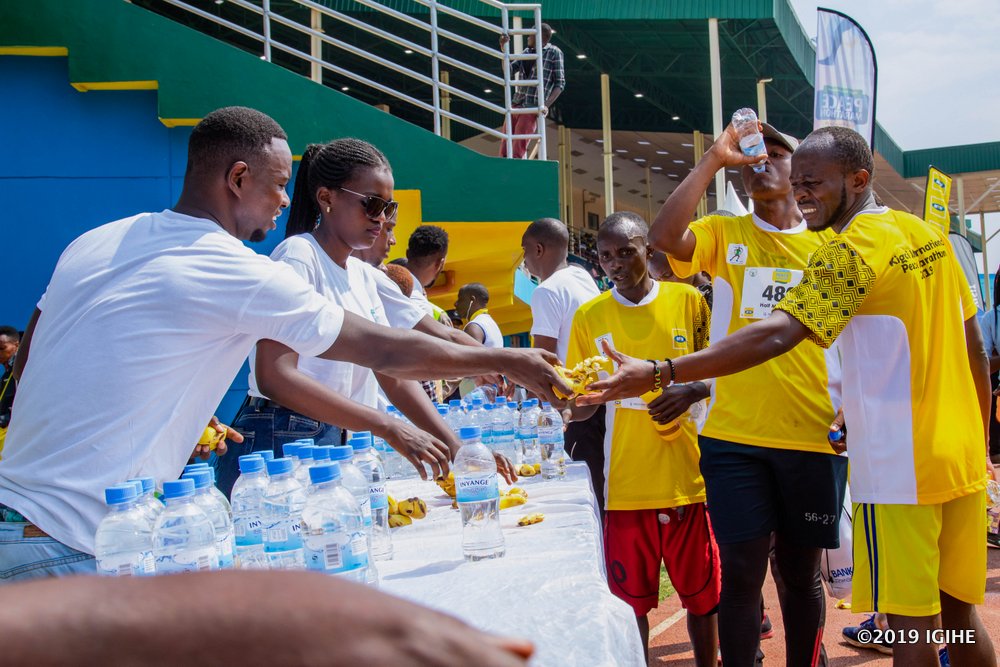
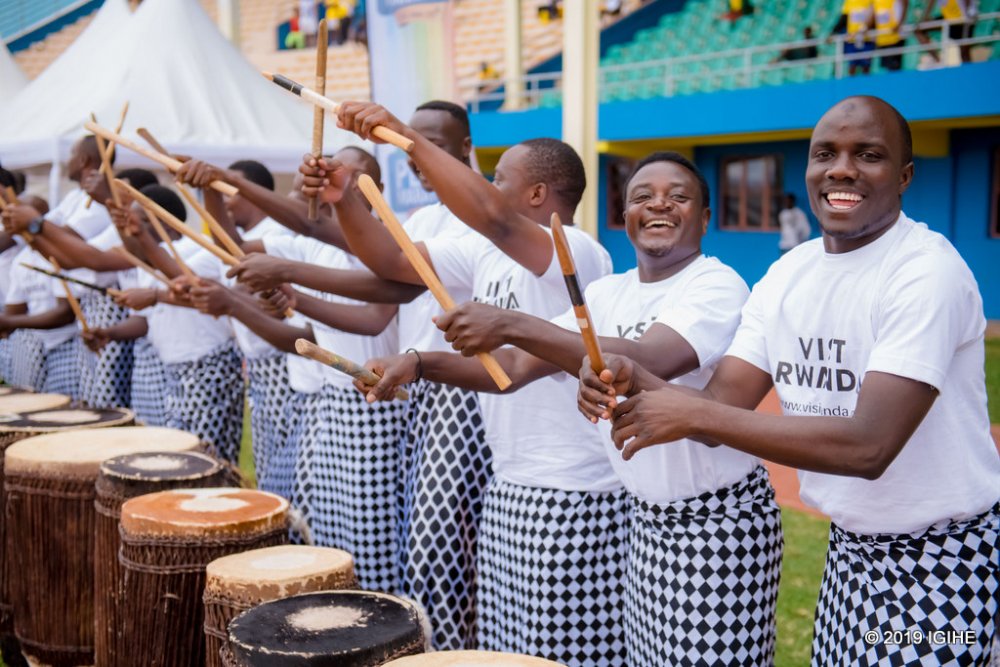
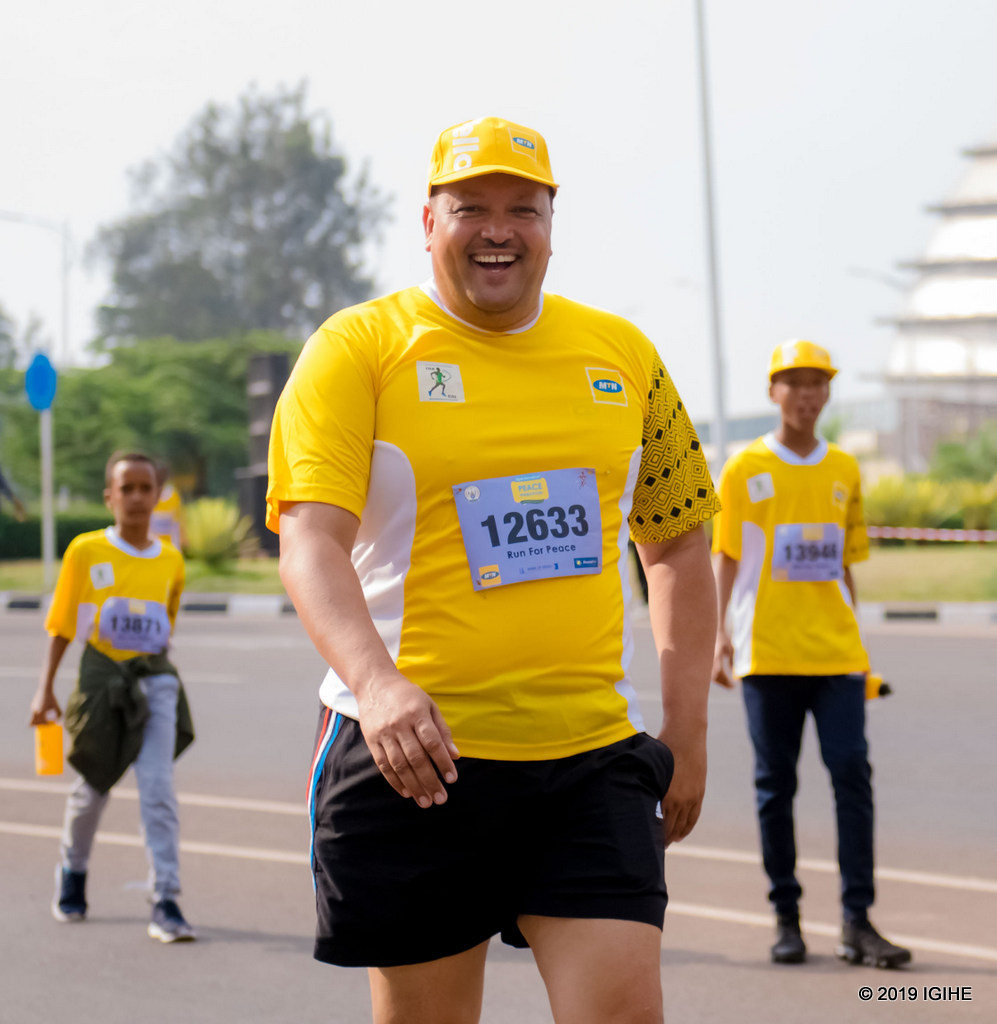
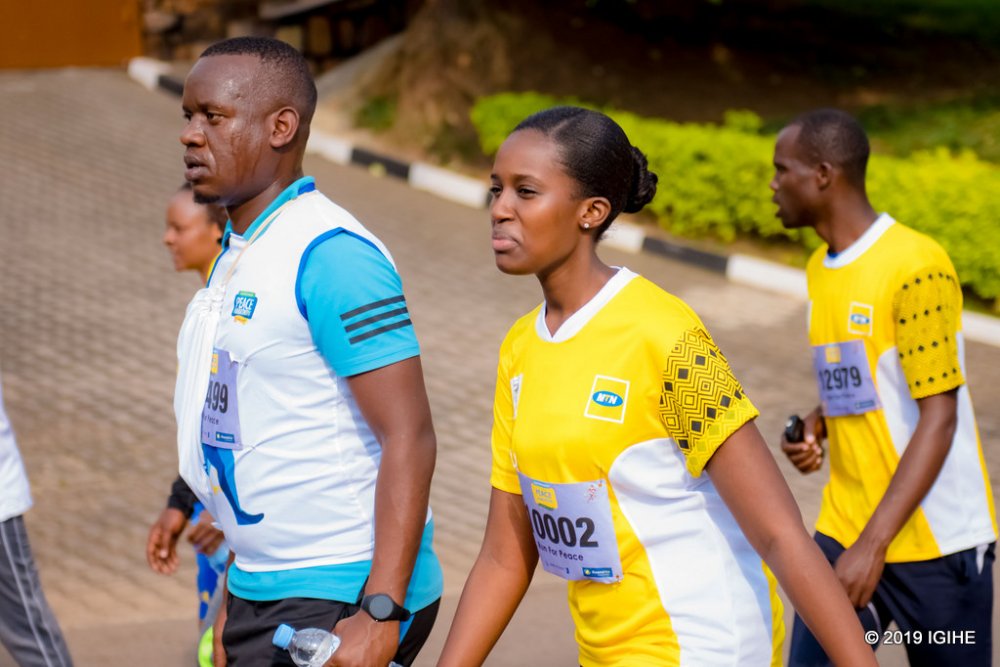
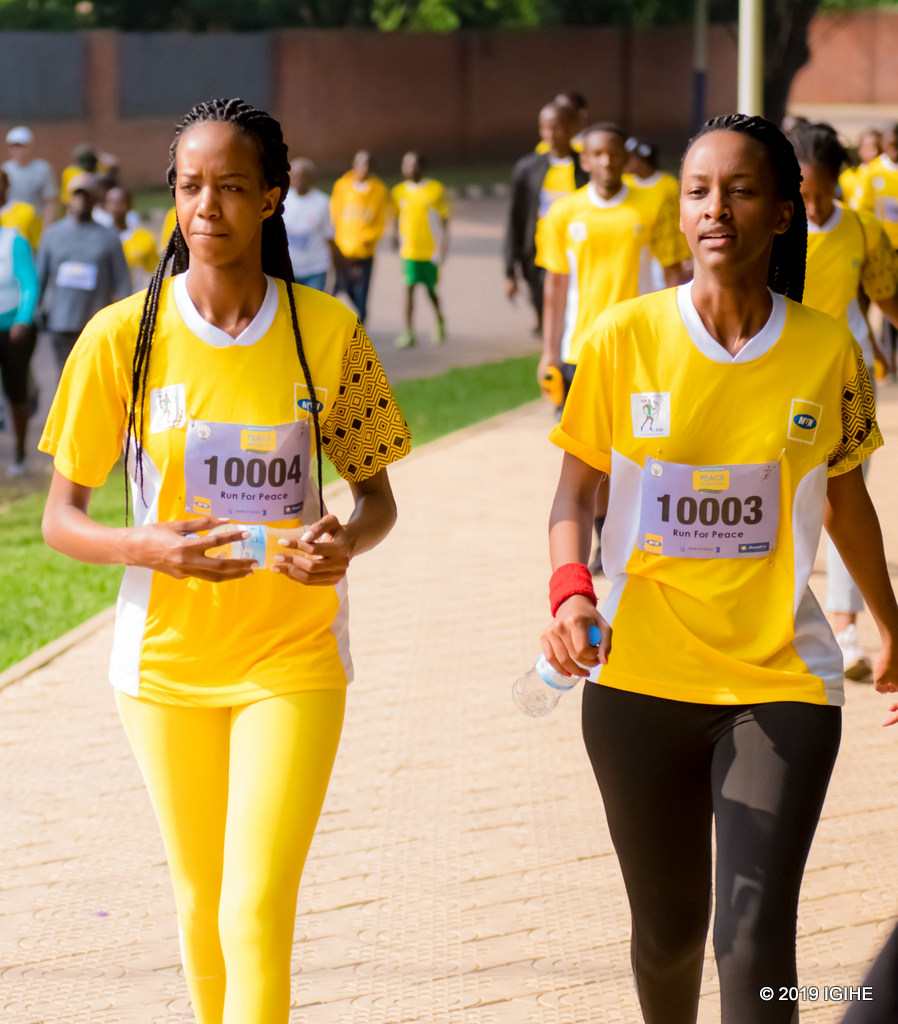
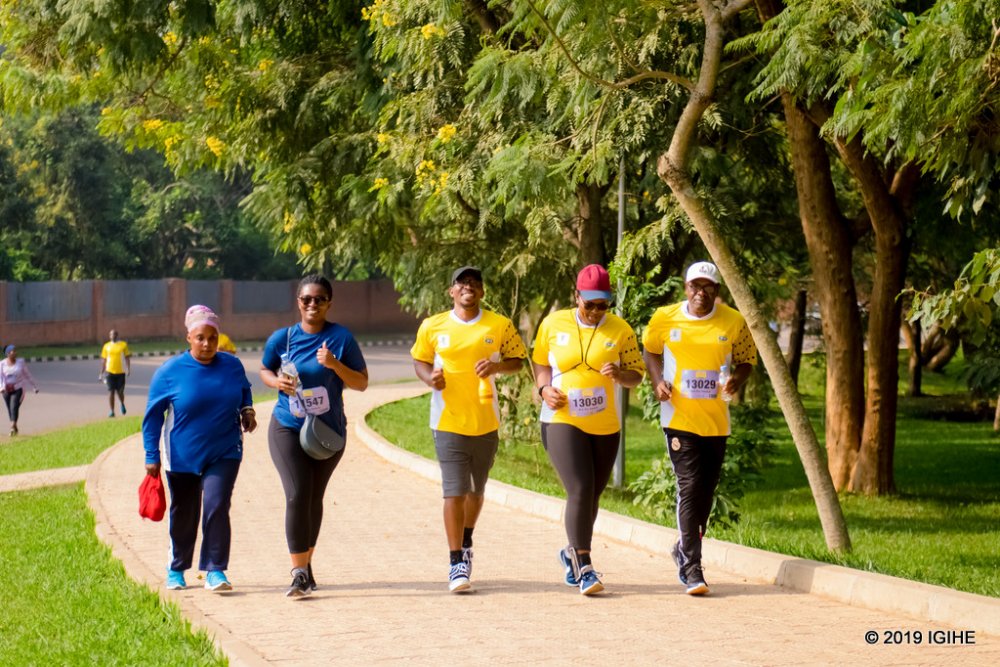
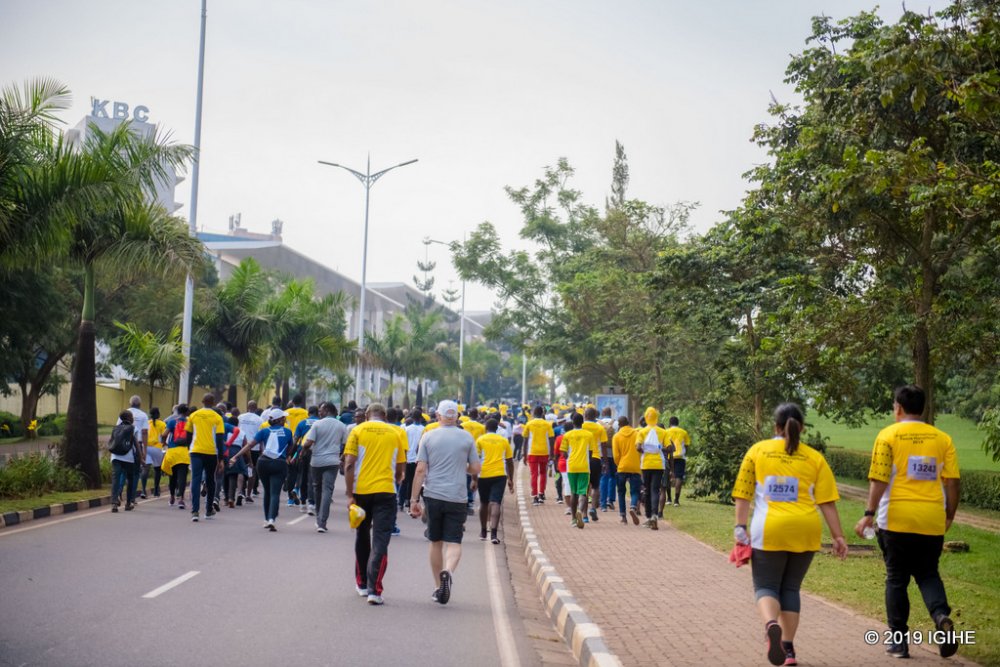
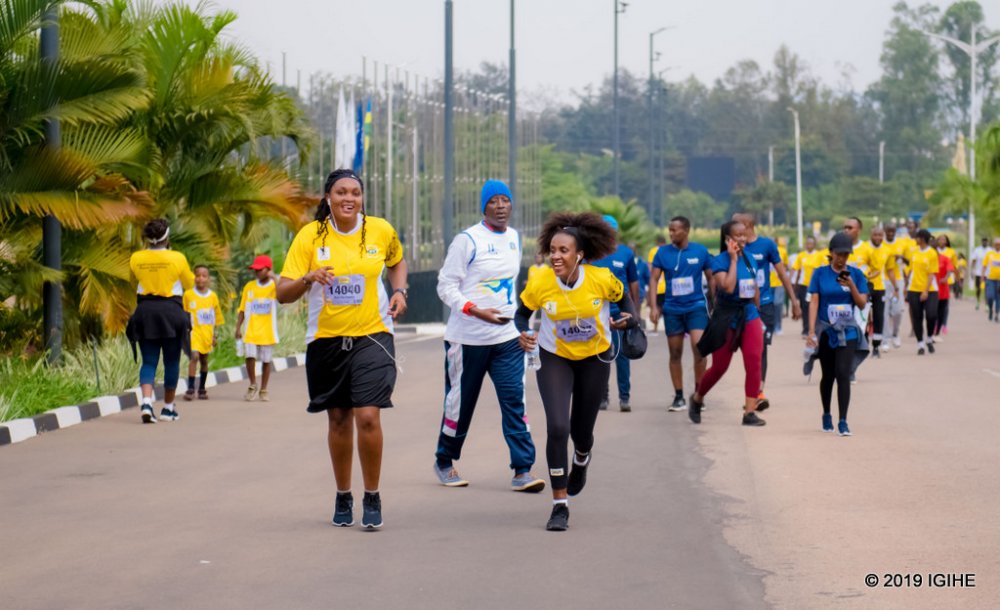
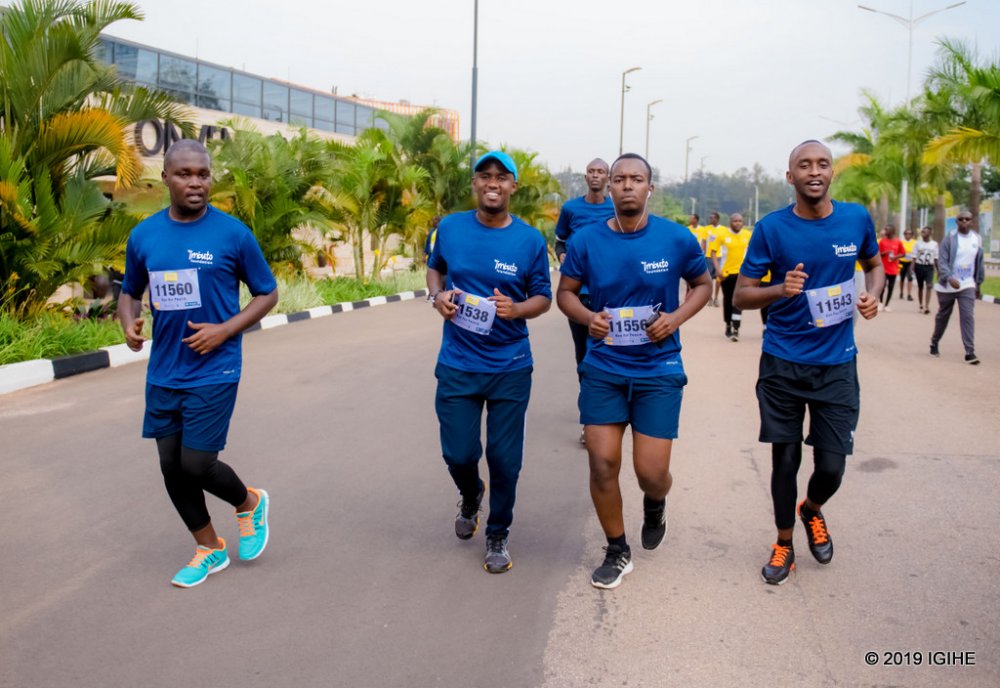
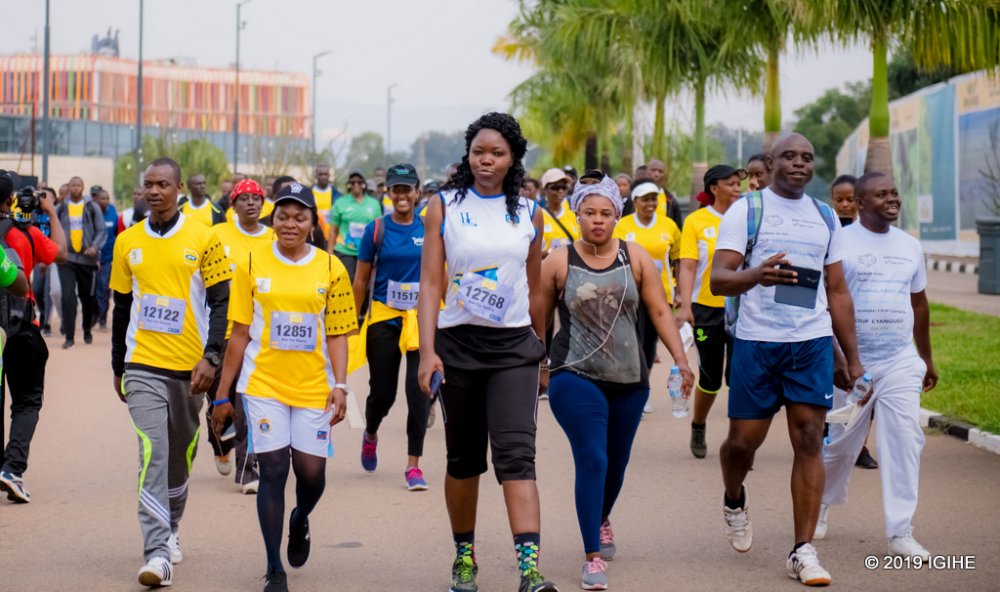
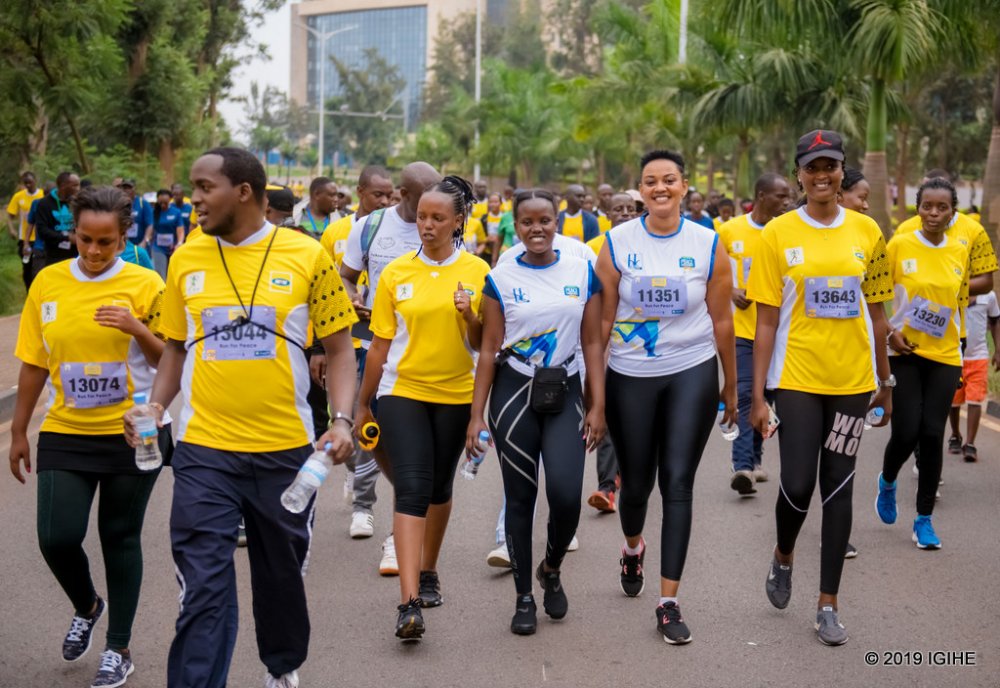
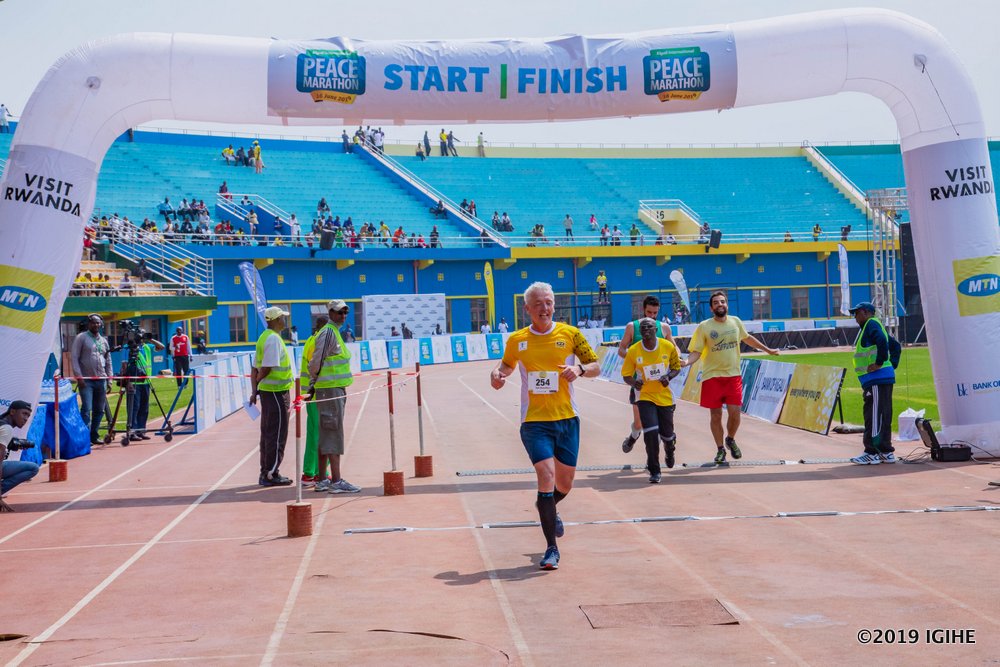
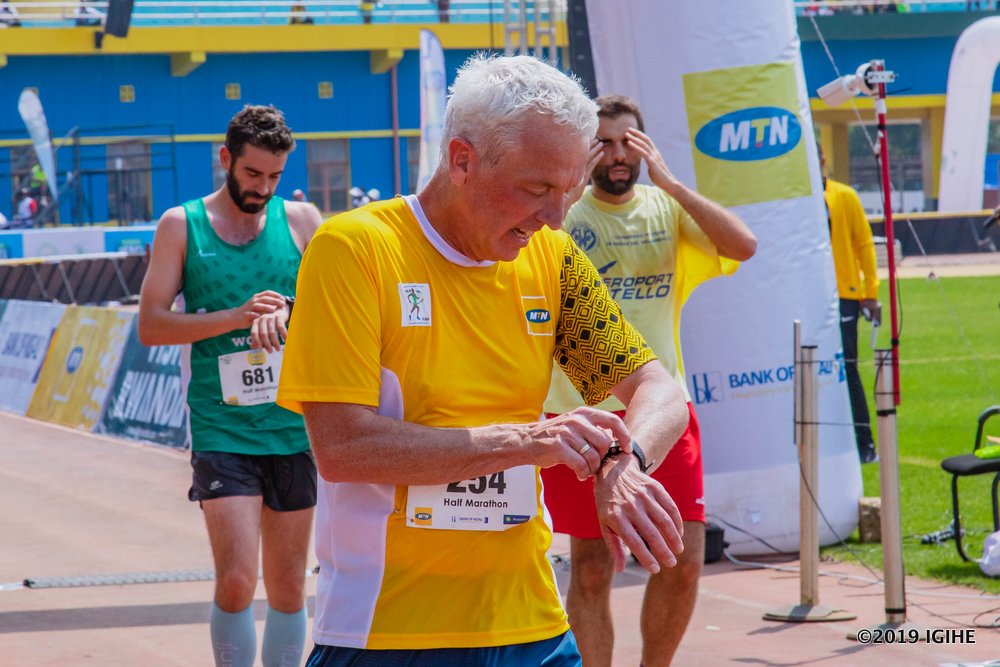
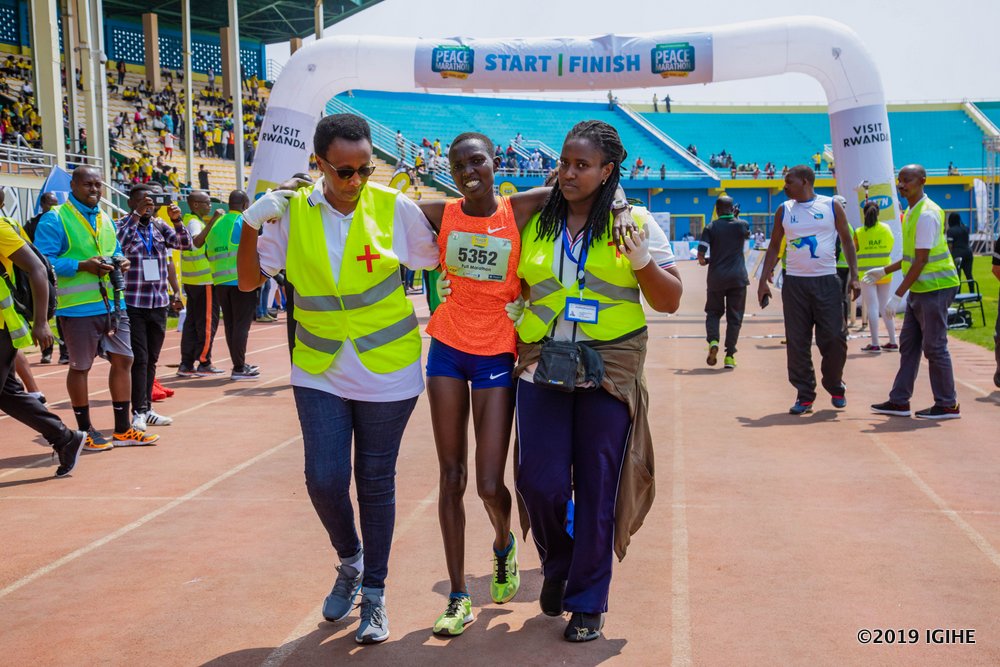
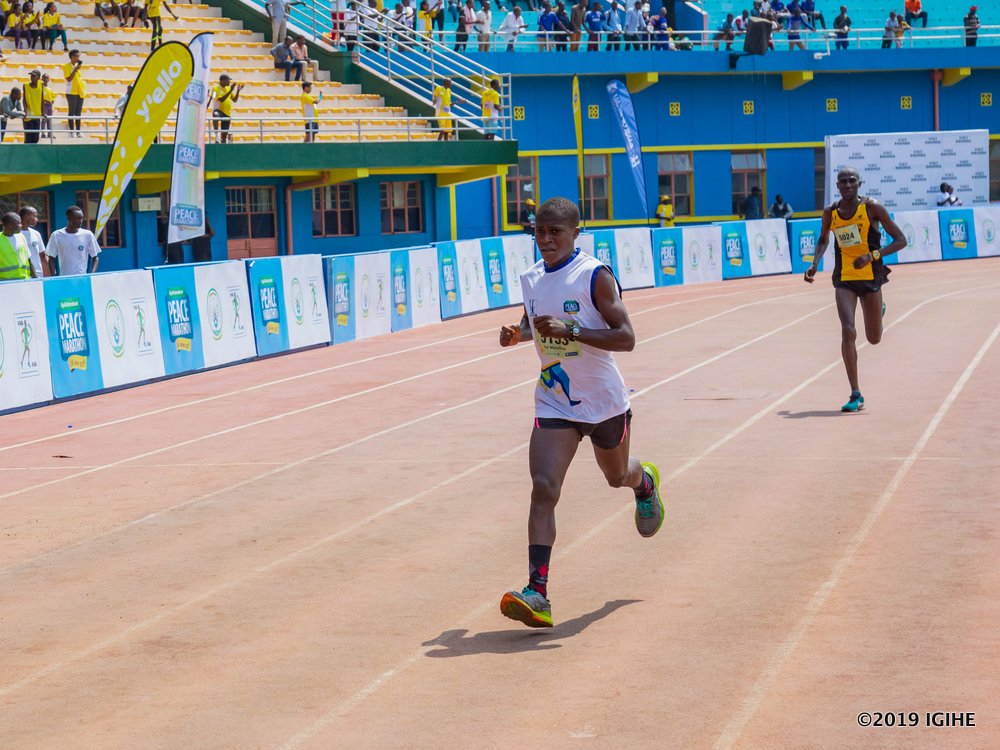
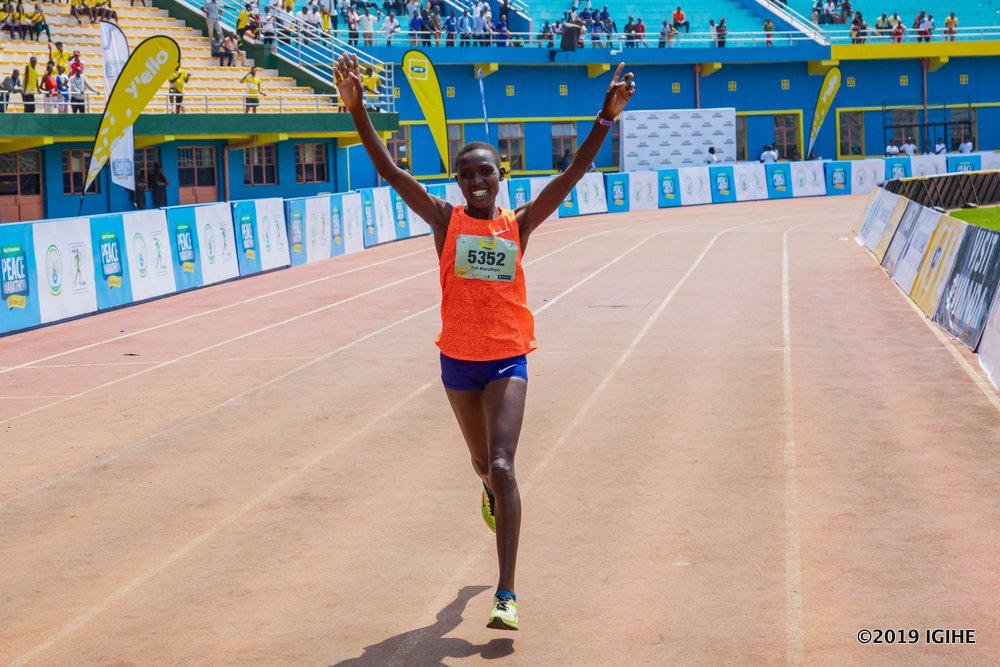
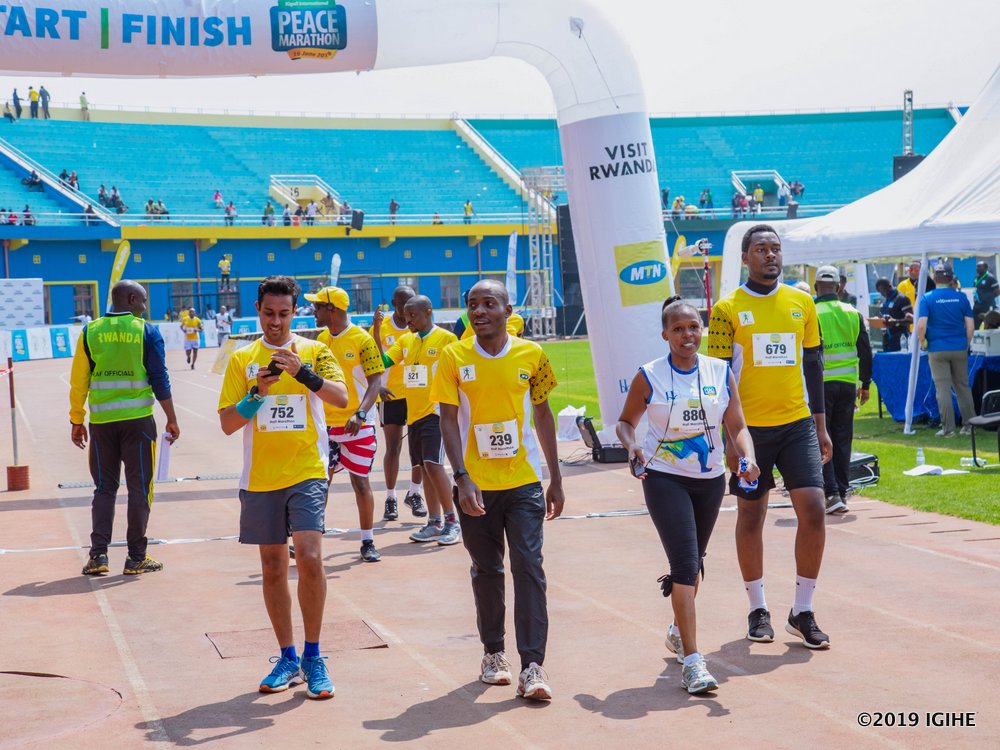
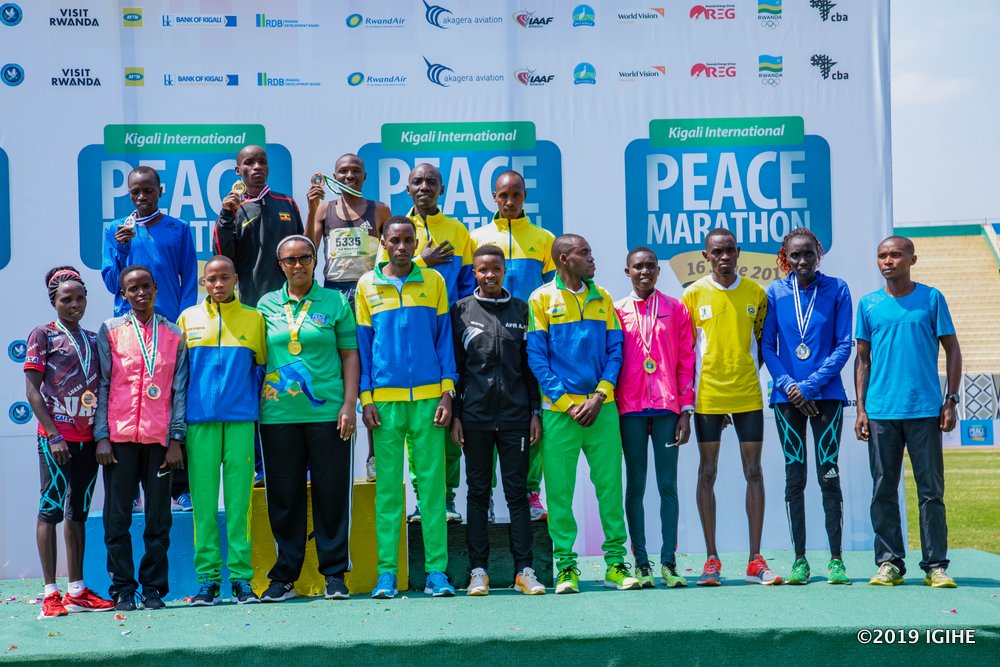
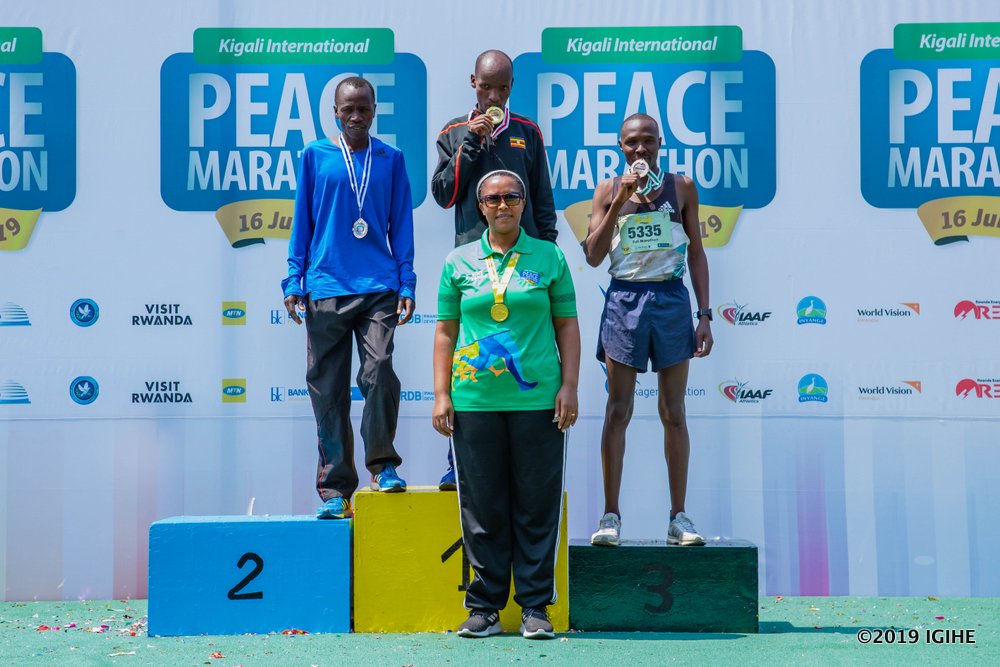
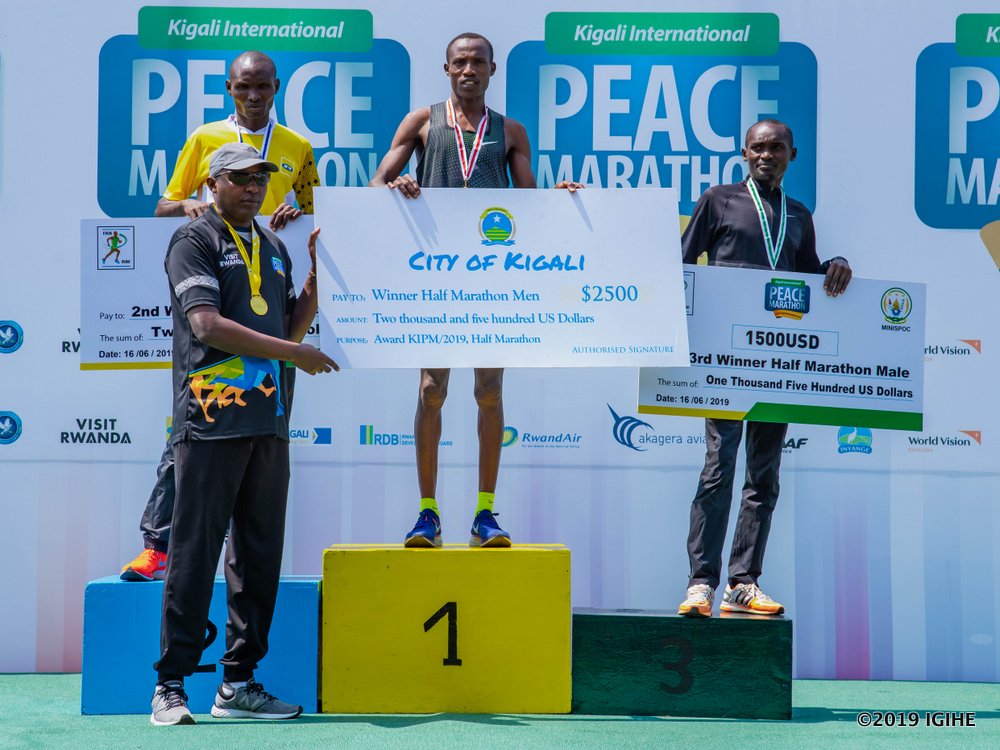
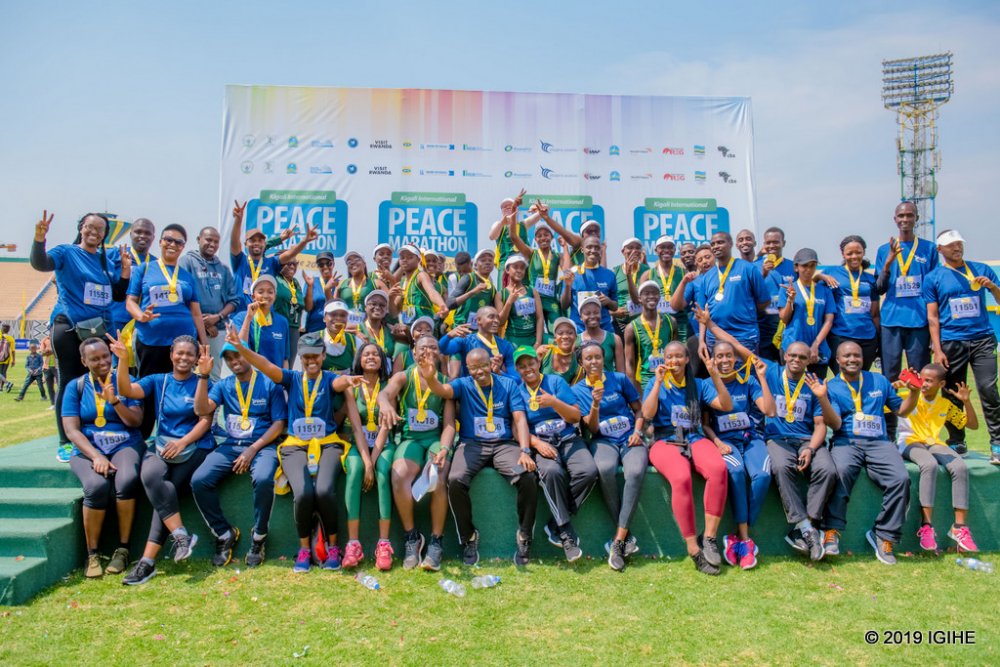
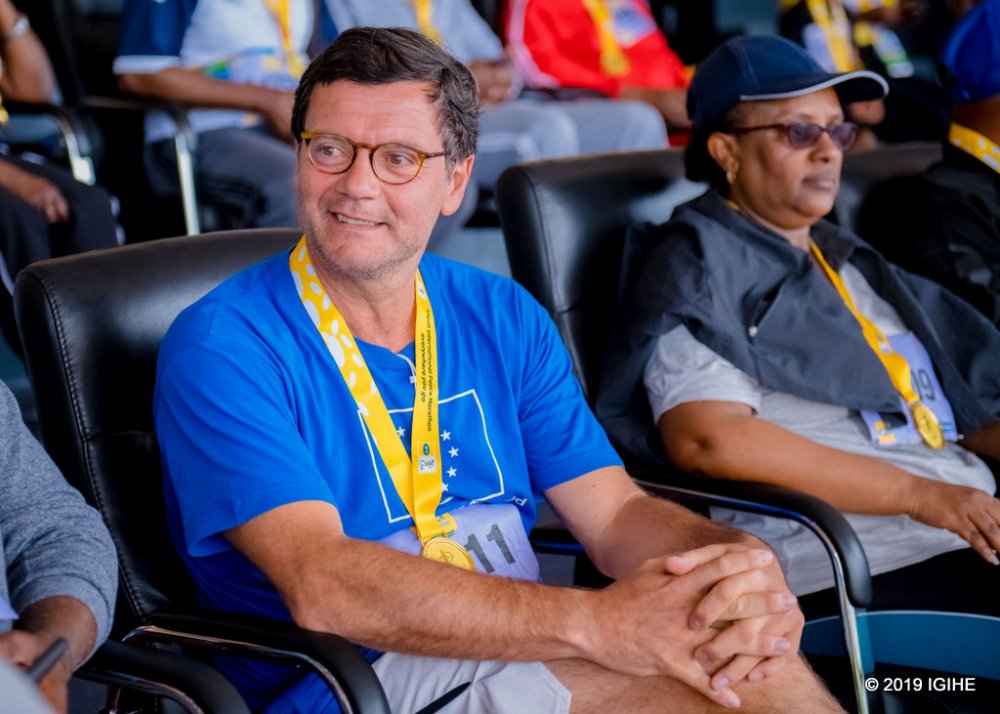
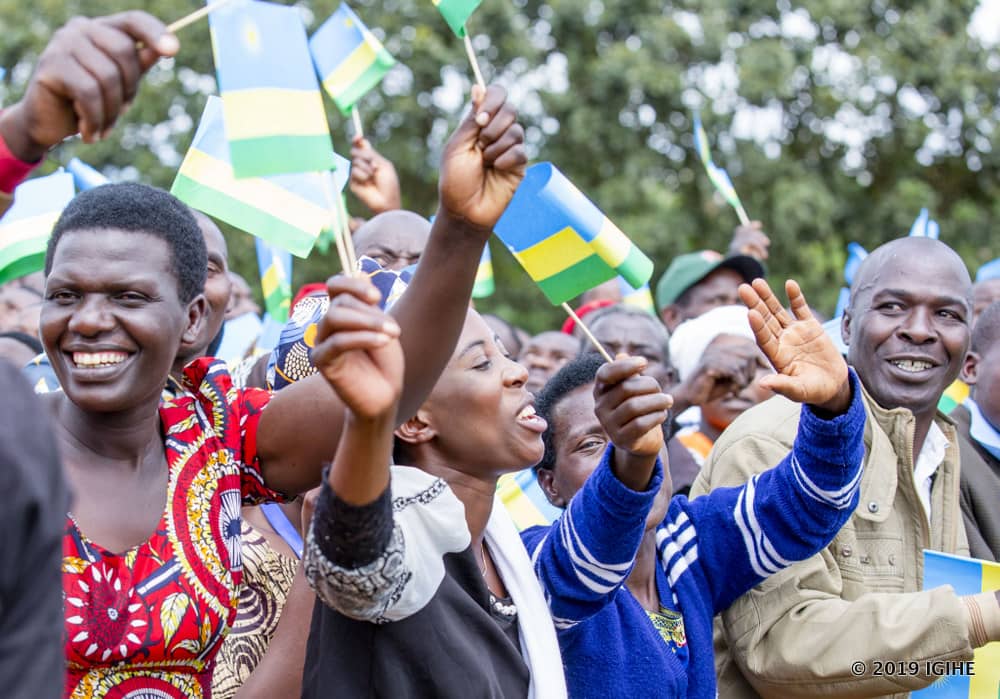
Yesterday’s Kigali International Peace Marathon which aims at promoting peace through sports was attended by 3899 participants from 55 countries who contested in its three categories namely: Marathon (42.195 km), Half Marathon (21.097) km and Run For Peace (10 km).
First Lady Jeannette Kagame participated in Run For Peace category where she run 10 km along with the Minister of Sports and Culture, Espérance Nyirasafari; the mayor of Kigali City, Chantal Rwakazina among other dignitaries.
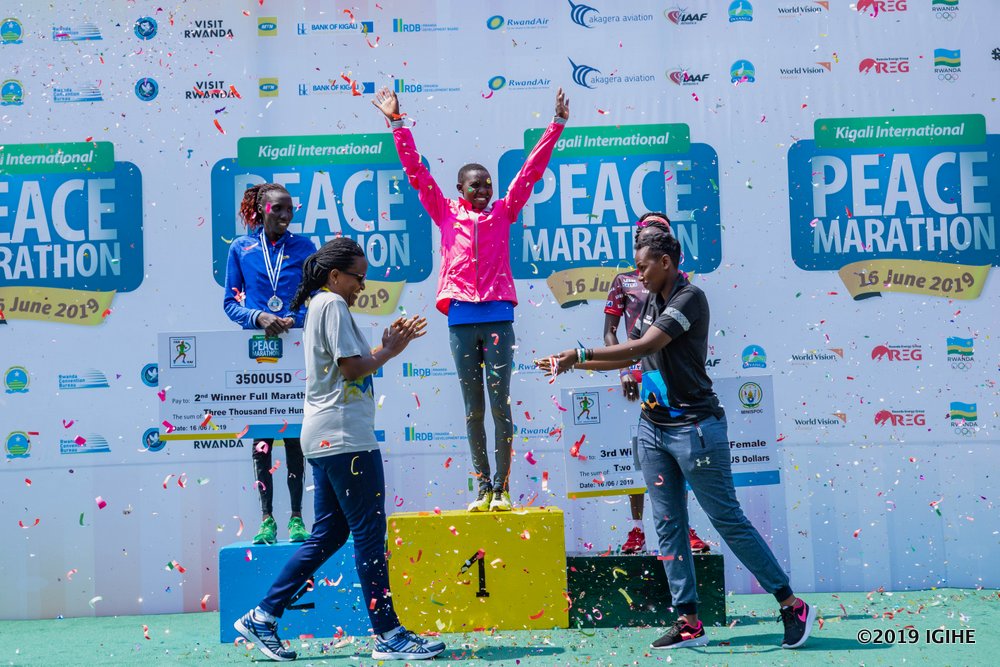
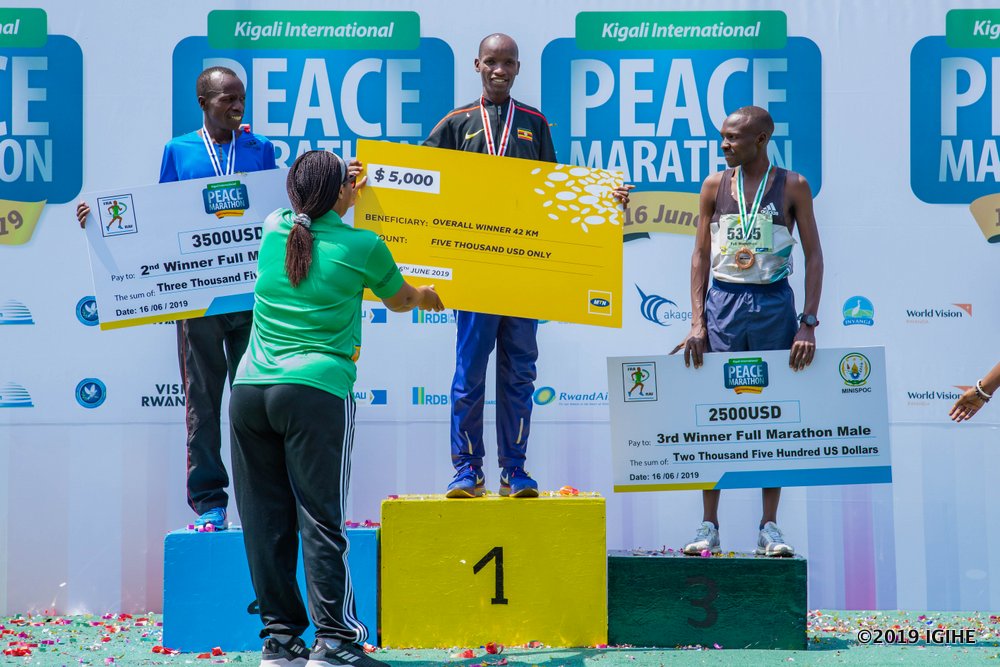
Philip Kiplimo from Uganda won 42 km run in men category while Jepchirchir Korir from Kenya won in women category.
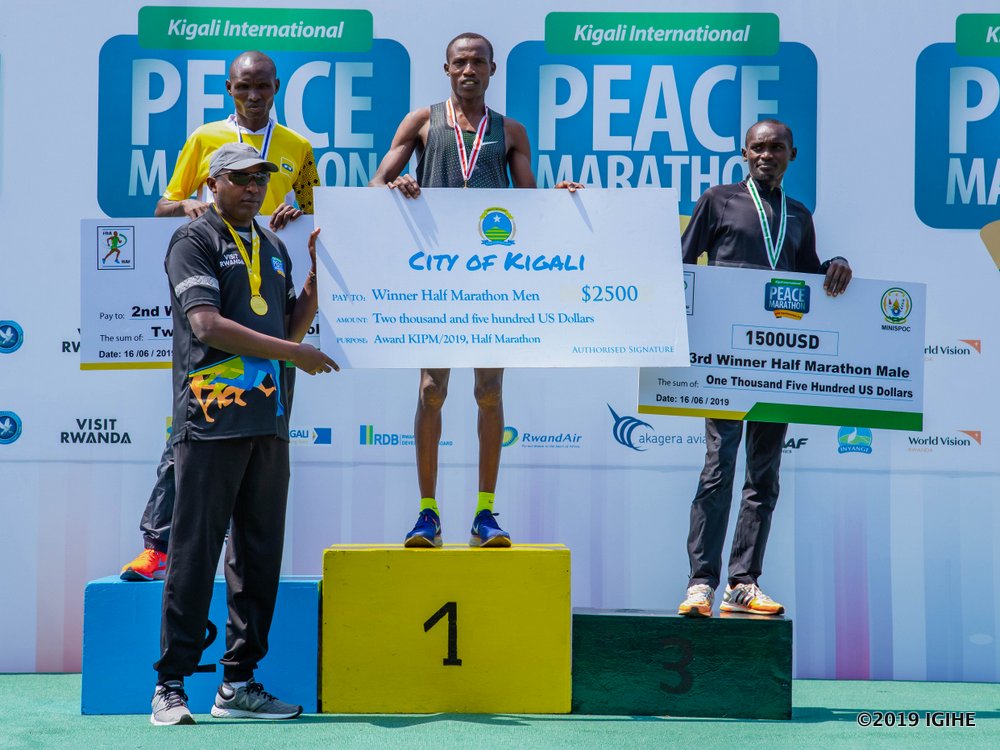
Chepchirchir Celestine from Kenya won the Half Marathon in women category while Kiminine Shadrack from Kenya won in men category.
Kigali International Peace Marathon started in 2005 supported by President Paul Kagame.
Rwanda Athletics Federation (RAF) president, Fidele Mubiligi Fidèle said that this year’s marathon was successfully completed though Rwandans didn’t emerge among first runners.
“ The marathon ended on a high note in general. Half Marathon was won by Rwandans last year but no Rwandan won for this edition except one who emerged the second in women category. It is normal in competitions. This year’s marathon attracted competent runners because awards were increased,” he said.
Three Rwandans who performed well in each category of Kigali International Peace Marathon were also awarded.
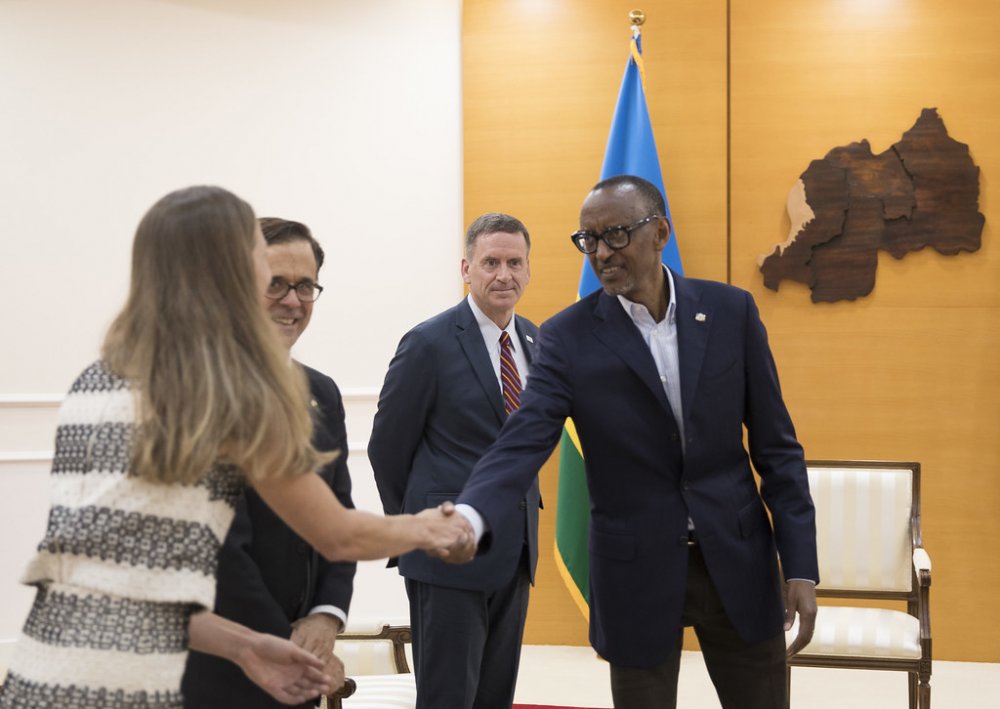
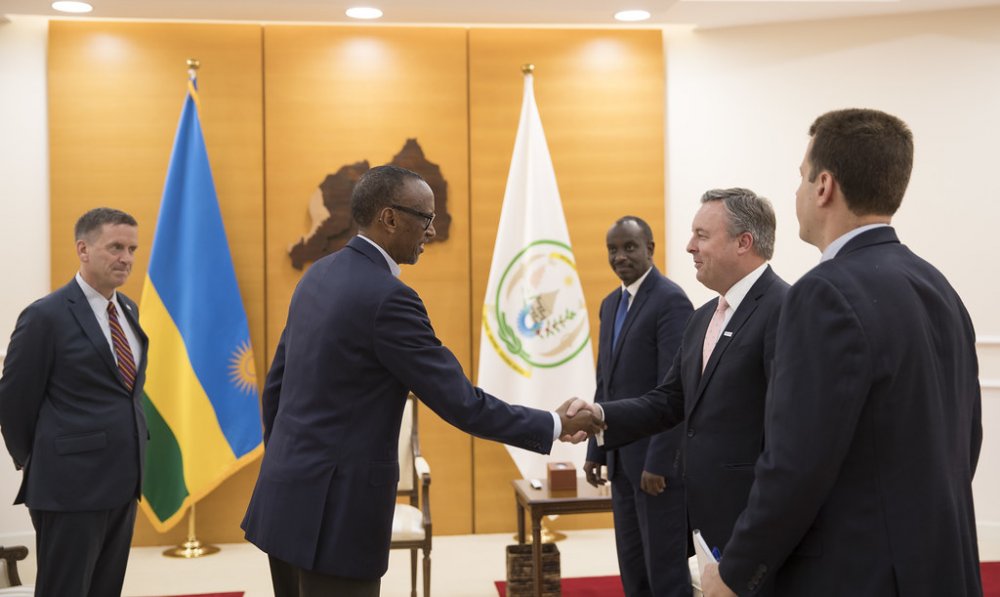
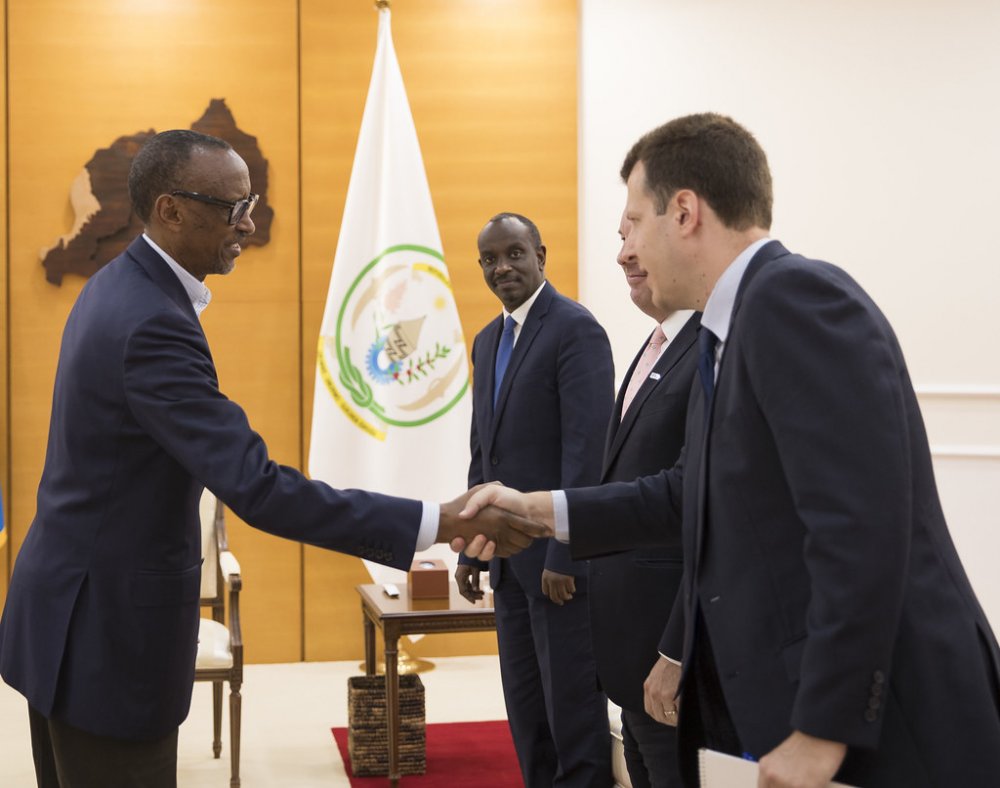
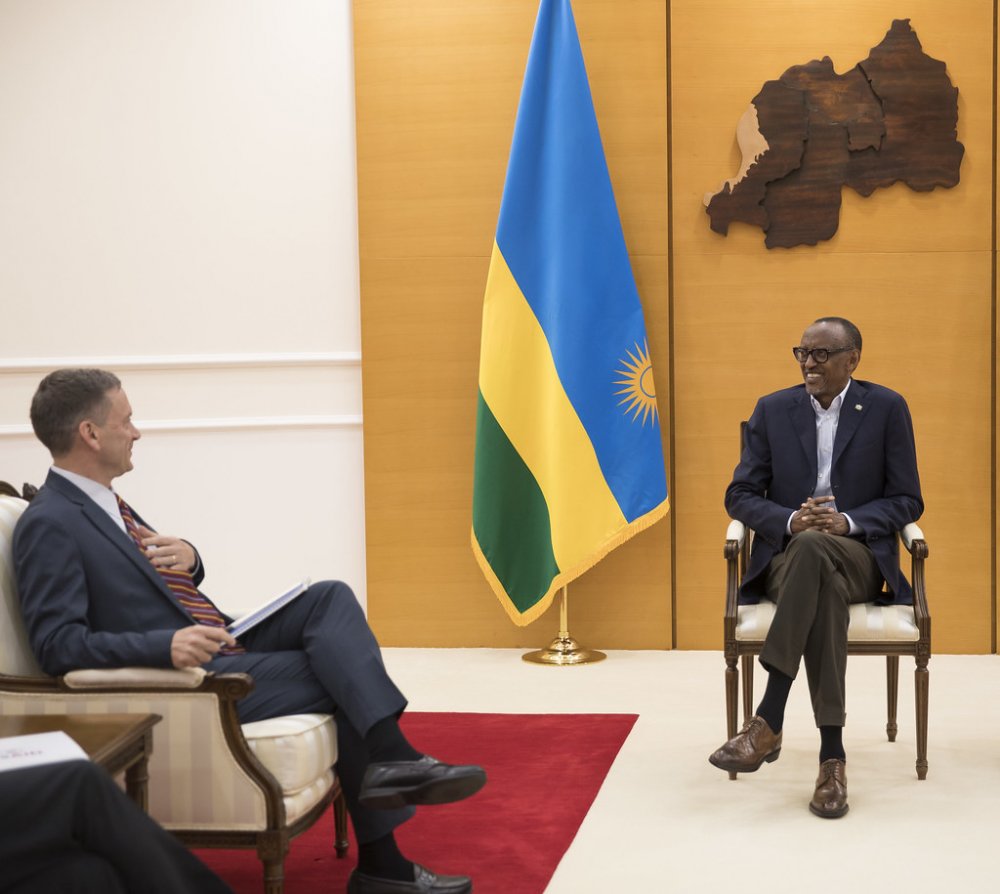
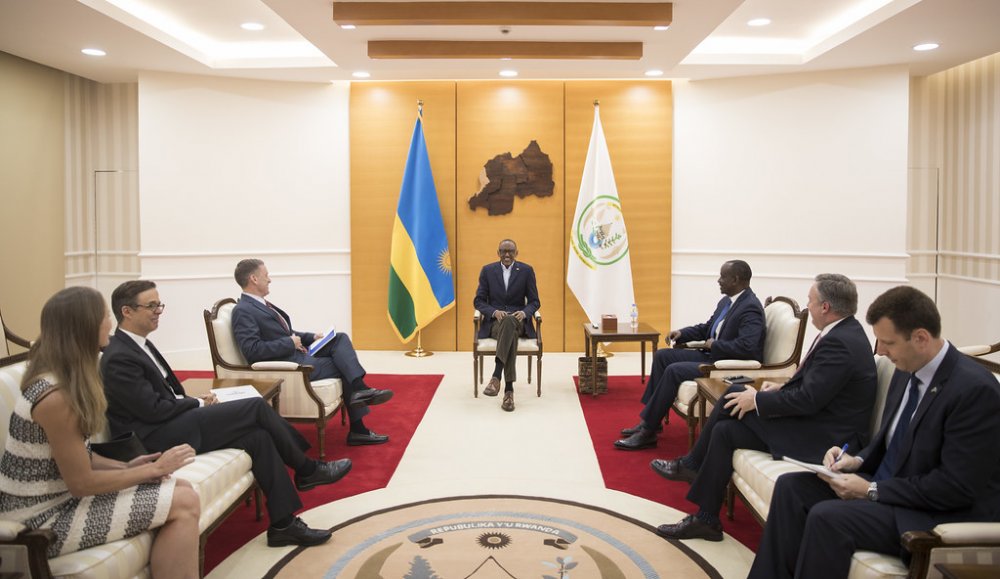
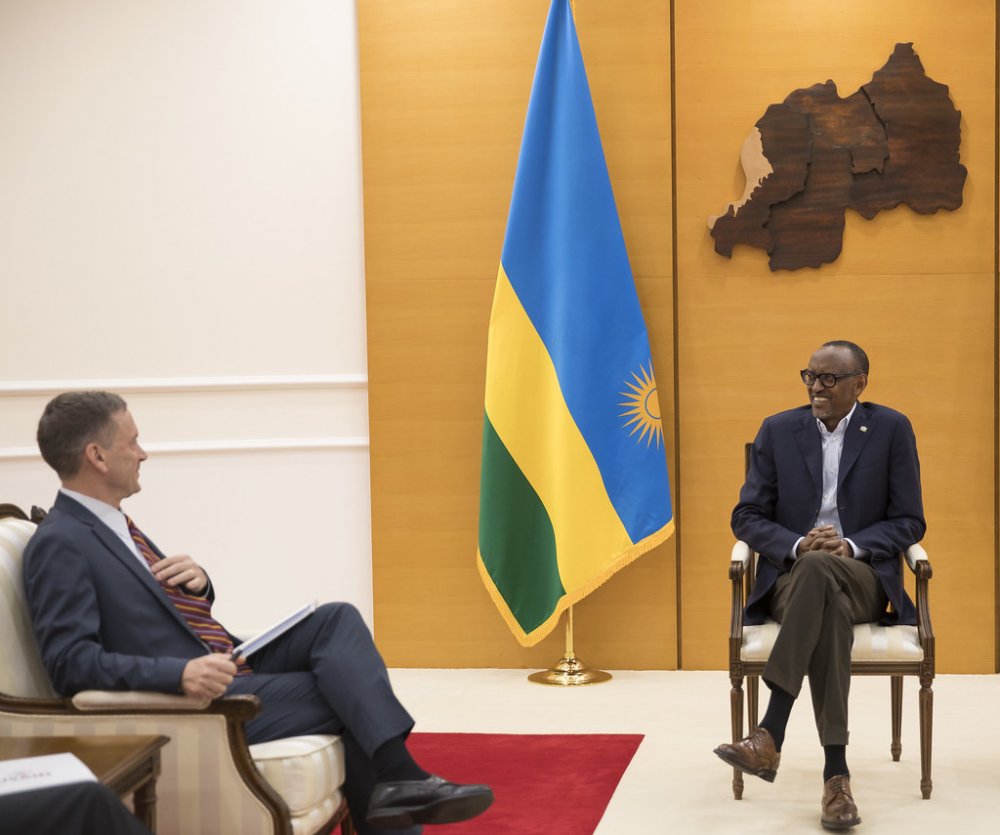
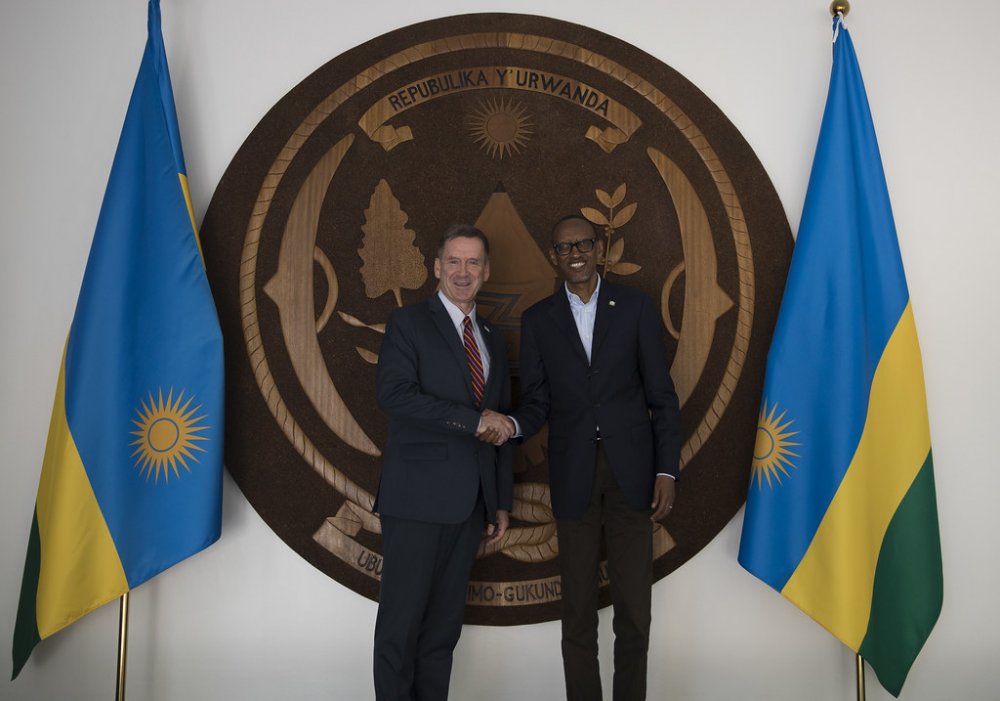
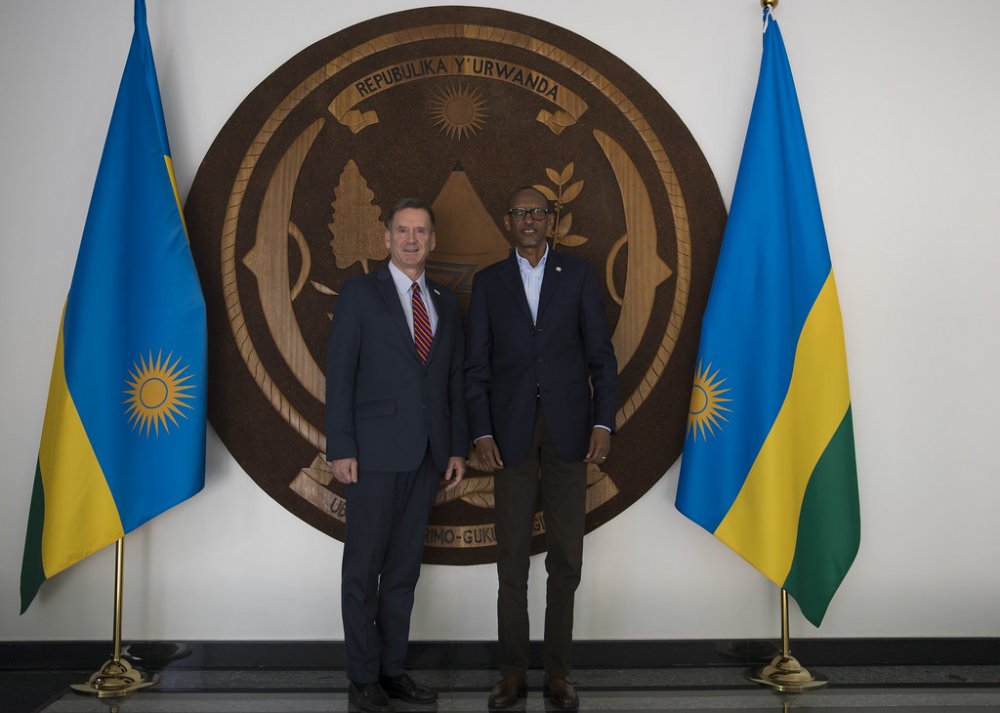
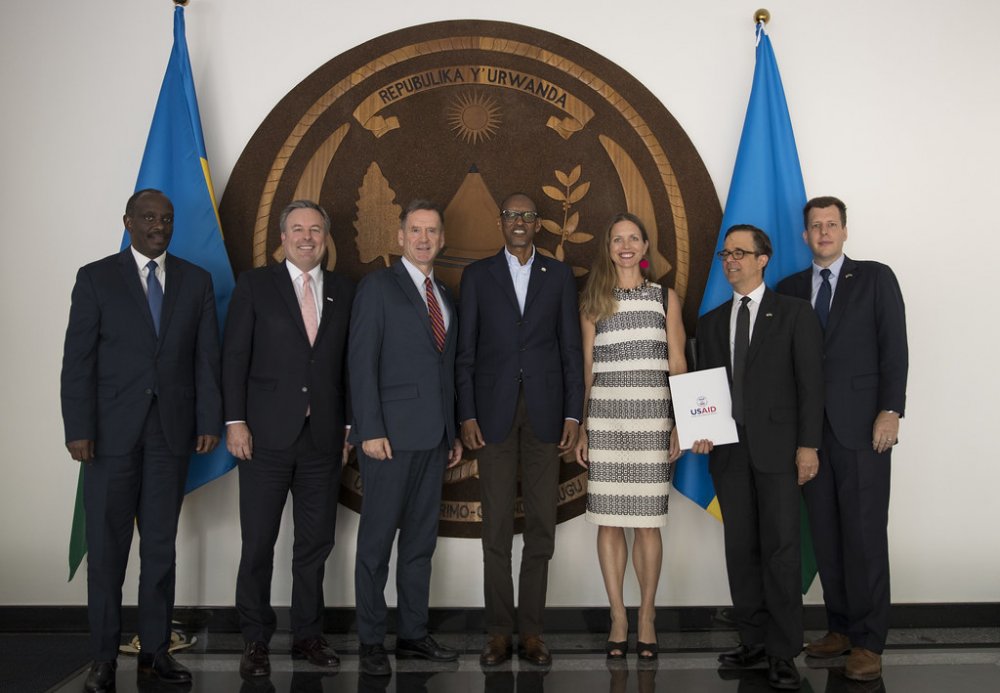
Mark Green came to Rwanda as part of his visit to various countries in Africa including the Democratic Republic of Congo, Kenya and Mozambique.
According to a communiqué from the Presidency, Kagame and USAID Administrator also discussed the agency’s plans to boost cooperation with concerned countries to eliminate reliance on foreign aid.
Rwanda will finance 68% of her 2019/2020 budget.
Rwanda and USAID enjoy good relations in different areas including agriculture, food sufficiency, health and education. The agency has allocated USD $ 71 million to support these areas this year.
Through Chemonics International Inc, USAID donated USD $ 32 million to buy medicine and equipment used to prevent HIV/AIDS and Malaria.
The organization also donated USD $ 11million through Hinga Weze project to promote small scale agriculture.
The project runs in 10 districts including Bugesera, Gatsibo, Kayonza, Ngoma, Karongi, Ngororero, Nyabihu, Nyamagabe, Nyamasheke and Rutsiro.
USAID has other projects supporting 50,000 vulnerable households from 12 districts including Muhanga, Kamonyi, Nyaruguru, Nyamagabe, Huye, Ruhango, Rwamagana, Kayonza, Rulindo, Gakenke, Kicukiro and Nyarugenge.
Other projects supported by the organization include Turengere Abana and Gimbuka projects supporting children from secondary and primary schools.
The report was revealed during the ongoing Sustainable Development Goals/Africa summit, which is scrutinizing how far the SDGs are implemented.
Seychelles and Libya are excluded on the ranked countries due to the fact that they do not meet the 97 weighing criteria that are based on 17 goals of SDGs. Tunisia leads the list with 66% points, and South Africa lags behind with 29%.
In early September 2015, United Nations established new 17 SDGs to replace Millennium Development Goals (MDGs)
Tunisia tops, followed by Seychelles, Morocco, Cape Verde and Egypt respectively. Rwanda leads East African countries and 12th on the continent, Kenya follows and 15th on the continent, Tanzania 16th, Uganda 18th and Burundi in 34thposition in Africa.
South Sudan, Central Africa, Tchad, Somalia and Democratic Republic of Congo bottom the list. Africa remains behind towards SDGs implementation due to extreme poverty. In 2015, 410 million people were below the poverty line.
Dr Uzziel Ndagijimana, Rwanda’s minister of finance and economic planning, encouraged Africans to own up the goals and implementation process.
“Countries need to eye SDGs as their own and stop assuming that other players help implement them; it is Africa’s luggage” Dr Uzziel said.
Dr Agnes Kalibata, the president of Alliance for a Green Revolution in Africa (AGRA), says that the delay in SDGs implementation is not due lack of funds but downplaying what benefits they will bring.
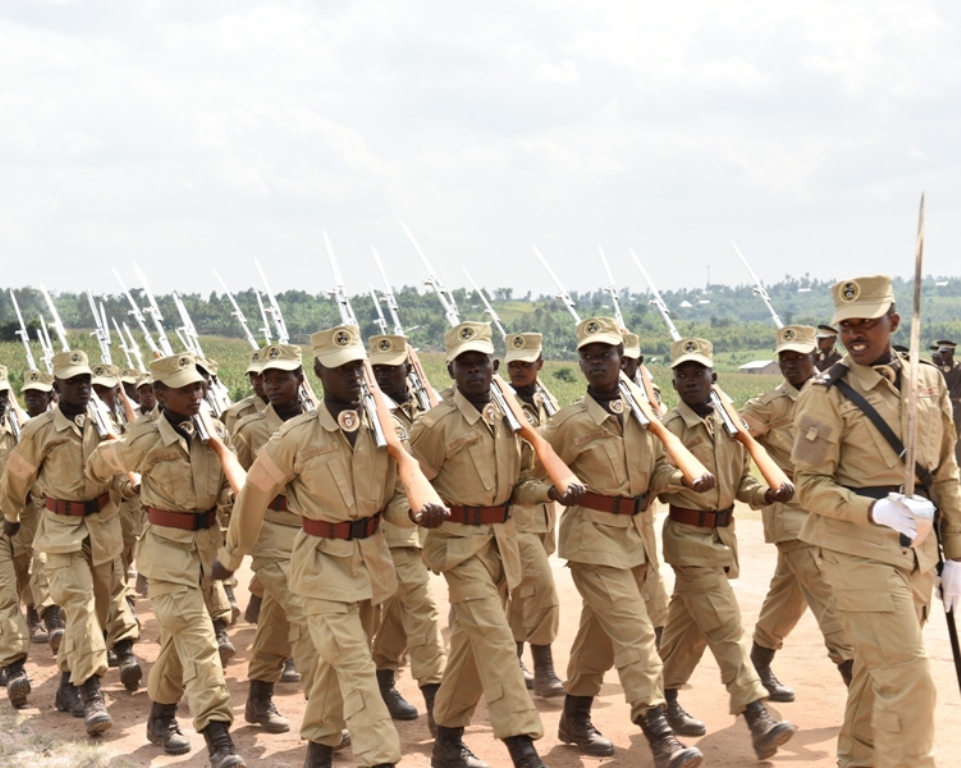
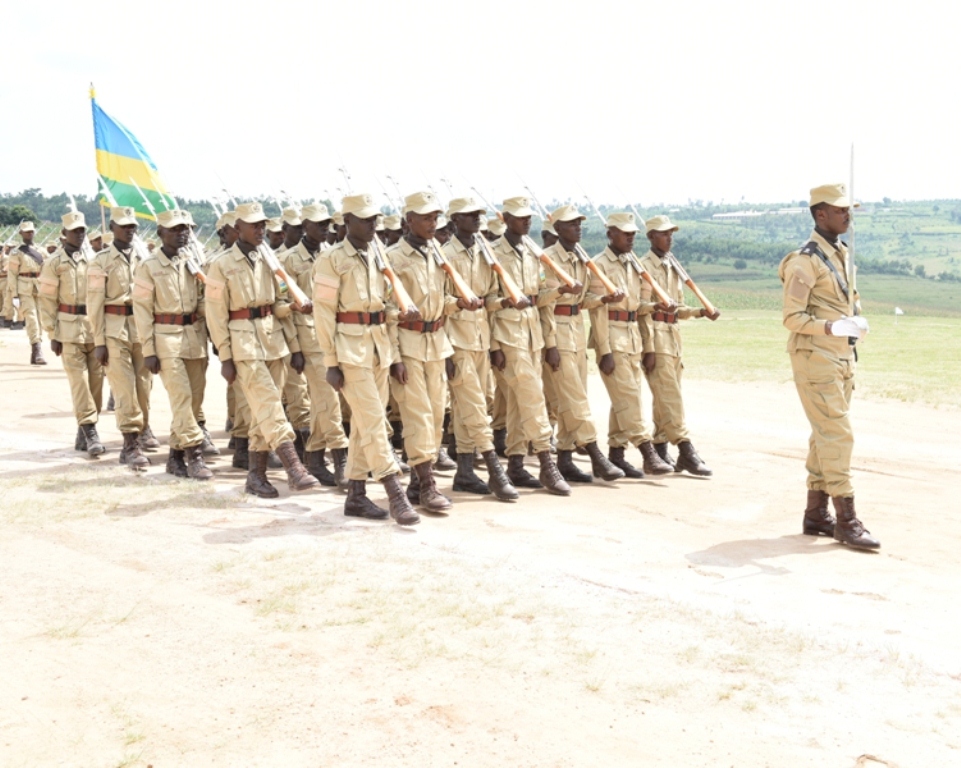
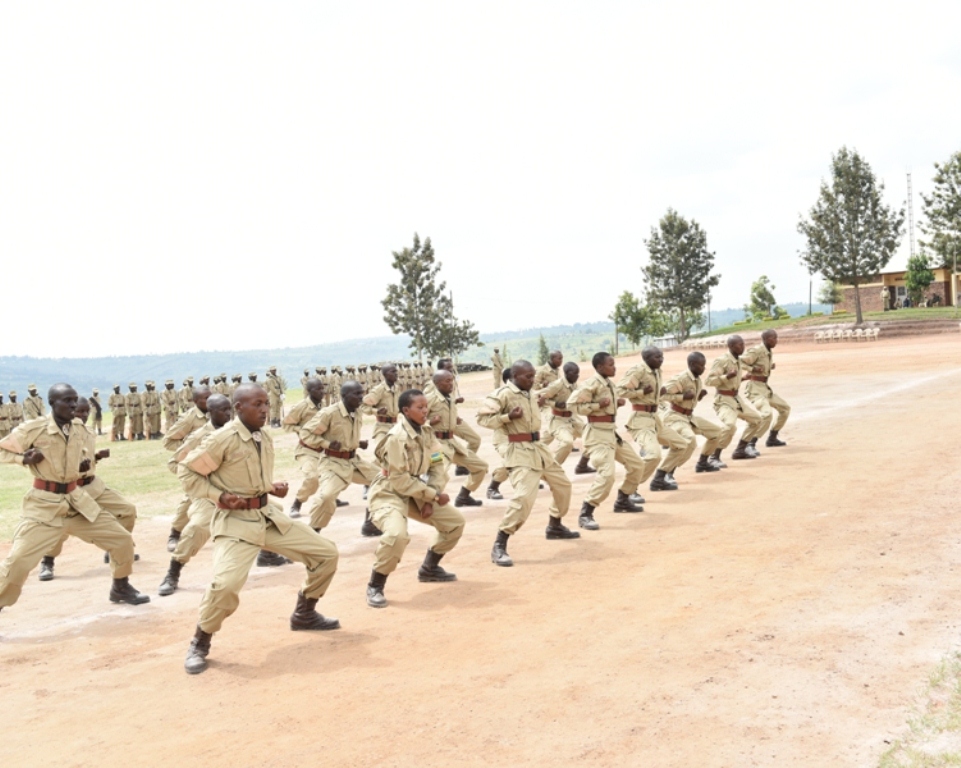
The new warders who passed out yesterday have completed nine months’ training at RCS training school in Rwamagana district on prisoners’ rights, handling guns and resolving disputes.
It is the 3rd intake since the school was established.
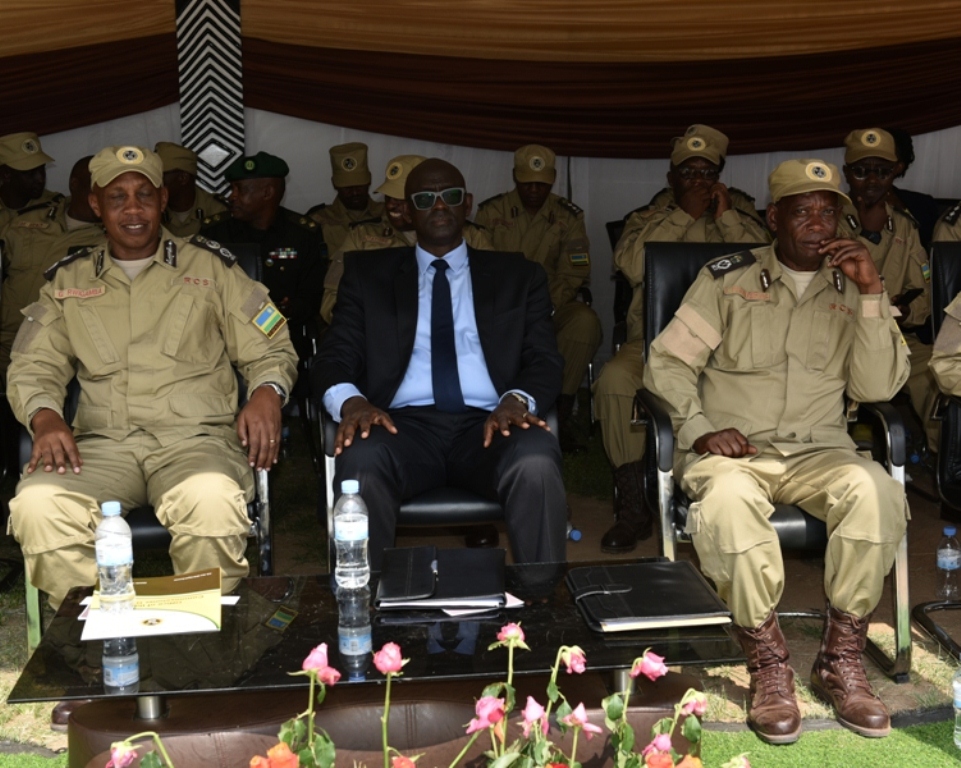
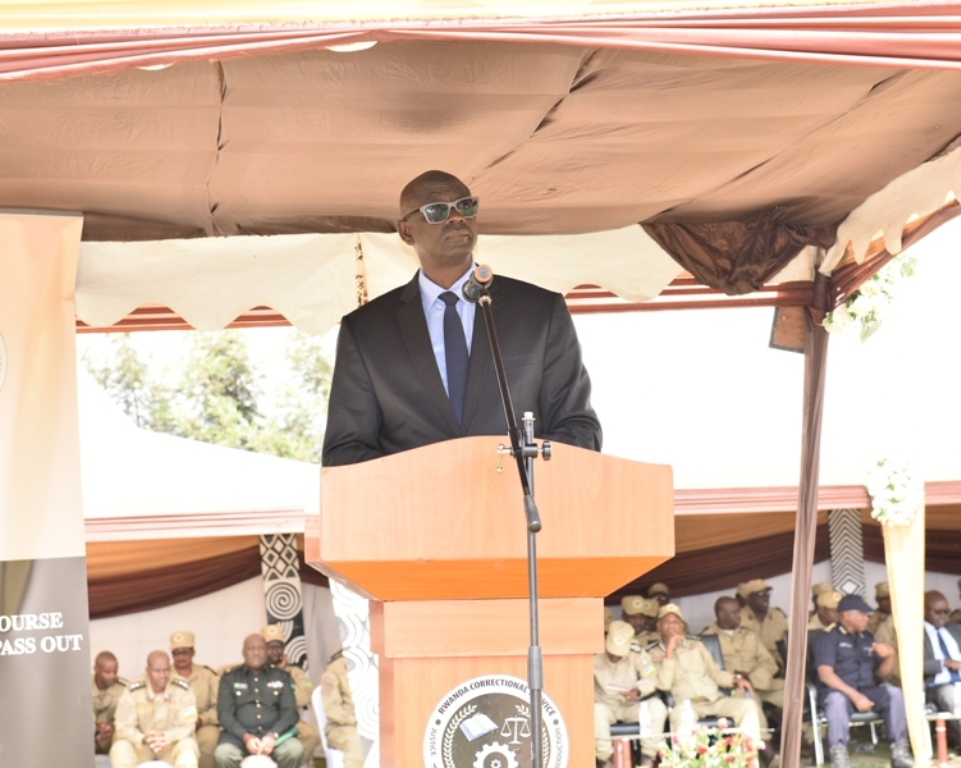
The Minister of Justice, Johnston Busingye who graced the event said the ceremony reflects Rwanda’s efforts to build professional prison warders.
“The core objective is to equip prison warders with skills to correct inmates to transform them to comply with Government’s regulations,” he said.
“We commend your commitment and courage that characterized you during the training. You have to apply acquired basic skills on duty, working together with fellows and strive to maintain a good reputation of RCS,” added Minister Busingye.
He urged them on professionalism and respecting laws.
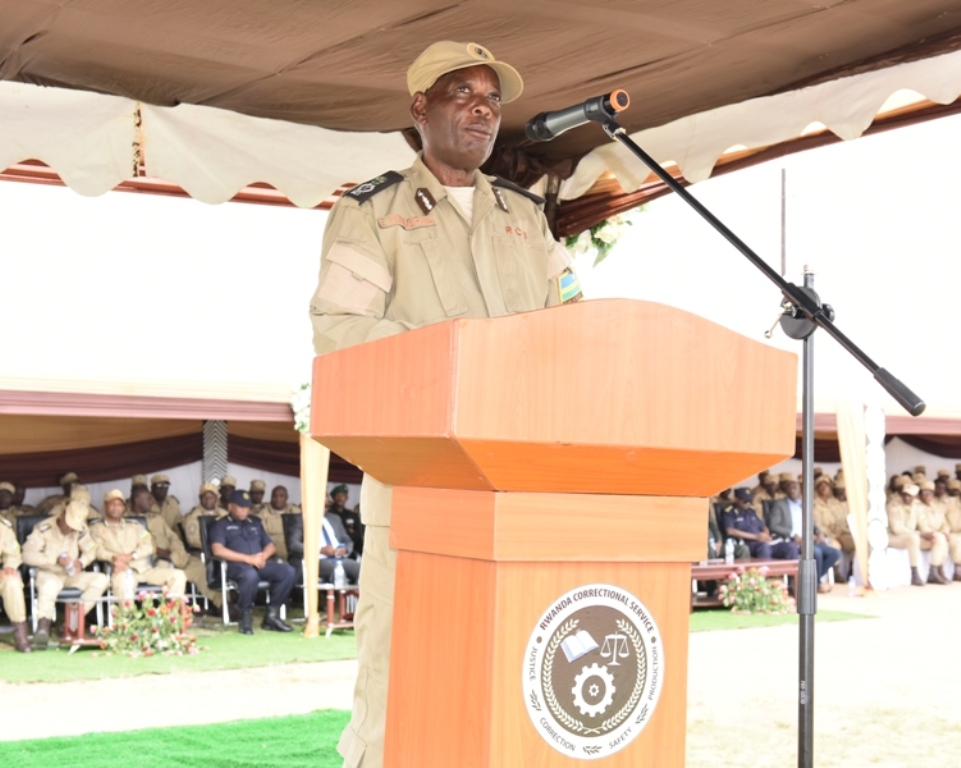
The Commissioner General of RCS, CGP George Rwigamba said the new recruits join existing 1600 prison warders. He revealed that another training program is scheduled next year to increase the number which is still low.
One of the duo identified as Thacien Munyaneza, 38, was intercepted with 110kgs of cassiterite on Thursday in Kigali. Other 35kgs were recovered from an illegal dealer in Kayonza District.
Munyaneza was arrested on Thursday as he transported the minerals on a motorcycle RE 573G, which was also impounded.
Chief Inspector of Police (CIP) Marie Gorette Umutesi said that Munyaneza was intercepted in Nyabugogo, Kimisagara Sector of Nyarugenge District.
“Police in Kigali received information that a motorcycle had left Rutongo concession with a consignment of stolen cassiterite,” CIP Umutesi said.
“The motorcycle was tracked and intercepted in Nyabugogo, its rider arrested and minerals seized,” she added.
It is said that illegal dealers connive with workers in mining sites to steal minerals from concessions. In other cases, people conduct illegal mining activities especially at night, which sometimes result into disasters in cases where miners don’t know the status of the concession, thus tilting weak or unsupported cliffs.
Article 1 of the Ministerial Regulations No 001/Minifom/2011 relating to fighting smuggling in mineral trading stipulates that nobody is allowed to purchase or sell minerals without commercial registration.
Article 4 of the same instrument indicates that transportation of minerals outside mining licensed areas (concessions and permits perimeters) is only allowed, when the consignment shows the source mine, its value and when it has the right tag.
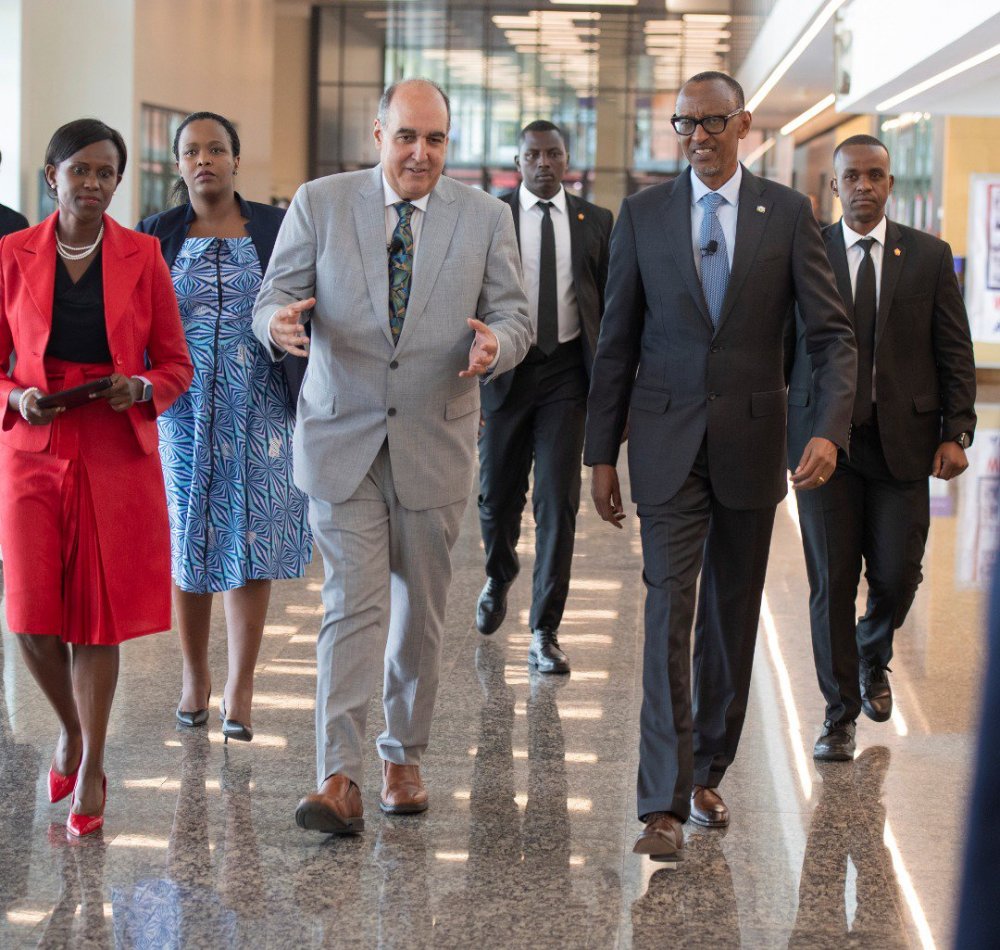
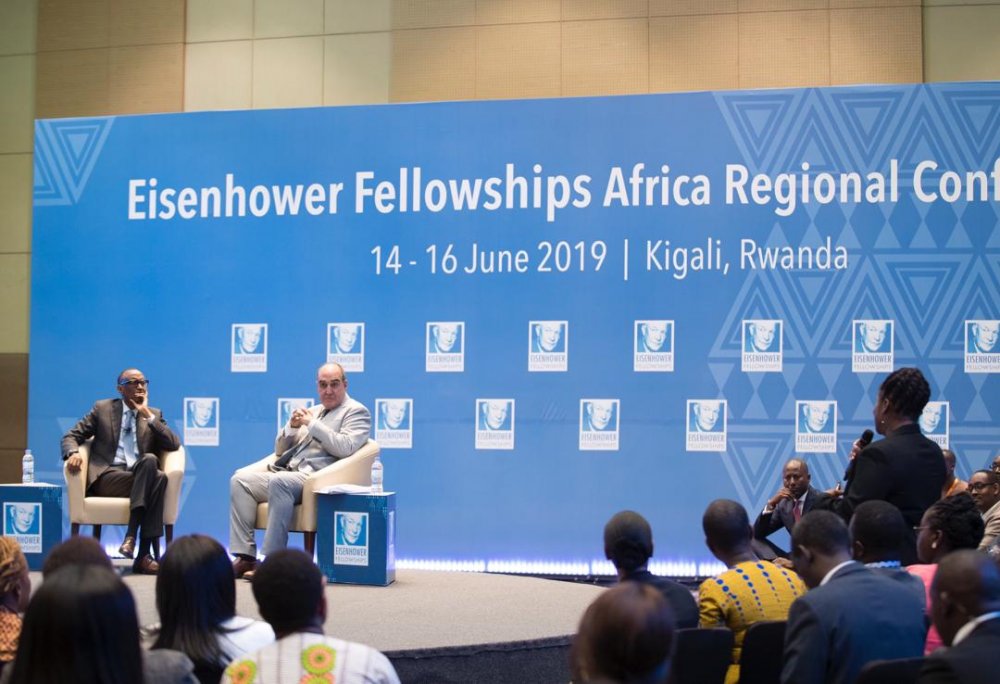
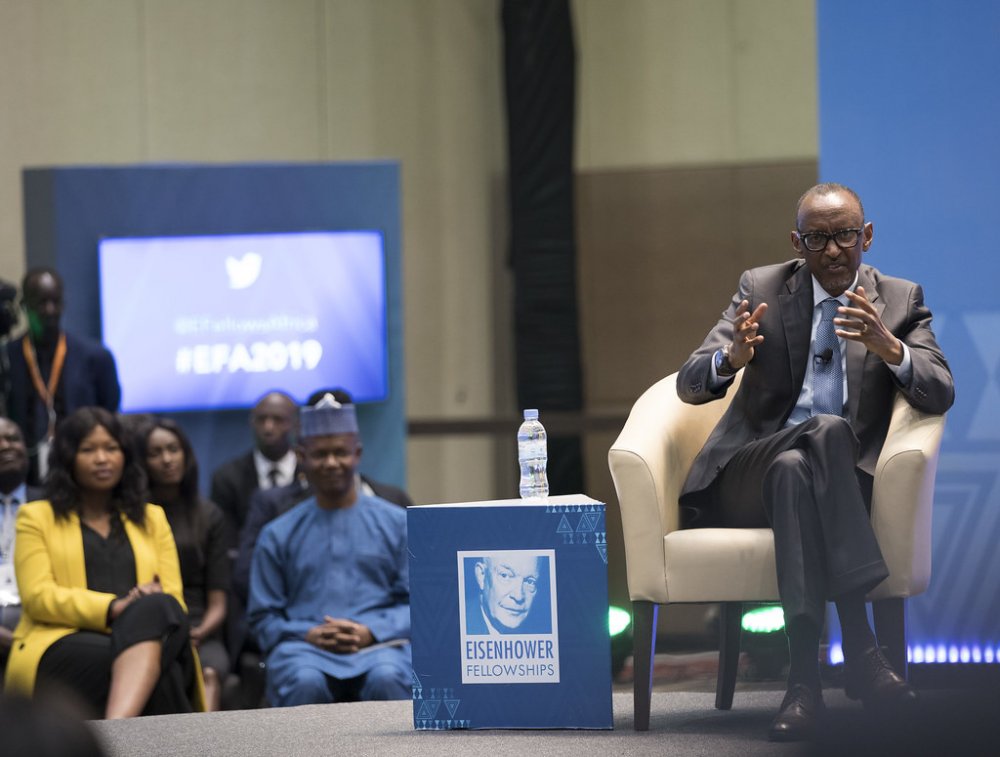
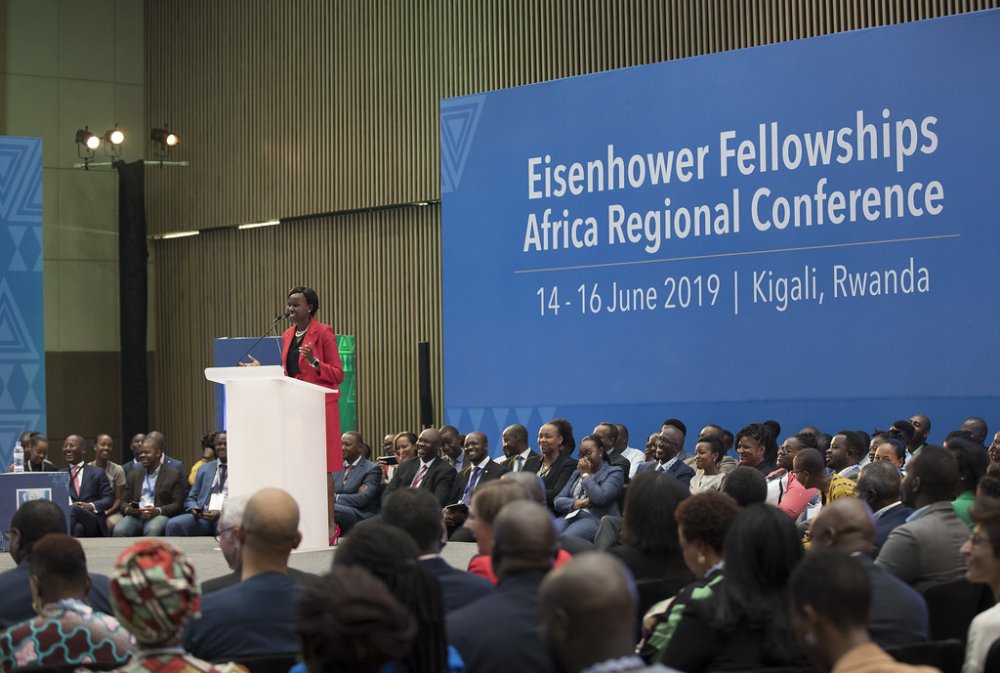
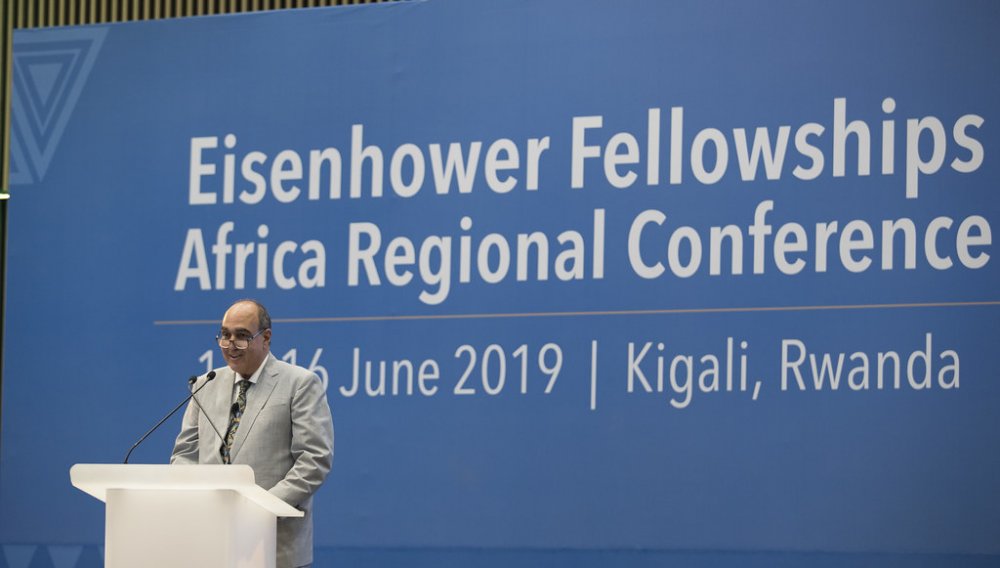
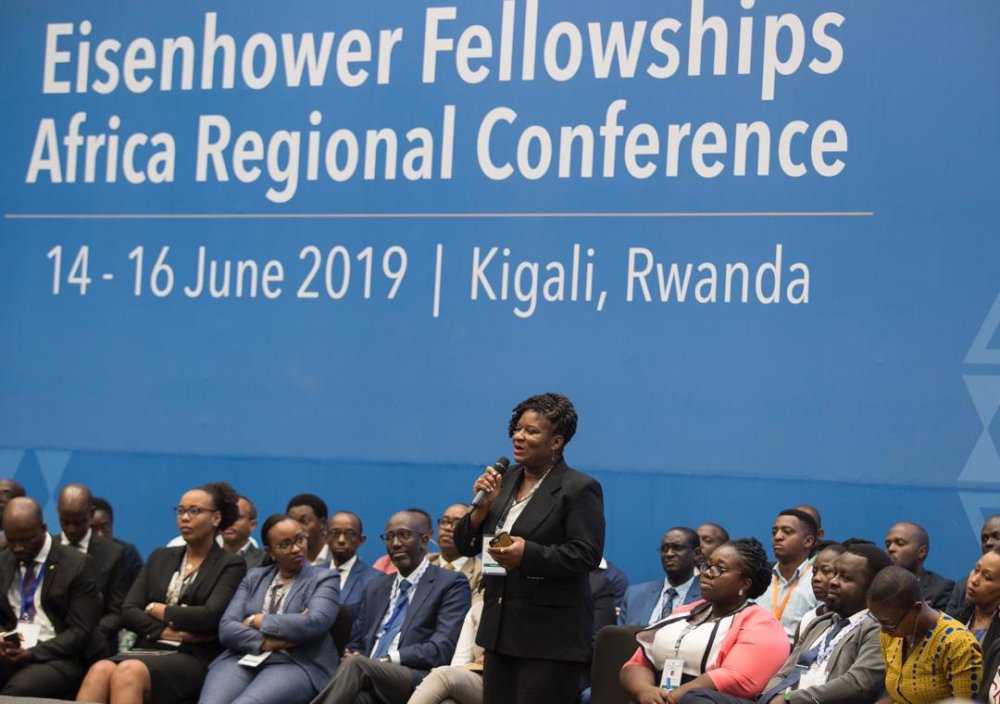
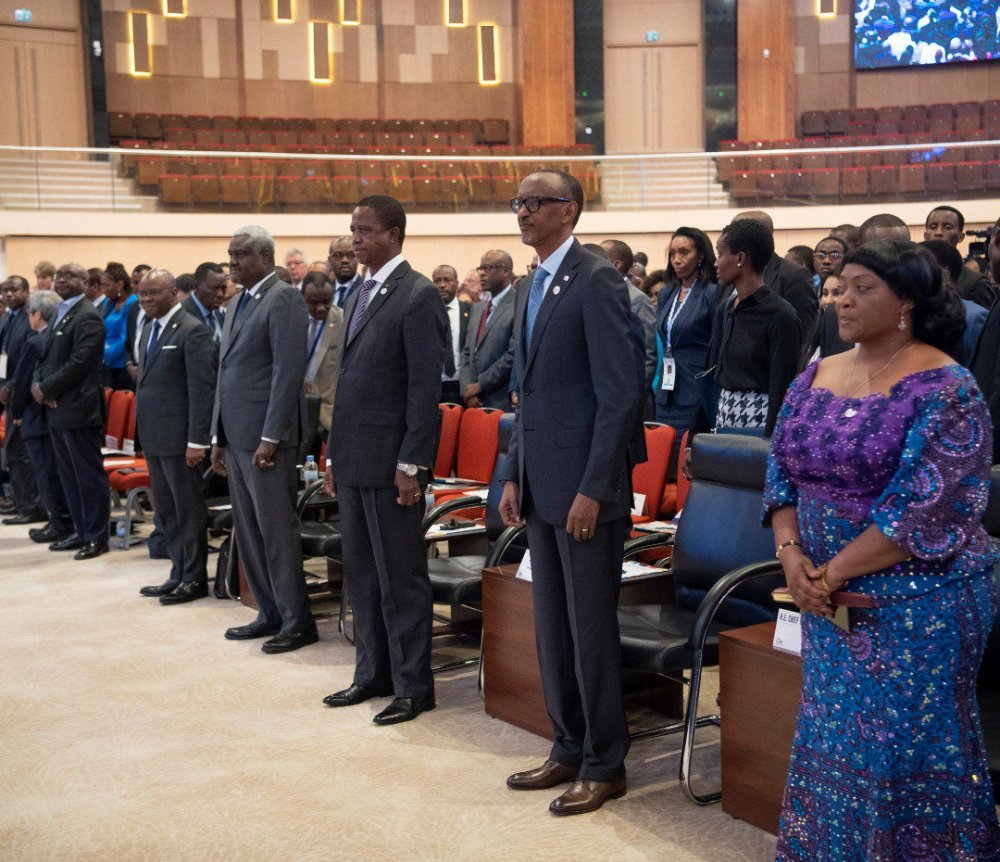
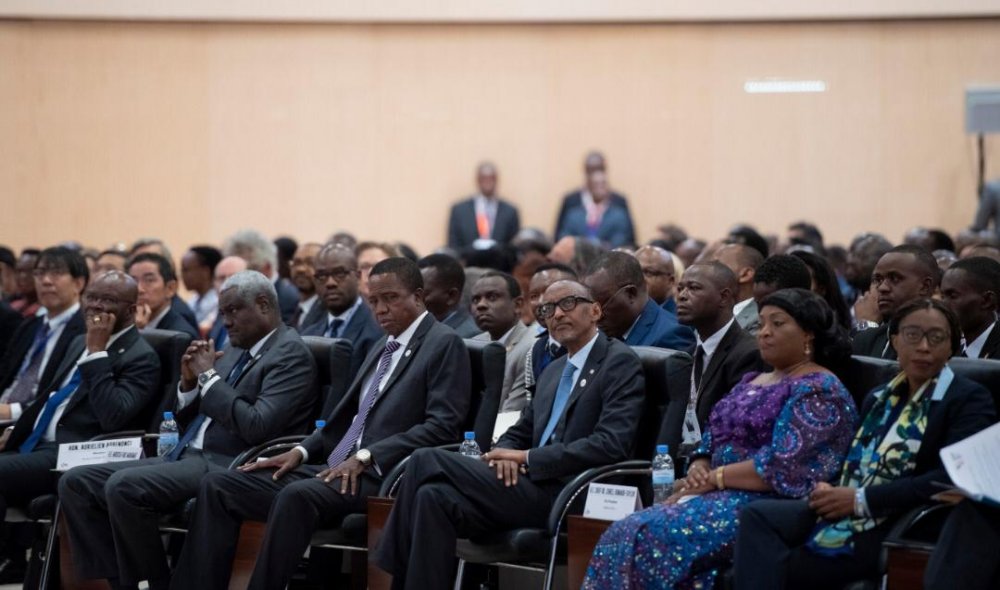
Kagame delivered the message yesterday as he officially inaugurated three-day Eisenhower Fellowships (EF) Conference held in Kigali.
The conference is organized by Eisenhower Fellowships (EF), an organization that was started in 1953 in honor of the 34th US President Dwight Eisenhower.
The summit is themed around Africa’s integration in multiple aspects such as trade, work, technology, governance and partnerships.
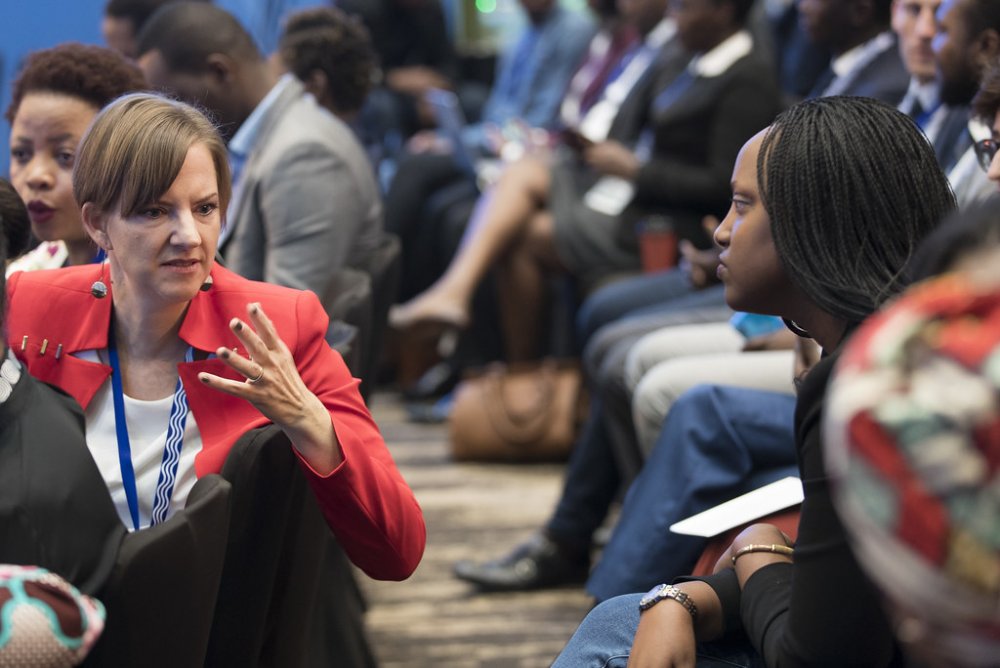
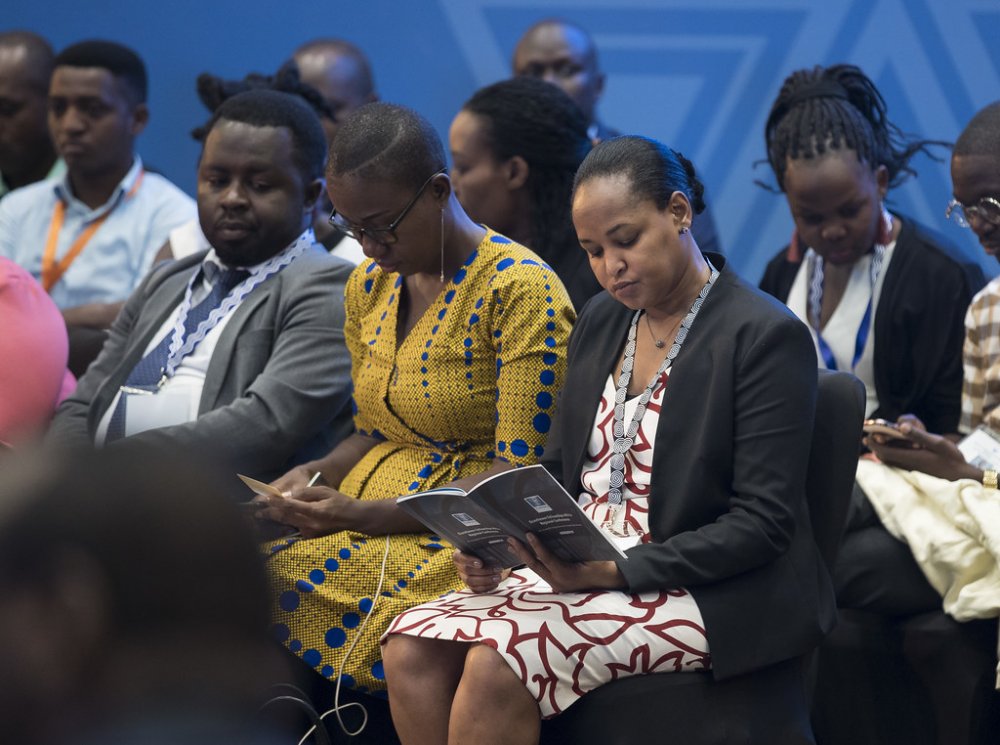
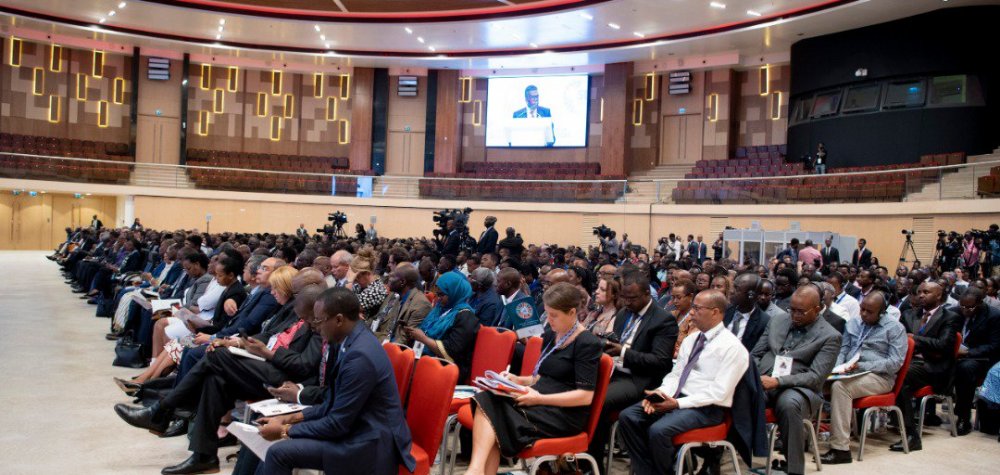
It brought together over 200 delegates including top government officials, business leaders, academics, scientists and journalists.
The conference took place at a place where African Continental Free Trade Agreements (AfCFTA) were signed by 44 countries during the AU General Assembly held in Kigali in March 2018.
AfCFTA went into implementation since 30th May 2019.
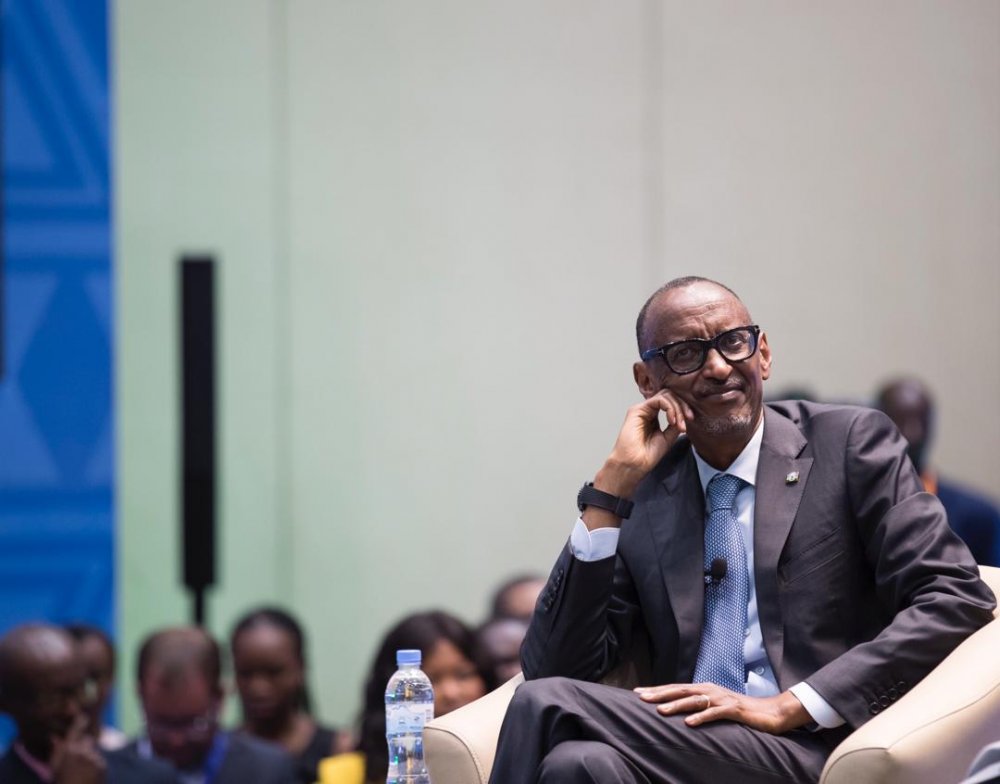
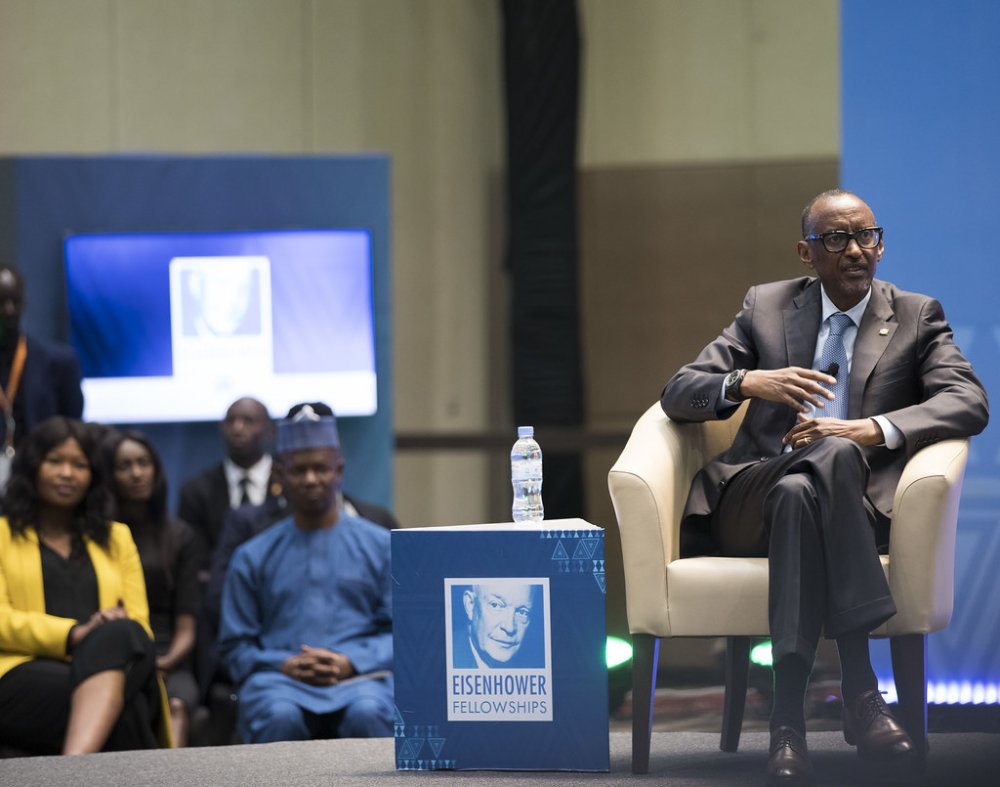
As he addressed participants, President Kagame said Africa understands benefits of working together.
“I think it went into implementation for two reasons mainly Africans willingness and external factors that contributed to dividing the continent which have been slowing down. The outside is preoccupied with their own problems, rather than thinking everything is fine and all they have to do is to manipulate things, starting with Africa,” he said.
“It is the right time for Africa to correct mistakes we made. We sometimes knew that what we do affects our people and economy. Africa is at high pace to address its problems,” added Kagame.
He highlighted the youth should take the lead to correct what went wrong.
“ If you look at Africa and the enormous wealth, people should be asking why is it that parts of the world that were at the same level of economic standing 40-50 years ago, today are 100s of time better off,” he said.
“The question must be what went wrong. This is a question everyone should be answering including the young ones because otherwise how will they correct it, they must understand they owe it to themselves to understand the challenge and address them,” added Kagame.
The president explained that the youth represents great wealth along the journey to implement real Africa’s collaboration with the rest of the world.
“We know there is a lot of work to do to be where we want to be. We know we can count on not only ourselves but others for cooperation and collaboration; those are keys for us to be able to continue making progress,” he stressed.
Serving with Rwanda’s example, Kagame reflected how Rwandans unity was the enabler during 25 years resilience process after the 1994 Genocide against the Tutsi.
Rwanda is the first African country to host the Eisenhower Fellowships (EF) conference.
The organization’s mission is to identify, empower, and connect innovative leaders through a transformative fellowship experience and lifelong engagement in a global network of dynamic change agents committed to creating a world more peaceful, prosperous and just.
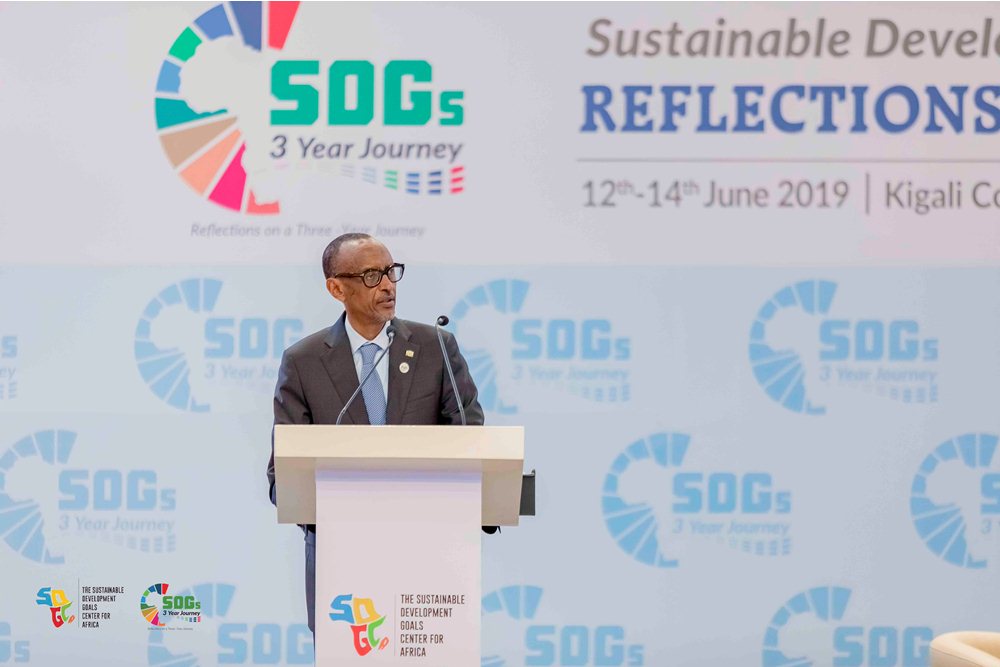
President Kagame made the observation yesterday as he addressed participants in the Sustainable Development Goals Summit held in Kigali yesterday.
The Sustainable Development Goals (SDGs) are a collection of 17 global goals set by the United Nations General Assembly in 2015 for the year 2030.
These goals’ targets by 2030 are Poverty eradication, achieving Zero Hunger, Good Health and Well-being, Quality Education, Gender Equality, Clean Water and Sanitation, Affordable and Clean Energy, Decent Work and Economic Growth, Industry, Innovation, and Infrastructure, Reducing Inequality, Sustainable Cities and Communities, Responsible Consumption and Production, Climate Action, Life Below Water, Life On Land, Peace, Justice, and Strong Institutions and Partnerships for the Goals.
On the third day of the Summit reflecting on three years of SDGs, President Kagame talked on the report of Sustainable Development Goals Center for Africa (SDGC/A) highlighting that on almost every Goal, the continent is not on track to achieve the 2030 targets that even the best are lagging behind the rest of the world.
“This would not necessarily be discouraging, if the rate of change was high. We all know where Africa is coming from, and how much catching up we have to do. However, on too many indicators, the pace of progress is stagnant or even declining,” he said.
President Kagame stressed, the most important thing is the right mindset understanding that ‘The SDGs are universal and ambitious, meaning they set targets that apply to countries at every level of economic development’.
He explained that achieving the SDGs represents the attainment of a significant level of prosperity and well-being, not merely the elimination of extreme poverty that Africa should consider it as the problem and responsibility.
“The development assistance is not growing, and it is reasonable to expect that trend to continue. Foreign investment is also flat. On the other hand, speeding up progress toward the SDGs is first and foremost our problem and responsibility as Africans,” said Kagame.
SDGC/A report show SDGs financing gap in Africa estimating between 500 billion and 1.2 trillion dollars per year.
President Kagame stressed the need to work closely with partners noting that the political leadership on this topic has to be heard most strongly from African voices. He said remittances from the African diaspora are now the largest source of external income for our continent.
SDGC/A has recently announced plan to concert much effort on education, health and agriculture as central areas to other goals.
President Kagame hailed the initiative emphasizing that the idea to establish dedicated African funds for education, water, and health has a lot of merit.
“This is an opportunity to work with Africa’s partners in new and better ways, and deliver human-scale projects that directly touch the lives of farmers, families, and schoolchildren,” he said.
Director General to the Sustainable Development Goals Center for Africa (SDGC/A), Dr. Belay Begashaw also highlighted that achieving SDGs remains a major concern of Africans.
The Chairperson of African Union Commission (AU), Moussa Faki Mahamat said that intervention of private sector is of great importance to preparing, implementing and assessing the impact of SDGs and AU Vision 2063.
Starting from 14th June to 7th July, 12 national teams (10 South American teams, plus Qatar and Japan) will participate the Copa América in Brazil this year.
As all knows, Copa America is titled as “Thrilled with sexy football”, and explicitly expressed by super football stars like Messi (Argentina), Sanchez (Chile), Suarez (Uruguay), Fermino (Brazil), and J Rodriguez (Colombia). Their style is the purest and most enjoyable football culture which is thrilled by most football fans. StarTimes will broadcast all Copa América matches live and HD on ST World Football and ST Sports Premium.
Here are the tips for Rwandan football fans to watch and enjoy the “trilled with sexy football” Copa America 2019 for free:
Existing StarTimes Subscribers: Subscribe to any monthly bouquet and you can watch Copa America for free, plus get upgraded to a higher bouquet for free.
New Customers: Just buy a StarTimes decoder or a TV (Starting from 149,000 Rwf) and watch Copa America for Free.
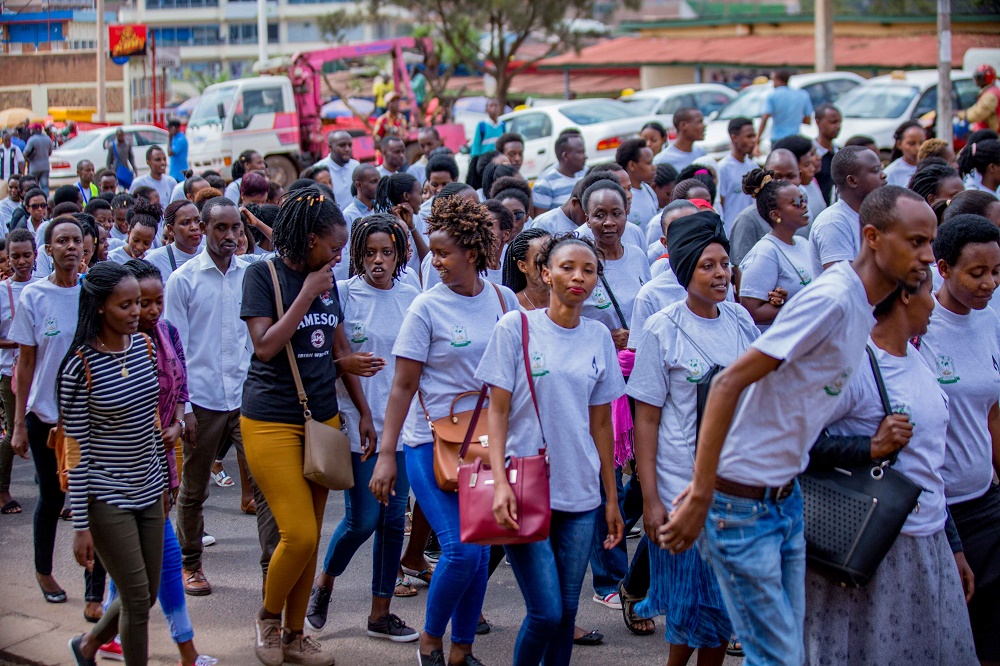
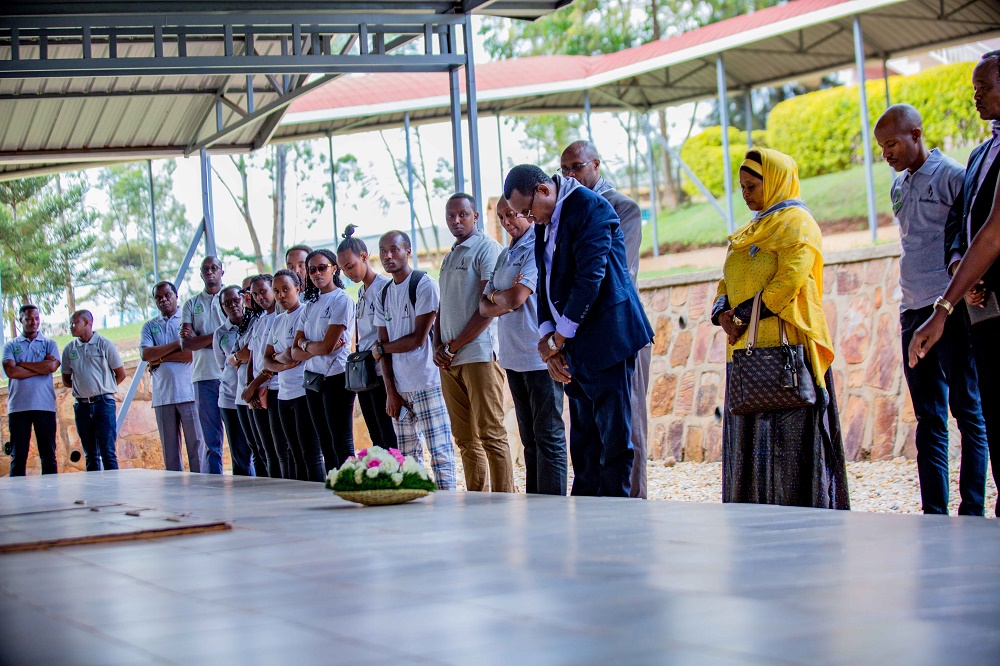
The event held on Thursday was marked by a walk to remember from UTB headquarters at Sonatubes to Eto Kicukiro where a large number of Tutsi were killed during the genocide and laid wreaths at Nyanza genocide memorial in Kicukiro.
Prof. Gustave Tombola, UTB Vice Chancellor in charge of Academic Affairs and Research said commemoration period is used to honor the bravery of those who stopped genocide.
“As we commemorate, we condemn the cowardice of the Government that prepared and executed the 1994 Genocide against the Tutsi as well as Rwandans who accepted to kill neighbors. When you reflect on cowards, it means you have to learn from it and strive for bravery. We commend the courage of RPF Inkotanyi soldiers that stopped genocide,” noted Tombola.
The Chairperson of National Itorero Commission, Edouard Bamporiki who graced the event took students through Rwanda’s history and reminded them to grab opportunities learning from President Paul Kagame’s outstanding leadership promoting unity among Rwandans.
“You should be active internet users to go through advice of President Paul Kagame to emulate these values. It will help you to build the nation. We need to sit and look at our role to consolidate achievements under the championship of the president in collaboration with soldiers who liberated the nation. It is a good legacy that we continue to uphold,” said Bamporiki.
Nyanza-Kicukiro is distinctly known as one of the places where thousands of people were massacred a few days after the beginning of the 1994 genocide against the Tutsi.
When the genocide began on April 7, over 3000 Tutsi from Kicukiro sought refuge at a former technical school, Ecole Technique Officielle de Kicukiro (ETO), in the belief that they would be protected by the United Nations peacekeeping forces for Rwanda (MINUAR) that was based there.
MINUAR would however desert them a few days later, despite the tension that had built up as the Interahamwe militia and government soldiers had surrounded the school.
Following the departure of the UN troops, government soldiers and Interahamwe took control of ETO Kicukiro.
In the school, Tutsi were taken by government soldiers and Interahamwe to Sonatube to be murdered there but the then mayor of the city, Lt. Col. Tharcisse Renzaho, ordered that they instead be taken to Nyanza and killed from there because Sonatube was too visible along the road to the airport.
The Tutsi were then forced to march back, all the way to Nyanza, amid a heavy downpour. Many had not eaten for a couple of days. Those too weak to walk were killed on the way. When they arrived at Nyanza, the militia asked them to present their IDs to ensure that no Hutu were among the group.
Mass killings then began and many of them were killed using machetes. The next morning, as the killers attempted to finish off those who were still alive, the Rwandan Patriotic Army soldiers arrived and rescued the few who had survived the massacre.
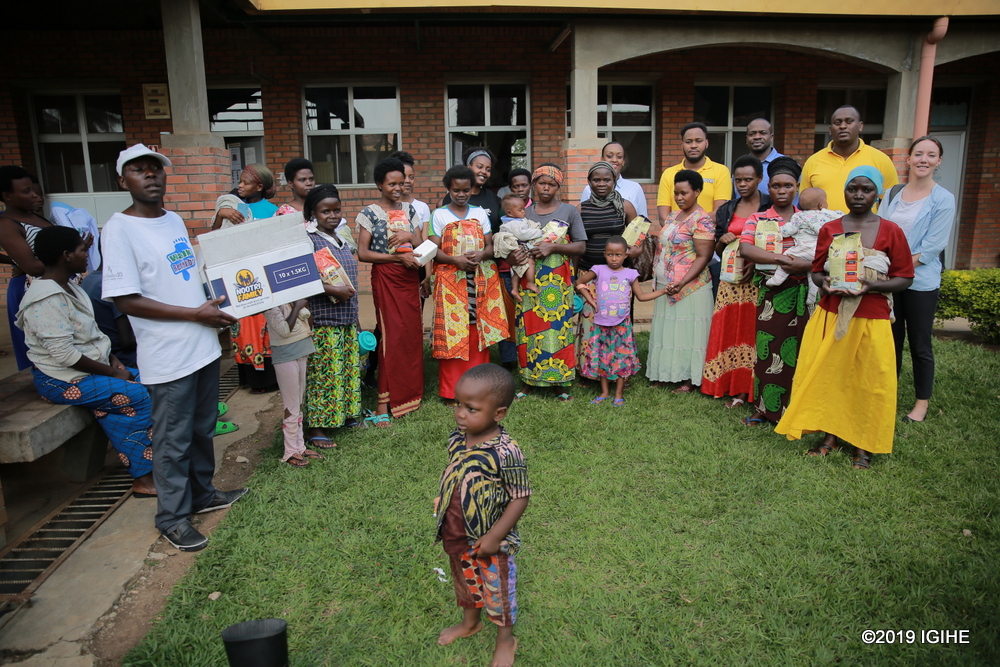
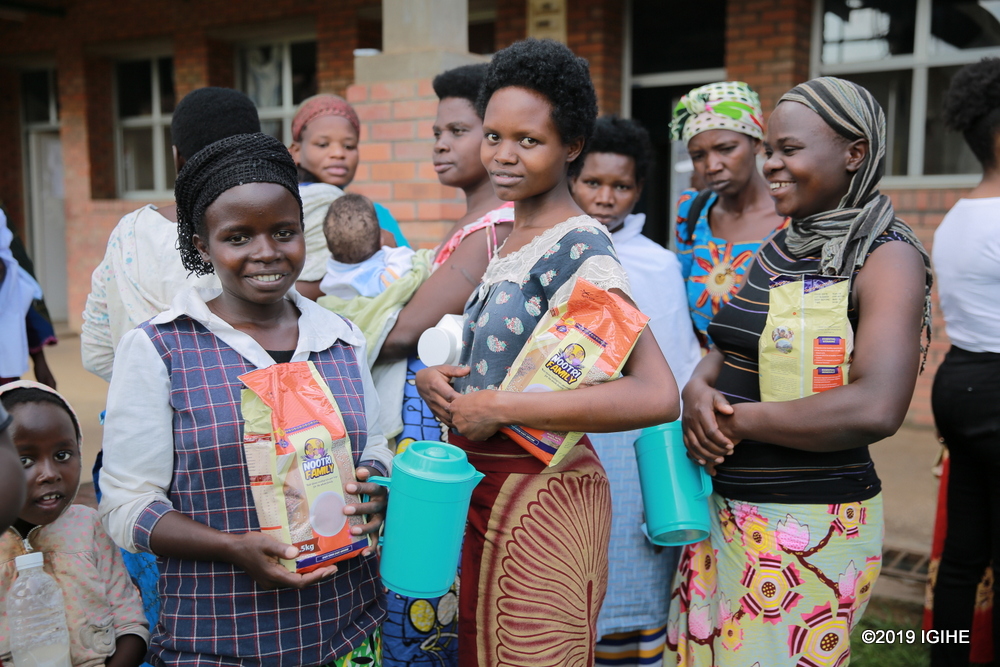
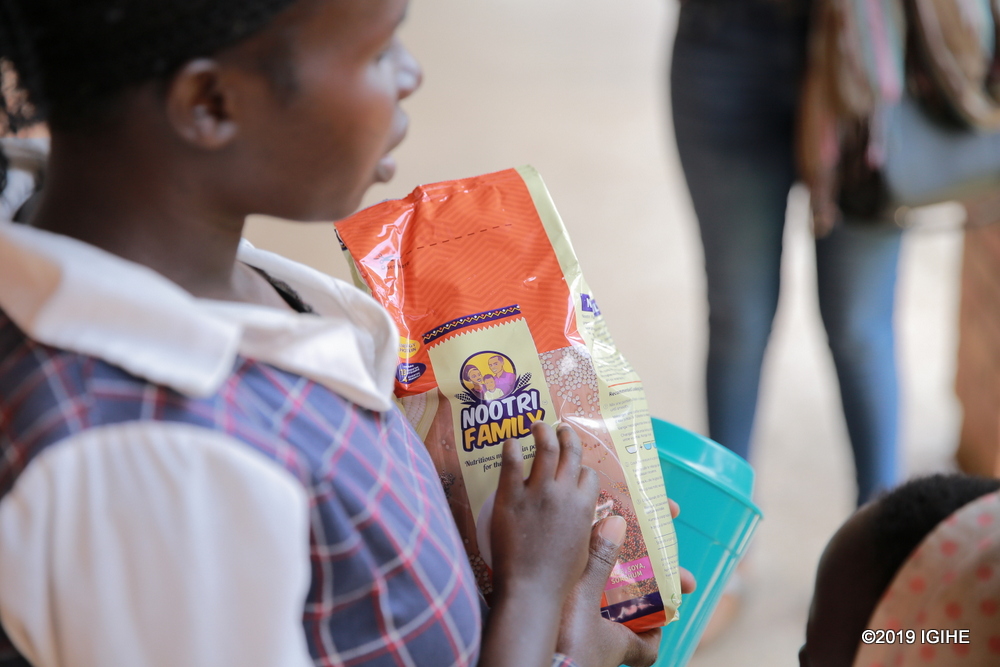
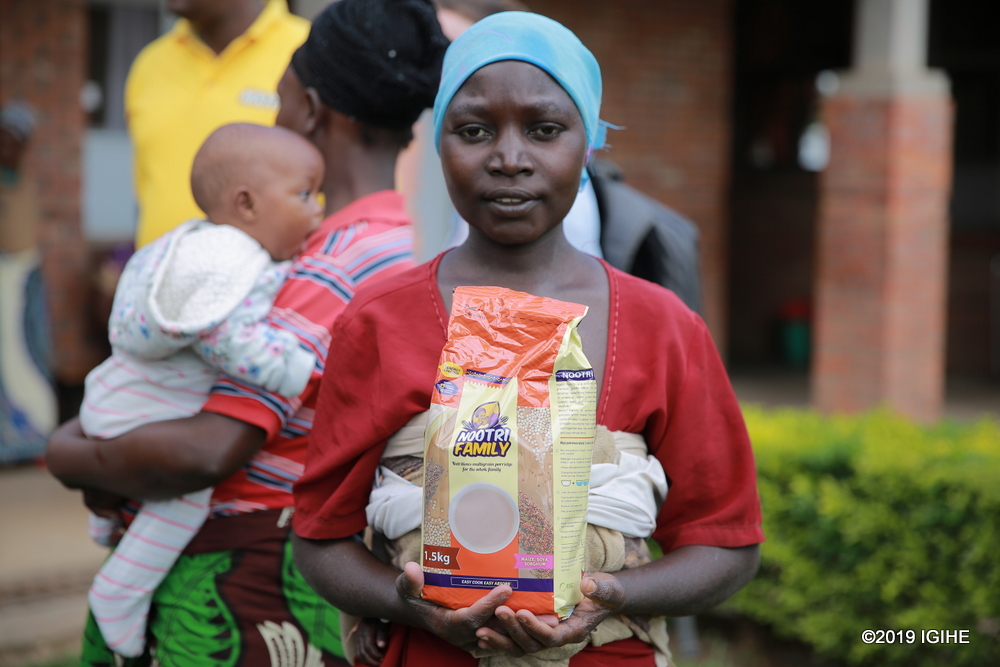
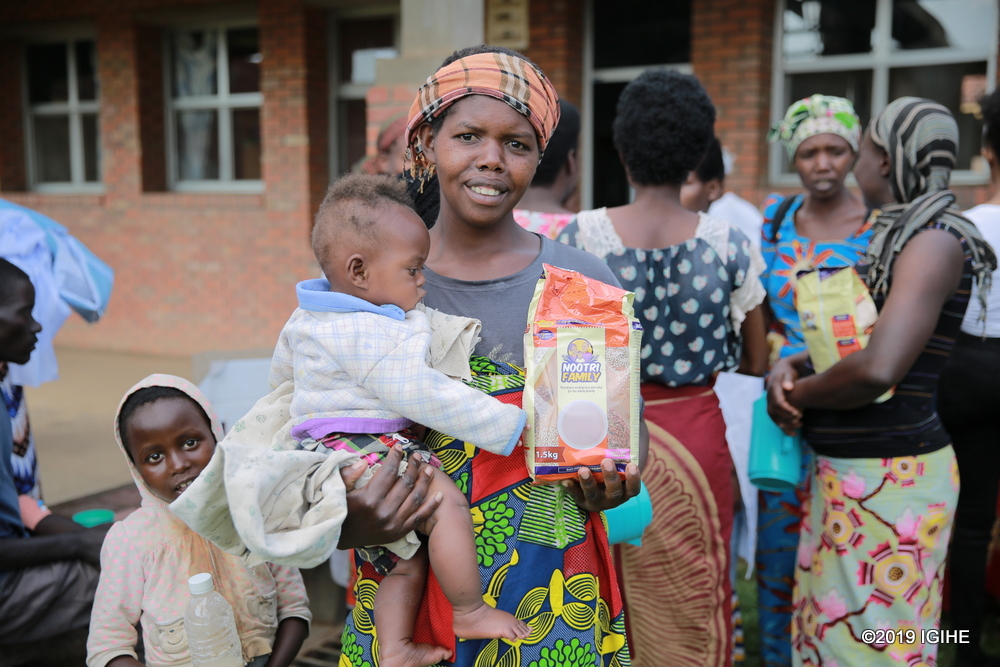
Nootri flour is part of various kinds of nutritious flour for porridge processed by African Improved Food (AIF).
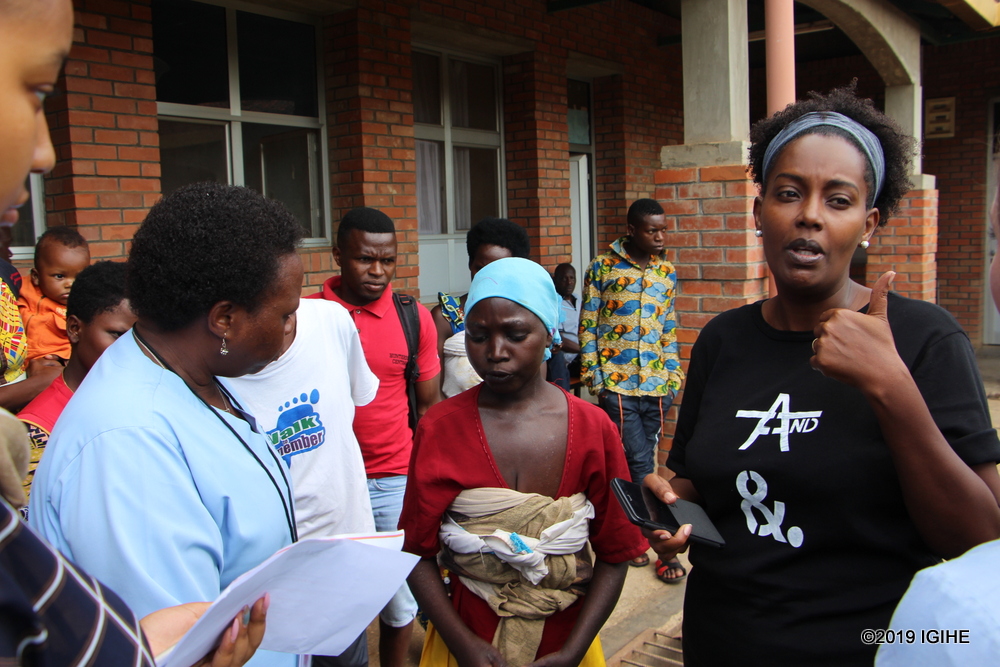
The act of generosity donating ‘Nootri’ flour to patients was conducted under the initiative ‘Jesus Care for Kids’ introduced by Teta Mbabazi Nadine, a Human Resources Management consultant.
Mbabazi told IGIHE that she introduced the program to help people who find it hard to afford basic needs like food and health care.
“I am a Christian mother of four children. I meditated and got courage to support those who cannot afford basic needs yet God blessed me with food sufficiency and access to health care,” she said.
Mbabazi explained that she launched the charity in 2010 where she has been providing support to patients at CHUK among other places in Kigali.
His activities are funded by different donors including Africa Improved Food.
AIF, Aretha M Rwagasore, the Head of Corporate Communications at Africa Improved Food said the company funded the charity organization ‘Jesus Care for Kids’ to push forward the drive of combating malnutrition.
“The country is worried of malnutrition. That is why we work with hospitals and different organizations to seek solution to this problem and we are optimistic we shall achieve the goal,” she reiterated.
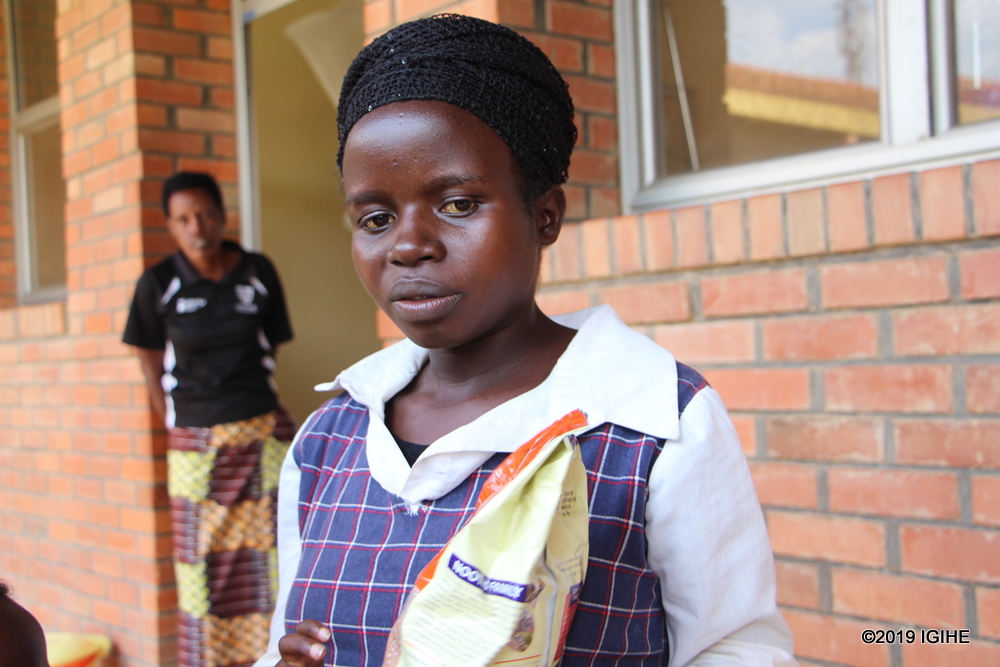
One of the beneficiaries, Theresia Uwambajimana gave birth to premature twins of whom one died while another is incubated. She lauded the donation saying it will help to prepare porridge for her little children.
The National Coordinator of the National Early Childhood Development Program (NECDP), Dr Anita Asiimwe recently told IGIHE that the country targets reduction of stunting and malnutrition in Rwanda by 19% in 2024.