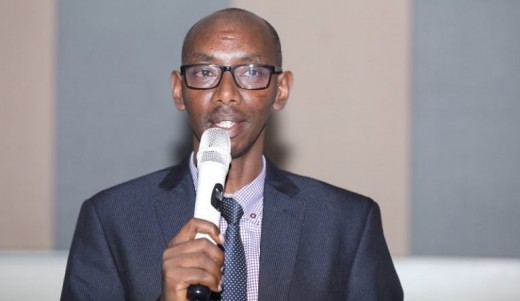
Rev. Karangwa was arrested in October 2019. He was charged with using a forged document while running for the position of Deputy Spokesperson for ADEPR, as it required that the candidate must have a Bachelor’s Degree.
He purported that he graduated from the Philippines and Uganda, but it turned out all his academic documents were fake.
On the evening of June 30, 2020, the Nyarugenge High Court handed down its final verdict in the case, declaring Rev Karangwa innocent.
“Court decided to accept the prosecution’s complaint because it came in the way and accordance with the law but finds it unfounded. It decided that the Prosecution should not extend the period of further investigation because the case has been in court for more than six months.”
It ruled that there was no irrefutable evidence against Karangwa John for making and using forged documents.
Rev. Karangwa John, who was imprisoned in Mageragere, was released and the news of his release was well-received by his family.
IGIHE learned that ADEPR had not yet replaced Rev Karangwa John.
Rev. Karangwa was elected ADEPR Deputy Spokesperson on May 20, 2017.
While the highest number of cases has been reported for days in Rusizi, Kirehe, Rubavu, and Kigali Districts; some have begun to think that the pandemic is only in those areas.
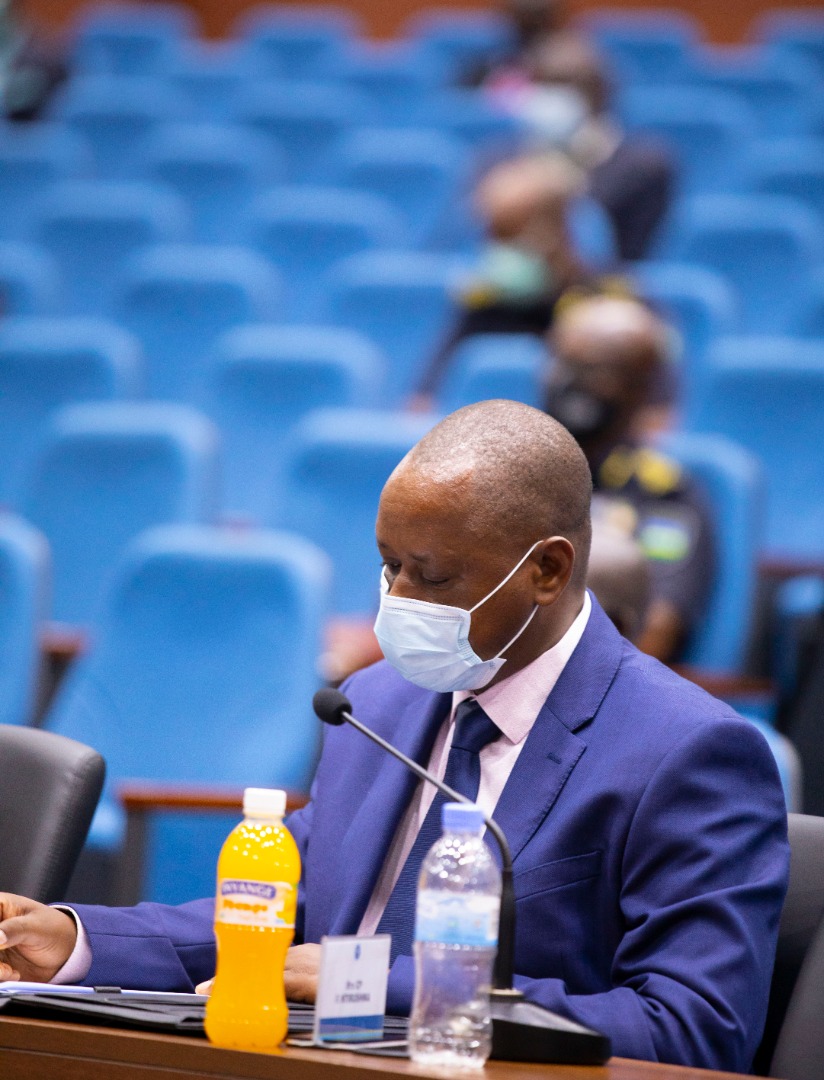
“Take the example of Rusizi District and take Kirehe District which is at the border areas and they are at risk these days. The city of Kigali, even though it does not work on the border, is a gathering place for large numbers of people from different regions,” Dr. Nsanzimana said.
“Our country is not so large that from one border to another or coming to Kigali it can be [five] hours which means that the pandemic can move from one border to another in the country even though the numbers appear to be high in the border areas,” he added.
“That number is high, but the fact that we know them is also good for the treatment of patients,” he said.
To date, 1,025 people have been diagnosed with Coronavirus in Rwanda, of which 444 have recovered while two have died, including a police officer and a driver.
Although many services are opened, Rwandans are urged not to think that the pandemic has ended. They are advised to abide by the established rules, remember to wear a mask every time they leave home, wash their hands frequently, avoid meetings and anything else that gathers many people and especially those who feel the symptoms of this pandemic including coughing, shortness of breath, weakness and so on, calling the toll-free line 114 for medical help.
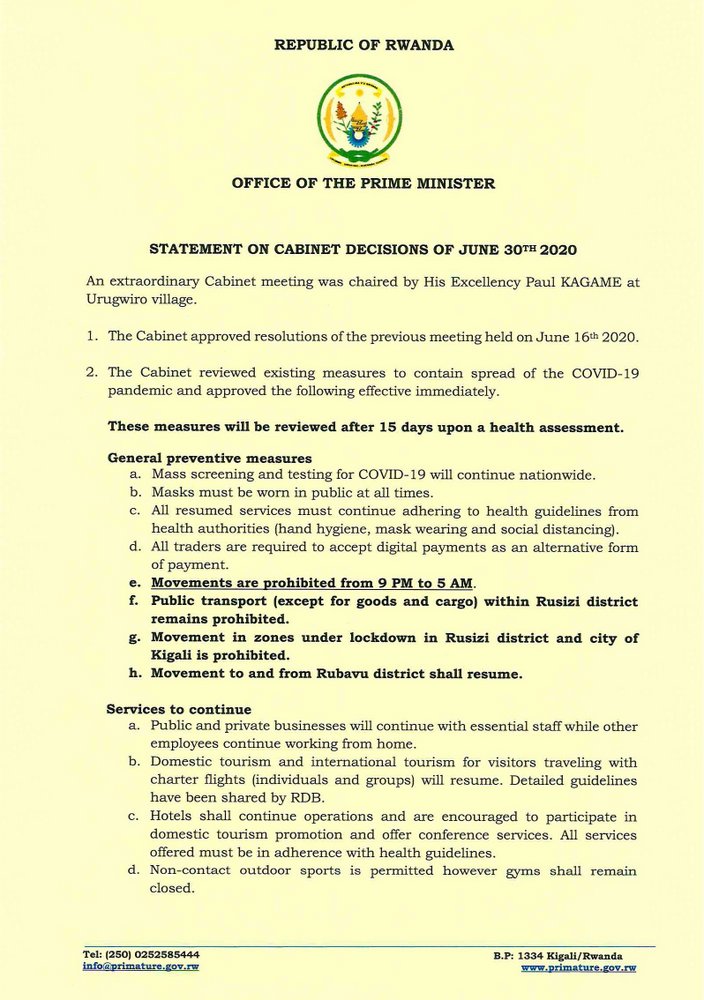
“Movements to/from Rubavu district shall resume,” the cabinet’s statement reads, bringing to an end a month of isolation that the district was in since early June when new COVID-19 cases were reported in Rusizi and Rubavu districts, Western Province raising national concern.
The cabinet meeting chaired by President Paul Kagame agreed on maintaining public and private services operational with only essential employees going to the office and the rest working from home as it has been for more than three months.
Domestic tourism and international tourism for visitors traveling with charter flights have also been maintained.
Hotels will also remain operational and will give conference services but following strict hygiene guidelines.
However, public transport and any other movements (except for goods and cargo) are prohibited in zones under lockdown in Rusizi and Kigali.
Noncontact outdoor sports will continue, but gyms remain closed.
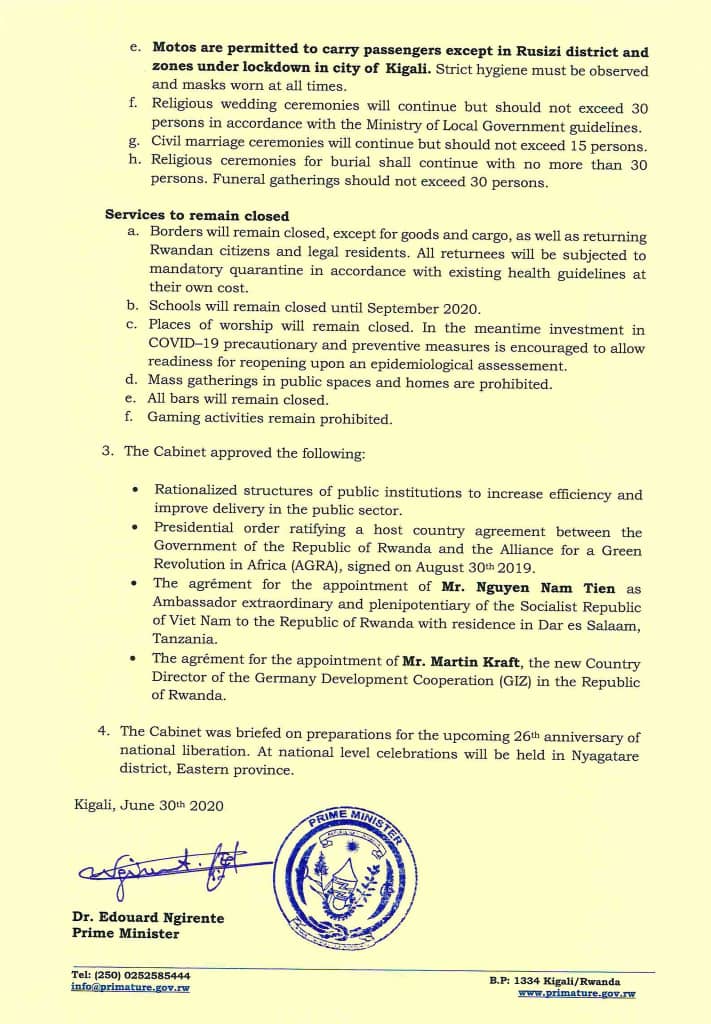
Motos will also continue to work respecting hygiene and other precautions guidelines despite fears that were raised a couple of days ago when 2 moto-taxi riders tested COVID-19 positive in Kigali.
The religious weddings that were reopened in the previous cabinet meeting and the civil wedding permitted much earlier will also continue with 30 participants and 15 participants respectively.
Religious ceremonies for burial and funeral were maintained with a maximum of 30 participants.
Church services will remain closed despite an earlier hope that they would open soon.
“Places of worship will remain closed. In the meantime, investment in COVID-19 precautionary and preventive measures is encouraged to allow readiness for reopening after epidemiological assessment,” part of the cabinet’s resolutions in a statement reads.
Churches have an assignment to work hard on preparations which would facilitate the government on deciding to reopen them, should COVID-19 spread slow down.
Meanwhile, bars and gaming activities remain closed while schools, as decided earlier, will open in September 2020.
It was on June 30, 2009 in the evening hours that IGIHE officially launched operations after a year of preparations that had begun in 2008, starting with no much financing but only standing on great ideas.
As the years went by, the number of services provided increased, and the clientele base expanded as confidence and trust among the public bloomed. For the past 11 years, IGIHE has also been at the forefront of the online media.
It began when the use of the Internet was beginning to take root in the country, at a time when radio was the source of information, with only one television. There were few magazines and since they all printed, not everyone could afford to buy them.
IGIHE contributed to fostering a culture of reading in three languages: Kinyarwanda, English and French; mostly Kinyarwanda. With about 51% of Internet users in the country and still rising, it has been a privilege for us to have a large number of readers.
{{How IGIHE has expanded over the past 11 years}}
IGIHE’s journey over the past 11 years has been marked by progress in all corners; having started from almost nothing, with no operational place to today where it has expanded in service delivery.
Over the years, IGIHE has become a demonstration platform to hundreds of young people who have studied journalism and other talented people in the profession, allowing them to pretty show their potential and creativity, through internships and job creation.
IGIHE started with providing one media service, then gradually expanded its operations providing other IT services such as creating and managing websites, providing video production services, audio production and various other business activities. it all comes down to helping our customers marketing their businesses professionally.
For the past 11 years, IGIHE has been at the forefront of Rwanda’s most widely read online news, according to various collections. According to the International Bureau of Statistics, Alexa ranks IGIHE as the 2nd most visited website in Rwanda right after Google.com.
According to Rwandan newspapers, IGIHE is at the forefront in having the largest number of readers, with an average of 150,000 people a day, and often more than 200,000. This has been emphasized by the annual survey conducted by the National Governance Board, RGB, which has media development in its responsibilities; there Rwandans have voted for IGIHE four times in a row as the most popular online magazine.
{{We owe it all to you…}}
The birth of IGIHE and the steps it has already taken are all thanks to you, our readers and the various partners we work with. You are ones to encourage us to continue to work day in and day out by being appreciative of what we do and also sharing with us news of what is going on so that we can improve our services to you.
This 11th anniversary reminds us that we should not take for granted the trust you have placed in us since day one, and that we must continue to build on it to improve our work, and provide better services.
It also reminds us of our role in building a professional media in Rwanda and continuing to contribute to the development of our country, in line with our vision of becoming a market for information about Rwanda for Rwandans and foreigners, and broadening the boundaries of performance, insuring that everyone in the world has access to a reliable source of information for our country. Thank you for being with us on this ongoing journey.
Especially in these extraordinary times our country and the world as a whole are in, we wish you all the best, as we all follow the instructions given by the health authorities to help us continue to fight this COVID-19 pandemic.
{{Happy Anniversary to us all. Work continues!}}
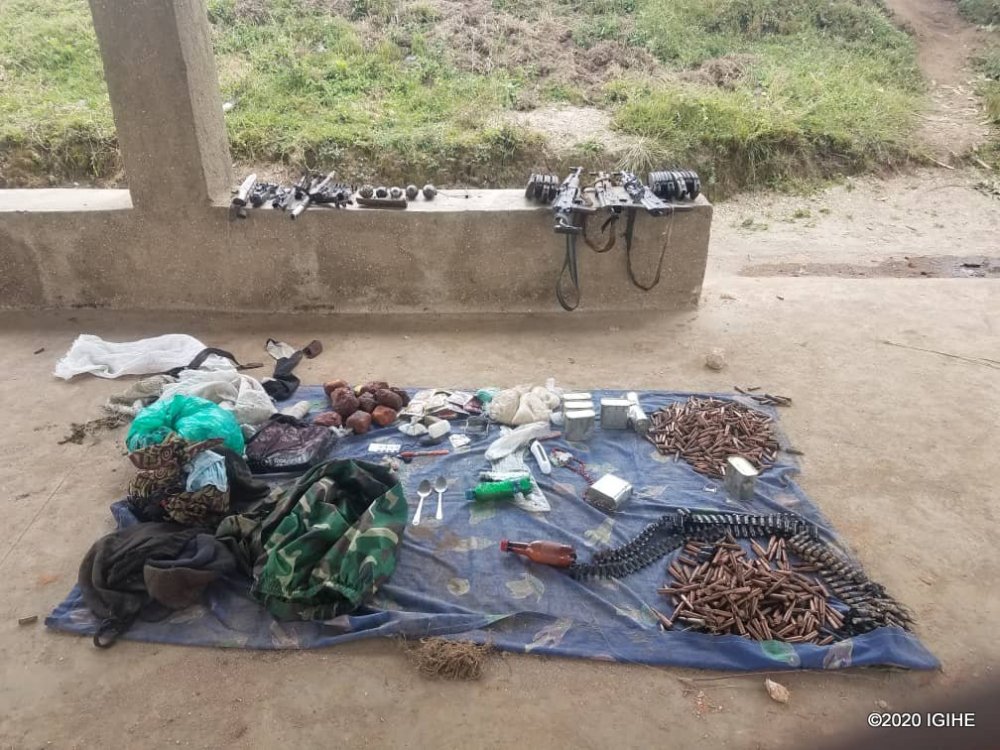
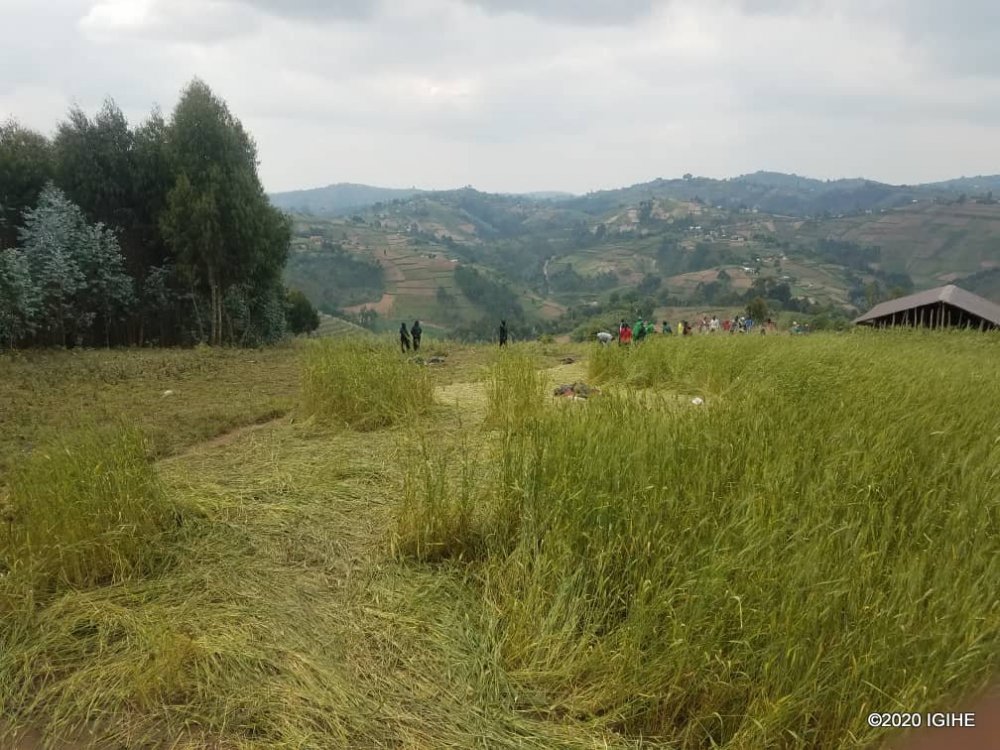
At about 0020hrs, on the 27 June, about 100 unidentified people holding machine guns, rockets, among other weapons, attacked people of Yanze IDP Model Village located 1 km away from Burundi border.
RDF statement reads: “The gunmen attacked from Burundi and they fled back in the same direction.
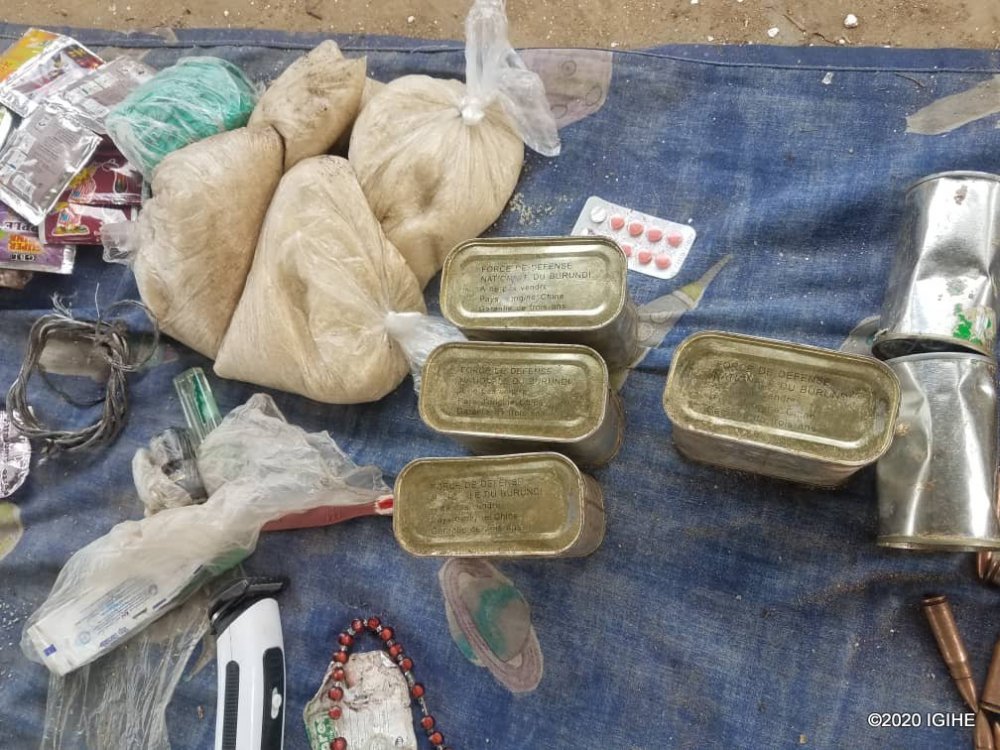
When running back, this group left four assailants killed, 3 captured and military equipment and dry rations marked “FORCE DE DEFENSE NATIONALE DU BURUNDI” were seized
“The Ministry of Foreign Affairs and International Cooperation of the Republic of Rwanda wrote to the Ministry of Foreign Affairs of the Republic of Burundi requesting for an explanation regarding the attack by unidentified attackers from Burundi and urged the Government of Burundi to take all necessary measures so that those guilty of that criminal act, who withdrew to Burundi, be quickly arrested and brought to justice or extradited to Rwanda so they can answer for their actions.”
The letter was sent the same day of the attacks but the Burundian government is yet to respond.
Rwanda’s Military Spokesperson, Lt Col Innocent Munyengango said “We assure Rwandans that the perpetrators will be prosecuted and identified. We are seeking, through diplomatic channels, reliable information on these attacks that are constantly coming back.”
On their side, the Burundian army, National Defense Force of Burundi (FDNB) has denied any involvement in the attack, but they neither denied nor confirm the allegations in a statement issued Friday.
“Burundian soil cannot be a sanctuary for armed groups that attempt to disturb the peace of our neighbors,” said Burundi’s army spokesman Floribert Biyereke
At the Annual General Meeting held virtually on Monday, June 29, it was decided that each shareholder will be paid Rwf 3.72 per share.
The company has announced the revenue in 2019 fell to Rwf1.3 billion from Rwf1.5 billion in 2018.
The Annual General Meeting approved the Director-General of the National Security Board, RSSB, Regis Rugemanshuro as a member of the CTL Board of Directors, replacing Richard Tusabe.
{{{The retirees include 147 commissioned officers. At least 20 left active service on medical grounds.}}}
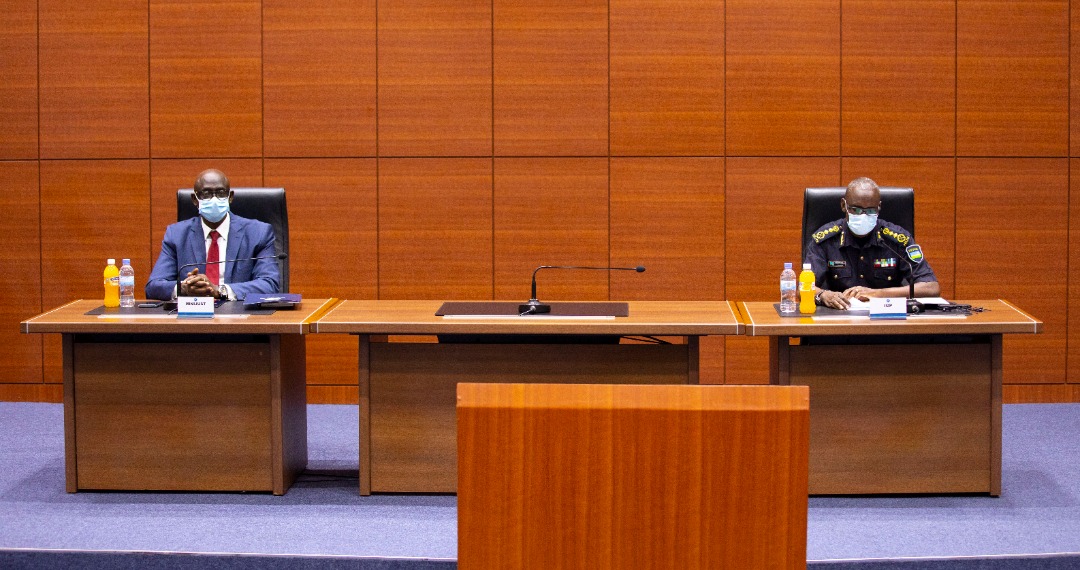
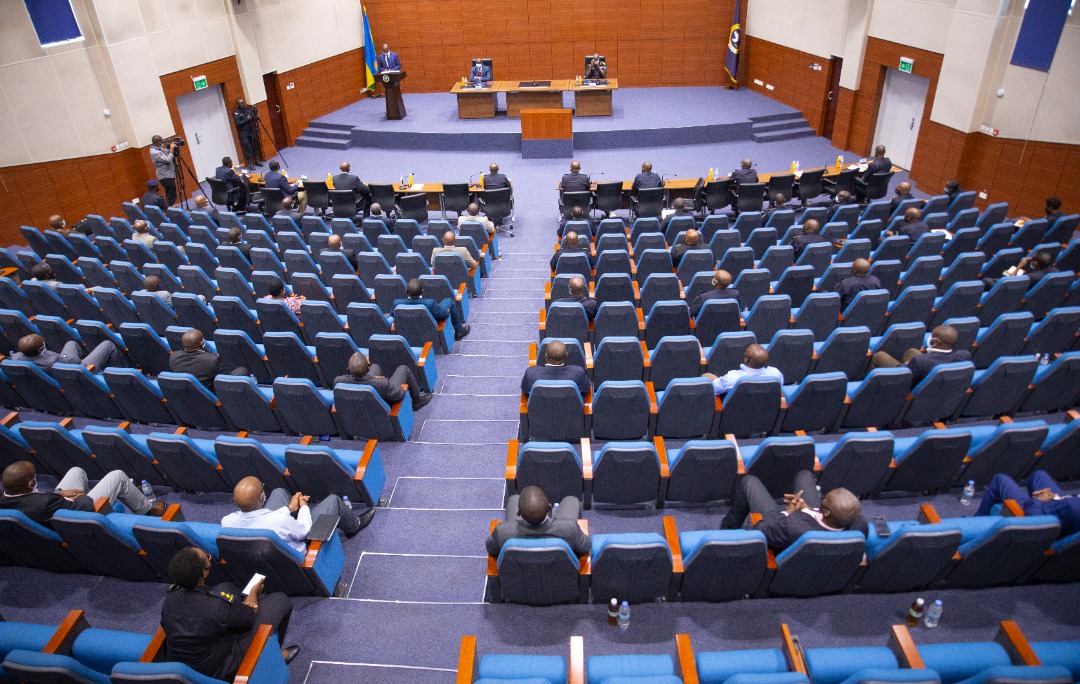
The official send-off function held at the RNP General Headquarters in Kacyiru, was presided over by the Minister of Justice and Attorney General, Johnston Busingye.
The event was also attended by the Inspector General of Police (IGP) Dan Munyuza, Deputy IGPs; Juvenal Marizamunda of Administration and Personnel and Felix Namuhoranye of Operations.
Forty retirees represented others in the special send-off event as part of the national guidelines to prevent mass gathering or congestion to avoid spreading the pandemic of COVID-19.
Minister Busingye thanked them for their contribution in the transformation of the country.
“We are gathered here today to celebrate and thank you for the good service to your country; the resilience and exemplary character that defined your committed service in providing security for your country,” Minister Busingye said.
He reminded them that they are just leaving active service but the country still needs them in many aspects of security and development.
“Retiring with dignity is a pride that others, who were not patient enough, did not achieve. Your being here today makes you heroes for your resilience and sticking to the national and Rwanda National Police values,”
The country and those they have left behind, the Minister said, will continue to sustain and build on what the retirees achieved. He urged them to always strive to preserve what they fought for even in their new life.
“You are now joining a wider family of Rwandans that you were part of but in other capacities. Continue to work with them to build a safer country,” Minister Busingye said, while wishing them a “better life ahead.”
IGP Munyuza thanked the retired officers for their “invaluable contribution” in the policing journey and building a professional force.
“You are leaving active service but your contribution to the country will continue in many other capacities. We worked together well, you served selflessly and you are leaving the RNP family with pride and dignity. Continue to be defined by that character even in your new life,” IGP Munyuza told the officers.
With majority of the senior officers who retired, having participated in the liberation and stopping the 1994 Genocide against the Tutsi, IGP Munyuza observed that they “stood for the values they fought for” throughout their service and “leaving with the dignity they so deserve.”
He, however, reminded them that serving the country is for both uniformed and non-uniformed Rwandans, urging them to continue to be mentors and opinion leaders to guide and support security and development matters in their respective communities.
“RNP will continue to count on you when there is need to tap from your experience in one way or another. Remember, policing is the way of life in this era and done by both uniformed and the ordinary citizens.”
He reminded them that discipline will always be key in all spheres of life and urged them to be defined by the same in the new life they have started, and always respect the law.
CP (rtd) Faustin Ntirushwa, who spoke on behalf of the retirees, thanked all those who played part and supported them to serve ably and to retire with pride.
“We thank our President, His Excellency Paul Kagame for his strategic guidance; he instilled in us the spirit of patriotism, self-respect and self-reliance; to think big and awake at all times to fight anything that attempts to destabilize the security and wellbeing of Rwandans,” Ntirushwa said.
He added: “These are among the things that guided us in service with the support of RNP leadership that gave us training, equipped us and cared for our welfare. We are happy to have served our country in all ways we could,” he added.
He thanked their families, fellow Police officers, the media and Rwandans in general for the support, and pledged, on behalf of all the retirees, to carry on serving their country in other capacities with integrity, towards sustainable security and development.
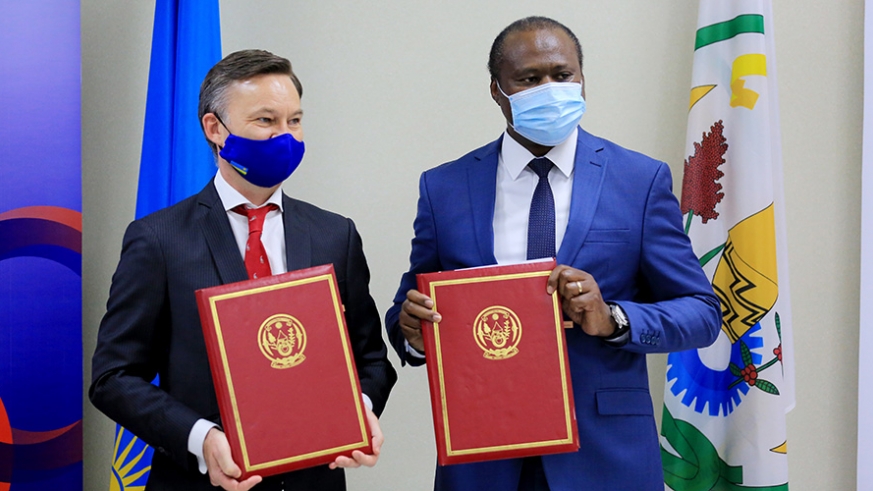
The first agreement consists in a €40 million concessional budget loan (about Frw 42.5 billion). It will support the strategy to combat the COVID-19 epidemic and the social recovery plan drawn up by the Rwandan authorities.
Based on WHO recommendations and country health and social protection strategies, the Government of Rwanda has developed its national plans, in order to: (i) prepare for and respond to the COVID-19 pandemic with the purpose to preserving and improving the health of the people and (ii) to protect the living conditions of the most vulnerable segments of the population.
AFD’s global support will provide flexibility to allow the government of Rwanda to adapt allocation of resources to the evolution of the disease.
On the Health side, the contribution will support priority measures to prevent transmission of the COVID-19, increase diagnostic capacities (tests, lab capacities), prevent and control infections in health centers (set up of isolation centers, personal protection equipment) and improve the treatment of affected patients (set up of treatment referral points). Overall, these actions will contribute in the long term to strengthening the capacities of the national health system and to improving the socio-economic livelihoods of the communities most affected by COVID-19. The health action plan is implemented by and under the supervision of the Rwanda Biomedical Center.
On the Social Protection side, the AFD facility will help Rwanda mitigate the social effects of COVID-19 on the most affected households by: (i) providing cash transfers to 150.000 vulnerable households, (ii) providing cash for works to 190.000 vulnerable households, (iii) enabling access to the nutrition program to 75.000 households with pregnant women or children under 2 years old, (iv) extending nutrition and financial support programs to more than 212.000 households from the informal sector who are not covered by the social protection system, and (v) supporting the funding of health insurance contributions for more than 1.9 million policyholders to the Rwanda Social Security Board. The Social Protection Plan is implemented by and under the supervision of the Local Administrative Entities Development Agency (LODA).
In addition to the €40 million budget support loan to the Government, AFD is also providing a grant to the tune of €2 million (about Frw 2.1 billion) to the International Committee of the Red Cross (ICRC) that will support COVID-19 response to the most vulnerable households in cooperation with the Rwanda Red Cross Society and Rwandan Authorities.
This €42 million total support against COVID-19 is part of the broader #TeamEurope response which is the tangible expression of the European Union Member States solidarity to help partner countries deal with the COVID crisis. In that respect, France launched a €1.2 billion initiative in response to the worldwide public health crisis caused by the global pandemics: “Health in Common”.
A second grant agreement was signed, to the tune of € 5.8 million (about Frw 6 billion), in support of the country’s vocational training system’s development. The project will increase the employability of Rwandan youth by strengthening their technical and linguistic skills through the inclusion of modules to reinforce the teaching of French. It thus responds to the Rwandan authorities’ strategy to make the country a hub for regional growth and languages.
The funding will also contribute to the implementation of a territorial plan in the district of Rulindo, which brings together those involved in the education, entrepreneurship and vocational integration of young people. Rwanda Polytechnic, a key player in vocational training, will be in charge of the implementation of the project.
An extra € 1.7 million will be provided by AFD to French operator Expertise France, to provide technical assistance to Rwanda Polytechnic, which will bring France’s total support to € 7.5 million.
These financing agreements, to a tune of €49.5 million, are in line with France’s cooperation policy, defined around the following five thematic priorities: the fight against vulnerability, education, climate, gender equality and health. This goes together with two central and cross-cutting concerns: the environment and social cohesion.
“As part of the unprecedented global solidarity drive to address the COVID-19 health crisis in Africa, AFD is fully committed to a targeted response to the health challenges posed by this pandemic. Given the emergency situation, the Agency is mobilizing all its teams and resources to provide fair, rapid and appropriate responses to the needs expressed by our partners, with the priority objective of strengthening health systems and supporting the actors engaged in this fight that concerns us all. One year to the day after my first visit to Rwanda in June 2019, I am happy to see the progress made in reviving AFD’s activity with the government of Rwanda. These are our first commitments in sovereign financing after about thirty years. They are part of a revival dynamic for our two countries partnership, at the service of the Rwandan population and in particular their youth”, says Rémy Rioux, AFD Chief Executive Officer.
“The signing of these financing agreements marks an important step in the revival of relations between France and Rwanda. I am profoundly delighted. The € 40 million budget loan demonstrates France’s determination to stand by Rwanda to address the health aspects of the COVID-19 epidemic and to support social measures that benefit the populations most affected by the economic impact of the crisis. This loan is part of the commitment of Team Europe (the European Union and its Member States) to support Rwanda’s determined action against COVID-19. The € 5.8 million grant materialises our desire to support Rwanda’s ambitious development strategy by backing the vocational training sector in order to promote access to employment for young Rwandan men and women. I hope that AFD’s reengagement in Rwanda will continue in the spirit of partnership that presides over Franco-Rwandan relations” says Jérémie Blin, Chargé d’affaires of the French Republic to Rwanda.
{{About Agence Française de Développement:}}
The Agence Française de Développement (AFD) Group funds, supports and accelerates the transition to a fairer and more sustainable world. Focusing on climate, biodiversity, peace, education, urban development, health and governance, our teams carry out more than 4,000 projects in France’s overseas departments and territories and another 115 countries. In this way, we contribute to the commitment of France and French people to support the Sustainable Development Goals (SDGs).
The budget will be funded by 40% from the state treasury; 40% from taxes and duties levied by the City of Kigali while the rest will be supported by development partners.
Infrastructure projects will account for about 51% of the budget, while other projects will account for 49%.
It will include roads and alleys that will first be completed, improve traffic in Kigali City, light various roads, and build more than 30 kilometers of new roads.
The budget will also cater for relocation of residents in high risk zones in Nyabisindu, Gatenga, and Nyagatovu as well as construction of homes for the needy.
Poverty alleviation programs will account for 4.9% of the budget, with 49,000 new jobs created and co-operatives set up to uplift members’ livelihoods.
In other projects, this budget will find construction of 1,634 classrooms, 2263 toilets and three new health facilities.
The Mayor of the City of Kigali, Pudence Rubingisa, said the 19% reduction was based on loans and donations from donors that had not returned to this year’s budget.
Last year there was a major 54-kilometer road project worth Rwf 29 billion.
He said that in general, the revenue of the City of Kigali and its revenue will increase.
The activities of the City of Kigali are planned in the budget based on the national vision but especially on the vision to have Kigali as a model city by 2050.
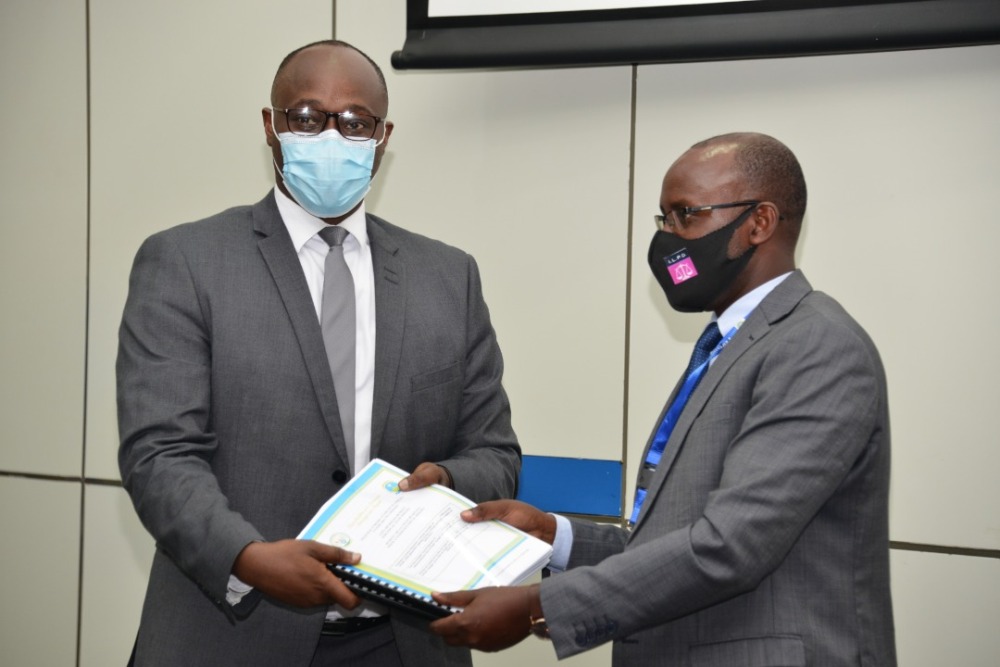
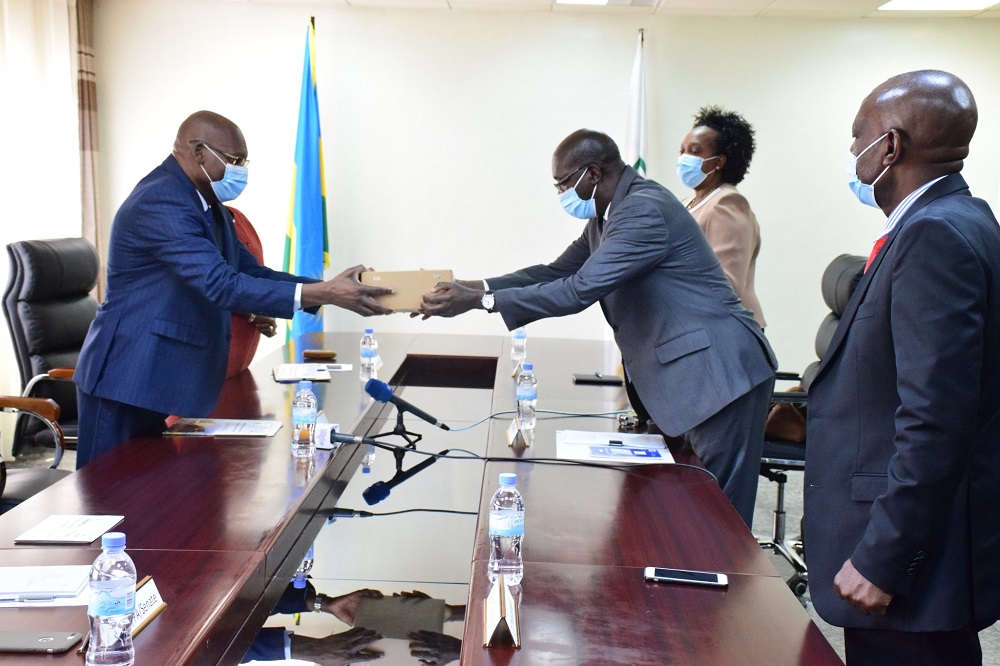
The announcement was made on Monday, June 29, 2020, when the Office of the Rwandan Senate received the documents of the Property of the Ombudsman and the Deputy Ombudsmen and other staff members of the Office of the Ombudsman.
Receiving, saving, and monitoring annually information on the actual assets of the national authorities from the highest to the lowest level and other staff provided by law, is one of the main responsibilities of the Ombudsman office.
In this year 2020, the number of people required to declare their assets in the country is 13,000. The last date for the declaration of assets is 30 June 2020.
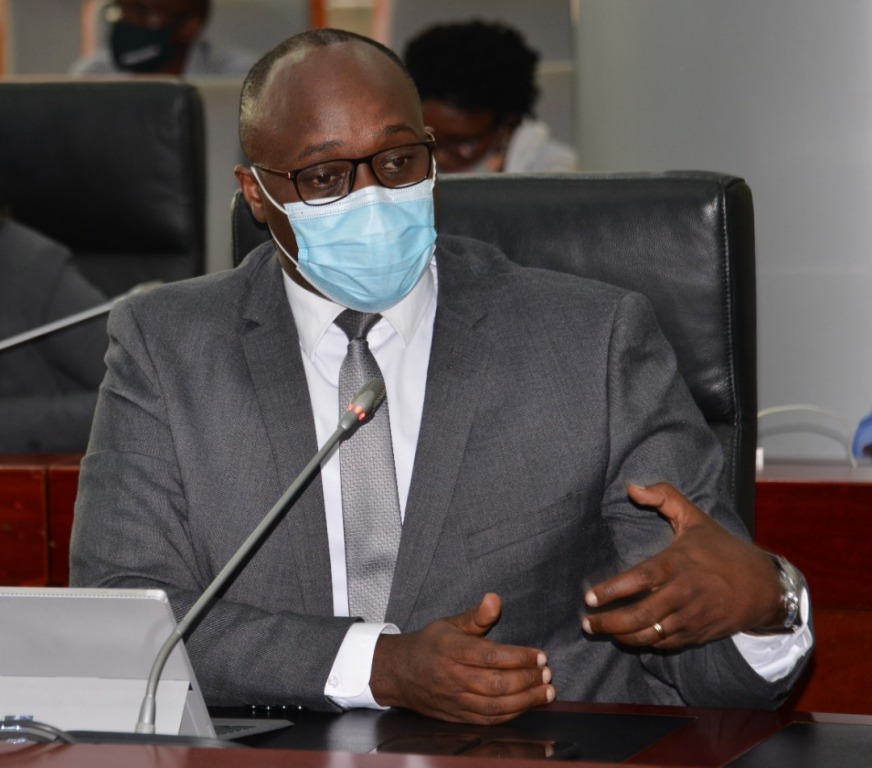
After submitting the declaration of assets to the Senate, the Ombudsman Murekezi said that among the officials and civil servants required to declare their assets, about 11,000 have already done so.
He said 15 people are under investigation for failing to explain the origin of their assets.
Of those 15, six were sent to court, seven are still under police investigation and two are still being investigated by the Ombudsman, he said.
Declaration of wealth is mainly to publicize property of government officials and public servants, to prevent leaders from misappropriating public funds.
For those who like to register property on other people so that they will not be discovered, the Ombudsman Murekezi warned them, urging them to stop it because it is a heinous act.
He also urged those who have not disclosed their assets to do so as soon as possible on Tuesday, June 30, otherwise, they will be punished.