Scores of people, who cut trees and destroy protected forests have been arrested in Police operations against environmental degradation, in partnership with the public.
On Tuesday, November 15, Police, local leaders and residents of Rulindo District apprehended one Elias Tuyisenge, 28, who was allegedly felling trees in a protected forest located in Gatete Village, Kamushenyi Cell in Kisaro Sector.
At the time of his arrest, Tuyisenge had already cut over 40 trees.
“He had turned this into a business… to cut trees in this protected forest and sell them,” said Superintendent of Police (SP) Alex Ndayisenga, the Northern Region Political and Civic Education Officer (RPCEO).
Tuyisenge, he added, was reported by residents after they saw him coming out of the forest carrying trees.
SP Ndayisenga warned against these serious acts of destroying biodiversity and called for increased public ownership to fight deforestation.
Article 44 of Law N°48/2018 of 13/08/2018 on environment prohibits the following acts in order to protect biodiversity: burning forests, national parks and reserved areas, burning swamps, grazing land, bushes, grass with the aim of agriculture or organising grazing land, killing, injuring and capturing animals of endangered species, destroying or damaging habitats, larvae, pupae or the young animals of the endangered species, causing death or burning protected plants, harvesting or destroying them, transporting or selling the remains of a whole or part of an animal and plants of endangered species, and cutting trees in forests or protected areas or in national parks.
In article 59; any person, who causes death, destroys protected plants, harvests or damages them, commits an offence. Upon conviction, he/she is liable to imprisonment for a term of not less than three years and not more than five years and a fine of not less than Rwf1 million and not more than Rwf3 million.
Ramsar Independent Advisory Committee on Wetland City Accreditation selected the City of Kigali, among the 25 accredited cities for the second edition of the Wetland City Accreditation.
The Wetland City Accreditation scheme encourages cities in close proximity to and dependent on wetlands – especially designated Ramsar Wetlands of International Importance – to promote the conservation and wise use of urban and peri-urban wetlands, as well as sustainable socio-economic benefits for local people.
This initiative also represents a direct link between Sustainable Development Goal 11 – “Make cities and human settlements inclusive, safe, resilient and sustainable” – and SDG6 – “Ensure availability and sustainable management of water and sanitation for all”.
“As cities grow and demand land increases, the tendency is to encroach on wetlands, which are often viewed as wasteland,” said Martha Rojas Urrego, Secretary General of the Ramsar Convention. “But urban wetlands are prize land, not wasteland and therefore they should be integrated into the development and management plans of cities.”
To date, out of 43 wetlands Accredited Cities in the World, only 4 are in Africa namely; Ghar el Melh (Tunisia), Mitsinjo (Madagascar), Kigali (Rwanda); Ifrane (Morocco), and Cape Town (South Africa).
Kigali Wetlands have been threatened by human activities mainly conversion to agriculture, human settlements, and commercial and industrial activities decreasing the flood and pollution abatement capacity of wetlands.
Strategic ecological rehabilitation solutions that will help to reverse these impacts were put in place, and so far, the following have been achieved:
• All illegal business activities inside wetlands were evacuated;
• The Kigali wetland masterplan was approved to support Kigali in efficiently managing and utilizing its wetland system sustainably;
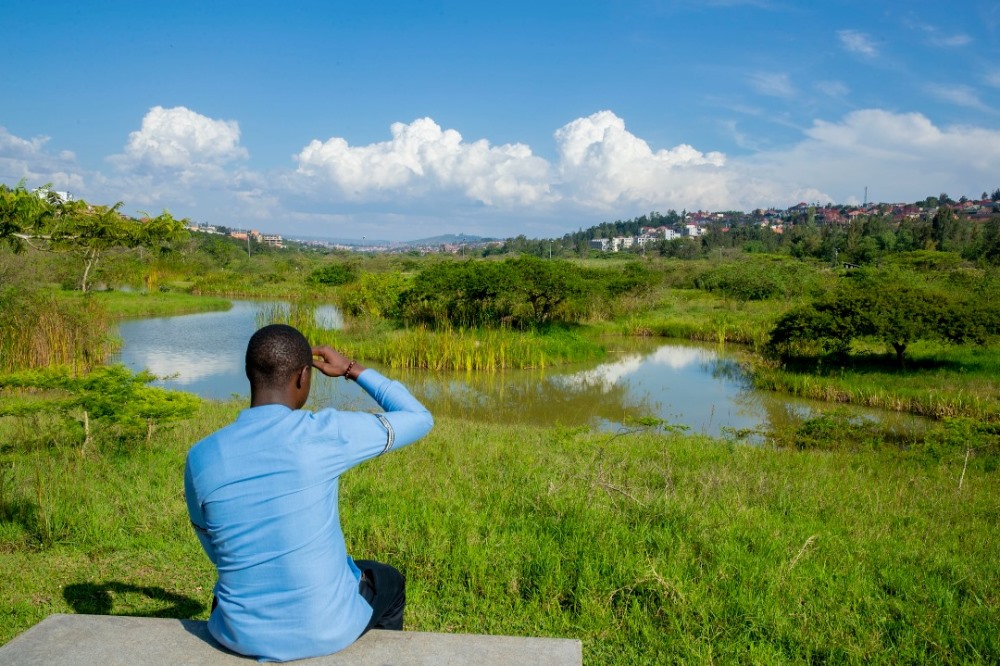
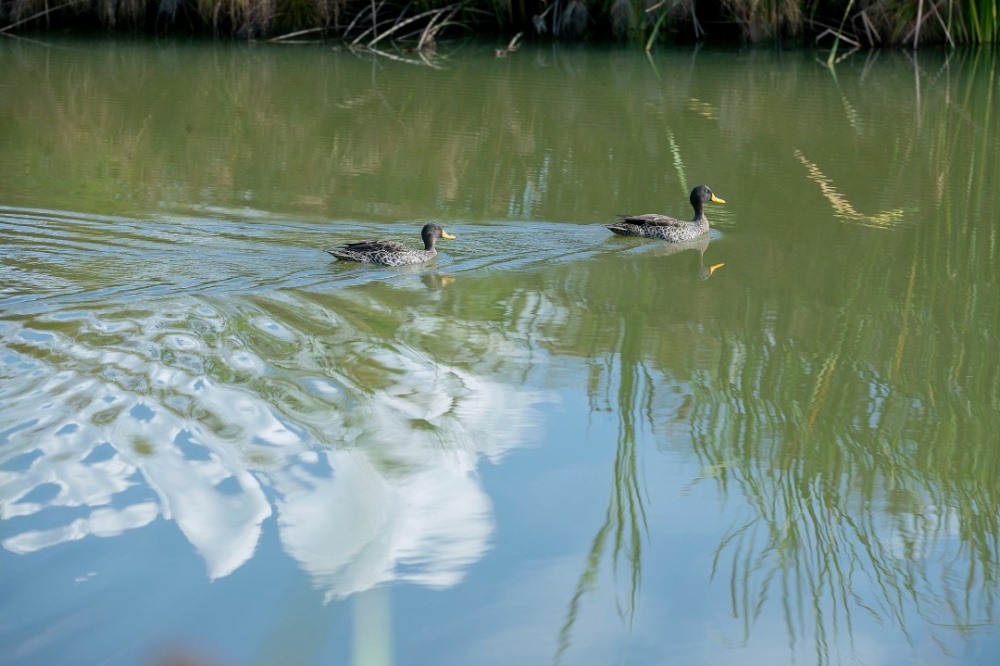
• Nyandungu wetland has been restored into a healthy urban wetland eco-tourism park that covers 121.7 hectares in size, including 70 hectares of wetlands and 50 hectares of forests, home to more than 62 local plant species and is home to more than 100 bird species and 17,000 trees made up of 55 indigenous species.
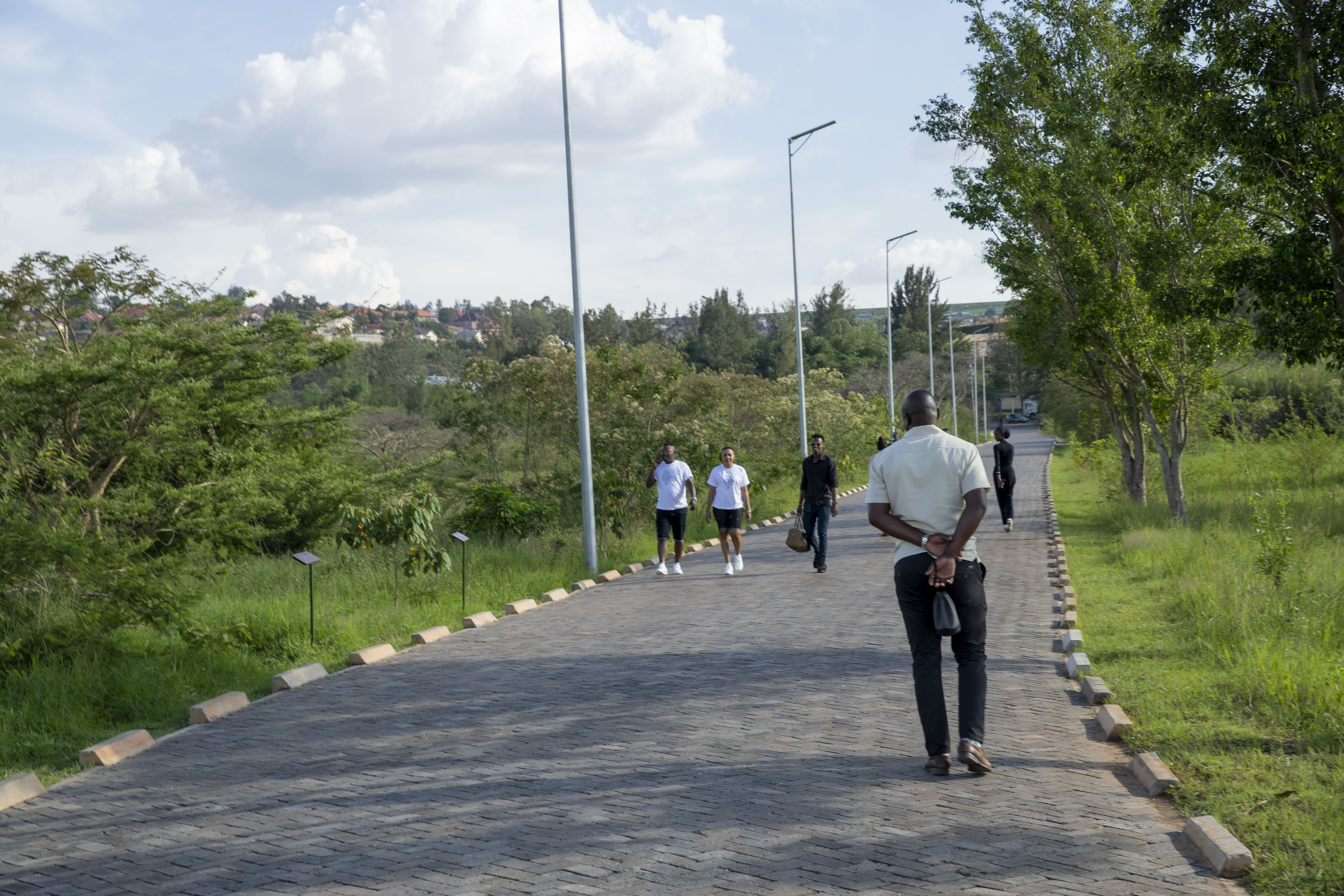
It has a network of paths, bicycle tracks, a service road, bird habitats, a medicinal plant garden, and picnic areas to provide the facilities required by tourists and visitors. Included in the project is a concession for a restaurant in a central location on the site.
{{Rehabilitation of Nyandungu Wetland has restored the following services:}}
{{1. Environmental Services: }} They have demonstrated how Nature Based Solutions can be used to attenuate floodwater, control flooding and water pollution (Wetland restoration through the spreading of channels and creation of attenuation ponds and use of gabions to allow slow and natural water movement to remove pollutants and manage floods). – They have restored flora (A forest ring around the site made up of native and indigenous plant species) and fauna (The creation of a bird habitat, and attraction of beneficial species of butterflies). In fact, we have restored ecosystems and biodiversity
{{2. Social services:}} They created spaces for the community to meet, mingle and socialize within a safe and secure environment (Eco-tourism opportunities including Bird watching).
3. Recreational services: They served the recreational need of the community and the City of Kigali as a whole through walking and jogging facilities, biking, and picnicking.
4. Economical services: – Land values have increased in the surrounding areas. – Employment created after completion during its operation and management (A restaurant, Ablution facilities, Iconic Entrance, and Maintenance House). – Revenue from various activities and services provided in the park as well as local and international tourism.
5. Educational and Research services: – The project has contributed to the implementation of Rwanda’s Green Growth and Climate Resilience Strategy. – Education through demonstration of how wetlands work and their benefits (Information Center). – Research sites on wetland ecosystems and species by students, institutions, and universities
As part of our Vision 2050 of developing a Green City, we are completing the study to rehabilitate 5 wetlands namely Rwampara, Gikondo, Rugenge-Rwintare, Kibumba, and Nyabugogo lower urban wetlands as key priorities for wetland rehabilitation based on their critical contribution to effective management of wetlands in Kigali, that cover 491 ha in total. The main objectives of wetland rehabilitation in the City of Kigali are as follows:
a. Flood mitigation acknowledging climate changes.
b. Improvement of wetlands’ biodiversity.
c. Water quality improvement.
d. Enhancement of the city’s landscape and development of recreational activities
Sustainable utilization of rehabilitated urban wetlands will be achieved by acknowledging the multiple demands on the urban space that include public amenities and socio-economic potential.
This may include the establishment of recreation parks with low-impact infrastructure for leisure and environmental education purposes that would promote public awareness of biodiversity, water provision and quality, and other functions.
It may also include community agricultural activities, eco-tourism parks, or other economic initiatives where these may enhance synergy with local communities and may even support wider water security and climate adaptation objectives of the city.
The City of Kigali aims to promote the sustainable management of wetlands by re-establishing wetland habitats, introducing heterogeneous indigenous habitats in the buffer zone, and supporting, flood attenuation in the city as well as livelihood diversification to enhance incomes for local communities through enhancement of recreational and tourism opportunities.
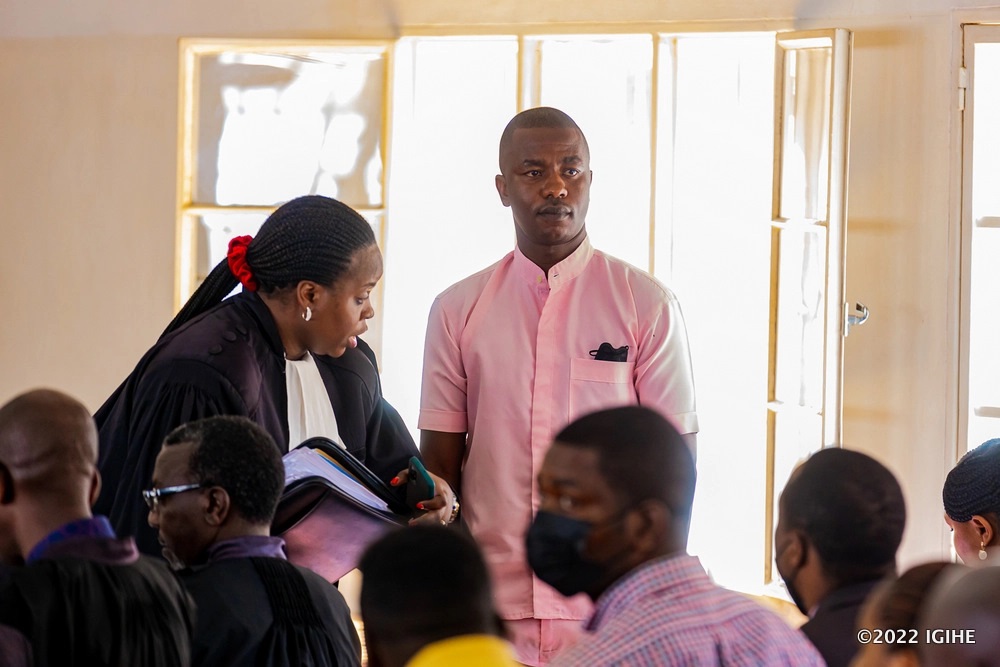
The decision has been reached after the accused and defence lawyers claimed that they can’t continue to stand trial without knowing whereabouts of witnesses.
Prince Kid and defence lawyers put forward the objection after observing that witnesses were to attend the court session virtually.
His defence lawyer Nyembo disclosed that they want witnesses to provide testimonies physically in a selected place instead of doing it virtually via Skype.
Prince Kid was arrested on 8th May 2022 over alleged sexual abuse against some of participants of Miss Rwanda beauty pageant which he organized for long through his company, Rwanda Inspiration Backup.
He faces charges including soliciting or offering sexual favours, and harassment connected to sexual relations.
Apart from these people washed away, six houses were also destroyed.
It poured down few days after the weatherman forecasted heavy rain in different parts of the country between 10th and 20th November 2022.
The Ministry of Emergency Management (MINEMA) continues to remind people to take into consideration all measures instituted to prevent rain related disasters by tightening roofs among others.
They are called upon to collect rain water by applying appropriate techniques, digging waterways, building terraces, and remain vigilant as they cross rivers and bridges.
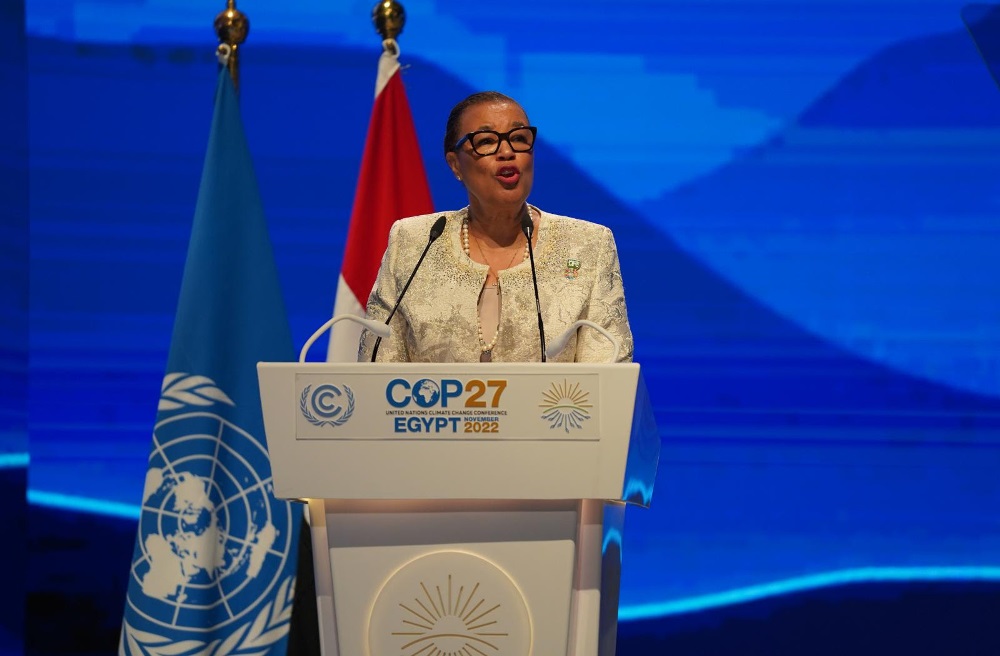
As the final days of negotiations approach for the annual summit, attended by more than 35,000 delegates from almost 200 nations, the Secretary-General called for actions that will close the gaps on emissions, finance and justice, while taking into account the needs of vulnerable countries.
In her statement to the conference plenary, the Secretary-General Scotland emphasised: “As climate change advances, we have lost momentum. The gap on emissions, finance and justice has widened, while the window for action continues to narrow.
“It is our duty to close that gap – and this process is our only chance. Because we cannot compromise with catastrophe, so we must compromise with each other.”
She highlighted the series of climate disasters that have affected millions of people across the Commonwealth in recent months. In Pakistan, devastating floods have claimed more than 1,700 lives and affected 33 million people since June. Similarly in Nigeria, more than 600 people have died and 1.3 million displaced, due to the worst floods seen in the country in more than a decade.
The Secretary-General continued: “Vulnerable states face being consumed by the waves or drowned by debt. The unthinkable has become typical…
“We must reject the violence of inaction against those who need us to succeed, now and for generations to come, and commit ourselves to action on land, ocean, energy, finance and resilience.”
The Commonwealth comprises 56 member countries brought together by shared values and principles, including 33 small states, 25 of which are small island developing states.
In 1989, Commonwealth Heads of Government met in Langkawi, Malaysia, and raised the alarm on the “permanent and irreversible damage” to the environment, demanding a “co-ordinated global effort” to address the challenge.
Since then, the Commonwealth has championed global advocacy around climate change and ocean action. This year, Secretary-General Scotland is heading a delegation from the Commonwealth Secretariat to COP27, with the aim of amplifying the concerns of member countries, advocating for small and other vulnerable states, supporting partnerships and raising awareness about the various Commonwealth programmes offered to support members.
This includes initiatives such as the Commonwealth Living Lands Charter, the Commonwealth Blue Charter, the Commonwealth Climate Finance Access Hub and the Commonwealth Sustainable Energy Agenda.
The money was recovered on Tuesday, November 15, from the prime suspect identified as Tuyishimire Jean Pierre, 33, who was the victim’s house-help.
Tuyishimire was intercepted in Maswa I Village, Rubona Cell in Rukumberi Sector following swift collaboration between the District Police Units of Gasabo and Ngoma.
Superintendent of Police (SP) Hamdun Twizeyimana, the Police spokesperson for the Eastern region, said that the victims suspected Tuyishimire to be the thief, after the money went missing and their house-help nowhere to be seen.
“The victims reported on Tuesday morning that money amounting to Frw1.3 million had been stolen from their home, and suspected their house-help, who was not at home, to be the thief,” SP Twizeyimana said.
It was suspected that Tuyishimire had escaped to Ngoma with the money.
“Tuyishimire was tracked to Rubona in Rukumberi Sector where he was arrested at about 9p.m. He was at the time traveling on a motorcycle. He was searched and recovered Frw1,096,000 on him,” SP Twizeyimana explained.
Article 166 of law determining offences and penalties in general states that; any person convicted of theft is liable to imprisonment for a term of not less than one (1) year and not more than two (2) years and a fine of not less than Frw1 million and not more than Frw2 million, community service in a period of six (6) months or only one of these penalties.
One of them is a driver said to be the brain behind the message, which has been circulating on various social media platforms claiming that he committed a traffic offence attracting a fine of Frw10,000 and that he was instead fined Frw150,000.
The spokesperson for Traffic and Road Safety department, Senior Superintendent of Police (SSP) Rene Irere, said that the driver in question altered the message to spread rumors.
“This driver received a message specifying a traffic offence he had committed and a fine of Frw10,000. Instead, he got the same message, edited it and added 5 to make it Frw150,000, and started circulating the same altered message on social media platforms, to make it look like he was unfairly penalized,” said SSP Irere.
This, he added, is an act of publishing rumors, which is punishable by law.
Under article 39 of law No. 60/2018 on prevention and punishment of cyber crimes; any person, who knowingly and through a computer or a computer system, publishes rumors, that may incite fear, insurrection or violence amongst the population or make a person lose their credibility, commits an offence.
Upon conviction, he or she faces an imprisonment of not less that three years but not more than five years, and a fine of between Frw1 million and Frw3 million.
Meanwhile, the second suspect is a taxi-moto operator, who had devised means to use a wire to flip number plates in an attempt to beat speed enforcement cameras everytime he is violating traffic rules and regulations.
SSP Irere warned against these criminal tendencies and advised motorists to observe traffic rules and regulations for their safety and of other road users.
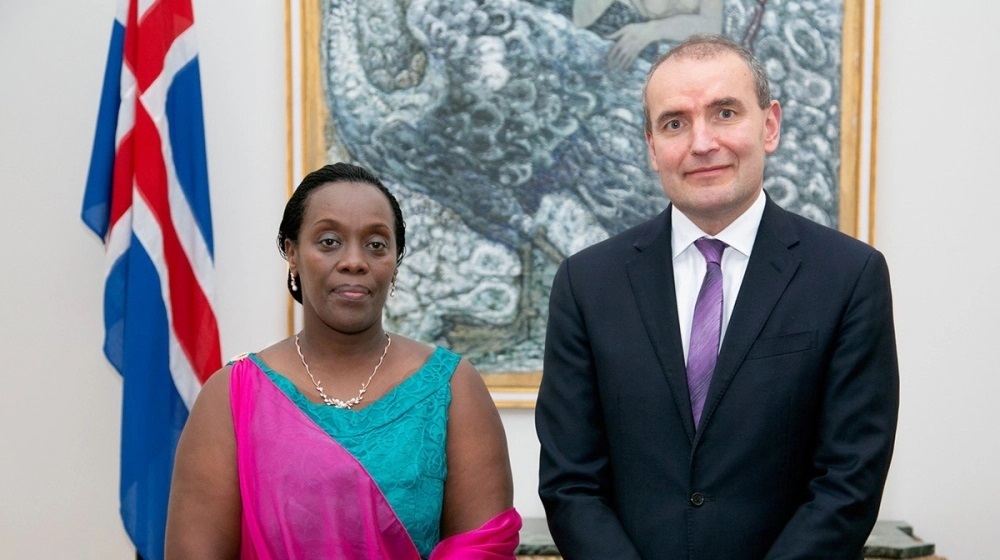
Dr. Gashumba presented credentials to the President of Iceland, Guðni Th. Jóhannesson on Tuesday 15th November 2022.
She will oversee Rwanda’s interests in Iceland with residence in Sweden.
During the ceremony, the President of Iceland commended President Paul Kagame’s strong conviction towards gender equality and commitment towards better life of Rwandans. He said that it is a common vision between the two countries and ‘both put these visions into action’.
Amb. Gashumba conveyed the greetings from President Kagame to Jóhannesson and presented an overview of Rwanda’s development progress and strong commitment to improve the lives of its citizens after the 1994 Genocide against the Tutsi.
In September 2022, Rwanda and Iceland signed an MoU on political consultations.
Amb. Gashumba informed Jóhannesson that Rwanda is keen on strengthening its relations with Iceland, especially through trade and investment, tourism, fishing and education, and commended Iceland’s commitments in several of Rwanda’s priority sectors including human rights and gender equality.
Both Jóhannesson and Amb. Gashumba pledged their commitment to further developing bilateral relations and strengthening cooperation between the two countries.
During her visit to Iceland, Dr. Gashumba held several meetings with senior officials at the Icelandic Ministry of Foreign Affairs including Ms Nína Björk Jónsdóttir, Director General, GRÓ – Centre for Capacity Development, Sustainability and Societal Change; Martin Eyjólfsson, Permanent Secretary of State, Ministry for Foreign Affairs and Mr Þórður Bjarni Guðjónsson, Director, Directorate for Development Cooperation, Members of Parliament including Arndís Anna Kristínardóttir Gunnarsdóttir, Jódís Skúladóttir, Lilja Rannveig Sigurðardóttir as well as Dr. Jón Atli Benediktsson, Rector of the University of Iceland.
The appeal is made amidst escalating tensions between Rwanda and DRC over reciprocal accusations related to the fight between Congolese Army (FARDC) and M23 rebel group.
FARDC continues to loose bases to M23 rebel group and attributes its strength to alleged support from Rwanda.
Rwanda has however denied the allegations repeatedly calling the fight with M23 an internal problem which should be addressed by DRC.
DRC President, Félix Tshisekedi recently revealed figuratively that it is time to wage a war on Rwanda after elucidating that diplomatic process is no longer a promising option to restore peace in the eastern part of his country.
The letter sent to the Prime Minister of Canada to which IGIHE has a copy reads that the Rwandan Community in Canada is gravely concerned about the deteriorating security situation in eastern DRC and its manifestation through hate speech and genocidal ideology spreading across the Rwandans and Congolese communities both at home and in Canada.
{{Read the letter in full:}}
{{Open letter}}
November 9, 2022
To: The Right Honorable Justin Trudeau, Prime Minister of Canada
{{Appeal to the Government of Canada to support the Peace Process in the DRC}}
Dear Prime Minister: The Rwandan Community of Canada is gravely concerned about the deteriorating security situation in the Eastern Democratic Republic of the Congo (DRC) and its manifestation through hate speech and genocidal ideology spreading across the Rwandan and Congolese communities both at home and here in Canada. We strongly urge that the government of Canada do more to help stabilize the situation in the Eastern DRC and be vigilant to curb activities and incitement which create tensions in the communities who left these regions to settle in Canada.
There are laws about hate speech in Canada and we believe that they have been contravened. For example, a Congolese public figure by the name Martin Fayulu held a conference in Montreal on October 2, 2022, where he delivered a toxic rhetoric against Rwanda and Rwandophones. During his remarks, an inspired member in the audience declared that Rwanda is led by Nazis! Similar hate messages are being spread on social media, calling for killing Rwandans, in particular the Tutsi. In the eastern Democratic Republic of Congo which has ethnic Rwandan populations, anti-Rwandan sentiment that is rampant among public officials, in the civil society and the DRC government has done little to quell such toxic incitements.
Sir, we would like to bring to your attention and to let the Canadian public understand the fundamental issues in the conflict of the eastern Democratic
Republic of Congo (DRC) as we believe that until these issues are addressed, will there be lasting peace in the region. The conflict in the eastern DRC has at its root three fundamental issues namely:
• The right of Congolese “Rwandophones” (Congolese of Rwandan cultural heritage) to be fully accepted as citizens with all rights as other Congolese.
• Insecurity posed by the genocidal FDLR (Democratic Forces for the Liberation of Rwanda) rebel group and more than one hundred other negative armed groups in the Eastern region of DRC.
• Lack of political will by the DRC government to implement Peace Processes and Agreements that have been sponsored by regional governments, the United Nations, the African Union, and other Regional Organizations such as the ICGLR and East African Community, to address political issues and insecurity in DRC and the region.
From independence in 1960 different administrations of the Democratic Republic of Congo have taken conflicting positions on the status of the Rwandophones community of DRC. Under Mobutu Sese Seko who was President from 1965 to 1997, Rwandophones were fully accepted in the Constitution as Congolese citizens and permitted to participate in all affairs of the state. In latter administrations, however, particularly after 1994 the status of Congolese Rwandophones, especially those identified as Tutsis became less tenable. They became victims of the politics and prevailing circumstances. A genocidal regime of Rwanda had just been defeated and the perpetrators crossed into the eastern DRC and camped within less than 20 kilometers from the Rwandan border. Furthermore, they created a rebel group currently known by its acronym of FDRL and set on the strategy of rearming with the intent to destabilize Rwanda. They also targeted the local population especially the Tutsi communities of Eastern DRC forcing tens of thousands to flee into Rwanda and other countries. Today, in Rwanda, there are more than 50,000 of these Congolese refugees since 1996, as a direct consequence of the instability in the eastern DRC brought by genocidal remnant forces.
The rebel group code-named M23 (March 23), was born following the failure by the Government of DRC to implement previous agreements intended to primarily defend and protect the rights of the Congolese Rwandophones, and to create a conducive environment to enable the repatriation of Congolese refugees back to their lands and property in East Congo. In December 2013, the Government of DRC and M23 signed an agreement to put an end to the conflict, but it was never implemented due to lack of political will from the government. Since the resumption of hostilities in June 2022, the M23 rebel group has sought to negotiate with the DRC government for a political settlement, and the response of the DRC Government was to scapegoat Rwanda, alleging that it supports the rebellion; a charge Rwanda denies. Since then, through regional efforts, the Nairobi peace process was adopted to deal with all non-State actors in Eastern DRC, and the Luanda roadmap was adopted to de-escalate tensions between Rwanda and the DRC.
For the purposes of principle and clarity, it should be stated that in fact, it is not for the DRC government to decide on the rightful citizenship of the Rwandophones of DRC. When Africa was partitioned at the Berlin Conference in 1884-1885, these communities already lived in their present lands that are now in DRC. Therefore, unless the DRC government would like to suggest a revision of the international boundaries, the Congolese Rwandophones have a legitimate and indestructible right to remain Congolese citizens regardless of which regime is in power. The DRC government must exercise due diligence and treat all its citizens without discriminations based on ethnicity.
To bring about lasting peace in East DRC, one of the most important conditions is to permanently eradicate the problem of the genocidal FDLR (Democratic Forces for the Liberation of Rwanda) and other domestic and foreign negative forces operating in DRC and the International Community have done little to solve this problem. The United Nations Peace Mission, MONUSCO, which is more than 20,000 men strong with a sizable budget has been in the eastern DRC for more than 20 years and failed to eradicate these forces. In fact, the DRC government has for its part recruited members of FDRL among its own army, FARDC (Armed Forces of the Democratic Republic of the Congo) to try and defeat the M23- a fact that has been documented recently by Human Rights Watch (HRW). The DRC government cannot have it both ways—fight the rebels while also recruiting rebels in its own ranks!
Underlying the mess in the eastern DRC is the existence of more than one hundred other irregular armed groups which roam the swaths with no immediate recognizable demand except to loot and plunder in this resource-rich region. And at times, local leaders and military officials do connive with these rebel groups to share in their exploits. Corruption and indiscipline reign high among security agents in this country.
We kindly urge the Canadian government to use its power and influence to support the Nairobi and Luanda Peace Processes in a bid to help push for sustainable peace in the eastern Democratic Republic of Congo and the sub-region. The DRC government must be persuaded to take its own responsibility instead of shifting the blame of its own failures to its neighboring countries, notably Rwanda. We also urge the Canadian government to monitor and curb the spread of hate speech in Canada by stakeholders in the DRC conflict as such speech can lead to tensions and polarization in the Rwandan and Congolese communities here in Canada.
{{Yours sincerely,
Alain Patrick Ndengera
President, Rwandan Canadian Community Abroad -Canada}}